Diary Reviews


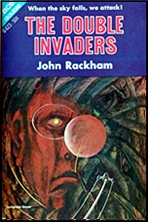
JOHN RACKHAM – The Double Invaders. Ace Double G-623, paperback original, 1967. Published back-to-back with These Savage Futurians, by Philip E. High (reviewed here).

   This seemingly simple story of invasion from outer space is indeed something more. The prologue introduces the mystery, a secret plan of Earth against the expanding empire of Zorgan. Without knowing about this underlying factor, the reader would proceed quickly and enjoyably through the greater part of the book.

   As it turns out, a little more concentration is required. Motivations are not as obvious as they might first seem, relationships are not as they might first appear. And yet, if the blurb on the inside front cover is interpreted correctly, everything becomes as obvious as it does at the story’s conclusion. It should be obvious all along, but Rackham does a creditable job of fooling the reader.

   The society of Scarta, the invaded planet, is very well developed, with a [Poul] Anderson-like astronomy influenced theology. Another feature, passing almost without notice, is the linguistic problem of translation: for example (page 69) how do you describe war without a word for it?

Rating: 4½ stars.

– June 1967


Bibliographic Notes: John Rackham was a pen name of British writer John T. Phillifent. Under that name and as Rackham, he wrote 18 traditional SF novels for Ace and Daw between 1964 and 1973. He also wrote three of the series of “Man from UNCLE” books published by Ace in the 1960s.

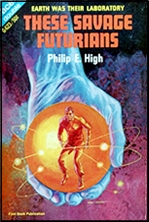
PHILIP E. HIGH – These Savage Futurians. Ace Double G-623, paperback original, 1967. Published back-to-back with The Double Invaders, by John Rackham (review to be posted shortly).

   Two rival organizations surviving the end of present-day Earth’s civilization battle over a psycho-genetically controlled primitive named Robert Ventnor. As it often happens in High’s stories, Ventnor is captured and quickly trained in almost an overnight transformation.

   In fact, Ventnor becomes an expert in both micro-robotics and biology, combining both fields to find new methods in curing diseases. It is therefore not surprising that he becomes the key to the future of mankind.

   The story of mankind’s fall is not the usual one, not war, but the over-centralization of production, and that of decreasing quality. The description of gradual anarchy is quite chilling.

Rating: **½

– June 1967


Biographical Update: Quite a bit of information about the author can be found in his online obituary written by John Clute, from which the following excerpt seems relevant:

   “Nothing High wrote was as unremittingly apocalyptic as Shute’s On the Beach (1957), but his space operas consistently pit figures of valour (and science-fictional super powers) against dystopian cultures and worlds. One of the best of them, Butterfly Planet (1971), typically engages manipulative aliens against an Earth splayed into dystopian factions; telepathic sex for the good, and instant devolution for villains, arousingly ensue.”

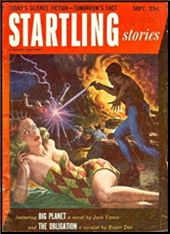
STARTLING STORIES, September 1952. Overall Rating: 1½ stars.

JACK VANCE “Big Planet.” Complete novel [92 pages]. A long and tedious account of the adventures of a commission from Earth as they make their way from their wrecked spaceship to their Enclave on Big Planet. Vance does a good job in describing the numerous cultures on this heterogeneous planet, but the effect is lost under the weight of so many. An adventure story only. (1½)

Comment: This was expanded (perhaps) and published in hardcover by Avalon Books (1957), then in paperback as half of an Ace Double (D-295; 1958). Reprinted in novel form several times since. I am aware that many readers consider this a minor classic, and I knew so even at the time, but it just didn’t click for me.

ROGER DEE “The Obligation.” Novelet. A fairly interesting story of Man’s first meeting with Alien, taking place during a wild storm on Venus. Ending tries to make up fo a lack of solid characterization. (3)

Comment: Reprinted in Adventures on Other Planets, edited by Donald A. Wollheim (Ace, paperback, 1955).

R. J. McGREGOR “The Perfect Gentleman.” An effort to show the effects of being lost in space on a woman’s repressed sexuality. (1)

CHARLES E. FRITCH “Night Talk.” Obvious parallel to Christmas story on Mars. (1)

Comment: Collected in Crazy Mixed-Up Planet (Powell, paperback, 1969).

– June 1967

ELLERY QUEEN’S MYSTERY MAGAZINE, November 1966. Overall Rating: 2½ stars.
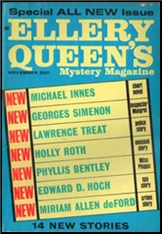
MICHAEL INNES “The End of the End.” Short novel. Sir John Appleby solves a murder committed in a snowbound English castle. Method of murder quite contrived to make it appear suicide. (3)

Comment: According to the cover, this was the first publication of this story. Based on my short description of it, it’s one of my favorite sub-genre of traditional Golden Age stories, even though published way later, in 1966.

EDWARD D HOCH “The Spy Who Walked Through Walls.” Rand of Concealed Communications. Mystery of disappearing reports has a very obvious solution. (2)

Comment: While always solid tales, Hoch’s Rand stories have never seemed as memorable to me as those with either Dr. Sam Hawthorne or Nick Velvet.

FRANK SISK “The Face Is Familiar.” Crooked con becmes involved in bank robbery by his cousin. (3)

JONATHAN CRAIG “Top Man.” A gangland story based on an eventually obvious pun. (2)

HENRY SLESAR “The Cop Who Liked Flowers.” A detective story with heart. (5)

Comment: The highest ranked story of this issue. Apparently a sentimental story that caught my fancy.

MIRIAM ALLEN deFORD “At the Eleventh Hour.” Another execution story: no surprises. (1)

PAMELA JAYNE KING “Nightmare.” Clever short-short [2 pages] by junior high stoudent, about a girl in trouble. (4)

Comment: This was this issue’s First Story, a standard feature of the magazine. up through and including today. While I enjoyed this one, the young author never published another work of crime fiction.

PHYLLIS BENTLEY “Miss Phipps and the Invisible Murderer.” Miss Phipps solves a church killing in the last four paragraphs [of a 13 page story]. (1)

Comment: Miss Phipps was a writer of detective novels who kept stumbling onto mysteries to solve. Her earliest appearance was in 1937, but none of her many others appeared until 1954. Several were collected in Chain of Witnesses: The Cases of Miss Phipps (Crippen & Landru, 2014), but I do not know if this is one of them.

J. F. PEIRCE “The Pale Face of the Rider.” German artists painting save daughter. Weird. (2)

GEORGES SIMENON “Inspector Maigret Deduces.” First US publication. Maigret solves train murder from studying character. No real clues. (2)

Comment: This was, of course, Maigret’s usual way of solving crimes.

JAMES CROSS “The Hkzmp gav Bzmp Case.” The spy story is demolished by this inane nonsense. Title is code for “Spank the Yank.” (3)

VINCENT McCONNOR “Pauline or Denise.” Murder of his two sisters leaves playboy trapped in asylum. Distinctly French. (4)

HOLLY ROTH “The Game’s the Thing.” An interesting anticipation of Dr. Berne, but story may be overshadowed. (3)

Comment: Dr. Berne was the author of Games People Play: The Basic Handbook of Transactional Analysis (1964). This was Holly Roth’s last published story; she died in 1964.

LAWRENCE TREAT “M As in Mugged.” Lieutenant Decker’s 60th birthday. A comparison of present and past police methods, with experience the key factor. (1)
« Previous Page