REVIEWED BY MICHAEL SHONK:


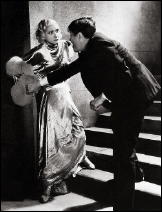
JERICHO. CBS, 1966-67. MGM/Arena Productions. Created by William Link and Richard Levinson in association with Merwin A. Bloch. Cast: Don Francks as Franklin Sheppard, John Leyton as Nicholas Gage, and Marino Mase as Jean-Gaston Andre. Executive Producer: Norman Felton. Supervising Producer: David Victor. Produced by Stanley Niss (pilot episode produced by David Victor). Theme by Jerry Goldsmith.
JERICHO TV series

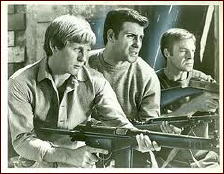
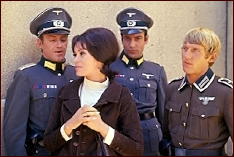
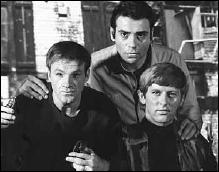
   JERICHO was set in war-torn Europe during World War II. It told the adventures of three men. American Captain Franklin Sheppard was the leader and an expert on explosives. British Royal Navy Lieutenant Nicholas Gage was a former circus performer and expert in getting in and out of tough situations. Free French Lieutenant Jean-Gaston Andre specialized in weapons, ancient and modern. Together they fought the Nazis behind enemy lines as a group, code named Jericho.

   I watched this series at Warner Archives Instant (free two week trial membership) here.

   Considering the talent behind this series I was very disappointed. The series first reminded me of another CBS series premiering that fall, MISSION: IMPOSSIBLE for its premise and soundtrack. However, JERICHO took on the style of the two other MGM and Norman Felton’s Arena Productions, MAN FROM U.N.C.L.E. and GIRL FROM U.N.C.L.E.

   The theme and opening featured a narrator (no on air credit) introducing the characters over the actor names with clips of each in action. The story then began with the narrator giving the date, location and Jericho’s mission.
JERICHO TV series

   Today, a major reason to watch this series is who created it. William Link and Richard Levinson would become two of television’s greatest creators of TV series with such series as COLUMBO, ELLERY QUEEN, and MURDER SHE WROTE. But JERICHO was before they joined Universal Studios. Link has discussed how little control they had over their freelance scripts such as their pilot script for MANNIX (in the commentary on MANNIX season one DVD).

   The pilot script for JERICHO would air as episode three “Upbeat and Underground.” From the credits it can be assumed Dean Hargrove (MAN FROM U.N.C.L.E.) rewrote some of the script. Paris 1942, the Nazis plan to force the French National Symphony Orchestra to play Wagner on Bastille Day, so Jericho smuggles the entire orchestra (one hundred people) under Nazis guard in occupied Paris to London. If only Jericho had been available for THE GREAT ESCAPE (John Layton was in the 1963 film but sadly did not play his Jericho hero).

   And who was fellow JERICHO creator Merwin Bloch? Bloch’s greatest success would come later as one of the most influential and successful producers of movie trailers. He would also produced the 70s cult film comedy THE TELEPHONE BOOK. At this time he was just starting out from advertising and had wrote one episode of BLUE LIGHT (which I reviewed here ). According to his IMDb bio, Bloch would supply many of JERICHO’s plots. At least one JERICHO plot was obviously inspired by BLUE LIGHT, in “Panic in the Piazza” Jericho was assigned to blow up a heavily guarded Nazi headquarters buried deep underground.

   JERICHO’s production values for a network show were embarrassing, from inept reusing of a few studio lot exterior sets to the too many times when you wondered if anyone was paying attention or cared.
JERICHO TV series

   In the episode “Long Walk Across a Short Street,” action took place at night and in an area where all power was out, yet the streets where bathed in sunlight and the interiors brightly lit. The only way we knew it was dark was when the characters told us. Surprisingly, the director was the talented Richard C. Sarafian (VANISHING POINT, 1971), and the director of photography was the experienced, Emmy award winner and innovator Lester Shorr. Both of these men would have known better, leaving one to wonder how such amateur mistakes could have happened.

   The scripts, because of its YA take on the plots, had problems maintaining the proper balance of believability, humor, action and suspense. For me the most successful was writer Jackson Gillis (MAN FROM U.N.C.L.E.) in “Have Traitor, Will Travel.” A French General and known spy is fed false information. Jericho escorts him to the front hoping to get captured, but encounter problems when the local underground rescues them. The story’s surprising twists had a darkness to them that kept the absurdity from overwhelming the drama.

   The soundtrack was a cross between MAN FROM U.N.C.L.E. and MISSION IMPOSSIBLE. The “Film Score Monthly” review of the record featuring the soundtrack to JERICHO (and THE GHOSTBREAKER), noted that the theme used by JERICHO was scored by Jerry Goldsmith (MAN FROM U.N.C.L.E.) from the second episode, and the pilot music score (and unused theme) was done by Lilo Schifrin.

   Schifrin would find a place for some of the rejected music in his next series, MISSION: IMPOSSIBLE. JERICHO, especially episodes scored by Richard Shores (MAN FROM U.N.C.L.E.), often had scenes with background music familiar to viewers of MISSION IMPOSSIBLE. While one of the more noticeable MAN FROM U.N.C.L.E. influences was the sound used with the graphic break for jump cuts.

   This YouTube clip is from a promo sent to local stations. It is terrible visually and features a different narrator, but illustrates my point about the soundtrack (around 2:05 on the clip):

https://www.youtube.com/watch?v=5r28TEIgI-w

   Perhaps the oddest element of JERICHO was Norman Felton producing CBS’s JERICHO while under exclusive contract to NBC. “Broadcasting” reported the story in issues December 27, 1965 and January 10, 1965. Norman Felton was one of MGM’s most successful producers until NBC signed Felton to an exclusive contract. Felton’s obligations to MGM would end June 30, 1966, but there were exceptions. Felton would continue to produce the show if either of Arena Production’s pilots for CBS went series. JERICHO did. Thus a NBC producer and company (Arena) produced a prime time series for CBS.

   Don Francks’ (HEMLOCK GROVES) performance was the best of the three regulars but lacked a dramatic depth to counter the silliness of the stories leaving him at times bordering on camp such as in “Wall To Wall Kaput” where he posed as a worker wallpapering the office where the top-secret papers were kept. John Leyton had been a British pop star and appeared in films (VON RYAN’S EXPRESS -1965), but by JERICHO his career was in decline. Marino Mase went from starring in films such as Jean-Luc Godard’s LES CARABINERS (1963) to minor roles in films such as GODFATHER 3 (1990).
JERICHO TV series

   Fans of actors will enjoy spotting such people as Barbara Anderson, John Drew Barrymore, Billy Barty, Tom Bosley, John Dehner, James Doohan, Marianna Hill, Walter Koenig, Mark Lenard, Jay North, Michael Rennie, Mark Richman, Gia Scala, Malachi Throne, and Ian Wolfe.

   The series featured one minor recurring character, Jericho’s contact Mallory played in the pilot by Ben Wright and in two episodes by John Orchard.

   The ratings were never good. The hour-long JERICHO aired in color on Thursday night at 7:30-8:30PM opposite of the popular BATMAN and F-TROOP on ABC and DANIEL BOONE on NBC (which usually finished second in the time slot).

   The November 28, 1966 issue of “Broadcasting” reported CBS had cancelled JERICHO, saying the series would remain on until mid-January.

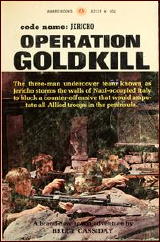
   There was a tie-in original paperback by Bruce Cassiday titled Code Name: Jericho – Operation Gold Kill (Award, 1967).
THE BACKWARD REVIEWER
William F. Deeck


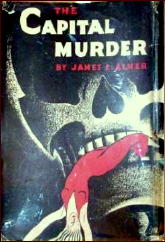
JAMES Z. ALNER – The Capital Murder. Knopf, hardcover, 1932.

JAMES Z. ALNER The Capitl Murder

   Gathered at the Serpentine Club — considering the plot, one wonders whether the author named the club playfully — five men of various talents and one nonentity who chronicles the investigation are discussing crime. They are Trevor Stoke, an epidemiologist; Henry Selden, one of the three commissioners of Washington, D.C., where the novel takes place; Lieut. Runy O’Mara, U.S. Navy; Dr. Basil Ragland, eminent psychiatrist about whom more later; and Lance Starr-Smith, the famous architect.

   An odd event occurs during their discussion, and then Commissioner Selden is told that a woman some of them knew had died shortly before under suspicious circumstances. Stoke discovers how and who, none of it coming as any surprise to the reader, who in addition has been anesthetized by the many unlikelihoods that take place.

   The author was acquainted with various famous fictional detectives of the time. It’s a pity he didn’t learn from their creators how to write better. Oh, there are a couple of good similes — “Empty as a dime-novel detective’s head” and “Open as a Congressman’s mouth” — but that’s about it. Unfortunate also is the 1930’s view of blacks, about whom the “eminent psychiatrist” says:

   The crime was carefully planned. A negro does not do that. When a negro commits murder, as unfortunately does happen, it is either in a drunken frenzy or in an impulsive brawl. A mulatto might plan a homicide, but more likely against one of this own race, if he did it at all.

— From The MYSTERY FANcier, Vol. 13, No. 1, Winter 1991.


Bibliographic Note:   This was the author’s only published work of crime fiction.

REVIEWED BY DAN STUMPF:


CAUGHT James Mason

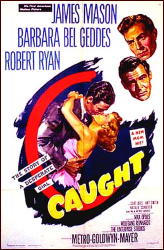
CAUGHT. MGM, 1949. James Mason, Barbara Bel Geddes, Robert Ryan. Very loosely based on the novel Wild Calendar by Libbie Block. Director: Max Ophüls.

   Speaking of endings, as I was when discussed Kiss Me Deadly a short while ago, something similar happened six years earlier — intentionally, this time — with the ending of the MGM film Caught, where we see one ending, a richly satisfying one in which (WARNING!) Barbara Bel Geddes murders her abusive husband Robert Ryan, but we hear — in a jarring, dubbed-over tone — another one in which the characters talk about how she saved his life at the last minute. (END OF WARNING.)

   Obviously there was some last-minute fudging by the studio heads at MGM, to appease the censors and give audiences a happy ending, even if it meant throwing out the whole point of the story. Yet in spite of what we hear the characters say, the evidence of our eyes remains.

   I guess actions — even images of actions — speak louder than words.


Editorial Comment: Based on Mike Grost’s review of the film, which you can find here, I’ve changed the category in which I placed the movie from “Crime Film” to “Romantic Drama,” in spite of the fact that other experts often consider Caught to be film noir.

REVIEWED BY WALTER ALBERT:         


FOUR HOURS TO KILL

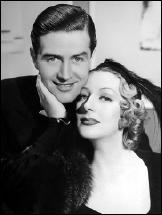
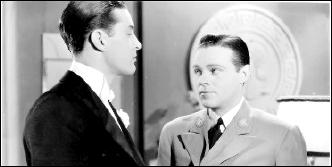
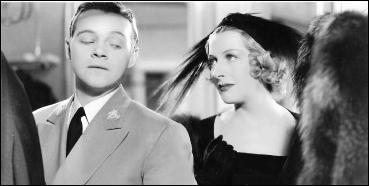
FOUR HOURS TO KILL. Paramount, 1935. Richard Barthelmess, Gertrude Michael, Ray Milland, Helen Mack, Dorothy Tree, Henry Travers, Roscoe Karns. Director: Mitchell Leisen. Shown at Cinefest 19, Syracuse NY, March 1999.

   A sort of Grand Hotel that’s set in a theater, and with a good cast rather than the constellation of stars in the MGM film. Leisen, one of the interesting stylists of the period, concentrates on keeping the interlocking plot lines moving smoothly, which he does more than capably.

   Barthelmess (one of the most popular of silent film stars, here in the twilight of his career) is attending a play handcuffed to a cop who’s killing time waiting for the next train to take Barthelmess back to the prison he’s escaped from.

FOUR HOURS TO KILL

   Roscoe Karns, usually the quintessential wisecracking reporter, plays an expectant father who keeps making phone calls to the hospital where his wife is in labor. (It’s not clear why he’s at the theater rather than the hospital, but given his manic behavior, somebody probably didn’t want him around to upset his wife.)

   Ray Milland, in an early role, is a smooth gigolo rendezvousing with his elegant girl friend (Gertrude Michael), stepping out on her rich husband, and willing to save his hide by letting an usher be arrested for a theft for which Michael is unwilling to press charges. The pot is already boiling when Barthelmess escapes but hangs around waiting for the arrival of the man he broke out of prison to kill.

   All this, and no commercial breaks.

FOUR HOURS TO KILL

A TV Review by MIKE TOONEY:


IRONSIDE Raymond Burr

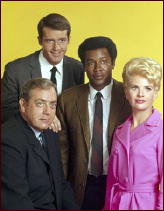
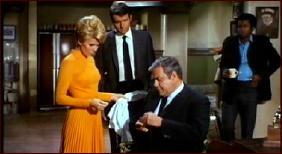
“The Monster of Comus Towers.” From the Ironside TV series. Season 1, Episode 10 (of 196 total). First telecast: 16 November 1967. Regular cast: Raymond Burr (Ironside), Don Galloway (Det. Sgt. Ed Brown), Barbara Anderson (Officer Eve Whitfield), and Don Mitchell (Mark Sanger). Guest cast: Warren Stevens, David Hartman, Joan Huntington, Michael Forest, Donald Buka, Kevin Hagen, Evi Marandi, Renzo Cesana, Harper Flaherty. Teleplay: A. J. Russell and Stanford Whitmore. Story: A. J. Russell. Director: Don Weis (58 Ironside episodes to his credit).

   Most long-running crime dramas seem to find it impossible to produce genuine whodunnits on a regular basis (it does require thinking a lot), so the majority of them work on the Encyclopedia Brown level of complexity.

   This particular episode, however, is something of an exception to the general rule.

IRONSIDE Raymond Burr

   A collection of one-of-a-kind art masterpieces valued at $20 million is being displayed on an upper floor of Comus Towers, headquarters of a computer firm. With alarms still sounding, security guards rush to the art exhibit only to find another guard with a knife sticking out of him and the head of security lying on the floor nearby, unconscious and wounded.

   The 6-foot-long, 40-pound centerpiece of a triptych has apparently been spirited out of the high-rise through a smashed plate glass window by someone who can either fly in gale force winds or shinny up the side of a tall building while wearing tennis shoes.

IRONSIDE Raymond Burr

   When Ironside & Co. are called in, the chief has no shortage of suspects, some more obvious than others: the wealthy owner of Comus Towers, the self-assured head of security (no one is above suspicion to Ironside), the bespectacled art insurance expert, the cool female employee of the firm, the two-timing ex-con she’s having an affair with, the Italian sponsor of the art exhibit who’s hard up for money, and his abnormally nervous young wife.

   The sponsor, however, soon eliminates himself from the suspect list by literally dropping dead from cyanide poisoning, leaving Ironside with two murders to solve.

   In Golden Age detective fiction style, the chief gets proactive, gathers all the remaining suspects together, and sets a trap according to the old adage of divide and conquer.

   You can watch “The Monster of Comus Towers” along with lots of annoying commercials on Hulu here.

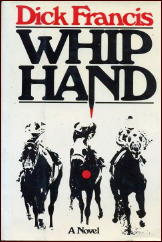
DICK FRANCIS – Whip Hand. Harper & Row, hardcover, 1979. Pocket, paperback, 1981. Reprinted many times since, in both hardcover and soft.

DICK FRANCIS Whip Hand

   Thanks to some exposure on public television’s recent venture into mystery drama, this the latest of Dick Francis’ novels on racetrack chicanery has been flirting in recent weeks with the lower extremities of various best-seller lists.

   Mystery fans may not be so pleased with this state of affairs once they realize that Harper & Row have been pushing it as straight fiction, not what it actually is — a straightforward private eye detective thriller. But of course, as everyone knows, private eye stories just don’t sell.

   Sid Halley, the jockey who lost a hand in a previous Francis adventure, has had some success recently as a PI dealing largely in horsey matters, perhaps too much so for his own good. When the villains see him coming, they think they know what it will take to scare him off.

   And they’re not so very far from wrong. Halley has to come to some strong grips with himself before he can start tackling the end of the case. But because of all the soul-searching, perhaps, the pace seems to plod more than it has in much of Francis’s previous works. The violence seems to be too calculated and perfunctory, and in spite of the odds, Sid Halley comes up smelling of roses, just as expected.

Rating:  B

— Reprinted from The MYSTERY FANcier,
       Vol. 4, No. 4, July-August 1980 (somewhat revised). This review also appeared earlier in the Hartford Courant.

REVIEWED BY DAN STUMPF:


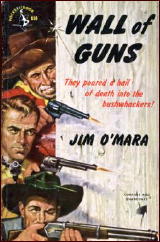
JIM O’MARA – Wall of Guns. Dutton, hardcover, 1950. Pocket #816, paperback, June 1951. Signet, paperback, 2002.

   I almost started this review by saying that Jim O’Mara’s Wall of Guns is Western writing at its finest. On second think, that honorific is better suited to books like The Big Sky, Saint Johnson and True Grit. Perhaps it’s more apt to say Wall is Western writing at its most enjoyable.

JIM O'MARA Wall of Guns

   Frank Landry drifts down from Montana to the Rio Grande to find out who killed his brother and stole their ranch, eventually ending up in Broken Wheel, Texas, a town like something from Red Harvest, with sundry factions in a range war at each other’s throats, various hombrae and varmints crossing and double-crossing one another, and a general feel of violent malfeasance roaming the plains.

   Landry’s fit for it, though, being one of those Western hero-types who never loses a gun-or-fist fight, thinks faster and smarter than any sidewinder, and draws the women-folk to him like kids to Christmas.

   And we’re still in the first chapter when he meets up with Mary Wayne, purty as prairie flower, whose dad is a local rancher being squeezed out by a bunch of cattle thievin’ no-goods over on the next range, and whose weak-willed brother has fallen under the spell of one Carolina Steele, the local cattle queen and de facto head of the rustlers.

   From this clichéd start, and with those boiler plate protagonists, Wall of Guns could have been a very ordinary western, no better or worse than most. But O’Mara has a smooth, vivid way of evoking the landscape, a good hand with action, and he peoples his story with a supporting cast far from the usual stock types. A dumb goon-type shows a surprising, gentle loyalty to his spineless boss, one of the good guys goes wrong when Landry’s girl dumps him, people make dumb mistakes now and then, and show surprising insight at other times — it’s as if a spear carrier in Aida suddenly dropped his lance and burst into an aria.

   There’s a remarkable moment late in the book where one of the bad guys starts thinking about how he took the wrong road, and wonders if it’s too late to retrace his steps. At which point the good guys catch up with him and

   â€œEd,” he smiled his crooked, thin smile, “What if I were to tell you that this moment has nothing to do with cows or land or money? That it is merely a matter of two roads?”

   â€œYou can’t talk your way out of this,” Ardoin said, low and thick, “It’s too late.”

   â€œPrecisely,” said Kirby Steele. And then he went for his gun. It was a gesture and nothing more.

   Characters like that, propelling a violent, fast-moving story, lift Wall of Guns well out of the usual rut and make it one to look for. And remember.

IT IS PURELY MY OPINION
Reviews by L. J. Roberts


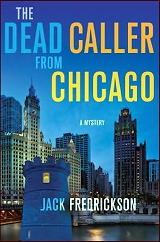
JACK FREDRICKSON – The Dead Caller from Chicago. St.Martin’s Minotaur Books, hardcover, April 2013.

Genre:  Mystery. Leading character:   Dek Elstrom, 4th in series. Setting:  Chicago.

JACK FREDRICKSON

First Sentence:   It was March, well past midnight, and it was cold.

   Free-lance investigator Dek Elstrom is still trying to fight his local city hall to regain zoning rights to the tower — no castle, just a tower — in which he lives, but strange things start occurring. A large hole is dug for a new McMansion in a block of bungalows, a phone call from someone thought to be dead, and Dek’s best friend and loved ones suddenly disappearing. Dek is on the trail of answers and trying to stay alive.

   I have two admissions from the very start; 1) I have loved this series but, 2) this is not my favorite book of the series.

   Among Fredrickson’s strengths is his ability to create a vivid atmosphere from the very beginning. He has a great eye for detail and conveys it in a way that you are part of the scene. You feel the cold, you experience the turbulence of the boat ride and the
driving rain; the tension becomes real and the atmosphere, threatening.

   He also has an excellent ear for dialogue, whether in the narrative or between characters. It’s clear, it has the right edge to it and just enough dry humor.

   The main characters are impossible to resist; Dek, who is trying hard to rebuild his life and his wonderful brilliant, completely devoid of any fashion-sense friend Leo are
interesting and people about whom you want to know more. A few characters, however, feel as though they have become a bit of a joke that has gone on too long.

   The weakest element, I felt, was actually the plot. It seemed we didn’t really knowwhat was going on until nearly half-way through the story. Sometimes, this can work. In this case, it was only the question of Leo and an act of faith that draws you on.

   The Dead Caller From Chicago is still a good read. If anything, I feel my frustration is in feeling that Mr. Fredrickson is capable of doing so much more. I’m waiting….

Rating:   Good.

       The Dek Ekstrom mysteries —

1. A Safe Place for Dying (2006)

JACK FREDRICKSON

2. Honestly Dearest, You’re Dead (2008)
3. Hunting Sweetie Rose (2012)
4. The Dead Caller of Chicago (2013)

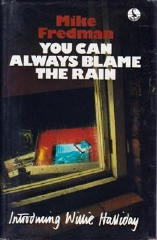
MIKE FREDMAN – You Can Always Blame the Rain. St. Martins, US, hardcover, 1980. First published in the U.K. by Paul Elek, hardcover, 1978.

MIKE FREDMAN You Can Aways Blame the Rain

   If Harry Stoner [the PI hero of The Lime Pit, reviewed here not too long ago] can be considered a member of the knighthood for his willingness to rescue damsels in distress, so also should Willie Halliday, the British private eye making his American debut in You Can Always Blame the Rain.

   That both Fredman and Halliday are English may or may not have a great deal to do with it, but the action here is noticeably more refined than much of anything found in Jonathan Valin’s deliberately shocking expose of false Midwestern piety.

    But, needless to say — or I wouldn’t have started this review the way I have — there are similarities. There are pictures, and one of the daughters that Halliday is hired to protect is nude in them — but that is all we are told about them. There are also some references to Moroccan white slave traffic, but perhaps thankfully we are spared any further details.

   Willie Halliday is a vegetarian, by the way, and he neither smokes nor drinks, He is well-versed in the history of Eastern religions, seems to have a good deal of money on his own, and none of the girls he attracts, including his new secretary, ends up in bed with him.

   His first case is entertaining fun, in a quiet, genteel sort of way, but especially in comparison to a book like that of Valin’s, hard-boiled detective buffs are going to end up wondering just what scandal it is that he’s saving the girls from.

Rating:   C.

— Reprinted from The MYSTERY FANcier,
       Vol. 4, No. 4, July-August 1980 (somewhat revised). This review also appeared earlier in the Hartford Courant.


NOTE: There was a second case in which Willie Haliday is known to have been involved, that one being Kisses Leave No Fingerprints (1979/1980), but nothing has been heard of him since.

REVIEWED BY WALTER ALBERT:         


MURDER BY THE CLOCK

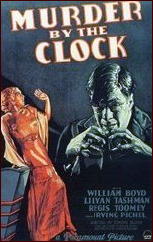
MURDER BY THE CLOCK. Paramount, 1931. William (Stage) Boyd, Lilyan Tashman, Irving Pichel, Regis Toomey, Sally O’Neil. Based on the novel by Rufus King (Doubleday/Crime Club, 1929). Director: Edward Sloman. Shown at Cinefest 19, Syracuse NY, March 1999.

   This was an end-of-day screening (after 11 p.m.) that I would probably have skipped had the notes not pointed out that the film is “celebrated” by William Everson in his Classics of the Horror Film.

MURDER BY THE CLOCK

   Tashman had a brief Hollywood career (she died shortly after the release of this film, according to the notes), but she was worth staying up for. She’s the sultry villainess who masterminds three homicides and appears to be getting off Scot-free until Boyd upstages her in the final minutes of the film.

   This is an old-house mystery with a crusty dowager heiress who rigs her coffin in the family crypt so that an alarm can be sounded if she’s buried alive. As indeed, she appears to have been. Pichel (whose most memorable screen performance was as Gloria Holden’s minion in Dracula’s Daughter) has a hoot playing a deranged legatee and he almost manages to steal kinky acting honors from Tashman.

   An improbable but delicious early sound romp among the corpses.

« Previous PageNext Page »