IT IS PURELY MY OPINION
Reviews by L. J. Roberts


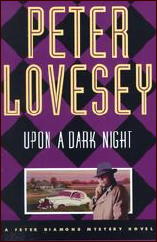
PETER LOVESEY – Upon a Dark Night. Mysterious Press, hardcover, 1997. Soho Crime, softcover, 2005. First published in the UK by Little Brown, hardcover, 1997.

Genre:   Police Procedural. Leading character:  Det. Supt. Peter Diamond; 5th in series. Setting:   Bath, England.

PETER LOVESEY Peter Diamond

First Sentence:   A young woman opened her eyes.

   An unconscious woman, found in a hospital parking lot, awakens to find she has no memory. Released to social services, she is placed in a hostel and befriended and named “Rose” by Ada Shaftsbury, a good soul with a large personality and a penchant for shoplifting.

   The Bath police have their own problems with the apparent suicides of an elderly farmer by shotgun and a woman off a roof. But were they suicides, and how do they link to Rose, whom Ada is pushing the police to find after she’s not seen her for two weeks? It’s up to DS Peter Diamond to figure it out.

   There is nothing better than a book that not only has an intriguing beginning but also causes you to wonder what you’d do in a similar situation.

   An unusual facet to this story is that Diamond doesn’t begin to play a major role until quite a way into the story, but what a dynamic, and flawed, character he is. I enjoy the relationship he has with his wife, Stephanie, and their cat, Raffles.

   At the same time, he is not an easy person for others to deal with, particularly Detective Inspector Julie Hargreaves. Diamond respects her, but releases his frustration publicly on her and it is through his imperfections and some of their interchanges that we get to know Diamond better.

   Ada, with all her faults, is a pivotal character and often allows Lovesey to exhibit his delightfully dry humor… “While her old man was refusing to admit to anything, she was singing like the three tenors.”

   What I most appreciate, however, is the plotting. It takes you down interesting, unexpected roads where you learn about everything from film shooting schedules, ancient English history and detectorology and treasure troves. The inclusion and care of such details is only one element that sets Lovesey apart as a writer.

   I particularly like that DS Diamond investigates the case by looking for evidence, doing the research, working his team and following the clues rather than working from assumption. There are good climatic twists and a very well done ending. I am delighted that there are many more books in the series waiting for me to read.

Rating:   Excellent.

       The Peter Diamond series —

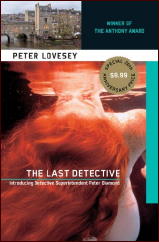
1. The Last Detective (1991)

PETER LOVESEY Peter Diamond

2. Diamond Solitaire (1992)
3. The Summons (1995)
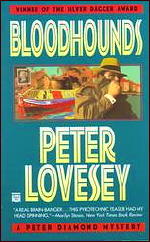
4. Bloodhounds (1996)

PETER LOVESEY Peter Diamond

5. Upon A Dark Night (1997)
6. The Vault (1999)
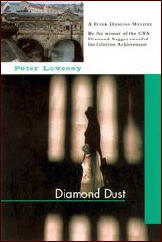
7. Diamond Dust (2002)

PETER LOVESEY Peter Diamond

8. The House Sitter (2003)
9. The Secret Hangman (2007)
10. Skeleton Hill (2009)
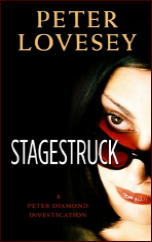
11. Stagestruck (2011)

PETER LOVESEY Peter Diamond

12. Cop to Corpse (2012)

THE BACKWARD REVIEWER
William F. Deeck


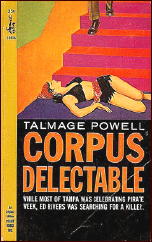
TALMAGE POWELL – Corpus Delectable. Pocket, paperback original, October 1964.

TALMAGE POWELL Ed Rivers

   Apparently this is the fifth and last case of private investigator Ed Rivers, the agent in charge, though there seem to be no other agents, of the Southeastern Division of the Nationwide Detective Agency.

   Two things are happening in Tampa, Florida: The annual Gasparilla Week has begun, “a fun week dedicated to the legendary Jose Gaspar, who roamed these Gulf [of Mexico] waters back when buccaneers were for real,” and Rivers is waiting somewhat impatiently for a possible client who is running late.

   The client, a lovely young lady as are all the females in this novel when they aren’t downright beautiful, is shot by a silenced gun in the hall leading to Rivers’ office. She manages an obscure dying message: “Incense.”

   Her killer also tries to murder Rivers on this and another occasion. He fails in the latter attempt because, like most professional hit men in private-eye novels, he’d rather narrate what he is going to do than do it. Which is good for the longevity of private eyes, I suppose.

   Rivers begins an investigation of his would-be client’s background, which involves the recent death of a rich old woman and some rather unpleasant characters connected with the woman. The reader will be way ahead of Rivers, but then the reader isn’t threatened by a garrulous gunsel or attacked by a chap with a pirate’s sword or encountering females likely to divert one’s mind.

   Rivers is an early “sensitive” private eye, and the Florida setting, I believe, was unusual in the 1960s. The novel is rather fun reading.

— From The MYSTERY FANcier, Vol. 11, No. 1, Winter 1989.

       The Ed Rivers series —

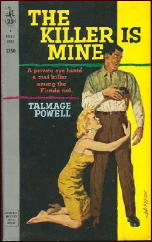
The Killer Is Mine. Pocket, 1959.

TALMAGE POWELL Ed Rivers

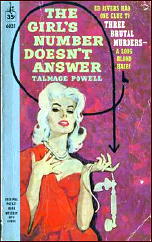
The Girl’s Number Doesn’t Answer. Pocket, 1960.

TALMAGE POWELL Ed Rivers

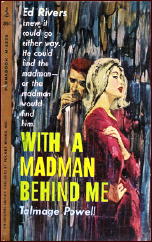
With a Madman Behind Me. Permabooks, 1961.

TALMAGE POWELL Ed Rivers

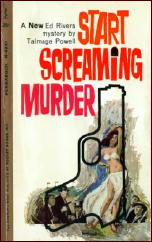
Start Screaming Murder. Permabooks, 1962.

TALMAGE POWELL Ed Rivers

Corpus Delectable. Pocket, 1964.

REVIEWED BY WALTER ALBERT:         


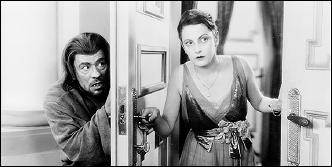
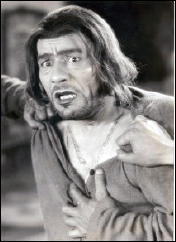
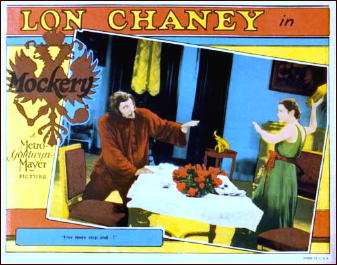
MOCKERY Lon Chaney

MOCKERY. MGM, 1927. Lon Chaney, Ricardo Cortez, Barbara Bedford, Mack Swain, Emily Fitzroy, Charles Puffy, Kai Schmidt, Johnny Mack Brown. Scenario by Benjamin Christensen based on a story by Stig Esbern. Cinematography by Merritt B. Gerstad; edited by John W. English. Director: Benjamin Christensen. Shown at Cinevent 35, Columbus OH, May 2003.

   After a notable career as a director and actor in his native Denmark that included the controversial Häxan: Witchcraft Through the Ages, Christiansen was brought to America in 1926 by MGM, where after completing two films, The Devil’s Circus and Mockery, and working on The Mysterious Island (begun by Maurice Tourneur and completed by Lucian Hubbard), he moved to First National.

MOCKERY Lon Chaney

   There he completed (among other films) a version of A. Merritt’s Seven Footprints to Satan that’s not a lost film but one that’s in restoration limbo. (It was announced for a showing on Turner several years ago that was cancelled with the explanation, as I recall, that the soundtrack was not up to standard. An odd explanation for a silent film’s cancellation. A good friend, Charlie Shibuk, who saw the film some 25 years ago at the Museum of Modern Art with Czech intertitles, points out that the original titles were written by Cornell Woolrich as William Irish.)

MOCKERY Lon Chaney

   Chaney plays Sergei, a brutish peasant who rescues the Countess Tatiana (Barbara Bedford) from revolutionaries, helping her to escape to Novokutsk to deliver a message to the Czarist forces. Sergei falls in love with Tatiana and she, in turn, falls in love with a Czarist officer (Ricardo Cortez) who arrives in time to save her from the Bolsheviks.

   Chaney learns to hate the aristocrats but can’t overcome his love for Tatiana and sacrifices his life for her. Chaney, almost unrecognizable in his effective makeup, gives a nuanced performance, one of his strongest in a non-genre film that I’ve seen.

   I didn’t detect any of the stylistic flourishes for which Christiansen’s horror films are known, but his sensitive handling of the fine cast is, perhaps, a testament to his own acting skill.

   I wondered if the editor is the same John English who co-directed, with William Witney, some of Republic Studio’s finest serials in the late 1930s. IMDB says yes.

MOCKERY Lon Chaney

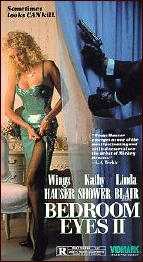
BEDROOM EYES II. 1989. Wings Hauser, Kathy Shower, Linda Blair, Jane Hamilton. Director: Chuck Vincent.

BEDROOM EYES II

   Harry Ross is a guy who seems to have an inordinate amount of trouble with women. His ex-wife JoBeth evidently tried to murder him five years before, and now here she is, out of prison. His present wife Carolyn is still in a case of traumatic shock — something to do with another of Harry’s girl friends, Alexandria, who died in a hit-and-run accident the same night he broke up with her.

   And now there’s Sophie, an artist who provides Harry with an overabundance of sympathy soon after he spots Carolyn (also a patron of the arts) in the passionate embrace of her own current discovery. (Nor is Sophie all she seems, either.)

   Harry is also a successful stockbroker who, with his partner, is on the verge of making five million dollars in an illegal inside stock transaction. This makes him especially vulnerable to blackmail, say, but what actually happens is that he ends up being framed for murder, in a sloppy, murky sort of way.

   The sexual activity pictured in this movie — it is rated “R” — is fast and perfunctory. There is also a considerable amount of of promiscuous violence — reason Number Two for the rating. Surprisingly, or perhaps not, each of these two factors often happen in close proximity to each other.

   As far as the people in the movie are concerned, Wings Hauser and Linda Blair both seem to be veterans of this sort of film-making, and they each turn in an adequate, professional-looking job. The others in the cast have moments when they seem alive and functioning, but for the most part they seem to have only been pointed in the right direction, just before the cameras started to roll.

   But then again, that’s why they’re called directors, right?

— Reprinted from Mystery*File 33, Sept 1991 (slightly revised).

Reviewed by RICHARD & KAREN LA PORTE:    


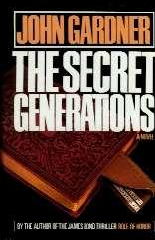
JOHN GARDNER – The Secret Generations. Putnam, hardcover, 1985. Charter, paperback, 1986.

JOHN GARDNER The Secret Generations.

   This might be called The Railton Saga. It is billed as a panorama covering the years between 1910 and 1939. It begins in 1910 with the death of General Sir William Railton, but almost all of the story is in the first decade.

   When Sir William dies his brother takes over the clandestine network of informants the General has gathered. One by one brother Giles works other members of the family into the league. His daughter is in Paris with her French husband. One son, Andrew, is in London with a cover in the State Department. The other is in Ireland with his Irish wife Bridget and both are operating, unbeknownst to the other, inside the Sinn Fein.

   The General’s two sons, John and Charles, are also in the family business. And, eventually, Denise of the third generation is in occupied Belgium running a courier service behind the Kaiser’s lines.

   You can’t fault Gardner’s writing. It’s up with the best and it shows off well in a long novel like this. There are plots within plots, many twists to every turn, and any other cliche you would like to use.

   But there is no cliched material in this book. The story line is unusual and the people are fresh, bright, right for their parts, and carefully drawn. The post-WWI sections are brief but revealing as a lightning-lit scene. The last chapter brings a surprise that backlights the rest of the story with a whole new meaning of the idea of “double agent.”

— Reprinted from The Poisoned Pen, Vol. 6, No. 4,
Fall 1986.


       The Railton Family series —

The Secret Generations. Heinemann, UK, 1985 [1909-1935]
The Secret Houses. Bantam, UK, 1988 [1940s]
The Secret Families. Bantam, UK, 1989 [1964]

A REVIEW BY MARYELL CLEARY:
   

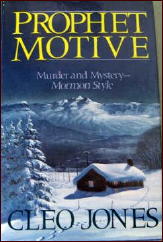
CLEO JONES – Prophet Motive. St. Martin’s, hardcover, 1984. No paperback edition.

CELO JONES Prophet Motive

   This is a first mystery, though not a first novel, and it’s a real find. In Magpie, a suburb of Salt Lake City, Police Chief Christopher Danville, himself a lapsed Mormon, must deal with the murder of Mormon Bishop Manion in an atmosphere of suspicion and hostility.

   Newcomer Naomi Green, Planned Parenthood director, is the townspeople’s prime suspect because of their opposition to her work. There are also Mormon fundamentalists who hold on to the old way of polygamy. Danville’s sergeant, Wilkes, turns out to be one of them, so he is automatically a suspect.

   Danville himself is a complex character. Divorced from a “good Mormon wife,” feeling guilty about not spending enough time with his daughter, sexually attracted to Naomi, his own conflicts get in the way of his work. However, he goes about tracking down a good Mormon husband who has supposedly run off with a dancer at a Las Vegas casino owned by a wealthy Magpie Mormon.

   He finds that there are others interested in the missing man as well. The denouement is startling, but no more so than some of the action along the way. I recommend this highly, except to Mormons, who aren’t going to like the inside information this ex-Mormon author spills.

— Reprinted from The Poisoned Pen, Vol. 6, No. 4,
Fall 1986.


Bio-Bibliographic Notes:   Al Hubin has no information about the author, except to say that she is an “ex-Mormon living in Utah.” I have a feeling that ‘Cleo Jones’ may be a pen name. She wrote one other mystery, The Case of the Fragmented Woman (St. Martin’s, 1986), which takes place in San Francisco and does not involve Police Chief Danville as a character.

REVIEWED BY MICHAEL SHONK


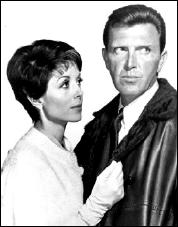
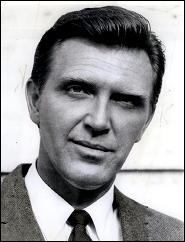
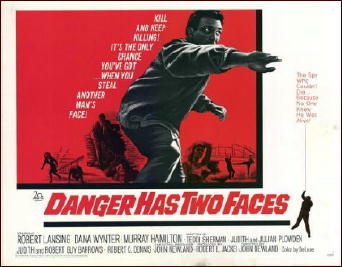
DANGER HAS TWO FACES. 20th Century-Fox/Palomino Production, 1967. Cast: Robert Lansing as Peter Murphy/Mark Wainwright, Dana Wynter as Eva Wainwright, Murray Hamilton as Colonel Jack Forbes, Alex Davion as Roger Wainwright. Created by Teddi Sherman, Judith and Julian Plowden, and John Newland. Theme by Frank Cordell. Written by Teddi Sherman, Judith and Julian Plowden, Robert C. Dennis, and Judith and Robert Guy Barrows. Executive Consultant: Merwin Gerald. Director & Executive Producer: John Newland.

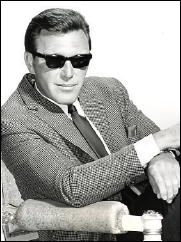
THE MAN WHO NEVER WAS Robert Lansing

    This movie was made from episodes of ABC-TV series The Man Who Never Was (1966-67) edited together, and released theatrically and for TV syndication by 20th Century Fox in 1967 (Broadcasting, September 25, 1967, and October 9, 1967).

    Peter Murphy is an American agent in East Berlin. He meets with his contact and handed pictures of four men, but before he can learn more his contact is killed and he is on the run. He stops to pick up a woman he loves so they can escape together. During a chase through secret tunnels under the Berlin Wall, his lover is killed and he is hurt.

    Peter makes it into West Berlin with the Eastern killer on his trail. Peter ducks into a bar and is shocked to find his exact double, drunk, and about to leave the bar. Stunned, he watches as the killer from the East gun down his unsuspecting double. The killer leaves and a confused Peter exit the bar only to be mistaken for his double by the man’s chauffeur. Peter collapses and wakes up in his double, billionaire Mark Wainwright’s bed and his wife talking to him about a meeting they need to attend.

THE MAN WHO NEVER WAS Robert Lansing

    The wife, Eva needs her husband alive or his evil stepbrother will take over the family’s billions and shove her and her family out. Peter’s control, Colonel Forbes wants him to continue as billionaire Mark Wainwright who has access to many important people and places. While the two looked exactly alike, Peter and Mark were opposites. Peter is a kind caring man while Mark was a rude mean drunk. Mark was an expert mountain climber but Peter is not, so in one episode he had to fake an injury to avoid suspicion.

    Limited by the thirty-minute format, the series never succeed in making this Mark Twain’s Prince and the Pauper theme believable as a spy drama. Instead, the interesting plots with surprising twists, fitting soundtrack, visual locations, and exciting action was overshadowed by the series implausible premise.

    Early reviews of the series were mixed, and perhaps best expressed by Dean Gysel of the Chicago Daily News, “If you can swallow the first episode, it may turn out exciting” (Broadcasting, September 12, 1966).

    As a movie it was further weakened by the obviously edited together 30-minute TV episodes. Every thirty minutes or so, Colonel Forbes would show up and give Peter/Mark his next assignment.

    The beginning of the story focused on establishing the premise. Then the killer discovers Peter is not dead. Eva joins him as they travel to save a priest from the East’s secret police. Eva is close friends with the wife of a suspected security leak. Over time, Peter and Eva would fall in love and give the movie a surprising final ending.

THE MAN WHO NEVER WAS Robert Lansing

    The Man Who Never Was had an interesting past. 20th Century Fox produced the TV pilot for sponsor Philip Morris tobacco (Broadcasting, November 1, 1965). Originally the series was not supposed to be on ABC’s fall schedule, but in March 1966, it suddenly replaced the never to air The Long Hunt of April Savage (Broadcasting, March 28, 1966).

    The Man Who Never Was was filmed in Germany and suffered from production problems that had some concerned the series might get cancelled before it even aired (Broadcasting, June 20, 1966). The series filmed all over Europe and the locations were distractedly beautiful. Oddly, every source from Broadcasting to IMDb claim the series (and this movie) was done in color, but my copy was in black and white off a broadcast by KYW (Philadelphia).

    In September 1966, ABC previewed several of their new shows a week early. Of the twelve new shows, The Man Who Never Was received the lowest rating of a 38.6 share (Broadcasting, September 12, 1966).

    The next week, up against the other networks premieres, its ratings (Arbitron) dropped to a 27 share versus CBS’ Green Acres 38 share and NBC’s Bob Hope Presents the Chrysler Theatre with a 25 share (Broadcasting, September 19, 1966). By October, the series was ranked #50 (out of 88) in the ratings (Broadcasting, October17, 1966) and cancelled by November (Broadcasting, November 7, 1966).

    The Man Who Never Was lasted 18 episodes, beginning September 7, 1966, and ending January 4, 1967.

THE MAN WHO NEVER WAS Robert Lansing

IT’S ABOUT CRIME, by Marvin Lachman

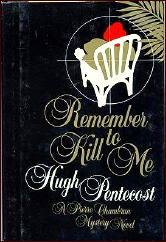
HUGH PENTECOST – Remember to Kill Me. Dodd Mead, hardcover, 1984. Worldwide, paperback, 1988.

HUGH PENTECOST Remember to Kill Me

   Longevity is one of the strong points of Judson Philips, who was a sports reporter while a student at Columbia University where he was a contemporary of Cornell Woolrich and Jacques Barzun in the early 1920s.

   He’s been writing ever since, under his own name and the more famous pseudonym of Hugh Pentecost, with hundreds of magazine stories in the “pulps” and the “slicks” plus over a hundred novels since his first in 1936.

   Never a great literary stylist, Philips-Pentecost is often not readable, especially when his plot is weak. On the other hand, considering his prolificity, he has done some very good work, and one of his best recent Pentecost novels, Remember to Kill Me, has recently been reprinted by Worldwide Library in paperback.

   In a far from new plot device, terrorists take over the luxury Beaumont Hotel, holding hostages and planting bombs throughout the building. The Pentecost nuts-and-bolts prose works beautifully here as the suspense builds up while Pierre Chambrun tries to resolve matters without loss of life.

   The growth in books about what the television networks call “hostage situations” has led to this new sub-genre of the mystery, which I’ll call “howdoit,” depending upon how (if at all) the authorities will end a siege without loss of life. Remember to Kill Me is one of the best and most suspenseful of this new breed.

— Reprinted from The MYSTERY FANcier,
Vol. 11, No. 1, Winter 1989.


[UPDATE] 05-14-12.   Judson Philips died in 1989, at the age of 86, with one book published after his death. Pierre Chambrun, one of his most popular characters, appeared in 22 novels and one short story collection. For more about the author, his Wikipedia entry can be found here, and his page on the Golden Age of Detection wiki is here.

REVIEWED BY WALKER MARTIN:


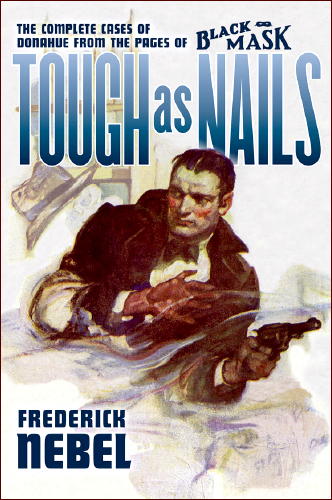
FREDERICK NEBEL – Tough As Nails: The Complete Cases of Donahue from the Pages of Black Mask. Altus Press, softcover, May 2012. [A limited edition hardcover may still be available.]
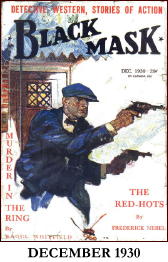
FREDERICK NEBEL bLACK mASK

   This is rapidly turning out to be the year that Frederick Nebel was rediscovered. First we had The Complete Casebook of Cardigan, Volume One, which I reviewed here. Then just recently Black Dog Books published Empire of the Devil, a collection of Nebel’s adventure tales.

   Coming up later in the year will be additional volumes in the Cardigan series from Altus Press plus the complete stories from the Black Mask series starring Kennedy and MacBride. And now just published we have this latest book from Altus Press collecting all the Donahue stories from Black Mask.

   Like The Complete Casebook of Cardigan, this book is a must buy for any lover of hardboiled fiction. The Donahue stories are also historically significant because in 1930 it was very obvious to Joe Shaw, the editor of Black Mask, that he was about to lose his best writer. Dashiell Hammett would be following the money to Hollywood, and no pulp magazine could compete with the enormous paychecks available from the movie industry.

   Shaw asked his second best writer (Chandler did not appear until 1933) to develop a series similar to the Continental Op made famous by Hammett. I stress the word “similar” because in 1930 no one could compare to the quality of Hammett. The result was Donahue of the Interstate Detective Agency. There were 15 novelettes published between November 1930 and March 1935.
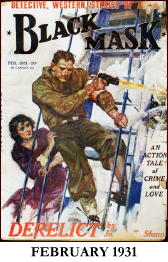
FREDERICK NEBEL bLACK mASK

   The first question readers will be asking is how do these stories stand in comparison to the Cardigan stories? The answer is simple: if you liked Cardigan, then you will like Donahue. I really do not see much of a difference between the two characters.

   Like Cardigan, Donahue is tough, hardboiled, no nonsense, and a private operative working for a detective agency. We learn very little about the private lives of either character and the stories are fast moving examples of crime fiction which stand up very well even though 80 years have passed since the Cardigan and Donahue stories appeared.

   The Donahue stories were written according to the above standards set by Shaw during his time as editor for Black Mask, 1926-1936. Frankly, I consider this collection another bargain from Altus Press. The quality paperback, which is almost 600 pages is available for $29.95 from Altus Press, Mike Chomko Books, and Amazon.com.

   The limited edition hardcover, which I had to have because of the importance of this collection, is priced at $39.95 and can be ordered through the Altus Press website. These books are print on demand and hold up to the usual high qualities of Matt Moring, the publisher.
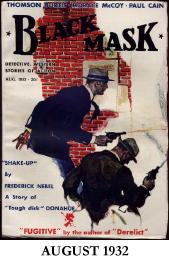
FREDERICK NEBEL bLACK mASK

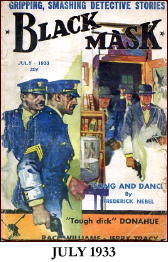
   In addition to the 15 long novelettes, all 30 some pages long except for the last one which clocks in at 56 pages, the stories all have the original illustrations by the Black Mask artist Arthur Rodman Bowker. Bowker had a very distinctive style and I’ve always liked his work. He seems to fit in with the no nonsense, hard as diamonds Black Mask style. The cover is a stunner from Black Mask also, and I believe it shows Donahue(or a character very much like him), in action, gun in hand.

   The introduction is by pulp historian, Will Murray, and the book is edited and compiled by Rob Preston. Rob has also compiled a bibliography of the works of Frederick Lewis Nebel. This is an important feature of the collection and runs 14 pages grouped by magazine title chronologically.

   It shows that Nebel had around a hundred or so stories in the slick magazines and in addition to the fiction in Black Mask and Dime Detective, he also had over a hundred stories in other pulp magazines such as Northwest Stories, Action Stories, Air Stories, Wings, and so on. The bibliography also lists the books written by Nebel as well as the anthologies he appeared in. The screenplays based on his work are also listed.

   Earlier, I mentioned that we don’t learn much of Donahue’s private life. But here are a few items of note. Donahue’s philosophy can be summed up in the passage from the first story in the series, “Rough Justice.” On page 18 Donahue says:

    “I know I’m in a rotten game… I’m not defending it. I don’t know why I’m in — but I’m in it. It keeps me in butts and I see the country and I don’t have to slave over a desk. I get places. It’s not a pretty game, and no guy ever wrote a poem about it. But it’s the only hole I fit in.”
FREDERICK NEBEL bLACK mASK

   Donahue lives in a hotel apartment, made up of a small living room and bedroom. It has a bath and a small pantry. He smokes a pipe, cigarettes and cigars. He’s in his thirties, tall, lean and good looking. He eats well, attends boxing and hockey sports and says that he never gambles. He drinks brandy, scotch, martinis, wine, and beer.

   Through the first 14 stories he has no girl friends, in fact he seems to mistrust the women he meets and this is understandable since they mostly turn out to be nothing but trouble. However in the last story he does meet a girl that he likes and trusts and the story ends with Donahue making a date.

   Speaking of drinking, when this series commenced prohibition was still in effect across the country. I have read books about the widespread popularity of speakeasies and this series certainly shows the speakeasy as a very popular illegal hangout. They may have been illegal but everyone in NYC seemed to be drinking in these establishments including the local police.

   This series shows just how impossible it was to make the general public stop drinking. It was an impossible task and prohibition just encouraged crime and corruption. None of this ever bothered Donahue and his police contacts.

   I’ll repeat what I said again. This book is a must buy for all readers of the hardboiled and quality pulp fiction. Altus Press is doing excellent work reprinting such fiction and I urge everyone to support their efforts. They have some excellent books scheduled for future publication.

FREDERICK NEBEL bLACK mASK

      Contents:

“Rough Justice” (November, 1930)
“The Red-Hots” (December, 1930)
“Gun Thunder” (January, 1931)
“Get A Load of This” (February, 1931)
“Spare the Rod” (August, 1931)
“Pearls Are Tears” (September, 1931)
“Death’s Not Enough” (October, 1931)
“Shake-Up” (August, 1932)
“He Could Take It” (September, 1932)
“The Red Web” (October, 1932)
“Red Pavement” (December, 1932)
“Save Your Tears” (June, 1933)
“Song and Dance” (July, 1933)
“Champions Also Die” (August, 1933)
“Ghost of a Chance” (March, 1935)


Acknowledgment:   The magazine covers you see above were obtained from the Galactic Central website, thanks to Phil Stephensen-Payne.
THE ARMCHAIR REVIEWER
Allen J. Hubin


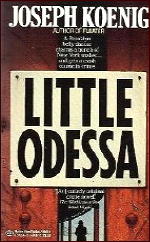
JOSEPH KOENIG Little Odessa

JOSEPH KOENIG – Little Odessa. Viking, hardcover, 1988. Ballantine, paperback, 1989.

   Perhaps contrary to the prevailing view, I had sizeable reservations about Joseph Koenig’s first, Floater, but I have none about his second, Little Odessa, an innovative and grimly amusing slice of New York’s nether regions.

   Kate Piro, born in Odessa, Russia, dances nude at one of the city’s sleazier night spots while yearning for something better. An arrest brings her in touch with Stanley Bucyk, cop, which is not better. Kate “moonlights” at another joint, whose owner (like all males within viewing distance) wants her in bed.

   She resists, but he offers her the management of his joint, and the loan of his townhouse and its resident wolfhound, while he takes a trip to Israel. Everyone in this little caper is bent — it’s just a matter of degree.

   Terminally bent, someone is, for in short order Kate has a corpse leaking all over the townhouse and nowhere to turn. This is a dandy.

— Reprinted from The MYSTERY FANcier,
       Vol. 11, No. 1, Winter 1989.


[UPDATE] 05-13-12.   Joseph Koenig wrote four well-regarded crime novels between 1986 and 1993, then seemingly dropped out of sight as far as the world of mystery fiction was concerned. He has recently resurfaced as an author, however. His first novel in nearly 20 years, False Negative, will be published in June by Hard Case Crime. You can read more about it here.

« Previous PageNext Page »