March 2007
Monthly Archive
Sat 3 Mar 2007
One of my collecting interests for many years was what’s called Old Time Radio; that is to say, radio programming from before 1962 or so. I was one of the early birds in the hobby, starting in the mid-1970s I’d guess, with all of my shows on reel-to-reel tape.
Which I still have, and they still are. I have close to 3000 of these tapes, with about 12 half-hour shows per reel. I never did switch over to cassettes, as most people did, thinking them too flimsy for long-term archiving. Once the Internet and MP3’s came along, reel-to-reel recorders were like dinosaurs, or living fossils. One CD, if the input is compressed enough, can now hold over 100 shows.
And the shows often sound terrible. To me MP3’s usually sound shrill and sharp-edged in tone. I’m told that MP3’s, if processed correctly, can sound as good as these old shows did when they were broadcast live, but if that is true, then I’ve never heard one.
In one sense, MP3’s have expanded the hobby tremendously, as the amount of money to amass a collection is a teensy fraction of what it cost me to put mine together. On the other hand, the ubiquitousness of MP3’s has done nothing to expand the number of shows that are in circulation. I’ve not been actively collecting for nearly 20 years, I would estimate, and the shows that were available then are still nearly all of the shows that are available now.
The dealers who found new shows then no longer find it financially profitable to buy the disks, clean them up, and transfer them to tape or CD. Once available, the MP3ers, to coin a phrase, will have copies made and out and available for next to nothing, and the person who did the basic discovery and necessary groundwork is left out in the cold.
So there are tons of OTR shows safely stored away in various archival bunkers across the country, or so I’ve been told. They’re just not going anywhere, and maybe they never will. The asking price for other collections in private hands is simply too high for anyone to pay the price, and so they sit.
But if you are interested in listening to the shows and not necessarily in building your own collection, this is almost the Golden Age of Old Time Radio. Via the Internet, there are several sources of programming you can listen to absolutely free. Even with my own collection here at arm’s length away from me, it’s easier to turn on the computer and head for one of the following sites and listen to almost any program that’s in circulation.
Being stored in the MP3 format, the sound is not always so very good, for the most part, but the price is certainly right. This is not meant to be a complete list. It consists only of the sites that I stop by every once in a while. For the person not wishing to download and store the shows, most of these sites have the option of “click and play.”
I’ll list these in reverse order of recommendation:
1. www.freeotrshows.com. For mystery fans, a long run of Philip Marlowe shows; more moderate runs of Richard Diamond, Ellery Queen, Let George Do It, Nick Carter and several others.
2. www.otr.net More selection than the site above, but the sound generally does not seem as good. Here’s a sampling: 55 Sam Spade shows, 36 Casey, Crime Photographer, 84 Suspense, 14 Pat Novak, 201 Escape, 53 Green Hornet, and as they say, much more.
3. www.archive.org, then do a search on “Old Time Radio,” in quotes. Great selection, with varying sound quality. Not available on the previous two sites are a large number of The Shadow shows, which is one of the first programs I remember listening to as a child. I had to be less than 10 years old, more likely 8 or 9, and I still remember a whole new world opening up before my ears. Lots of Ellery Queen radio shows, plus The Whistler, Suspense, Inner Sanctum, and so on and so on. The site is not organized for easy locating of shows, and dates are not always given, but if you’re looking for a particular program, you’re more likely to find it here.
And of course I have not mentioned at all programs like Jack Benny, Amos & Andy, Lux Radio Theater, Gunsmoke, X Minus One, Bob Hope, Vic and Sade, Cavalcade of America and Flash Gordon that you can find for free on the web.
Just to name a few.
Sat 3 Mar 2007
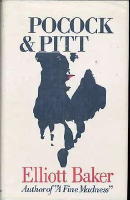
Elliott Baker, a screenwriter and novelist with one book listed in Crime Fiction IV, by Allen J. Hubin, died on February 9th. He was perhaps best known for his first book, A Fine Madness, which was made into a movie starring Sean Connery, Joanne Woodward and Jean Seberg.
Described elsewhere as a “dark, picaresque” tale, A Fine Madness told the story of Samson Shillitoe, a poet forced to work as a carpet cleaner. Mr. Baker also wrote the screenplay for the fillm.
Born Elliot Joseph Cohen, December 15, 1922, he changed his name when he began his writing career.
His entry in CFIV is scant, as previously mentioned:
BAKER, ELLIOTT (1922-2007 )
* -Pocock & Pitt (Putnam, 1971, hc) Joseph, 1974.
The dash indicates a title of marginal crime content. The cover shown is that of the British edition. Some online reviews praise Pocock & Pitt but do not elucidate:
“It’s a long time since I read a book that was so consistently enjoyable. The whole novel, while tough and disenchanted, increases your appetite for life.” –
Eastern Daily Press
“A strange and comic odyssey, too complicated to summarize, but a joy to read.” –Daily Telegraph
“Pocock and Pitt” is philosophical, witty and erudite, wise and exciting and one of the best novels I have read this year.” –Irish Times
“Elliott Baker is one of the wittiest of American authors. Quite rightly, this is a ‘one of a kind’ fiction.” –The Scotsman
Adderly, a series created for Canadian television by Mr. Baker, was based on a character from Pocock and Pitt, described by one source as being in the “humorous adventure” category.
Excerpting from a synopsis from IMDB:
“V. H. Adderly, a former James Bond style operative for I.S.I., is given a desk job in the Department of Miscellaneous Affairs after losing function in his left hand – the result of torture by enemy agents. He hates the mundane assignments he is given, thumbs his nose at protocol, and somehow manages to dig up a threat to national security or a spy at every turn.”
Adderly aired in the US from September 1986 through March 1988 by CBS at 11:30 pm, opposite Johnny Carson and Dave Letterman, but it made little ratings headway against the two late night hosts.
Excerpting from a NY Times review:
“[Adderly is the] sole agent in a basement operation called the Bureau of Miscellaneous Affairs. ‘What’s Miscellaneous Affairs?,’ someone asks. ‘Making your tax dollars work,’ answers Adderly sourly.
“The tough, no-nonsense agent is played determinedly by Winston Rekert. His weekly cohorts are his bumbling, bureaucratic boss, Melville Greenspan (Jonathan Welsh); Mona (Dixie Seatle), the kooky agency secretary who adores Adderly, and Major Clack (Ken Pogue), the crusty intelligence chief with a heart of plutonium.
“Think of The Man From U.N.C.L.E. done at bargain prices.
“Adderly is not about to be overly demanding. It would be gratifying if the viewer were able to stay awake until the conclusion. If not, nothing’s missed.”
I don’t know. I wish I’d seen it when it was on. I liked The Man from U.N.C.L.E. I even liked Get Smart. From the rest of the review, however, which is rather unfavorable, the chances of seeing the series on DVD are fairly slim.
On the other hand, actors and other people responsible for putting the show on the air either won or were nominated for a number of Canadian Gemini awards, including Winston Rekert for best actor. Blame it on provincialism here in the US?
Fri 2 Mar 2007
Announced today was the death of Carolyn Hougan, 63, on February 25th. She was a highly praised thriller writer under her own name as well as “John Case,” a pen name she and her husband Jim shared together.
The books she and/or her husband wrote were filled to the brim with contemporary terrorists, rogue CIA agents, high-tech science, voodoo magic, deadly viruses and secret conspiracies – the entire gamut of huge-stakes danger and the possible ways in which the world could be destroyed in a moment, or at least be brought to its knees.
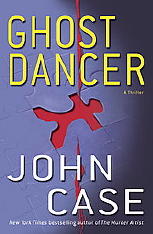
Of special note, Ghost Dancer, the couple’s most recent novel, has been nominated for this year’s Dashiell Hammett Award for Best Literary Crime Novel by the International Association of Crime Writers. (For the complete list of nominees, go here.)
BIBLIOGRAPHY: [Based in part on her entry in Allen J. Hubin’s Crime Fiction IV.]
Best known in combo with her husband as –
CASE, JOHN F.; pseudonym of Carolyn Hougan & Jim Hougan
* The Genesis Code (Columbine, 1997, hc)
* The First Horseman (Columbine, 1998, hc)
* The Syndrome (Ballantine, 2001, hc)
* The Eighth Day (Ballantine, 2002, hc)
* The Murder Artist (Ballantine, 2004, hc)
* Ghost Dancer (Ballantine, 2006, hc)
On her own –
HOUGAN, CAROLYN (A.) (1943-2007)
* Shooting in the Dark (Simon & Schuster, 1984, hc). Trade paperback, Felony & Mayhem, 2006.
* The Romeo Flag (Simon & Schuster, 1989, hc). Trade paperback, Felony & Mayhem, 2005.
* Blood Relative (Columbine, 1992, hc)
And on her own under yet another pen name –
BELL, MALCOLM; pseudonym of Carolyn Hougan.
* The Last Goodbye (St. Martin’s, 1999, hc)
Thanks to J. Kingston Pierce of The Rap Sheet for the link to her obituary on the Washington Post website.
Fri 2 Mar 2007
Posted by Steve under
Covers ,
Publishers1 Comment
Covers for the 1945 mysteries are now included in the online Phoenix Press project. Right now 1945 begins a page to itself, so if you don’t mind, would you check to see that the links to all of the earlier years are working the way they’re supposed to?
Thu 1 Mar 2007
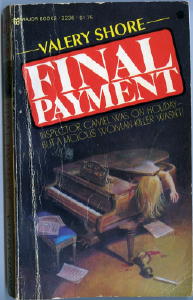
VALERY SHORE – Final Payment
Major Books 3236, paperback original; copyright 1978; no other date stated.
Next on the agenda, and the final book I read in 2006, is the only mystery written by the pseudonymous Valery Shore. Al Hubin in Crime Fiction IV says that Shore was the pen name of Lon Viser, born in 1932. All I’ve been able to come up with regarding Mr. Viser is that he had something to do with the American Art Agency, a publisher based in North Hollywood in 1965.
From the small print inside Atualidades Globo Controle Da Natalidade, written in Portuguese and illustrated throughout, aka The Complete Book of Birth Control:
Parliament News, Inc. Publisher: Milton Luros. Executive Editor: Harold Straubing. Managing Editor: Lon Viser. Art Director: Wil Hulsey. Associate Art Director: J. D. Pecoraro.
It’s not a common name. Maybe it’s the same man. All that comes up for Valery Shore, in case you were wondering, are a few dealers offering this book for sale on eBay, or maybe it’s the same book offered at different times. I didn’t check.
The dedication reads as follows: “To Yvonne, Rhoda, and Lon, without whose help this book could not have been written,” so I assume that Al is correct – not that there’s any reason to doubt him.
The primary detective in Final Payment is a former Scotland Yard inspector by the name of Christopher Camel, still young, who’d recently been left a fortune by an aunt, in her day a sex symbol of the silver screen. Staying with Camel in his aunt’s Tudor-style Hollywood mansion is “his beautiful Eurasian companion, Kim Lee Chance.” I’m quoting from the back cover.
In attendance upon them both is Potter Goodleigh, his aunt’s former lover and a long ago movie director who’d been exiled to the guest cottage, but who is now cook, butler and father figure to the two young people who are now “livening up the old museum,” as he puts it.
It is Potter’s daughter Felicia who’s murdered, her body found in the piano in her living room. Unfortunately Felicia was also a blackmailer, and there are thirteen suspects that Camel, Kim Lee, and the local lieutenant of police named Davidson have to deal with. In spite of his new-found money and all of his resultant leisure time, there is no way Camel can be kept off the case, as you can well imagine if it had happened to you and sunny fortune had smiled your way in such a fashion.
The story, as I’ve relayed to you so far, may also sound to you as the basis for a made-for-TV mystery movie. If so, you share my feelings exactly, and I have the advantage of having actually read the book. If you also were to suspect that on page 177 there would be a gathering of the suspects in the dead woman’s living room, in an attempt to recreate the crime, I would certainly begin to wonder about you. How could you possibly know that it was on page 177?
As entertaining as made-for-TV mystery movies may be, and some more than others, in general I’ve always had a relatively low opinion of them. This one, I’ll conclude by saying, is better than most of them. If there had ever been a second book in the series, I’d make sure that I had it in my collection too.
— written in December 2006
UPDATE [03-01-07] Victor Berch has done some preliminary spadework on Lon Viser, and so far he’s come up with the following: His full name as Lorenzo Ludwick Viser, born February 26, 1932 in FL, died August 9, 1994 in LA. There was a Lorenzo M. Viser living with him in the 90s, probably a son. More later, if and when!
Thu 1 Mar 2007
After I posted my
review of
The Nightmare Blonde, by Morton Wolson, in which I included all I knew about the author, his son, Peter Wolson, left a comment, which because of some HTML peculiarities, was truncated after only the first few lines.
The Nightmare Blonde was Morton Wolson’s only mystery novel, but to pulp readers and collectors, he’s far better known as Peter Paige, author of the Cash Wale stories for
Dime Detective, plus many other short stories for the pulp magazines throughout the 1940s.
Here now is the complete version of what Peter Wolson had to say about his father, as he sent it to me later via email. –Steve
I am Mort Wolson’s son, a psychoanalyst in Beverly Hills, and can tell you a lot about him. But first some corrections. He was living in Leisure World in Laguna Hills, with his wife Gaye when he died of congestive heart failure. He was 89.
The William Bendix episode, “Prime Suspect,” was based on his story, “The Attacker.”
His first published ‘pulp’ narrative was “I Guard Nudes,” when he was a bouncer at the Cuban Village in the 1939 World Fair in which he described his job protecting the strippers from overly enthusiastic men and putting wraps on their bodies as they left the stage. It was printed in the pulp magazine Black Mask in September, 1939.
The Nightmare Blonde was based on a previous novella, “Softly Creep, Softly Kill,” which anticipated The Bad Seed. “Softly Creep, Softly Kill” was published in Detective Tales, August, 1947. Mort always felt that this work was plagiarized by the author of The Bad Seed.
Mort always regarded his detective stories as puzzles in which he would constantly try to fool the reader, while the clues for the denouement would be embedded in the material. But they came easily to him and, unfortunately, he did not regard them as valuable as writing the great American novel. So he spent the bulk of his time and energy during the fifties and beyond writing what he regarded as “serious fiction.”
One such attempt was about a dual personality. In in one internal world, the assumption prevailed that Hannibal had successfully crossed the alps and defeated the Romans, with civilization developing in North Africa, in which blacks became the majority population and whites, the minority. In the other split-off personality, the world was as it is today, with the clash between the worlds occurring in the individual’s mind.
Another novel was entitled Nightmare Bullet, in which a scientist had discovered how to insert a nuclear device in a bullet, and this involved foreign espionage. Mort also wrote a book about his experiences in the Spanish Civil War, called The Dragon Lady and I. He also wrote over a hundred sonnets to Gaye, his third wife, in the literary form of true Shakespearean sonnets.
Clearly, he did best at writing pulp detective stories, and most of his stories published in Black Mask and Dime Detective, were the main feature, with the magazine covers representing their themes. He respected Raymond Chandler, Cornell Woolrich and Dashiell Hammet, but had contempt for Mickey Spillane, feeling that he cheated to earn his fame by exaggerating blood and gore.
The lapse in his writing was due to his efforts to earn a living as a furniture store owner, which occupied most of his time. In retirement, he was able to write The Nightmare Blonde and his memoirs.
Mort was a very good-looking, manly, powerfully built, blond-haired individual, who smoked a pipe and loved to argue. He prided himself on being a divergent thinker, and loved to take the most oppositional point of view in any discussion, to the delight of some, and to the dismay of others.
Thanks for your interest in him.
« Previous Page