May 2010
Monthly Archive
Sat 1 May 2010
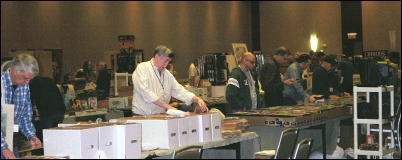
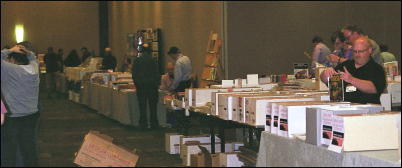
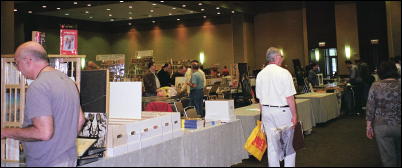
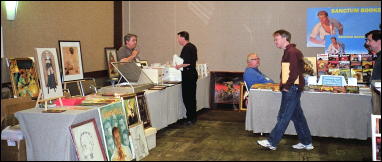
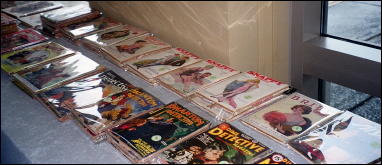
The dealers room is, of course, the center of all activity at pulp conventions, whether it be Windy City or Pulpfest. If it’s your first visit, it’s a sight to see. For old-timers, it may be the smell of old musty paper that staggers the senses first:
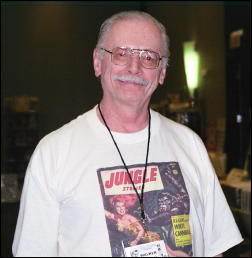
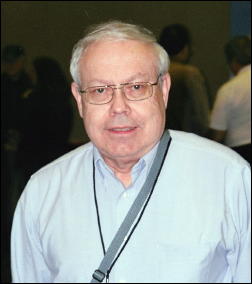
I don’t recognize any of the faces in these first three photos, but that’s Walker Martin’s back in the lowermost one (in the white T-shirt).
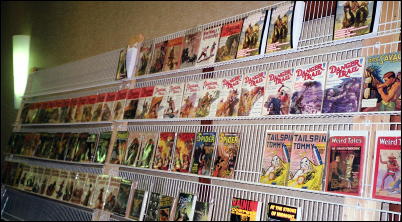
The most jaw-dropping display was, as always, behind John Gunnison’s table. Nobody in the room had seen more copies of Danger Trail in one place at one time. Not only that, these were all in Very Good to Fine condition, if not better:
Another shot of the room. That’s Nick Certo behind the table, making a deal (or small talk) with Paul Herman, whom I traveled to the show with.
A better shot of Walker Martin, whose back you saw earlier above. I believe this was taken the day after the auction, where he outbid everyone on three large lots of romance or “love” pulps. This is what a collector looks like when he’s cornered the market on an entire category of pulp fiction:
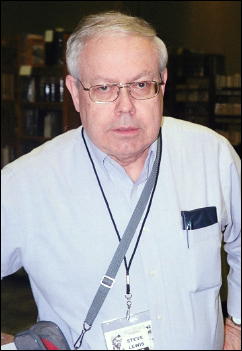
Walker then obliged me by taking this photo of me:
If you missed it, you can go back a few posts and read Walker’s report on the convention here.
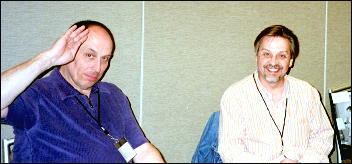
Here next are Gene Christie and Tom Roberts, the guys behind Black Dog Books. Gene forgot at the time that he’s no longer in my Squadron and he no longer has to salute me. I wish I’d managed to get some of the books they were selling into the photo:
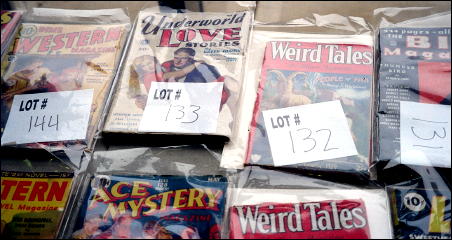
The first night’s auction was an estate sale, and the number and variety of scarce and hard-to-find pulps was significantly higher than there’s been in many years. First of all, a copy of the one-shot Underworld Love Stories, a magazine that most people had never seen before:
I thought the magazine might sell for over a thousand dollars, but I was told that it went for only $720 or so. (If I’m wrong about this, I’m sure someone will let me know.)
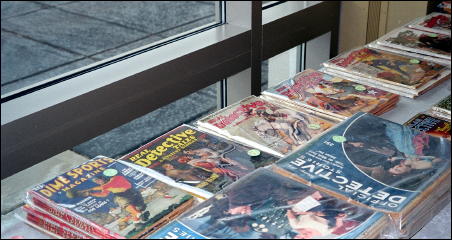
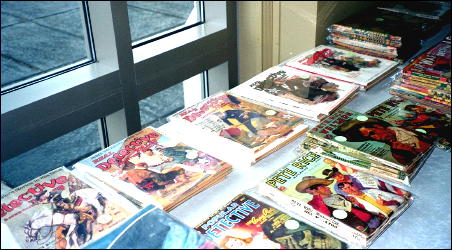
There was also a beautiful run of Real Detective Stories. I took two photos of these, hoping that at least one would come out:
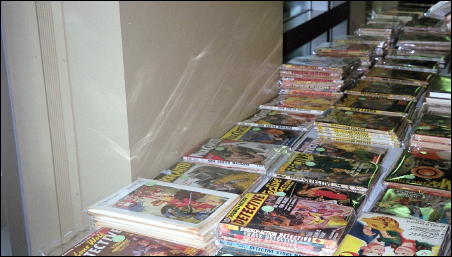
These were sold in several lots, each of which commanded a sizable stash of money. Next, a long run of Nick Carter pulps (not the dime novels) in very nice condition. Unfortunately I took only one photo of these, and you get a better glimpse of the spines, I’m afraid, rather than the covers:
Both Snappy Stories and Breezy Stories were in good supply:
Before heading off to the Art Room, I took a close-up photo of Paul Herman, last seen buying magic carpets from Nick Certo:
And of course Paul demanded retribution, and he took this photo of me in return. You can see that Paul does not know how to take pictures, as I really do not ever look like this.
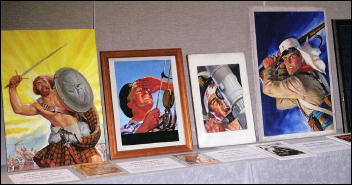
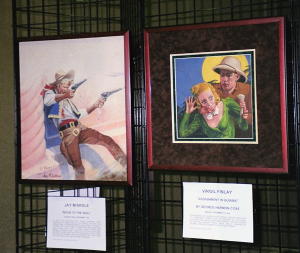
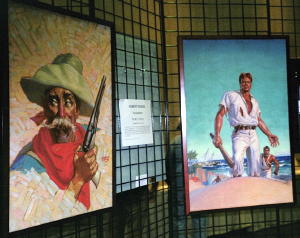
The theme of the convention was the 100th anniversary of Adventure magazine. I failed to take any pictures during the panel discussion, but I did take several in the Art Room. All of original art on display came from Adventure or some of its several competitors. I also failed to take any notes on these, so I’m sorry I can’t tell you either the artists or the magazines:
And all too sudden, the convention was over.
Sat 1 May 2010
REVIEWED BY WALTER ALBERT:
LOVER COME BACK. Columbia, 1931. Constance Cummings, Jack Mulhall, Betty Bronson, Jameson Thomas, Katherine Givney. Screenplay by Dorothy Howell and Robert Shannon, from a story by Helen Topping Miller; photography: Joseph Walker. Director: Erie C. Kenton, director. Shown at Cinecon 45, Hollywood CA, September 2009.
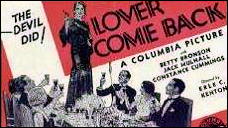
There were films with the same title released in 1946 (with Lucille Ball and George Brent) and in 1961 (with Doris Day and Rock Hudson).
I’ve not seen the two later films, but none of the IMDB postings suggests any connection between the three except the title. In any case, the situation as it developed in the 1931 film would never have made it to the screen in the later periods in anything resembling its treatment of sexual relationships.
Constance Cummings is a secretary who’s had an affair with Jack Mulhall, general manager of the firm for which she works. When he breaks off their relationship and marries Betty Bronson (groomed by her mother, Katherine Givney, for a suitable marriage) Cummings accepts the longstanding offer of her boss, Jameson Thomas, and moves into a Park Avenue apartment he’s set up for her.
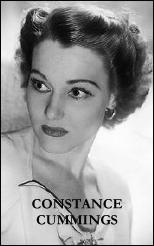
She continues to work at the firm as the organizer and hostess of parties entertaining out-of-town clients. When Bronson begins an affair with Thomas, Cummings attempts to protect Mulhall from the knowledge of his wife’s indiscretions, but eventually Bronson’s blatant cheating precipitates the film’s not-too-surprising climax.
Beautiful Constance Cummings may be the victim of a blind lover and a scheming rival, but she has a strong will and an intelligence that make it clear who’s going to carry the day.
She gives a commanding performance in a frank treatment of sexual relationships that may seem astonishing to someone who’s not familiar with Hollywood’s license for sinning in the pre-code era.
Sat 1 May 2010
Posted by Steve under
Reviews[2] Comments
IT IS PURELY MY OPINION
Reviews by L. J. Roberts
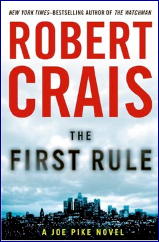
ROBERT CRAIS – The First Rule. G. P. Putnam’s Sons, hardcover, January 2010. Paperback reprint: Berkley, December 2010.
Genre: Private eye. Series character: Joe Pike/Elvis Cole, 2nd in Joe Pike series. Setting: Los Angeles.
First Sentence: Frank Meyer closed his computer as the early winter darkness fell over his home in Westwood, California, not far from the UCLA campus.
Joe Pike receives word that, Frank, one of the members of his former mercenary team has been murdered, along with his entire family and the nanny, in a violent home invasion. The police and FBI want to know what Frank was into.
Pike knows he Frank was clean but, along with the other members of the former team and his friend, PI Elvis Cole, are dedicated to find the killers and elicit their own form of justice. This becomes particularly true when Pike realizes Frank wasn’t the target, but only collateral damage.
In general, I am a big fan of Robert Crais and the Elvis Cole/Joe Pike series. I liked The Watchman which gave us more information about Pike’s past. But I don’t think Pike works as a lead protagonist. Pike works as Cole’s backup, sometimes known as the “psychopathic sidekick,” because he is an enigma. He doesn’t do friendship, in the classic sense of the word but, by heaven, he does loyalty and he has a code by which he leads his life, and that makes him work as a character.
I appreciate Crais wanting to stretch the character of Pike, but it just didn’t quite work because of problems with the story and the writing. First, if Pike had said “Sh” one more time, I’d have taken out whatever virtual weapon — I am so NOT a gun person — and shot him.
Second, Pike formed a relationship with a baby that, even allowing for the metaphysical, stretched credulity beyond the point of belief. But third, and most important, Pike broke his own rules. The situation did not call for it and it didn’t make sense.
The one thing that did hold true, was Pike’s tribute to his fallen comrade, which I appreciated. Crais does give the story an element of place, but there also seemed to be a large assumption that the reader is familiar with the environs of Southern California/Los Angeles. I do find it interesting — i.e., unbelievable — that whenever there would be a car chase, there was no traffic to slow them down.
The First Rule was, as always, an exciting read with lots of action and some good twists to the plot, but this is far from Crais’s best work. I’m certain I’ll read his next book, but I may not buy it in hardcover.
Rating: Okay.
Previously reviewed on this blog:
Indigo Slam (by Steve Lewis).
« Previous Page