August 2011
Monthly Archive
Tue 9 Aug 2011
Posted by Steve under
Reviews[12] Comments
REVIEWED BY DAN STUMPF:
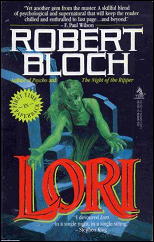
ROBERT BLOCH – Lori. Tor, hardcover, 1989; reprint paperback, 1990.
Speaking of brainless books, I’ve always enjoyed Robert Bloch’s mysteries, despite themselves. Bloch’s idea of detection is to have sundry characters run up to the protagonist and spill everything they know, leaving the detective/reader to decide how much of it is true and if the reasons they gave for spilling it are what they seem.
Bloch started plotting this way with Spiderweb in 1954 and was still at it thirty-five years later with Lori (1989). Not that Lori is a bad book, exactly. Bloch was always too good a pulpster to write something dull, and his pleasure in his craft is evident throughout, with colorful characters, a corkscrew story, and the light, gruesome prose he did so well.
What there is of a plot revolves around a young woman, newly-graduated from college and suddenly orphaned, who finds a twenty-year-old college yearbook (carefully hidden from her) with her picture in it.
Bloch takes this premise and runs amok with it, throwing in well-timed (but otherwise unexplained) murders, nightmares, spiritual possessions, and the usual parade of “helpful” friends who may not be all they seem. He cheats outrageously from time to time, but somehow that didn’t diminish my enjoyment, and when I closed Lori, it was with a smile of satisfaction.
Mon 8 Aug 2011
WEB ORIGINALS: SLACKER PI, THE BANNEN WAY
and ANGEL OF DEATH
Reviewed by MICHAEL SHONK
Web series are stories shot on video or film to premiere on the Internet. Each episode is usually between five to ten minutes long. The story can be in serial form with the series forming one movie like story or as a series of stand alone adventures featuring a cast of the same characters.
The form has attracted the attention of big name talent such as Lisa Kudrow (Web Therapy) and Felica Day (The Guild), cable networks such as IFC and Cartoon Network’s Adult Swim, and studios such as Fox and Sony. Web series have made it to cable TV, released as movies, and released on DVD.
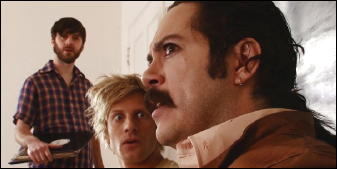
SLACKER, PI. 15 Gigs (division of Fox TV), 2009. Five stand alone series episodes. Written and Directed by Noel Shankel. Cast: Thomas Sigby (Bo), Tanner Thomason (Wyatt), Charlie Pecoraro (Derringer). available at Hulu.com and YouTube.com.
Fox was looking for alternative ways of producing TV pilots for possible network TV series and turned to the web. Slacker, PI was made as a web series with viewers response aiding Fox decision to pick up or reject the possible TV series. While Slacker, PI never would have succeeded as a TV series, it is worth watching.
Not unlike Woody Allen’s Play It Again, Sam, fictional 1980s TV PI Derringer shows up and gives advice to two young losers. While the scenes featuring the losers are a waste of pixels, the Derringer scenes are not to be missed by any fan of 1980s TV PIs. There is even a music video tribute called “Too Deep.”
https://www.youtube.com/watch?v=yuUHQu1aJUI
THE BANNEN WAY. Colton Productions. 2010. Sixteen episodes to be aired as a serial form series or as a movie. Written and Directed by Jesse Warren. Cast: Mark Gantt (Neal Bannen), Robert Forster (Mr. B), Vanessa Marcil (Madison), Michael Ironside (Chief Bannen). Available at Crackle.com, a website owned by Sony Pictures Television.

Neal is a criminal who wants to go straight, but he has some problems to deal with first. Besides his usual problems with smoking, gambling and women, Nick needs to find enough money, and keep it long enough, to pay off a debt to a gangster who is after him. Meanwhile, his Uncle and Mob boss wants him to stay in the business.
Professionally produced, The Bannen Way is the ideal entertainment for those who like their movies with lots of crime, fast cars, and even faster women.
ANGEL OF DEATH. White Rock Lane. 2009. Ten episodes to be aired as a serial form series or as a movie. Created and Written by Ed Brubaker. Directed by Paul Etheredge. Cast: Zoë Bell (Eve), Lucy Lawless (Vera), Brian Poth (Graham). Available at Crackle.com and on DVD.

Eve is the perfect assassin until a job goes wrong, a young girl is killed, and Eve ends up with a huge knife stuck in her head.
Written by award winning writer of several graphic novels, Ed Brubaker (Incognito) and starring stuntwoman and actress Zoë Bell (Kill Bill, Game of Death), it should not surprise anyone that Angel of Death will appeal to fans of Quentin Tarantino and gory noir comic books.
The future for the web series is bright as the e-world of the Internet, conqueror of records and print, turns its attention to TV and movies. Netflix, iTunes, Amazon, Hulu, and the rest of those streaming and downloading programs continue to grow in profits and popularity with viewers.
The web program is no longer just about cute cats on YouTube. It is a format that offers independent producers and writers an opportunity to reach viewers, and a chance for viewers to experience different types of stories, stories and programs that might not appeal to the size of audience today’s television and movie markets demand.
SOURCES:
IMDb.com
http://www.wired.com/underwire/2009/12/15-gigs-online-pilots/
http://mashable.com/2010/04/01/the-bannen-way
Mon 8 Aug 2011
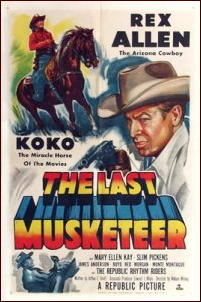
THE LAST MUSKETEER. Republic, 1952. Rex Allen, Koko (the Miracle Horse), Mary Ellen Kay, Slim Pickens, James Anderson, Michael Hall, The Republic Rhythm Riders. Director: William Witney.
Someone more knowledgeable than I about B-western movies will have to explain (in the comments, if you would, if you can) why titles of B-western movies have so little to do with the movies as they were filmed, and this one (I shouldn’t have to tell you) is about as puzzling as they come.
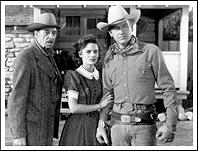
The son of Taskerville’s founder (with a statue of him in the town’s square, a touch I don’t remember seeing before in any western, B or not) is the villain of the piece. His reservoir is the only water in the valley, and his prices are so steep that the cattle of all of the other ranchers is curling up and dying.
A fact that Rex Allen, cattle buyer, soon discovers as he rides into town. He also discovers the local divining wizard, Slim Pickens, being beaten up by Tasker’s men. Coming to Slim’s assistance, Rex then finds himself on the outs with Tasker’s men throughout the rest of the movie, and Tasker himself.
Tasker is no ordinary villain, though. He has plans. A dam across the end of the valley, once the other ranchers have moved on, will generate electric power for the vicinity, then the whole state, then a big chuck of the entire West. No small planner, he.
You may have noticed the presence of the Republic Rhythm Riders in this movie, and if you were to infer from that that this is a singing cowboy movie, you’d be right. A good portion of this film is taken up with songs and music (including the most horrible braying, there is no other word for it, by Slim). Rex is a pretty good yodeler, though; in fact, he’s better than OK, though I’m not sure I would have agreed when I was 10 years old, which is the age level this movie was aimed for.
What I really wonder what I at that age would wondered about the ending of the movie, one in which the villain is defeated by a not-so-small case of breaking, entering and worse. By which I mean totally illegally. Foul means, unsportsmanlike conduct, and below the belt. All in a good cause, but still.
Sat 6 Aug 2011
REVIEWED BY BARRY GARDNER:
GAR ANTHONY HAYWOOD – You Can Die Trying. Aaron Gunner #3. St. Martin’s, hardcover, 1993. Penguin, paperback, 1994.
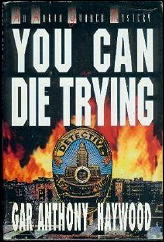
Haywood first wrote about black PI Aaron Gunner in the 1988 Fear of the Dark. For some reason, even before the President put his two cents in, Walter Mosley had gotten more attention as a black crime writer. Recently, Barbara Neely has been in the spotlight. I think Haywood writes about blacks better than either, and is a better writer overall.
Gunner, for that best of reasons, poverty, takes a case that can bring him nothing but grief: proving that a bigoted cop was innocent of killing a 14 year old black youth in an attempted robbery. The cop had been fired for his actions, and eight months later ate his gun.
A man comes to Gunner who said he witnessed the shooting, and that the kid fired at the cop first; and that he failed to come forward because he received anonymous threats on his family. No one wants to change history; not the black community, and not the police, who are re-building an image after the riots. Only Gunner. And he’s not really sure that he does. He knew the cop, too.
Gunner is to me a believable person, but that doesn’t really mean anything. Any WASP male who claims to understand blacks is a fool, and in that regard at least, I’m not.
Haywood is a thoroughly competent writer, and knows his way around the black middle-class as well street life. One of the book’s strongest points is that it clearly lays out why bigoted, brutal cops exist, and why, except in isolated instances, the black community can never like or trust people with badges.
It is not a hopeful book, except in that it portrays a few decent people on both sides of the equation. It is a thoughtful book, though, and I think a good one.
— Reprinted from Ah, Sweet Mysteries #8, July 1993.
The Aaron Gunner series —
1. Fear of the Dark (1988)
2. Not Long for This World (1990)
3. You Can Die Trying (1993)
4. It’s Not a Pretty Sight (1996)
5. When Last Seen Alive (1997)
6. All The Lucky Ones Are Dead (2000)
Sat 6 Aug 2011
IT IS PURELY MY OPINION
Reviews by L. J. Roberts
MICHAEL ROBOTHAM – Bleed for Me. Sphere, UK, hardcover, 2010. Mulholland Books, US, hc, February 2012.
Genre: Unlicensed Investigator: Psychiatrist. Leading character: Joe O’Laughlin (4th in series). Setting: England.
First Sentence: I should start by telling you my name, although it’s not really important.
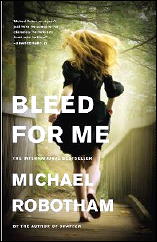
Psychiatrist Joe O’Laughlin is trying to deal with having Parkinson’s disease, being separated from his wife and only seeing his daughter part time. When his daughter’s best friend is accused of murdering her father, a former police detective, Joe can’t ignore his daughter’s plea to help.
I’ll admit I’m always excited when a new Robotham book comes out and, once again, he delivers. From the very powerful and disturbing prologue to the nail-biting ending, I was completely absorbed.
One thing I really appreciate is that, although this is the fourth book in the series, he doesn’t assume you’ve read any of the previous books. Without burdening the plot or slowing down the story, within a very short period the author does an excellent job of providing a comprehensive back story on the characters. You never feel as though you’ve missed something.
The portrayal of a couple who are amicably yet needfully separated is effective without being maudlin. I don’t know how accurate the psychiatry aspects are; it does seem Joe is, at time, a bit too insightful for belief, but it works and provides some interesting observations.
Having recently served on a criminal-case jury; albeit not a murder, I found his comments on juries fascinating as well as the demonstration that, with motivation, anyone can be pushed to violence.
It’s the balance of introspection and suspense that brings me back to Robotham every time. The plot is complex, twisty and fast-paced. I liked that all the clues were there to identify the killer, yet I didn’t, and that justice prevailed.
If you’ve not yet discovered him, Robotham is an author I definitely recommend trying.
Rating: Good Plus.
The Joseph O’Loughlin series —
1. The Suspect (2004)
2. Lost (2005) aka The Drowning Man (US)
3. Shatter (2008)
4. Bleed for Me (2010)
Thu 4 Aug 2011
PULP VAULT 14:
The Greatest Single Issue Ever of a Pulp Fanzine
by Walker Martin
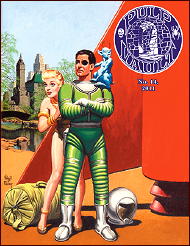
Recently while discussing PulpFest 2011 I made the claim that Pulp Vault 14 was the best ever issue of a pulp fanzine. I was immediately questioned by a reader concerning this statement. First, what qualifies me to make such a claim? I’ve been collecting pulps since the 1950’s and I’ve read most of the pulp fanzines published along the way. (By the way, I’m not talking about the SF fanzines which is a different subject.)
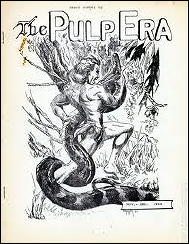
The first quality pulp fanzine that I read was Lynn Hickman’s Pulp Era in the late 1960’s and early 1970’s. During the same period I was reading Fred Cook’s Bronze Shadows which published Robert Jones survey of the weird menace pulps in several issues.
I was so impressed by this long article that I literally nagged Bob Jones into writing the book, The Shudder Pulps, and we became good friends especially through our correspondence which lasted 20 years until Bob’s early death.
Robert Weinberg published Pulp which I recall as lasting 6 issues.
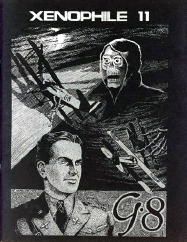
Then I became a subscriber to Xenophile which was an excellent ad zine full of for sale and want ads. The editor was Nils Hardin who also started publishing articles about the pulps. The magazine lasted over 40 issues in the 1970’s. Echoes lasted over 100 issues and was edited by Tom and Ginger Johnson.
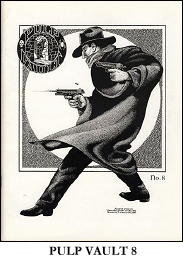
John Gunnison published The Pulp Collector and Doug Ellis started Pulp Vault. Another quality pulp fanzine was Purple Prose edited by Mike Chomko. At present we have Blood n Thunder, edited by Ed Hulse, another excellent magazine which has just reached the 30th issue.
Other magazines were published but the above titles remain in my memory as the best. If I have left out your favorite pulp fanzine please let me know in the comments.
All the above editors have one thing in common, they all were awarded the Lamont Award, or in Mike Chomko’s case, the Munsey Award. If we tried to pick the best single issue from all the above titles, we would find no consensus among all the issues.
Until Pulp Vault 14, that is. Fifteen years ago when Doug Ellis published Pulp Vault 12/13, I began pestering him about the next issue. It had taken him three years to publish issue 12/13 and I was worried that issue 14 might also take three years.
Each year at Pulpcon, I asked him the same question, “When will Pulp Vault 14 be published?” His response was always “Soon, Walker”. Well it took 15 years but the wait was worth it.
What makes this issue the best ever? First of all it is larger than any single issue that I recall: 264 pages in the large 8 by 10 inch format. It has at least 10 major articles including an unpublished Virgil Finlay cover. Actually one article makes this issue a must buy: a 44 page piece by Mike Ashley titled, “Blue Book — The Slick in Pulp Clothing.” This magazine is one of the great pulp titles and lasted over 50 years, 1905-1956. (It was later revived by another publisher as a men’s adventure magazine, 1960-1975.) Mike Ashley covers the magazine’s history in five long chapters.
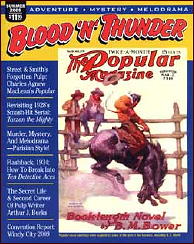
This tremendous survey belongs right up there with the great pulp surveys, such as Ed Hulse’s two-part coverage of Popular Magazine and his slightly shorter two-part article on Short Stories. Both articles appear in Blood n Thunder as well as excellent issues devoted to Adventure and Dime Detective.
Sam Moskowitz’s history of the Munsey publications is another fascinating survey but though it mainly covers All Story and Argosy, it really is about several magazines and not a survey of one title like Mike Ashley’s.
I also don’t want to forget the extensive coverage of Western Story Magazine in Jon Tuska’s The Max Brand Companion and in Eggenhofer: The Pulp Years. Another great pulp magazine, Adventure, is covered in a long article by Richard Bleiler in The Adventure Index. Astounding also had a book covering its history.
So Mike Ashley’s long piece on Blue Book belongs with the great pulp surveys. But that is just a part of Pulp Vault 14. We also have a long essay on Thrill Book by Will Murray; a discussion of the Clues Detective character Cyrus North (with a unpublished long novelet!); an article by Hugh Cave with a reprint of one of his very best long stories.
And there’s more: an article on Singapore Sammy by Rick Lai; a memoir by Robert Barbour Johnson on the Weird Tales days; an article by J. Edward Leithead on writing for the pulps, especially the early western titles; Otto Binder on his trip to NYC and many photos of the NYC World SF Convention in 1939; artist and publisher Tom Roberts on painting Doc Savage; and David Saunders on his father Norman Saunders.
That’s like ten major, long articles! And there is more such as Bob Weinberg on Strange Stories; Link Hullar on artist Frank Hamilton; and a long adventure novelette from Popular Magazine. So this is why I call Pulp Vault 14 the greatest single issue ever published of any pulp fanzine. Copies may be obtained from Black Dog Books or Amazon.com.
On page 2 of the issue editor Doug Ellis says, “Walker, please don’t ask us about issue number 15!” Needless to say the first thing out of my mouth when I saw Doug at PulpFest in July 2011 was, “Hey Doug, when will the next issue of Pulp Vault be out?”
Thu 4 Aug 2011
REVIEWED BY WALTER ALBERT:
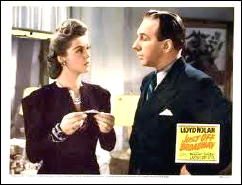
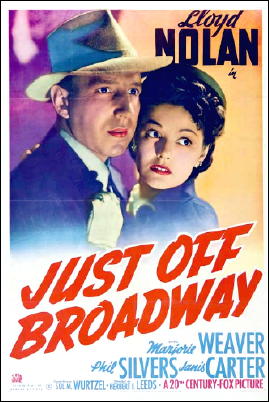
JUST OFF BROADWAY. 20th Century Fox, 1942. Lloyd Nolan, Marjorie Weaver, Phil Silvers, Janis Carter, Richard Derr. Screenplay by Arnaud d’Usseau, based on the character created by Brett Halliday and an idea by Jo Eisinger; photography by Lucien Andriot. Director: Herbert J. Leeds. Shown at Cinevent 40, Columbus OH, May 2008.
This sixth, and penultimate Shayne film starring Nolan as the brash private eye, finds the series showing signs of running out of steam. Nolan is as engaging as ever, but the script, which has Shayne serving as a juror and attempting to prove that the wrong person is being tried while he’s sequestered with the jury, requires some stretch of the imagination to find credible.
I will give the scriptwriter a point for originality (Shayne wraps up the case from the jury box with nary a peep from the judge or lawyers), but nothing for believability. Jim Goodrich, who watched this film with me, added that Phil Silvers, “as always,” brightens up the proceedings.
Wed 3 Aug 2011
PRIME TIME SUSPECTS
by TISE VAHIMAGI
Part 5.1: Theatre of Crime (Hours of Suspense Revisited)
Following the riches of the 1950s, the anthology series moved into its final period as a stimulating television form. The enormous mass of episodic series featuring regular characters placed the format of the anthology firmly on the back burner.
Both Dow Hour of Great Mysteries (NBC, 1960) and Boris Karloff’s Thriller (NBC, 1960-62) were essentially, and quite effectively, horror-fantasy series, many with strong elements of mystery.
Dow Hour used celebrated classics such as Mary Roberts Rinehart’s “The Bat”, John Willard’s “The Cat and the Canary” and Sheridan Le Fanu’s “The Inn of the Flying Dragon”.
Half of the premier season of Thriller was composed of crime/suspense stories under producer Fletcher Markle, which included tales by Charlotte Armstrong, John D. MacDonald, Cornell Woolrich, Don Tracy and Fredric Brown. Discovering that horror-fantasy worked even better with viewers when they transmitted “The Purple Room” (1960), producers Maxwell Shane and William Frye took over from Markle and concentrated on the macabre. They unleashed scary treats such as Robert Bloch’s “The Cheaters” and “The Hungry Glass”, Robert E. Howard’s “Pigeons from Hell”, and Harold Lawlor’s “The Grim Reaper”. Much to the viewers’ delight.
The opening season of Kraft Mystery Theatre (NBC, 1961-63; not to be confused with the 1958 series) was made up entirely of British cinema second features (B movies) and it was not until the second season (1962-1963) that the series proper began.
The first two episodes of the latter (crime thrillers “In Close Pursuit” and “Death of a Dream”) were directed by Robert Altman. It wasn’t until I happened upon the Mike Doran/Steve exchange in Mystery*File (July 2009) that one episode that had previously puzzled me, called “Shadow of a Man” (1963) starring Broderick Crawford as insurance investigator Barton Keyes and his assistant Jack Kelly as Walter Neff (teleplay credited to Frank Fenton from a story by James Patrick with no mention of James M. Cain or Double Indemnity), was finally laid to rest. Thanks to their information, “Shadow of a Man” proved to be a pilot for a proposed Double Indemnity TV series.
Something of an immediate sister show to the above, Kraft Suspense Theatre (NBC, 1963-65) boasted three interesting contributions: John D. MacDonald’s “The Deep End” (1964) and William P. McGivern’s “A Truce to Terror” (1964) and “Once Upon a Savage Night” (1964) [the latter published as Death on the Turnpike].
Shamley Productions returned with The Alfred Hitchcock Hour (CBS, 1962-65), but now with its crisp little half-hour story format enlarged to an hour. Among the stretched-out storytelling could be found such gems as Woolrich’s “The Black Curtain” (1962), Richard Matheson’s “Ride the Nightmare” (1962), Henry Kane’s “An Out for Oscar” (1963), the latter with teleplay provided by David Goodis, the superbly spooky “Where the Woodbine Twineth” (1965), from a Davis Grubb story, and the genuinely unsettling “An Unlocked Window” (1965), from a story by Ethel Lina White.
Although a mix of drama, comedy, musicals and would-be pilots, Bob Hope Presents The Chrysler Theatre (NBC, 1963-67) did present an altogether intriguing pilot, or rather a series of pilots, featuring Jack Kelly as private eye/secret agent Fredrick Piper. The first attempt was made with “White Snow, Red Ice” (1964), written by Richard Fielder. It was followed by “Double Jeopardy” (1965), co-starring Lauren Bacall, “One Embezzlement and Two Margaritas” (1966), written by Luther Davis, and, finally, “Time of Flight” (1966), written by Richard Matheson (here Kelly’s name changed to “Al Packer”).
Oh, there was also “Guilty or Not Guilty” (1966), a legal drama pilot starring Robert Ryan and co-scripted by Evan Hunter & “Guthrie Lamb” (the latter name belonging to a private eye character created by Evan Hunter [writing as Hunt Collins] for Famous Detective Stories magazine in the early 1950s). Unfortunately, all of the above remained unsold.
During the 1970s, between the TV pleasures of Harry O (ABC, 1974-76) and The Rockford Files (NBC, 1974-80), Joseph Wambaugh’s Police Story (NBC, 1973-78) was the only other series worth keeping an eye on (the author created the anthology for Columbia Pictures Television).
Arguably, one of the finest genre anthologies to grace the small-screen, even though it was nearly 40 years ago, the earthy stories culled from LAPD interviews were developed into some remarkable episodes, among them “Requiem for an Informer”, where a careful rapport develops between a detective and his street-wise informer, “The Wyatt Earp Syndrome”, focusing on Harry Guardino’s obsessive officer, and the two-hour “Confessions of a Lady Cop”, with Karen Black as a vice detective on the edge of a nervous breakdown. The series Police Woman (NBC, 1974-78) evolved from “The Gamble” (1974) and Joe Forrester (NBC, 1975-76) from “The Return of Joe Forrester” (1975).
Fallen Angels (Showtime, 1993; 1995) seemed to be created as something of a small-screen tribute to hard-boiled literature. The carefully constructed series unfolded its noir-ish stories at a leisurely pace, underlining a symbiotic relationship between actor and story.
In this writer’s opinion, all episodes were nothing short of superb. Many remain etched firmly on the memory. For instance, Jonathan Craig’s “The Quiet Room”, in which two corrupt cops receive their just punishment, Jim Thompson’s “The Frightening Frammis”, celebrating flashbacks and femme fatales, and Chandler’s “Red Wind”, featuring an interminably morose Danny Glover as Marlowe.
The above selected anthologies (including the earlier Part 5.0) had, admittedly, minimum influence on the TV Crime and Mystery genre in general, but their exposure of the work of important crime authors (the Chandlers, the Hammetts, the Christies) acknowledges the form as something of a television pinnacle.
The sheer range and diversity of these one-off presentations during the latter half of the last century remain as something to marvel. Perhaps this overview may serve to mark its passing.
The concluding Part of this history of genre anthologies will observe the UK television history.
Note: The introduction to this series of columns by Tise Vahimagi on TV mysteries and crime shows may be found here, followed by:
Part 1: Basic Characteristics (A Swift Overview)
Part 2.0: Evolution of the TV Genre (UK)
Part 2.1: Evolution of the TV Genre (US)
Part 3.0: Cold War Adventurers (The First Spy Cycle)
Part 3.1: Adventurers (Sleuths Without Portfolio).
Part 4.0: Themes and Strands (1950s Police Dramas).
Part 4.1: Themes and Strands (Durbridge Cliffhangers)
Part 5.0: Theatre of Crime (US).
Tue 2 Aug 2011
CONVENTION REPORT: PulpFest 2011
by Walker Martin
Over the past 40 years I guess I’ve attended 40 pulp conventions and I’ve always traveled by car either alone or with another collector. This is the first year that five of us rented a van and it was quite an experience. Between the five collectors there must of been at least 200 years of collecting books, pulps, digests, and vintage paperbacks. Three of us even collect original pulp cover paintings, not to mention slicks and other old magazines such as literary magazines, men’s adventure magazines, etc.
We kept each other amused by recalling strange book adventures and bizarre topics like The Craziest Pulp Collector I Have Known. Needless to say, some of the people in the van qualify for this title! I might as well mention the names of these demented souls who spend their lives dreaming of pulps and books. In addition to myself, the collectors cooped up in this van were Nick Certo, Steve Kennedy, Digges La Touche, and last and not least, Ed Hulse, who was our driver.
Somehow, this overloaded van arrived safely a little over eight hours later. Even more surprising was the fact that we had not killed each other and were still on speaking terms. After checking into the Ramada Plaza, we all headed for the dealer’s room to set up our tables.
It was the same large room as last year and held over 100 tables. Because the large unloading doors were open to the 95 degree heat, there appeared to be very little air conditioning in effect.
We were not amused to find out at dinner that the restaurant was also very warm. Not only that but they were out of certain items on the menu, including hamburger at one meal. When I ordered beer, practically every brand I tried to get was not available. Frankly, the restaurant did not seem set up to handle a convention weekend.
Next day when the dealer’s room opened officially, it was obvious that this was another rousing success due to the hard work of the PulpFest committee: Mike Chomko, Jack Cullers, Ed Hulse, and Barry Traylor. Jack Cullers also seemed to have an army of support from his family and friends.
I really must say these people deserve the thanks of pulp collectors for putting on such an excellent show. The attendance was the highest yet of any Pulpcon or PulpFest, over 425 attendees, which is a nice 10% increase over last year’s figure.
At my table, I sold far more than I thought I would, selling DVDs, cancelled checks from the files of Popular Publications and Munsey, and all 39 duplicate Manhunt’s.
The biggest sale I noticed involved a 1929 Black Mask with white paper, in fine condition. The seller asked me what I thought it was worth and I said over $500, perhaps closer to a $1000. The first collector I told ran over and paid $900 for the issue. The unusual thing is that the reason the magazine sold was not because of the fine condition or because it was a 1929 Black Mask with a Hammett story. It sold because the collector was a rabid collector of Erle Stanley Gardner.
Another big sale I witnessed was the Ace Double original cover painting for Mrs. Homicide by Norman Saunders. After much haggling, this went for over $8,000.
Several pulp reprints made their debut including Ed Hulse’s new issue of Blood n Thunder; Savages by Gordon Young; and The Best of Blood n Thunder. I bought all three publications and Ed said he sold just about all the copies that he brought to the convention.
Laurie Powers also had good sales on her new book, a collection of Paul Power’s stories, titled Riding the Pulp Trail. Tom Roberts of Black Dog Books also had several new books for sale, including Pulp Vault 14, the best single issue of a pulp fanzine ever published.
Matt Moring of Altus Press has an ambitious reprint schedule, including collections of Fred Nebel’s Tough Dick Donahue, Kennedy and McBride, and Cardigan. These are major publications and well worth buying because the original Black Mask and Dime Detective pulps are so expensive.
The 20th issue of The Pulpster also made its debut and looked like one of the best issues yet. The editor is Tony Davis and he included 10 articles, including an unpublished story by H. Russell Wakefield. There were articles on William Cox and H. Bedford Jones and Don Hutchison’s memories John Fleming Gould. He appeared at Pulpcon 19 in Wayne, NJ and I remember his visit vividly. I was high bidder on one of his sketches showing G-8’s Herr Doktor Krueger. John Locke is also present with an interesting piece on “Hunting Pulpsters In Graveyards”
I heard later that John Locke and John Wooley visited the gravesite of D.L. Champion, who wrote such crazy series starring Inspector Allhoff for Dime Detective, and Rex Sackler for Black Mask. The grave is evidently near the convention hotel and I would have liked to visit it but then again I get very emotional about pulp writers and probably would have made a fool of myself, not to mention getting arrested for trying to sell the remains at PulpFest.
One of the big surprises of the convention was the visit of former Pulpcon chairman and organizer, Rusty Hevelin. In the early years, Rusty single handedly kept Pulpcon going and deserves our thanks for his efforts, without which there might not be a convention all these years later.
He received a round of applause as he entered the dealer’s room and because he is in his late 80’s, I figured he would just visit for a short time and then leave. However, he evidently enjoyed himself and stayed all three days. He even attended the evening programming with his friend, Gay Haldeman. Welcome back Rusty.
Another collector I was glad to see, was Gordon Huber, the only person to actually attend every Pulpcon and Pulpfest since the first one in 1972. Unfortunately there were several collectors who could not attend this year, including such long time attendees as Al Tonik, Steve Lewis, and Dave Kurzman.
The evening programming was some of the best I’ve ever seen. Some of the highlights were the three “Shadow” shorts from 1931-1932; the speech given by David Saunders on three pulp artists; the grandaughters of the pulps panel featuring Laurie Powers, Karen Cunningham, and Nicky Wheeler-Nicholson; Stephen Haffner’s talk on C. L. Moore; Garyn Roberts discussion of steampunk in the pulps and dime novels: and the panel on Walter Gibson and The Shadow.
The auction was disappointing to me but I imagine some collectors found some good items. Tony Tollin won the Munsey Award for his extensive project which reprints the pulp novels featuring The Shadow and Doc Savage.
The daytime programming consisted of readings and panels featuring contemporary authors discussing the new pulp fiction. The Pulpster also had an article about this recent movement and I have to admit I like the old pulp fiction from the original magazines. But evidently there are some fans of this new pulp fiction.
Finally, I would like to thank the people responsible for stocking the Hospitality Room with beer, soda, and snacks. I also noticed a couple pizzas floating around and whoever ordered them let me have a piece. Each year, I notice Rusty Burke in the room and he is one of the collectors responsible for the beer and locking up the room. Thank you Rusty.
I hope to see even more collectors in attendance next year because it is so important to support this convention.
After all, book and pulp collectors are my favorite people…
Mon 1 Aug 2011
REVIEWED BY MICHAEL SHONK:
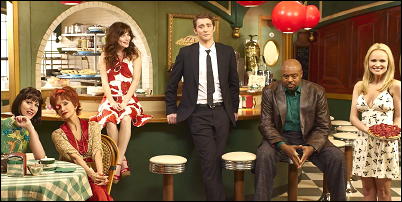
PUSHING DAISIES. ABC-TV/Warner Brothers. October 3, 2007 through June 13, 2009. 22 episodes @60 minutes. Created and Showrunner : Bryan Fuller. Cast: Lee Pace (Ned), Anna Friel (Chuck), Chi McBride (Emerson Cod), Jim Dale (Narrator), Kristin Chenoweth (Olive Snook), Ellen Greene (Vivian), Swoosie Kurtz (Lily)
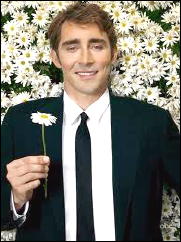
One of the most redeeming qualities of television is no matter how mundane mainstream television gets, there are always the unusual and delightful series on the air we will remember forever. Sadly, most of these series last only long enough to find a small enthusiastic following.
One such series was Pushing Daisies, a screwball comedy mystery fantasy featuring a pie maker who can raise the dead with a touch and uses that talent to help a PI solve murder mysteries.
Ned’s secret magical finger was not without rules. The first touch woke the dead, but a second touch killed them forever. And if Ned did not touch them a second time within one minute the formerly dead would stay alive and someone near by would die.
Enter cynical PI Emerson Cod, who saw a way to profit off Ned’s special talent. Ned would revive murder victims, ask them who killed them, solve the murder, and they would collect the reward. But it was never that easy and sixty seconds were never long enough. In the episode “Bitches,” the victim told them he was killed by his wife, but then they learned he had four wives.
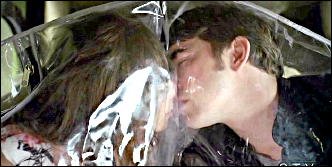
The mystery shared the story with the personal comedy drama of the strong well-developed characters, all with their own secrets and story lines. Because the series is told in fairy tale serial form, it is wise to watch the episodes in order.
When Ned and Emerson decided to solve the murder of Ned’s childhood crush, Chuck, Ned decided to let her live at the cost of an evil funeral director’s life. Chuck and Ned fall in love but can never touch, the tragedy of two lovers who can never touch lightened by the funny ways Ned and Chuck find to express their love.
Jim Dale’s narration and Jim Dooley’s music were perfect in setting the mood in this fantasy world of bright colors and odd locales. The camera with its angles and symmetrically frames shots also added to the series special look.

Each story began with an absurd death such as an exploding scratch ‘n’ sniff book. After talking to the victim and getting little to go on, they would meet the suspects, find clues and twists until the killer was revealed. Meanwhile, a story arc featuring the relationships and secrets of the characters formed the subplot of each episode.
Mystery fans found much to enjoy in the series, especially episodes such as “The Norwegians,” featuring the brilliant Norwegian forensic team and their crime solving bus, “Mother.”
The oddness of characters, stories, look, sound, and fast paced lyrical dialog drew us happily into Pushing Daisies’ whimsical world of mystery, romance, and pie.
The television series ended with closure for the characters, but there were still some loose ends involving Chuck and Ned’s fathers. After the series was canceled, Bryan Fuller promised Pushing Daisies would continue as a comic book much as Buffy the Vampire Slayer and others had.
The comic book written by Bryan Fuller and drawn by Jonathan Wayshak continues in search of a publisher. In April 2011, Fuller posted at various websites the first two pages of the comic book. Here is a link to one site where you can read the two page sample of what is called “Season Three.”
The complete TV series is available on DVD or for download. You can watch the first season of nine episodes for free here.
« Previous Page