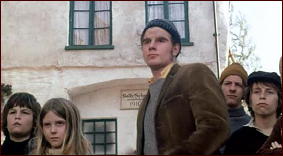
DOOMWATCH. Tigon Films, UK, 1972. Released in the US as Island of the Ghouls, AVCO Embassy Pictures, 1976. Ian Bannen, Judy Geeson, John Paul, Simon Oates, Jean Trend, George Sanders. Screenwriters: Kit Pedler & Gerry Davis. Director: Peter Sasdy.
Based on the popular BBC television series of the same name, Doomwatch follows the work of the eponymous fictional British government scientific agency tasked with investigating environmental threats. In this feature length theatrical release from Tigon British Film Productions, actors John Paul and Simon Oates reprise their roles as Dr. Spencer Quist and Dr. John Ridge, respectively.
But the star of the proceedings is Scottish actor Ian Bannen who portrays Dr. Del Shaw, an intense man who doesn’t easily take no for an answer when it comes to his investigations. The plot follows Dr. Shaw as he probes into strange goings on occurring on Balfe, an isolated island off Cornwall. Initially sent there by Doomwatch to investigate pollution, he soon discovers that the islanders are not only an odd, insular sort, but also that they are hiding something dark and disturbing. His suspicions are readily confirmed when he encounters a dog that is unusually violent and a child’s body buried in a local forest.
But what is really happening on Balfe? The locals seem to believe that somehow they are the victims of a cosmic hex or divine judgment.
Good scientist that he is, Shaw thinks this is just superstitious and religious hokum. So he enlists schoolteacher Victoria Brown (Judy Geeson), an outsider to the island community who has been working as an educator there, to find out why the townsfolk are so darn secretive.
As it turns out, the mystery itself is more captivating than the ultimate revelation. [SPOILER ALERT.] Many of the islanders are suffering from a disease caused by exposure to a toxic stew of chemicals and radioactive waste dumped in the local fishing grounds by an unscrupulous waste disposal company and the British Navy. This is nothing remotely supernatural happening on Balfe. Just all too human behavior: fear in the face of human villainy and greed.
The lead singer of this psychedelic rock group from the Rochester NY area is Anya Cohen. They recorded only this one self-titled LP for Verve in 1968. I do not believe it has ever been re-issued on CD.
WADE CURTIS – Red Heroin. Berkley X1723, paperback original; 1st printing, August 1969. Reprinted as by Jerry Pournelle: Ace Charter, paperback, October 1985.
Even when this book first came out, it was no secret that the author was SF writer and early computer technology expert Jerry Pournelle. The copyright was in his name, on the reverse of the title page. But his fame came later. This was his very first book, written when he was only 36. It was the first of two adventures of an amateur counterspy named Paul Crane; the second was Red Dragon (Berkley, 1971).
Crane, a consulting engineer by profession, is contacted by the CIA and asked to infiltrate the various counter-cultural groups hanging out around the fringes of a local Seattle university. Object: to find out who’s responsible for the importation of heroin into the US, an effort sponsored by the Chinese government to help recruit (and pay for) a network of undercover agents in this country.
This is all off the books, of course. The CIA has no legal authorization to work anywhere inside this country’s boundaries. And more, truth be told, this is a very minor work. The first half of the book is somewhat interesting, as Crane, once married, but on the job, finds a new girl friend, an event he didn’t expect to happen. Still, the question he has is this: Is she as innocent of nefarious activity as she seems, or is she one of the higher-ups of the plot he’s trying to uncover?
Unfortunately, the tale Curtis/Pournelle tells tails off badly from there. The second half was of no interest to me, I’m sorry to say. The story is as straight as a string, and unless you’re interested in learning a lot about sailing a small yacht in Puget Sound and along the coast of the Pacific Northwest, you may not find anything out of the ordinary in the final 80 pages or so either.
What bothered me the most, though, was that a couple of Crane’s close friends die in this book, and there is no evidence that he cares. He says he’s angry, but it never goes beyond that. A few pages on, all is forgotten, even as a motivating factor, and it shouldn’t have been.
What the book may be most famous for, though, is this quote from Robert Heinlein on the front cover: “The most convincing and realistic counterespionage story I’ve read in a long, long time — and besides that, a hell of a good yarn.” I wish I could say the same, but I can’t.