by Walker Martin
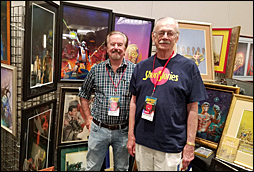
Once again, five over the top book, art, and pulp collectors, squeezed themselves into a big van in order to attend PulpFest 2017 in Pittsburgh, Pennsylvania. Luckily we rented the biggest van that they had because we needed all the space when we drove back to New Jersey. It was a 15 passenger van which we converted into larger cargo space by taking out some seats.
In my opinion, after attending almost all the pulp conventions since 1972, this is the best hotel that we have ever had for our shows. Sure the hotel rooms cost $125 each night but they were worth it. Not only were we close to all the action taking place in the dealers room and program room, but we had a free buffet breakfast, the best I’ve ever seen at a pulp convention. It had to be worth $15 to $20. I devoured so much food at breakfast that I skipped lunch each day.
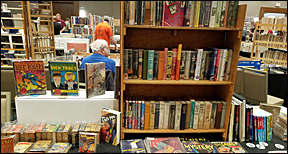
Yes, there were cheaper hotels down the road, but staying at the host hotel helps the convention because if they reach a certain number of rooms then big discounts kick in. These discounts are necessary in order for us to have future PulpFests. I have always stayed at the host hotels because they are so convenient and help the conventions meet expenses.
The past several years in Columbus, Ohio, we lacked a hospitality room because the hotel wanted us to buy their alcohol and use their bartenders. However at the Double Tree hotel we had our own room, and thanks to abebooks.com, the PulpFest committee was able to buy pizzas and craft beer. I would have to say that this was the best beer I’ve ever had at a pulp show. And instead of the usual snack items, the pizza was a real treat.
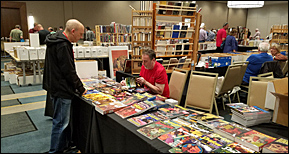
Right outside the hospitality room was a nice restaurant that also served pizza and beer. They had live entertainment also. All the hotel employees were friendly and helpful. This is a big plus because I’ve stayed at hotels where the employees have attitude problems and don’t want to be bothered.
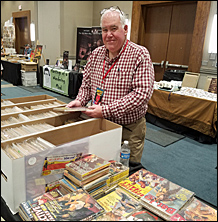
Attendance was 350 and the dealer’s room seemed fairly busy each day. There were over 100 tables, most crammed with pulps, vintage paperbacks, digest magazines, DVDs, and original artwork. I always have a table at PulpFest and I sold pulps, DVDs, books, and cancelled checks from the Popular Publication and Munsey files.
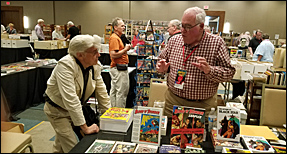
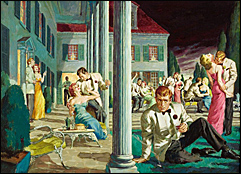
I bought quite a bit including artwork like an interior illustration by John Fleming Gould and a large wraparound cover painting for an early Lion Book. The painting covers the front and back of the book and was used on the Lion book titled The Naked Year (The Inheritors) by Philip Atlee.
The blurb says “They groped for excitement in an age of boredom” and the image shows a big party with some two-fisted drinking and a bit of kissing with some good looking women. I’ve always had a weakness for these risque, sort of sleazy paperback novels.
One funny thing however, I had just told several of my friends that I would not be buying any original art because I have run out of wall space and I have many pieces of art just leaning against bookcases or the wall. What a liar I am. Once a collector, always a collector! I then promptly go over and buy a large cover painting. One big blunder that I never would have made in my younger days, I failed to recognize an Edd Cartier drawing, illustrating a scene from The Wheels of If by L. Sprague de Camp, and from Unknown, one of my favorite magazines. One of my younger friends snapped it up (by younger, I mean 30 years younger). I spent the rest of the convention cursing my stupidity and bemoaning the onset of senility.
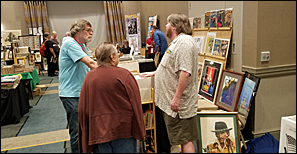
A large batch of London Mystery Magazine was delivered to me and now I only need 16 issues out of 132. When I went to the bookstores in London and Hay On Wye, I couldn’t find a single issue. I also found three boxes of bound men’s adventure magazines. Completely unreadable of course, unless you love to read about Nazis partying with girls in their underwear, but the artwork is exceptional. I bought all of them of course, mainly bound volumes of Saga and Man’s World from the fifties and sixties. My descent into the depths of depravity continues but so what? The WW II vets loved these magazines and what’s good enough for those guys is good enough for me!

Pulp T-shirts have become very popular especially since Altus Press started cranking out all sorts of pulp titles. For those readers who are into fashion I wore my lucky Fred Davis T-shirt, the one given to me by Davis’ granddaughter many years ago, and shirts showing the logos of Black Mask, Short Stories, and Adventure. All well dressed pulp collectors wear such T-shirts.
Artist Gloria Stoll returned as Guest of Honor and she was fabulous. Though in her nineties, she was witty and very interesting concerning her seven years as a pulp artist in the forties. She then went on to have a career painting in a more abstract style. David Saunders did a nice job interviewing her and showing a slide show of her covers and career.

The Munsey Award was won by Phil Stephensen-Payne, who is one of the main men behind The FictionMags Index and Galactic Central. These sites are excellent online sources for information about the writers and the cover art. I visit them just about every day. Phil lives in the UK and couldn’t attend the convention, but I had the pleasure of reading his acceptance speech for him. A remarkable pulp scholar indeed! Sometimes we complain about the validity of some awards but this is an example of an award that they got right. Congratulations, Phil!
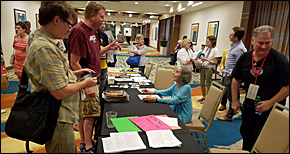
PulpFest is known for its great programming, and there was so much going on that I could fill pages talking about each night. I’ll just mention a few that I found to be excellent or of great interest. Author Chet Williamson read from Psycho Sanitarium; Garyn Roberts talked about 100 years of Robert Bloch; Jeffrey Marks covered the characters of Erle Stanley Gardner; Matt Moring discussed Dime Detective; Philip Jose Farmer was covered; and finally Tom Krabacher and I discussed “Hard-Boiled at 100: The Don Everhard Stories of Gordon Young.” My conclusion was that these stories were more about a gentleman adventurer who acted as a sort of Robin Hood, doing good and fighting criminals. I like Young’s Hurricane Williams south sea stories a lot more and the Don Everhard series is inferior to such novels as Days of ’49 and Huroc the Avenger.
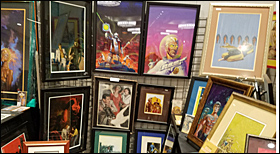
The auction was of interest and had many items worth bidding on. I managed to get some rare Western Story magazines. I have over 1250 issues, 1919-1949 and only need a few. I obtained two exceptionally rare 1919 issues in dime novel format and an issue from 1925. Other items of interest were a complete run of Amra, volume two, #1-71. I wanted this but lost out since I didn’t want to pay a very high price.
Fred Cook’s rare copy of the Argosy Index went for $400. I’ve never seen a copy for sale. Some Shadow and Doc Savage premiums went for high prices. Tom Krabacher, who has written the definitive article on Gordon Young, wanted a large travel trunk once owned by Gordon Young but it went to someone else for $425. All in all there were almost 300 lots.
Each year the convention publishes The Pulpster, which is a magazine full of interesting articles about the pulps. This issue was number 26 and edited by William Lampkin. There were articles on women in the pulps by Ron Goulart and Bill Pronzini; several pieces on Robert Bloch; an article about Mary Elizabeth Counselman by Tony Davis; Curt Phillips on preserving pulps; several other articles including one by me on collecting Detective Fiction Weekly. This is an excellent magazine and we should thank Bill Lampkin for editing and Mike Chomko for publishing it.
One book I noticed made its debut at the show. Pride of the Pulps is a collection of magazine studies by Ed Hulse. The articles originally appeared in his Blood ‘n’ Thunder magazine, but they have been extensively revised and expanded. The magazines covered are Adventure, All-American Fiction, Famous Fantastic Mysteries, The Popular Magazine, Short Stories, and the 1920’s issues of West.
A great convention for collectors of old fiction magazines is now part of history but I’m looking forward to the next year at this fine hotel. Thanks to Paul Herman for the use of his photos in this report. I’d also like to thank the Pulpfest committee for another job well done. Thank you: Jack and Sally Cullers, Mike Chomko, Barry Traylor, William Lampkin, and Chuck Welch. Your hard work is very much appreciated!