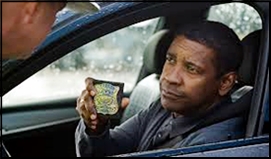
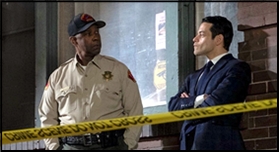
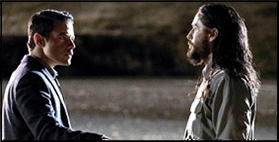
THE LITTLE THINGS. Warner Brothers / HBO Max, 2021. Denzel Washington as Joe “Deke” Deacon, a Kern County Deputy Sheriff, Rami Malek as Jim Baxter, LASD Detective, Jared Leto as Albert Sparma (their top suspect). Written and directed by John Lee Hancock.
It more or less begins like any other serial killer movie. There’s a girl being chased and a tired lawman whose best days may very well be behind him. In this case, however, the lawman is portrayed by Denzel Washington. You know you’re going to – at the very least – get to witness a solid acting performance.
And for the first hour or so, that’s about all The Little Thingshas to offer. There’s very little new under the dark sun. Washington portrays Kern County Deputy Sheriff by the name of Joe “Deke†Deacon. Formerly an LASD homicide investigator, he has downsized to a slower, more rural part of California. All that changes when he’s asked to retrieve some evidence from his former employer. While there, he encounters Jim Baxter (Rami Malek), a younger and cockier version of his former self.
The two don’t exactly get along, but they see something in each other. Before you know it, Deke and Baxter are unofficially working together to solve a series of murders. Deke happens to believe that this recent rash of killings of young women is somehow connected to the murders of prostitutes he failed to solve five years ago.
Deke is seemingly mentally tortured by the ghost of a victim he failed to save and appears to be just a little too eager to connect the past with the present. It’s the standard stuff of serial killer movies. An obsessed detective, one who even goes so far as to pin photographs of victims on his bedroom wall.
Expectations are subverted when Deke focuses on a prime suspect, a greasy, sleazy repairman who lives alone in a shoddy Hollywood apartment. The problem is that there is really nothing tying Albert Sparma (Jared Leto) to the crime other than the guy is weird – really weird – and seems to know a lot about the case. Maybe he’s the killer or maybe he’s just a disgustingly odd man with a true crime fascination.
Without giving anything away, let’s just say that the second half of the movie, in which Deke and Baxter play a cat-and-mouse game with Sparma is far superior to the first hour. And, at some point, things change. And everything you thought you knew about Deke gets upended. No. He’s not the serial killer – this film doesn’t go for that level of cheapness – but he does have secrets he aims to guard at all costs.
Although the movie isn’t nearly as clever as it purports to be, it’s nevertheless a decent thriller largely kept afloat by its stellar cast and stark, haunting cinematography. Set in the 1990s, the movie also benefits from good set design and an unmistakable sense of place. I happen to enjoy watching detective movies in which not everyone has a cell phone. Somehow adds to the allure and the mystery and danger of it all. Unless there is a call box or a pay phone, how are you going to call for help?
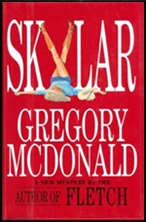
I’m one of the relatively few people who never was particularly fond of the “Fletch†books, though I thought a later one, Son of Fletch, was pretty good. Mcdonald’s writing always struck me as okay, even better than that sometimes; I just didn’t care much for “Fletch.†Mcdonald thought he was a whole lot cuter than I did.
Skylar Whitfield is a young man who seems determined to underachieve. His placid existence is disrupted one summer when a northern cousin who is the paragon of every virtue Skylar seems to lack comes to visit, and then a young lady widely regarded as Skylar’s is brutally murdered. Not everybody believes Skylar did it, but the law does, and he has to prove he didn’t by finding out who did.
If that doesn’t sound like much of a plot to hang a novel on, well, it isn’t. I swear, sometimes it seems to me that there’s not a writer new or old (and by implication not an editor, either) who gives the slightest damn about plot credibility, Come up with a cute character, write some readable prose, and to hell with whether it all makes sense or not – and that exactly describes Skylar. The character is reasonably interesting if a bit superficially done, Mcdonald does his usual decent brand of prose, and the plot is absolutely, totally, unequivocally stupid.
Unbelievable. In-fucking-credible. I’ve always been a character – rather than a plot-driven reader, but Jesus, there are limits. Well, there are with me, anyway; evidently there aren’t with a lot of people. Pass this gobbler up.
— Reprinted from Ah Sweet Mysteries #21, August-September 1995
Bibliographic Update: There was but one additional entry in the series, that being Skylar in Yankeeland (1997)
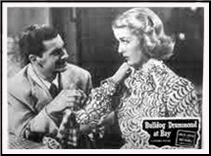
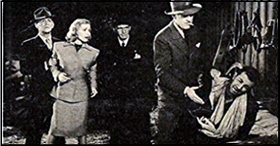
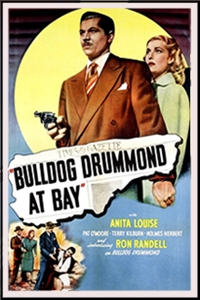
BULLDOG DRUMMOND AT BAY. Columbia Pictures, 1947. Ron Randell, Anita Louise, Patrick O’Moore, Terry Kilburn, Lester Matthews, Holmes Herbert, Leonard Mudie. Screenplay by Frank Gruber from the novel by H. C. “Sapper†McNeile. Directed by Sidney Salkow.
Whatever might be said of the novels and five short stories about Captain Hugh “Bulldog†Drummond written by retired Major Herman Cyril McNeile, who began his career writing critically acclaimed short fiction about the First World War, it is hard to deny Drummond had a fairly good and remarkably long film career from his first appearance in 1919, finally bowing out after a last appearance during the sixties spy craze.
Along the way there was a long running radio series, with a memorable opening, “Out of the fog, out of the night …â€, a hit play, two movie parodies, and outings in the American pulps, the Strand Magazine, song, and even comics. Drummond even made it into a Warner Brothers cartoon, albeit as an actual bulldog.
We won’t even go into the influence on writers like Leslie Charteris and the Saint, John Creasey and Department Z, Patrick Dawlish, and Bruce Murdoch, Berkeley Gray and Norman Conquest, Mickey Spillane and Mike Hammer, Ian Fleming and James Bond, and Clive Cussler and Dirk Pitt save to note the film Drummond was certainly as much of an influence as the literary version on later writers. An entire school of Drummond imitators exist in British thriller fiction.
Over the years on-screen Drummond was played by a variety of actors including twice by Ronald Colman who received an Oscar nomination for his first outing in 1929’s Bulldog Drummond (ironically losing to Warner Baxter playing the Cisco Kid in In Old Arizona), Rod La Roque (in a silent American film based on the book but basically ignoring it), Ralph Richardson, Ray Milland, Tom Conway, Walter Pidgeon, and Richard Johnson.
In 1947 Australian actor Ron Randell (who was also the Lone Wolf on screen for a while) picked up the reins dropped by the John Howard Paramount Drummond series of the thirties in a remake of 1937’s Bulldog Drummond at Bay with John Lodge.
Unlike the Lodge film, which had splendid villainy by American Victor Jory, this version, scripted by Frank Gruber (who among other things wrote the splendid screenplay for A Mask for Dimitrios), actually resembles the book it is based on, finding Drummond down in the Fen country, planning to assassinate some ducks after retiring from the army, when a stone thrown through his window in the middle of the night plunges him into adventure.
No sooner does Drummond step outside to look about than two men in a car pull up and one (Lester Matthews) pulls a gun on him. Drummond plays dumb and they depart after a quick search, but driving away they spot what they were looking for, the man who threw the rock through Drummond’s window.
The next morning Doris Meredith (Anita Louise) shows up with convenient car trouble and tries to drug Drummond so she can search for the message tied to the rock when he serves her tea. Curiouser and curiouser as Alice observed. Doris claims she needs Drummond’s help and that her brother is in trouble.
At this point Drummond calls his old friend Inspector McIver (Holmes Herbert) and enlists a local would be reporter (Terry Kilburn) and his old pal Algy Longworth (Pat O’Moore billed as Patrick here).
When Drummond’s hunting dog is killed and his housekeeper drugged while he is recruiting Algy things start picking up, then Drummond captures one of the men watching his house, who is murdered before he can talk shortly after an angry McIver arrives explaining one of his under cover men, Richard Hamilton, is missing.
Does Hamilton have a sister? Maybe, maybe not.
From there on the whole thing moves at a clip to a satisfying conclusion.
Unfortunately they leave out the chief villain of the book, none other than Carl Peterson’s murderous inamorata Irma Peterson.
As far as I know this is only available as part of a pricey set of Drummond DVD’s including all the Drummond films extant in two volumes (most, including the Conway films are easily found on YouTube and elsewhere). Picture quality is poor, but watchable and there are a few weak spots with the sound, but it and the second and final Randell film Bulldog Drummond Strikes Back are both fairly good B-programmers, largely because Randell is much closer to the Drummond of the books than most of the actors cast in the role with broad shoulders and a barrel chest.
Whatever his limits as an actor he had easy charm on screen, a fine voice, looked good in action, and was more than capable of carrying this sort of thing effortlessly (which I rate has a fairly high level of skill, every actor doesn’t have to play Lear). Tom Conway would follow in two Drummond outings with One Step Beyondhost John Newland as Algy a year later, then in 1951 Walter Pidgeon would step out in a major Drummond film, Calling Bulldog Drummond, based on the book by the McNeile’s successor and the model for Drummond, Gerard Fairlie and starring sexy voiced Margaret Leighton, Bernard Lee (M from the Bond films), and future Drummond (in a television pilot) Robert Beatty. After that Drummond was pretty much silent until 1967 and 1969’s Deadlier Than the Male (*) and Some Girls Do with Richard Johnson.
There have been a couple of attempts at updating Drummond in recent years by various writers including one series imagining him as a modern retired SAS type. None of them have really caught on. A little over a century since he debuted taking out a classified ad looking for adventure Drummond seems relegated to nostalgia, but who knows. In popular fiction anything can happen.
(*) The novelization of that one by Henry Reymond is supposedly by none other than master mystery writer H. R. F. Keating, though from reading the second book also by “Reymond†seems unlikely to be Keating.