A 1001 MIDNIGHTS Review
by Julie Smith
RON GOULART – Ghosting. Raven House, paperback original, 1988.
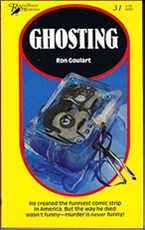
A writer of very funny mysteries and science fiction, Goulart has said he likes to mix “murder, bug-eyed monsters, and satire.” Ghosting contains no BEM’s, but there is plenty of murder and satire. The hero, Barney Kains, is “a defrocked commercial illustrator who got dragooned into the comic book business” as a ghost writer for the comic strip “Poor Little Pearl.”
It seems Archie Judd, the creator of the strip, is down with the flu for the moment. And since Archie’s granddaughter, Beth, is the first woman who’s been able to get Barney’s mind off his ex-wife, a top model whose picture is everywhere, the job is all the more enticing.
But Barney begins to have his doubts about Beth when he learns that Archie’s tirades from his sickroom are on tape: There’s no one in Archie’s bed. What’s happened to the artist? Barney has no choice but to poke around and find out.
This is a delightful piece of fluff with lots of laughs and good material about the comics biz.
Another good Goulart mystery with a comics background is A Graveyard of My Own ( 1985) which introduces Bert and Jan Kurrie, a husband-and-wife team of amateur sleuths. Goulart’s other whimsical crime novels include the futuristic Hawkshaw (1972) and four books in the John Easy private-eye series, the best of which is One Grave Too Many (1974).
———
Reprinted with permission from 1001 Midnights, edited by Bill Pronzini & Marcia Muller and published by The Battered Silicon Dispatch Box, 2007. Copyright © 1986, 2007 by the Pronzini-Muller Family Trust.
DICK STODGHILL “Deadtown.” Appeared in Alfred Hitchcock Mystery Magazine, November 2009. Never reprinted or collected, as far as I’ve discovered so far.
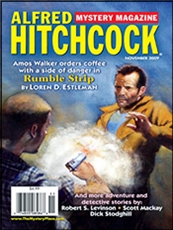
The year Is 1940, and a man drives into the gritty out-of-the-way town named Dealtown with an empty tank and forty-seven cents in his pocket, and as chance would have it, he decides to stay for a while. He’s the kind of guy who’s offered a job as soon as the man who owns the roadhouse just outside of town sees him. (He takes it.) He also meets the girl who works behind the registration counter at the local hotel where he’s advised to spend the night.
Both of these two people come with stories this story is about, and thereby hangs the tale. It’s a story that might have appeared in a detective pulp magazine of the same vintage, and it’s one I can recommend on that basis only … but with a caveat,
It’s not as easy to explain as I thought it was going to be when I started writing this review, but I’ll give it a try anyway.
Dick Stodghill, about whom I’ll say more shortly, was too good a writer to make us believe he is really writing a story of crime and romance taking place in a small but deadly town in 1940. Writers in a day know exactly what they were wring about, those whose stories were accepted on a daily basis in hundreds of pulp magazines aficionados buy fervently today, and at collectors’ prices. They lived the life, albeit not directly, more than likely, but they did not, in general, have the ability to put into words as smoothly and efficiently the grittiness they were writing about. (Some did.) And yet, at the time, the effect was more real and more immediate. The time is a couple of generation away now, I’m afraid.
Dick Stodghill was a former newspaper reporter as well as a mystery writer, and he was a good one. Not a famous one. He doesn’t have his own Wikipedia page, for example. nor did he have many mystery novels to his credit, if any. But he did wrote several dozen short stories for AHMM and Mike Shayne Mystery Magazine between 1979 and 2009, when he died. This one is the last one of those, and in spite of all my nattering above, it’s a good one.