THOMAS WALSH “Murder Twist.” Short story. First published in Ace-High Detective, August 1936. Probably never reprinted.

   I haven’t taken the time to check this theory out, but it’s my sense of things that most Edgar winners for Best First Novel come from nowhere, so to speak, or in other words are brand new to the mystery field. Not so in the case of Thomas Walsh, whose novel Nightmare in Manhattan (Little Brown, 1950) was indeed a winner, but he’d been writing short mystery fiction since 1933, when a story titled “Double Check” appeared in the July issue of Black Mask magazine.

   Walsh gradually graduated to the slicks, magazines such as Collier’s and The Saturday Evening Post, many of them later being reprinted in Ellery Queen Mystery Magazine. Almost all of these, if not out-and-out police procedurals, were cases solved by policemen largely working alone but in their ordinary tours of duty.

   Such a one is “Mystery Twist,” in which a cop named Gannet — his only appearance, I believe — tackles what appears to be a straightforward suicide, that of a woman whose grieving husband claims she jumped out of a window on the 20th floor of an apartment building.

   Gannet is the kind of cop who doesn’t like to take anything for granted, however, but it takes some psychological prodding on the part of his immediate superior, Inspector Powell, to make sure he follows up on his instincts in cases such as this.

   As the title of the story suggests, there is a twist in tale, and I’m going to pat myself on the back by telling you that I figured it out as quickly as Gannet did. But if the story’s well told, and this one definitely is, then the facts should point to the conclusion all along the way, shouldn’t they?
“Whiskey in the Jar” is a traditional Irish folk song that’s also been played by may hard rock bands over the years (Thin Lizzy, Metallica, and so on). Here’s yet another version that caught my ear yesterday:


REVIEWED BY JONATHAN LEWIS:


THE CROOKED WAY. United Artists, 1949. John Payne John Payne, Sonny Tufts, Ellen Drew, Rhys Williams, Percy Helton, John Doucette, Don Haggerty. Director: Robert Florey.

   Although in many ways a highly impressive film noir, The Crooked Way doesn’t have much in the way of depth. The story is a familiar one to those steeped in the works of writers such as Cornell Woolrich and David Goodis. World War II has ended. A man (John Payne) wakes up in a U.S. Army hospital in San Francisco with a metal fragment in his skull and no memory of his past life. He thinks he’s named Eddie Rice and from Los Angeles.

   It therefore makes sense that he’d go to the City of Angels to piece together who he is so he can begin living again. When he gets to LA, though, he soon learns that his real last name isn’t Rice. It’s Riccardi. Eddie Riccardi. And he led a life of crime and was mixed up with some seriously bad dudes.

   He also had – or has – a wife named Nina Martin (Ellen Drew), who is now working with his former associate, the nasty and brutish Vince Alexander (Sonny Tufts). Much of the running time is spent on the cat-and-mouse games played by the LAPD and Vince with Eddie (Payne) caught in the middle. And just when things don’t seem as if they could get any worse for him, he finds himself framed for the murder of a LAPD officer.

   All standard material in the world of late 1940s crime cinema, topped off with a significant amount of time devoted to the then nascent science of forensics. Payne does more than an admirable job in portraying the film’s doomed protagonist, although he isn’t quite able to capture his character’s inner life. How tormented is Eddie Rice/Riccardi after all he’s been through? To be honest, we don’t really know. Had the producers wanted more of the lead character’s trauma explored, someone like Robert Ryan would have been a more suitable actor for the part.

   What The Crooked Way may lack in depth, however, it more than makes up for in flair and style. The movie was lovingly photographed by cinematographer John Alton, who lent his signature touch to numerous films noir in the 1940s and 1950s. From the lighting to the prototypical noirish mood settings, the movie is steeped in the dark and shadowy world of film noir.

   I know that sometimes there is a debate about whether a movie can rightly be considered a film noir. Trust me, this one with the neon lights, the nightclubs, the rainy LA street, the shootout in a warehouse, the unique camera angles, is about as visually noir as you can get. Recommended.


REVIEWED BY DAVID VINEYARD:

JIN ROH, THE WOLF BRIGADE. Japan, 1999. Voices (in the English version): Michael Dobson, Moneca Stori, Colin Murdock, Maggie Blue O’Hara. [From Wikipedia: “The film is the third adaptation of Mamoru Oshii’s ‘Kerberos saga’ manga, Kerberos Panzer Cop, after the two live-action films: The Red Spectacles and StrayDog: Kerberos Panzer Cops released in 1987 and 1991 in Japanese theaters.”] Directed by Hiroyuki Okiyura.

   Japanese anime can be as stylized and foreign to Western audiences as Kabuki theater or Chinese Opera in some cases, and tied in with the cultural differences, it can be a hurdle for older viewers in the US who didn’t grow up with it to follow, but it is also a universal storytelling medium that doesn’t always need language to tell its stories, and a well-told story is a well told story regardless of medium.

   Jin Roh, the Wolf Brigade is set in an alternate Post-War setting where Japan is beset by native terrorists and protected by Special Units of Police trained as jin roh “human wolves.” There are developing tensions between the special units and the regular police and they are as much at each other’s throats as the terrorists.

   When jin roh Kazuki Fuse (pronounced Fu-say) hesitates to kill a young female courier who then triggers a deadly explosion, it gives the police something to use against the special units, and they act quickly to discipline Fuse, sending him back to training under an officer whose son is with the regular police. Then Fuse, still suffering flashbacks to that night and guilt-filled hallucinations, meets and falls for the dead girl’s sister, who bears her an uncanny resemblance.

   Done in realistic style animation, the story is a strong mix of noir, action, and Le Carre style intrigue, where nothing and no one is quite telling the truth, and loyalties shift on treacherous moral sands.

   This is as grim and dark as any live action film, as morally complex, and as unrelenting. It is also beautifully told, with strong elements visually and easily identifiable characters whose animated faces reveal their character as well as many actors.

   Unlike most anime, other than the set-up there is little in the way of science fiction or fantasy elements here, rather a powerful dystopian future, handsomely rendered and deftly told with as many twists as any thriller.

   The film was submitted for an Academy Award in animation, but wasn’t qualified because it first played on Japanese television. It is not a story you will easily forget once seen.


REVIEWED BY BARRY GARDNER:


THOMAS PERRY – Vanishing Act. Jane Whitefield #1. Random House, hardcover, 1995. Ballantine, paperback, 1996.

   The Butcher’s Boy is one of my favorite books, with Metzger’s Dog not far behind. I’m always glad to see a new one by Perry.

   Jane Whitefield is a young woman who is part Seneca by blood, all by heritage. She lives in upstate New York, and is a guide. Not the kind of guide you may be thinking of, though; she guides people who need to be lost, people who have other people looking for them. Jane puts them on the road to not being found, and teaches them how to walk it.

   And then one day a man named John Felker shows up at her door. He says he’s an ex-cop, that he’s been framed, and that there’s a contract out on him. There are people after him, all right, as Jane finds as they set out on the road to anonymity, but he’s not exactly what he seems. A different road lies ahead, with a different destination.

   Two things you can depend on with Perry: he’ll have a strong, somewhat off-beat central character, or characters, and he’ll tell a hell of a good story. Jane Whitefield is one of his more memorable leads, and the story is a fast-moving thriller that will drag you right along.

   There’s a good deal of Native American lore and history interspersed in the third person narrative, about the verisimilitude of which I have no idea at all, but which certainly enhances the story and fits in well with it. Perry seldom writes the same book twice, but he always writes a good one, and this one is very good.

— Reprinted from Ah Sweet Mysteries #18, February-March 1995.
REVIEWED BY JONATHAN LEWIS:


THE MAN WHO DIED TWICE. Republic Pictures, 1958. Rod Cameron, Vera Ralston, Mike Mazurki, Gerald Milton, Richard Karlan. Writer: Richard C. Sarafian. Director: Joseph Kane.

   Albeit brief in running time, The Man Who Died Twice is a surprisingly stylish film noir from Joseph Kane, a director better known for his work with Gene Autry and Roy Rogers. With a taut screenplay from Richard C. Sarafian, there’s more than a hint of sleaze in this crime thriller. Let’s see. There’s the lead character who may or may not be a Kansas City cop, a nosy old woman who gets more than she bargains for when she snoops on a couple of hitmen, a heroin addict who double crosses her dealer, and a nightclub singer who pretends not to see the obvious sin all around her. All good stuff if you’re into that sort of thing.

   Rod Cameron portrays Bill Brennon, the Kansas City cop who shows up in town after he learns that his good for nothing brother T.J. died in an automobile accident. He soon finds out that T.J., a nightclub owner, was mixed up in a heroin smuggling operation and that he got into some disputes with his business associates.

   Further complicating matters is Lynn Brennon, his brother’s widow. She professes to know nothing about what her deceased husband was mixed up in. But Bill feels protective toward her. In fact, he may even be falling in love with her. All of this is quite displeasing to Rak (Mike Mazurki), one of bartenders at the nightclub, who obviously is also holding a candle toward Lynn.

   There’s not really one second wasted in this Republic Pictures release. It moves at breakneck speed and has some exceptionally well-crafted moments, especially those involving the two hitmen sent from Chicago to recover a payload of heroin from the dead brother’s apartment. In this way and others, this movie reminded me quite a bit of The Lineup (which I reviewed here), also released in 1958. Although the latter film is clearly superior, the two put together would make for a great double feature.


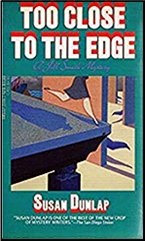
SUSAN DUNLAP – Too Close to the Edge. Jill Smith #5. St. Martin’s, hardcover, 1987. Dell, paperback, July 1989.

   Detective Jill Smith works out if the Homicide-Felonious Assault division of the Berkley police department, and in this case she solves the murder of a handicapped woman dumped from her wheelchair and drowned in a few inches of water at the edge of the bay.

   What I don’t know about police procedure you could write a book about, but the investigating techniques displayed here seem awfully chaotic and uncoordinated to me. And while Dunlap is a good writer, someone should tell her not to make up clues as she goes along.

–Reprinted from Mystery*File #14, July 1989.

SIMON & SIMON “Details at Eleven.” CBS, 24 November 1981. (Season 1, Episode 1.) Jameson Parker (A.J. Simon), Gerald McRaney, (Rick Simon), Jeannie Wilson, Cecilia Simon, Eddie Barth. Guest Cast: Peter Graves, Markie Post, Sharon Acker. Writer: Philip DeGuere Jr. Director: Corey Allen.

   Total opposites, even if they are brothers, make good partners, even in the private eye business, or so is the premise of this long-running TV series. A.J. is the laid-back one, wearing blue jeans and cowboy boot,s while Rick wears suits and ties in the bast Wall Street tradition.

   As I understand it, this first episode was not the pilot, but while it takes a while, I’d have to say that it serves the purpose, which is to introduce the recurring vast members, letting the viewer get to know them and who they are. The two brothers bicker a lot, mostly about their childhood and how Mom liked the other best.

   Of course when they get in a jam, as in “Details at Eleven,” when they get stuck in Mexico without a car, who comes to their rescue? Mom, of course. In this story they’re hired by a woman whose daughter is missing. It turns out that she has documents that will prove that her stepfather, a prominent newscaster in San Diego area, is on the take from gangsters who are hoping to promote him to public office.

   What I noticed first of all is how fast paced this episode was. No long scenes of cars driving from one place to another, or planes landing or taking off, a la some episodes of The Rockford Files, among a few others.

   I also assume the bickering between the two mismatched brothers had a lot to do with their long-term appeal. The show was on for eight seasons, but for whatever reason this is the first episode I’ve ever seen, and I don’t know why. I enjoyed this one, and as I have the first season on DVD, I will be watching more.


J. ALLAN DUNN “In the Grip of the Griffin.” Novelette. Gordon Manning vs. the Griffin #30. First published in Detective Fiction Weekly, May 18, 1935. Reprinted in In the Grip of the Griffin: The Complete Battles of Gordon Manning & The Griffin, Volume 3 (Altus Press, 2015).

   The first of this long saga of 31 stories was, I believe, “The Crime Master,” which appeared in the November 30, 1929, issue of Detective Fiction Weekly. IN this and stories yet to come, Gordon Manning remained continually on the trail of the notorious madman and supervillain known only as the Griffin, his real identity unknown.

   Readers of “In the Grip of the Griffin” were treated to more of same — capture, escape, capture again, rescue, and so on — but what they didn’t realize it at the time, but there was but one more to go: “The Seventh Griffin” (DFW, Oct 5, 1935). I haven’t read that one, but I have been told that the series did have a finale, and I kind of hope it was a good one.

   The Griffin was the key reason why the series lasted as long as it did. It is the evil villain who attracts readers, not the mild-mannered adventurer (in this case Gordon Manning) whose sworn duty is to bring the mad killere to well-deserved justice. (Who remembers the fellow who chased Fu Manchu all around the globe, back in the day? Almost nobody.)

   In this case the Griffin sends one of his henchmen to break into Manning’s home — object: eliminate him — not knowing that Manning is ready and waiting for such a contingency. Once the tables are turned, however — and I hope I’m not revealing too much — the tables are turned again, with Manning bands in the hands of the Griffin. And in what better place to be held captive than a mausoleum located below an abandoned cemetery.

   All ends well for Manning, though, have no doubts about that. Narrow escapes in these kinds of stories are only to be expected. On the other hand, the Griffin is shot and wounded as he makes his own escape one more time. You shouldn’t expect a lot of characterization in stories such as this one, and in fact, there isn’t any at all. But they are in fact a lot of fun to read. Not too many at once, though!

« Previous PageNext Page »