A 1001 MIDNIGHTS Review
by Bill Crider:


NICK QUARRY – The Hoods Come Calling. Gold Medal 747, paperback original; 1st printing, March 1958. Cover art: Barye Phillips.
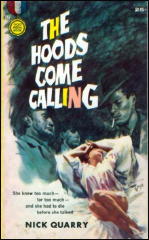
NICK QUARRY

   Nick Quarry (a great pseudonym) was one of the names used by prolific paperbacker Marvin H. Albert, who also wrote entertaining books as Al Conroy and Tony Rome. Most of the Quarry novels are part of the series featuring Jake Barrow, a tough private eye in the Spillane tradition. The Hoods Come Calling is the first book in the series.

   Barrow returns to New York after two years in Chicago, where he has been trying to forget his wife’s infidelities. All he wants from her is the $1600 he left in their joint account, which he plans to use to buy into a private detective agency.

   He goes to her apartment to pick up the money, and she shows up drunk. He carries her upstairs and is seen by the neighbors. When he leaves for a minute, she is murdered. Barrow conceals the body, but he is soon being hunted by the police, as well as by his wife’s hoodlum friends. He must prove his innocence by finding the guilty party.

   Along the way, there is a bit of 1950s sex (not too graphic) and a considerable amount of violence (which Quarry handles very well). The familiar story has just the right mixture of action and detection to keep things moving along at a rapid clip, and Barrow makes a credible hard guy, though his character seems a bit inconsistent at times.
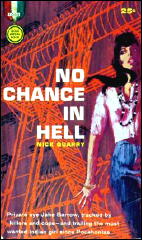
NICK QUARRY

   There is at least one nice surprise in store for the reader; and the ending, in which Barrow proves to be not quite as dishonest as the hoods believe him to be, is quite satisfactory.

   Other lively Nick Quarry novels include No Chance in Hell (1960), Till It Hurts (1960), and Some Die Hard (1961).

         ———
   Reprinted with permission from 1001 Midnights, edited by Bill Pronzini & Marcia Muller and published by The Battered Silicon Dispatch Box, 2007.   Copyright © 1986, 2007 by the Pronzini-Muller Family Trust.


Editorial Note: A few years ago Bill Crider wrote a lengthier article about Marvin Albert, the man behind the Nick Quarry moniker, for the primary Mystery*File website. Follow the link to check it out. Included is a complete bibliography for Albert, including work he did under all of his several pen names.
A 1001 MIDNIGHTS Review
by Francis M. Nevins:


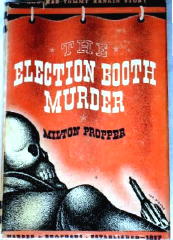
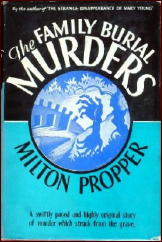
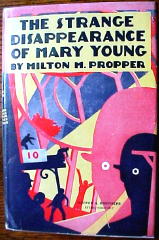
MILTON PROPPER – The Family Burial Murders. New York: Harper & Brothers, 1934. Hardcover reprint: Grosset & Dunlap (cover shown).

MILTON PROPPER

   Milton Propper was born in 1906, graduated from the University of Pennsylvania Law School with honors in 1929, and saw his first detective novel published the same year. He never practiced law but went to work in the mid1930s for the Social Security Administration and continued mystery-writing on the side.

   His fourteen whodunits are usually set in Philadelphia and its suburbs and feature young Tommy Rankin, the homicide specialist on that city’s police force.

   Propper was far from a paragon of all the literary virtues. He wrote dull prose, peopled his books with nonentities, flaunted like a badge of honor his belief that the police and the powerful are above the law, and refused to play fair with the reader.

   Yet paradoxically his best books hold some of the intellectual excitement of the early novels of Ellery Queen. Propper generally begins with the discovery of a body under bizarre circumstances: on an amusement park’s scenic railway in The Strange Disappearance of Mary Young (1929); during a college-fraternity initiation in The Student Fraternity Murder (1932); in a voting booth in The Election Booth Murder (1935).

MILTON PROPPER

   Then he scatters suspicion among several characters with much to hide, all the while juggling clues and counterplots with dazzling nimbleness. His detectives are gifted with some extraordinary powers — for example, they can make startlingly accurate deductions from a glance at a person’s face — and have no qualms about committing burglary and other crimes while searching for evidence.

   Propper novels often involve various forms of mass transportation and complex legal questions over the succession to a large estate. Near the end, having proved all the known suspects innocent, Rankin invariably puts together some as yet unexplained pieces of the puzzle, concludes that the murderer was an avenger from the past who infiltrated the victim’s life in disguise, and launches a breakneck chase to collar the killer before he or she escapes.

   Such is the Propper pattern. One of the books in which it shows to best advantage is The Family Burial Murders, whose opening is reminiscent of Ellery Queen’s 1932 classic The Greek Coffin Mystery.

MILTON PROPPER

   Rankin is summoned to one of Philadelphia’s stately mansions after one body too many turns up at the gravesite during the funeral of a wealthy dowager. The old lady clearly died of natural causes, but her nephew, who also lies in her coffin, was just as clearly murdered, and Rankin’s investigation turns up an assortment of suspects with motive and opportunity.

   Propper juggles the legal tangles surrounding the dead woman’s estate with an array of trains, trolleys, elevated lines, and interurban electric trams that give him the crown as mystery fiction’s number one transportation buff.

   Unlike his novels, Propper’s life became ever more wretched and messy. He alienated his family, lived in squalor, was picked up for homosexual activity by the police whose lawbreaking he had glorified, eventually lost all markets for his writing and, in 1962, killed himself.

         ———
   Reprinted with permission from 1001 Midnights, edited by Bill Pronzini & Marcia Muller and published by The Battered Silicon Dispatch Box, 2007.   Copyright © 1986, 2007 by the Pronzini-Muller Family Trust.

THE BACKWARD REVIEWER
William F. Deeck

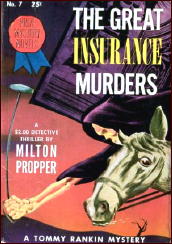
MILTON PROPPER – The Great Insurance Murders.

Harper & Brothers, hardcover, 1937; Prize Mystery Novels #7, digest-sized paperback reprint, 1943.

MILTON PROPPER The Great Insurance Murders

   While seated on a horse during a polo game, Bruce Clinton is shot in the head by a gunman using a .38 automatic with silencer from “less than 200 feet.” “A neat shot, but not too skillful, after all,” Tommy Rankin, Homicide Squad detective, opines.

   Hard man to impress, I’d opine.

    “By a system of trial and error, he [Rankin] ultimately cleared up his problems, sometimes even blundering into the answer.” In this novel he is convinced at various times that three separate people were the murderer. Luckily, he does blunder into the answer, leaving profuse loose ends.

   Should anyone have an urge to read a Milton Propper mystery, this is probably not the one to choose.

   Parenthetically, certain low-level detectives and obvious crooks say “yu,” sometimes, in place of “you.” Could a kindly Philadelphian, since that city is where this novel takes place, explain the difference in pronunciation?

– From The MYSTERY FANcier, Vol. 10, No. 3, Summer 1988.


REVIEWED BY DAN STUMPF:         


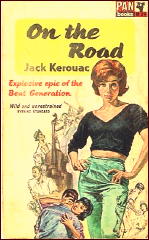
JACK KEROUAC On the Road

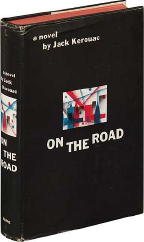
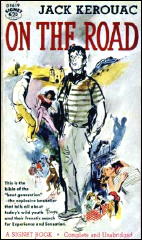
   We took a trip around Memorial Day to Williams Arizona, an old cowboy town on Route 66, and thence to the Grand Canyon and Las Vegas, and I spent the rare idle hours reading Jack Kerouac’s 1957 memoir/novel On the Road. Or rather, re-reading it for the first time in 40 years.

   Wow.

   It’s one of those books that makes you see things differently while you’re reading it. I could never subscribe to the lifestyle (In fact, I spent a big chunk of my life trying to curb those who did.) but Kerouac’s visceral prose is the kind of writing that goes right through the eyes and into the brain.

   Every drunk and drug-addict has, when smashed, felt the sensation of discovering something wild and important, deep, secret and beautiful (and how quickly that feeling is lost the next morning!) but Kerouac is one of the few who can get it down on paper and put it across to a relatively sane and completely sober reader.

   His characters are wonderfully flawed and brilliantly etched in a few lines, the backgrounds and situations vividly evoked, and the sheer, rambling plotlessness of the thing somehow makes up a startling momentum of its own.

JACK KEROUAC On the Road

   I have to say that this is a book that needs a soundtrack album to go along with it — I had a bit of trouble relating to some of the passages sitting in bars listening to blues, jazz and more blues — but I really fell in love with the scene of the flat-broke Sal Paradise and his friends living for a day and a night in an all-night movie house, sitting among bums and winos, watching the same double-bill over and over again.

   I’m tempted to quote the passage as a whole, but just let me throw in:

   The picture was Singing Cowboy Eddie Dean and his gallant white horse Bloop. That was number one; number two double feature film was George Raft, Sidney Greenstreet and Peter Lorre in a picture about Istanbul. We saw both of these things six times each during the night. We saw them waking, we heard them sleeping, we sensed them dreaming, we were permeated completely with the strange gray Myth of the West and the weird dark Myth of the East when morning came. All of my actions since then have been dictated automatically to my subconscious by this horrible osmotic experience…

JACK KEROUAC On the Road

   It’s a passage that resonates clearly with the old-movie-buff in me, and one I can relate to, having spent much of my youth sitting in the local grind house for hours on end, letting the Technicolor wash over me as I nursed my adolescent angst.

   And I mark it as a sign of Kerouac’s brilliance that a wild and shiftless wanderer like Sal Paradise could reach out and touch a hide-bound old fudd like this one.

Covers shown: The Viking Press, hardcover, 1957. Signet D1619, paperback, 1958. Pan M39, UK, paperback, 1961.

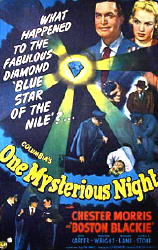
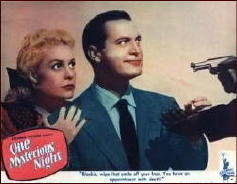
ONE MYSTERIOUS NIGHT. Columbia, 1944. Chester Morris (Boston Blackie), Janis Carter, Richard Lane, George E. Stone, William Wright, Robert Williams, Mark Roberts, Dorothy Malone (uncredited). Based on the character created by Jack Boyle. Director: Oscar [Budd] Boetticher Jr.

ONE MYSTERIOUS NIGHT (Boston Blackie)

   If you were to go back to a review I did quite a while ago, that of Meet Boston Blackie, the first of the series, you’ll see that I wasn’t entirely impressed with it — or if I was, it wasn’t favorably.

   I’d happened to have taped a whole run of the Blackie movies at the time, and here it is, over two years later, and last night I finally watched another one, the seventh overall, just so you know where we stand when we start.

   And I might as well tell you this frankly. Not even the fact that this was famed Budd Boetticher’s first directorial effort, the first he was given credit for, can save this movie from itself. Bad? Well, maybe not, but let me tell you this, it sure isn’t good.

   Blackie in this one is called in by Inspector Farraday (Richard Lane) to find a stolen diamond. Working on the side of the law, Blackie still finds the need for disguises and other funny stuff inorder to check out the scene of the crime, for example, as well as a couple of other instances.

   But even though he spots how the thief did it within five minutes (and I still don’t believe the guards on duty were really that stupid), he’s spotted so quickly in turn by a ubiquitous blonde reporter (the slim and stunning Janis Carter), that Blackie ought to turn in his license as an unlicensed (and no longer active) crook and go back to the amateur level himself.

ONE MYSTERIOUS NIGHT (Boston Blackie)

   There are two things going for this movie, and Janis Carter is one of them, though how she manages to pop up every time the movie needs a boost in another direction, I’ll never know.

   The other is the non-stop action that leaves absolutely zero time for reflection on how or why, only ever onward to the next scene.

   Connoisseurs of sappy lunkhead comedy crime movies like this one should note that I am not including the so-called alleged humor as one of the positives. Picture this. The two main crooks are standing like dummies (no, I really mean dummies, or manikins, perhaps) in a pawnshop with the owner seriously wounded from a gunshot on the floor, while the two policemen they’re hiding from play cards in front of them while they’re waiting for the ambulance to come.

   Well, I suppose you could call it funny. And do you know what? Right now I’m sitting here grinning like a nine-year-old!

A 1001 MIDNIGHTS Review
by Bruce Taylor:


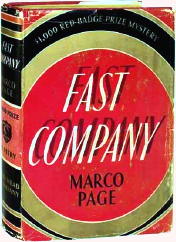
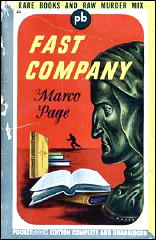
MARCO PAGE – Fast Company. Dodd Mead, hardcover, March 1938. Pocket #222, paperback; 1st printing, July 1943; Paperback Library 52-192, ca.1962. Film: MGM, 1938 (scw: Marco Page, Harold Tarshis; dir: Edward Buzzell).

MARCO PAGE Fast Company

   Harry Kurnitz (a.k.a. Marco Page) will be remembered, if at all, as a screen writer. He penned the weakest of the Thin Man films — The Thin Man Goes Home (1944 ) — but partially redeemed himself in 1957 with his excellent script for the screen adaptation of Christie’s Witness for the Prosecution.

   His novels, including the bibliomystery Fast Company, have sunk into a more or less deserved obscurity. In this novel, rare-book dealer and part-time sleuth Joel Glass teams up with his wife, Garda, to solve the murder (referred to as “the blessed event”) of a much hated fellow New York book dealer.

   It seems there are two main suspects in the killing of Abe Selig. The prime suspect is Ned Morgan, a former assistant of Selig’s, who happens to be a convicted book thief recently paroled from prison. Suspect number two is everybody else who ever met Ab Selig.

   There are several other murders, and rare books keep disappearing and reappearing, but it’s all rather ordinary. There are some interesting glimpses into the world of rare books and book forgery.

MARCO PAGE Fast Company

   There is even an occasional good line: “[He] had an alibi tighter than a Scotch auditor…”

   But the parts add up to less than the whole. The plot is predictable and doesn’t begin to live up to the “hard-boiled” promise of the dust jacket.

   Fast Company was the winner of the 1938 Red Badge Best First Mystery Prize, which says something about the quality of the competition that year. It was made into a movie called Fast and Loose that same year (screenplay by the author) — an obvious attempt to capitalize on the success of the Thin Man series. The movie version isn’t very good either.

   The other Marco Page novels are The Shadowy Third (1946), which also has a New York setting; and Reclining Figure (1952), which takes place in California.

         ———
   Reprinted with permission from 1001 Midnights, edited by Bill Pronzini & Marcia Muller and published by The Battered Silicon Dispatch Box, 2007.   Copyright © 1986, 2007 by the Pronzini-Muller Family Trust.

Editorial Comments: An earlier review of Fast Company by Bob Schneider appears here on the blog.

MARCO PAGE Fast Company

   Question: It seems obvious that the movie Fast Company (MGM, 1938) was based on the book, and that’s the only one I’ve included in the bibliographic details so far. (See above.)

   But both Al Hubin (in the Revised Crime Fiction IV) and Bruce Taylor say that Fast and Loose (MGM, 1939) was also based on Fast Company. Can both movies, made so close together, be based on the same book?

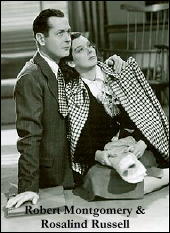
   There was a third film in the same series, Fast and Furious (MGM, 1939). What’s remarkable about the three films is that they all had the same leading characters, Joel and Garda Sloane, but in each of the three outings there was a different pair of Hollywood stars playing the parts.

   In order: Melvyn Douglas & Florence Rice; Robert Montgomery & Rosalind Russell; and Franchot Tone & Ann Sothern. I have all three on tape, probably from TCM at various times over the years, but I’ve yet to watch one.

[UPDATE] 08-08-09. On the ‘Golden Age of Detection’ group on Yahoo, Monte Herridge left the following comment:

    “A sequel to Fast Company was published in 1939: Fast and Loose was serialized in 5 parts in Argosy beginning in the February 25, 1939 issue.

    “It may never have been published in hardback, but at least there is a sequel for those interested.

    “The cover of Argosy for 2/25/39 describes the novel as ‘The Newest Hit from Hollywood!'”

   And the release date for the film, for which Page (as Kurnitz) was the screenwriter, was 17 February 1939, making it difficult to say which came first, the novel or the screenplay. What you have to wonder the most about, though, is why the serial in Argosy was never published in book form.

REVIEWED BY WALTER ALBERT:         


SKINNER’S DRESS SUIT. Universal, 1926; Reginald Denny, Laura La Plante, Ben Hendricks, Jr., E. J. Ratcliffe, Arthur Lake, Hedda Hopper. Director: William A. Seiter. Shown at Cinevent 41, Columbus OH, May 2009.

SKINNER'S DRESS SUIT

   Skinner and Honey (Denny and La Plante) are a young married couple, with Skinner’s office job bringing in a salary that’s not up to Honey’s expectations of her husband’s worth. Egged on by his ambitious wife, Skinner finally works himself up to asking his boss for a raise.

   Although the request is refused, Skinner finds himself incapable of confessing the failure to his wife, who immediately assumes he has the raise and starts spending down their savings on the expectation of the increased income.

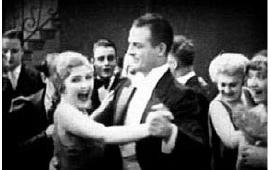
   Denny and La Plante gave such charming performances that it was difficult for me to find his wimpiness and her pushy nature distasteful. As their financial difficulties mount, an invitation to a fancy party proves to be their salvation, a plot turn fueled by their skill at the Charleston that leads to a dancing sequence that lifts this expertly directed and played comedy to new levels of effervescence.

REVIEWED BY TED FITZGERALD:         


ARREST AND TRIAL (ABC)

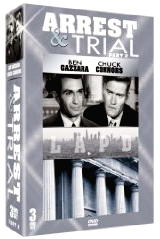
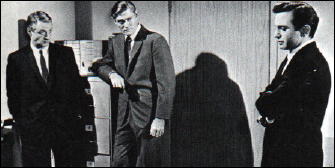
ARREST AND TRIAL. ABC-TV, 1963-64. Ben Gazzara, Chuck Connors, Roger Perry, John Larch, Don Galloway, Joe Higgins, John Kerr. On DVD: The Best of Arrest and Trial, Part Two, Timeless Media Group.

   I was disappointed with this set of shows. This was the 90 minute 1963 ABC series that first tried out the Law and Order formula of having the first half chart the police work and the second half cover the resulting legal proceeding.

   The difference here is that the second half focused on the defense attorney, rather than the prosecutors, in this case, Chuck Connors as “Irish” John Egan. Some critics said this undercut the show’s premise but I think it expanded the storytelling possibilities, although there are times you wonder which side of the street Egan is working.

   What hurt the show, based on the nine episodes on view in this three-disc set, was its length. It was too long, it was sloooow, scenes dragged or were dragged out for padding. It was confusing as stories lost their way and guest stars like James Whitmore, John McIntire, Kim Hunter and Roddy McDowall gave great performances that were swallowed up in the maelstrom.

   The writers didn’t seem to know how to write for the show’s length; potentially strong 60 minute stories became weak, discursive and ultimately boring behemoths.

ARREST AND TRIAL (ABC)

   While Connors projected authority and had presence as Egan, Ben Gazzara phoned in his cop character, Nick Anderson. Anderson was an absolute cipher and Ben did nothing to flesh him out.

   This isn’t so much a bad show as one that didn’t live up to its potential. There’s another box set out there, but I don’t think I’ll be looking it up.

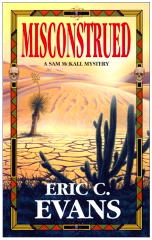
ERIC C. EVANS – Misconstrued.

Worldwide; paperback reprint, Feb 2003. Hardcover edition, 2001, Avalon Books.

ERIC C. EVANS

   I was talking about coincidences a while back, and (such is the way of the world) here’s a book that’s built on — well, if not a story-making coincidence of title-making proportions, a killer who’s awfully serendipitous in his choice of victims.

   Without letting the plot completely out of the bag, let me show you what I mean by quoting from page 217:

    “It’s all so …” she said, searching for the right word.

    “Unbelievable,” I said, fearing the worst.

    “Well, yes, it is unbelievable, but the word I was searching for is … misconstrued,” she finally landed on it.

    “Misconstrued?” I said, somewhat relieved.

    “Yes, whoever is doing this to you is incredibly lucky,” she said.

   Sam McKall, whose second recorded adventure this is, is the political aide to the governor of Utah, who (as the story begins) is trying to stop a nuclear waste dump being built on a Pishute reservation in the state. Pushed into investigating a series of deaths the police believe are only accidents, Sam and a reporter friend soon find themselves in what may be a huge conspiracy of corporate-based murder.

   What puzzled me almost as much as the case they’re working on, which is smoothly told, in a totally workmanlike manner, is why the capital of Utah is referred to as Wasatch City. A minor matter. I’ve only been there once, and maybe it is.

   What disappointed me was how the mix of cerebral detection with a modicum of action suddenly — with just over 20 pages to go — became an over-the-top (but non-pyrotechnic) thriller of Bruce Willis proportions.

   And surely we didn’t need most of Chapter 23, which recaps the entire scenario, filling in details we already knew. Better than average, then, but not by much.

— April 2003.


      Bibliographic data:

   ERIC C(HARLES) EVANS

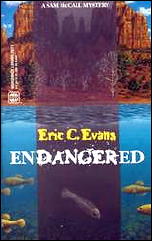
Endangered. Avalon, hc, 1999. Worldwide, pb, Jan 2001. Sam McKall.

ERIC C. EVANS

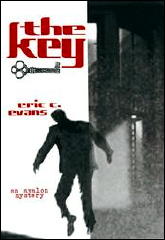
The Key. Avalon, hc, 2000.

ERIC C. EVANS

Misconstrued. Avon, hc, 2001. Worldwide, pb, Feb 2003. Sam McKall.

REVIEWED BY BOB SCHNEIDER:         


MARCO PAGE – Fast Company. Dodd Mead, hardcover, March 1938. Pocket #222, paperback; 1st printing, July 1943; Paperback Library 52-192, ca.1962. Film: MGM, 1938 (scw: Marco Page, Harold Tarshis; dir: Edward Buzzell).

MARCO PAGE Fast Company

   Marco Page, a pseudonym of Harry Kurnitz, 1909-1968, wrote or co-wrote 33 screenplays for Hollywood movies between 1938 and 1966. He wrote or adapted four plays for the stage between 1954 and 1963.

   More importantly for the purposes of this review, he wrote four mystery/detective novels between 1938 and 1955. Fast Company was the first of these.

   Of his screen work, Shadow of the Thin Man (1941) and The Thin Man Goes Home (1945) are the most telling of his style, because Page’s detecting couple in Fast Company is obviously based upon Nick and Nora Charles from Hammett’s novel The Thin Man (1934).

   The plot of Fast Company revolves around some dirty business going on in New York’s rare book trade. A frame-up and an elaborate scheme for stealing, altering and re-selling valuable books are the main plot-drivers in this fast-paced mystery.

   Rare book dealer Joel Glass (with help from his wife, Garda) discovers that working for insurance companies recovering valuable stolen books is more remunerative than depression era bookselling. The characters make prodigious amounts of wisecracks and drink prodigious amounts of liquor before the story is concluded.

MARCO PAGE Fast Company

   One would not think that so much gunplay, knife-throwing, fist-fighting, kidnapping, head-conking, pistol-whipping, book stealing and fem-fataling was going on in the 1930’s New York rare book milieu!

   The best way that I can describe Page’s recipe is as follows: Combine one part Hammett’s Nick and Nora with one part screwball comedy with one part thriller-ish action and then add a tiny dash of fair-play clueing.

   One plot point that really annoyed me was that, one day after a character is shot in the shoulder, he manages to free himself from being tied up, beats up a crook and jumps out of a second story window. It’s almost as if Page forgot that the character had been shot.

   To be fair to Page, the general consensus of Catalogue of Crime and Twentieth Century Crime and Mystery Writers is that Fast Company is probably the weakest of his four mystery novels.

MARCO PAGE Fast Company

   Still, it was good enough to win Dodd Mead’s second Red Badge Prize Mystery award and got him to Hollywood where three movies were made based on the lead characters of Fast Company.

   Page/Kurnitz’s three other mystery novels are:

    The Shadowing Third (1946), in which NYC lawyer, David Calder, searches for a stolen priceless violin.

    Reclining Figure (1952), in which NYC art dealer, Ellis Blaise, investigates modern art forgeries in California.

    Invasion of Privacy (as Harry Kurnitz, 1955), wherein movie studio rep Mike Zorin troubleshoots for his employers.

   I have not read any of Page’s other work, but I’ll be on the lookout for his books just to see if he really did improve on his first effort.

Note: A very good review of Fast Company written on 05/09/08 by “prettysinister” on the LibraryThing website indicates that it was one of the earliest American bibliomystery novels. This doesn’t seem to be correct information. I will have to research further.

— This review also appears on the Golden Age of Detection Wiki in slightly different form.


Coming soon: Another view of this book, taken from 1001 Midnights.

« Previous PageNext Page »