IT IS PURELY MY OPINION
Reviews by L. J. Roberts


TESS GERRITSEN – I Know a Secret. Rizzoli & Isles #12. Ballantine, hardcover, August 2017.

First Sentence:   When I was seven years old, I learned how important it is to cry at funerals.

   Detective Jane Rizzoli and medical examiner Maura Isles have two murders to investigate. Although they occurred in separate locations and no connection seems to exist between the two victims, there is a commonality in their wounds. Also when Maura visits her biological mother, an imprisoned serial killer who is dying of cancer, she receives a cryptic message. What does her mother know?

   Such a well-done beginning. It is one filled with very intriguing information and leaves one with many questions— “You’ll find another one soon.” –to which one wants answers.

   Third-person, anonymous narration is a writer’s element; i.e., trick, which can be annoying, and disruptive to the flow and tension of the story. Bear with it, however, as it not only makes sense but leads one down an unexpected path.

   Gerritsen really knows how to write natural dialogue. It serves many purposes, even to indicate the difference in educational backgrounds between Isles and Rizzoli— “Bilateral globe enucleation,” said Maura softly. “Is that some kind of fancy medical talk for someone cut out her eyeballs?” “Yes.”

   The dialogue is only one aspect of Gerritsen’s literary voice. Excellent analogies is another— Cops were like terrorists. They tossed devastating bombs into the lives of victims’ friends and families, and then they stood around to watch the damage they’d done.”

   Learning about the families of the protagonists gives them dimension and life. It makes them vulnerable and realistic. If one has a character who is Italian, one can also be ensured of large meals with good food— “The leg of lamb was studded with garlic cloves and roasted to a perfect medium rare. Surrounding it were bowls of crisp rosemary potatoes, green beans with almonds, three different salads, and homemade dinner rolls.” –Yet one is also reminded that cops don’t get Christmas off.

   A fascinating benefit of Gerritsen’s novels, due to her background, is the medical and scientific information one learns. It takes the investigative information just another step up.

   The plot is so skillfully developed. The investigation is layers built on layers. It is refreshing even when theories are developed that don’t prove out … or do they? And the twists keep coming, one of which could not have been more unexpected. What is particularly enjoyable is that they don’t feel contrived, although you know Gerritsen labored long and hard on them, because the logic works.

   I Know a Secret is an excellent book. It is skillfully plotted with twists that give definite “Wow!” moments. Gerritsen is a “must read” author.

— For more of LJ’s reviews, check out her blog at : https://booksaremagic.blogspot.com/.


REVIEWED BY DAN STUMPF:


THE MAD DOCTOR OF MARKET STREET. Universal, 1942. Lionel Atwill, Una Merkel, Claire Dodd, Nat Pendleton, Richard Davies, Noble Johnson, Ray Mala. Produced by Paul Malvern. Written by Al Martin. Directed by Joseph H. Lewis.

   The good news is that this predestined 2nd-feature was done by people who knew their way around cheap movies. Producer Paul Malvern started out at Monogram with Duke Wayne’s Lone Star series, and went on to memorable kitsch like House of Dracula (far from the best in the series, but showing fine use of stock footage and contract players).

   Writer Al Martin’s resumé is less distinguished, but director Joseph H. Lewis (who would go on to Gun Crazy and beyond) had lavished bizarre camera angles and punchy editing on low-budget movies for half a decade by the time this trifle fell onto his plate.

   And then there’s the cast: Lionel Atwill at his supercilious best; Una Merkel ditzy as ever; Nat Pendleton clueless as always, and Noble Johnson playing a nasty Native Chief as one to the manner born. The only downside is that the film itself isn’t much good.

   That is to say, I enjoyed it, and you might too, but there are definitely some Quality Control issues here. For one thing, there’s no Monster in this purported Horror Film, and that’s always a bit of a let-down for those of us who used to stay up late watching “Shock Theater” or the local equivalent thereof – indeed it was not until my later years, with mature critical sensibilities, that I learned to appreciate this work on its own terms, such as they are.

   For another thing, Merkel and Pendleton are fine comedy performers, but they don’t have a funny line between them. And finally, the story tends to meander a bit, starting with a bit of Mad Doctoring in Frisco, then the hunt for a fugitive killer aboard a luxury liner, a little dab of shipwreck, and then some testy diplomacy with Island Natives who evince a taste for human sacrifice.

   Well. it certainly moves around a lot, and like I say, Mad Doctor of Market Street carries this nonsense with a certain amount of style. There’s a particularly fine second or two toward the end, when Lewis’ camera pans in on Atwill’s terrified expression as he realizes the jig is up, a perfect confluence of fine acting and skillful direction. And if it seems wasted on a dumb picture like this, well, like I say: It’s still fun.

DANGEROUS CROSSING. 20th Century Fox, 1953. Jeanne Crain, Michael Rennie, Max Showalter (as Casey Adams), Carl Betz, Mary Anderson, Marjorie Hoshelle, Willis Bouchey. Based on the radio play “Cabin B-13” by John Dickson Carr. Director: Joseph M. Newman.

   You probably know the story, or one very much like it. After a young honeymooning couple board a trans-Atlantic ocean liner in New York City, married for only a day, the husband (Carl Betz) goes off to run an errand at the purser’s office and promptly disappears. The new bride (Jeanne Crain) simply can’t believe it.

   An intensive search takes place and shows that the husband is nowhere on board. The couple’s stateroom is empty, the wife’s luggage is in a room down the corridor, and most telling, there’s no one on board who can even say they saw the two of them together.

   There is only one person is not thoroughly convinced that she is crazy, and that’s the ship’s doctor (Michael Rennie). If not for him, the new Mrs. Bowman would surely think she has gone mad.

   To my mind, this is one of the great suspense movies of all time — or at least it could have been and should have been. It begins well, but it doesn’t maintain the same sharp, keen edge it should have over the full length of the movie.

   It does have its moments, however. You certainly should not watch this film if you suffer from any of the ten warning signs of paranoia. The ocean crossing is a foggy one, with the constant blaring of foghorns, and that helps considerably. Nonetheless, as you sit there watching, you’ll probably begin to wonder what might have happened if someone like Alfred Hitchcock had gotten his hands on it.

— Reprinted from Mystery*File #24, August 1990. (slightly expanded and revised).


GORDON DAVIS – Ring Around Rosy. Gold Medal k1380, paperback original; 1st printing, January 1964. Cover art by Robert McGinnis. Also published as From Cuba, with Love, as by E. Howard Hunt. Pinnacle, paperback, 1974.

   By 1964 the revolution in Cuba was solidly in place, but its aftermath was still a mass of recrimination and guilt. Dave Mallory is no PI, but when he’s hired by a beautiful Cuban exile to find the man who informed on her father, he jumps at the chance.

   The man is also the foreman of the Cuban plantation her father once owned. Davis, a pen name of the notorious E. Howard Hunt, always surprises me how good a writer he is, no matter what byline he is using — mostly due, I am sure, to the feeling of the strong gritty authenticity that permeates his work.

— Reprinted from Mystery*File #23,, July 1990. (slightly revised).


Bibliographic Note:   The Pinnacle reprint is exceedingly scarce. At the time this review was posted, no copies could be found offered for sale on line. Amazon has a page for it, however, along with a photo, so it does exist.

REVIEWED BY BARRY GARDNER:


MAX ALLAN COLLINS – Carnal Hours. Nate Heller #7. E. P. Dutton, hardcover, 1994. Signet, paperback, 1995.

   Max Collins is another writer I think of under-rated. He hs written 30 or more crime books (I have 28), all competent, and many very good. He won a Shamus for True Detective, the first of the Heller books, and was nominated for another. And yet, despite his considerable and continued successes, he is too often ignored by critical opinion.

   Heller is in his 30’s now, back in operation Chicago after seeing action in WWII and being discharged, he flies to Nassau at the request of (and for a healthy fee from) Sir Harry Oakes, a rough-hewn multi-millionaire who made his fortune in Canadian gold and is now the “King of the Bahamas.” Oakes wants Heller to find evidence that his daughter’s husband is cheating on her, and a check for $10,000 convinces Heller that this is the thing to do.

   Before he can accomplish his goal, though, Oakes is brutally murdered, and the son-in-law is charged with the crime. Oakes’ daughter, convinced of her husband’s innocence, hires Heller to prove it; but the island’s power structure is solidly in his way.

   The Oakes case is one of the 20th century’s premier unsolved cases, and Collins has done his usual thorough research. As always with the Heller series, he has mixed historic with fictional characters, and in addition to the principals in the case has tossed in Erle Stanley Gardner and Ian Fleming for good measure.

   I like the series, and I liked this book. Collins blends history with crime fiction better than anyone else dong it on a regular basis, and never lets the background get in the way of his story — though the background is meticulously laid out, and engrossing.

   He’s a story-teller; he would have been, I think, a premier pulp writer had he been born at the right time. Before you take that as damning with faint praise, please spend a respectful moment considering who some of the premier pulp writers were.

— Reprinted from Ah Sweet Mysteries #13, June 1994.


Bibliographic Note: According to the Thrilling Detective website, there are now 17 Nate Heller novels and four story collections. Most recent in the series is Better Dead (2016), which takes place in the 1950s in the midst of the Joe McCarthy era.

A 1001 MIDNIGHTS Review
by Ed Gorman


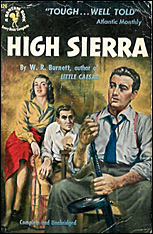
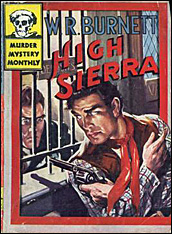
W. R. BURNETT – High Sierra. Alfred A. Knopf, hardcover, 1940. Reprint editions include: Avon Murder Mystery Monthly 40, digest-sized paperback, 1946. Bantam #826, paperback, 1950. Carroll & Graf, paperback, 1986. Film: Warner Brothers, 1941 (Ida Lupino, Humphrey Bogart).

   “Early in the twentieth century, when Roy Earle was a happy boy on an Indiana farm, he had no idea that at thirty-seven he’d be a pardoned ex-convict driving alone through the Nevada-California desert towards an ambiguous destiny in the Far West.”

   Thus begins what is, in effect, the biography of Roy Earle, a fictional creation who reflects the lives of several eminent American outlaws of the 1920s and 1930s. The structure and texture of the opening sentence signals the reader that this will be much more than simply a genre piece of tommy guns and molls. Burnett will attempt nothing less than a definitive appraisal of a bandit’s life as Earle leaves prison, falls in love, and works toward the robbery that will doom him.

   For many, Sierra is probably more familiar as the finest of Bogart’s films (with the arguable exception of The Treasure of Sierra Madre). In the film version, John Huston sought to create a romance, a complex variation on the Robin Hood myth, but Burnett creates a novelistic portrait of Roy Earle that is full of fire and contradiction.

   Chapter 37 is the key scene in the book. In the space of 3000 words, Roy Earle expounds on himself (“I steal and I admit it”); on his inability to trust (“The biggest rat we had in prison was a preacher who’d gypped his congregation out of the dough he was supposed to build a church with.”); and on the failure of the common man to fight for himself (“Why don’t all them people who haven’t got any dough get together and take the dough? It’s a cinch.”).

   He is, throughout the novel, idealistic, naïve, ruthless, and doomed in a way that is almost lyrical. Not unlike Studs Lonigan, Roy Earle becomes sympathetic because his faults, for all their outsize proportion, are human and understandable, and his humility almost Christ-like: “Barmy used to talk to me about earthquakes,” Roy says; “he said the old earth just twitched its skin like a dog. We’re the fleas, I guess.”

   Far from the myths created by J. Edgar Hoover’s biased attitude toward the criminals of the 1930s, Burnett gives us a sad, sometimes surreal look at a true outlaw. High Sierra is filled with every possible kind of feeling, from bleak humor to a pity that becomes Roy Earle’s doom. The book’s theme of time and fate is worthy of Proust. If you want to know what made the work of “proletariat” America so powerful in the 1930s, all you have to do is pick up this novel.

         ———
   Reprinted with permission from 1001 Midnights, edited by Bill Pronzini & Marcia Muller and published by The Battered Silicon Dispatch Box, 2007.   Copyright © 1986, 2007 by the Pronzini-Muller Family Trust.

Reviewed by JONATHAN LEWIS:         


F.B.I. GIRL. Lippert Pictures, 1951. Cesar Romero, George Brent, Audrey Totter, Tom Drake, Raymond Burr, Raymond Greenleaf. Director: William Berke.

   There are plenty of shadows in FBI Girl. Unfortunately, they are a product of bad lighting rather than a film noir aesthetic. And that’s not necessarily the worst thing about this rather poorly constructed black-and-white semi-docudrama crime film. No. The worst aspect about the whole affair is that it wastes the talents of both Cesar Romero and Raymond Burr on a movie with a less than compelling plot and stilted, unrealistic dialogue.

   Romero portrays FBI Agent Glen Stedman. He’s tasked with investigating the suspicious death of a female FBI clerk working in the fingerprint division. Little does he know that his investigation will lead him straight into a morass of political corruption in Capitol City and the shrewd machinations of Grisby, a Southern politician (Raymond Greenleaf) and Blake, his corrupt, violent henchman (Raymond Burr). Much of the film follows Stedman as he travels from Washington D.C. to Capitol City and back again in search of possible clues.

   It’s a potentially intriguing premise for a movie, but FBI Girl never really gets off the ground. It’s consistently bogged down by either poor acting, an intrusive score, or as I mentioned earlier, bad lighting. There’s also a sound stage quality to the whole affair, making it seem a lot less like a feature film and more like a television show from the same era. Overall, a rather below average production.

DARK CITY. Paramount Pictures, 1950. Charlton Heston, Lizabeth Scott, Viveca Lindfors, Dean Jagger, Don DeFore, Jack Webb, Ed Begley, Harry Morgan, Mike Mazurki. Director: William Dieterle.

   In this film Charlton Heston is a small-time grifter who, along with his gang of cohorts, fleeces a LA businessman (Don DeFore) in a game of cards. When the man commits suicide, his brother (Mike Mazurki), not altogether sane, doesn’t take kindly to it and decides to do something about it.

   This wasn’t Charlton Heston’s film debut, but it was close. He had done a very early experimental film (Peer Gynt) back in 1941, then one other film (Julius Caesar) earlier that same year, plus a single episode of an obscure TV show called The Clock.

   While I think the movie is a small gem, it would be stretching it to say that you could tell from seeing it that Heston would soon be a major star. In fact, in old movies such as this one, I usually enjoy watching people such as Jack Webb, Ed Begley, and Harry Morgan performing a whole lot more.

   One other thing. This movie was released a long time before Jack Webb and Harry Morgan teamed up to do Dragnet on TV. Webb plays a shifty-eyed hood named Augie, with a wide-rimmed hat twice the size of his head, while Morgan is a punch-drunk hanger-on with a heart as big as all outdoors.

— Reprinted from Mystery*File #24,, August 1990 (expanded and revised).


IT IS PURELY MY OPINION
Reviews by L. J. Roberts


CLAIRE BOOTH – Another Man’s Ground. Sheriff Hank Worth #2. Minotaur Books, hardcover, July 2017.

First Sentence:   The dispatch call said there was stripping goes on in the woods, and the property owner was not happy about it.

   Sheriff Hank Worth of Branson County, Missouri, is in the midst of his re-election campaign when called out on a case of an unusual theft, but one of considerable value. He is successful in keeping a certain aspect of the case quiet from the general populous, until a body is found.

   A very clever hook definitely captures one’s attention. Booth then proceeds to provide some very interesting “who knew?” information.

   Hank’s having to go through all the work of a political campaign provides an interesting look at what is involved and how manipulative they are. There is a religious sensibility which runs through the story, but not in any way that is preachy or should cause anyone of any faith, or no faith, discomfort.

   Booth’s depiction of a mother whose child has been missing is very effective and painful. She conveys the eternal hope one would have even in the face of knowing the case is no longer a priority for law enforcement.

   The team of officers is a true ensemble with Hank as its supportive lead, and one officer wanting to be involved— “But, man, was he in some kind of business, where getting handed two homicide cases improved an employee’s morale.” Sheila, in particular, is a well-crafted character as a detective who is a good team member and one who truly cares about the victim. Yet all the characters are very well developed, not only on the job, but with Hank’s relationship to his wife and Lovinia, an older woman who shows up at every crime scene and is as wise as she is delightful.

   Another Man’s Ground has murder, drugs, and politics in a wonderfully unpredictable plot. This is a book once started won’t be put down until it’s finished.

Rating:   Excellent.

— For more of LJ’s reviews, check out her blog at : https://booksaremagic.blogspot.com/.


Editorial Note:   The first Hank Worth mystery was The Branson Beauty (2016).

THE BACKWARD REVIEWER
William F. Deeck

   
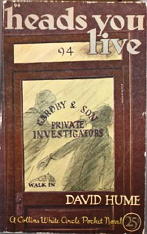
DAVID HUME – Heads You Live. Collins, UK, hardcover, 1939. Collins White Circle #94, Canada, paperback, 1944 (shown). No US edition.

   Another investigation, if you are generous and willing to call it that, by Cardby & Son, Private Investigators, although this features the son, Mick, whose father appears only infrequently.

   This, I take it, is an example of the typical tough-guy English novel. If it is, it is about the level of most American tough-guy novels of the period, filled with a great deal of senseless violence perpetrated by both the good and bad guys,·although Cardby fils, despite some splendid efforts on his part, doesn’t kill anyone.

   As is usual in this type of novel, there is little plot. Cardby & Son, when they make it plain they can’t get a man’s capital out of Austria, are then hired to protect it once it reaches England. It doesn’t reach England, or at least the part of it where Mick Cardby is waiting, and he begins to investigate.

   Several cases of arson, in which Cardby pere and then Cardby fils are the targets, a great deal of shooting and fighting, with a short respite for some minor torture that Mick engages are the highlights, if such they can be called, of the novel.

   Cardby is lucky in that he, not particularly bright, manages to encounter villains even less astute than he. One character, a born killer — Cardby points out that these people are branded as distinctively as cattle, although he is not aware he is facing one until it is too late — also appears to have been born a talker. That talent is what he occupies with until Cardby confuses him by telling that the “safety catch” of his revolver is on. (Another peculiar revolver, this one with a silencer that works, appears in the story earlier.)

   The dialogue is also odd, or at least that is how it strikes me. It sounds much like a mixture — 75% U.S. underworld argot, as imagined by an author, 25% English slang. I had to keep going back to make sure it was all taking place in England.

   For those readers who like a lot of violence, little realism and even less thought. Still, it is amusing in its own way. And Hume adheres to P.G. Wodehouse’s dictum not to let a female play a prominent role and thus louse up the action.

— Reprinted from CADS 15, November 1990. Email Geoff Bradley for subscription information.

Bibliographic Note:   David Hume was one of two pen names used by J. V. Turner, 1905-1945. There were in all 28 Mick Cardby novels published between 1932 and 1946. Turner also wrote an additional 20 or so detective novels under his own name, as Hume, and as as Nicholas Brady.

« Previous PageNext Page »