REVIEWED BY WALTER ALBERT:         


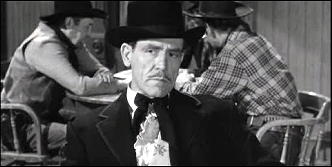
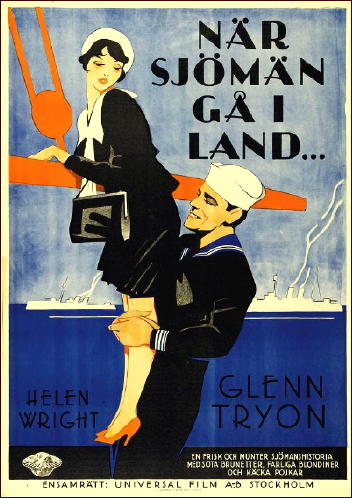
DAMES AHOY. Universal, 1930. Glenn Tryon, Helen Wright, Otis Harlan, Eddie Gribbon, Gertrude Astor. Director: William James Craft. Shown at Cinecon 39, Hollywood CA, Aug-Sept 2003.

   An early version of a situation so memorably later treated by Leonard Bernstein, Betty Comden and Adolph Green in On the Town (the effervescent stage musical, somewhat diminished in the MGM film).

   Tryon, Harlan and Gribbon are three sailors on weekend shore leave. Tryon and Gribbon promise to help Harlan find the conniving blonde who has swindled Harlan out of half his monthly pay as his wife and go to a dance hall where Harlan had met her.

   The problem is that he can only remember a distinctive tattoo and the boys spend much of the film trying to get into position to sneak a peek at the tattoo. During the search, Tryon is maneuvered into a short engagement and quick marriage in a dance contest, but he finds true love, Harlan locates his duplicitous blonde, and all three sailors seem headed toward domestic bliss at the end.

   A pleasant, low-keyed comedy.

DAMES AHOY


Editorial Comments:   Helen Wright’s movie career was a short one. According to one online source, she was an operatically trained singer with blue eyes and auburn hair. She made only one other film, Spurs, a western starring Hoot Gibson that was also released in 1930.

   And in case you were wondering, the tattoo (or birthmark; sources vary) was on her knee.

IT IS PURELY MY OPINION
Reviews by L. J. Roberts


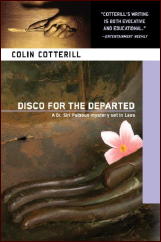
COLIN COTTERILL – Disco for the Departed. Quercus, UK, hardcover, 2006. Soho Crime, US, softcover, August 2007.

Genre:   Licensed Investigator/Paranormal. Leading character:  Dr. Siri Paiboun; 3rd in series. Setting:   Laos, 1977.

COLIN COTTERILL - Disco for the Departed

First Sentence:   Dr. Siri lay beneath the grimy mesh of the mosquito net watching the lizard’s third attempt.

   Dr. Siri and his associate, Nurse Dturi, have been sent to a “guest house” at revolutionary headquarters in the mountains of Huaphan province to attend a seminar intended to provide them with an “enlightened” understanding of the Marxist-Leninist system.

   What they did not expect was for an arm to be discovered rising out of a concrete path. The arm was attached to the body of a man who’d been encased in the concrete while still alive.

   Siri also did not expect, at 73, to find himself dancing to disco music only he could hear, nor for the Russian to whom Siri and Dturi reported back in Vientiane to ship their mortuary assistant, Geung off to Xieng Ngeim without their knowing.

   It is always a pleasure to be back with Dr. Siri and friends. They truly are some of my favorite characters and it was particularly nice to learn more of mortuary assistant Geung’s background.

   Cotterill works in an interesting point through Siri’s friend, Dr. Santiago who believes in shamans and the spirit world, that some form of shamanism is common to most cultures of the world outside those of European origin. Points such as that remind us the world is one filled with diverse philosophies and beliefs beyond our own; one of the gifts of reading.

   Cotterill’s writing is filled with wonderful dialogue and humor, yet he also makes me think. The supernatural element [Siri’s gift for conversing with the dead] is not present only for the sake of fantasy; Coterill uses it to serious purpose — to make a point such as the impact of war on its innocent victims; those who just happen to live in the wrong place. He also makes us aware that bigotry exists in every country.

   The story is one of relationships and loyalty. The mystery is an intriguing blend of the mystical and the plain, old ferreting-out of information. The book is an absolutely wonderful read.

BLACK MEMORY. Ambassador Bushey, UK, 1947. Michael Atkinson, Michael Medwin, Frank Hawkins, Winifred Melville, Jane Arden, Moyra O’Connell, Sydney James, Arthur Brander. Story, screenplay, assistant director: John Gilling. Director: Oswald Mitchell.

   I’ll go out on a short limb here and say that most of the names in the cast are as unknown to you as they were to me, unless you live in the UK. For several, it was one of their earliest appearances on film.

   It’s a very minor film, a crime drama, but on the other hand, what was the movie industry like in the UK in 1947? You will have to tell me, I’m sorry to say, but maybe making films this soon after the war was low on the list of the country’s priorities.

   The beginning is rather confusing. This is one of the movies in which the explanations come only as the film goes along, and good luck with that if you live in the US and British accents are sometimes decipherable and sometimes you don’t fare so well. A bigger problem, though, is that the copy I have of this rare film is not the best; the picture is somewhat faded and the sound had to be cranked up to ten.

   But given the luxury of watching the first 20 minutes or so of this film again, I took advantage of the chance I had, and I’m fairly certain I can tell you something about the story line.

   During a local disturbance of some sort (drunken louts egged on, perhaps) a man is killed, and another man who is actually innocent is arrested for the crime, tried, found guilty and hung. This takes up all of five minutes or so of running time.

   The son of the man found guilty, perhaps ten or twelve years old, is faced with a dying mother and a gang of local boys his own age who pick on him before they follow him off to a sort of orphanage/reform school, from which he quickly decamps through a open window. Another five minutes has passed.

   Ten years later, story time: The boy (now a young man) returns, takes a room with the family of his mother’s best friend. Of the two adopted daughters, one takes a shine to Danny (that’s his name), but the other, running with a tough crowd, takes up with Danny’s former tormenter, Johnnie Fletcher (Michael Medwin).

   To complicate matters, Johnnie has plans to rob the sewing factory where the two girls work. Assisting him – willingly or not – is one of the men on or near the scene where the murder took place ten years earlier.

   This was billed as a “noir” film when my copy was sold to me on DVD, and if the production values could only have been higher, it may have been a very effective vehicle in showing what life was like in postwar England for the lower classes.

   Unfortunately, it’s only in bits and pieces and occasional places that the plot rises above the purely pedestrian. If I were Leonard Maltin, the best I could give this movie would be 1½ stars out of five and I still think I’d be just a little bit generous if I did. Nonetheless, its historical significance is high, so I was glad to have had the opportunity to have seen it, and you may too.

1. INQUIRY: From Bill Pronzini: Just for the heck of it, here’s a quiz question for you and M*F readers: Can you name at least one mystery novel narrated by a chauffeur, or in which a chauffeur is the investigating detective? I can supply the title and author of one and am wondering if there are others.

2. A New OTR Website. It might not be correct to call the CBS RADIO MYSTERY THEATER “Old Time Radio,” but given that the program ran for eight years beginning in 1974, it means that it’s been nearly 30 years since its last broadcast. There is a website that not only lists all 1399 episodes, but it also includes cross-listings for all of the performers and writers. And not only that, you can download or listen to each and every one. How many months would that take, if you did it non-stop? Pull out your calculators! Check it out at http://www.cbsrmt.com/

3. Pulp fiction writer Charles Boeckman is 91 and no longer writing, but his jazz band is still going strong. Check out a photo gallery of his latest gig here.

4. Headline in a local paper: Police were called to a day care center where a three-year-old was resisting a rest.

UPDATE. 01-06-12. My description of Charles Boeckman as a pulp fiction writer was challenged on a Yahoo group where I also posted the link to the photo gallery above. I was advised that Boeckman was a writer of hard-boiled fiction but not published in pulp magazines.

   I shouldn’t have been so short and brief in my post there, nor in the one above. I should (and could) have supplied more of a résumé for Boeckman, and I’m sorry I didn’t.

   It was Walker Martin who came to my rescue on that Yahoo list, and I hope he doesn’t mind my repeating some of the credentials for Boeckman I should have provided:

    “Charles Boeckman under the name Charles A. Beckman started writing for the Popular Publication line of pulps in the late 1940’s and continued until the pulps bit the dust. Such titles as Fifteen Western Tales and Detective Tales carried much of his short fiction. He also made the switch to the digests. I recently noticed his name in Manhunt.”

   Boeckman is one of the very few authors who wrote for the pulps still living — a survivor — and he should be recognized as such. I’m wondering whether he might be a suitable guest for one of the two annual pulp conventions sometime soon. Playing in a jazz band at the age of 91 seems to suggest that his health may be good enough to attend.

FIRST YOU READ, THEN YOU WRITE
by Francis M. Nevins


   As a novice widower I find myself thinking of three other mystery writers who lost wives to Mister Death. The first name that springs to mind in this connection is Raymond Chandler (1888-1959), who was so devastated by the death of his wife Cissie that he tried to shoot himself in his bathroom.

   Being blind drunk at the time, he missed his target. “She was the music heard faintly at the edge of sound…” he said of Cissie. “She was the light of my life, my whole ambition. Anything else I did was just the fire for her to warm her hands at.”

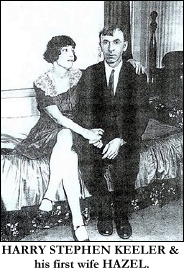
HARRY STEPHEN KEELER & first wife Hazel

   Next comes Harry Stephen Keeler (1890-1967), whom I never met but have been associated with for most of my life. He married the former Hazel Goodwin in 1919 and they were together until she died of cancer in May 1960.

   During the months of her final illness and after her death he was unable to write fiction, but he continued sending out his off-the-wall “Walter Keyhole” newsletters to just about everyone whose address he had.

   He called them polychromatic or multitinctorial cartularies since each page was printed on paper of a different color. We who have lived into the computer age recognize them as the functional equivalent of a blog. It cost him as much as $50 to have each installment prepared by a professional typing service and mailed out en masse.

   I have originals or photocopies of 188 of these, which a few years ago I organized and offered to a panting public as The Keeler Keyhole Companion (2005). Among the hundreds of topics he touched on was his life as a lonely widower in his early seventies, “a guy who lives on canned Campbell’s soups and canned Sultana pork and beans.”

   Here’s his account of the “long lonely Thanksgiving holiday” in 1962. “We [he often uses the royal we in these cartularies] had our choice of having 3 soft-boiled eggs (only thing we can cook) as a dinner, then seeing the Three Stooges conk each other over the heads [at the local movie house], or of having 3 soft-boiled eggs as a dinner and re-reading Keyser’s Mathematical Philosophy. You guess!”

   I now feel closer to that genuine mad genius than ever before. He was only a year or two older at his wife’s death than I at Patty’s. He sold the old house they had lived in for decades and moved into an apartment hotel, while I’ve recently bought a condo and put my own Toad Hall on the market. I’m no better at cheffery than Harry was but have the advantage of living in the age of that fantastic contraption known as the microwave.

   The third author in whose moccasins I now walk became a widower not once but twice. Fred Dannay (1905-1982), better known as Ellery Queen, married the former Mary Beck in 1926. She died of cancer on July 4, 1945, leaving Fred with two small children to raise.

   In 1947 he married the former Hilda Wiesenthal, who was ten or eleven years younger than he and was the daughter of a cousin of Nazi hunter Simon Wiesenthal. She died in 1972, also of cancer.

   By that time I had come to know Fred well and he had become the closest thing to a grandfather I had ever known. I went through this awful period of his life with him. There’s a photograph of him taken at this time which shows the empty devastated face of a man waiting for the dark to claim him.

   Just as Keeler had married again a few years after Hazel’s death, so did Fred a few years after Hilda’s. I got to know Thelma Keeler well and am convinced that she saved her husband’s life. I also have no doubt that Fred’s third marriage, to the former Rose Koppel, saved his. Will I luck out in my final years as they did?

***

   I apologize for devoting so much of this column to death but I really don’t have much choice at the moment. Less than a week before Christmas I learned that I’d lost one of my closest mystery-loving friends.

ROBERT E. BRINEY R.I.P.

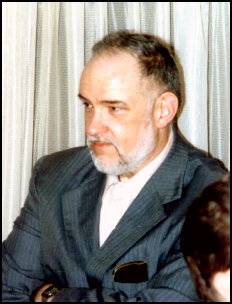
   Bob Briney was something of a universal genius. Physically he evoked Orson Welles or Nero Wolfe but was soft-spoken and totally without their irascibility and moved with a certain gingerliness as if he were afraid he’d crush something if his movements were more forceful.

   He was born near Benton Harbor, Michigan in December 1933 and spent most of his academic career in Massachusetts, at Salem State University. He earned a Ph.D. in mathematics and recovered from the ordeals of his dissertation and orals, so he told me, by reading most of the novels of John Dickson Carr in less than a month.

   Like the clever men of Oxford in The Wind in the Willows, he “knew all that was to be knowed”—about mystery fiction, fantasy, s-f, horror, Westerns, just about every form of popular fiction you can name, plus ballet and opera and movies and classical music and so much more.

   His ability to keep prodigious masses of data in perfectly organized form would have shamed many a computer. He wrote prolifically and with dry wit about books and authors, assiduously collected works in the genres he loved — every room in his large house including the bathroom was a library first and foremost — and corresponded with Sax Rohmer, P.G. Wodehouse, John Creasey and countless other authors.

   It was pure pleasure to read his commentary or listen to his conversation. We started corresponding in the late Sixties, thanks mainly to Al Hubin and The Armchair Detective, and met for the first time in 1970 when I took a bus from New Jersey to a science fiction convention in Manhattan that he was attending.

   Beginning in 1980 he followed in Keeler’s footsteps by putting out the pre-computer equivalent of a blog, which he called Contact Is Not a Verb (a famous line from one of Rex Stout’s Nero Wolfe novels) and kept going until September 2006, a grand total of 149 issues, of a copy of every one of which I am a proud possessor.

   Bob developed diabetes and in the fall of 1990, when I was a visiting professor in New Jersey, had to have some of his toes amputated. Unable to climb the stairs of his own house, he was sleeping in a hospital bed installed on the ground floor. I traveled to Salem by Amtrak and spent a long weekend playing housekeeper: schlepping cartons around so he could access the classical music he loved, taking his clothes to the laundry, even cooking us a few meals (for whose quality I will not vouch).

   Until a few years ago we would rendezvous every summer at the Pulpcon in Dayton, Ohio. Then unaccountably this shy but gregarious man dropped out of sight. Almost no one heard a word from him or knew anything about his health.

   Finally, just a few days before Christmas, I learned he’d been found dead in his house late in November. He had no immediate family. As of this writing I don’t know the cause, or what will happen to the vast library he had accumulated over the decades. All I know is that he was one of the most brilliant and memorable people in my life.

ROBERT E. BRINEY R.I.P.

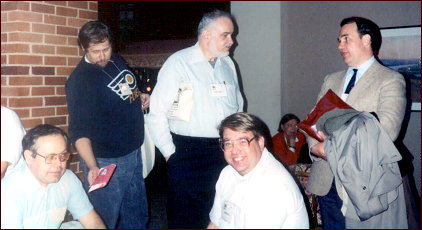
Bouchercon, Philadelphia, 1989. Me (Steve Lewis), Art Scott, Bob Briney, George Kelley, and Mike Nevins. Photo taken by Ellen Nehr.


ROBERT E. BRINEY R.I.P.

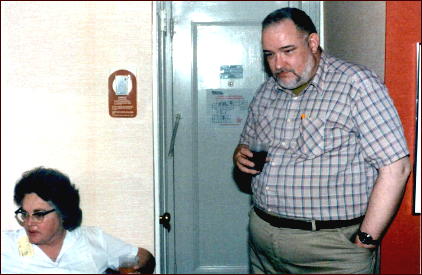
Bouchercon, New York, 1983. Ellen Nehr and Bob Briney.


ROBERT E. BRINEY R.I.P.

Bouchercon, Chicago, 1984. Marv Lachman, Bob Briney, Ellen Nehr and Steve Stilwell.


   Many thanks to Art Scott for providing the photos above.

THE BACKWARD REVIEWER
William F. Deeck


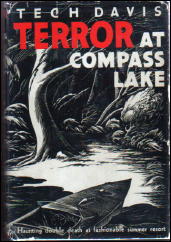
TECH DAVIS – Terror at Compass Lake. Doubleday Crime Club, hardcover, 1935.

TECH DAVIS

   Occasionally when I am on the fringes of a group of diehard mystery fans — which is about as close as they’ll let me get — the name Tech Davis is mentioned. Then when I am spotted, the subject is immediately changed.

   Why this happens I do not know. Oh, I know why I’m allowed only on the fringes; it’s their not wanting me to hear about Davis that baffles me. While Davis is not a good author; he isn’t an exceptionally bad one.

   His prose doesn’t elevate, indeed may be said to enervate. His detective, Aubrey Nash, is so bland that I wish he’d been given the one or two idiosyncrasies that I usually deplore in other fictional detectives whose creators can’t seem to make come alive. But he does plot well.

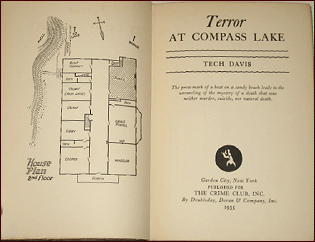
   In this novel, the first of three by Davis, Aubrey Nash is asked to come to the wilds of upstate New York to investigate the apparent suicide of a chauffeur — it must be suicide since everyone has a perfect alibi — and the later stabbing death of his employer in a locked room. Nash isn’t interested until he receives a telegram telling him the crime is insoluble and he shouldn’t waste his time with it.

   Recommended for locked-room fanciers, and other problem solvers.

— From The MYSTERY FANcier, Vol. 12, No. 4, Fall 1990.


TECH DAVIS Compass Lake


BIBLIOGRAPHY: Mystery fiction by TECH DAVIS, pen name of Edgar Davis (1890-1974). Series character: Aubrey Nash in all.

      Terror at Compass Lake. Doubleday, 1935.
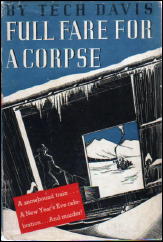
      Full Fare for a Corpse. Doubleday, 1937.

TECH DAVIS

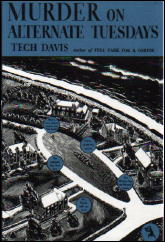
      Murder on Alternate Tuesdays. Doubleday, 1938.

TECH DAVIS


Editorial Comment:   Just in case anyone is tempted by Bill’s last line into putting together a complete set of all three Tech Davis mysteries, there are five copies of his books currently listed on ABE. Four of them are of Compass Lake, available at $75 and up, and there’s one of Full Fare, the latter having an asking price of a fairly solid $250.

   And not a single copy of Alternate Tuesdays.

UPDATE. 01-08-12.   Thanks to Bill Pronzini, I can now show you cover images for all three Tech Davis mysteries, in jacket.

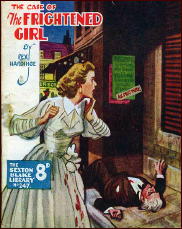
REX HARDINGE – The Case of the Frightened Girl. Sexton Blake Library #247. Paperback original. [Amalgamated Press, UK, 3rd series, September 1951.]

   The basic premise of this short novel, 64 pages of small type in a double-column format, was promising – in fact, more than promising, if “impossible crimes” are meat if not potatoes in your regular diet of detective fiction reading.

THE CASE OF THE FRIGHTENED GIRL Sexton Blake

   The girl in the title is Moira Leonard, a girl with a fabulous singing voice, but with a overbearing Svengali of a manager and singing instructor. After her public vocal debut, she cracks under the strain she’s been under and flees the music hall. Max Rosen follows her, argues with her, and ends up dead, stabbed in the back, with plenty of witnesses to say there she was the only one near their final (and fatal) confrontation.

   But when the body is examined there is no murder weapon to be found. The girl must have done it and taken the knife with her. Sexton Blake does not believe she did the deed, however, nor does his young assistant Tinker, especially the latter, even though she has disappeared, and into literal thin air.

   This takes us through the first eight or nine pages. We also learn that Ron Pearce, a would-be lover of Moira – they grew up together in the same orphanage – would have also had a motive, but the absence of the weapon clears him.

   So as I say, a promising premise, but once we learn that Pearce is the one responsible for kidnapping Moira, there is little more I need to tell you about the story.

   Rather than a detective story – until the end when the “how” is revealed – this is a thriller novel, and not a very good one. There is too much padding, too much recapitulation of the plot, and too much chase and too little suspense to give me little reason to recommend this to you, unless you’re curious about knowing what a Sexton Blake novel was like in the early 1950s. Or at least what this one was like, as I was.

   And oh, as for the “impossible crime” aspect? Totally mundane and not very believable at that. [See Comment #1 for more!]

REVIEWED BY DAN STUMPF:         


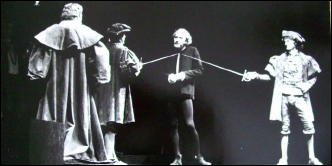
HAMLET Nicol Williamson

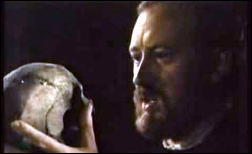
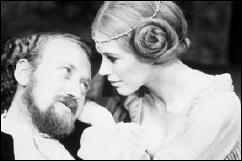
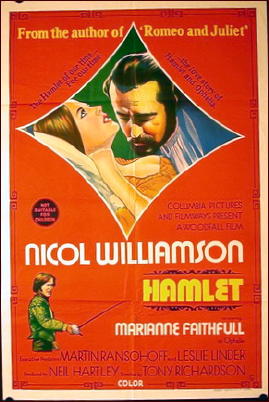
HAMLET. Columbia, 1969. Nicol Williamson (Hamlet), Judy Parfitt (Gertrude), Anthony Hopkins (Claudius), Marianne Faithfull (Ophelia), Mark Dignam, Michael Pennington, Gordon Jackson, Ben Aris, Clive Graham. Based on the play by William Shakespeare. Director: Tony Richardson.

   I also recently saw Nicol Williamson’s 1969 film of Hamlet, directed by Tony Richardson, made on the heels of Zeffirelli’s surprise Romeo & Juliet hit. Didn’t care much for it, but I was prejudiced two-score years ago by the film’s banal ad campaign, which billed it as “The story of Hamlet’s immortal love for Ophelia!”

HAMLET Nicol Williamson

   Now Hamlet is about a lot of things, but it ain’t about Hamlet’s love for Ophelia, and this slant on the film, intentional or not, put me off on it right from the outset, no doubt clouding my judgement somewhat.

   Williamson plays Hamlet as a bookish Grad Student, Weak rather than Vulnerable and Pedantic instead of Poetic. It’s a valid interpretation, but not much fun to watch for two hours.

   Likewise Judy Parfitt’s portrayal of Queen Gertrude as Lady MacBeth. Marianne Faithfull is okay as Ophelia, but an incredibly young Anthony Hopkins, looking like a kid in a false beard, is woefully out of his depth as the King.

HAMLET Nicol Williamson

   This is very much a late-60s film, with the kids in revolt against corrupt and complacent authority figures, which again is a valid interpretation, but robs the play of some of the depth and complexity it gets when characters like Polonious, Claudius and Gertrude are developed as rounded characters.

   Finally, there are no sets to speak of (this looks to have been shot in the back of UCLA’s Theatre Department Building) and Richardson tries hard to hide this by concentrating on close-ups and restricting physical movement, which works but stifles the action.

— Reprinted from A Shropshire Sleuth #52, March 1992.


HAMLET Nicol Williamson

A THREE STOOGES Movie Review by MIKE TOONEY:


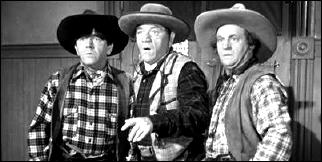
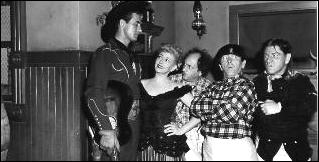
“Punchy Cowpunchers” (1950). A Three Stooges short. Running time: 17 minutes. Shemp Howard, Larry Fine, Moe Howard, Jock O’Mahoney (Elmer), Christine McIntyre (Nell), Kenneth MacDonald (Dillon), Dick Wessel (Mullins), Vernon Dent (Colonel), Emil Sitka (Daley), George Chesebro (Jeff, uncredited). Written and directed by Edward Bernds.

PUNCHY COWPUNCHERS

   The Three Stooges are definitely not for all tastes, so if you don’t like slapstick comedy just skip this review.

    Punchy Cowpunchers” spoofs just about every cliche hitherto found in Western films: the outlaw gang looting the town; the stalwart, jut-jawed, guitar-playing, “aw shucks!” hero; the virginal love interest for the hero; and the U.S. Cavalry ready to ride in on a moment’s notice and save the day.

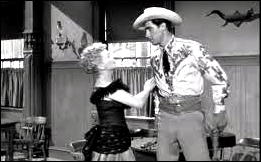
   Only the outlaws (“The Killer Dillons”) aren’t too bright — and neither is our hero (Elmer), a total klutz who can’t stay on his horse, constantly collides with objects and people (“I hurt mah knee agin”), forgets to load his guns (and when he does remember can’t shoot straight), and, let’s face it, doesn’t play his “geetar” very well.

PUNCHY COWPUNCHERS

   As for his “gal” (“Nell honey”), she’s far from being the “poor, defenseless woman” she claims to be. When one gang member after another tries to kidnap her (for nefarious purposes, no doubt), she decks them all and then each time demurely passes out — but not until she’s found something soft to land on.

   And forget the cavalry — they just got paid, and as the colonel says, “Well, you know, boys will be boys.”

    Punchy Cowpunchers” takes the best of Stooges slapstick and distills it into less than twenty minutes of fast-paced nonsense. The only other short feature I really liked from these guys was “Dutiful But Dumb” (1941), a political satire featuring Curly’s epic battle with his supper, a bowl of chowder inhabited by a very rude clam (a masterpiece of timing and film editing).

PUNCHY COWPUNCHERS

   The klutzy “hero” was played by Jock Mahoney (1919-89), a former stunt man double for Errol Flynn, Gregory Peck, and John Wayne. Mahoney went on to appear many times in films and TV, including 77 episodes of The Range Rider (1951-53), 34 episodes as Yancy Derringer (1958-59), and several appearances in Tarzan films, sometimes as the villain and sometimes as the vine swinger himself. For a more intellectual Mahoney, see the sci-fi snoozer The Land Unknown (1957).

    “Nell honey” was played by Christine McIntyre (1911-84), who possessed an operatic-level singing voice (not employed in Punchy Cowpunchers”). She spent most of her film career working in short features, many of them with The Three Stooges. She even appeared several times in Mahoney’s Western series, The Range Rider.

PUNCHY COWPUNCHERS

   Kenneth MacDonald (1901-72) frequently showed up in Stooges shorts as a bad guy. He went on to play the judge 32 times in the Perry Mason series, starting with the second show and finishing up with the very last episode.

   Mention should also be made of George Chesebro (1888-1959), whose film career started in 1915. Chesebro often appeared as a henchman (usually the third one through the door) or a cop. The IMDb credits him with over 400 titles.

   You can watch Punchy Cowpunchers in two segments on YouTube: Part 1 here and Part 2 here.

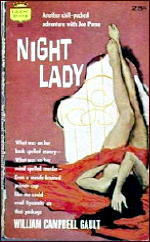
WILLIAM CAMPBELL GAULT – Night Lady. Crest 260, paperback original, 1958. T.V.Boardman, UK, hardcover, American Bloodhound Mystery #307, 1960. Never reprinted in the US.

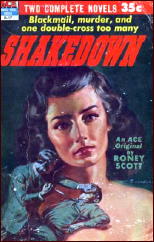
   William Campbell Gault got his start writing for the pulp magazines, beginning around 1940, maybe earlier, producing not only mystery stories and crime fiction, but doing a slew of sports stories as well. When the pulps faded away and paperbacks came along, he, as did many others, went with the flow. His first Joe Puma novel, Shakedown, was written under the name of Roney Scott as half an Ace Double in 1953.
WILLIAM CAMPBELL GAULT

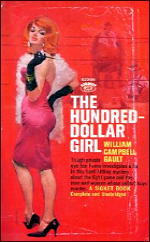
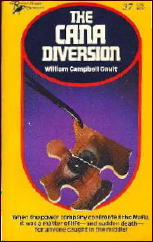
   Then after a short hiatus came five Puma adventures in three years from Crest, then a hardcover novel, The Hundred-Dollar Girl, from Dutton in 1961. Gault switched to writing boys’ adventure fiction after that, and Joe Puma disappeared until The Cana Diversion was published in 1980 – about which more in a moment.

   In many ways Joe Puma is your standard medium-boiled kind of private eye. His bailiwick is Los Angeles and immediate environs, mostly the seedier side of town, mixing it up with former small-time hoods, chiselers, grifters and big-time mobsters, along with a wide assortment of women. Night Lady is Puma’s third appearance, and while I can recommend it to almost any devout fan of private eye fiction, I have some serious reservations about it, and it’s highly unlikely that any publisher would consider reprinting it today.

   I may totally wrong about this, but in terms of his writing, Gault seems to have been somewhat of a maverick, refusing to go along with the conventional, and veering off on occasion into strange, unusual ground.

   Take the following excerpt from the first couple of paragraphs from Night Lady, as a mild example. As any good pulp writer should know, the first few lines are the most crucial in sucking the reader into the story. They have to be good, clear, and picturesque. Not this time. Here’s Gault’s take on professional wrestling and the wrestlers themselves:
WILLIAM CAMPBELL GAULT

   It’s a trade that appeal [sic] to the narcissist. And from self-admiration it’s only a step to love of like for like.

   And love of like for like can lead a man into something as socially responsible as Rotary or something as socially repugnant as homosexuality.

   What is “love of like for like”? It stumped me the first time I read it, and the second and third time, too. The words were there, but they didn’t make sense.

   You’re probably way ahead of me in knowing what Gault was saying, but to me, it was like running a race with hurdles, and suddenly the hurdles are too close together, you trip, and you knock down the next one, and suddenly you’re cartwheeling down the track, arms and legs swinging out in all different directions, thud, thud, thud – and it stopped me cold.

   And at the least, I wasn’t expecting this particular variety of deeply felt philosophy (page 23) to be expressed so abruptly and succinctly, not in the first paragraph. It caught me by surprise. I wasn’t an English major in college, and I avoided all of the English courses that I could, so don’t give me a letter grade on any of what I’m saying, but in any case, I think I flunked the first page.

   You’ve also noticed the reference to homosexuality. In terms of either political correctness or just plain good taste, there are some references to gays in this book that probably would cause some fuss if they appeared in most fiction today: lavender lads (page 9), weirdies (page 11), a pansy bed (page 14), homo (page 29) and the old stand-by, queer (page 49). The word “gay” itself is not used.

   Sometimes it’s Puma talking, sometimes it’s the people he’s talking to, without any particular rancor, other than the choice of words, but they’re there and they can’t be ignored. Someone else will have to finish this doctoral dissertation from this observation onward, however, not me.
WILLIAM CAMPBELL GAULT

   You’re still waiting for me to say more about The Cana Diversion, perhaps. I haven’t forgotten, but let me first take care of those people who want to know more about the case Puma is working on in this book. He’s hired by a successful show-business wrestler named Adonis Devine to find his business manager, who’s been missing for two days. The business manager, male, also lives with Adonis, which means calling in the police may cause some problems.

   When the missing man is found dead, the police do have to be called in, but since Puma does his best to stay on the good side of the law, he not only manages to keep a lid on things best kept hushed up, but he’s allowed to keep working on the case.

   Which he does, and not only that, he obtains a new client, a rich girl who Puma thinks is seriously slumming, given her previous relationship to the dead man, his connection with the crooked (well, fake) wrestling entertainment business, and his “double-gaited” life style.

   There is another girl involved as well, an eye witness to the killer’s departure, who is nice and who naturally needs Joe Puma’s protection. He’s kind of prickly about it, though. He’s a very class-conscious sort of individual. The women in this case, especially his new client and her friends, are high class group of people. Joe is lower middle class, and he quietly resents it. There is a chip on his shoulder throughout the book, not a nasty one, but a noticeable one.

   Unusual. It gives the story some oomph that lesser accomplished private eye writers wouldn’t include, an edge that Gault has that other authors don’t. As for the mystery itself, Puma does a lot of detective work, but on page 128, with less than 30 to go, he himself has to admit that he has no more leads to follow or suspects to interrogate.

   Then with some inspired guesswork and a curious slip on the part of the killer – there’s little the armchair detective at home could do to contribute – the case is solved, with still almost ten pages to go.

   More of Gault’s maverick writing nature at work. Instead of cleaning up the loose ends, as he easily could have, Puma takes the time instead to fight a grudge match with his original client, Adonis Devine, the wrestler. Over five pages worth.
WILLIAM CAMPBELL GAULT

   He also ends up in bed, just before that, with one of the two women in the case. I leave it to you to decide which one, or read the book for yourself. Given the caveats I’ve already expressed, Gault was a writer who always had something to say, and here as well, he’s definitely worth reading.

   Now. If you’ve never read The Cana Diversion, and you think you might want to, you might also want to stop here. It’s common knowledge, though, so it’s not as though I’m releasing the Pentagon papers.

   Gault’s other private eye detective was Brock “The Rock” Callahan, and when Gault starting writing mysteries again in the 1980s, he brought them together in the same book, The Cana Diversion.

   Unfortunately, what he did was make Puma the murder victim, leaving Callahan the task of tracking down his killer. No other author has ever done this, before or since. I don’t know about you, but the idea has always seemed awfully creepy to me, and I’ve never read the book. (That’s a purely personal reaction, and if I were to try to explain further, it would probably tell you more about me than either you or I would want to know.)

   And I realize, of course, that this leaves me open to widescale expressions of surprise and disdain, if not derison and dismay. In 1983 The Cana Diversion did nothing less than win the Private Eye Writers of America award for the Best Paperback Original of the Year. Sometimes it pays to go your own way.

Note: Thanks to Bill Crider, Richard Moore and Bill Pronzini for some insightful commentary they made on some preliminary versions of this review. The opinions as expressed above, however, remain as always, mine alone.
— December 2003

« Previous PageNext Page »