REVIEWED BY TREVOR TRILLION:


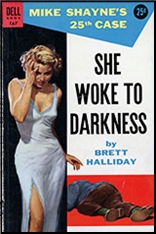
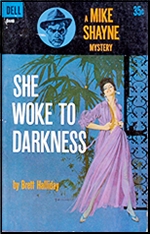
BRETT HALLIDAY – She Woke to Darkness. Mike Shayne #25. Torquil/Dodd Mead, hardcover, 1954. Dell #867, paperback, 1956; reprinted as Dell D446, paperback, 1962.
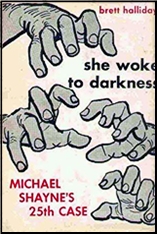
   The 25th case for Michael Shayne, who finally appears in Chapter 11. Since 1938, Shayne arrived in the first sentence of 21 books. I will mention some of the plot in this review, but truthfully, I am compelled to talk about significant changes in Davis Dresser’s writing style; his sudden desire to “crank up” the sexiness and violence in dialog among a lower class of despicable characters.

   Brett Halliday, the major character, attends a Mystery Writer’s Convention in NYC, 1953. In the author’s foreword, Dresser, as Brett, states that Mike Shayne’s “previous 24 books were written in Third person by me”, but now this case has happened to me,’ and in first person. Brett becomes the #1 murder suspect.

   Surrounded by contemporary writers both real and fictitious, Brett overhears harsh criticism, describing him as an ”out-dated old timer”, a hack writer… doubt if he ever reads anything but his own stuff… what a bore that must be”. From peer pressure, style changes begin.

   As usual, the cognac flows throughout pages 11 to 25. This boozing allows Brett to meet his newest admirer, Elsie, the heavy-drinking, hot babe, mystery-writer-wannabe. She’s writing a True Crime murder mystery based on her own horrible experience three months ago, and would Brett please read it to suggest a continuation?

   They go back to her place, Brett gets the original 56-pages, they drink more, kiss more, as Brett begins his new-found romantic style. He lights two cigarettes (a la film Now, Voyager, 1942) “… her eyes dancing, ‘Darling’. It was a long kiss…”. Elsie gets a phone call then kicks Brett out at midnight. Guess who the Police find strangled at 2am?
   Elsie had commented that she read all 24 Shayne mysteries, in order, and considers Mike Shayne, ” …so real, not like Philo Vance (the 1920s-30s fictional crime solver). … Characters like Philo remain so exactly the same book after book, year after year. They never change.”

   Brett’s words here are his own, sarcastic comment upon his Shayne, because for 24 books Shayne is one that has remained the same… and sadly, Dresser knows it. Shayne never develops from his hot-headed ways; his cognac for breakfast, lunch, dinner, cognac before driving and taking Lucy Hamilton’s affections for granted. (Spoiler alert: Readers will see changes in books 25 – 31)

   Halliday now reads Elsie’s first chapters where several cruder types, not found in earlier Shayne novels, are described using their new names, but keeping the true facts in the case.

1. Aline, is Elsie’s new name… “She Woke To Darkness” alone (?) in a hotel bed with a two-dollar bill stuffed in her rolled-down nylons. She’s become a “two-dollar whore,” has alcoholic black outs. She remembers nothing about last evening.
2. Mr. Unknown, an unattractive, dead guy with his throat slashed… on the hotel room floor.
3. Ralph, the suave, ever-horny, ladies’ man.
4. Doris, the plump, blonde, that opens her front door at midnight, for Ralph.
5. Dirk, the (again) alcoholic-black-out, married guy, smooched, then was rejected by Elsie, and he can’t remember anything either.
6. Gerry, who will swear Elsie is guilty of murder, or could her body keep him quiet? New vocabulary: “he pressed his pelvic bone against hers”’ (This was probably pretty racy dialog in 1954.)
7. Brett Halliday, who is described thusly:, “drunk as a coot, has-been loser, one-eyed bastard, He writes those lousy books about a redhead Miami detective.”
   Shayne flies into NYC becoming desperate character #8 because murder suspect #1, Halliday, goes missing. Two murders and now Halliday might be number three? Shayne visits suspects and lays on the new, 1953 charm, “Give me his name or, so help me, sweet Jesus… I’ll kick your face into a pulp that none of your women will ever recognize again.”

   “Tell him…” sobbed Estelle, “He’s capable of anything.”

   Shayne yells, “I’m going to beat his God-damned brains out.” (Yikes, Brett, Mike, the Lord’s name taken in vain? That’s a change!)

   In conclusion, the romance ended in chapter three, everybody lies, and kidnapped Brett is beaten senseless. The cops were stumped, Shayne solves it and Mr. Unknown never spoke a word. Usually the victim has a role somewhere in a Shayne novel… not here.

   Rest assured Readers, these changes affect the next few Dresser novels. After 24 shy novels along the lines of, “she had a small waist, her skirt rose above her knee, her curves…” Those days are over. In #26, Death Has Three Lives, Shayne demonstrates undying love for kidnapped Lucy. Violence abounds in #27, Stranger In Town, Shayne is beaten to a pulp and still kills a guy. #30, Shoot The Works, we meet Kitty and Lola; two of the horniest, hot young ladies yet. But Shayne is still loyal to Lucy.

   Finally, in 1958, Dresser rewrites 1946’s Dinner At Dupré’s, into an expanded version titled, Murder and the Wanton Bride. Dresser ends his writing career with #31, a “Wanton Bride” to surpass all previous babes; more desirable and provocative than any McGinnis cover art. (Chapter 8 is devoted to her.)

   Viva the new 1954-style Brett Halliday!
REVIEWED BY JEFF MEYERSON:


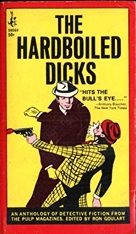
RON GOULART, Editor – The Hardboiled Dicks: An Anthology and Study of Pulp Detective Fiction. Sherbourne Press, hardcover, 1965. Pocket 50560, paperback, 1965.

   This excellent anthology has an introduction by Goulart and eight stories originally published in Black Mask, Detective Fiction Weekly and Dime Detective between 1932 and 1941. Goulart says that he hopes to rescue a few hardboiled detectives from oblivion. He has certainly chosen fine stories for it.

   Probably the best story in the book is Lester Dent’s “Angelfish,” about Oscar Sail, which is almost as good as the earlier “Sail.” It’s unfortunate that Dent didn’t write more short stories of this type rather than the Doc Savage stories. Two other excellent stories are Raoul Whitfield’s “China Man,” about island detective Jo Gar in the atmospheric Philippines, and Norbert Davis’s tough and amusing “Don’t Give Your Right Name,” featuring Max Latin.

   Richard Sale’s A Nose for News” and Frederick Nebel’s “Winter Kill” have newspapermen as detectives, while others feature a cabby (John K. Butler’s “The Saint in Silver”), encyclopedia salesman Oliver Quade (Frank Gruber’s “Death on Eagle Crag”), and crooked detective Lester Leith (Erle Stanley Gardner’s “Bird in the Hand”). There isn’t a weak story in the bunch. Recommended.

–Reprinted with permission from The MYSTERY FANcier, Vol. 1, No. 2, March 1977.

REVIEWED BY DAN STUMPF:


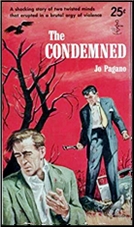
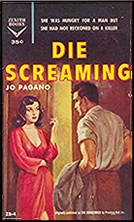
JO PAGANO – The Condemned. Prentice-Hall, hardcover, 1947. Perma Star, paperback, March 1954/ Also published as: Die Screaming (Zenith, paperback, 1958).

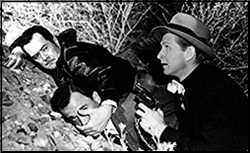
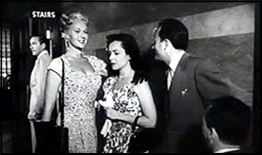
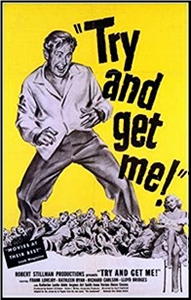
THE SOUND OF FURY. United Artists, 1950. Re-released as Try and Get Me!. Frank Lovejoy, Kathleen Ryan, Richard Carlson, Lloyd Bridges, Katherine Locke. Adele Jergens. Screenplay by Jo Pagano, based on his novel The Condemned. Director: Cyril Endfield.

   Philosophers and scientists posit the existence of a Life-Force, an energy behind the existence (and persistence) of life under the most adverse and unlikely conditions throughout the- world, and perhaps the universe. Well, I’ve come to suspect the existence of a Pulp-force, an irresistible pressure. that takes profound ideas and classic works of art, music and literature, vulgarizes them (This is not always a bad thing.) and turns them into Pop Art. So we get rock songs based on themes from classical music, Classics Illustrated comic books, and films like ROMEO AND JULIET (1996) and WAR AND PEACE (1956) with Henry Fonda as a Russian aristocrat.

   Case in point is a novel written by Jo Pagano in 1947, THE CONDEMNED. It opens with a taut, engrossing kidnap-and-murder, then flashes back to the events and social conditions that led Howard Tyler, veteran and family man, to hook up with sociopath Jerry Slocum for a series of petty robberies that culminate in tragedy. Pagano handles the action well enough – even memorably sometimes — and ratchets up the suspense quite well toward the middle, as a drunken and remorseful Howard tries to keep a grip on reality, but CONDEMNED is also bulked up with pages (And pages. And more pages.) of psychosociological ramblings, as if Pagano were determined to write an “important” book, and it stows up the momentum of what could have been a very fine read, in the Jim Thompson vein. There’s also a coda in the narrative (Based on a true story) that could have had dandy dramatic impact, but here seems merely moralizing.

   THE CONDEMNED was turned into a movie in 1950, released as THE SOUND OF FURY, directed by Cyril Endfield (Better known for epics like ZULU and SANDS OF THE KALAHARI) and adapted by the author, whose screen credits also include JUNGLE MOON MEN. It’s a creditable effort, with effective performances from Frank Lovejoy and Lloyd Bridges (Not usually the most evocative actors in the business) and truly moving turns by Kathteen Ryan as Howard’s worried wife, and Katherine Locke as a pathetic floozie. And I mean they take stock parts and really make them live, helped considerably by Pagano’s writing and Endfield’s feel for character. There are also some effective stylistic flourishes — swiped from other B-movies, but useful nonetheless — like a drunken binge filmed entirely in tilted camera angles, or a robbery shot in one take from inside the getaway car.

   But there are also Important Messages to contend with, and the notion that this movie has to Say Something. So a handful of well-meaning characters try to tell us moviegoers the Meaning of All This, and they get awfully tiresome in the process. Not enough to completely kill the film, but they cripple it up pretty bad.

   And then the Pulp Force began working: SOUND OF FURY (Geeze, what a pretentious title!) was released with all due self-importance — The San Francisco Chronicle made it their “Premier of the Week” — and promptly died a dog’s death at the box office. Nothing daunted, the producers re-titled it TRY AND GET ME! and re-released it with lurid ads to play up its trashy aspects, and a few months after SOUND OF FURY made its pretentious debut, TRY AND GET ME –· the same film in a different wrapper — was unreeling at grind houses and burlesque shows.

   As for the source novel, THE CONDEMNED re-surfaced years later in drug stores and bus-stations as DIE SCREAMING.

— Reprinted from The Hound of Dr. Johnson #40, September 2005.


EARTHBOUND. 20th Century Fox, 1940. Warner Baxter, Andrea Leeds, Lynn Bari, Charley Grapewin, Henry Wilcoxon, Elizabeth Patterson. Director: Irving Pichel.

   This is one of those films in which after a person’s death, his ghost is forced to remain on earth until he somehow rights the wrongs committed by his murderer. The ghost this time around is that of Nick Desborough, Warner Baxter’s character, whose one offense he’s done on the earth is to have ab affair with Lynn Bari’s character while married to Adrea Leeds, who plays his wife.

   And he’s broken off the affair. Lynn Bari doesn’t take this lightly and pulls a gun on him. In the ensuing struggle, the gun goes off, and Baxter is dead. Bari’s husband (and Baxter’s business partner, played by Henry Wilcoxon) takes the blame, and according the one of the rules that ghosts have to play by, it is up to Baxter to exonerate him, even as the case goes to court.

   Charley Grapewin plays Baxter’s elderly and somewhat whimsical Bible-wielding mentor in this land of limbo he is in, but no matter much running around and talking to people that Baxter does, no one can hear him. One should think he would figure this out long before he does, but he perseveres, the real killer is determined, and eventually all is right in the world and beyond.

   I don’t know what you might think, but none of this made a lot of sense to me. The special effects are more than OK, however, making Warner Baxter quite transparent after his character dies and he must carry on in his new ghostly realm.

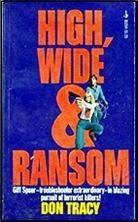
DON TRACY – High, Wide and Ransom. Giff Speer #7. Pocket 80254, paperback original; 1st printing, January 1976.

   Giff Speer, one-time member of a secret Military Police elite, now a run-of-the-mill private investigator, is embarrassed by a skyjacking he can’t lift a finger to stop. A stewardess is killed before his eyes, and it doesn’t go down very well. He also senses that the terrorists responsible are not really on their way to Algeria.

   Speer is not the most cerebral agent around, but he soon becomes the center of a lot of action. Run of the mill.

Rating: C

–Very slightly revised from The MYSTERY FANcier, Vol. 1, No. 2, March 1977.

      —

Bibliographic Notes: Tracy was the author of nine Giff Speer novels. I do not know when he stopped working as an undercover agent for the Military Police and became a PI working on his own, but even though he doesn’t have an entry in Kevin Burton Smith’s Thrilling Detective website, he deserves one.

   For more on the author and his writing career (including a long list of Peyton Place sequels as by Roger Fuller in paperback) go here. One thing I did not realize until now is that the Don Tracy who wrote the Giff Speer paperbacks in the 1970s was the same Don Tracy who wrote four hardcover crime novels in the 1930s.

REVIEWED BY DAVID VINEYARD:


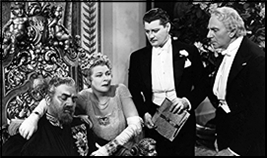
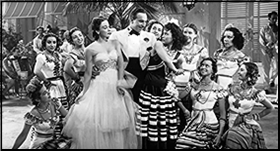
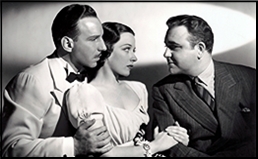
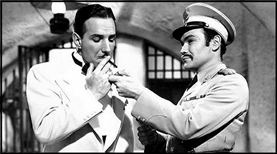
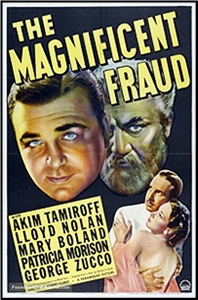
THE MAGNIFICENT FRAUD. Paramount Pictures, 1939. Akim Tamiroff, Lloyd Nolan, Patrica Morrison, Mary Boland, Ralph Forbes, Steffi Duna, George Zucco, Robert Warwick, Albert Biberman. Screenplay by Gilbert Gabriel and Walter Ferris, based on the unpublished short story “”Caviar for His Excellency,” by Charles G. Booth. Directed by Robert Florey. Remade as Moon Over Parador (1988).

   President Alvarado (Akim Tamiroff) is the wise leader of a poor South American nation negotiating with wealthy American Harrison Todd (Ralph Forbes) to save his country, but when Alvarado is assassinated it falls to his right hand man fast talking Yankee Sam Barr (Lloyd Nolan) to cover up the crime so that Alvarado’s crooked successors and Sam can get the money.

   To that end Sam has the bright idea of employing theatrical impersonator Jules LaCroix (Tamiroff) to impersonate Alvarado until the deal is sealed and then take his bribe and run. And it seems the perfect plan, with Sam so close to the President no one will doubt his word that Alvarado survived the assassination attempt. Especially with crooked general Robert Warwick and Police Captain Albert Biberman behind him.

   All he has to do is keep the honest Dr. Luis Virgo (George Zucco) away until the deal is sealed and limit who sees LaCroix to a distance.

   Sounds easy enough until the complications start to pile on, but then it did in The Prisoner of Zenda too.

   Complications include the French policeman Duval (Eugene Crossart) who has just shown up to arrest Jules LaCroix for crimes he committed in France and has been a fugitive from for years. Or Mme. Geraldine Genet (Mary Boland), the famous diva who once was President Alvarado’s lover, and who is there accompanying Claire Hill (Patrica Morrison) as her chaperone as she travels with fiance Harrison Todd.

   Then there is the general greed of all the parties involved including LaCroix who finds he likes being President Alvarado and Mme. Genet and Sam’s less than trustworthy partners who are infighting over who replaces Alvarado.

   Add beautiful Claire and Sam Barr falling for each other, and Carmelita (Steffi Duna) a Spanish dancer who thinks Sam is already hers and doesn’t like his new attention to Claire, and things are starting to get sticky.

   Nor does it help when Sam starts having second thoughts about this little con game and his partners arrest him and throw him in prison with plans for him to “escape” all too easily and collect a bullet in the back. All the while Jules LaCroix is starting to be infected by the nobility of the late President he is impersonating and wondering if the country wouldn’t be better off with Dr. Virgo in charge, certainly as Sam’s partners seem to be planning another assassination.

   If this sounds like the kind of fast paced pulp story you might have found in the pages of Argosy, Blue Book, or Adventure you aren’t far off, especially considering the screen story is from Charles G. Booth, one of Joe Shaw’s Black Mask Boys who wrote novels like The General Died at Dawn and Mr. Angel Comes Aboard (and picked up an Academy Award for best story for The House on 92nd Street, ironically also with Nolan starring).

   The pacing is that of a pulp story too: tough, fast paced, slightly screw-ball, and filled with eccentric colorful characters. This might be a minor A from Paramount, but the money spent on it shows in the sets and production values.

   It’s mostly a showcase for Nolan and Tamiroff who are clearly having fun making it. Nolan, sporting a pencil thin mustache, is playing a familiar role for him, the fast-talking, fast-thinking semi-honest smart guy who goes good at the last possible minute, and Tamiroff adds another great character to his repertoire. The two of them obviously enjoying themselves would be enough alone, but this one is lively fun played in just the right key of laughs, intrigue, action, romance, and Latin American Zenda-ing with wisecracks replacing sword fights.


ANDREW WELSH-HUGGINS “Home for the Holidays.” Short story. PI Andy Hayes. First published in Ellery Queen’s Mystery Magazine, January-February 2020.

   Andy Hayes’ base of operations as a PI is Columbus OH, which may be a first. He’s best known, however, as a former quarterback for the Ohio State football team, and in particular for messing up on a crucial play in a game for the national championship. He’s already appeared in six novels, but this seems to be his first case that’s been told in the form of a short story.

   The story takes place just before Christmas, hence the title, but besides an office party he goes to at the end with a comely companion he meets along the way, that’s the extent of the holiday trappings. He’s hired by the wife of a man who’s gone missing to find out why. The man turns out to be an auditor for a huge firm that manages the state’s retirement fund. Somebody’s been messing with the books? You the reader wonder.

   And you the reader would be correct. There’s little more to the story than that. It’s capably told, but it’s as plain (but not bland) as vanilla pudding. So’s Columbus for that matter, unless you live there, in which case it’s a fine town in which nothing worse ever happens than someone making off with the state employee’s retirement fund. (Notice, though, that I didn’t say who.)

   There’s potential here, but maybe the short form doesn’t show Andy Hayes off to best advantage. Here below is a list of his longer adventures. I may check out the first one sometime soon.


      The Andy Hayes series –

Fourth Down and Out. Swallow Press, 2014.
Slow Burn. Swallow Press, 2015.
Capitol Punishment. Swallow Press, 2016.
The Hunt. Swallow Press, 2017.
The Third Brother. Swallow Press, 2018.
Fatal Judgment. Swallow Press, 2019.
An Empty Grave. Forthcoming, Spring 2021.

REVIEWED BY RAY O’LEARY:


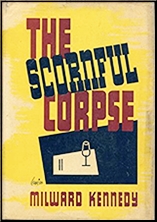
MILWARD KENNEDY – The Scornful Corpse. Dodd Mead, hardcover, 1937. No paperback edition. First published in the UK as Sic Transit Gloria (Gollancz, hardcover, 1936).

   James Southern, a successful British novelist, keeps a one-room apartment for use when he visits London. Though married, he has a platonic relationship with an American named Gloria Day, whom he has given a key to the place, and The Scornful Corpse concerns itself with what happens when he finds her there dead.

   The Police find a brief typewritten note at the scene, and when they learn Gloria was “up the spout” as they say over there, they classify the death as Suicide. Southern, convinced that Gloria would never kill herself, decides to investigate, and learns that she was rather actively involved in the Anti-Nazi movement, and in fact, there are shadowy agents out there looking for her Address Book.

   Slow-moving, tedious and predictable, this may be the earliest Mystery involving Evil Nazis, but that would be its only claim to interest: There’s also some Unintentional humor in a couple of the Character Names: Southern’s wife is Ann (presumably before she left for Hollywood) and the erstwhile father of Gloria’s baby is named. after the gay German hero of the American Revolution — Baron Von Steuben.

— Reprinted from A Shropshire Sleuth #66, July 1994.

   
Bibliographic Notes: Milward Kennedy was pseudonym of Milward Kennedy Burge, (1894-1968). Other pseudonyms were Evelyn Elder & Robert Milward Kennedy. Between the three pen names he wrote 18 detective novels, of which perhaps only half were reprinted in the US. For more information on the author himself, his Wikipedia page is here.

THE OLD GUARD. Netflix, 20 July 2020. Charlize Theron as Andy / Andromache of Scythia,
KiKi Layne as Nile Freeman, a former US Marine, Matthias Schoenaerts as Booker / Sebastian Le Livre, once a French soldier who fought under Napoleon, Marwan Kenzari as Joe / Yusuf Al-Kaysani, a Muslim warrior who had participated in the Crusades, Luca Marinelli as Nicky / Niccolò di Genova, a former Crusader, Chiwetel Ejiofor as James Copley, former CIA agent, Harry Melling as Steven Merrick, greedy CEO of a pharmaceutical empire. Screenplay: Greg Rucka, based on his comic book of the same title. Director. Gina Prince-Bythewood .

   If you’ve read any amount of science fiction, you’ve probably come across the premise of this recent Netflix release before, or something close to it. A band of immortal vigilantes find themselves in a new situation on two fronts: First, they discover that there is a fellow immortal who they must incorporate into their group, a young female marine and the first such recruit in several hundred years. Secondly, their existence is leaking out into the real world, and the villainous head of Merrick Pharmaceuticals wanted their secret to “help the world,” but the profit incentive is his real obsessive purpose.

   Even if there’s nothing very much new in all this, the movie is both well filmed and well acted. Being killed and finding yourself coming back to life over and over again can extract a terrible mental toll on a person. Charlize Theron as Andromache of Scythia, is the oldest of the group, and their de facto leader, and more than her own personal beauty she manages to display a weariness that weighs so heavily on her after so many centuries of life.

   KiKi Layne, as the new addition to the group and the other of the two female leads, is also very impressive, showing both disbelief at first to her new status, then the agony of learning that she is now being forced to leave her family behind. Only the supervillain hard on the group’s trail shows the film’s comic book roots, but as such, once again, that aspect of the story is also most excellently done.

   There’s lots of guns and other bloody action involved, as well as hand to hand combat, for those for favor that aspect of watching thriller extravaganzas such as this, but I found the personal side of the film, and the characters in it, were what made spending the two hours with them all the more worthwhile.


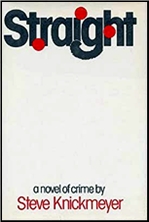
STEVE KNICKMEYER – Straight. Steve Cranmer & Butch Maneri #1. Random House, hardcover, 1976. Pocket, paperback, 1977.

   Referring to the comment with which I ended my previous review, it is too early to mourn the passing of the private eye yarn. This is Knickmeyer’s first novel, and one presumes it won’t be the last we shall hear of the detective agency team of Steve Cranmer and Butch Maneri.

   There office is in Oklahoma City, a locale which certainly is not the usual New York, Los Angeles or San Francisco. A jeweler in the small town of Solano, population 3000, is at first thought to have committed suicide, but their investigations delve deeply into this outwardly friendly country of western swing and John Wayne rednecks. Intruding on the scene are two high-powered syndicate killers, hired for local reasons.

   Knickmeyer has good control over his main characters, although Maneri might agree that he could reign in his active sex life a lot more effectively. The minor characters are less well drawn, and in particular the transformation of Richard Straight from dedicate city cop to mysterious Mafia hit-man seems too flatly stated.

   In the end, it is the wry humor throughout and the strong portrayal of a pair of private eyes happy with what they’re doing that carry the book along so agreeably.

Rating: B

–Very slightly revised from The MYSTERY FANcier, Vol. 1, No. 2, March 1977.

      —

Bibliographic Update: Knickmeyer has only one other entry in Al Hubin’s Crime Fiction IV, that being Cranmer (Random House, hardcover, 1978).

« Previous PageNext Page »