THE BACKWARD REVIEWER
William F. Deeck


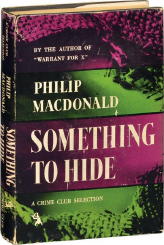
PHILIP MacDONALD – Something to Hide. Doubleday Crime Club, US, hardcover, 1952. No paperback edition. Published in the UK as Fingers of Fear: Collins, hardcover, 1953. A “Queen’s Quorum” title.

PHILIP MacDONALD - Something to Hide.

    This collection comprises two novellas and four short stories, all exceptionally well done. Two of the stories display the abilities of Doctor Alcazar, MacDonald’s “clairvoyant” detective.

    In “The Green-and-Gold String,” Alacazar is at his tent at the carnival and reads the future — “General Reading–50 cents. Special Delineation–$1.00” — of a lady’s maid, who is murdered several days later. Her employer offers a reward of $5000, and Alcazar can’t resist the “easy” money. Alcazar is a character, of course, but a superb psychologist and bluffer, and he traps the murderer into a confession.

    In the second story about Alcazar, “Something to Hide,” he and companion, the carnival’s former Weight-Guesser, are down on their luck. Their former client knows a rich woman with a problem, but how is Alcazar to know what the problem is? No one needs to tell a clairvoyant anything; he should already know it. As Avvie says:

    “Pinkertons! The Bass-Ackwards Detective Agency Inc. — No Crime Necessary — All We Need’s The Clues!” “Very funny,” said Doctor Alcazar. “Quite amusing.”

    “The Wood-for-the-Trees” has Anthony Gethryn returning to England from the US in the summer of ’36. He is delivering a letter from a Personage of Extreme Importance in the US to another P.O.E.I. in England. The area to which he is delivering the letter has recently had two murders by, ostensibly, an obvious maniac.

    A third occurs while Gethryn is there, and he quite frankly admits that a motiveless crime is best handled by “routine politico-military methods.” Something his son says on his return home and wifely suspicions, however, put him on to the murderer.

    “Malice Domestic” deals with a husband who is being given poison, most probably by his wife, and the “happy” ending, or at least happy if you’re the murderer.

    “Love Lies Bleeding” is something of a horror story. How does Cyprian Morse, having killed a young lady in hot blood after she tries to seduce him — Cyprian is CD all of the way, you see — manage to be freed after telling a quite implausible tale of how the murder happened? A fairly evident ending, but nonetheless a powerful story.

    Finally, “The Fingers of Fear” deals with a child molester and murderer. After he has presumably been apprehended, Lieutenant (acting Captain) J. Connor, the man who arrested him, begins to have doubts, doubts that are reinforced by his wife. Connor and his wife begin their own investigation.

— From The MYSTERY FANcier, Vol. 10, No. 1, Winter 1988.


REVIEWED BY WALTER ALBERT:         


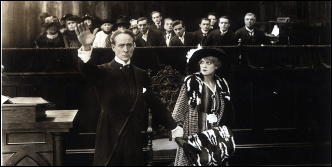
THE MARKET OF VAIN DESIRE. Triangle, 1916. H. B. Warner, Clara Williams, Charles Miller, Gertrude Claire, Hutton. Story: C. Gardner Sullivan. Director: Reginald Barker. Shown at Cinefest 26, Syracuse NY, March 2006.

THE MARKET OF VAIN DESIRE

   Mrs. Badgely (Gertrude Claire) has engineered a marriage between her reluctant daughter Helen (Clara Williams) and the too smooth and obviously villainous Count Bernard d’Montaigne (Charles Miller). (You have to suspect that he’s not all he seems to be since no true French aristocrat would drop the “e” in d(e) Montaigne.)

   Pastor John Armstrong (H. B. Warner, warming up for his role as the Christ in DeMille’s King of Kings), upset by the blatant insincerity of the arranged marriage, preaches a sermon in which he compares the “selling” of a daughter to a woman selling her body on the street, bringing home this message with the introduction of a streetwalker (Leona Hutton) into the service.

   The congregation is horrified and when Helen’s father calls off the engagement, the “Count” confronts and assaults the minister. When the fake aristocrat is exposed, the members of the congregation are reconciled with their pastor, and he and Helen, realizing that they love one another, pledge their troth.

   I like a meaty melodrama, and this heady mix of religion, prostitution and social climbing was to my taste. I wasn’t raised a Southern Baptist for nothing. The moral lessons I absorbed in countless sermons and bible classes still resonate in the proper setting and with the right material.

   I noted with some surprise that C. Gardner Sullivan was both the author of the scenario for Hairpins [reviewed here ] and of the story for the very dissimilar Market.

FIRST YOU READ, THEN YOU WRITE
by Francis M. Nevins


   Health issues, tax chores, snow — I have more excuses for the lateness of my latest column than a toad has warts. This month we cross the Atlantic and resurrect my impressions of some British whodunits I read back in the late Sixties and Seventies. I didn’t read them in chronological order but I’ll arrange them that way for the column.
***

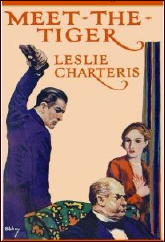
   Leslie Charteris’s Meet—the Tiger! (Ward Lock 1928, Doubleday Crime Club 1929) is just as cornily melodramatic as the title suggests, featuring a pure heroine whom the mustachioed leering villain tries to force into marriage and a hidden mastermind captaining a clutch of super-crooks.

   What saves this book from the graveyard of worthless imitations of Edgar Wallace is that its hero, appearing for the first time, is a daring young swashbuckler christened Simon Templar but better known as The Saint.

   Simon’s two-front war against Scotland Yard and the super-crooks for the prize of a fortune in gold hidden somewhere around a Devonshire village lacks the gleeful outrageousness in plotting, prose and people-drawing that was soon to become the hallmark of the Saint Saga, but its historic interest is hard to deny.
***

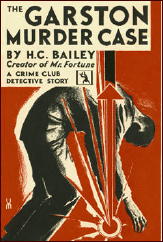
   H.C. Bailey’s Garstons (Methuen, 1930; U.S. title The Garston Murder Case, Doubleday Crime Club 1930) is set on the palatial estate of the munitions-manufacturing Garston family and in the surrounding towns and villages.

   The 20-year-old disappearance of an obscure chemist whose formulas the Garstons may have stolen, the theft of some cheap jewelry from the fiancée of a long-dead Garston scion, and the strangulation of the ailing matriarch in a dark archway of the family castle, blend into a neat problem for psalm-spouting criminal lawyer Joshua Clunk.

   Bailey here uses the multi-viewpoint approach, putting us inside the heads of Clunk, his Scotland Yard antagonist Superintendent Bell (who will be familiar to readers of the author’s Reggie Fortune stories), a local inspector, a Jane Eyre-like nurse, and the young student who falls for her in the chaste old-fashioned way.

   The interplay of each one’s knowledge with the others’, some fine scenes of interrogation and recapitulation, and a wealth of details of time and place and history and geography combine to make this long, slow, carefully constructed work a model British detective novel of the Golden Age.
***

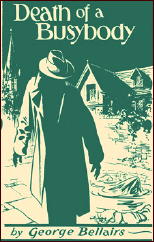
   George Bellairs’ Death of a Busybody (John Gifford 1942, Macmillan 1943) finds genial Inspector Littlejohn paying a wartime visit to the town of Hilary Magna to find out who drowned the village voyeur in the vicar’s cesspool.

   He encounters some amusing bucolic suspects and his investigation moves more briskly than is customary in English whodunits, but the climax is clumsily structured, the solution is reached purely by legwork, and the culprit is obvious to readers (though not to the supposedly seasoned officials) as soon as he offers his alibi.

   A sharp incidental picture of a country hamlet in wartime is the highlight of this all too average specimen.
***

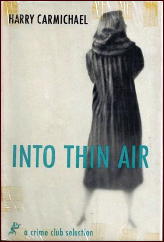
   In Harry Carmichael’s Put Out That Star (Collins, 1957; U.S. title Into Thin Air, Doubleday Crime Club 1958) we follow insurance investigator John Piper as he looks into the disappearance of a glamorous British movie queen from a fashionable London hotel.

   Eventually he discovers how, who and why, but the only readers who won’t have tumbled to the truth a hundred pages ahead of Piper are those who are completely innocent of the hoariest cliche denouement in English mystery fiction.

   Carmichael also manages to slip in the most hackneyed American climax in the genre and to leave several huge holes in the plot. Quite an achievement, yes?
***

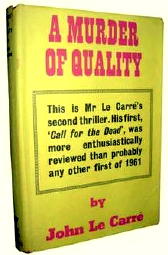
   A Murder of Quality (Gollancz 1962, Walker 1962) casts John LeCarre’s ex-spy George Smiley in the unusual role of private sleuth, invading Dorsetshire’s posh and snobby Carne School in order to look into the fatal bludgeoning of an instructor’s wife shortly after she stated that she was afraid her husband was trying to kill her.

   Smiley pokes into the animosities between townies and gownies and between the Anglicans and the Baptists without neglecting physical clues like the piece of bloody coaxial cable and the altered examination paper, but LeCarre never clarifies how Smiley reached his solution nor what the murderer’s plan was.

   However, the confused plot is balanced by fine evocations of scene and character, including two of the bitchiest females I’ve ever encountered in a whodunit.
***

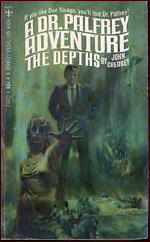
   John Creasey’s The Depths (Hodder & Stoughton 1963, Walker 1967) isn’t really a mystery but a blend of philosophy, SF and suspense that’s typical of his postwar novels about Dr. Palfrey and the international organization Z5.

   This account of Palfrey’s war against the mad-scientist ruler of an undersea kingdom who’s discovered the secret of prolonging life indefinitely and can also create tidal waves powerful enough to destroy any ship or seacoast in the world crawls at snail speed and bulges with plot holes.

   But it’s worth reading for a few fine character sketches — notably that of another doctor who slowly discovers a humanistic conscience — and especially for the climax where Creasey evokes the moral nightmare of politico-military decision-making in today’s world. The implied value judgments may rouse readers to fury but very few of the tough questions are evaded in this early specimen of the techno-thriller.

***

   Douglas Clark’s Deadly Pattern (Cassell 1970, Stein & Day 1970) is a plodding and drearily written quasi-procedural in which snobbish Detective Chief Inspector George Masters and his three Scotland Yard subordinates are dispatched to a tiny coastal town to investigate the almost simultaneous disappearances of five drab middle-class women.

   When four of them are found buried by the seashore, Masters and company crawl into action, taking 169 pages to uncover a psychotic killer whose identity should be apparent to every reader by page 30.
REVIEWED BY DAN STUMPF:         


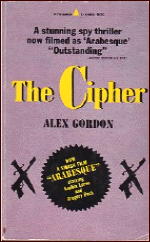
ALEX GORDON – The Cipher. Simon & Schuster, hardcover, 1961. Grove Press, paperback, 1961. Pyramid X-1483, paperback, 1966.

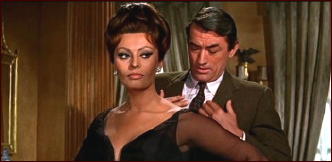
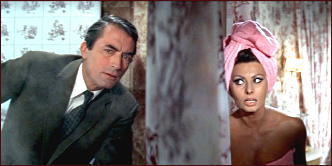
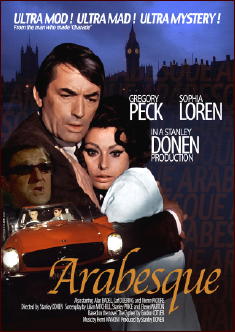
ARABESQUE. Universal, 1966. Gregory Peck, Sophia Loren, with Alan Badel, Kieron Moore, Carl Duering, John Merivale, Duncan Lamont, George Coulouris. Based on the book The Cipher, by Alex Gordon. Director: Stanley Donen.

THE CIPHER / ARABESQUE

   Alex Gordon’s The Cipher is a polite little mystery that tiptoes into Graham Greene country now and again on its gentle way to wherever it’s going.

   Philip Hoag carries the tale, a reedy, asthmatic professor of middle-eastern anthropology, bullied by his superiors at college, handymen in his apartment building, and lately deserted by his wife and child — the sort of burnt-out case Greene evoked so well, here trotted out to play an unlikely part in a scheme of international intrigue and all that sort of thing.

   Hoag finds himself suborned by a corpulent Arabian tycoon named Beshraavi (who could as easily been called Sydney Greenstreet) to decipher an inscription that Beshraavi may have murdered to get. The money’s good and Hoag is easy to push around, so he soon finds himself working on it—and just as quickly finds himself warned by Beshraavi’s perky little college-girl niece that finishing the job will almost certainly prove hazardous to his health.

   We turn another couple of pages and Hoag is running for his life, trying to escape the Arab’s minions, prevent an assassination and protect his own wife and child.

   Given this premise, it’s surprising how little action there actually is in The Cipher, as Hoag spends most of the book trying to figure out the people involved and maneuver his way around and through a web of tangled motivations and petty personal problems.

   I think I know what author Gordon was trying to do though: As Hoag moves through various strata of society and begins to understand the personalities involved, he grows increasingly adept at persuading, manipulating and even bullying on his own part, and The Cipher becomes less an action story and more about the growth of his character.

   And if Gordon never quite achieves the heights of Graham Greene or Eric Ambler, one has to give him marks for trying and note that the last few chapters generate some real suspense, capped off with a genuinely amusing curtain line.

THE CIPHER / ARABESQUE

   When this was turned into a movie, they credited Gordon under his real name (Gordon Cotler, a busy screenwriter in his day) and changed the title to Arabesque, but this was only the beginning of the cheerful havoc wreaked on The Cipher by director Stanley Donen and a phalanx of writers that included Peter (Charade) Stone. To play the book’s frail asthmatic professor with thinning blonde hair, Donen naturally turned to Gregory Peck, who transforms the character into that staple of the Movies: a healthy, handsome, straight guy with no visible neuroses who has somehow grown into early middle age without ever getting married.

   The gluttonous Arab is played by slender British actor Alan Badel (who infuses the part with a genial, easy-going nastiness, coupled with a neat touch of fetishism) and the perky little niece becomes Sophia Loren, a fine actress but one to whom the words “perky” and especially “little” simply do not apply.

THE CIPHER / ARABESQUE

   With this as a start, Donen and his crew proceed to run through Gordon’s gentle book with a mulching mower, filling the movie with witty quips, furious fight scenes and hairbreadth escapes reminiscent of the old serials while cinematographer Christopher Challis (best remembered for Tales of Hoffman) shoots everything at odd camera angles, through chandeliers, from inside fish tanks, reflected in mirrors or from underneath rugs, giving the film a baroque look that more than justifies the title.

   Somewhere in all this is a story about a cipher to be decoded, a planned assassination and a few other bits and pieces from Gordon’s book that pop up from time to time like frightened squirrels looking fearfully about the turbulent surroundings, ready to flee at once. But it’s all so much fun and (like Loren herself) so easy to look at that one easily forgives the excesses to relax and enjoy a simple fun movie.

THE CIPHER / ARABESQUE

Reviewed by JONATHAN LEWIS:         

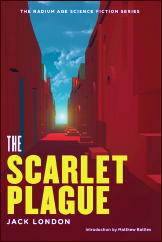
JACK LONDON – The Scarlet Plague. HiLo Books, US, softcover, 2012. (The Radium Age Science Fiction Series 1.) Introduction by Matthew Battles. Originally published in London Magazine in 1912. This edition follows the text of the hardcover edition published by The Macmillan Company, also 1912.

JACK LONDON The Scarlet Plague

   Although perhaps best known for his 1903 novel, The Call of the Wild and his 1908 version of the short story, “To Build a Fire,” San Francisco native Jack London also wrote proto-science fiction and dystopian literature. London’s 1912 novella The Scarlet Plague, reprinted in paperback in 2012 — the first in HiLo Books’ The Radium Age Science Fiction Series—remains a lesser known, but still culturally significant, work of early science fiction.

   Set in the scenic Bay Area in 2073, The Scarlet Plague is best categorized a work of post-apocalyptic literature. Sixty years prior, a plague of unknown origin wiped out most of the population. Survivors are scant. Civilization has fallen. What’s left of mankind has been reduced to what London depicts as a state of barbarism and savagery.

   There is one man, however, who remembers — with great sadness it should be noted — the era before civilization’s fall. Enter Professor James Howard Smith, a professor of English literature at the University of California-Berkeley. The novella centers around the elderly Smith (known simply as “Granser”) recounting the emergence of the scarlet plague and its destructive impact on humanity. He tells his primitive grandsons what life was like before the plague and how the post-apocalyptic tribal society in which they now live was formed.

   London’s vision of civilization’s decline, illuminated by Granser’s story, is both intriguing and one that has been recast in myriad forms by different authors. Think Stephen King in The Stand. (Also, substitute zombies for the plague and the fundamentals of the story could still work.)

   That isn’t to say that London’s novella is simply an adventure or proto-zombie story. There is a definite philosophical meaning to be found within the work. As Matthew Battles aptly notes in his Introduction, London’s work resounds with echoes of the 18th-century Italian philosopher Giambattista Vico’s cyclical interpretation of History. Toward the end, Granser tells his grandsons that eventually, civilization will be reborn, but that it too shall fall.

   Just as the old civilization passed, so will the new. It may take fifty thousands years to build, but it will pass. All things pass. Only remain cosmic force and matter, ever in flux, ever acting and reacting and realizing the eternal types — the priest, the soldier, and the king. [Page 126]

   Strong stuff. It’s unfortunate, then, that London chose the weak narrative device of a character telling a tale to semi-eager listeners. Also, one wishes London showed why Granser was immune to the plague or at least potentially hinted at an explanation. But perhaps London’s point was that History’s path is an incredibly random one.

   The Scarlet Plague remains a worthwhile, albeit quick, read. That said, it’s difficult to imagine that a publisher would consider publishing such a work today. Nevertheless, the novella provides the contemporary reader with a greater understanding of London’s worldview and how he envisioned the class system in the United States might look in 2013.

   In conclusion, The Scarlet Plague is a chilling reminder that all that mankind has accomplished in the name of technology could one day disappear. A hundred years have elapsed since London’s work was published. Science fiction has not yet tired of contemplating civilization’s fall and asking the question: what then? Maybe it never will.

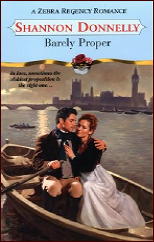
SHANNON DONNELLY – Barely Proper. Zebra, paperback original. First printing, December 2003. Cool Gus Publishing, softcover, October 2013.

SHANNON DONNELLY Barely Proper.

   On the surface, this is nothing more than just another Regency romance. When you investigate, however, you will find that there is a murder committed in Chapter One – a duel at dawn in which the second party arrives early and finds the first party had arrived even earlier, and he is already dead.

   Found holding the murder weapon in his hand, Terrance Winslow [the party of the second part] makes his escape, but not without fracturing his leg in the attempt. He is found by Sylvain Harwood, whom he has known since childhood. No longer the thin and gawky girl he once knew, she is now somehow different. Her figure is different. She has attractive curves that somehow were not there before.

   Aha, you say. When it gets down to it, this is just another Regency romance. Well, yes and no. While the “solving the mystery” aspect is definitely mired in second place, neither do all Regency romances have a Bow Street Runner as a significant (if not prominent) character, and this one does – although acting largely in his own interests – mixed in with the usual misunderstandings and other romantic pitfalls so intricately inherent in the genre.

   One other comment. Regency romances all took place in England, more or less in the ten-year-period between 1811 and 1820. If you took all of the Regencies ever written and published and tried to fit them all into that one tiny sliver of time, you’d never be able to do it.

— April 2004


[UPDATE] 03-13-14. In one way this review, in case you may be wondering, is yes, a filler while I spend a bigger chunk of my spare time getting IRS material ready to take to our accountant on Monday. On the other hand, the novel is a mystery, as I was careful to point out when I originally wrote the review.

   What I don’t remember is why I read the book in the first place. I may have come across the book at a local library sale and before offering it for sale on Amazon, I’m guessing, the blurb on the back cover may have tempted me into giving it a try.

   The category of Regency romances, per se, is dead. They were extremely common at one time beginning with Georgette Heyer reprints from Ace back in the 1960s or so. Why did the category die out? The simple answer is that the books were too chaste. See David Vineyard’s review of the Lora Leigh book posted here a week or so ago. Sizzlers like this are what readers of romance fiction seem to want now, to the exclusion of all else.

Reviewed by DAVID VINEYARD:         

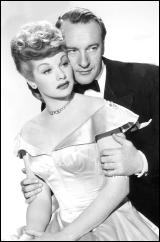
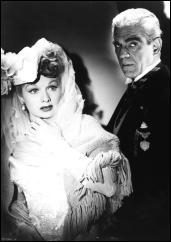
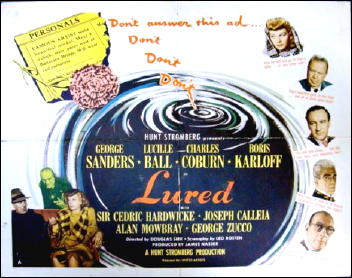
LURED George Sanders

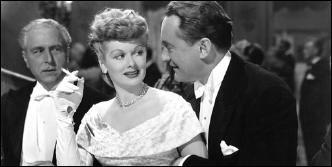
LURED. United Artists, 1947. George Sanders. Lucille Ball, Charles Coburn. Sir Cedric Hardwicke, Boris Karloff, George Zucco, Joseph Calleia, Alan Mowbray, Robert Coote, Alan Napier. Screenplay by Leo Rosten. Story by Jacques Companéez, Simon Gantillion & Ernest Neuville. Directed by Douglas Sirk.

   Douglas Sirk’s name is primarily associated with a series of glossy brilliant soap operas made in the 1950’s such as Written on the Wind, Tarnished Angels, and All That Heaven Allows, but before turning to these lush technicolor films the European Sirk produced three droll crime films: A Scandal in Paris with George Sanders as the thief turned policeman Eugene Francois Vidocq, Summer Smoke again with George Sanders and based on Anton Chekhov’s short novel The Shooting Party, and this, Lured.

   The setting is post war London where the city is paralyzed by a series of murders of young women who all answered ads in the agony column of the London Times. After each killing the murderer sends a taunting poem to Scotland Yard daring them to catch him.

   Inspector Harley Temple (Charles Coburn) is in a bad mood, because so far his investigation is getting nowhere, but when he meets Sandra Carpenter (Lucille Ball), the best friend of the latest victim, he has a bright idea. What if he turned the killers method of meeting his victims against him — set a trap for him with an attractive lure — and Sandra Carpenter a smart savvy American showgirl is the perfect lure.

   George Zucco is the sardonic Officer Barrett assigned as Ball’s bodyguard. She will answer the ads, meet the men who sent them, and when the killer shows his hand Barrett will pounce.

LURED George Sanders

   After a couple of false starts, including a fine performance by Boris Karloff as a mad dress designer, they get their first real lead, Robert Fleming, a nightclub producer and impresario whose shows Ball had been trying to get into from the beginning.

   But the game is complicated when Ball starts to fall for Sanders even though she has been warned by his business partner Julian Wilde (Sir Cedric Hardwicke), and he fits the bill of the killer all too well.

   Ball resigns, convinced Sanders is innocent, but then a turn convinces her she was wrong, he is arrested, and then the real killer makes his move …

   Coburn is a pleasure as the Inspector, and Zucco, fine in a rare comic performance, is a droll delight. In fact Zucco comes near stealing every scene he appears in, which is no easy thing because Ball is not only beautiful, but holds the screen with real star power.

LURED George Sanders

   If you ever thought George Sanders would be an odd match for Lucille Ball you’d be wrong. They are a perfectly matched romantic pair here, and Sirk builds some real suspense because even cast as the hero Sanders had played so many villains it was no sure thing which side he would turn out to be on.

   The word that best defines this movie is droll. The screenplay by Leo Rosten is sharp (Dark Corner, Captain Newman MD, Where Danger Lives, Silky …), and the cast is a fine collection of character actors from the Hollywood Raj. It’s the kind of film where the smallest performance is perfectly timed and delivered.

   Comedy, romance, and suspense are expertly blended in this one. Sirk’s notable cinematic eye never lets the viewer down and a fine cast are all at their best.

   Still even among that fine cast. Lucille Ball and George Zucco are standouts and even if it is little more than a bit, it is nice to see Boris Karloff in a first class production having a bit of fun on screen.

   These three films were impossible to see for many years, but A Scandal in Paris and Lured have been issued in handsome DVD’s from Kino Video and both have played on TCM. Summer Storm was released on DVD by VCI in 2009 and is worth obtaining since it contains fine performances by Sanders and Edward Everett Horton as nineteenth century Russian noblemen caught up in a crime of passion.

LURED George Sanders

REVIEWED BY WALTER ALBERT:         


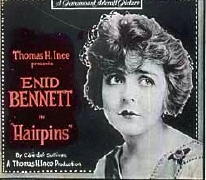
HAIRPINS. Famous Players-Lasky Corporation, 1920. Enid Bennett, Matt Moore, William Conklin, Margaret Livingston, Grace Morse. Story: C. Gardner Sullivan. Art director: W. L. Haywood. Art titles: F. J. Van Halle, Carl Schneier, & Leo Braun. Director: Fred Niblo. Shown at Cinefest 26, Syracuse NY, March 2006.

HAIRPINS Enid Bennett

   This film, which I had seen before, was substituted for Over There, a WWI patriotic drama. I like to expand my repertoire, but since Hairpins is a charming light drama, I happily sat through it again.

   Muriel Rossmore (Enid Bennett) has settled too comfortably for her husband Rex’s liking (Matt Moore) into the role of frumpy wife, so he begins a dalliance with Effie, his attractive, nattily dressed secretary (Margaret Livingston).

   When Muriel finds out about the affair, she consults her stylish neighbor, grass widow Mrs. Kent (Grace Morse), who supervises a new look for her and introduces her to Hal Gordon (William Conklin), a playboy friend who pays her the kind of attention that husband Rex finds mightily offensive when he stumbles on to what his wife is doing during his evenings out wth Effie.

   Fred Niblo married his star during the production of this film, and his direction is a tribute to her charm and beauty. I’ve credited the art director and the creators of the attractive intertitles for their contribution to the style and wit of this delightful film.

REVIEWED BY DAN STUMPF:         

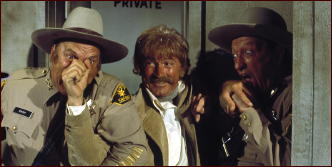
THE MANCHU EAGLE MURDER CAPER MYSTERY. United Artists, 1975. Gabriel Dell, Jackie Coogan, Huntz Hall, Joyce Van Patten, Dick Gautier, Vincent Gardenia, Anjanette Comer, Barbara Harris and Will Geer. Also with Old Tom and Winston as themselves. Written by Dean Hargrove and Gabriel Dell. Directed by Dean Hargrove.

THE MANCHU EAGLE MURDER CAPER MYSTERY

   Surprisingly off-beat and witty (considering that it comes from an ex-Dead End Kid and the creator of Matlock) this is also a film of engaging pointlessness and the sort of absurd humor that later characterized Airplane and The Naked Gun.

   Gabriel Dell, that perennial hanger-on from the Bowery Boys, stars as Malcolm, a bio-engineer (he’s trying to develop a chicken that will lay Easter eggs) in a speck-sized community (the richest man in town lives in a double-wide trailer) who decides to try his luck as a Private Detective and gets involved in a case of murder, adultery, incest and bestiality, all handled very tastefully and with considerable style.

   For a film where Jackie Coogan and Huntz Hall play cops, this is also rather well-acted. Dell, a veteran of more bad movies than I can remember or he could forget, injects a Bogart-like weariness into his role, supported by Nicholas Colasanto as a bartender who speaks in clichés, Anjanette Comer as a flower child who spouts wisdom from fortune cookies, and Nita Talbot as a concerned wife looking for her missing husband (he’s been gone all day) who enters Dell’s office already wearing widow’s weeds.

THE MANCHU EAGLE MURDER CAPER MYSTERY

   Gardenia and Geer do their usual best, un-flapped by the silliness around them, and Old Tom and Winston put in cameo appearances neat enough to merit special mention.

   Eagle proceeds merrily on its way to no place special, speeded along by zany characters, neck-snapping non sequiturs, and a shoot-out like something out of Monty Python. And it caps off with a surprisingly thoughtful (and quite funny) discourse on the folly of pursuing dreams and why we do it anyway. In all, a rough little gem but one worth seeing.

IT IS PURELY MY OPINION
Reviews by L. J. Roberts


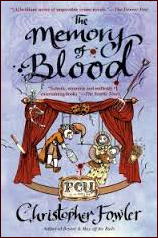
CHRISTOPHER FOWLER – The Memory of Blood. Bantam,US, hardcover, March, 2012; softcover, September 2013. (Police procedural: Bryant & May, 9th in series.)

CHRISTOPHER FOWLER Memory of Blood

   First Sentence: The following undated document appeared on Wikileaks and is now the subject of a government investigation.

   During the cast party, someone has murdered the theater owner’s infant son. The bedroom is locked from the inside and neither blood nor fingerprints are found; only the life-sized puppet of Mr. Punch, lying on the floor.

   A cast of characters is always helpful, but usually not very inventive. From Page One, it is clear this will not be your usual read with your usual characters and each is fully developed and fascinating. They are not necessary all people you’d want to know, but each becomes real in your mind. The Peculiar Crimes Unit team, including their long-suffering superior Raymond Lamb, is colorful and imaginative.

   You are immediately caught up in the author’s voice; his observations of the English and the wonderful wry humor… “People described Salterton as ageless in a way that wasn’t intended as a compliment. He seemed to exist somewhere between post-menopause and post-mortem.” Throughout, the author punctuates the story with simple statements of truth… “The gap between rich and poor was not just one of wealth but of accountability.”

   His use of language is to be savored… “This, then, was Arthur Bryant at work, his furrowed forehead bowed beneath the yellow light of the desk lamp, a shambling Prospero residing over the desiccated pages of his literary arcane, stirring fresh knowledge into the heady stew of ideas that filled his brain.” The dialogue is excellent with some of the exchanges between Bryant and May left to flow unhampered by interruptions of so-and-so said.

   The crime itself is anything but ordinary. It is, at times, gruesome. It is also a wonderful entry into the behind scenes working of a theater and the history of Punch and Judy. Fowler is particularly good in teaching the reader about things you didn’t even know you wanted to know.

   The Memory of Blood is a very good book, filled with humor, imagination, suspense, and wonderful characters. I am very happy to say there are, as of now, two more books after this … and eight wonderful books before it.

Rating:   Very Good.

« Previous PageNext Page »