REVIEWED BY TINA KARELSON:         


JULIE KRAMER – Stalking Susan. Doubleday, hardcover, July 2008. Reprint paperback: Anchor, June 2009.

JULIE KRAMER Stalking Susan

   First in the series following the adventures of investigative reporter Riley Spartz, Stalking Susan is set in the Twin Cities.

   Returning to work at the TV station after being widowed and going through a rough mourning period, she hopes to revive her flagging career by finding a serial-killer link between murder victims connected only by their first name, Susan, and the month and day on which they were killed, November 19.

   The plot is clever, and Riley untangles the mystery cleverly and tenaciously. The Minneapolis/St. Paul setting is accurately portrayed, and the characters are reasonably engaging, though Riley is a rather conventional mystery heroine: independent, 30-something, saddled with a tragic romantic past — and of course her late husband and her current would-be suitor had or have careers in law enforcement.

   The author, an investigative producer, visited the March meeting of Saints & Sinners, my local book club, to discuss both this and the second in the series, Missing Mark. The third, Silencing Sam, will be released in hardcover this summer.

Reviewed by DAVID L. VINEYARD:         


ERIK LARSON – Thunderstruck. Crown, October 2006. Trade paperback: Three Rivers Press, September 2007.

    Within twenty-four hours Captain Kendall would discover that his ship had become the most famous vessel afloat and that he had become the subject of breakfast conversation from Broadway in New York to Piccadilly in London. He had stepped into the intersection of two wildly disparate stories, whose collision on his ship in this time, the end of the Victorian era, would exert influence on the world for the century to come.
ERIK LARSON

    Alfred Hitchcock was so fascinated by it that he included elements in two of his films, Rear Window and Rope. As it was happening, then Home Secretary Winston Churchill had his home wired with the new Wireless technology so he could follow the case even when he as away from the Home Office.

    It was the basis for novels by Ernest Raymond and Francis Isles among others, and even Raymond Chandler refers to it in one of his novels. Head of Scotland Yard’s Murder Squad, Frank Froest, later a mystery writer, was involved. It made the career of the young forensic genius Bernard Spilsbury who would later help catch George Joseph Smith, the Bath Murderer, and help convict Christie, the Rillington Place murderer.

    It was the case of the young century, and perhaps the first worldwide news event followed by millions as it unfolded virtually live before them. It was highlighted by one of the most brutal and bloody murders in history and a spectacular race across the Atlantic monitored by fascinated readers across the world.

    Today the name Dr. Crippen still brings up images of a mild mannered little man, his beautiful lover, and a dogged Scotland Yard Inspector in the chase of his life.

    Erik Larson, whose earlier book The Devil in the White City, was the story of serial killer H. H. Holmes and the 1893 Chicago World’s Fair, combines in Thunderstruck the story of Gugliemo Marconi, the creator of the wireless, and Hawley Crippen, one of the most notorious murderers of the Twentieth Century, and how their two stories came together to foil a nearly perfect murder and give birth to modern communications, and in one sense the modern world.

    Hawley Crippen was an American eye doctor living in London and in a bad marriage. When his wife Cora disappeared, the facts did not add up and the police began to suspect something was wrong.

    Gugliemo Marconi was a brilliant but troubled inventor obsessed with the idea that radio waves could be transmitted through the airwaves without traveling through wires — from a transmitter to a receiver. His invention would transform the world, but it would take the spectacular Crippen case to demonstrate its potential to the world at large.
ERIK LARSON

    The two stories came together on a British ship, The Montrose, commanded by Captain George Kendall. Hawley Crippen and his mistress Ethel La Neve had disappeared, sought by the police, when Captain Kendall noticed something odd about two of his passengers, Mr. Robinson and son.

    Armed with his suspicions Kendall used the Marconi as the wireless was known to contact the authorities, and set off one of the most famous pursuits in criminal history — one that would not have been possible without Marconi’s invention.

    Imagine if you can the pursuit of O.J. Simpson’s white Bronco going on for days across the breadth of the Atlantic.

    Even the cleverest mystery writer would have trouble coming up with a scenario as improbable as what followed. Inspector Walter Dew, in charge of the case, boarded the Laurentic, a sister ship of the Montrose, in a race to reach Canada before Crippen, so the doctor and Ethel LaNeve could be arrested on the Montrose — which was British territory as long as it was at sea.

    (There was some concern that had they reached Canada, there may not have been sufficient evidence for their extradition.)

    What made this case unique was that the world press traveled in his wake, and every aspect of this chase was wired hourly to the breathless world, while in London the noose that would hang Crippen drew taut as the new science of forensics pieced together the story of the brutal death and bizarre fate of Cora Crippen’s corpse.

    Meanwhile on board the Montrose, Kendall and his officers worked to keep Crippen and La Neve and the other passengers ignorant of the whirlwind of events surrounding them, while Dew raced to pass them and arrive in Canada first.

    Larson is a master at orchestrating the events so they read as compellingly as any novel, and it comes down to perhaps the most famous example of British phlegm since African explorer Henry Morton Stanley’s “Dr. Livingstone, I presume?”

    Dew had come aboard the Montrose with the ships pilot in disguise wearing the pilot’s cap:

    Kendall watched Dew. The captain looked for some sign that Dew recognized the passenger below. The inspector said nothing. Kendall led the party to his cabin and sent for Mr. Robinson. A few moments later the man appeared, looking unconcerned and cheerful.

    Kendall stood. Discreetly he put his hand in his pocket and gripped the revolver. He said, “Let me introduce you.”

    Dew stepped up, still in his cap. The passenger smiled and held out his hand. Dew took it and with his free hand took off his cap. He said quietly, “Good morning, Dr. Crippen.”

    The expression on the passenger’s face changed rapidly, Dew wrote. First came surprise, then puzzlement, then recognition. Finally, in a voice Dew described as being ‘calm and quiet,’ Crippen now said, “Good morning, Mr. Dew.”

    Agatha Christie could not have written it better.

    Larson follows up on the fates of those involved. The spectacular trial that became an international sensation, Dew’s retirement after his most famous case, Captain Kendall’s adventurous career that reads like a Conrad novel, Mussolini praying at the beside of the dead Marconi, the still unanswered questions regarding the murder, and a final touching interview with Ethel La Neve shortly before her death.

    Thunderstruck reads like the best of novels, but has the weight of truth behind it. Carefully crafted and brilliantly written, it is a true crime story that compares with the best fiction for twists, turns, and moments of crime-solving worthy of Dr. Thorndyke or Sherlock Holmes.

    A fascinating look at one of the key events in the birth of the Twentieth Century and modern communications, and in the wake of cell phones, ipods, instant video, and world wide satellite communications — a reminder that the world was once much larger.

    Though Jung might have been right when he said that it was made of glass for a murderer, the birth of the modern world made that metaphor reality for Hawley Crippen.
IT IS PURELY MY OPINION
Reviews by L. J. Roberts


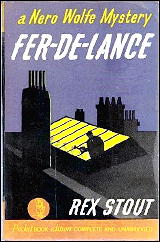
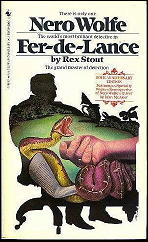
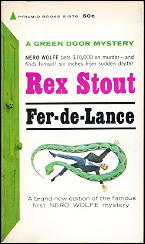
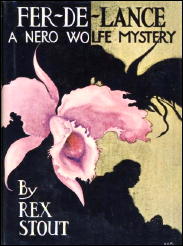
REXT STOUT Fer-de-Lance

REX STOUT – Fer-de-Lance. Farrar & Rinehart, hardcover, 24 October 1934. Preceded by an abridged version in The American Magazine, November 1934, as “Point of Death.” Reprinted many times, including once with a title change: Meet Nero Wolfe. Mercury Mystery #37, digest ppbk, abridged, 1941.

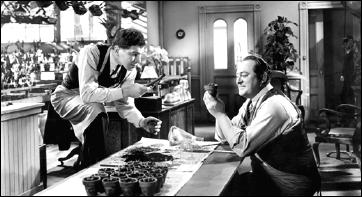
Film: Columbia, 1936, as Meet Nero Wolfe (with Edward Arnold and Lionel Stander as Nero Wolfe and Archie; director: Herbert Biberman).

Genre:   Private investigator. Leading characters:  Nero Wolfe/Archie Goodwin; 1st in series. Setting:   New York City, 1934.

First Sentence:   There was no reason why I shouldn’t have been sent for the beer that day, for the last ends of the Fairmont National Bank case had been gathered in the week before and there was nothing for me to do but errands, and Wolfe never hesitated about running me down to Murray Street for a can of shoe-polish if he happened to need one.

REXT STOUT Fer-de-Lance

    Nero Wolfe and Archie Goodwin’s first published case becomes one of two parts; a young woman hires Wolfe to find her missing brother, and a college president has been murdered on the golf course. The link: a golf club.

    The fun of reading Nero Wolfe is not the plot, although this one did have a good twist to it, but for the characters. On one hand, you have Wolfe, the corpulent, beer drinking, gourmand who has orchids cultivated in his attic conservatory.

REXT STOUT Fer-de-Lance

   He is well-read, well-spoken, often difficult to deal with, yet a brilliant deductive and intuitive thinker. On the other hand is Archie, orphaned as a child, lives in Wolfe’s brownstone, uses common English, and drinks milk.

   The two characters are complete opposites but one immediately senses the underlying respect and affection which goes beyond a working relationship. It is the dialogue and relationship of these two characters that make the book, and series, work.

   An interesting aspect to this book is that we meet the characters seven years in, so references to previous cases abound. In most cases, this would annoy me as there would be that sense of something missing.

REXT STOUT Fer-de-Lance

   Stout, however, is so adept in his writing and his characters are so well developed, the previous case references simply become historical notations. Stout was writing in present time, now history to us.

   Because of that, we are presented a living sense of time, place, social mores and behavior. There were certain expressions, common at the time. They are objectionable to us today and serve as a reminder of our advancement from the past.

   One element with which I did have a problem was some of Archie’s slang. There were times I had to re-read sentences or paragraphs to understand what he was saying.

   It was fun to go back and re-visit Nero and Archie, but not so much as to make me want to reread all the books. However, if you’ve never read Rex Stout, I do recommend picking up at least a few of his books.

Rating:   Good.

REXT STOUT Fer-de-Lance

THE BACKWARD REVIEWER
William F. Deeck


RUFUS KING – The Steps to Murder. Doubleday/Crime Club, hardcover, 1960. No paperback edition.

   The first tale in this collection — more novelette than short story — gives the book its title. A rich amoral woman who manipulates people for her greater good, using as her excuse her presumed ugliness, has lost her to some extent blackmailing hold over her husband. Quite insupportable, so his death is necessary.

   The rest of the stories are set in Halcyon, Fla., King’s fictional small town, “composed of the modestly retired, seasonal tourists, native crackers, horse-happy railbirds, amiable bookies, and glazed divorcees.”

   O.K., not so small, perhaps.

   An open-and-shut case of murder interests Monsignor Lavigny. Enlisting the aid of St. Jude, the good Father comes up with an alternative explanation that convinces Stuff Driscoll, in “The Patron Saint of the Impossible.”

   In “Murder on Her Mind,” a jet-setter comes to a psychiatrist to make sure that her brother-in-law will be declared sane so he can remain at large and kill her sister. She is, so to speak, hoist by her own petard.

   An embezzler commits suicide in “A Little Cloud. . . Like a Man’s Hand.” Or does he? Stuff Driscoll, without the Monsignor, solves this one.

   Another ugly woman, rich now that her family has been wiped out in a boating accident, faces a definite death in the near future from natural causes and a possibly more immediate death from unnatural causes in “Rendezvous with Death.”

   While everybody liked Jackson, Jackson didn’t like anybody. He also didn’t like the idea of being executed for murder, but murder was necessary to further his interests in “A Borderline Case,” borderline in more ways than one.

   Six fine stories, a couple fair play, all with the special atmosphere of menace that King created so well.

— From The MYSTERY FANcier, Vol. 11, No. 2, Spring 1989.


Bibliographic Data:   The title story was original to this book and “Murder on Her Mind” first appeared in Mike Shayne Mystery Magazine. The other four came from Ellery Queen’s, not surprisingly.

       Previously on this blog:

Museum Piece No. 13 (reviewed by Bill Deeck)
Rufus King’s Florida short stories (by Mike Grost)
Holiday Homicide (reviewed by Mike Grost)
Design in Evil (reviewed by Mike Grost)
Malice in Wonderland (a 1001 Midnights review by George Kelley & Bill Pronzini)
Murder by Latitude (a 1001 Midnights review by George Kelley)
Design in Evil (reviewed by Bill Deeck)

A 1001 MIDNIGHTS Review
by Max Allan Collins:


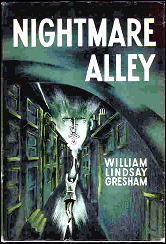
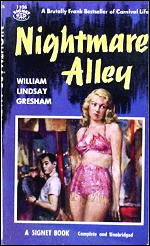
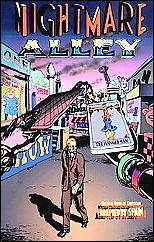
WILLIAM LINDSAY GRESHAM Nightmare Alley

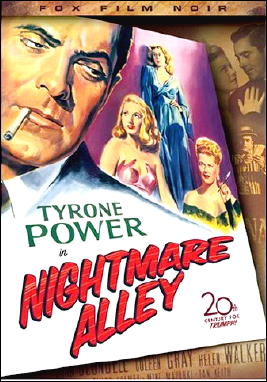
WILLIAM LINDSAY GRESHAM – Nightmare Alley. Rinehart & Co., 1946. Softcover reprints include: Signet #738, 1949, several printings; Carroll & Graf, 1986; Fantagraphics Books, graphic novel, February 2003; New York Review of Books, trade paperback, April 2010. Reprinted in Crime Novels : American Noir of the 1930s and 40s (Library of America).

Film: 20th Century Fox, 1947 (Tyrone Power, Joan Blondell; director: Edmund Goulding).

   The underside of show business is given a brutal and yet somehow affectionate examination by William Lindsay Gresham in this justly famed novel. Carnival life is vividly, lovingly portrayed:   “Swearing, steaming, sweating, scheming, bribing, bellowing, cheating, the carny went its way.”

   Even his protagonist, Stan Carlisle, the slick, self-serving grifter, is viewed with world-weary compassion as Gresham leads him to his inevitable, much-deserved doom.

WILLIAM LINDSAY GRESHAM Nightmare Alley

   Young, ambitious Stan Carlisle has a small-time job in a traveling carnival, but by worming his way into the good graces — and bed — of mind reader Zeena, he learns the tricks of the “mentalist” trade.

   Along the way he accidentally causes the death of Zeena’s dipsomaniac husband, giving him wood alcohol; and he turns the beautiful, virginal, father-fixated Molly into his mistress and reluctant partner in crime.

   Though Zeena’ s tarot cards have predicted Stan’s eventual downfall, the Great Stanton rises to certain heights in vaudeville. But he is not satisfied, and involves himself and Molly in the even more lucrative “spook racket”: The Great Stanton becomes the Reverend Stanton and begins bilking the wealthy, preying upon their lost loves and buried guilts.

   Then he meets and falls in love with Dr. Lilith Ritter, a psychiatrist to whom he bares his breast, and soon the seductive Lakeshore Drive psychiatrist is helping him plan one big last score.

WILLIAM LINDSAY GRESHAM Nightmare Alley

    Nightmare Alley is not a perfect book — Gresham’s poetic prose at times turns a shade of purple, and his Freudian explanations for the behavior of various characters are pat and a little dated; but few tough-guy crime novels are more powerful than this, and never have “the lower depths of show business” been explored with a more knowledgeable and sadly sympathetic eye.

   Gresham, whose own suicide is foreshadowed in the suicidal impulses of several of the characters in Nightmare Alley, was fascinated with the sleazier aspects of the entertainment world.

   Just as convincing as his depiction of carnival life is his inside look at the phony medium racket, which he further explored in his nonfiction work Houdini (1959).

   His only other novel, Limbo Tower (1949), is a hospital tale with criminal overtones

         ———
   Reprinted with permission from 1001 Midnights, edited by Bill Pronzini & Marcia Muller and published by The Battered Silicon Dispatch Box, 2007.   Copyright © 1986, 2007 by the Pronzini-Muller Family Trust.

WILLIAM LINDSAY GRESHAM Nightmare Alley

REVIEWED BY BARRY GARDNER:


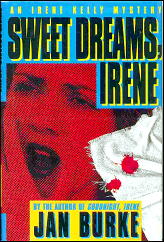
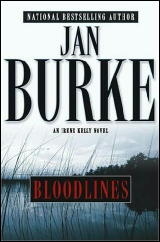
JAN BURKE – Sweet Dreams, Irene. Simon & Schuster, hardcover, March 1994. Reprint paperbacks: Avon, February 1995; Pocket, September 2002. Irene Kelly #2.

JAN BURKE Irene Kelly

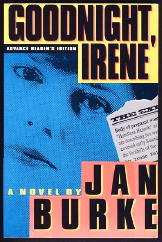
   I thought Burke’s first novel, Good Night, Irene, was one of the better new voices this year, and Irene Kelly one of the better characters. The sophomore jinx seems to be a common thing with mystery novelists, though, so I kept my expectations under control.

   Things are going good and bad for intrepid reporter Irene Kelly. Good is her romance with the cop from the first book, and bad is that her paper has taken her off the police beat because of the relationship.

   She’s handling a race for DA as the book opens, and the son of one of the candidates comes to her for help. His father’s opponent is going to relase a picture that shows the kid as part of a Satanic cult; except it’s not, it’s a witches’ coven, and he’s not really part of it.

   Irene begins to dig around, but before she gets very far, the rich, elderly neighbor of her lover is murdered, with signs pointing toward satanic worship. The murdered woman sponsored a homeless shelter where some of the “witches” lived. Could there be a connection? Could, yes.

   I still like Burke’s writing. She has an easy, unforced style, and paces her story very well. As with her first book, the characters major and minor are clearly drawn and believable. The plot is complex, and in the end, I’m afraid it wasn’t very convincing. A villain was dragged in out of left field, or maybe from a neighboring ballpark.

   Burke did well telling the story of Irene and her lover, but despite a lot of bloody action the criminal plot just didn’t hang together for me. Good taste, but not enough calories.

— Reprinted from Ah, Sweet Mysteries #10, November 1993.


      The Irene Kelly Mysteries:

* Goodnight, Irene (1993)

JAN BURKE Irene Kelly

* Sweet Dreams, Irene (1994)
* Dear Irene (1995)
* Remember Me, Irene (1996)
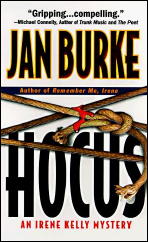
* Hocus (1997)

JAN BURKE Irene Kelly

* Liar (1998)
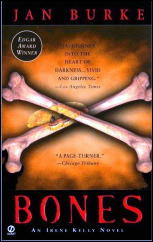
* Bones (1999)    [Edgar winner, Best Novel]

JAN BURKE Irene Kelly

* Flight (2001) (from the POV of Frank Harriman)
* Bloodlines (2005)

JAN BURKE Irene Kelly

* Kidnapped (2006)

      Award Nominations —

Agatha Award Best Novel nominee (1997) : Hocus
Agatha Award Best Novel nominee (1998) : Liar
Macavity Awards Best Novel nominee (1998) : Hocus
Anthony Awards Best Novel nominee (2000) : Bones
Anthony Awards Best Novel nominee (2002) : Flight
Macavity Awards Best Novel nominee (2003) : Nine
Anthony Awards Best Novel nominee (2006) : Bloodlines
Anthony Awards Best Novel nominee (2007) : Kidnapped

REVIEWED BY WALTER ALBERT:         


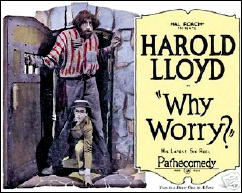
WHY WORRY? Hal Roach Studios, 1923. Harold Lloyd, Jobyna Ralston, Johan Aasen, Wallace Howe, James Mason, Leo White. Directors: Fred C. Newmeyer & Sam Taylor. Shown at Cinecon 27, Hollywood CA, September 1993.

WHY WORRY? Harold Lloyd

   Harold Lloyd plays a “young millionaire with an absolute patent on hypochondria.” (And I thought I had that sewed up tight.)

   He travels to a “sleepy” Latin American village on the eve of a revolution where — with an apparently inexhaustible supply of energy and ingenious tricks — this most engaging of silent film comedians sets about foiling the dastardly designs of villain James Mason, with the help of a gentle giant played by John Aasen.

   The organ accompaniment was played by octogenarian Gaylord Carter who worked with Lloyd in the thirties, preparing musical scores for the re-release of the silent masterpieces.

Editorial Comment:   I went to IMDB to be sure, but the James Mason in this movie is not THE James Mason, just in case you might be wondering about him. Usually billed as Jim Mason, the one in this film became a cowboy actor, playing mostly small parts until his career ended in the early 1950s.

   The movie itself is available on DVD, in the box set The Harold Lloyd Comedy Collection, Volume 1, on sale everywhere.

THE SPY IN BLACK U-Boat 29

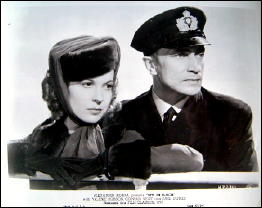
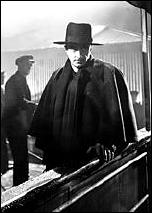
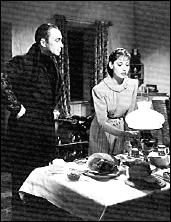
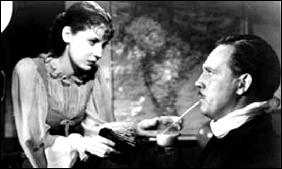
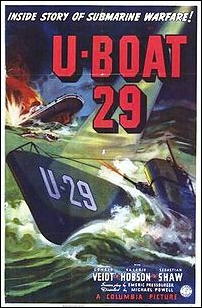
THE SPY IN BLACK. Columbia Pictures, UK, 1939. Released in the US as U-Boat 29. Conrad Veidt, Valerie Hobson, Sebastian Shaw, Marius Goring, June Duprez, Cyril Raymond. Screenplay: Emeric Pressburger, based on the novel by J. Storer Clouston. Director: Michael Powell.

   What’s unusual about this wartime movie is not that it takes place in World War I, but for at least the first half of the film it’s more or less from the point of view of a German submarine captain (Conrad Veidt) who undertakes a deadly game of espionage in the Orkney Islands (all the way in the UK, off the northen tip of Scotland).

THE SPY IN BLACK U-Boat 29

   Aided by a phony schoolteacher (Valerie Hobson) and a turncoat British naval officer (Sebastian Shaw), Captain Hardt lays a deadly U-Boat trap for a large contingent of British warships. If he can pull it off, it would be a serious blow to Britain’s war making capabilities.

   Things don’t go as planned, however, and that’s when the fun begins. The local vicar expects the new schoolteacher and her fiancé to come to dinner, and neither the phoney schoolteacher nor her new boarder expect the fiancé at all.

THE SPY IN BLACK U-Boat 29

   And of course that’s only the beginning. Since of course the spectacular event in the works never happened, there’s no suspense in that regard, but how it’s avoided – and who survives – is still very much up in the air.

   Getting back to my first paragraph, though, it’s quite remarkable that a German officer could be portrayed as sympathetically in 1939, sort of, as Captain Hardt is in the first part of the movie – finding a good meal – with real butter! – one of the great advantages of going undercover in wartime Britain. Of course when his role requires him to become a deadly enemy, he does that too – but honorably.

   I wish I could tell you what it is that makes a movie like this one so unmistakably British, but it is – a certainly style, a certain attitude – whatever it is, I think it mirrors the British people as well.

THE SPY IN BLACK U-Boat 29

   So British, I have to admit, as to make the opening scenes, taking place in Germany, somewhat awkward, if not clumsily done. The newspapers are in English, not German, and the people in the tavern speak English, not German.

   Once Captain Hardt is back at sea, though, and his mission is underway, the film gets off this small artifice and the crew members speak German, or largely so.

   Other than that, while not an award-winner by any means, this is still a better than average wartime thriller. It’s also one that takes place not on the battlefield or at sea, but on the home front, just in time for the next one.

THE SPY IN BLACK U-Boat 29

A TV Review by MIKE TOONEY:


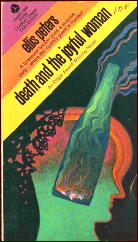
“Death and the Joyful Woman.” An episode of The Alfred Hitchcock Hour (Season 1, Episode 27). First air date: 12 April 1963. Gilbert Roland, Laraine Day, Don Galloway, Frank Overton, Laura Devon, Tom Lowell, Richard Bull, Raymond Greenleaf. Teleplay: James Bridges, tenuously based on the novel Death and the Joyful Woman (1961) by Ellis Peters. Director: John Brahm.

ELLIS PETERS Death and the Joyful Woman

    It’s going to be quite an evening at the Aguilar estate. Luis Aguilar (Gilbert Roland) plans to make an announcement at a big dinner party he’s throwing. He intends to publicly disown his son, Al (Don Galloway), because he won’t take on the family business (wine bottling); ironically enough, Al doesn’t even drink alcohol! For Luis, this is intolerable.

    Before this night is over, Luis will make a pass at a young woman; Al will nearly drink himself into a coma trying to win $5,000 from Luis, money that would help pay the bills for the baby that’s on the way; someone will be murdered; another will get koshed and thrown in a giant vat to drown; and a faithful servant will see her hopes dashed and attempt suicide.

    Yes, indeed, quite an evening is in store at the Aguilar estate.

    Ellis Peters (real name: Edith Pargeter, 1913-95) is most famous for her series of novels featuring the medieval monk Brother Cadfael, filmed and shown on PBS as Cadfael (13 episodes, 1994-98). This Hitchcock adaptation of her novel radically alters the story, if the description of it on the Fantastic Fiction website is accurate. (See below.)

    Gilbert Roland (1905-94) was a silent film star who successfully made the transition to the talkies. Laraine Day (1920-2007) was present in Hollywood’s Golden Age; her last screen credit was a two-parter on Murder, She Wrote (1986). And Don Galloway (1937-2009) is best remembered as Detective Sergeant Ed Brown in just about every episode of the Ironside TV series (1967-75).

    “Death and the Joyful Woman” is available on Hulu here.

    From the Fantastic Fiction website:

    “One of the George Felse mysteries. Det Sgt Felse is called in to investigate a murder at a new roadhouse, once a beautiful old inn known as ‘The Joyful Woman.’ There is no shortage of suspects, but the arrest of Kitty Norris leads Felse’s young son, who is convinced she is innocent, into danger.”

IT IS PURELY MY OPINION
Reviews by L. J. Roberts


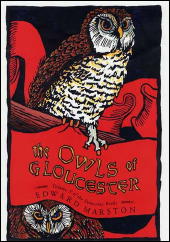
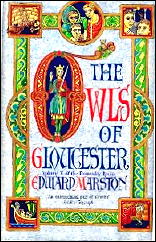
EDWARD MARSTON – The Owls of Gloucester. St. Martin’s, US, hardcover, April 2003. Headline, UK, hardcover/softcover, 2000.

Genre:   Historical mystery. Leading characters:  Sir Ralph Delchard/Gervase
Bret; 10th in series. Setting:   England-Middle Ages/1000s.

EDWARD MARSTON Domesday series

First Sentence:   ‘Do you want to be beaten again?’ asked Brother Frewine quietly.

    King William’s commissioner’s; Sir Ralph Delchard, accompanied by his wife Golde, lawyer Gervase Bret, Canon Hubert and Brother Simon, arrive in Gloucester to follow up on discrepancies and disputes found after the first round in the making of the Domesday Book.

    The largest dispute is over land, which has four claimants. However, their visit becomes more complicated with the discovery of a murdered monk, Brother Nicholas, the Abbey’s tax collector, the disappearance of a young novice, and the impending arrival of King William himself.

    There is nothing I did not like about this book. Marston places us in the 11th century both in sight and sound. By his descriptions, it is easy to visualize the surroundings. You know the conditions around them and when the characters are riding “hell-for-leather,” you can see and hear the horses.

    The pattern and syntax of the dialogue provides a reflection of the period without being literal to it. The inclusion of subtle humor is always appropriate and gives balance to the action.

    Marston’s characters are wonderful. Ralph, the newly married, battle-scarred soldier, is a realistic combination of an impatient Norman warrior and one who never expected to remarry after the passing many year’s prior of his beloved first wife. In this book, I particularly appreciated Ralph learning to be a husband to Golde, the realistic display of his anger and his confession to Gervase of a personal fear.

EDWARD MARSTON Domesday series

    Gervase, Saxon by ancestry, is the younger, recently married, educated lawyer who thinks before acting. The two have different natures and approaches but their friendship has given them a perfect balance. With them are the egotistical Canon Hubert and the very fearful, particularly of women, young Brother Simon.

    It is aspects such as that which gives dimension and realism to the characters. The plot was interesting and intricate with fascinating historical information which was interwoven with the story. There are multiple threads to the story which adds to the realism, and a very effective red herring.

    What is most impressive is the way in which the various threads come together at the end in a double climax, neither villain being one I anticipated. All these elements, and the overall quality of Marston’s writing, made for an excellent read.

    It is also nice that, while I always recommend reading series in order, with the Domesday series, it is not essential as each book includes enough background for each of the leading characters that the book stands on its own.

    My one regret is that there are only, to date, only eleven books in this series. I’ve only read five, though, so I still have several yet to enjoy.

Rating:   Excellent.

       The Domesday series:

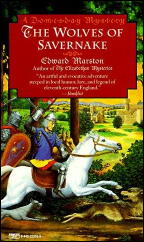
1. The Wolves of Savernake (1993)

EDWARD MARSTON Domesday series

2. The Ravens of Blackwater (1994)
3. The Dragons of Archenfield (1995)
4. The Lions of the North (1996)
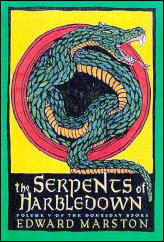
5. The Serpents of Harbledown (1996)

EDWARD MARSTON Domesday series

6. The Stallions of Woodstock (1997)
7. The Hawks of Delamere (1998)
8. The Wildcats of Exeter (1998)
9. The Foxes of Warwick (1999)

EDWARD MARSTON Domesday series

10. The Owls of Gloucester (2000)
11. The Elephants of Norwich (2000)

« Previous PageNext Page »