A REVIEW BY CURT J. EVANS:         


FOYLE’S WAR. ITV (UK), PBS (US). “The White Feather.” Season 1, Episode 2. 03 November 2002 (UK date). Michael Kitchen, Honeysuckle Weeks, Anthony Howell; Lisa Ellis, Charles Dance, Maggie Steed, Paul Brook, Tobias Menzies, Mali Harries, Ed Waters. Series creator: Anthony Horowitz.

   The second episode of Foyle’s War pits Detective Superintendent Foyle against a group of despicable British Nazi sympathizers. Germany is on the march through the Netherlands and Belgium and into France and the British Expeditionary Force looks doomed.

FOYLE'S WAR

   The Nazi sympathizers meeting at the appropriately named White Feather Inn welcome the German invasion that they think is right around the corner. Then one of them, the inn owner, is murdered, shot during their meeting.

   But was she the intended target, or was it the group’s noxious leader, Guy Spencer (played by the splendidly villainous Charles Dance, who also played the awful Mr. Tulkinghorn of Bleak House)? Foyle’s on the job!

   I thought the mystery plot in “The White Feather” was quite strong, though the overall story was not as compelling as that in the first episode, “The German Woman” (reviewed here ). There are actually two mysteries in the film, who murdered the inn owner and the whereabouts of a purloined paper, the publicizing of which would greatly embarrass the British government at this critical time. Both are nicely handled.

   Viewers should probably be able to guess the murderer (I did!), but the exact mechanics of the crime are very nice indeed, surprisingly more reminiscent of an R. Austin Freeman or John Rhode story than Agatha Christie.

   Though I enjoyed the mystery, I was not as drawn into “The White Feather” as I was “The German Woman.” Much of the time is spent with the repulsive Nazi sympathizers, who let us know they are Nazi sympathizers mainly by disparaging Jews at every opportunity. One gets tired of their company very quickly.

   There are a couple pf lower class characters we are supposed to sympathize with, a maid and her fisherman boyfriend, but these rather dim characters never make much of an impression, unlike their counterparts, the pub serving girl and shop assistant, in “The German Woman.” Only the thwarted intellectual son of the inn owners really drew my sympathetic attention.

   Scripter Anthony Horowitz links the plot to the Dunkirk evacuation, but this almost feels like another film and I didn’t feel like it came off too convincingly. We also meet for the first time Sergeant Milner’s wife, Jane, who tells him she doesn’t want to even see his prothesis leg in their bedroom!

   Personally, forced to choose between Jane Milner and the Nazi sympathizers, I might rather spend time with the latter. What a horrid woman. This marriage will not last, I hazard to guess.

   Once again the aristocratic types come off rather badly. After the first two episodes in the series, one might conclude that the British aristocracy spent most of its time getting their German wives exempted from internment regulations, when not actually attempting to help facilitate a Nazi invasion.

   In real life, while there were Nazi sympathizers among the aristocracy, there were plenty others who weren’t and gave their lives to the fight against the Nazis. Historically, the British aristocracy as a class has served the state in its many wars in large numbers.

   This may sound like a lot of carping, but I did enjoy “The White Feather” and would recommend it. It was not up to the top-flight level of “The German Woman,” in my opinion, but it certainly maintained my interest in the series and made me want to see what will happen next!
IT IS PURELY MY OPINION
Reviews by L. J. Roberts


Genre:   Historical mystery. Leading character:   Roger the Chapman, 1st in series. Setting:   England–Middle Ages/1522.

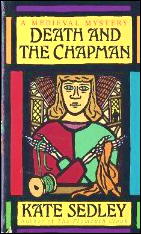
KATE SEDLEY – Death and the Chapman. Harper,US, reprint paperback, April 1994. Originally published by Collins Crime Club, UK, hardcover, 1991. Also: St. Martin’s Press, US, hc, 1992.

First Sentence:   In this year of our Lord 1552 I am an old man.

KATE SEDLEY Roger the Chapman

   Roger Chapman is 70 years old. As he approaches the last chapter of his life, he decides to write the memoirs of his years spent on the road as a peddler and solving mysteries.

   As a young 18-year old, Roger left the Benedictine monastery for the road with London being his objective. His first investigation is into the disappearance of two separate gentlemen and the servant of the second servant while their bags were left behind.

   Both men were carrying a good deal of money, but their bodies have never been found. At the same time, the Duke of Gloucester wishes to marry Lady Anne Neville; a marriage opposed by her late husband’s brother. Can Roger do a service to the Royal family?

   One of the main reasons I enjoy historical mysteries is that combination of learning and the puzzle. Richard of Gloucester was a figure with whom I was not familiar, yet he achieved positions of tremendous power and responsibility by the age of 19.

   I also had not known about “corpsing,” the recovery of bodies from the Thames, their clothing stripped to be sold and the bodies returned to the river. The most interesting element, however, is the character of Roger. Here we meet him both at the beginning of his years; very young and able to be shocked; and see a bit of him at the end of his years.

   As long as the later doesn’t too much portend the latter, the stories should hold and allow us to see the character develop over time. Sedley knows her period and know how to bring it alive to her reader. Her descriptions engage your senses; sight, sound and nearly smell.

   In fact, there are points where the descriptions nearly overpower the plot. For a first book, the plot is well done although it does rely on some rather large coincidences. I do appreciate it when the author allows that coincidences do happen in life. There is some good suspense at the end, and a satisfying resolution. I did enjoy this book and I look forward to Roger’s next adventure.

Rating: Good Plus.

The “Roger the Chapman” series —

1. Death and the Chapman (1991)
2. The Plymouth Cloak (1992)
3. The Hanged Man (1993) aka The Weaver’s Tale (US)
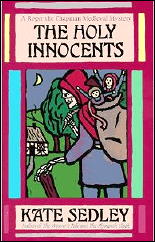
4. The Holy Innocents (1994)

KATE SEDLEY Roger the Chapman

5. The Eve of Saint Hyacinth (1995)
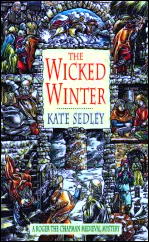
6. The Wicked Winter (1995)

KATE SEDLEY Roger the Chapman

7. The Brothers of Glastonbury (1997)
8. The Weaver’s Inheritance (1998)
9. The Saint John’s Fern (1999)
10. The Goldsmith’s Daughter (2001)
11. The Lammas Feast (2002)
12. Nine Men Dancing (2003)
13. The Midsummer Rose (2004)

KATE SEDLEY Roger the Chapman

14. The Burgundian’s Tale (2005)
15. The Prodigal Son (2006)
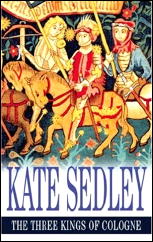
16. The Three Kings of Cologne (2007)

KATE SEDLEY Roger the Chapman

17. The Green Man (2008)
18. The Dance of Death (2009)
19. Wheel of Fate (2010)

A REVIEW BY RAY O’LEARY:
   

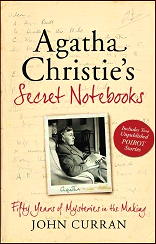
JOHN CURRAN – Agatha Christie’s Secret Notebooks. HarperCollins, hardcover, September 2009.

JOHN CURRAN Agatha Christie

   Since John Curran is the literary adviser to the Agatha Christie estate he was allowed to enter the two locked rooms of her house after it was donated to the National Trust and opened to tourists.

   The two rooms mostly contained copies and first editions of her various novels, story collections and plays but in the smaller room, on the bottom shelf of a bookcase, he found a cardboard box containing notebooks in which Christie jotted down various story ideas and preliminary plotting for most of her novels, stories and plays.

   These notebooks were in no manner orderly; when Christie had an idea she grabbed a notebook at random and jotted it down on the first blank page available. So notes for various of her works are scattered, most of them in more than one notebook and the numbers on them mean nothing as to when she made her entries.

   Also, despite what is printed on the dust jacket, none of the notebooks contains any of the plot ideas for The Murder of Roger Ackroyd nor Murder on the Orient Express and a few others of her works. (He never discusses Witness for the Prosecution, play or story, so I’m presuming that might be another.) The notes for those works presumably are lost. What is here is an abundance of ideas used and rejected for most of the things Christie wrote.

JOHN CURRAN Agatha Christie

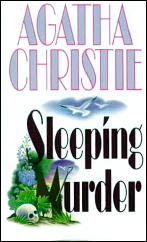
   One thing Curran discovered was that the last Miss Marple novel, Sleeping Murder, was written in the late 40’s and not during World War II as previously believed. (Curtain is another book not covered here.)

   Sleeping Murder‘s original title was going to be Cover Her Face, but it was changed after P. D. James used that title. The two major finds, however, are unpublished short stories featuring Hercule Poirot, which are printed at the end of his commentary.

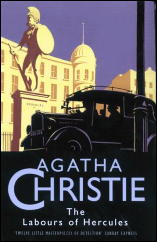
   The first story was “The Capture Of Cerberus” the 12th Labor Of Hercules. From November, 1939 through most of 1940 the first 11 Labors had been published by the Strand Magazine. It wasn’t until 1947 that she wrote the 12th story which completed the Labors and made possible the collection of that title.

   This original story was unsuitable for pretty obvious reasons: It features a character clearly based on Adolf Hitler and portrays him in a favorable light since, in this story, he has a change of heart and becomes a proponent of World Peace, which would have been pretty hard to swallow with bombs falling on London.

JOHN CURRAN Agatha Christie

   And though Curran doesn’t say so it in his notes, a plot device turns up that was used in Hitchcock’s 1940 film Foreign Correspondent: the kidnapping of a political figure and his replacement by a double who is then assassinated.

   The other story is called “The Incident Of The Dog’s Ball.” This is much better, but was never offered for publication because it is a 20 page version of what was to become the novel Dumb Witness (Poirot Loses a Client). Christie must have realized she could easily turn it into a novel so never sent it to her agent.

   Finally, if you haven’t read a lot of Agatha Christie’s output and are planning to, be warned: before every chapter Curran states which novels and stories will have their solutions revealed in his discussion.

   I finished Christie’s detective novels and stories and some of her plays (she wrote 20) a long time ago so that didn’t bother me. For those who haven’t, you might put off reading this until after you have. Also, Curran uses the politically incorrect (racist) original title for And Then There Were None when talking about that book.

REVIEWED BY DAN STUMPF:         


ERROL FLYNN —

ERROL FLYNN

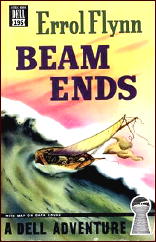
    ● Beam Ends. Longmans Green & Co., US, hardcover, 1937. Paperback reprint: Dell #195, 1947.
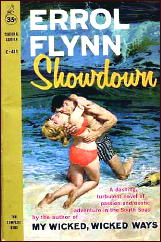
    ● Showdown. Sheridan House, US, hardcover, 1946. Paperback reprints include: Dell # 351, 1949; Pocket Cardinal, 1960.

   It’s been a pretty mixed bag of reading/watching recently, starting with two books by Errol Flynn, Beam Ends (1937) and Showdown (1946) both quite well done and easily enjoyable.

   Beam Ends tells the autobiographical tale of a voyage up the coast of Australia from Doney to New Guinea in a ship manifestly unsuited to the task. Flynn was in his early 20s when he launched this bit of adolescent insanity, and in his early 30s when he wrote of it — older but hardly wiser, and the book is suffused with that youthful energy that only comes once in life; somehow we never really appreciate being young and foolish till we get to be old and stupid.

   Flynn’s prose is like his acting: hardly deep and not really skillful, but gracefully done and easy on the eyes.

ERROL FLYNN

   Pity, then, that it took him almost ten years to put out his only other book-length effort (I’m not counting the ghost-written posthumous autobiography My Wicked, Wicked Ways) a slight novel called Showdown.

   But a fun one. Cast almost entirely with stock characters, Showdown tells of a footloose Irish sailor and his run-ins with missionaries, head-hunters, spies and movie stars in the South Seas.

   A wild tale, acted out by a cast of characters no deeper than the thickness of pulp-paper, but fast-moving, suspenseful and quite readable. Turning the last page, I again got the feeling one gets from Errol Flynn’s movies: there’s talent here that’s fun to watch, but with a little more work it could have been something really fine.

THE BACKWARD REVIEWER
William F. Deeck


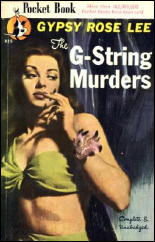
GYPSY ROSE LEE The G-String Murder

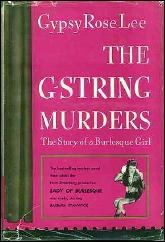
GYPSY ROSE LEE – The G-String Murder. Hardcover edition: Simon & Schuster, 1941. Also published as: Lady of Burlesque, Tower, hardcover, 1942. Ppaperback reprints include: Pocket #425, 1947; Pop. Library Eagle A3635, 1954; Avon T258, 1958. Penguin, 1984; The Feminist Press at CUNY, 2005. Possibly ghost-written by Craig Rice. Film: United Artists, 1943, as Lady of Burlesque, with Barbara Stanwyck as Dixie Daisy & Michael O’Shea as Biff Brannigan.

   Burlesque impresario H. I. Moss brings Gypsy Rose Lee to the Old Opera Theater — “GIRLS! GIRLS! GIRLS! Laffs! Laffs! Laffs! Boxing Thursday Nights” — and Lee brings her old friend and fellow stripper Gee Gee Graham with her. Soon after their arrival, one of the strippers is strangled with her own G-string, and later another stripper is strangled with yet another G-string.

   Biff Brannigan, the first comic and Lee’s boyfriend, is the unofficial detective in the novel. With his help the police unmask at least one murderer — or maybe a would-like-to-have-been murderer — meanwhile putting Lee’s life at risk.

GYPSY ROSE LEE The G-String Murder

   Most of the novel deals with the rather unpleasant backstage life of the performers, who aren’t a very mixed crew. Except for the one with a lisp, the strippers are hard to tell apart; they all sound alike in their dialogue, which is mostly puerile and self-centered.

   They aren’t even, if we can believe the rather cattish comments of their peers, attractive physically. Also, more should have been done with what occurred on the stage, certainly the most interesting aspect of burlesque from the customers’ viewpoint.

   Of interest, I would say, only to readers who enjoy show-business-type mysteries, who must be abundant or else there are still many doddering Lee-as-stripper fans around. As evidence, the recent Penguin Books reprint went into a second printing. The earlier Simon and Schuster edition went into printings of double figures, but Lee was still stripping strongly at the time and was in the movies.

   (It appears to be accepted in mystery circles that Craig Rice wrote The G-String Murders. J.R. Christopher’s article in The MYSTERY FANcier 8:3, “Who Really Wrote the G-String Murders?” raises a question about this acceptance.

GYPSY ROSE LEE The G-String Murder

   In a postscript to the Simon and Schuster edition, Lee is given full credit for the novel. It is said that she did all three drafts by herself, although for the final draft she had the aid of a thesaurus.

   In Erik Lee Preminger’s Gypsy & Me, he mentions The G-String Murders several times, with no indication that anyone other than his mother wrote the book. Responding to a letter I wrote him, he said:

    “The question of Craig Rice’s contribution to The G-String Murders was settled shortly after the book was published. Success has many fathers… Mother’s friend George Davis also claimed credit for G-String.

    “I wasn’t around when Mother wrote the book. Georgia Sothern swore Mother wrote every word, as did Mother. And I saw her write every word of Gypsy.”

   I don’t know what Mr. Preminger meant by Rice’s contribution having been settled, but he is obviously convinced that his mother did indeed write The G-String Murders. My conclusion, for what it’s worth, is that the novel does not have the Rice flair and reads as if Lee were the author — that is, that it is an amateurish effort.)

– From The MYSTERY FANcier, Vol. 10, No. 2, Spring 1988.


Editorial Comment:   My own review of this book immediately precedes this one; or in other words, right here.

GYPSY ROSE LEE The G-String Murder

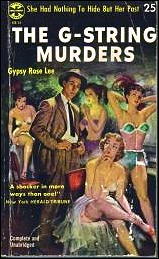
GYPSY ROSE LEE – The G-String Murder. Avon T258, reprint paperback, 1958. Hardcover edition: Simon & Schuster, 1941. Also published as: Lady of Burlesque, Tower, hardcover, 1942. Other paperback reprints include: Pocket #425, 1947; Pop. Library Eagle A3635, 1954; Penguin, 1984; The Feminist Press at CUNY, 2005. Possibly ghost-written by Craig Rice. Film: United Artists, 1943, as Lady of Burlesque, with Barbara Stanwyck as Dixie Daisy.

   The famous stripper helps solve two “impossible” crimes occurring in the rundown burlesque theater where she’s appearing. While extremely mild today, for 1941 this book must have been something else, bawdier and racier than almost anything — except for Thorne Smith’s “Topper” books, of course. The detective work which fills the second half is awfully weak, though — both confused and confusing.

GYPSY ROSE LEE The G-String Murder

COMMENT: I’ve re-read the final couple of chapters a couple of times now, and I’ve finally decided it’s just not worth the effort.

   I’m not alone, either. Because of the locked room aspects, the book is included in Bob Adey’s book on the same, but when it comes to an explanation, here’s what he says: “The solution could be a second door, an open window, or simply the removal and replacement of the original seal — take your pick.”

   I didn’t read any of this in the book I read. [WARNING] What I thought happened was that the body was put into the room before the wax seal was put on the lock. The second murder, with the body found inside a locked prop room, has an even simpler solution. The killer had a key. (Bob Adey doesn’t even mention this one.)

— Reprinted from Mystery*File #35, November 1993.


[UPDATE] 05-26-10.   The comment above was published at the same time (and place) as the review. I didn’t go into the provenance of the book then, but Bill Deeck did when he also reviewed the book, a review that will be posted next.

REVIEWED BY WALTER ALBERT:         


RUMBA George Raft

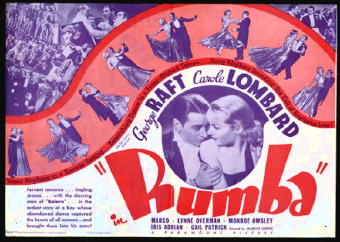
RUMBA. Paramount, 1935. George Raft, Carole Lombard, Lynne Overmann, Margo, Iris Adrian, Gail Patrick.

Photography: Ted Teztlaff; art direction: Hans Dreier and Robert Usher. Dances and ensembles staged by LeRoy Prinz; specialty dance created and staged by Veloz and Yolanda. Director: Marion Gering. Shown at Cinecon 45, Hollywood CA, September 2009.

   Maybe I was just worn down by four days of movie watching, but this second pairing of Raft and Lombard (after their success in Bolero, 1934) didn’t consistently hold my interest.

RUMBA George Raft

   Lombard is a socialite, Raft a dancer, both of them with the same winning lottery ticket, but Raft’s is shown to be a counterfeit and he is forced to return the money. When Lombard sees him dance and recognizes his talent, she tries to give him back the money but he refuses to take it.

   The film continues along this path of characters at odds, from different social classes and different temperaments, the. reserved Lombard, the hot-tempered Raft, but fated to be drawn to each other. The complex mix is eventually resolved by a dance that climaxes the film and cements their relationship.

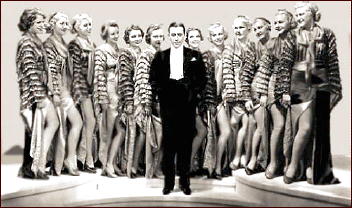
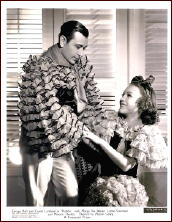
   The film’s strong suits are a pulsating, insidiously seductive Latin beat, and a striking performance by Margo as the Latino dancer who is Lombard’s rival for Raft as a dance partner and as a lover. (Seen with George Raft in the photo above and to the left.)

RUMBA George Raft

   On her blog, author Jane Haddam takes issue with my review of her book Cheating at Solitaire here on this one. She’s certainly right to take issue. Overall I didn’t find the book particularly rewarding, and I tried to explain why.

   I did end the review on a positive note by suggesting that “…values are the key to Cheating at Solitaire — hometown values, small town values, I don’t believe it matters either way. Maybe they’re even universal values and and maybe this is why readers keep coming back for more.”

   Earlier on, though, I expressed my displeasure with the lack of actual detection that went on in what I assumed to be a book about a detective, ex-FBI agent Gregor Demarkian, the leading character in most if not all of the author’s books. I had to conclude that solving a mystery, the undoing of a puzzle plot, was not one of the reasons readers keep coming back for more of his adventures.

   Nor does Jane Haddam deny it. Quoting here and there from her comments, and you can go read them in full to fill in any blanks I’ve omitted, she says:

    “Now, I’ve got a sneaking suspicion that the author of the review/blog linked above is male. In my experience, men tend to like lots of plot and to see nothing but wasted time and space in a concentration on character.

    “But even so, even most plot-besotted readers should have noticed by now that there really isn’t anything new in the way of plot out there, and hasn’t been for years. There isn’t much new in the way of detection, either. I’ve been watching my way through four and a half seasons of the old Perry Mason, and I can see the plots coming down the pike as predictably as summer follows spring.

    […]

    “I guess what I’m saying here is that I can’t imagine reading a mystery for the plot, and I really have no particular use for reading one for the continuing characters, who are either going to be boring as hell in no time at all or are going to have the kind of overwrought lives that make Dark Shadows look like a children’s story.

    “Apparently, however, a lot of people out there are innocent of the idea that you might want to read mystery fiction for any other reason.”

   So there we are, miles apart. Miles. (But you might also want to read my second paragraph above again.)

   Copied from the TCM website, the following news:

      TCM Ready to Shine Brightly with Eighth Edition of SUMMER UNDER THE STARS

   The dog days of summer are the best time of the year for movie fans as they turn on the air conditioning and park themselves on the couch for the latest edition of Turner Classic Movies’ (TCM) ultimate movie star showcase: SUMMER UNDER THE STARS. Now in its eighth year, the August festival dedicates each of its 31 days to one of Hollywood’s most enduring actors and actresses. Assembled from the network’s library of more than 5,000 films, this one-of-a-kind festival is an opportunity for viewers to enjoy a varied selection from each star’s body of work, uncut and commercial free.

   Fourteen of the month’s actors and actresses featured in this year’s SUMMER UNDER THE STARS are first-timers to the festival. The memorable performers include five Oscar® winners: Julie Christie (Aug. 2), Ethel Barrymore (Aug. 4), Margaret O’Brien (Aug. 8), Warren Beatty (Aug. 9) and John Mills (Aug. 22). Other stars getting their first showcases include Woody Strode (Aug. 5), Kathryn Grayson (Aug. 10), Gene Tierney (Aug. 14), Robert Stack (Aug. 17), Ann Sheridan (Aug. 18), Walter Pidgeon (Aug. 19), John Gilbert (Aug. 24), Lee Remick (Aug. 26) and Thelma Todd (Aug. 30).

   This year’s SUMMER UNDER THE STARS also features 52 films making their first appearances on TCM during the festival, including I Was Monty’s Double (1958), starring John Mills and M.E. Clifton-James, who really was General Montgomery’s double during World War II; Richard Lester’s decade-defining film Petulia (1968), with Julie Christie and George C. Scott; the film adaptation of Joe Orton’s frantic play Loot (1970) and the concert-piano drama The Competition (1980), both starring Lee Remick; Richard Rush’s incisive black comedy The Stunt Man (1980), with Peter O’Toole in a brilliant performance; an extensive collection of early comedies featuring Thelma Todd; and the Hope-and-Crosby-style comedy Ishtar (1987), with Warren Beatty and Dustin Hoffman.

          >>>

   Thanks and a tip of the hat for this advance notice to Ivan G. Shreve, Jr., whose Thrilling Days of Yesteryear is one of the blogs I take a look at every day, and if you love old movies and old TV shows, as well as Old Time Radio, then you should too.

   You can see the entire August schedule for yourself, but Ivan goes through each of the 31 days of the month and points out the highlights of each from his point of view. (Follow the link above.) Often his is the same as mine, but what he has to say depends on which of the movies he already has on tape or DVD, and which he doesn’t, and I have a feeling that his collection is bigger than mine. Either way, there’s a lot to be looking forward to!

IT IS PURELY MY OPINION
Reviews by L. J. Roberts


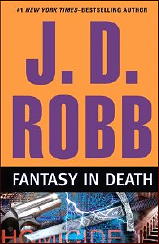
J. D. ROBB (aka NORA ROBERTS) – Fantasy in Death. Putnam, hardcover, February 2010. Reprint paperback: Berkley, July 2010.

Genre:   Police procedural. Leading character:   Det. Eve Dallas, 37th in series. Setting:   New York City–Future/2060.

J. D. ROBB Fantasy in Death

First Sentence:   While swords of lightning slashed and stabbed murderously across the scarred shield of sky, Bart Minnock whistled his way home for the last time.

   U-Play is a fast-rising gaming company with a quartet of co-owners. One of them takes the disk home for a game in development, and literally loses his head over it. Lt. Eve Dallas is faced with a locked-room mystery where she and her team have to find out not only who did it, but how it was done.

    Reading J. D. Robb has always been one of my guilty pleasures. I enjoy her voice and her humor. Only Robb can write a conversation about private parts that is neither silly, salacious or scatological, but is laugh-out-loud funny.

   She has such a wonderful ear for dialogue and banter. I appreciate her references to books, literature, television and movies, including a delightful homage to “The Godfather.”

   She also does a very good creating life in 2060; the not-too-distant future. It’s a tricky balance of making it seem possible but not fantastical. “It’s always fiction until science catches up.”

   The focus of this book is relationships; friends, partners, lovers. It is nice watching Eve develop emotionally with each book and the sexual relationship with Roark, while still there, be less prominent. The usual supporting relationships were all there in a more cameo role than in the past, but they contributed to the theme.

   Where the book fell apart a bit, for me, was the plot. It started off really well as a locked-room mystery. There were viable suspects and some good red herrings. However, because of the type of crime, it didn’t quite make sense that Eve was the one who came up with the solution; the logic, perhaps, but not the technicality.

   The final climatic scene seemed abrupt and over the top. I did enjoy the book, do still enjoy the series and know I’ll continue reading it, but would like to see Robb/Roberts change it up a bit.

Rating: Good.

Editorial Comment:   Can there already really be 37 in this series? The first one was Naked in Death, which came out in 1995 as a paperback original from Berkley. That’s well over two books a year ever since.

   But when I went to look the series up online, I found that while the Fantastic Fiction website agrees that Fantasy in Death is #37 in the series, it appears that a few of the 37 were only long novelettes that appeared in collections with other authors. Looking further on the same page, though, I see that some of these have been published individually as novellas under the J. D. Robb byline, so I’m assuming the number is at least semi-legitimate and to let it stand.

« Previous PageNext Page »