REVIEWED BY DAN STUMPF:         


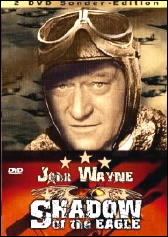
SHADOW OF THE EAGLE John Wayne

SHADOW OF THE EAGLE. Mascot, 12 episode serial, 1932. John Wayne, Dorothy Gulliver,Kenneth Harlan, Walter Miller, Edward Hearn, Richard Tucker, ‘Little Billy’ (Rhodes), Ivan Linow, James Bradbury Jr. Directors: Ford Beebe & B. Reeves Eason (the latter uncredited).

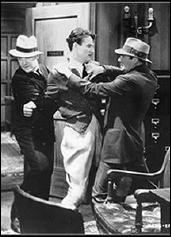
   Shadow of the Eagle was John Wayne’s first Serial and a highly enjoyable effort, in its own way, for those prepared to spend four-and-a-half hours of their Precious Youth with a low-budget, low-brow movie no one ever heard of.

   According to Tuska’s book on Mascot, the Duke was offered more money at this time to appear in Nothing Parts for major studios, but he wanted to play Hero Parts, and Nat Levine, King of Cheap Thrills in the early Thirties, told him it was a Lindbergh-type part.

   He signed on, and the next day was carted off in the wee small hours of the morning to arrive at some remote location in time to start shooting at Dawn. (Mascot paid their Actors bv the day and in order to economize they started filming with the first Light of day and often didn’t finish till Midnight.)
SHADOW OF THE EAGLE John Wayne

   It was a career gamble that paid off, but there must have been times when Wayne wondered about it, what with long days, grueling conditions and short pay.

   Whatever the case, Levine managed to churn out three highly entertaining serials over the next year with his new star before the Duke left for the Wide Open Spaces at Monogram.

   Shadow of the Eagle concerns itself with the efforts of the mysterious “Eagle” to blackmail the Directors of an Aircraft Factory and cast the blame on an innocent Circus Owner, who happens to be the Heroine’s father and Duke’s employer.

   John is allegedly a stunt-flier here, but the closest he probably ever got to a plane in this thing was watching the grainy old stock-footage of Mascot’s Bi-Plane and being chased across a field by it in a scene that looks to have inspired North by Northwest.
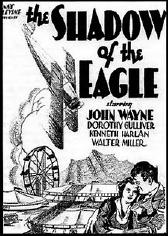
SHADOW OF THE EAGLE John Wayne

   Still, it’s an entertaining film, in its way, with Wayne or some other sympathetic character apparently getting killed off at the end of each chapter, only to be miraculously “saved” in the opening of the next installment — often by the most outrageous cheating or unlikely contrivance.

   There’s even some convincing Circus atmosphere, with various carnival denizens coming to the rescue at odd moments, including Ivan Linow as the Strong Man, James Bradbury Jr. as a rubber-limbed ventriloquist and Little Billy as — you guessed it.

   Watching this thing, I find myself consistently amazed by the sheer quantity (if not Quality) of Thrills that Levine managed to pack in his film for peanuts. The Mascot serials may be a long way from Artistry, but they have an un-self-conscious innocence and energy that I find totally captivating.

A MOVIE REVIEW BY DAVID L. VINEYARD:         


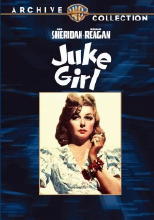
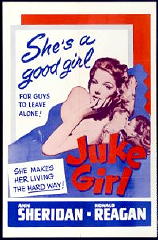
JUKE GIRL Ann Sheridan

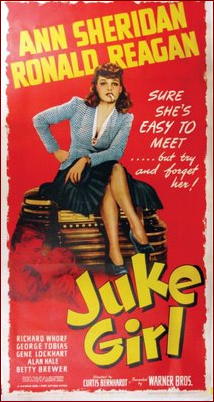
JUKE GIRL. Warner Brothers, 1942. Ann Sheridan, Ronald Reagan, Richard Whorf, George Tobias, Gene Lockhart, Alan Hale, Howard da Silva, Donald McBride, Faye Emerson, Fuzzy Knight, Willie Best. Screenplay by A.I. Bezzerides, based on a story by Theodore Pratt, adapted by Kenneth Gamet. Directed by Curtis Bernhardt.

   History adds a touch of irony to this Warners social drama since in it Conservative icon and Republican President Ronald Reagan plays a radical left wing itinerant farm organizer, sort of an Anglo Cesar Chavez.

   It’s the depths of the Depression and Reagan and pal Whorf have just wandered into the farming town of Cat Tail, California (“population 3,000 nine months a year, 30,000 the other three”) where shipper Gene Lockhart and his tough manager Howard da Silva are using their monopoly to break the farmers, like Greek George Tobias.

   Whorf takes a job with Lockhart, but Reagan sticks up for Tobias and thus is set up a classic rivalry between buddies — pal against pal.

JUKE GIRL Ann Sheridan

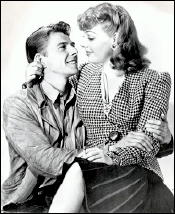
   Enter Ann Sheridan, the dance hall girl of the title (a ‘Juke Girl’), a tough brassy broad who is no better than she has to be and not as bad as her face is painted — a typical Sheridan role, and a typical Warners leading lady — smart, self sufficient, tough, but with a heart of gold, and more morals than she lets on.

   She and Reagan only need one look and the sparks fly (“You been burnin’ to get out of everywhere you ever been,” Reagan tells her). They teamed again more effectively in the classic King’s Row, but this one is closer to B territory, and they have more fun with it.

   Reagan takes up with trucker Alan Hale, a two-fisted fellow also battling Lockhart and da Silva to help get Tobias and the other farmers in the cooperative’s crops to market — I told you this was an ironic role for Reagan — but Lockhart murders Tobias and frames Reagan and Sheridan for it.

   As the lynch mob marches on the jail to take the lovers, Whorf and Hale coerce a confession from Lockhart, and save the lovers. Reagan and Sheridan end up with their own farm, Lockhart goes to jail, Hale is now in charge of helping the farmers, and Whorf hits the road again — but he’ll see them in nine months when the crops come in.

JUKE GIRL Ann Sheridan

   Reagan’s “Maybe I just don’t like to see a man kicked around,” is no Tom Joad’s speech from The Grapes of Wrath, but Sheridan has ‘oomph’ to spare, and if she is a thousand times better looking than the best looking dance hall girl who ever went to bed complaining about her aching feet, she had real skill at playing the kind of tough, human, and believable women Hollywood films too often turned into cliches.

   Claire Trevor and Barbara Stanwyck were among the rare actresses who did it as well. Their working women had a way of making you think you might actually find them in a diner or dance hall — however unlikely that might be in real life.

   Juke Girl lacks the righteous anger of Grapes of Wrath and the tragic eloquence, nor is it as emotionally tough as other Warners social drama classics such as I Was A Fugitive From a Chain Gang and Black Fury or the bright comedy/drama of films like Manpower, Slim or They Drive By Night. It’s also lacking a Paul Muni, Edward G. Robinson, James Cagney, or even George Raft, though Whorf does well in the Raft role in the film.

JUKE GIRL Ann Sheridan

   Reagan is a perfectly good lead, but he lacks the passion or the conviction this one calls for, the quiet dignity of a Henry Fonda, the caged power of a Cagney, or the depth and anguish of a Paul Muni — you keep half expecting him to mount a plough horse and ride off into a Republican sunset — exit stage right, of course. (In all fairness this was probably less a stretch before we knew his politics).

   The film gets a good deal of good will though from fine contributions by Hale, Lockhart, da Silva, Tobias, Willie Best, and particularly from Sheridan’s famous ‘oomph.’ Whenever she is on screen, the film sparkles and threatens to become something more than what it is.

   Juke Girl doesn’t have the head or the heart to be what it wanted to be, though it at least has the ambition to be something more. The seeds have been sewn, but all they bear are the grapes of mild indignation. It needed John Steinbeck and John Ford to turn social injustice into an American tragedy. Here we have a western with trucks and crops substituting for horses and cattle.

JUKE GIRL Ann Sheridan

IT IS PURELY MY OPINION
Reviews by L. J. Roberts


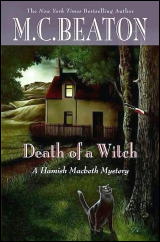
M. C. BEATON – Death of a Witch. Reprint paperback: Grand Central Publishing, January 2010. Hardcover edition: February 2009.

M C. BEATON Death of a Witch

Genre: Police procedural/cozy. Series character: Hamish Macbeth, 25th in series. Setting: Scotland.

First Sentence: Police Constable Hamish Macbeth, heading home to his police station in the village of Lochdubh n Sutherland, heaved a sigh of relief.

   Constable Hamish Macbeth is back in the Scottish village of Lochdubh after his less-than-restful vacation to Spain. He is greeted with the news that a witch has moved into town. But she’s not there long and she is murdered shortly after Hamish’s return. As Hamish’s investigation proceeds more die.

   The Hamish books lie somewhere between traditional mysteries and cozies. On the traditional side, by the end of the book there are a lot of bodies and the protagonist is a policeman. However, rather than there being a detailed investigation, it’s almost as if, when Hamish appears, people confess and everything falls into place.

   On the cozy side, there is an awful lot of time spent dealing with his relationships with women. He has better relationships with his pets. As for characters, Hamish is a little too good to be true. He’s tall, red-haired, good looking to the point where every woman but the one he wants throws themselves at him, and can run like the wind.

   I was a bit annoyed that Hamish’s superior, CI Blair, is portrayed as so incompetent but at least it’s balanced by Hamish’s friend, DS Jimmy Anderson, and Blair’s boss, CS Davoit

   The style is a bit simple for my taste, almost as if written for young adults. I do like that the dialogue is written with an indication of people’s accents without it becoming laborious.

   The element I most enjoyed was the sense of place. Beaton’s descriptions of the highlands and the weather, which can be a critical element in living in, and navigating around, the highlands, is well done. This was a light, enjoyable read but it’s a series I’ve put behind me.

Rating: Good.

Editorial Comment: Say welcome to LJ Roberts and her first review for the Mystery*File blog. Her reviews previously graced the pages of both the printed version and the M*F website, but in the space of time between the latter and the blog, she moved them elsewhere, but only temporarily, I’m pleased to say. Here she is again.

   I don’t know if you’ve noticed, but I’ve jammed a sizable number of posts into the span of the last two or three days. Ordinarily I might have been spread them out over a longer period of time, but something’s up. Soon after noon tomorrow, I’ll be on my way to Chicago and this year’s annual Windy City Pulp & Paper Convention.

   And I won’t be back until Sunday, with my satchels full of books and magazines and my checkbook empty. Heck, if I plan it right, my checkbook will be empty several minutes after the doors to the dealers’ room open on Friday. It won’t be hard to do, especially with all the wares that’ll be out for display, fully designed to tickle everyone’s fancy. Well, mine, at least.

   Some of you I will see there, I am sure. If not, so long until next week Monday. For the rest of this evening, it’s time to pack.

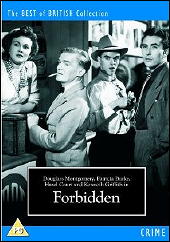
FORBIDDEN. British Lion Film Corp, UK, 1948. Douglass Montgomery, Hazel Court, Patricia Burke, Garry Marsh, Ronald Shiner, Kenneth Griffith. Director: George King.

   By sheerest of chances, one imagines, I’ve come across both an episode of a TV show (Adam Adamant Lives) and a movie (Forbidden) which takes place along the “Golden Mile,” a stretch of Promenade between the North and South piers in Blackpool, England, filled (in its heyday) with carnival booths and amusement arcades, slot machines and various other means of taking money from the pockets of passers-by.

FORBIDDEN Hazel Court

   The episode (Adam Adamant Lives) was the second of the series, “Death Has a Thousand Faces” (30 June 1966), in which Adamant (Gerald Harper) and Georgina Jones, his female assistant (Juliet Harmer) meet and recruit the third member of the program’s recurring cast, a barker by the name of William Simms (Jack May). Unaccountably, Simms does not appear in the third episode, reflecting some of the production problems the TV crew were having at the time.

   But this is not a review of Adam Adamant, nor of the Golden Mile, but of Forbidden, in which one actor on the way down, Douglass Montgomery – this was his last movie before heading over to solely a television career – meets one on the way up, Hazel Court, red-headed beauty of many a later Hammer horror film, several years in her future yet.

   She’s the girl behind a candy counter along the Golden Mile, and across the way is Montgomery’s booth, in which he sells tonics of all sorts for all kinds of maladies – a sort of stationary medicine wagon. Baldness, sore feet, upset stomach? Stop in, please.

   But it must pay well. Jim Harding (that’s his name) could be a research chemist instead, and for real, but his wife, determined to become an actress, has a standard of living that demands he say no to mere (and low-paying) academic pursuits.

   The girl’s name is Jane Thompson (played by Hazel Court) and she’s not his wife, but she’d like to be. But don’t get the wrong impression here. She’s an innocent and doesn’t know that he’s even married. But he does — boy does he ever — and here is where the noir aspect of this relatively mild British thriller kicks in.

   Harding is a weakling, though, though not strictly in a physical sense. Maybe mild-mannered is a sufficient description — not a forceful fellow at all. Things do take their course, however, and after his wife’s death and a suspenseful chase scene taking place in the tower high above the promenade, there is a happy ending – or at least an ending that’s as happy as it could be, given the circumstances.

   I’ve used the word “mild” a couple of times. As thrillers go, that just about sums this movie up in one word: mild. The presence of Hazel Court in this movie was enough to keep me watching it, even in black and white. She may, or may not, be reason enough for you.

[UPDATE.] 04-22-10.   While the DVD cover shown is that of the UK edition, I thought I should let you know that Forbidden has been commercially released in the US also, and that’s the copy I have.

REVIEWED BY DAN STUMPF:         


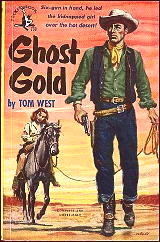
TOM WEST – Ghost Gold. E. P. Dutton “Diamond D Western,” hardcover, 1950. Reprint paperback: Pocket #733, October 1950.

TOM WEST Ghost Gold

   I almost pitched Ghost Gold after the first few pages: the local bank is found robbed, a teller murdered, and a handsome stranger on the floor, unconscious, with the murder weapon in his hand.

   Well, it’s perfectly obvious he can’t be the killer, and equally obvious that someone’s going to walk his horse out from under him if he can’t prove his innocence. Looked like pretty standard stuff, and I didn’t feel like spending a whole book plodding toward the obvious.

   Fortunately, neither did the author, Tom West.. In short order our hero is cleared of the crime and on the track of the guilty owlhoots what done it. Which is also fairly standard stuff for a western, except that this one is peppered with a saucy supporting cast that livens up even a plot as stale as this one.

   West throws in a corrupt lawman with a stubborn streak, colorful heroine, drunken lawyer, doughty squatters, and best of all, a colorful detective, Scripture Sam, who goes about methodically collecting clues and sifting evidence in the best tradition, while mis-quoting the Bible and ventilating side-winders.

   Ghost Gold is worth reading just for this, but it also offers a few well-paced chases, gun-battles and a dandy wrap-up for the hombres. In all, a lively time and I’m glad I stuck with it.

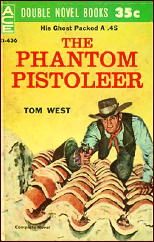
TOM WEST Pistoleer

Editorial Comments:   Tom West is not an author who’s remembered very much today, even, I suspect, by most collectors and connoisseurs of western fiction. But between 1944 and 1980 he wrote some 60 plus western novels, most of them as paperback originals, many by Ace in their “Double Novel” format.

   Of special note, I think, is the fact that he favored alliterative titles, ones such as Meddling Maverick (his first), Bushwhack Basin, Battling Buckaroos, Lobo Lawman, The Toughest Town in the Territory, and Bad Blood at Bonita Basin. Plus Ghost Gold as well, of course.

   I have a complete checklist of his westerns to post online, and I will, as soon as I can get to it, perhaps as early as next week.

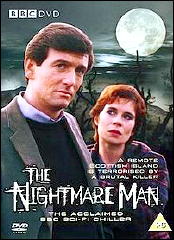
THE NIGHTMARE MAN. BBC-TV, UK, four-part mini-series, 01 May to 22 May 1981. James Warwick, Celia Imrie, Maurice Roëves, Tom Watson, Jonathan Newth, James Cosmo. Screenplay: Robert Holmes, based on the novel Child of the Vodyanoi by David Wiltshire. Director: Douglas Camfield.

THE NIGHTMARE MAN (BBC)

   That both the screenwriter and the director were involved with the BBC’s Dr. Who, both before and after, suggests why this moderately well-plotted SF-thriller comes off so well.

   All four parts take place on a unnamed Hebrides island, up around Scotland way. About 35 square miles in size, the island has a police force of four men, headed by Inspector Inskip (Maurice Roëves), and a coast guard station with three more.

   Is that enough to protect the island’s inhabitants from a crazed killer whose victims have been mauled to death by a creature that seems to be half animal and half human? Under ordinary circumstances, yes, but the island is socked in by fog with no access to the mainland. Until the weather clears, the people on the island are strictly on their own.

   Pictured on the DVD cover are the two principal characters in this four-act play. James Warwick as Michael Gaffikin, the island’s dentist, an outsider who honorable intentions are questioned by the closely-knit townspeople in regard to the incipient love affair between him and the island’s druggist, Fiona Patterson, played the lovely Celia Imrie.

   Only once do we see the latter in anything resembling glamorous, however, during a dinner date with Gaffikin, in which she wears a daring low-cut dress. Otherwise she is as bundled up against the fog as the rest of the guys. Of course it is she who has previously mapped out the island, so it is also she who is their guide up and down and across some fairly rugged terrain (actually filmed in Cornwall), trying to reach campers in danger and to track the increasingly murderous intruder — who just may be an alien newly arrived from space.

   As usual in stories like these, the truth, while equally fantastic is also rather prosaic, making the fourth of the four episodes the weakest. It takes a lot of sedentary (standing around) exposition to make the details of the island’s attacker understood.

   But before then, by which I mean the previous three episodes, this is a fine example of horror fiction, slightly old-fashioned now and only moderately gory, one supposes, due to its being made for TV — shown only once, by the way, until recently released by the BBC on Regions 2 and 4 DVD.

   I watched all four episodes (two hours) in one evening. I couldn’t stop myself.

THE BACKWARD REVIEWER
William F. Deeck


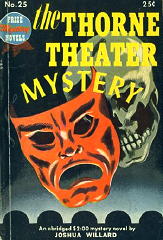
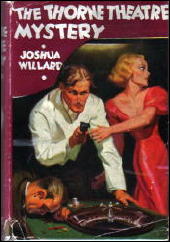
JOSHUA WILLARD The Thorne Theater Mystery

JOSHUA WILLARD – The Thorne Theater Mystery. Phoenix Press, hardcover, 1937. Reprint paperback: Prize Mystery novel #25, digest-sized, 1944, condensed.

   In upper New York State lies the town of Thorne, which contains the Thorne Theater and the last of the male Thomes with a pitch fork stuck in him. The show — an amateur production of Laugh, Lou, Laugh — must go on while Doctor Glover, the town’s coroner, investigates with the unhelpful assistance of the editor of the town’s newspaper.

   Despite what I would, to be overly considerate, describe as the author’s efforts to conceal the information, the murderer is evident almost throughout the novel.

JOSHUA WILLARD The Thorne Theater Mystery

   Go see Laugh, Lou, Laugh, and ignore the book, an even more dreadful amateur production than the show must have been.

– From The MYSTERY FANcier, Vol. 13, No. 3, Summer 1992.


Editorial Comments:   According to the Revised Crime Fiction IV, by Allen J. Hubin, this is the only mystery novel that the author Joshua Willard wrote.

   I don’t know if it makes any difference, but I suspect it may have been the abridged edition that Bill read and reported on, but perhaps not. The mystery fiction published by Phoenix Press was, let’s face it, less than average, to put it kindly, by any standard or norm in place at the time or since.

   Follow the link above to Bill Pronzini’s well-known and very enjoyable essay on Phoenix Press and the brand of lending-library mystery fiction they published.

REVIEWED BY WALTER ALBERT:         


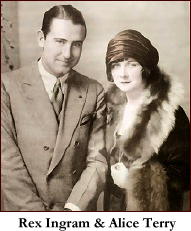
TURN TO THE RIGHT. Metro, 1922. Alice Terry, Jack Mulhall, Harry Meyers, George Cooper, Edward Connelly, Lydia Knott, Betty Allen, Margaret Loomis, Billy Bletcher, Eric Mayne, Ray Ripley. Scenario by June Mathis and Mary O’Hara, based on a play by Winchell Smith and Jack E. Hazzard; photography: John Seitz. Director: Rex Ingram, director. Shown at Cinecon 45, Hollywood CA, September 2009.

REX INGRAM & ALICE TERRY

   I saw this in 2005 at Cinefest, and I’m going to repeat the review, which, after a second viewing, still reflects my feelings.

   The program notes characterize this film as a comedy, but it’s actually a rural comedy/drama with characters familiar to audiences for generations: the hard-hearted landlord, the penniless widow he’s trying to evict, the country bumpkin who turns out to be something of a financial wizard, and the Alger-like country lad who fights against adversity and eventually achieves vindication and success.

   What is surprising is that the film is directed by Rex Ingram, better known for such films as The Four Horsemen of the Apocalypse and The Prisoner of Zenda, and not normally associated with traditional melodrama.

   This rural fairy tale has an ingratiating playfulness that allows the villain to save his face and the comic foils (memorably played by Harry Myers and George Cooper) to find redemption as well as win the hearts of two village maidens.

Reviewed by DAVID L. VINEYARD:         


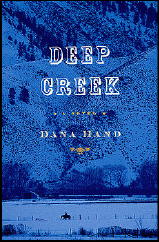
DANA HAND – Deep Creek. Houghton Mifflin Harcourt, hardcover, February 2010. Trade paperback: Mariner Books, March, 2011.

DANA HAND Deep Creek

   This dark tale of one of the byways of the history of the American Northwest begins with a particularly grim incident. Police Judge Joe Vincent, a one time marshal, is taking his daughter Nell fishing when they snag something big:

    He sat up and stared at her catch: an arm waving in the water. He foundered into the shadows to seize the small, bloated body by shoulder and thigh. Long black hair, unbound, trailed over his hands like riverweed… Nell had thrown in a line and caught a man.

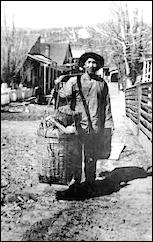
   Not just one man either. More than thirty bodies are eventually recovered, all Chinese miners. It is June of 1887 in the Idaho territory and Joe Vincent has just been thrown into the case of his lifetime, one that will take him on a personal journey and across countryside and through cities and a sham trial in Oregon before he uncovers the truth.

   Deep Creek is based on a forgotten but true incident of Northwestern American history, and Joe Vincent based on Judge Joseph Vincent, the man who investigated the mass murder.

   Written in a simple but powerful style by a pair of writers, Will Howarth and Anne Matthews, who have written eighteen books of non-fiction, Deep Creek derives its power from a story of three good, if complex people, drawn into a mystery both deeper and darker than they can imagine.

DANA HAND Deep Creek

   As Vincent sets out to follow the trail of the bodies up river he is joined by Lee Loi, an ambitious investigator sent by the Sam Yu Company, and Grace Sundown, a half metis mountain guide with secrets of her own. Together they have to piece together how this brutal crime happened and why, while fighting their own demons and the inherent injustice of racial matters at the time.

   It might sound as if this is a particularly dark book, but that would be unfair. Above all, the book celebrates the simple goodness of three people who will not allow an injustice to go unmarked or strangers far from their home to go unavenged.

   Much of the novel has to do with those three investigators learning to trust each other as they encounter lies, deceit, and cover-ups at all levels and distrust from both those they want to help and those they hope to bring to bear for the crime. At times they face danger from unseen forces, and the violence of the brutal slaughter of the thirty Chinese is never far from the surface.

   The novel covers a time period from June of 1887 to August of 1892 but echoes the difficult history of the Asian immigrants to the American West through much of the 19th and the first half of the 20th Century.

   The ending of the book is a perfect touch of ironic justice, one that might have come from Jack London at his best. It echoes that and Traven’s Treasure of the Sierra Madre and brings a fine book to a perfect close.

DANA HAND Deep Creek

   As with real life the novel is not tied up neatly in a package, and justice is not so much served as attempted by three good people and others like them that they meet and ally with. And the writing … the writing is simply beautiful:

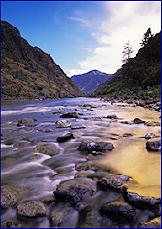
    On the Idaho shore the mare waited a while, then trotted east, reins loose. A full moon rose over the canyon of the Snake. In the dark waters a great fish swam upstream, trolling as it went, drifting sideways and dropping back, over and over. A promising eddy waited near Deep Creek. Long as a river dory, splendid as a dragon, no one and nothing would disturb it there.

   This one is something special, with some of the power of works by Ivan Doig and Jim Harrison as well as a compelling mystery and solid detective work by its three protagonists. It goes on a small shelf of powerful novels of the West such as those by Willa Cather, Mari Sandoz, Frederick Manfred, and Wallace Stegner. Once you read it, you won’t forget it.

Note: In 2005 the site where the bodies were found was recognized as a significant American historical place and renamed Chinese Massacre Cove. Final recognition for a forgotten crime.

« Previous PageNext Page »