COLLECTING PULPS: A MEMOIR
PART FIVE — REMEMBERING MIKE AVALLONE
by Walker Martin


   While commenting on “Fifty Funny Felonies” by David Vineyard this past week, several readers started to talk about Mike Avallone. Sometimes the comments take over the original subject and go off in a different direction. I started to think about my friendship with Mike and how he was such a larger than life person. Is he really gone? Here are some of my memories.
MICHAEL AVALLONE

   Stephen Mertz mentions how Mike would start talking and telling jokes “full tilt,” and how his wife Fran would yell at him to shut up and listen, but Mike would carry on. There was no stopping him.

   In 1995 Mike was Guest of Honor at the Pulpcon convention along with Hugh Cave. Everett Kinstler, the famous portrait painter and Shadow illustrator, also was a guest but to tell you the truth I was so busy buying and selling pulps that I don’t even remember Kinstler being there. But I sure remember Mike Avallone.

   He had been a regular at previous Pulpcons, and though he couldn’t afford to buy any, he loved being around the old magazines and talking about them. I was part of a group of East Coast collectors who included Mike in their meetings and since he didn’t drive we would drive him to our homes for pulp get-togethers and conventions like Pulpcon. In fact one of our friends to this day still has “Ed Noon” as part of his email address and for many years he had stenciled on his car window, “Ed Noon Associates.”
MICHAEL AVALLONE

   Mike was so excited and hyper at this convention that he was practically out of control. Why? Because he took being Guest of Honor seriously and was so pleased at the recognition from his friends and fellow collectors. He received a beautiful plaque showing four pulps and digests that he had appeared in with stories. Mike did actually have a few tales in the pulps before they disappeared.

   The entire four day weekend, I don’t think Mike got much sleep. Every night he was up telling jokes, talking about movies and baseball, interacting with the other collectors. One of my close friends, Harry Noble who was one of the great pulp collectors, had a habit of going to bed early at 9:00 pm and getting up at 3:00 am. He got up as usual at 3:00, saw Mike and a several collectors sitting around laughing and talking, and thought we were all getting up early like him. The truth was that we had not even gone to bed yet.

   Some people did not take to Mike at all. He seemed to have the ability to annoy or make some collectors angry. I was witness to this at the Bouchercon in Philadelphia in 1989. Again Mike was over the top and greeted a fellow collector’s wife and grown daughter with hugs and smiles. But they were really uptight and dignified and acted horrified at his friendly behavior. It was comical to see the collector’s embarrassment as his wife and daughter backed away from Mike with big frowns. On the other hand, my wife and daughter loved Mike and his funny compliments.
MICHAEL AVALLONE

   When it was time to eat dinner, we made the mistake of going into Bookbinders restaurant, which was too classy for people like us. We sat down with the help of several waiters, saw the menu and prices, and immediately realized we had blundered.

   I was prepared to stay and pay the high price of the meal rather than leave, but not Mike. He stood up and led us out past the disapproving gaze of the waiters and other diners. I felt like a fool lugging my two sack of books but Mike just laughed as usual, and we ate at a nearby pub.

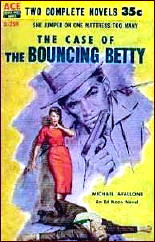
   Many times Mike visited my house with other collectors and often stayed for dinner. He liked my wife’s Italian cooking. But he liked my pulp and paperback collection even more. I happened to have the original cover painting to the Ace novel by Mike titled The Case of the Bouncing Betty.

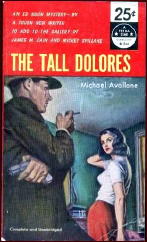
   He loved looking at the painting and gave me a photo of the painting that he owned to The Tall Dolores, another Ed Noon novel. I tried many times to buy the painting from him and though I had the impression that he needed money, he just couldn’t sell it.

   For many years Al Tonik held meetings at his house which we called Tonikcons. There were around 20 or these, most of which Mike attended. We would eat and drink, meanwhile talking books and pulps. One meeting he bought a video tape showing when he was a guest on the TV show To Tell the Truth. I believe he appeared in 1981.

   When he would visit me he often headed to my paperback room which had a couple of stacks of Avallone paperbacks. The first couple times he pulled out his pen and offered to sign them all. But every time I said “no, don’t sign, they are worth more without the signature.” Many authors would have been angry at such a joke, but not Mike.
MICHAEL AVALLONE

   One disaster was just barely avoided the night Mike walked out of the paperback room and almost took a header down the staircase. We grabbed him in time and he joked about the headline in local papers that might have read, “Fastest Typewriter in the East Falls to Death in Pulp Collector’s House.”

   He said that would be the way he would want to die if he had to go. Mike said he wrote a short story about almost falling down the stairs, but I’ve never seen it.

   But the thing he liked even more than the paperbacks, was my Spider pulp collection. He said it was his favorite magazine as a boy and he loved looking at the issues. In the late nineties he sold his house in New Brunswick, NJ and he moved to the west coast.

   His friends back east worried about him not having his support system of pals, and I guess we were right. He died soon after moving within a year or two in 1999. Soon after his death I sold my Spider set, and so ended a period of my life that I’ve still not come to terms with.

   A Partial Bibliography. This list of titles that follows, taken from the Revised Crime Fiction IV, by Allen J. Hubin, consists only of Mike Avallone’s mystery and detective fiction published under his own name. It does not include crime fiction written under the pseudonyms Priscilla Dalton, Mark Dane, Jean-Anne de Pre, Dora Highland, Steve Michaels, Dorothea Nile, Edwina Noone & Sidney Stuart, not does it attempt to list any of his non-criminous work.

       AVALLONE, MICHAEL (Angelo, Jr.) 1924-1999.

* The Tall Dolores (n.) Holt 1953 [Ed Noon]
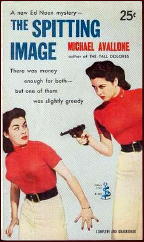
* The Spitting Image (n.) Holt 1953 [Ed Noon]
MICHAEL AVALLONE

* Dead Game (n.) Holt 1954 [Ed Noon]
* Violence in Velvet (n.) Signet 1956 [Ed Noon]
* The Case of the Bouncing Betty (n.) Ace 1957 [Ed Noon]
* The Case of the Violent Virgin (n.) Ace 1957 [Ed Noon]
* The Crazy Mixed-Up Corpse (n.) Gold Medal 1957 [Ed Noon]
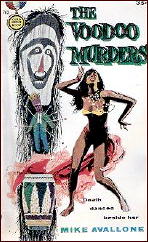
* The Voodoo Murders (n.) Gold Medal 1957 [Ed Noon]
MICHAEL AVALLONE

* Meanwhile Back at the Morgue (n.) Gold Medal 1960 [Ed Noon]
* The Little Black Book (n.) Midwood 1961
* The Bedroom Bolero (n.) Belmont 1963 [Ed Noon]
* Shock Corridor (n.) Belmont 1963
* Tales of the Frightened (co) Belmont 1963
* There Is Something About a Dame (n.) Belmont 1963 [Ed Noon]
* Lust Is No Lady (n.) Belmont 1964 [Ed Noon]
* Run, Spy, Run [with Valerie Moolman** ] (n.) Award 1964 [Nick Carter]
* The China Doll [with Valerie Moolman** ] (n.) Award 1964 [Nick Carter]
* Saigon [with Valerie Moolman] (n.) Award 1964 [Nick Carter]
* The Man from U.N.C.L.E. (The Thousand Coffins Affair) (n.) Ace 1965 [Napoleon Solo]
* The Birds of a Feather Affair (n.) Signet 1966 [April Dancer; Girl from U.N.C.L.E.]
* The Blazing Affair (n.) Signet 1966 [April Dancer; Girl from U.N.C.L.E.]
* Kaleidoscope (n.) Popular Library 1966
* Madame X (n.) Popular Library 1966
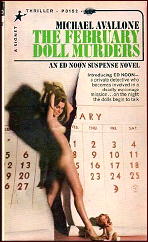
* The February Doll Murders (n.) Signet 1967 [Ed Noon]
MICHAEL AVALLONE

* The Felony Squad (n.) Popular Library 1967
* The Man from AVON (n.) Avon 1967
* Assassins Don’t Die in Bed (n.) Signet 1968 [Ed Noon]
* The Coffin Things (n.) Lancer 1968
* Hawaii Five-O (n.) Signet 1968
* The Incident (n.) Popular Library 1968
* Mannix (n.) Popular Library 1968
* The Doomsday Bag (n.) Signet 1969 [Ed Noon]
* The Killing Star (n.) Hale 1969
* Missing! (n.) Signet 1969
* Terror in the Sun (n.) Signet 1969 [Hawaii Five-O]
* A Bullet for Pretty Boy (n.) Curtis 1970
* One More Time (n.) Popular Library 1970
* The Partridge Family #2: The Haunted Hall. Curtis 1970
* Death Dives Deep (n.) Signet 1971 [Ed Noon]
* The Fat Death (n.) Curtis 1971 [Ed Noon]
* Little Miss Murder (n.) Signet 1971 [Ed Noon]
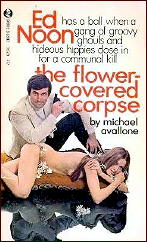
* The Flower-Covered Corpse (n.) Curtis 1972 [Ed Noon]
MICHAEL AVALLONE

* The Girl in the Cockpit (n.) Curtis 1972 [Ed Noon]
* The Horrible Man (n.) Curtis 1972 [Ed Noon]
* The Living Bomb (n.) Curtis 1972 [Ed Noon]
* London, Bloody London (n.) Curtis 1972 [Ed Noon]
* Shoot It Again, Sam (n.) Curtis 1972 [Ed Noon]
* The Alarming Clock (n.) Curtis 1973 [Ed Noon]
* The Hot Body (n.) Curtis 1973 [Ed Noon]
* Kill Her — You’ll Like It! (n.) Curtis 1973 [Ed Noon]
* Killer on the Keys (n.) Curtis 1973 [Ed Noon]
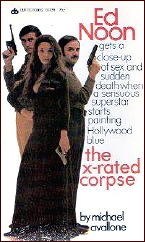
* The X-Rated Corpse (n.) Curtis 1973 [Ed Noon]
MICHAEL AVALLONE

* Fallen Angel (n.) Warner 1974 [Satan Sleuth: Philip St. George]
* The Werewolf Walks Tonight (n.) Warner 1974 [Satan Sleuth: Philip St. George]
* Devil, Devil (n.) Warner 1975 [Satan Sleuth: Philip St. George]
* The Big Stiffs (n.) Hale 1977 [Ed Noon]
* -Carquake (n.) Star 1977
* CB Logbook of the White Knight (co) Scholastic 1977
* Dark on Monday (n.) Hale 1978 [Ed Noon]
* 5 Minute Mysteries (co) Scholastic 1978 [Ed Noon]
* Charlie Chan and the Curse of the Dragon Queen (n.) Pinnacle 1981
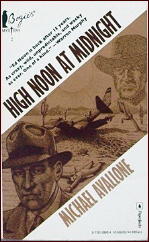
* High Noon at Midnight (n.) PaperJacks 1988 [Ed Noon]
MICHAEL AVALLONE

* Open Season on Cops, and The Arabella Nude (co) Gryphon Books 1992 [Ed Noon]
* Mitzi (n.) Gryphon Books 1997

Previously on Mystery*File:   Part Four — Collecting Detective Story Magazine.
Coming next:   Part Six — Collecting the other Popular Publications pulps.

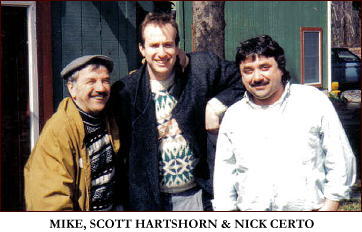
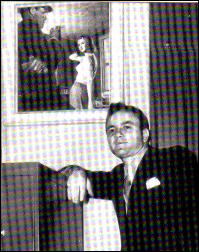
Editorial Comments:   Thanks to Scott Hartshorn for providing the two photos you see above. The first was taken outside Nick Certo’s house, circa 1992. The black and white photo, taken in the early 50s, is that of Mike standing beside the cover painting for The Tall Dolores. The cover itself you can see in color just above the photo and to the left.

   Note that Mike can be seen in the cover of The X-Rated Corpse. He’s the fellow on the right.   Coming tomorrow: Bill Pronzini’s 1001 Midnights review of The Case of the Violent Virgin.
REVIEWED BY DAN STUMPF:         


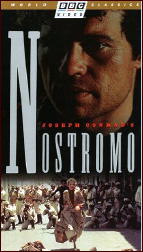
NOSTROMO Joseph Conrad BBC TV

NOSTROMO. BBC-TV mini-series, 1996. Claudio Amendola, Paul Brooke, Lothaire Bluteau, Claudia Cardinale, Joaquim de Almeida, Brian Dennehy, Albert Finney, Serena Scott Thomas, Colin Firth, Roberto Escobar. Based on the novel by Joseph Conrad. Director: Alastair Reid.

   Somewhere over the last couple months I found time to watch Undersea Kingdom (Republic, 1936) in which Ray Corrigan battles the tyrant of Atlantis while dressed as a Mardi Gras Queen. It’s done with the usual care Republic lavished on their serials: splendidly tacky sets, ambitious special effects and action action action, but it lacks the energetic stuntwork that usually graced their films of this period, and I only mention it because shortly after seeing this I watched another lengthy tale of internecine warfare in an exotic locale, a 5-hour BBC miniseries from 1996 of Joseph Conrad’s 1904 Nostromo.

   While I was watching it, I re-read the book, which proved to be a rewarding experience as the film adds some clarity to the characters and narrative while the book … well Nostromo is Conrad at his best, which is very good indeed: fights, shooting, hair-breadth escapes and house-to-house street battles, all laid on with surprising thoughtfulness and skill as Conrad makes it happen to people we believe in.

NOSTROMO Joseph Conrad BBC TV

   The mini-series carries this complex plot without dropping it, though they expand on the narrative where Conrad didn’t and rearrange it for clarity, which was probably necessary in the miniseries format. Characters who come on late in the book are introduced earlier in the film to provide for continuity, and sometimes they say baldly what Conrad only hinted at.

   Colin Firth and Serena Scott Thomas as the English couple who form the nucleus of the story acquit themselves quite well, Albert Finney throws in a fine character part as a disreputable doctor (one of Conrad’s finest characters) while Joaquim de Almeida and Roberto Escobar make a daunting pair of villains.

NOSTROMO Joseph Conrad BBC TV

   Only Claudio Amendola, in the title role, disappointed me, and that was probably a personal thing. Conrad wrote the character as a stylish swashbuckler, the kind who would have been played by Doug Fairbanks Sr. in the old days, or perhaps Errol Flynn or Gilbert Roland in Hollywood’s golden age: a man who can leap onto a speeding train, gallop across the plain, and cut buttons off a coat with one sweep of a knife.

   Amendola seems formidable enough, but entirely too serious, as if the producers saw the character’s end and wanted to telegraph it to us early on. As I say though, that’s entirely a personal thing and I didn’t let it spoil my enjoyment of a fine effort that should be more widely available.

Editorial Comment:   The mini-series, for which I have not yet unearthed the exact dates of its first (and only?) run, is available commercially on VHS but not on DVD. For the former, think the $40 range.

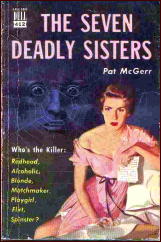
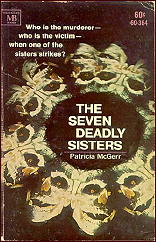
PAT McGERR – The Seven Deadly Sisters. Doubleday Crime Club, hardcover, 1947. Paperback reprints: Dell 412, mapback edition, 1950; Macfadden 60-364, 1968.

PAT McGERR Seven Deadly Sisters

   It begins as a gimmick story, as you may already know, if only by reputation. Sally Bowen and her new husband have just moved to England, and there she receives a letter from a friend back home, expressing her sorrow over the fact that the husband of one of Sally’s aunts died of poison, and that when she was discovered as the murderer, the aunt committed suicide.

   Unfortunately for Sally, she has seven aunts, and between them they have at least that many husbands, and what the friend neglected to mention is what she most desperately needs to know — who was it that was murdered?

   Granted, the situation is contrived. As Sally begins to tell her husband the tangled story of her aunts’ various love affairs, however, with all of them eventually pressured into marriage by the oldest who raised them, often largely for the sake of family honor and “what people would think,” the reader (me!) becomes more and more wrapped up in affairs properly none of his or her business, and more and more fascinated by the kinds of messes people of supposedly good sense and breeding can get themselves caught up in.

   Considering the year that this book was written, I thought that Pat McGerr titillates the reader’s imagination with an amazing amount of scandalous behavior going on. Doris, deeply in love with Tessie’s husband, for example, is the chief culprit — and Bert is not the only husband in her life.

   The solution to the mystery is a knockout, but I think I’d have to admit that the sheer process of sorting through people’s dirty laundry like this could easily become habit-forming.

— Reprinted from The MYSTERY FANcier, Vol. 3, No. 5, Sept-Oct 1979 (slightly revised).


Previously on this blog:

      Pick Your Victim, reviewed by Marvin Lachman.
      Death in a Million Living Rooms, reviewed by William F. Deeck.

Editorial Comment:   It surprises me more than you, I’m sure, to find this review here, the last of three in a row by Patricia McGerr. After uploading the first two earlier this evening, I went to the garage to continue my every November task of cleaning the garage of its summer accumulation so that Judy can get her car into her side this winter.

   When done repacking and rearranging some boxes of books, I idly picked up one of the copies of old mystery fanzines I’ve been using as sources of material to post here on the blog, when lo and behold, here I found this one.

   Coincidences do happen, happily so, even if this one of the more boring ones I could tell you about, and for that I apologize. Walker Martin asked me earlier if I could include the letter grades with these old reviews. I’m even happier to say that I gave this one an “A plus.”

A 1001 MIDNIGHTS Review
by Marvin Lachman:


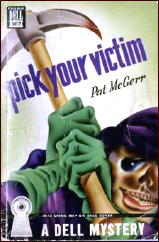
PATRICIA McGERR – Pick Your Victim. Doubleday Crime Club, hardcover, 1946. Paperback reprints: Dell #307, mapback edition, 1949; Macfadden 75-306, 1970.

PATRICIA McGERR

   While literally thousands of mysteries have been based on the attempt to discover a murderer, Patricia McGerr’s is unique in disclosing the killer at the beginning and challenging detectives (and readers) to select the victim.

   Not content to rely upon an original idea, she followed through, though this was only her first book, to create a mystery that was worthy of its conception. It is small wonder that Barzun and Taylor, who labeled this book a “whodunin,” also called it a masterpiece.

   Pick Your Victim starts in the Aleutians in 1944, where a group of U.S. marines are fighting the “Great Battle of Boredom.” Reading matter is in short supply, and the never-broken rule is that “if there was printing on it, you read it.”

   Thus, a torn piece of newspaper discloses to Pete Robbins, former publicity agent, that his previous boss in Washington, D.C., has been arrested for murder. The name of the victim is missing, although the item states that it was an officer at SUDS (Society for the Uplift of Domestic Service), where Robbins was employed.

PATRICIA McGERR

   Pete and his fellow marines agree on a sweepstakes with the prize going to the first to guess who was murdered before the news arrives from back home. Playing the role of a GI Scheherazade, Robbins tells his barracks mates about SUDS and his colleagues during his four years at that philanthropic organization.

   McGerr knows Washington, D.C., and the political, economic, and social life of the nation’s capital come alive in her novel. This is an unusually good blend of realism and satire, with the leading characters limned in a manner that makes them believable.

   The story is well plotted, with clues adroitly inserted. Unlike many books that start with splendid gimmicks, Pick Your Victim has an ending that is not a letdown.

   Much of the authenticity in this book undoubtedly came from McGerr’ s employment, from 1937 to 1943, as director of public relations for the American Road Builders Association in Washington. Though never quite matching the success of Pick Your Victim, she has built a writing career in which originality has been the keynote.

PATRICIA McGERR

   Thus, in her next book, The Seven Deadly Sisters (1947), she leaves the identities of both victim and culprit to be determined when she has her heroine learn, through a letter, that one of her seven aunts has murdered her husband.

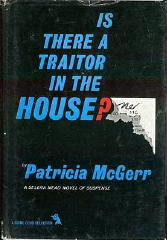
   McGerr’s one series character is Selena Mead, a Washington, D.C., society woman who doubles as a counterespionage agent. In addition to appearances in two novels Is There a Traitor in the House? (1964) and Legacy of Danger (1970). Mead is featured in numerous short stories in Ellery Queen’s Mystery Magazine.

   Some of her other non-series mysteries are Catch Me If You Can (1948), Murder Is Absurd (1967), and Dangerous Landing (1975).

         ———
   Reprinted with permission from 1001 Midnights, edited by Bill Pronzini & Marcia Muller and published by The Battered Silicon Dispatch Box, 2007.   Copyright © 1986, 2007 by the Pronzini-Muller Family Trust.

THE BACKWARD REVIEWER
William F. Deeck


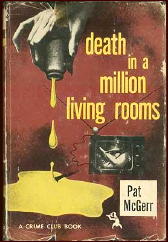
PAT McGERR – Death in a Million Living Rooms. Doubleday Crime Club, US, hardcover, 1951. Paperback reprint: Macfadden 75-281, 1969. Collins Crime Club, UK, hardcover, 1952, as Die Laughing.

PAT McGERR Death in a Million Living Rooms

   Since television is becoming a big business, Enterprise magazine plans a major takeout on the new medium. A small part of the story is assigned to Melissa Colvin, a researcher. Her interest in TV centers on the announcer of the “Podge O’Neill” program. Convinced he embarrassed her during their college years, she wants to pay him back.

   As appears to be usual with comedy teams, one member is the idea person. In this case it’s Scottie, Mrs. Podge O’Neill the first, who discovered Podge, made him what he is today, picked his second wife for him, and rules the program with an iron hand.

   All involved with the program are trying to wrest Podge from Scottie’s control to further their own careers. Since ordinary persuasion isn’t working, a roller-skating “accident” occurs, but it’s merely a temporary setback to Scottie’s reign. Then the sponsor’s product, a beverage, is spiked with nicotine, and a death takes place in full view of the studio and home audience.

   A fair-play mystery that will appeal to readers who enjoy show-business settings, particularly those who are interested in the early television years. Not McGerr’s best work, but still very good, despite The Crime Club most misleadingly putting it in its “Damsel in Distress” category.

— From The MYSTERY FANcier, Vol. 11, No. 4, Fall 1989.


Editorial Comment:   For more about Pat(ricia) McGerr (1917-1985), see the review of Pick Your Victim (1946), one of her earlier books, to follow immediately. Please stay tuned!

REVIEWED BY CURT J. EVANS:         


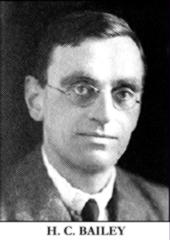
H. C. BAILEY

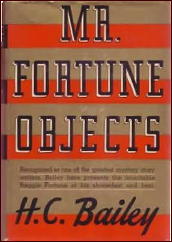
        ● Mr. Fortune Objects. Victor Gollancz, UK, hardcover, 1935. Doubleday Crime Club, US, hardcover, 1935.

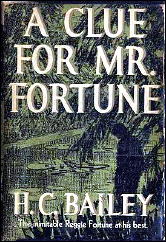
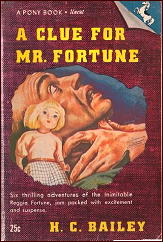
        ● Clue for Mr. Fortune. Victor Gollancz, UK, hardcover, 1936. Doubleday Crime Club, US, 1936, as A Clue for Mr. Fortune. Paperback reprint: Pony Book #52, US, 1946.

H. C. BAILEY

    Despite his one-time prominence during the Golden Age of the detective story, H. C. Bailey is not that well-known today, outside the community of knowledgeable collectors. Bailey’s tales of the brilliant deductive deeds of his two series detectives, doctor Reggie Fortune and lawyer Joshua Clunk, frequently are first-rate, however.

    Clunk appeared only in novels, Fortune in both short stories and novels. Both then and now, the Reggie Fortune short stories probably were/are Bailey’s most highly regarded achievement in mystery fiction.

    Indeed, Bailey’s American publishers, Doubleday, Doran, confidently (if somewhat inaccurately, as things turned out) declared in 1936: “Few critics or readers will dispute the fact that of living mystery story writers Bailey is one of those most likely to achieve immortality…and few will deny that Reggie Fortune is his greatest creation.”

    There are, I believe, 85 Reggie Fortune short stories, published between 1920 and 1940 — an impressive body of work. If not quite on the level with the Father Brown stories of G. K. Chesterton, they certainly rank high among mystery short stories and are deserving of some sort of reprinting, certainly at the very least a “best of” volume.

H. C. BAILEY

    Here I review two strong Reggie Fortune collections from the mid-1930s, Mr. Fortune Objects (1935) and A Clue for Mr. Fortune (1936).

    One of the best Reggie Fortune collections of short fiction is one of the rarest of them all, Mr. Fortune Objects. This volume contains six long stories: “The Broken Toad,” “The Angel’s Eye,” “The Little Finger,” “The Three Bears,” “The Long Dinner” and “The Yellow Slugs.” All are good tales, while three — “Toad,” “Dinner” and “Slugs” — are among Bailey’s very best short works.

    In his day as well as today, the detractors of Reggie Fortune (who included Julian Symons) deemed him a tiresome, precious creation. Reggie’s mannerisms, of which the author often makes a great deal, can be tiring. His speech is telegraphic (like Charlie Chan, who is sparing of pronouns, Reggie is sparing of verbs), affected and arch, he moans and mumbles, and he spends much time fussing over Darius, his blue Persian cat, and his elaborate luncheon and dinner menus. All this is granted.

    Yet Reggie also is a legitimate Great Detective, filled with a fervor, quite remarkable for the period, for justice. This moral fervor comes through strongly in Mr. Fortune Objects, in tales that deal in a mature, thoughtful way with the existence of evil in the world.

H. C. BAILEY

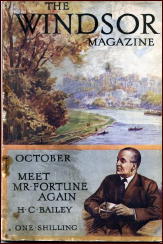
    In “The Broken Toad” (a brilliant title for a story that first appeared in the October 1934 issue of Windsor Magazine), the arsenic poisoning of a policeman leads Reggie, in his capacity as medical consultant to Scotland Yard, into a remarkable case of suburban dysfunction. Arguably Bailey’s best tale, Toad is suspensefully and vividly told and there is much genuine detection (some having to do, appropriately enough, with food).

    In “The Long Dinner,” a menu and the strange drawing on the back of it lead Reggie into the maze of a diabolical murder scheme. A serious moral question is explored here. Reggie is pretty intuitive here, but the plot is quite interesting. Reggie also reunites with his detective friend from France, who is a good character.

    In “The Yellow Slugs,” one of the better-known Fortune tales (it was anthologized by Dorothy L. Sayers), Bailey delves interestingly into child psychology. Bailey often dealt with threats to children in his works and could sometimes be tiresomely sentimental, but “Slugs” is not overdone in this regard and in fact is rather realistic, modern and dark. Reggie also does some real detective spade work here, rather akin to what one might find in an R. Austin Freeman tale.

    “Toad” and “Slugs” are particularly striking in that they are far removed from the aristocratic country house/quaint village settings so often associated with British Golden Age mystery. Instead, they focus on severe moral dysfunction in more modern-feeling suburban and urban settings.

H. C. BAILEY

    The three other tales are worth reading as well, especially “The Angel’s Eye,” which was praised by Jacques Barzun. This one actually is set in an English country house and involves a locked room problem of sorts (though anyone expecting John Dickson Carr will be disappointed).

    Published a year after Mr. Fortune Objects, A Clue for Mr. Fortune is another strong collection of six long stories: “The Torn Stocking,” “The Swimming Pool,” “The Hole in the Parchment,” “The Holy Well,” “The Wistful Goddess” and “The Dead Leaves.”

    None perhaps has the depth of “The Broken Toad,” “The Long Dinner” or “The Yellow Slugs,” but several rank near the top of the Bailey works, being quite clever and entertaining.

    Reggie Fortune is still bountifully bedecked with mannerisms some might fight irritating (he seems to have picked up the habit of quoting extensively in these later tales, though, thankfully he now looks less at people with the wondering eyes of a child), but he seems a mite less precious and more impressive in his role as an instrument of justice.

    The best-known of the Clue tales probably is “The Dead Leaves,” which was anthologized in The Oxford Book of English Detective Stories, but it is not the actual best of the tales in Clue, in my opinion. My favorites are “The Torn Stocking,” “The Hole in the Parchment” and “The Holy Well.”

H. C. BAILEY

    With “The Torn Stocking” we again see the exploration of a favorite theme of Bailey’s, that of the consequences of family dysfunction. The milieu is rather shabby urban middle-class. Reggie investigates the seeming suicide (head in the gas oven) of a teenage girl accused of shoplifting, with surprising results. His detective work is quite interesting.

    “The Hole in the Parchment” sees Reggie and wife Joan vacationing in Florence, Italy (a number of the Fortune tales takes place in France, Germany and Italy). There the two become involved in a case involving theft and forgery, quite cleverly done.

    In “The Holy Well,” Bailey gives bravura treatment to a classic detective story device. The story involves murder in rural Cornwall. Both the atmosphere and the plotting are first-rate.

    Both Mr. Fortune Objects and Clue for Mr. Fortune are fine mystery short story collection that merit reprinting for a modern audience.

REVIEWED BY JEFF MEYERSON:         

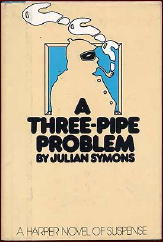
JULIAN SYMONS – A Three Pipe Problem. Harper & Row, US, hardcover, 1975. Collins Crime Club, UK, hardcover, 1975. Reprints include: Avon, US, pb, 1976; Penguin, US, pb, 1984.

JULIAN SYMONS A Three-Pope Problem

   A Three-Pipe Problem is a very enjoyable book! Symons’ hero is Sheridan Haynes (nicknamed Sher), an actor who portrays Sherlock Holmes in a British TV series that was once popular but is now slipping in the ratings.

   Sher demands absolute fidelity to the Holmes stories, which angers those who want to make the show more attractive to the audience by adding a love interest, etc.

   Haynes not only longs for the days when Holmes stalked London, but has even insisted on living in the old rooms in Baker street. His obsession with Holmes causes doubts about his sanity, and problems with his wife and co-workers.

   Haynes, in his role of Holmes, becomes gradually more involved in a case known as the Karate Killings, to the consternation of all. He states that Sherlock Holmes could have solved the case, then sets out to do it with the help of a Watson, and some Baker Street Irregulars (actually Traffic Wardens).

   Symons keeps the various strands of his story well in hand until they all come together on a cold and foggy London night, with Haynes/Holmes tracking the Karate Killer.

   Sher Haynes is a sympathetic character and the book, if improbable, is a lot of fun and very well done. Sherlockians should enjoy it.

— Reprinted from The MYSTERY FANcier, Vol. 1, No. 3, May 1977.


Bibliographic Note:   Sheridan Haynes made an encore appearance The Kentish Manor Murders (Viking, 1988).

Comment on FIFTY FUNNY FELONIES
by David L. Vineyard


   A funny thing happened on the way to the post …

   Most of you have had your own ISP nightmares so I won’t bore you with mine, but because of the down time between your comments on my Fifty Funny Felonies and my getting back to it, Steve suggested I do a post rather than bury my comments at the end of the original.

   First, I’m gratified with the responses, and the only thing I would point out to any of you is that I warned from the start my choices were subjective and favorites instead of bests. Almost every name everyone mentioned could easily have been on the list, and in some cases nearly were.

   In the end I tended to go with some more offbeat choices and a few certainly more eclectic ones, but only because if you don’t, these lists can easily end up nothing more than a rehash of the same titles; a bit like those AFI 100 Best specials that always end up with Citizen Kane, Gone With the Wind, Casablanca, and The Wizard of Oz in some variation of the top five films.

   Among the writers I was surprised no one brought up were Michael Bond of the Monsieur Pamplemouse books, Robert Barr’s Eugene Valmont stories, Agatha Christie (in Tommy and Tuppence mode), Michael Avallone (who granted was sometimes unintentionally funny — at least I think it was unintentional), and Damon Runyon.

   As Steve pointed out in one of his comments these could easily run to five hundred titles in short order.

   There was one deliberate omission on my part. And please be gentle — but I just don’t like Ross H. Spenser that much. I found it a one joke gimmick that was amusing one time, and after that the books more annoying than clever. Again that is a subjective judgment.

   I didn’t find him.

   That funny.

   Really.

   I probably would have included Robert Barnard, Simon Brett, Colin Watson, or Sarah Cauldwell, but it has been a long time since I read them, and they just weren’t fresh in my mind. As it is I have no excuse for leaving off some of Michael Gilbert, Peter Dickinson, certainly John Mortimer, Jasper fforde, Liz Evans (I even reviewed one of her books), or some of the others. As I said, at different times I might have gone with some different writers.

   In regard to Geoffrey Household, since his favorite form of novel is the picaresque (a la Don Quixote, Candide) and at least one of his short stories was filmed as the delightful British comedy Brandy For the Parson (1952) I was surprised there was any question about including him.

   Many of his short stories (and he did at least four collections of them) are humorous, and there are humorous elements in many of his books. Granted there aren’t a lot of laughs in Rogue Male, Watcher in The Shadows, or Dance of the Dwarfs, but Fellow Passenger, Olura, and The Life and Times of Bernardo Brown are all picaresque tales and there is some rather black humor in A Rough Shoot, A Time to Kill, and The Courtesy of Death.

   Victor Canning and Eric Ambler aren’t generally laugh riots either, but both wrote some comic works. Graham Greene is one of the few writers who was ever tragic and comic at the same time in the same book.

   I was a little surprised no one questioned my choice of Allingham’s Sweet Danger, so I’ll defend it anyway. The opening sequences in the French hotel are as good as anything in a classical farce. That’s the whole defense.

   So there.

   Re Edmund Crispin and why Love Lies Bleeding, I grant it is not as farcical as some of the others, but it is my favorite because it includes one of the great dogs in the literature, a creation of Falstaffian complexity, whose passing may be one of the rare times in any kind of fiction you will be laughing and crying at the same time.

   I grant The Blind Barber is funnier than Arabian Nights, I just happen to like the latter and think it gets less attention than it deserves. If nothing else it is worth reading just to see Carr’s portrait of what he considers a sexpot.

   For that matter a few of the Carter Dickson are probably bigger belly laughs than any of the Fell novels. Sir Henry Merrivale’s summation to the jury in The Judas Window is one of the high points of Carr-ian humor.

   I seriously debated 101 Dalmatians by Dodie Smith, so count yourselves lucky.

   In regard to Jonathan Latimer I don’t disagree with Curt’s points about the necrophilia, sexism, and racist language in Lady in the Morgue, but much of that went part and parcel with the whole screwball school of the hard boiled mystery and many of its proponents like Richard Sale, Norbert Davis, Geoffrey Homes, Cleve Adams (at least in the Rex McBride books), Robert Reeves, Dwight Babcock, and Robert Leslie Bellem worked similar territory.

   Since Latimer didn’t have to deal with pulp prudery he went farther than most and pushed the boundaries, but it’s honest writing, it feels real and not contrived, and “readers were supposed to be shocked.”

   I know that may seem far removed from today’s market where almost nothing is shocking any more (Bret Easton Ellis’s American Psycho — a black comedy most took seriously — is a rare exception), but once upon a time there were writers who dared to dare us — to shock, titillate, and even challenge us — and Latimer was one of the best, and did within the framework of some first class detective work too.

   I would only point out that Curt’s reaction was exactly what Latimer wanted much as Chandler would use a rough rather black and grim humor to color his stories and novels. Both writers wanted the reader to notice “the tarantula on the angel food cake.” It’s a very American tradition that goes back to Washington Irving and Poe and is notable in Mark Twain. In some ways it is the American literary voice.

   Again, thanks to everyone for the intelligent and cogent comments and additions. The comic mystery too often gets short shrift in the histories of the genre, as if somehow producing genuine laughs and good detection was simple or easy, and I’ve never understood why. It’s far easier to be grim than amusing, and much simpler to perplex a reader than to make him laugh. These responses show that some of us appreciate the effort.

   And on a personal note I find, that while I still appreciate the thrills, puzzles, and scares, the older I get the more I appreciate the ones that made me smile, laugh, or just chuckle in recognition.

IT IS PURELY MY OPINION
Reviews by L. J. Roberts


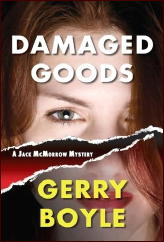
GERRY BOYLE – Damaged Goods. Down East Books, hardcover, May 2010.

Genre:   Unlicensed investigator. Leading character: Jack McMorrow; 9th in series. Setting:   Maine.

First Sentence:   I made my way down the trail through the pinewoods toward the house.

GERRY BOYLE

    Roxanne, the wife of freelance journalist Jack McMorrow has had a worse-than-usual day at work. A social worker for the state of Maine, she was forced to remove two severely neglected children from the home of a Satanist who is now threatening Roxanne and their daughter.

   In order to facilitate Roxanne leaving her job, Jack looks for more stories he can sell and finds Mindi, a young woman advertising to provide “companionship.” Mindi quickly becomes more than a story and it’s uncertain whether that is going to increase the danger to Jack’s family.

   I’ve missed Boyle’s Jack McMorrow and am very glad to see him back. While Jack, a journalist who isn’t afraid of physical violence, is an interesting character, his neighbor Clair, a Vietnam vet who has lost none of his edge, comes through as the more interesting character, especially when set off by his gentle wife, Mary.

   Jack’s wife, Roxanne, is one I’m not always certain I like, but her reactions are very realistic in view of the situation. The blending of all the characters is very well done.

   Boyle’s love of Maine is apparent as shares with us both the beauty and the problems of Maine. The story is has a good, tight plot and is layered with good suspense which escalates as things progress. The sense of anger and danger is there along with Jack and his friend’s protectiveness. The villain is satisfyingly nasty and while Mindi provides a somewhat unknown quantity element.

   It’s altogether quite well done. Boyle is a very good writer and journalistic background is very apparent. His books are ones I always recommend and I’m always anxious for the next one out.

Rating:  Good Plus.

       The Jack McMorrow series

1. Deadline (1993)

GERRY BOYLE

2. Bloodline (1995)
3. Lifeline (1996)
4. Potshot (1997)
5. Borderline (1998)
6. Cover Story (1999)

GERRY BOYLE

7. Pretty Dead (2003)
8. Home Body (2004)
9. Damaged Goods (2010)

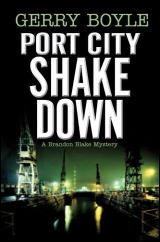
    Also by Gerry Boyle: The Brandon Blake mysteries

1. Port City Shakedown (2009)

GERRY BOYLE


   Visit the author’s blog here.

REVIEWED BY WALTER ALBERT:         


THE COMING OF AMOS 1925

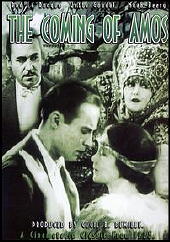
THE COMING OF AMOS. Cinema Corp. of America/PRC, 1925. Rod La Rocque, Jetta Goudal, Noah Beery, Richard Carle, Arthur Hoyt, Trixie Friganza, Clarence Burton.

Screen adaptation: James Ashmore Creelman & Garrett Fort from the novel by William J. Locke. Director: Paul Sloane; producer Cecil B. DeMille. Shown at Cinevent 42, Columbus OH, May 2010.

   This is the perfect Saturday matinee movie, with a climax in an island castle where the heroine (Jetta Goudal) is imprisoned by her villainous husband Ramón Garcia (Noah Beery) in a basement rapidly filling with water.

THE COMING OF AMOS 1925

   With a Russian Princess and a noted portrait painter (the hero’s uncle) figuring in the cast, and a ’20s jet set crew of party-loving characters, there’s ample reason to crowd the screen with lavish sets and fantastic costumes, especially when an important scene takes place during a joyous carnival.

   The hero is naive but persistent, the heroine beautiful and constantly in peril, and the smirking villain doing everything but twirl his nonexistent moustache.

   There are touches of humor throughout, with some witty satire, the sharpest of which is the portrayal of two French policiers as consummate bureaucrats, stopping every other minute as they lead the “chase” into Garcia’s lair to take notes of the information they’re being given.

   This is a matinee film for adults, but the kid in the fun-loving viewer will have a grand time, too.

Editorial Comment: This film is available on DVD, but be aware that two of the three reviewers on Amazon disagree noticeably as to the quality of the print.

« Previous PageNext Page »