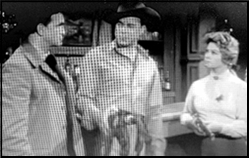
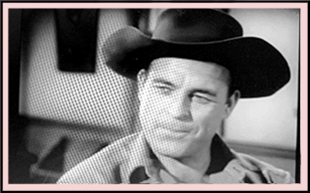
SHOTGUN SLADE “Crossed Guns.” Syndicated / Revue. 13 May 1960 (Season One, uEpisode 30). Scott Brady. Guest Cast: Barry Atwater, Sue Ane Langdon, Rick Turner, Larry Thor, Francis X. Bushman. Series created by Frank Gruber. Screenwriter: Barry Shipman, Director: Will Jason. Currently available on YouTube.

   One of the gimmicks of this show that separated it from other westerns at the time (and there were many) was that he was a PI for hire, only in the Old West. The other being his weapon of choice, a dual-barrelled hybrid shotgun combination that has a .32-cal. rifle upper barrel and a 12-gauge shotgun lower barrel. (Without IMDb I could not tell you otherwise.)
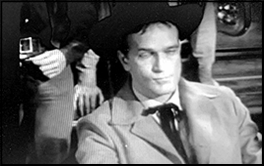
   The western PI aspect of the series is not much in evidence in this episode , however , unless you call himself his own client. When he rides into Grover’s Bend, it is to confront a man he sent to prison five years ago and who has just been released. The latter’s revenge, however, turns out to be by proxy, as he has lost his right hand while in prison, and a young local gunfighter named Billy has agreed to shoot it out with Slade on the main street of town.

   Complicating matters is that Billy has been secretly romancing the sheriff’s daughter. How Slade gets out of this without either himself or Billy killed is the essence of the story.

   Which is neither terribly good nor really down and out awful. It’s good enough to find another one to watch, and if/when I do, you’ll probably read about it on this blog.
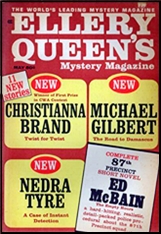
ELLERY QUEEN’S MYSTERY MAGAZINE – May 1967. Overall rating: ***½ stars.

CHRISTIANA BRAND “Twist for Twist.” Novelette. Inspector Cockrill solves the murder of a man no one wanted to see married, especially the bride. Good detection. (4)

MORRIS COOPER “As It Was in the Beginning,” Quite possibly the first detective story, occurring some 20,000 years ago. (5)

ELAINE SLATER “The Way It Is Now.” In contrast to the previous story, a search for lost romance in a modern-day marriage ends in murder. (4)

ARTHUR PORGES “The Scientist and the Invisible Safe.” A diamond thief hides them in light bulbs. (2)

MICHAEL GILBERT “The Road to Damascus.” Novelette. Previously published in Argosy (UK), June 1966.  A Calder and Behrens spy story of a World War II impersonation discovered only when an old resistance post is uncovered, fascinating in its accounts of past and present espionage. (5)

ALICE SCANLAN REACH “Father Crumlish and His People.” The hypocrisy of a murdered social worker is discovered. Good social comment. (3)

HENRY STONE “The Impersonator.” Psychiatrical fare. (1)

NEDRA TYRE “A Case of Instant Detection.” A cop in a sociology class is forced to make deductions on the spot. Interesting background. (3)

ROBERT L. TILLEY “The Other Man.” An escaped convict finds refuge in a country cottage, an ideal sanctuary. Personal involvement clashes with the ending. (2)

VERA HENRY “What They Don’t Know Won’t Hurt Them.”  The hired help take advantage of two suspicious deaths. (2)

JON L. BREEN “The Crowded Hours.” First story. Pastiche. A murder investigation by the 97th Precinct Squad. McBain’s style deserves this. (4)

ED McBAIN “The Empty Hours.” Short novel. Previously published in Ed McBain’s Mystery Book #1, 1960. A murder investigation by the 87th Precinct Squad. A girl posing as her cousin is killed by a burglar, but the police must learn everything through determined work. The plot is obvious from the beginning, and it is the emotional involvement that makes the story at all attractive, McBain has a flair for detail, but his style can be overdone and irritating. ***

– March 1968

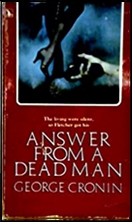
GEORGE CRONIN – Answer from a Dead Man. Virgil Fletcher #1. Condor, paperback original; 1st printing, February 1978.

   PI Virgil Fletcher is hired by a lady friend to investigate the disappearance of her brother. While Chantal Montez is a Hollywood movie star, her brother is a New York City accountant. His last audit was of halfway house for heroin addicts, a charity case.

   Cronin wrote one other book, Death of Delegate, but according to Hubin, Fletcher’s not in it (*). The guy’s not in Marlowe’s league – this case doesn’t set the world on fire, to be honest — but it’s solid enough, a job by a professional.

– Reprinted from Mystery.File.6, June 1980.


(*) According to the latest version of Al Hubin’s Bibliography of Crime Fiction, Fletcher is in the other book. It also came out in 1978, but I’m calling this one his first appearance, only because of its so early in the year publication date.

REVIEWED BY DOUG GREENE:


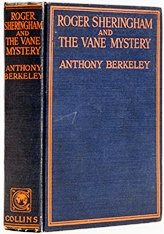
ANTHONY BERKELEY – The Mystery at Lover’s Cave. Roger Sheringham #3. Simon & Schuster, US, hardcover, 1927. Published in UK as Roger Sheringham and the Vane Mystery (Collins, hardcover, 1927). Spitfire Publishers, softcover, 2023. Also currently available in eBook form.

   “You are getting ready to be Roger Sheringham,” Tommy remarked to Tuppence in Agatha Christie’s Partners in Crime. “If you will allow me to make a criticism, you talk quite as much as he does, but not nearly so well.”

   As befits someone whose early works were sketches for Punch, Anthony Berkeley excelled at light, witty dialogue. He began writing about Roger Sheringham to satirize the great detectives of literature, and this book, like the later and more famous Poisoned Chocolates Case, emphasizes the detective’s foibles rather than his brilliance.

   The plot is relatively simple. A nasty woman has been pushed off a cliff, and Roger hies off to investigate the case for a newspaper. He sometimes make clever deductions, sometimes misreads the evidence, and always has the amused attention of the official policeman, especially after Roger’s cousin falls in love with the chief suspect.

   Berkeley handled physical evidence and setting well, but the book is worth reading primarily for the dialogue. As Agatha Christie pointed out, Roger talks constantly but always entertainingly.

– Reprinted from The Poisoned Pen, Volume 4, Number 5/6 (December 1981).

DOUGLAS OF THE WORLD. “The Terrorists.” Armed Forces Radio Service, 1953. Jack Moyles, as world-traveling reporter Brad Douglas, with Peter Leeds, Harry Bartell, Karen Steele, Paul Richards. Available online here.

   Brad Douglas, working as a reporter for the (fictional) New York World has a job that takes him to all of the hot spots of the world, including in this episode, Iran, where he goes to talk to the ordinary people of the country about their view of their new prime minister.   Oil is the big news of the day, and some things have never changed since then.

   But while doing due diligence to this week’s assignment, Brad also has an eye out for a pretty girl (played by Karen Steele), but she has an ulterior motive: her brother, a petroleum engineer has gone missing.  Brad offers to help, of course, and fairly soon all three of them are being held captive in a dark room who knows where. Faced with death at dawn as the only alternative, Brad agrees to write the news article their captors want published, only … he has a plan.

   Brad Douglas was portrayed by Jack Moyles, whom OTR fans remember best as the voice of Rocky Jordan, the American restaurant owner in Cairo whose weekly adventures in that exotic city were filled to overflowing with adventure and intrigue of all kinds.

   In spite of a fine cast, Douglas of World isn’t nearly as good — there’s just not enough juice to it — but perhaps the comparison is unfair. Rocky Jordan was one of the finest adventure shows on radio that wasn’t entitled Escape.  Information on DoW is skimpy, but it may have produced directly for the Armed Forces Radio Service. Perhaps only four or five have survived to this day.

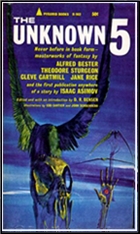
D. R. BENSEN, Editor – The Unknown Five. Pyramid R-962, paperback original; 1st printing, January 1964. Cover art by John Schoenherr.

   A collection of five stories in all, four of them reprinted from the pages of Unknown, plus one by Isaac Asimov which was accepted for publication shortly before that magazine folded, but never actually having appeared in print in it before it did. Strange to say, that one is also the weakest of the five. But even knowing that the other four were chosen from the best of the magazine, the only restriction being the stories never having been published in book form before, Unknown well deserves its reputation among fantasy fans.   Overall rating: ****

ISAAC ASIMOV “Author, Author!” Novelette. In which author Graham Dorn’s famous detective Reginald de Metzter comes to life and demands his say in future plots. Too slaphappy and hectic rather than truly funny.  (2)

CLEVE CARTMILL “The Bargain.” (From Unknown Worlds, August 1942.) Death gives immortality to a woman in exchange for information the world should not have. The “folksy” approach entertains.  (4)

THEODORE STURGEON & JAMES H. BEARD “The Hag Saleen.” (From Unknown Worlds, December 1942). A man and his wife and daughter living in a small cabin in the bayous arouse the anger of a swamp witch. Besides the basic background, the story’s excellence depends on balance between fantasy and the explainable.  (5)

ALFRED BESTER “Hell Is Forever.” (From Unknown Worlds, August 1942,) Short novel. Five degenerate people, in the search for newer and stranger sensations, enter into a bargain giving them their choice of realities. Their new worlds are not what they expect, however:
   An artist can create only in his own distorted image. A woman wishing the strength to kill her husband finds that strength only in an unhappy extension of herself. An imaginative man find truth only in hell, or is it heaven?  A woman without love becomes the Consort of a God. A logical man finds he cannot kill himself — for they are all dead already.
   The meaning of hell is twisted to suit each personality, resulting in a story that should be analyzed more deeply and thoroughly to reveal all its implications.  *****

JANE RICE “The Crest of the Wave.” (From Unknown Fantasy Fiction, June 1941.) A St. Louis gambler is tossed from a bridge, but his drowned body revenges his death. Extremely picturesque language adds to a rather average ghost story. (3)

– March 1968
A 1001 MIDNIGHTS Review
by Bill Crider


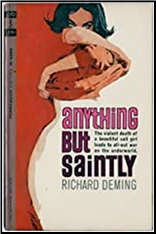
RICHARD DEMING – Anything But Saintly. Matt Rudd #2.  Permabooks M-4286, paperback original, 1963.

   Richard Deming wrote original mysteries and novelizations of numerous TV series, including two books based on Dragnet. The two Dragnet books appeared in 1958 and 1959 and perhaps led to Deming’s writing his own police procedural series in the early 1960s. Although the series was only three books, it was competently written and entertaining.

   The setting of each of the books is the riverside city of St. Cecelia, and the first-person narrator is Sergeant Matt Rudd (real name Mateusz Rudowski), a member of the city’s Vice Squad.

   In Anything but Saintly, a businessman visiting the city is rolled by a prostitute and robbed of $500. Rudd and his partner, Carl Lincoln, set out to recover the money, only to find that the girl was murdered shortly after returning to her apartment. Being a member of the Vice Squad does not keep Rudd from getting involved in the killing, because an attempt is soon made on his own life.

   What looked at first like a simple case suddenly escalates into something more, with a heavily protected procurer and a big-time politico getting dragged in. The procedural details, including the peculiar workings of the St. Cecelia Police Department, are well done, and the story is terse and fast, with a good depiction of a racket-ridden city and how it is run.

   Matt Rudd appeared previously in Vice Cop   (Belmont, 1961) and again in Death of a Pusher (Pocket, 1964 ). An equally good, but very different, paperback original by Deming is Edge of the Law (Berkley, 1960). He also created a one-armed private detective, Manville Moon, who appears in three novels published in the early 1950s, beginning with The Gallows in My Garden (Rinehart, 1952). Other of his mysteries appeared under the pseudonym Max Franklin, notably Justice Has No Sword (Rinehart, 1953).

———
Updated and reprinted with permission from 1001 Midnights, edited by Bill Pronzini & Marcia Muller and published by The Battered Silicon Dispatch Box, 2007.   Copyright © 1986, 2007 by the Pronzini-Muller Family Trust.

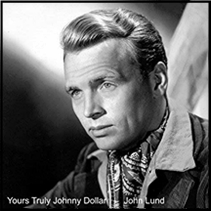
YOURS TRULY, JOHNNY DOLLAR. “The King’s Necklace Affair.” CBS, 17 March 1953. John Lund as Johnny Dollar, with Jack Moyles, Howard McNear, Lilian Buyeff, Jack Moyles, Tom Tully. Scriptwriter: Sidney Marshall. Easily found streaming online.

   This is the first episode of Johnny Dollar I remember listening to which has had John Lund in the leading role. He played the part for two seasons, from November 1952 to September 1954, followed by Bob Bailey’s long run beginning in October 1955 and ending in November 1960.

   For most of the time the show was on the air Johnny Dollar, the man with the “action-packed expense account” was a freelance insurance investigator working out of Hartford CT, but traveling all over the country checking out the validity of false claims and the like.

   In “The King’s Necklace Affair,” though, he goes even further, to a small island near Cuba which one man owns in its entirety, complete with a huge mansion and a valuable collection of art objects to go with it. One of these is a necklace worth a small fortune, which he thinks someone is trying to steal. When Johnny gets there, together they open the safe where it should be, only to discover it is only paste.

   When the owner is soon thereafter found dead on a balcony, Johnny finds that he really has a case on his hands. Unfortunately, from the perspective of an armchair detective listening at home, there are less than a handful of suspects, one of which is a sexy-voiced young lady (Lillian Buyeff) one suspects lives there for less than wholesome purposes. Not surprisingly the script does not go in that direction very far at all. Nonetheless, in spite of a paucity of suspects, the scriptwriter (Sidney Marshall) manages to pull off a small trick he had up his sleeve all along, and a well-clued one to boot.

   John Lund had a strong voice for radio, but not a distinctive one. I am speaking for myself, mind you, but if I were listen to another episode in which he was the star, I’m not sure I would recognize it, and for all of the others in the cast, I would.

POKER FACE.“Dead Man’s Hand.” Peacock, 26 January 2023. (Season 1, Episode 1.) Natasha Lyonne (as Charlie Cale, a casino worker who goes on the run), Benjamin Brat (as Cliff LeGrand, the casino head of security, who is on the chase after her), Ron Perlman (as Sterling Frost Sr., the casino owner (voice only in this first episode)). Guest star: Adrien Brody (as Sterling Frost Jr.). Written, created and directed by Rian Johnson.

   The gimmick in this one, a new well-received streaming series that I think qualifies as a solid hit, is that casino cocktail waitress Charlie Cale has the unique ability to know when someone is lying to her face. Until things got too hot for her, she made a lot of money playing poker, where an ability would be hugely helpful.

   And of course knowing who is telling the truth and who is not would come in equally useful in solving crimes, including murder, which she does quite easily in this first episode, the only one I’ve seen so far. Invited in to a high stakes poker game by the manager of the casino where she’s working, she solves the killing of a maid she knows well, but in doing so, gets so far into hot water that by the end of the episode she’s forced to head out of town as fast as she can.

   The show is told in Colombo-type fashion, as we the viewer first she the killing and then flashing back to see exactly where Charlie manages to fit in. And as the last sentence of the previous paragraph suggests, each followup episode is a page out of The Fugitive’s notebook.

   Charlie is a brassy, self-identified “dumb ass” with wild hair type, and Natasha Lyonne is perfect for the part. (I think she had a great deal to do with the creation of the character.) The first season consists of ten episodes, with lots of well-known guest stars, and I’ve read that the series has already been renewed for a second season.

   The only drawback that I can see is that as a superpower, being a human lie detector could easily make solving crimes all too easy. Superman had Kryptonite to keep him in check. What’s Charlie’s Achilles heel?

   It’s too bad you have to sign up for Peacock (a subsidiary of NBC) to see this, but on the basis of this first episode, it’s well worth the money, given that there’s other stuff there to watch as well.

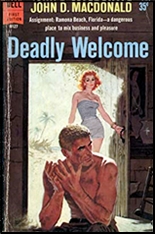
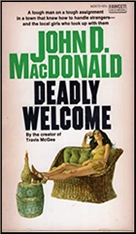
JOHN D. MacDONALD – Deadly Welcome. Dell First Edition B127, paperback original; 1st printing, March 1959. Cover art by Bob McGinnis. Reprinted several times in paperback over the years, eventually by Gold Medal.

   Alexander Doyle is a wanted man. Wanted by the Pentagon to have him transferred from the State Department to do a special assignment for them. It seems that an officer with considerable talents and abilities has had a heart attack, but while recuperating, his wife was murdered, and even though his sister is nursing him now, he feels unable (or is simply unwilling) to come back to work.

   Doyle’s job. Find the killer of Colonel M’Gann’s wife.

   What the Pentagon knows is that Doyle comes from the same small town in Florida, the kind of place that’s wary of strangers, but they believe that Doyle can easily be accepted by the locals, where others would not. What the Pentagon seems not to know is that Doyle left town under a black cloud, accused of a robbery he did not commit, but by agreeing to leave and join the army, everything would be hushed up.

   What the Pentagon definitely does not know is that Doyle had a one-night fling with the dead woman. What Doyle does not know is that the dead woman’s younger sister is all grown up now, and that she has had a crush on him ever since high school.

   Can he go home again? That’s the question. He agrees, but with a pain of reluctance in his gut. Mix in a passel of townsfolk who can’t stop talking as well as a self-important deputy sheriff who is a whiz with a nightstick, and you have the mixings of a story you won’t stop reading once started until you’re done.

   The detective aspect of things is minor. It’s the people who matter in JDM’s story, and the sense of memories that always come back whenever you or someone tries to go home again. That’s the essence of this book, and (I have to mention this) the fact that the dead woman’s sister, the victim of an attempted rape a few years bfore, is someone who needs the same kind of TLC that JDM’s later hero protagonist became famous for — by extending it to the wounded women who came into his life.

« Previous PageNext Page »