Fri 29 Dec 2006
Always worthy of your attention is Peter Rozovsky’s Detectives Without Borders blog. In a recent posting, Peter compares and contrasts super-spy Peter O’Donnell’s Modesty Blaise with Frank McAuliffe’s super-hitman Augustus Mandrell. His primary thesis is that both characters came about as differing reactions to Ian Fleming’s super-successful James Bond, but that all three of these caper/spy heroes are essentially products of pure wish fulfillment.
Peter goes on to say more, including some conjectures about what a romantic interlude between Modesty Blaise and Augustus Mandrell might be like, but the wish fulfillment part is as right as the bank. One wonders, though, or at least I always have, why Frank McAuliffe’s books were never as successful as those of other two authors. In recent years the Mandrell books have become a cult favorite among those who happen to have copies of them, and sad to say, they are not always easy to find. Here’s a complete listing of McAuliffe’s novels and story collections, excerpted from Al Hubin’s Crime Fiction IV:
McAULIFFE, FRANK (Malachi) (1926-1986)
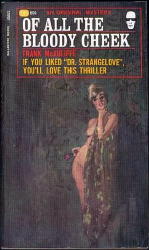
Of All the Bloody Cheek. Ballantine 1965, story collection. [Augustus Mandrell]
“The Dr. Sherrock Commission” ss
“The General LaCorte Commission” nv
“The Iranian Farmer Commission” nv
“The Scotland Yard Commission” nv
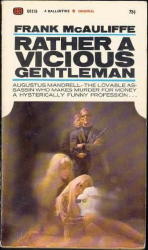
Rather a Vicious Gentleman. Ballantine 1968, story collection. [Augustus Mandrell]
“The American Mistress Commission” nv
“The Bullrusher Commission” nv
“The Irish Monster Commission” nv
“The Sealed Tomb Commission” nv
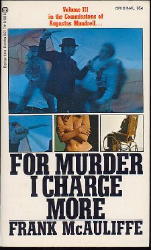
For Murder I Charge More. Ballantine 1971, story collection. [Augustus Mandrell]
“The American Apple Pie Commission” nv
“The Baseball Commission” nv
“The German Tourist Commission” nv
“The Hawaiian Volcano Commission” nv
The Bag Man. Zebra 1979
As Frank Malachy:
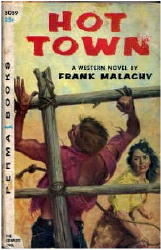
Hot Town (Permabooks, 1956)
A superb overview of the Mandrell stories can be found here, where Robert Wilfred Franson suggests that they should be read in order to get the full benefit from them. (Something I haven’t double-checked yet is whether all of the stories were original in the books or not. Nothing that I have found so far suggests that they aren’t, but there may be something I’ve missed.)
I don’t know anything about The Bag Man, and if you do, maybe you can help me out about it. In fact, I don’t believe I’ve ever even seen a copy of one. Trying to find one just a moment ago using www.bookfinder.com, not a single one turned up offered for sale.
Hot Town was published when McAuliffe was only 30, and in fact what it is, is a western novel. Since it is listed in CFIV, what it apparently is, is a western with strong criminous underpinnings. It also is fairly scarce, with only 5 or 6 showing up for sale, but this one I do happen to have a copy of. (And I did not know that it was written by McAuliffe until about maybe a minute and a half ago.) [UPDATE:01-01-07. Based on a comment left by Bob Franson, Al Hubin has decided to delete Hot Town from CFIV.]
The good news is that PointBlank is going to be reprinting some if not all of McAuliffe’s books. Allow me to quote from their website:
FRANK McAULIFFE (1926-1986) is the author of five previously published books. Of All The Bloody Cheek, Rather A Vicious Gentleman, For Murder I Charge More (the first three in the Augustus Mandrell series), Hot Town, and The Bag Man. Prompted by rumors of an unpublished fourth Mandrell novel, acclaimed mystery writers, Walter Satterthwait and Bill Crider contacted the author’s wife, Rita. (Incidently, her birth date, February 13th, is the one Augustus Mandrell perpetually refers to as “…that birth date, historically, of beautiful women…”) Through an uncanny chain of fortuitous events the manuscript was found, and will be published by PointBlank.
Frank McAuliffe was born the eldest of eight children to Irish immigrants, Con and Margaret McAuliffe in New York City, New York. He married Rita Gibbons and they had seven children together (Meg, Liz, Mark, Mary, Kate, Barbara, and Luke). After moving to Ventura, California, McAuliffe worked as a technical writer for the Navy, but spent most of his spare time writing fiction. In 1972 Frank McAuliffe was awarded the Edgar Allan Poe Award for his novel, For Murder I Charge More. Upon accepting the award for The Best Paperback Mystery of the Year, McAuliffe responded, “Ladies and Gentlemen, you have impeccably good taste.”
— The reason for the long delay in getting the fourth adventure of Augustus Mandrell published? McAuliffe submitted the manuscript of They Shoot Presidents, Don’t They? to his publisher just prior to death of President Kennedy, and the book was cancelled.