SIMON NASH – Dead Woman’s Ditch. Geoffrey Bles, UK, hardcover, 1964. Roy, US, hardcover, 1966. Perennial Library PL777, US, paperback; 1st printing, 1985.

   Most of this adventure of Adam Ludlow takes place in and around a small English hotel in remote Somerset at the end of September, and for some reason, all of the rooms are filled. What it takes a while for the police to realize, after one of the guests has been murdered, and unpleasant man by the name of Silas Taker, is that each of the others has a motive, that of blackmail.

   Scotland Yard is called in, and back in the days when they could still so things ike that, they call upon Ludlow for assistance themselves. Ludlow is what you might call a literary academician, an amateur dabbling in crime, and in this one he gets a (brief) taste of impending personal violence as well.

   There are obviously lots of suspects in the case, plus lots of clues and false trails, and it’s still a puzzle to me why the naming of the killer seems to fall as flat as it does. Barzun and Taylor [in A Catalogue of Crime] feel that this is one of Ludlow’s weaker adventures. Since it’s the first I’ve ever read, I wouldn’t know, but while I enjoyed the book, I guess what I was expecting was a stronger finale.

— Reprinted from Nothing Accompliced #4, November 1993, very slightly revised.


Bio-Bibliographic Notes:   Simon Nash was the pseudonym of Raymond Chapman, 1924-2013, a Professor of English at London University and an Anglican priest. There are no books in Hubin under his own name.

       The Adam Ludlow series [each also features Inspector Montero] —

Dead of a Counterplot, 1962.
Killed by Scandal, 1962.
Death Over Deep Water. 1963.
Dead Woman’s Ditch, 1964.
Unhallowed Murder, 1966
Ruby Starr was the long-time lead singer for the Southern rock band Black Oak Arkansas. This solo album is from 1976.

A 1001 MIDNIGHTS Review
by Ed Gorman


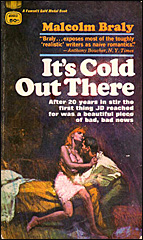
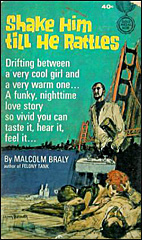
MALCOLM BRALY – Shake Him Till He Rattles. Gold Medal k1311, paperback original; 1st printing, 1963. Pocket, paperback, 1976. Stark House Press, trade paperback 2006 (a two-in-one edition with It’s Cold Out There).

   When On the Yard, the novel Malcolm Braly based on his ears in prison, appeared in 1967, everyone said he was major. But for a major writer, Braly, who was killed in an automobile accident at age fifty-five, is virtually forgotten today.

   By any standard, however, Yard and the three novels he wrote for Gold Medal in the early Sixties are books worth reading, books in many respects as frenetic and confessional ional as the more literary novels of the era.

    Shake Him Till He Rattles concerns Lee Cabiness, a sax player whose only goal is to stay out of prison. Lieutenant Carver of the San Francisco narc squad has other ideas. Braly obviously based Carver on both personal experience and his reading of Dostoevski, for the cop here is almost mythic in his malice and darkness, his repudiation of all human values.

   Braly posits the jazz musicians of his book, however, as magic revelers in the human song: “Furg was a child, a vagabond child, a fey and travel-torn minstrel barely suffered in the halls of the minor barons. But, whether they knew it or not, Furg was necessary to them, to breathe into their lives the vital stuff of myth.”

   Later Braly describes the same world Jack Kerouac earlier set down as “beat.” Only Braly saw it differently: “People were coming in. Pink, clean examples of college and social Bohemia, mostly young, roughly thirty per cent gay. He saw Clair moving around. In her white dress with her pale hair she looked chilly. He caught her smile coming and going, like distant sunlight on ice.”

   The conflict between Cabiness and Carver grows, of course, as the narc makes frustrated moves on his prey, trying to demean and unman him as he closes in. The battle, again, is out of Dostoevski — the perversion of a legal system and its victim. The details, interestingly, remain “beat.”

   Braly’s fiction testifies to the indomitable human spirit of the intelligent loser. There is a wealth of sadness and humor alike in his pages and a kind of quirky defiance. His was the ultimate loneliness, it seemed, belonging as he did to neither world, criminal nor straight. He charted a type of experience seldom seen in crime fiction –the real world of the criminal.

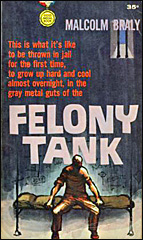
   A rediscovery of this and Braly’s other fine novels Felony Tank (1961), It’s Cold Out There (1966), and The Protector (1979) — is long past due.

         ———
   Reprinted with permission from 1001 Midnights, edited by Bill Pronzini & Marcia Muller and published by The Battered Silicon Dispatch Box, 2007.   Copyright © 1986, 2007 by the Pronzini-Muller Family Trust.

UPDATE:   The good news is that of the books Ed Gorman mentioned in this review, I believe that all but The Protector is currently in print. Stark House Press has reprinted this, It’s Cold Out There and in a separate edition, Felony Tank, while The New York Review of Books has recently published On the Yard.

REVIEWED BY JONATHAN LEWIS:


RAGE. Warner Brothers, 1972. George C. Scott, Richard Basehart, Martin Sheen, Barnard Hughes, Kenneth Tobey, Robert Walden, Dabbs Greer. Director: George C. Scott.

   Both starring and directed by George S. Scott (his directorial debut), Rage is an uneven thriller about a man at his wits’ end. Scott portrays Dan Logan, a widowed Wyoming rancher raising his young son as best he can. After a night spent outside camping, Logan wakes up to find both his son and his sheep extremely ill. Although the viewer soon learns that Logan’s son was accidentally poisoned by a military chemical weapons project gone wrong, Logan himself is kept in the dark as to what is afflicting his son.

   It seems as though no one can be trusted, a hallmark of the paranoid, political thrillers which were commercially released in the late 1960s and early 1970s. No one except Logan’s personal physician (Richard Basehart) who, truth be told, doesn’t prove particularly useful when Logan needs him the most.

   After Logan learns not only that his son has died, but also that the military and the public health service are doing their best to cover up what transpired, he begins a course of action which is supposed to be the ‘rage’ part of the film. Unfortunately, there’s just not that much rage and, for the most part, Logan ends up targeting people who really didn’t have much directly to do with his son’s death.

   Instead of targeting the hospital staff, including one young physician (Martin Sheen) who repeatedly manipulated him and lied to his face, Logan kills a cat owned by the local public health official, targets the chemical manufacturer for destruction, sets a cop on fire, and shoots an MP at an Army base.

   To be sure, Logan is at war and there are always casualties of war. But the more Logan’s rampage continues, the less sympathetic a character he becomes. Maybe that was the filmmaker’s whole point: that no one is innocent and that righteous rage has the capacity to consume an individual. If that was the case, it just doesn’t gel correctly in this particular movie. Or maybe the film is about the futility of rage in the face of the military-industrial complex.

   When all’s said and done, you might expect that a movie entitled Rage would have just a bit more of it. Scott’s portrayal of Logan is less of a man burning up with rage than a man who, despite being sickened by the same chemical weapon that killed his son, acts rather calmly and methodically. And when it eventually becomes clear how very little revenge ends up being inflicted upon the wrongdoers, it leaves the viewer wondering what the point of the whole proceedings was meant to be.

INGRID THOFT – Brutality. Fina Ludlow #3. Putnam, hardcover, June 2015; trade paperback, December 2016.

   I read Loyalty (2013), the first of Fina’s case adventures, almost three years ago, and you can read my review of it here. I am amused to see that I started my comments then by pointing out how thick the book was, 474 pages. Amused, because I was going to start my comments on this book the same way. It’s 450 pages of small print in the trade paperback edition, and it takes a lot of reading to get from beginning to end.

   And what you get, if you do, is a deep-plunge immersion into two weeks of Fina Ludlow’s life, totally and completely. Not only is she working on a case with lots of offshoots to it, but she also has to deal with members of her family, mostly her dysfunctional parents — her brothers, save one, who is a known pedophile, and their families seem to be normal; a close friend who is being pressured to give up a kidney to an aunt she never knew until the aunt needed one and went looking for her; and a couple of men in her life who sleep over once in a while.

   The case itself is the unexplained death of a young mother and housewife attacked in her kitchen by an unknown intruder. The only thing out of the ordinary about her is that she had been suing the university where she was a soccer player years before. She believed the school was responsible for the memory problems she’d been developing, the athletic department in particular.

   Fina’s approach is a scattergun one. The police can do their investigation their own slow, methodical way. She charges right in, asking questions, stirring up dust, so to speak, and sees how it settles. Existing, it seems, on a diet of Dunkin Donuts fare, not difficult to do in the Boston area where her father is the head of the area’s best known litigation firm, Fina is on the road constantly, juggling her personal life along with whatever case she’s on.

   Her smart aleck attitude gets her a long way into digging out the truth, mitigated greatly by how much she cares. It takes a while to get through as many pages as this, but to my mind, they’re well worth the investment in time.

   I do have one small complaint, however. If I read the ending correctly, one aspect of the case is not yet solved at book’s end. Since every other aspect of Fina’s life is carried over from book to book, I’m assuming this will be also. If not, I’m planning on being ticked off.

   Book two, which I happen to have missed, was Identity (2014). Book four, out only in hardcover so far, is Duplicity. Also of note, I’m sure, is that Brutality was the winner of last year’s Shamus award for best hardcover PI novel. A good choice.

From a self-titled LP released in 1971:

  THE HOUSE THAT DRIPPED BLOOD. Amicus Productions, UK, 1971. Christopher Lee, Peter Cushing, Nyree Dawn Porter, Denholm Elliott, Jon Pertwee, John Bennett, Ingrid Pitt, Chloe Franks. Screenplay: Robert Bloch. Director: Peter Duffell.

   This four-story-in-one horror film from Amicus has one major flaw, at least looking back upon it now. In spite of the title, there is no blood in it. It was, in fact, rated GP at the time of its release, the equivalent of today’s PG.

   It is possible to give the audience a few chills without a lot of gore, and that’s all the movie does: give the audience a few chills along with a few twists of plot, most of which are foreshadowed well in advance.

   The setting for all four segments is a common looking house in the English countryside, rather large but otherwise not very imposing. But it has its secrets, and each of those who rent it out find out what exactly that means.

   Part One: A writer of horror stories finds that one of the crazed killers he writes about is coming to life and haunting him, but his wife can neither see nor hear the man. The biggest twist in all four stories comes in this one.

   Part Two: A newly retired tenant (Peter Cushing) finds a waxwork museum in town with a figure of a woman inside whose face begins to haunt him. A friend who comes to visit falls under the spell of the waxwork face as well. A rather tepid tale with a easily foreseen ending.

   Part Three: A man (Christopher Lee) who rents the house with his very young daughter hires a tutor for her, a woman who soon learns that this is not a happy twosome she is working for, especially the daughter (a spellbinding Chloe Franks).

   Part Four and the underlying connection between all four segments: An inspector from Scotland Yard comes to the village looking for a famous movie actor (Jon Pertwee), who has disappeared, seemingly (as it turns out) under the spell of a vampire’s cloak. More special effects are used in this segment than any of the others, to little avail.

   There are lots of famous names in the cast, but the stories are both dull and obvious. Personally, I expected more from Robert Bloch, and I was disappointed.

A 1001 MIDNIGHTS Review
by George Kelley


WILLIAM HJORTSBERG – Falling Angel. Harcourt Brace Jovanovich, hardcover, 1978. Fawcett, paperback, 1982; Warner Books, paperback, 1986; St. Martin’s, paperback, 1996. Millipede Press, trade paperback, 2006. Film: Tri-Star, 1987, as Angel Heart (with Mickey Rourke as Harry Angel).

   William Hjortsberg is a highly unconventional writer who delights in mixing genres and breaking molds. His first novel, Alp (1969), blends pornography and mountain climbng; his science-fiction novel, Gray Matters (1971) features a Utopia run by incredible cybernetic machines dedicated to human transcendence while humans rebel against the perfect society. Other experimental works include Symbiography (1973) and Toro! Toro! Toro! (1975).

   In Falling Angel, Hjortsberg combines 1940s private-eye fiction with the occult. PI Harry Angel, a specialist in finding missing persons, is hired to track down a famous Forties singer, Johnny Favorite. The trail leads to Central Park, voodoo ceremonies, a black mass in an abandoned subway station, Coney Island fortune-tellers, and bizarre murders. Harry Angel finds he’s involved in a satanic plot, and he might not be able to escape alive.

   Fallen Angel is William Hjortsberg’s most successful book; descriptions of New York City in the post-World War II era are clever and accurate. A condensed version of Falling Angel was published in Playboy and proved very popular. In trying to describe Falling Angel, Stephen King said, “I’ve never read anything remotely like it. Trying to imagine what might have happened if Raymond Chandler had written The Exorcist is as close as I can come.”

         ———
   Reprinted with permission from 1001 Midnights, edited by Bill Pronzini & Marcia Muller and published by The Battered Silicon Dispatch Box, 2007.   Copyright © 1986, 2007 by the Pronzini-Muller Family Trust.


WILLIAM HJORTSBERG, R. I. P.   Quoting from The Rap Sheet earlier this week:

    “The New York City-born Montana novelist who gave us private investigator Harry Angel (in 1978’s Falling Angel), the lively detective pairing of Arthur Conan Doyle and Harry Houdini (in 1994’s Nevermore), and a drug-fueled nightmare excursion through 1960s Mexico (in 2015’s Mañana) passed away this last Saturday night of pancreatic cancer. Author William Hjortsberg, who was known to friends simply as ‘Gatz,’ was 76 years old.”

Home was Delaney and Bonnie Bramlett’s first album, released by Stax in 1969.

THE BACKWARD REVIEWER
William F. Deeck


WILLIAM RUSHTON – W. G. Grace’s Last Case, or the War of the Worlds, Part Two. Methuen, UK, hardcover, 1984; paperback, 1985. No US edition.

   [England in the 1890s], the War of the Worlds is at an end, with the earth and its microbes victorious. Castor Vilebastard (pronounced “Villibart” according to Vilebastard, but we know better), about to bowl to W. G. Grace, the world’s foremost cricketer, collapses on the pitch at Lord’s, an Apache arrow in his back.

   This novel is what may be called a reverse roman à clef — that is, there are fictitious people going about under real names. There are also real people using their real names.

   Some of the more active real people — there are scores of them — are Grace, Dr John Watson, Inspector Lestrade, Mrs Hudson, Oscar Wilde, Toulouse-Lautrec, and Professor Moriarty. The fictitious people, among others, are Dr Henry Jekyll, along with his compatriot, Mr Hyde, and A. J. Raffles. Lord Greystoke makes a brief appearance.

   Sherlockians will, of course, be fascinated by this new adventure of Dr Watson’s although they may be outraged when they note the suggestion that he has it off with Queen Victoria. They may also be puzzled by Watson’s introducing himself to Grace as “John D. Watson”, as if there weren’t enough problems with the good doctor’s name. To add to the confusion, Watson claims he saw Moriarty vanish over the Reichenbach Falls. And, unfortunately, Watson is portrayed as more than a bit of a nitwit, which he never was.

   Still, the author makes up for these strange statements by telling us, albeit too briefly, how Holmes, with Watson’s inadvertent aid, was responsible for the ultimate defeat of the Martians.

   To enjoy this novel, no reader need be aware of what a silly mid-on or even a silly mid-off does on the cricket field. What is essential to bring to it is an appreciation of delightful farce, verbal slapstick, and good bad puns as Grace, Watson, and allies pursue Pollux Vilebastard, twin brother of Castor and an even bigger villain than Moriarty, to find out just what in (and out of) the world he is up to.

   The Times Literary Supplement called this “a comic tour de force”. A typical English understatement, I’d opine.

— Reprinted from CADS 23, ca. 1994. Email Geoff Bradley for subscription information.


Biographical Note:   From his Wikipedia page: “William George Rushton (18 August 1937 – 11 December 1996) was an English cartoonist, satirist, comedian, actor and performer who co-founded the satirical magazine Private Eye.”

« Previous PageNext Page »