A REVIEW BY MARY REED:
   

JOHN BUCHAN

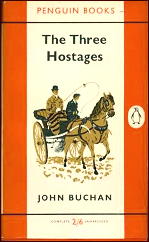
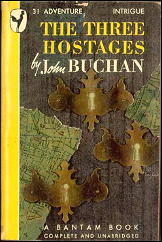
JOHN BUCHAN – The Three Hostages. Hodder & Stoughton, UK, hardcover, 1924. Houghton Mifflin, US, hc, 1924. Reprinted many times, in both hardcover and paperback, including Bantam #31, US, pb, April 1946; Penguin, UK, pb in dj, 1955 (both shown). TV movie: BBC, 1977, with Barry Foster & Diana Quick as Richard & Mary Hannay; director: Clive Donner.

   Having recently reread Greenmantle (reviewed here ), I’m now rereading some of the other Hannay novels. While some will certainly disagree, I view The Three Hostages as a mystery-thriller because there is a mystery to be solved: where are the three missing people and who is behind their abductions?

   The book opens a couple of years after WWI. Sir Richard Hannay and Mary Lamington are now married with a young son. They reside in Fosse Manor, a nice touch given they first met when she was staying with her aunts at the Manor while engaged in a bit of undercover work herself.

JOHN BUCHAN

   One evening the Hannays’ friend Dr Greenslade visits and their conversation turns to how to write a “shocker”. Dr Greenslade’s theory is the author should take three apparently unconnected things, invent a connection, and dream up a problem to solve involving the connection. His example: “an old blind woman spinning in the Western Highlands, a barn in a Norwegian sæter, and a little curiosity shop in North London kept by a Jew with a dyed beard.”

   In the real world ugly international doings are afoot and eventually they intrude into Hannay’s household. Members of the families of three great men — “the daughter of the richest man in the world, the heir of our greatest dukedom, the only child of a national hero” — have been kidnapped and are being held as hostages by a “combine” whose members are outwardly respectable but which is using the disaffected across Europe and elsewhere to further their own concerns, including fraud, profiteering, and even murder.

   Though known to the authorities, if members of this combine are captured too soon, the hostages will doubtless be executed and certain delicate political matters in the balance upset.

JOHN BUCHAN

   By a twist of fate Dr Greenslade’s literary example serves to aid Hannay and his friends get on the track of the villains in a race against a deadline at which they can only guess.

My verdict: Was Buchan following Dr Greenslade’s advice, I wonder? Hannay has quite a puzzle to solve and the first half of the book follows his attempts to make sense of the sole clue: six lines of doggerel sent to each of the three great men.

   There is more intelligence work and less physical action in this novel and the slow working-out of the mystery is convincing. Mary Hannay, while mostly off the page, plays a role near the end that is both gripping and believable and received a loud hurrah from here!

Etext: http://gutenberg.net.au/ebooks03/0301231.txt

         Mary R

http://home.earthlink.net/~maywrite/


Editorial Comment: Shown below is Stob Ban in the Mamores, one of the peaks that might have been used as a model by John Buchan. For more mountain scenes and commentary on where they might have shown up in Buchan’s work, go here.

   JOHN BUCHAN

A TV Review by MIKE TOONEY:


“The Trains of Silence.” An episode of Kraft Suspense Theatre (Season 2, Episode 28). First air date: 10 June 1965. Jeffrey Hunter, Tippi Hedren, Warren Stevens, Lloyd Bochner, Patrick Whyte, Francis DeSales, Dale Johnson. Teleplay: William Wood. Story: Ben Maddow. Story consultant: Anthony Boucher. Director: Douglas Heyes.

   Fred Girard (Jeffrey Hunter) storms into a hotel demanding to see the man who lives in the penthouse, his old college friend Wolfe Hastings (Lloyd Bochner).

   Fred is a Canadian geologist who has made a huge discovery: mineral deposits laced with titanium ore worth a cool three million dollars at current assay rates. He needs Wolfe, a reclusive multimillionaire, to finance development. All he wants is to see Wolfe, but he gets stonewalled from the get go, first by Wolfe’s alcoholic personal secretary Lee Anne (Tippi Hedren) and later by Wolfe’s righthand man, Mark Wilton (Warren Stevens).

   The D-Day invasion of Normandy proved easier than getting in to see Wolfe. Fred’s initial attempt to penetrate Wolfe’s lair nearly gets him killed. When that fails, Wilton tries to buy him off with a $3 million check — provided he leaves town to cash it. Fred accedes at first, but then has second thoughts. Now he wants to see Wolfe more than ever.

   With the unwilling assistance of an alley cat, at long last Fred breaks through the wall of security surrounding Humpty Dumpty and all the king’s men and discovers an ugly secret about his old college chum.

   Unfortunately for Fred, he’s the one — and not Humpty — who’s been chosen to take the fall — from a rooftop sixteen floors up ….

   This is Jeffrey Hunter’s show: He dominates every scene he’s in, and he’s in every scene. The script is already sharp, but Hunter improves on it. Tippi Hedren was a Hitchcock “discovery,” with The Birds (1963) being her first big starring role, followed by Marnie (1964).

   Warren Stevens has often played villains. A few of his crime drama credits: Phone Call from a Stranger (1952), Gorilla at Large (1954), Black Tuesday (1954), Women’s Prison (1955, reviewed here ), The Price of Fear (1956), Accused of Murder (1956), Intent to Kill (1958).

   TV credits for Stevens include two episodes of Checkmate, four appearances on Hawaiian Eye, three Kraft Suspense Theatre‘s (including “One Tiger to a Hill,” reviewed here ), Madigan (1968), and four episodes each of Mission: Impossible and Ironside.

Reviewed by DAVID L. VINEYARD:         


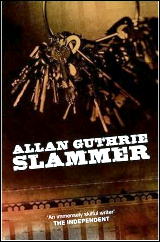
ALLAN GUTHRIE – Slammer. Houghton Mifflin Harcourt, US, hardcover, November 2009. Mariner Books, trade ppbk, September 2010. First Edition: Polygon, UK, softcover, March 2009 (shown).

ALLAN GUTHRIE

   This is a tough minded noirish thriller from British writer Allan Guthrie, who has previously been nominated for the Debut Dagger from the British Crime Writer’s Association and won Theakston’s Old Peculiar Crime Novel award for Two Way Split. His novel Kiss Her Goodbye was nominated for an Edgar and an Anthony.

   The man has some credentials for writing his particularly bleak version of the British crime novel. And bleak it is. Compared to Guthrie, Jim Thompson and David Goodies were cockeyed optimists. This one is the literary equivalent of those mad British crime films like Lock Stock and Still Smoking Barrel, but that sort of thing works better on screen than in print.

   Nick Glass is a prison guard at the ‘Hilton,’ a Scottish prison with a bad reputation, and between the inmates and his fellow officers he finds himself in a special hell caught between two equally brutal and dehumanizing forces.

   You might expect this to develop in classic noir form of a ‘hero’ who stands up to and defeats the forces on both sides after a brutal and bloody struggle, but that isn’t where Guthrie is going, though at times it seems so.

   Nick’s life takes an even worse turn when a group of cons in the prison uses outside pressure to threaten Nick’s wife and daughter to force him to do them a ‘favor’ on the outside.

ALLAN GUTHRIE

   I’d like to quote from the book, but frankly there isn’t much that could be quoted here without heavy editing, and even then it wouldn’t give the feel of the book.

   One problem I found with this is that I never cared what happened to Nick Glass. He’s an unappealing protagonist and it’s hard to care about his grim ironic fate. The novel takes a dark turn that I can’t discuss in fairness to Guthrie and anyone planning to read this, but I neither believed it nor felt he brought it off. I’m not sure any writer could bring it off.

   Frankly I haven’t decided whether I like this or not. I’ll have to put it aside and come back in a different mood to be sure. The writing is assured and strong, but there is something about this book that made me feel like I needed to stop an take a shower when I finished it.

   If the point of the book is that prison is a dehumanizing brutal place, I think most of us knew that going in. If it is that men break in strange ways I think we knew that too. And that’s the problem. I’m not sure exactly what Guthrie is trying to say, other than most of us would be better off to avoid a career in prison from either side of the law.

   I suppose there is a certain black humor is watching Nick Glass shatter (sorry, couldn’t resist — and neither does Guthrie or the publisher), but for the life of me I can’t say I cared. He’s a singularly weak and unattractive character, and his attraction to a femme fatale named Lorna only makes him less appealing.

   This type of book turns on the reader’s ability to identify with or at least emphasize with the protagonist’s grim predicament. In the case of Nick Glass I’m not sure his fate would have been much better if he had taken a job in the postal service or the mail room. He’s not merely a loser, but a high profile loser of the first order.

ALLAN GUTHRIE

   I don’t know where this book was supposed to take me. Where it did take me was to a depressing and bleakly unrelieved place with only a few grim moments of black humor to relieve the pressure — and I’m by no means certain they were even meant to.

   Guthrie can write. No question there. And if you want a strong, even stomach churning crime novel with no redeeming characters or features and an outlook as bleak as the gray walls of a Scottish prison, then this is the book for you.

   But I’ll have to be honest. I’m not sure if I would want to take this trip again, and when I do read a bleak novel of brutal crime I usually need some sort of cathartic release — even only a sort of grim irony or a satisfyingly operatic blood bath. I didn’t get that from this one, and that may be strictly me and where I am, but we all read books from that subjective point of view, and based on that, the most I can say is you’ll have to decide for yourself.

   Ted Lewis’s Get Carter and Gerald Kersh’s Night in the City both did this much better and Georges Simenon’s Stain on the Snow showed us even the most unappealing protagonist could hold out attention. For that matter I can think of a half dozen stunning little British crime films from the last decade that all would be a better investment in time and money.

   I wanted to like this one better. I went in expecting pretty much what I got, but I have to say that for me this one is an unappetizing and disappointing outing. That said, I’ll look up Guthrie’s previous novel and probably read his next. The talent is there if he can just tie it to some human element that we can identify with and care about.

   I’m not sure Guthrie failed at what he sat out to do, only that he failed to make me care.

Bibliography: ALLAN GUTHRIE.

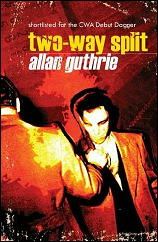
      Two Way Split (2004)
      Kiss Her Goodbye (2005)
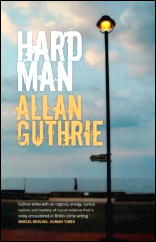
      Hard Man (2007)

ALLAN GUTHRIE

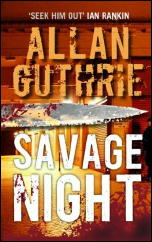
      Savage Night (2008)

ALLAN GUTHRIE

      Slammer (2009)
      Killing Mum (2009)

   Those of you who are pulp collectors, and maybe even if you aren’t, you might want to take a look at a lengthy interview Laurie Powers did with Walker Martin on her blog, where many of the posts always seem to have something to do with either pulps or pulp collecting.

   Walker, of course, is an occasional contributor and a frequent commenter here on the Mystery*File blog, as regular visitors already know. Over on Laurie’s blog, the primary topic of their question and answer conversation is “My Favorite Pulps,” referring to Walker’s collection, but that’s just the starting point.

   Unfortunately Walker and I have known each other for 40 years, so I have to admit I knew all the answers he was going to give before he gave them, but it’s still interesting reading. Go, read, but do find your way back!

THE BACKWARD REVIEWER
William F. Deeck


BELTON COBB – Murder: Men Only. W. H. Allen, UK, hardcover, 1962. No US edition.

   Fearing that Detective Chief Inspector Cheviot Burmann is losing his grip on his job by not following up on information received, Woman Police Constable Kitty Palgrave takes it upon herself to investigate what might be going on at Mrs. Munro’s boardinghouse. This establishment is perhaps unique in that Mrs. Munro takes in only nonpaying male guests who she thinks might be lonely.

   Taking leave from the police department, Palgrave gets herself employed as housemaid at the boardinghouse. Her main discovery there is the corpse of Burmann’s informant, a new inmate at the boardinghouse. When he becomes aware of Palgrave’s presence at the crime scene, Burmann comments: “As usual, you have wandered into one of my cases — and everything is considerably more complicated in consequence.”

   Mrs. Munro is a dotty landlady, seldom finishing a sentence or a thought, and Burmann has trouble coping with her. Nonetheless, he clears up the crime in a tolerably amusing book.

   There apparently is no such thing as a bad boardinghouse novel.

– From The MYSTERY FANcier, Vol. 13, No. 3, Summer 1992.


Editorial Comment:   This is a scarce but not particularly valuable book. There are two copies in English (and two in French) to be found on abebooks, for example, and in neither case is the asking price over $20.

   Cheviot Burmann was Cobb’s most commonly used series character, beginning with either No Alibi or The Poisoner’s Mistake, both of which came out in 1936 . A fellow named Bryan Armitage shared the billing in a few novels (including Murder: Men Only, although Bill did not happen to have mentioned it) plus had a few solo adventures on his own. Supt. Manning was the leading character in several more books.

   She’s not mentioned in Al Hubin’s Revised Crime Fiction IV, but reading between the lines in Bill’s review, it’s all but certain that Constable Kitty Palgrave was in more than one of Inspector Burmann’s books as well.

REVIEWED BY WALTER ALBERT:         


LAWRENCE BLOCK Keller

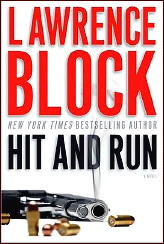
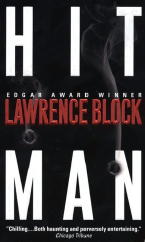
LAWRENCE BLOCK – Hit and Run. William Morrow, hardcover, June 2008. Harper, paperback, June 2009.

   Block’s sympathetic hitman Keller returns for a fourth outing. As he’s waiting for the go ahead to carry out a job in Des Moines, a charismatic African-American governor is assassinated and a photograph of Keller is widely disseminated as the face of the assassin.

   You might say that it’s poetic justice, but Keller’s been set up, and we always have the sense that the people who hire him are the real villains, with Keller the competent professional who’s just doing his job. His life in ruins, Keller goes on the run.

   With the help of a new person who comes into his life and the ever faithful Dot, he eventually recovers but the momentum of the series has been seriously damaged. Much of the novel finds him just marking time, and that new person seems nothing more than a plot device to rescue Keller from an almost impossible situation.

   As far as I’m concerned, this series has run its course, and if this is indeed meant to conclude Keller’s saga, it’s a lame resolution.

       The Keller series —

   1. Hit Man (1998)

LAWRENCE BLOCK Keller

   2. Hit List (2000)
   3. Hit Parade (2006)
   4. Hit and Run (2008)

REVIEWED BY DAN STUMPF:         


THE LOST WEEKEND

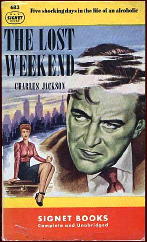
   ● CHARLES JACKSON – The Lost Weekend. Farrar & Rinehart, hardcover, 1944. Reprinted many times, in both hardcover and soft, including Signet #683, pb, 1948.

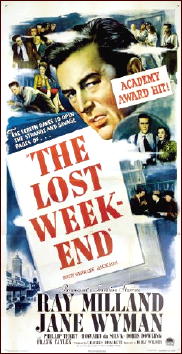
   ● THE LOST WEEKEND. Paramount Pictures, 1945. Ray Milland, Jane Wyman, Phillip Terry, Howard Da Silva, Doris Dowling, Frank Faylen. Screenplay: Charles Brackett, based on the novel by Charles R. Jackson. Director: Billy Wilder.

   Thinking of books and the films made from them, I recenly re-watched and reread The Lost Weekend. I first read Charles Jackson’s 1944 novel back in High School, five years before I took my own first serious drink. Coming back to it now, I found some bits rather labored, way too many pages of rambling introspection, and a disappointing conclusion.

THE LOST WEEKEND

   All that’s left is a gripping story that generates real suspense and painful pathos, a central character commanding the reader’s interest from the outset, and a heart-rending momentum that keeps the pages turning even through the more self-indulgent passages. That’s all.

   The film Billy Wilder made out of this in ’45 softens the ending, adds a love interest, and cuts away the fatty introspection that pervades Jackson’s book, to emerge as a typically tough, brilliant and rather showy Billy Wilder movie: fast-paced, well-developed, and fleshed out with performances — even in the bit parts — that come alive on the screen.

   Ray Milland’s break-out turn after a decade of shallow leads is the most famous, but there’s also memorable thesping from Howard DaSilva — and lovable Frank Faylen etches a part so evil it’ll make me dubious next time I see Wonderful Life.

   One other thing I noticed: the last shot in this movie is really the first shot run backwards. That means something but I don’t know what.

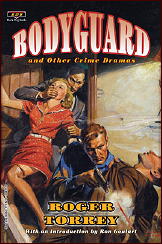
ROGER TORREY – The Bodyguard and Other Crime Dramas. Black Dog Books; trade paperback; 1st printing, 2009. Introduction by Ron Goulart.

ROGER TORREY

   Roger Torrey is probably not the first name you’d come up with if you were to start listing some well-known writers who wrote for the detective pulp fiction magazines, but in his day, he was one of the more prolific ones, and he traveled in high circles, with a considerable amount of his output in the 1930s being for one of the most prestigious of them all, Black Mask.

   Torrey wrote nearly 50 or so stories for that particular magazine, beginning in 1934 and continuing on to 1943, and one wishes that some of those could have been included in this particular collection. But alas, no. Even though this is a strikingly handsome volume, small press operations such as Black Dog Books do not have large budgets, and from all appearances the stories herein are all in the public domain.

   The magazines these stories were reprinted from, such as Romantic Detective, Private Detective and Super Detective, were not even of the second rank, as far as pulp magazines went. More like third or even fourth level, counting downward. Prestigious publications they were not.

ROGER TORREY

   I am sorry to have to tell you this. But not all is lost. Bodyguard is a handsome volume, as I mentioned before, and the stories that are in it were certainly among the best of the magazines they were in.

   Most of Torrey’s leading characters were private eyes, also a great big plus as far as I am concerned, but only a few of them have well-heeled clients or work for a big agency and have a steady job. Most of them seem to be struggling along in life as well as everybody else who inhabit these tales, and sometimes their clients have less money on hand than they do.

   One gets the feeling that Torrey’s characters live in the other end of town, and the stories he tells are earthier and closer to the ground than some of those by his contemporaries. One of the stories has a scene that is more than slightly risque, but otherwise the leading characters and the women they meet in these stories do what ordinary people do, casually but behind closed doors. Lots of hints, in other words, but nothing more than that.

ROGER TORREY

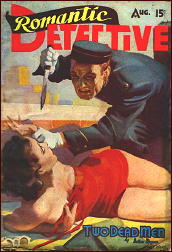
   The detective in “Two Dead Men” (Romantic Detective, August 1938) is a fellow named John Linehan, who in the course in telling this story reveals, without quite saying so, for example, that he’s been stepping out with his secretary on more than one occasion. It also is telling that she’s quite jealous when Lineham seems to be spending too much time in close proximity to a lady friend of his client, as they travels from party to nightclub and back again with his client and her boy friend.

   It seems as though she’s being blackmailed (her boy friend already has a wife) by someone who knows far too much about her, including the fact that she and the aforementioned boy friend were sharing a hotel room right next to one that from which a dead man jumped, falling not feet from Lineham, not working for Miss Morrison at the time.

ROGER TORREY

   It is a wonder that Lineham can solve the case, what with all of the heavy drinking that goes on in this story, but solve it he does. I’m not as sure of the “why” as he is, but I agree with the “who.” But readers of Romantic Detective were not so much interested in the detective end of things, I presume, and Torrey delivers what it was they were looking for.

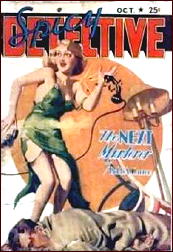
   Story number two is “Cook to Order” (Spicy Detective, October 1939), told by private eye George Andrews, who’s asked by a waitress in a place where he eats to find out what’s been bothering her roommate. Turns out that that’s just a ploy to get him over to her apartment, but as it turns out again, there actually is a case for “Andy” to solve.

   The plot is far too complicated for a story only ten pages long. The picture of tough living, dingy hash houses and bare-bones living quarters will stay with you a whole lot longer.

ROGER TORREY

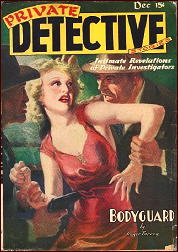
   The title story, “Bodyguard” (Private Detective, December 1938) is one of the longer tales in the collection, almost forty pages long. It doesn’t mean that it’s one of the better ones, I admit, but it has it moments.

   The bodyguard in question is William Dugan, who hired by a man of some wealth when some threats against his life have escalated into actual shots being taken at him. To my mind, Bill is not much of a bodyguard, although in all honesty the beating death of a gardener can’t be held against him, since the incident happened before he showed up.

   Nor can the shooting of a deputy sheriff, since the man was hardly one of the family. But when the throat of one of Miles’s two daughters is found with her throat slit, you’d think he might be fired on the spot, but he manages to keep his job until the case is solved.

   The dead girl was the pure in faith one; the other, a honey blonde with the morals of a tramp is the one who’s all over Bill — picture one guy with a stiff arm out to stave off her advances, and you’ve got our detective pictured to a T. And naturally Angela is more than jealous when Bill takes up with the other good-looking woman who’s recently come to town — a platinum blonde who claims to be a reporter, but her newspaper has never heard of her.

   Bill checked — one of the better moves he makes.

ROGER TORREY

   This is as far I’m going to go. I’m sure you have the idea. There are eight more stories in this book, and I enjoyed them about as much as I did these first three. None of them is as good as Dashiell Hammett or Raymond Chandler, and maybe they’re not even half as good. On the other hand, who is?

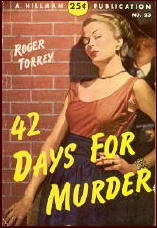
PostScript. Two more things. There is, first of all, a well-done checklist of all of Torrey’s pulp fiction that fills the last dozen pages of this book. (Torrey wrote only novel in his career — he died in early 1946 of acute alcoholism– that being 42 Days for Murder, published first by Hillman-Curl in 1938.)

   Secondly, if you are a pulp fiction fan of any vintage, old or new, you should also go visit the Black Dog Books website. They have a large number of other collections like this one already out or coming soon, including the one just above and to the right, and I recommend all of them to you very highly.

    In the comments that followed Bill Pronzini’s review of Warren Adler’s Trans-Siberian Express (1977), the discussion in the comments turned first to other favorite mysteries set on trains.

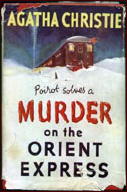
MURDER ON THE ORIENT EXPRESS

   Here’s David Vineyard’s list, repeated here for ease and convenience:

MURDER ON THE ORIENT EXPRESS — Agatha Christie
DREAD JOURNEY — Dorothy B. Hughes
MURDER ON THE CAMPAIGN TRAIN — the Gordons
STAMBOUL TRAIN — Graham Greene
COMPARTMENT EAST — Pierre Jean Remy
THE EDGE — Dick Francis
LADY ON A TRAIN — Leslie Charteris
THE WHEEL SPINS — Ethel Lina White (THE LADY VANISHES)
MURDER ON THE LINE — John Creasey
RUNNING SPECIAL — Frank L. Packard
THE MAN IN LOWER 10 — Mary Rinehart
THE ST. PETERSBURG-CANNES EXPRESS — Hans Koning
GHOST TRAIN and the THE WRECKERS both by Arthur Ripley based on his plays
BOMBAY MAIL — Lawrence G. Blochman

   What reminded me of David’s list was that I came across another Top 10 Train Thrillers list. It’s not clear who came up with this one, entitled “Murder on the Literary Express,” but it was sponsored by abebooks.com:

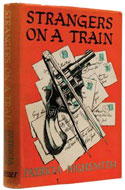
STRANGERS ON A TRAIN

1. Strangers on a Train – Patricia Highsmith.
2. The Wheel Spins – Ethel Lina White.
3. Murder on the Orient Express – Agatha Christie.
4. Stamboul Train – Graham Greene.
5. The Necropolis Railway – Andrew Martin.
6. The Edge – Dick Francis.
7. La Béte Humaine – Émile Zola.
8. 4.50 From Paddington – Agatha Christie.
9. Mr. Norris Changes Trains – Christopher Isherwood.
10. The Taking of Pelham One Two Three – John Godey.

   Most of the others I’ve come up with that are not on either list involve timetables, not actual train travel, and while I’ve not read all of the above, I can’t think of any that would replace the ones in either list.

      Steve,

   Here’s another “Man On The Run” question: I recently watched Odd Man Out with James Mason and could you or David recommend any other urban-type MOTR films? Whether they be wartime, comedic or western doesn’t matter much.

   I am interested in a city atmosphere. I imagine Escape from New York would be one although that is a little too sci-fi for my tastes. Anything at all that comes to mind would be of enormous assistance to me.

         Best,

            Josh

      — —

   This is, of course, a follow-up to David Vineyard’s four Top Ten lists of “Man on the Run” thrillers posted here about three weeks ago. Naturally I tossed the question on to him, graciously offering to let him tackle it. Here’s his reply:

   Hmm, urban man on the run films — there are quite a few of those, so I’ll limit myself a bit. Obviously Odd Man Out is an excellent choice, but here are a few more. Just to keep from going too far astray I’ll stick to ones where the protagonist is on the run in an urban setting rather than what I call ‘hunt the man down’ films like Panic in the City or M which feature classic manhunts.

   These are in no particular order, and vary as to genre (spy, crime, etc.). I’ll also leave off films like Desperate Hours and He Ran All The Way where the bad guy hides out in a home in an urban setting, that’s a genre to itself. Not included, but worth checking out, is The Lost Man with Sidney Poitier, a reworking of Odd Man Out set in the ghetto. Not really a success, but worth seeing. Others:

This Gun For Hire. (Based on Graham Greene’s novel.) Alan Ladd, Veronica Lake, Robert Preston, Laird Cregar. Remade as Short Cut To Hell, directed by James Cagney and as a television movie with Robert Wagner. Stick to the original.

Street of Chance . (Based on Cornell Woolrich’s Black Curtain). Burgess Meredith, Claire Trevor. Amnesiac is hunted as he tries to regain his memory. Also an episode of The Alfred Hitchcock Hour (reviewed here ) with Richard Basehart.

Dark Corner. (Novel by Leo Q. Ross — Leo Rosten.) Mark Stevens, Lucille Ball, William Bendix, Clifton Webb. Private eye Stevens gets help from secretary Lucy when he is set up for murder — great noir film with outstanding performances by all — especially Webb and Bendix.

The Fugitive. Harrison Ford, Tommy Lee Jones This made the first list due to the train wreck and the dam escape in the first part of the film, but much of the action takes place in Chicago making good use of the urban setting and that city in particular.

A Man Alone. Ray Milland. Noirish little western directed by Milland about a fugitive trying to clear himself of a murder in a small town. Perhaps not gritty or urban exactly but tense and claustrophobic. His The Thief set in New York is also worth checking, done with sound, but no dialogue.

The Confidential Agent. (Novel by Graham Greene.) Charles Boyer, Lauren Bacall, George Colouris. Boyer is in London to get help for his cause (Republican Spain in the novel) surrounded by enemies and Fascist agents, falling for Bacall who aides him.

Night and the City. (Based on the novel by Gerald Kersh.) Richard Widmark, Gene Tierney. Great film as Widmark’s wrestling promoter tries to avoid the fixers he has double-crossed in London. Skip the remake with Robert De Niro.

Whistling in Brooklyn. Red Skelton, Ann Rutherford Third film of Red’s series of films about radio sleuth the Fox has him on the run from crooks and cops in Brooklyn including a hilarious turn as a bearded baseball player with the real Brooklyn Dodgers. Probably not what you are looking for, but entertaining.

The Sleeping City. Richard Conte. Once controversial film finds undercover cop Conte in big city hospital ferreting out corruption and with every hand against him.

Twelve Crowded Hours
. Richard Dix, Lucille Ball Offbeat and entertaining B of reporter and girl racing to clear an innocent man.

Dr. Broadway. MacDonald Carey Early Anthony Mann film and part of a proposed series that never developed has young doctor getting involved with gangsters and finding himself hunted by crooks and cops. Based on the pulp stories of Borden Chase.

Somewhere in the Night. John Hodiak, Lloyd Nolan A war hero with amnesia returns to his home town where he was a less than honest private eye and finds himself pursued by everyone.

D.O.A. Edmond O’Brien One of the greats. O’Brien is hunting down the man who poisoned him, but at the same time he is literally on the run from death as his time runs out.

Slayground. (Based on the Richard Stark novel.) Peter Coyote is Parker hunted in an amusement park.

Side Street. Farley Granger Part time postman Granger steals some money and finds himself hunted on all sides. Beautiful use of location work in NYC, expertly directed by Anthony Mann. Great car chase finale in a careening taxi.

My Favorite Brunette. Bob Hope, Dorothy Lamour, Peter Lorre, Lon Chaney Jr. Early spoof of film noir staples (1947, yet they hit them all) as baby photographer Bob is mistaken for private eye Alan Ladd and finds himself hunted by the crooks who want heiress Lamour’s money and the cops who think he is a murderer.

The Web. Edmond O’Brien, William Bendix, Vincent Price. Bodyguard O’Brien gets framed by boss Price in good noir mystery.

Take One False Step. William Powell, Shelly Winters Powell gets involved with Winters and wanted by the police in entertaining tale with script by Irwin Shaw based on his own story.

Dark Passage. (Novel by David Goodis.) Humphrey Bogart, Lauren Bacall. Bogie is an innocent man who escapes prison, Lauren always believed he was innocent and helps him hide out, get plastic surgery, and catch the real killer. Extensive use of the subjective camera from the hero’s point of view for the first half of the film (until Bogart emerges after the plastic surgery).

The Big Clock. (Novel by Kenneth Fearing.) Ray Milland, Charles Laughton, Maureen O’Sullvan Editor at Time-like magazine conglomerate is framed for murder of the publisher’s mistress and ends up hunting himself in the claustrophobic building where he works. Remade as No Way Out and ‘borrowed’ countless times.

Ride the Pink Horse. (Novel by Dorothy B. Hughes.) Robert Montgomery, Thomas Gomez. Tough guy out for revenge and blackmail of vacationing gangster in New Mexico tries to elude killers and police during carnival. One of the greats of film noir. Remade for television as The Hanging Man with Robert Culp.

Mirage. (Based on the novel by Howard Fast.) Gregory Peck, Walter Matthau. Amnesiac loses his memory (or regains it partially) in a blackout and is hunted as he tries to piece his story back together by his former associates.

Arabesque. (Novel by Gordon Cotler.) Gregory Peck, Sophia Loren. While evading spies and assassins Peck and Loren try to put together puzzle involving a threat to a visiting Arab prince in largely comic caper from Stanley Donen (Charade).

Nowhere to Go. (Novel: Donald MacKenzie.) George Nader, Maggie Smith. A thief in London tries to evade police and fellow crooks in this excellent sleeper with notable jazz score by Dizzy Reece.

The Limping Man. Lloyd Bridges. Man finds himself on the run in London from a false charge.

Interrupted Journey. Richard Todd. Man on the run with another woman in suspenseful film — until the end.

Captive City. John Forsythe. Small town newspaper editor finds himself a fugitive in his own town in well done noir film based on a true story.

It Takes All Kinds. Robert Lansing, Vera Miles. Lansing accidentally kills a sailor and Miles hides him out.

The Whistler. (Based on the radio series.) Richard Dix. Solid entry to the B-series in which a man tries to cancel the contract he took out on his life when he thought he was dying.

Rampage. (Novel: Allan Calliou.) Robert Mitchum, Elsa Martinelli, Jack Hawkins. Mitchum and Martinelli find themselves hunting a killer leopard Hawkins has set free in Munich while Hawkins hunts them.

Arch of Triumph. (Novel: Erich Maria Remarque.) Charles Boyer, Ingrid Bergman. Paris on the eve of the Fall with refugees desperate to escape.

Saboteur. Robert Cummings. The second half of the film has innocent Cummings on the run in New York trying to stop the spies and clear his name including the famous Hitchcock shootout in the movie theater, the ship sinking (based on the suspected sabotage of the Normandie), and the finale atop the Statue of Liberty with assassin Norman Lloyd. And if you can call Monte Carlo urban or gritty, To Catch a Thief.

Cairo. Richard Johnson, George Sanders More or less a remake of The Asphalt Jungle but with a bit more of the urban man on the run theme for Johnson’s half breed character at the end.

Bedeviled . Anne Baxter, Steve Forrest. Seminary student Forrest helps Baxter when she is witness to a murder.

Christmas Holiday. (Novel by W. Somerset Maugham.) Gene Kelly, Deanna Durbin. Durbin tries to hide and protect her sociopathic killer hubby Kelly, directed by noir great Robert Siodmak. Kelly is good in unsympathetic role.

All Through The Night. Humphrey Bogart, Conrad Veidt, William Demarest, Judith Anderson. Bogie is a Runyonesque gambler who is framed for murder of Edward Brophy when he stumbles on a ring of fifth columnists. Genuinely funny film with a great cast including Jackie Gleason, Frank McHugh and Phil Silvers. Watch for the scene where Bogie and Demarest double talk a room full of Nazi saboteurs. Great looking film too with serial-like action and sharp script.

I Wake Up Screaming. (Novel: Steve Fisher.) Victor Mature, Betty Grable, Laird Cregar. PR man Mature is framed for murder and on the run in glitzy New York in this noir classic. Remade as Vicki with Jeane Crain, Eliot Reed, and Richard Boone.

Man Hunt. (Based on the novel Rogue Male by Geoffrey Household.) Walter Pidgeon, Joan Bennett, George Sanders. While this Fritz Lang film is a classic of the man hunted in rough country, the scenes in London with Pidgeon shadowed by Nazi agents and his deadly battle with killer John Carradine in the underground are fine examples of the chase film done in an urban setting. Those aspects are largely missing from the well made Rogue Male with Peter O’Toole. Lang recreates the subway setting in his serial killer manhunt film While The City Sleeps.

The Quiller Memorandum. (Novel: Adam Hall — Elleston Trevor.) George Segal, Alec Guiness, Max Von Sydow. Segal’s Quiller finds himself on the run in West Berlin in well done spy film with a screenplay by Harold Pinter.

27th Day . (Novel by John Mantley.) Gene Barry. Preachy but entertaining sf film of group of people from different nations hunted by everyone when aliens give them the power to destroy the world and twenty-seven days to decide whether to use the power.

Ministry of Fear. (Novel: Graham Greene.) Ray Milland, Dan Duryea. Fritz Lang film of amnesiac Milland framed and on the run and the hunt for a spy ring in wartime London. Atmospheric.

The Game. Michael Douglas, Sean Penn. Doesn’t really hold up, plus it’s mean-spirited, but Douglas finds his life turned upside down when his brother gives him an unusual birthday present

Kiss the Blood Off My Hands. (Novel: Gerald Butler.) Burt Lancaster, Joan Fontaine. Ex-POW accused of murder hiding out in London in noirsh film.

The Killers. (Story by Ernest Hemingway.) Burt Lancaster, Ava Gardner, Edmond O’Brien Insurance investigator O’Brien unravels the story of Swede (Lancaster) a one-time boxer who got involved with crooks who he double crossed and then was hunted down and killed by. Hemingway’s favorite film of his work though only the first few minutes of the film actually recreate the story. William Conrad and Charles McGraw memorable as the killers. Ava Gardner just plain memorable. Remade by Don Siegel with Ronald Reagan (his last film and only villain), Angie Dickinson, Lee Marvin, and John Cassavettes.

Enemy At the Gates. Joseph Fiennes, Jude Law, Ed Harris. Semi-fit of the theme as Russian sharpshooter Fiennes and German sharpshooter Harris hunt each other in the devastation of the battle of Stalingrad.

Five Fingers. James Mason, Michael Rennie. Valet turned spy in WWII Istanbul must evade British and German agents when he is revealed. Based on a true story if not the true story.

Behold a Pale Horse. (Based on the novel Killing a Mouse on Sunday by Emeric Pressberger.) Gregory Peck, Omar Sharif, Anthony Quinn. Again a mix of rough country and city chase. Legendary gunman Peck returns to Franco’s Spain to assassinate brutal Fascist police chief Quinn and becomes object of a manhunt.

The Paris Express. (Based The Man Who Watched the Trains Go By by Georges Simenon.) Claude Rains. Meek embezzler finds himself hunted for more than he expected.

   And since we started with James Mason and Carol Reed we’ll end with James Mason and Carol Reed:

The Man Between. James Mason, Claire Bloom. In post-war Berlin black marketeer Mason falls for Bloom and finds himself torn between East and West and hunted by both.

   But for this list more than the others I think we can count on numerous additions.

             — David
« Previous PageNext Page »