ROBERT CRAIS – Indigo Slam. Ballantine, paperback reprint; 1st printing, February 2003. Hyperion, hardcover, June 1997.
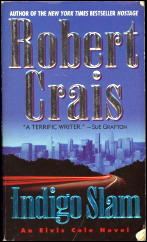
ROBERT CRAIS Indigo Slam

   To begin with, there are two small mysteries here. First, why did it take so long for a hot book by a hot author to make the move from hardcover to paperback? (At the moment, the paperback is ranked 4087th in Amazon’s listings, a fact which will be far out of date by the time you read this, but as far as private eye detective paperbacks go, this is Pretty Good.)

   And secondly, since this is the seventh Elvis Cole novel, why it is that this is the first one I’ve read? I have no answer. I do have a large backlog of books to read, though — is that an excuse? I probably should have started with the first one (The Monkey’s Raincoat, a paperback original from Bantam in 1987), but this one just came out, it looked inviting, and so in I dove.

   Refreshing it was, too. Crais is a smooth writer, and he manages to juggle a couple of unrelated plot lines in quite acceptable fashion. If nothing else, Cole is good at multi-tasking. What gets the book going and is its main point of focus thereafter are Cole’s clients, three young children whose father is missing. Thanks to the short prologue, we know more than Elvis does, but he fills in the gap soon enough: their dad is a drop-out from a Federal witness protection program.

   In backtracking Clark Hewitt’s trail, Cole has help from his laconic, all-purpose partner, Joe Pike — whether they admit it or not, an entire generation of private eye writers has definitely been influenced by Robert B. Parker — and the stakes keep growing higher and higher. I’ll skip the details. Read the book.

   In between run-in’s with various mobsters of every ilk, almost all of them with guns, Lucy, the love of Elvis’s life, is having trouble with her ex, and in the middle, of course, is our hero.

   If the story itself is little more than ordinary, the reason is because the people who are in it who are quite remarkable. The kids who Elvis is working for are superbly drawn: the youngest rather quiet and shy, the boy in the middle suitably bratty, and the oldest, well at 15, she’s been their mother of the other two for quite some time, and as such, she’s simply terrific.

— June 2003


[UPDATE] 03-31-10.   The current Amazon ranking for the paperback edition is #16,211, not bad for a mystery that’s nearly 13 years old (but still in print). Unfortunately for me, this is still the only book by Robert Crais that I’ve read. Re-reading my review just now, I’m stumped. I really am.
A REVIEW BY MARYELL CLEARY:
   

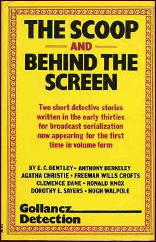
AGATHA CHRISTIE, DOROTHY L. SAYERS, E. C. BENTLEY and Other Distinguished Members of the Detection Club – The Scoop [and] Behind the Screen. Introduction by Julian Symons. Harper & Row, hardcover, 1983. Charter, reprint paperback, 1984. First published by Victor Gollancz, UK, hardcover, 1983.

DETECTION CLUB Scoop Behind the Screen

   According to Julian Symons, the Detection Club is “a slew of crime writers, slew being surely the right collective noun.”

   To raise money to acquire club premises, the members collectively wrote two crime novels to be read on BBC radio, each made up of chapters by different authors. These stories have remained buried in the files of the BBC’s magazine, The Listener, until now.

   It must have been fun to be a mystery fan in the 30’s:   Imagine being able to hear Christie, Sayers, Bentley, Berkeley, Knox, Dane, et al reading their own chapters over the air!

   And it must have been great fun writing them too. Mostly they are just fun, not to be taken seriously as mystery and detection stories. Perhaps the noted authors took the whole thing as a kind of game, a spoof on what they did for a living.

   The Scoop has a passable plot and cliched characters. The less said about the plot and characters of Behind the Screen the better. But taken as spoofs, just for fun, they are fun. And they are interesting examples of their authors’ work when they let down their hair and their standards.

— Reprinted from The Poisoned Pen, Vol. 6, No. 4, Fall 1986

REVIEWED BY WALTER ALBERT:         


AFRAID TO TALK. Universal, 1932. Sidney Fox, Eric Linden, Louis Calhern, Tully Marshall, Edward Arnold, George Meeker, Berton Churchill, Robert Warwick, Frank Sheridan, Mayo Methot, Matt McHugh, Thomas Jackson, Gustav von Seyffertitz, Joyce Compton, George Chandler, Arthur Housman, King Baggot, Walter Brennan, Margaret Lindsay. Screenplay by Tom Reed, based on the play Merry Go Round by Albert Maltz and George Sklar. Photography: Karl Freund; editor: Milton Carruth; art direction: Charles D. Hall and Edgar G. Ulmer. Director: Edward L. Cahn. Shown at Cinecon 45, Hollywood CA, September 2009.

   This superbly crafted crime thriller hit the Saturday evening audience with all the force of a speeding train and never let up in its character-driven 69 minute drive.

   Eric Linden and Sidney Fox, popular young players of the time, are the titular stars, with Linden the witness to a gangland killing who, after being promised immunity for his testimony, is framed by a corrupt Assistant D. A. (Louis Calhern).

   There’s not a weak link in the cast, but Calhern, a smooth career politician with not a shred of morality, gives an unforgettable performance. And the final, ironic scene undercuts any sense that the era of corrupt politics is finally over.

REVIEWED BY DAN STUMPF:         


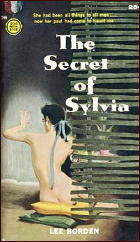
LEE BORDEN – The Secret of Sylvia. Gold Medal #744, paperback original; 1st printing, February 1958.

   I still remember seeing Lee Borden’s The Secret of Sylvia on the paperback rack next to the tube tester at my local drugstore back in the early 60s, and the effect it had on this callow youth from the Midwest.

LEE BORDEN / BORDEN DEAL

   So when it surfaced recently from the swamp that is my library, I decided to actually read the thing.

   Secret is more directly about Sex than most Gold Medal originals. Oh, there’s the usual quota of drinking, fighting, shooting and other Rugged Manly Action, but this is basically about Sex.

   The nameless narrator of the tale, Sylvia’s husband, starts out on his way home to kill his wife, then flashes back to the reasons why: apparently some time earlier he learned that Sylvia put it about a bit before they were married, so he set himself to looking into her past.

   Whereupon the book dissolves into four separate parts, each narrated by a former lover. Sylvia’s husband never tells us how he — a bookseller by trade — found these guys or how he got them to spill their intimate secrets all over him; we’re just supposed to take it on faith.

   Likewise his determination to kill Sylvia is something neither he nor author Borden spells out very convincingly. Well, there’s some dialogue (a lot of dialogue, actually) late in the book supposedly delving into the psychology of the thing, but nothing very convincing.

   I get the feeling, though, that the potential readers of Secret of Sylvia probably weren’t looking for anything very deep or convincing; this was frankly soft core porn, and probably … how shall I put this? — probably satisfied the one-handed readers in its day.

    Bibliographic Data: [Expanded from the Revised Crime Fiction IV, by Allen J. Hubin]

BORDEN, LEE. Pseudonym of Borden Deal, 1922-1985.

      The Secret of Sylvia. Gold Medal 744, pbo, Feb 1958.
      The Devil’s Whisper. Avon T-520 , pbo, 1961.

DEAL, BORDEN. 1922-1985. Born Loysé Youth Deal; pseudonym: Lee Borden.

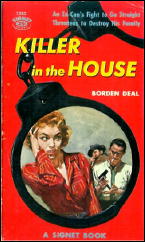
       Killer in the House. Signet 1383, pbo, Apr 1957.

LEE BORDEN / BORDEN DEAL

       A Long Way to Go. Doubleday, hc, 1965.
       -Adventure. Doubleday, hc, 1978.

A REVIEW BY MARY REED:
   

CATHERINE LOUISA PIRKIS – The Experiences of Loveday Brooke, Lady Detective. Hutchinson, UK. hardcover, 1894. Dover, US, trade paperback, 1986.

LOVEDAY BROOKE, LADY DETECTIVE

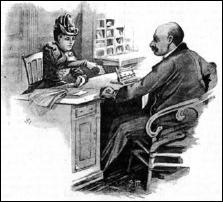
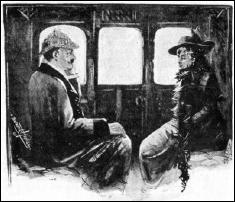
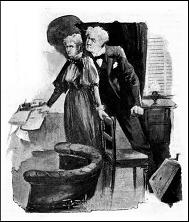
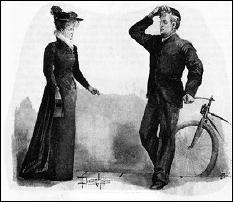
   This collection of stories appeared in the early 1890s and features Miss Loveday Brooke, who works for Ebenezer Dyer, head of a detective agency in Lynch Court, off London’s Fleet Street.

   Miss Brooke is in her thirties and began detecting as the result of an event (not described) by which she was “thrown upon the world penniless and all but friendless”.

   With no way to earn a living she chose this particular line of work, which had the effect of cutting her off from her friends and original position in society.

   By this we can safely deduce she is well bred, the more so as she has rooms in Gower Street and employs a maid. Miss Brooke is nondescript in appearance, making her occasional impersonation of, for example, a nursery governess seeking work or a lady house decorator easily carried off.

   A few words about her various adventures:

LOVEDAY BROOKE, LADY DETECTIVE

“The Black Bag Left on a Door-Step”

   Craigen Court is burgled, Lady Cathrow’s jewels stolen, and her French maid suspected of having a hand in the job. Is there a connection between the theft and a bag whose contents include clerical trappings and a suicide note found on a doorstep not far away?

“The Murder at Troyte’s Hill”

   Highly unpopular Alexander Henderson, lodgekeeper at Troyte’s Hill, is found murdered in his bedroom, which has been turned not so much topsy turvey as completely rearranged in a bizarre fashion, with bed-clothes up the chimney, mantelpiece ornaments arranged in a line on the floor, the clock on its head, and so on. Yet nothing has been stolen.

“The Redhill Sisterhood”

   Sister Monica has rented a house in fever-haunted Paved Court in Redhill, probably not the best location for the Sisterbood’s home for crippled orphans. The Sisters take children begging around local villages each day and strange to relate, burglaries seem to follow in their tracks.

LOVEDAY BROOKE, LADY DETECTIVE

“A Princess’s Vengeance”

   Major Druce is engaged to the Turkish Princess Dullah-Veih, but his gaze has been wandering to his mother’s amanuensis Mlle Cunier. Now the latter has disappeared, taking only her coat and hat …

“Drawn Daggers”

   Miss Monroe, staying with the Revd and Mrs Hawkes, has lost a valuable diamond necklace but she and Mrs Hawkes wish the matter to be hushed up. Now Mr Hawke is receiving anonymous drawings of daggers, and with his wife conveniently away, he engages Loveday to look into the matter.

“The Ghost of Fountain Lane”

   On holiday in Brighton, Miss Brooke investigates the matter of a blank cheque stolen from Revd Charles Turner, cashed for £600, and returned with the mysterious annotation 144,000 on its reverse. Then there’s the ghost….

LOVEDAY BROOKE, LADY DETECTIVE

“Missing!”

   Miss Irene Golding of Langford Hall, Leicestershire, has disappeared and £500 is offered for aid in finding her. Her Italian maid may know more than she is willing to reveal. The final plot twist will be too weak for many to accept.

My verdict: The collection is not terribly sparkling and occasionally does not play fair with the reader, although its explanations of Miss Brooke’s chain of deductions are reasonable and demonstrate one of her main traits: common sense.

   The stories will however certainly be an interesting read when viewed as an early example of the female detective, although sometimes too slowly paced for most modern readers.

Illustrated etext:   http://digital.library.upenn.edu/women/pirkis/brooke/brooke.html

         Mary R

http://home.earthlink.net/~maywrite/


Editorial Comment:   For more on the author and her Loveday Brooke stories, see Mike Grost’s Classic Mystery and Detection website.

A TV Review by MIKE TOONEY:


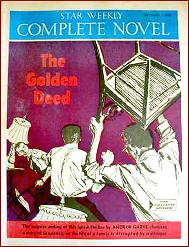
“House Guest.” An episode of The Alfred Hitchcock Hour (Season 1, Episode 8). First air date: 8 November 1962. MacDonald Carey, Robert Sterling, Karl Swenson, Peggy McCay, Adele Mara, Robert Armstrong, Billy Mumy. Writers: Marc Brandell and Henry Slesar. Based on the novel The Golden Deed (1960) by Andrew Garve. Director: Alan Crosland, Jr.

ANDREW GARVE The Golden Deed

   Sally Mitchell (Peggy McCay) and her son Tony (Billy Mumy) are at the beach; for some reason Tony insists on swimming far offshore (it’s only much later that we find out why), where he nearly drowns. Only the intervention of Ray Roscoe (Robert Sterling) keeps him from going under.

   Sally, needless to say, is profusely grateful to Ray and tells her husband John (MacDonald Carey), who offers Ray a temporary place to stay until he can get on his feet, financially speaking. According to Ray, he’s just out of the Air Force and looking for an orange grove to invest in.

   Soon, however, Ray shows his true colors, making barely concealed passes at Sally and neglecting to find work. He even tries to coerce John into paying him to leave.

   Ray’s behavior deteriorates even further when, while driving John’s car, he gets into a fender bender with George Sherston (Karl Swenson) and his wife Eve (Adele Mara). Sally can’t help but notice Ray now making passes at Eve, just like he did with her.

   But George isn’t blind, either. After Ray reportedly gets too physical with Eve and she scratches his face, an enraged George confronts him just outside John’s house. The two are in a slugfest when John intervenes, trying to stop it. Then a terrible accident occurs: When John pushes him a little too hard, Ray falls against a car bumper. George checks the body for life signs.

   The thing to do now would be to call the police, but George argues that it would be nearly impossible to prove it wasn’t premeditated murder, considering Ray’s sexual advances and attempts at blackmail. They all agree the best action would be to bury their “accident victim” and pretend he’s moved on.

   Funny thing about Ray’s accident, though — it’s exactly according to plan ….

   Karl Swenson was all over television for three decades; he usually played in Westerns (e.g., Little House on the Prairie, Bonanza, Cimarron Strip, Gunsmoke), but not always (The Mod Squad, Barnaby Jones, Hawaii Five-O, Mission: Impossible).

   Robert Sterling had a few criminous credits: Johnny Eager (1941), The Get-Away (1941), and Bunco Squad (1950) — but he usually played lightweight comedy roles or good guys: the Topper TV series (1953-55), Ichabod and Me (series, 1961-62), and the first captain of the U.S.O.S Seaview in Voyage to the Bottom of the Sea (1961).

   As for MacDonald Carey: Shadow of a Doubt (1943), the TV series Lock Up (1959-61), four appearances on Burke’s Law, and two on Murder, She Wrote — including what some regard as the smartest and trickiest episode of that series, “Trial by Error” (1986).

Hulu: http://www.imdb.com/video/hulu/vi886571033/


Editorial Comment:   According to IMDB, Andrew Garve’s The Golden Deed was also the basis for the first episode of a summer replacement series on NBC called Moment of Fear (1 July 1960; Season 1, Episode 1). Starring in the program were Macdonald Carey, in apparently the same role, Nina Foch, and Robert Redford.

A MOVIE REVIEW BY DAVID L. VINEYARD:         


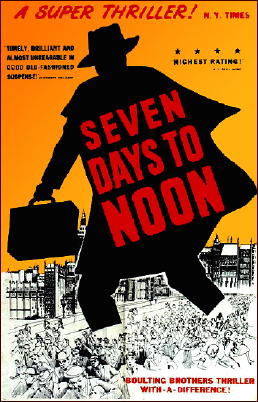
SEVEN DAYS TO NOON

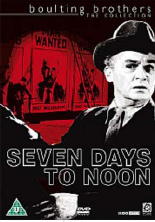
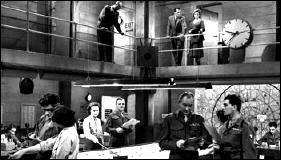
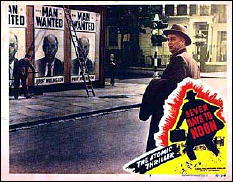
SEVEN DAYS TO NOON. British Lion Films, 1950. Barry Jones, Olive Sloane, André Morell, Sheila Manahan, Hugh Cross, Joan Hickson, Geoffrey Keen, Victor Maddern. Screenplay: Roy Boulting and Frank Harvey. Original Screen Story by Paul Dehn and James Bernard. Directors: John and Roy Boulting.

   This taut little suspense film is one of the best of its kind ever made. With an Oscar-winning original story by Paul Dehn and James Bernard (best known for composing many of the scores for the Hammer horror films) and a screenplay by co-director Roy Boulting and novelist Frank Harvey (White Mercenaries), the film is an achingly suspenseful exercise in nuclear extortion as a soft-spoken scientist holds London hostage amidst a nationwide manhunt, done in a variation of the docu-noir style of many American films of the period.

   The film also won the British Oscar, the BAFTA, for best picture and John and Roy Boulting received best directing nominations from the Venice Film Festival.

SEVEN DAYS TO NOON

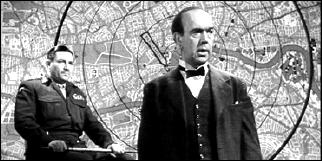
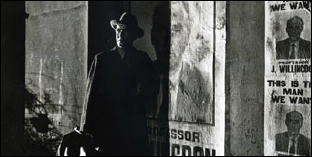
   Barry Jones (Brigadoon, Demetrius and the Gladiator, War and Peace) is the scientist, Professor Willington, who disappears from his job at a nuclear research facility and leaves a letter to the Prime Minister (Ronald Adam) stating he will destroy London in seven days at noon on the seventh day unless his demands for nuclear disarmament are met.

   The world was made in seven days, and London will be destroyed in seven days unless mankind stops the madness of nuclear research is the disturbed professor’s demand.

   Superintendent Folland (Morell) of the Yard and Stephen Lane (Hugh Cross), the professor’s research assistant and future son-in-law, head the nationwide manhunt once it is discovered that along with the professor a suitcase nuclear device is missing. (They didn’t exist then and still don’t now, but where would these films be without them?)

SEVEN DAYS TO NOON

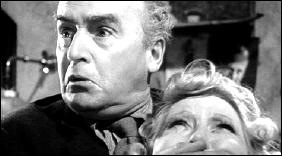
   The film focuses less on the hunt itself than on Willington as he flees to London and interacts with a handful of people including a somewhat flowsy Cockney woman (Olive Sloane) and his landlady (Joan Hickson — Miss Marple). The professor’s ideals are contrasted with the ordinary real people they threaten in a small Cockney neighborhood — not saints or even the salt of the earth, but human beings unaware their very existence is threatened.

   As the pressure intensifies and the noon deadline approaches, London is evacuated and the shots of the empty streets are both haunting and striking. Meanwhile the authorities close in and the professor’s mental state deteriorates more rapidly. The final confrontation in a church is both evocative and tense.

SEVEN DAYS TO NOON

   Solid as this is as a suspense film, there is more to it, which perhaps explains why it has a resonance still today. Jones is neither an egotist nor a monster, but a kindly and gentle man driven to the ultimate act of terror by the daily horror of the work he pursues. Morell is presented as a human and understanding policeman, and everyone involved seems weighted down by the horror of both the potential destruction and the morality involved.

   Willington is a madman and a terrorist, but a real effort is made to understand his mental breakdown and stop him without killing him; something it becomes increasingly obvious they may not be able to accomplish.

SEVEN DAYS TO NOON

   Seven Days to Noon is something more than a suspense film, an early example of the anti-nuclear movement, then in its infancy, and also a meditation on the beginnings of the arms race that would reach its high (or low) point with the Cuban Missile Crisis. The film bothers to ask important questions, and to force viewers to ask who the real madman is — the professor unbalanced by the horror of his work, or the society blithely ignoring the apocalypse under its nose.

   There are no easy answers here. Horrible as the Professor’s threat is it may be less horrible than the future he wants to prevent. The film never suggests such terrorism is justified, only that to an unhinged mind it may seem so.

SEVEN DAYS TO NOON

   This story has been done countless times since, but seldom this well. There is an interesting contrast with a 1953 American film from Fred Sears and Ivan Tors, The 49th Man, an altogether pulpier (but entertaining) version of the A-bomb in the city story with a few nice paranoid twists and a good performance by John Ireland as an undercover operative.

   But this film is neither shrill nor melodramatic; it is quiet and powerful, and it may be more relevant today than it was when it was made sixty years ago. It also offers a fascinating look at a London still marked by the bomb craters from WW II, at a time when you could actually conceive an orderly evacuation of a city the size of London.

Note: If you go to IMDb you will discover this is the first original film score by noted British film composer John Addison.

SEVEN DAYS TO NOON

REVIEWED BY WALTER ALBERT:         


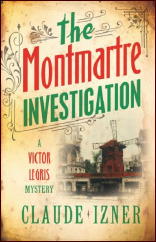
CLAUDE IZNER

  CLAUDE IZNER –
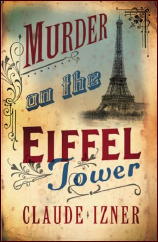
    ● Murder on the Eiffel Tower. St. Martin’s Press, hardcover, September 2008; trade paperback, September 2009.
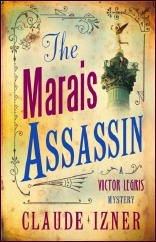
    ● The Marais Assassin. Gallic Books, UK, 2009. No current US edition.

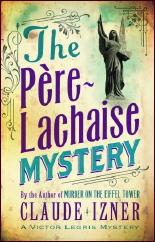
   I’d earlier read The Pere Lachaise Mystery, the second in the series, and The Montmartre Investigation, the third. Murder on the Eiffel Tower is in fact the first, while The Marais Assassin is the fourth.

   The amateur sleuth in the series is Victor Legris, a Parisian bookseller, who operates a shop with a partner, Kenji Mori, and a young shop assistant, Joseph Pignot (“Jojo”), a bright and ambitious lad who’s also a budding serial novelist and a fan of detective fiction.

   The first novel is set in May 1889, at the time of the Paris Exposition, whose centerpiece attraction is the recently constructed Eiffel Tower, while the fourth takes place in 1892.

CLAUDE IZNER

   The series was an automatic choice for me since its setting in Belle Epoque Paris presents the French capital at its most captivating, a bustling international center of the arts, and, in Izner’s fervid imagination, the setting for a series of ingenious, bizarre murders.

   In Eiffel, a series of apparently random deaths apparently caused by bee stings is seen by Victor as something more insidious, and in Marais the killing field stretches from rural England to Paris, with the spree occasioned by the theft of a goblet of apparently little value.

   Victor is a relentless pursuer of the cunning murderers, but his heart often overrules his head, and his romantic entanglements are fortified by a strong vein of jealousy that any reader of Proust will appreciate.

   Still, the virtues outweigh Victor’s weaknesses, which haven’t significantly reduced my enjoyment of the novels.

Bibliography:

    * Mystere rue des Saints-Pères, 2003. (Murder on the Eiffel Tower)
    * La disparue du Père-Lachaise, 2003. (The Pere-Lachaise Mystery)

CLAUDE IZNER

    * Le carrefour des Écrases, 2003. (The Montmartre Investigation)

CLAUDE IZNER

    * Le secret des Enfants-Rouges, 2004. (The Marais Assassin)
    * Le léopard des Batignolles, 2005.
    * Le talisman de la Villette, 2006.
    * Rendez-vous passage d’Enfer, 2008.

From the Gallic Books website:   “Claude Izner is the pen-name of two sisters, Liliane Korb and Laurence Lefèvre. Both booksellers on the banks of the Seine, they are experts on nineteenth-century Paris.”

REVIEWED BY DAN STUMPF:         


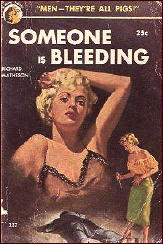
RICHARD MATHESON – Someone Is Bleeding. Lion #137, paperback original, 1953. Reprinted in Noir – Three Novels of Suspense: Someone Is Bleeding; Fury on Sunday; Ride the Nightmare: Forge, hardcover & trade ppbk, 2005. (Previous limited edition: G & G Books, hc, 1997.)   Film: Fox-Lira, France, 1974, as Les Seins de Glace (Icy Breasts).

RICHARD MATHESON Someone Is Bleeding

   It’s pleasantly perverse and quickly readable, this thing, Richard Matheson’s first novel — a couple hours of passion, mystery and intrigue; no great shakes in the plotting department, but quirky enough that I found myself wishing Hitchcock had turned this into Vertigo instead of the Boileau-Narcejac book, reviewed here not too long ago.

   And there are some interesting similarities: David, a callow young writer, meets cute and vulnerable Peggy, a withdrawn but passionate woman whose past seems to be riddled with blank spots and contradictions. Peggy quickly gets him reacquainted with Jerry, an old college buddy turned successful bent lawyer, and with Jerry’s murderous henchman, his neurotic brother, alcoholic wife and other sundry and colorful characters.

   With a cast like this you can’t go far wrong, but you can go some-wrong. The problem is that David never seems to do very much; he spends the novel reacting or over-reacting to the other characters, easily swayed by whatever version of the truth he hears last, and generally getting in the way of whatever may be going on —

   Which may actually be more realistic in terms of character, but hardly makes for compelling reading. What keeps the pages turning here are the lively characters, a great chase scene that seems to prefigure North by Northwest, and an ending I found really really chilling.

Editorial Comment:   On the primary Mystery*File website is an interview that Ed Gorman did with Richard Matheson back in 2004. Ed introduces the interview with an overview of Richard’s career that’s as long as the interview. It’s worth the trip. (Follow the link.)

IT’S ABOUT CRIME
by Marvin Lachman

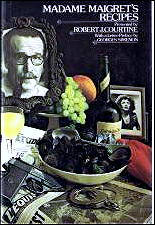
ROBERT J. COURTINE – Madame Maigret’s Recipes. Harcourt Brace Jovanovich, hardcover, 1975; trade paperback, 1987.

MADAME MAIGRET'S RECIPES

   I cannot explain the long life of Georges Simenon’s Inspector Jules Maigret, who has been around for almost sixty years. He spends much of his time on “stake outs,” standing around in the cold. To warm up, he drinks more brandy than is good for him or his liver.

   And what happens when he comes home? Well, according to Madame Maigret’s Recipes, compiled by Robert J. Courtine, he is served all the wrong foods. Still, I once said the same about Nero Wolfe, and he survived many years even though he also had to contend with obesity and a sedentary life style.

   Seriously, Courtine’s book is a delight for all who love good food, presenting recipes which range from soups like vichyssoise to deserts, e.g., profiteroles, an obscenely delicious concoction of eggs, butter, cream, chocolate, and ice cream.

MADAME MAIGRET'S RECIPES

   In between are more than a hundred dishes of meat, seafood, and chicken. Vegetables and salads are few and tend to be prepared with such cholesterol no-nos as butter, cream, and eggs. Still, everything sounds mouth-watering, and the mystery fan will have the added pleasure of being reminded of the book and circumstances under which Maigret ate each dish.

   My favorite cook says most of these dishes are relatively difficult to prepare, despite the contention that Louise Maigret prepared only “good, honest” food, because sophisticated fare had no appeal for her husband.

   However, when the detective comes home to lunch (!) in Maigret and the Loner (1975) she prepares coq au vin and must have spent the entire morning at the stove.

   She proves she loves the detective as much as do his readers. Perhaps it is that the French have a different viewpoint regarding food and, as has been said in a different context, vive le difference.

– Reprinted from The MYSTERY FANcier, Vol. 10, No. 4, Fall 1988.

« Previous PageNext Page »