REVIEWED BY DAN STUMPF:         


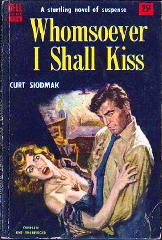
CURT SIODMAK – Whomsoever I Shall Kiss. Crown Publishers, hardcover, 1952. Paperback reprint: Dell 756, 1954.

CURT SIODMAK Whomsoever I Shall Kiss

   Quite without meaning to, I read two novels of Romantic Suspense last year. Curt Siodmak’s Whomsoever I Shall Kiss was the first, and it starts off well, with Royal Ludovici, a former small-time grifter and guy-with-a-funny-name, who lives by making himself useful to the very rich.

   In Italy to find proof of an heiress’s death (and thereby speed an inheritance to a distant relation), Royal finds the heiress very much alive and maybe suffering from amnesia … or maybe not.

   Well, Royal is suave, good-looking and unattached, the heiress is lovely, lonely and broken-hearted, so the only question for Royal is whether to get her to marry him, then tell her she’s wealthy, or to make sure that reports of her death weren’t so far wrong after all.

   It’s a nice set-up for a story, and I expected to see something interesting spun out of it by a hack with Siodmak’s credentials, but he doesn’t do much with it; in fact, he does practically nothing at all. Pages go by filled with sight-seeing, passionate embraces, tearful farewells, torrid embraces and even a bit from The Wolfman, all to very little effect. By the time Siodmak tacked an unsatisfactory ending on, I wasn’t even interested enough to be disappointed.

A REVIEW BY RAY O’LEARY:
   

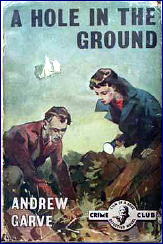
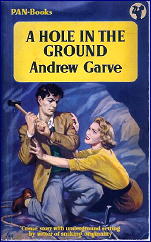
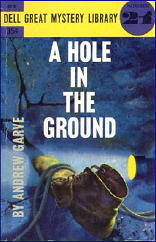
ANDREW GARVE – A Hole in the Ground. Dell, paperback reprint D275, 1959; Great Mystery Library #21. UK edition: Collins Crime club, hardcover, 1952. US First Edition: Harper & Brothers, 1952. Also: Pan #343, UK, pb, 1955; Lancer 72-730, US, pb, 1964.

ANDREW GARVE A Hole in the Ground

   I’d read quite a few of Andrew Garve’s novels, but I never heard of this one until I came across it on a sidewalk table at Barnes and Noble’s.

   Laurence Quilter is the Labour Party Member of Parliament for the area around the town of Blean in West Cumbria. He has a wealthy background and a wife named Jane. They have recently donated his family’s large house to the National trust and moved into a cottage on the estate and he is up for re-election. He is bitterly disappointed that he has never been given a position in the ruling Labour Party’s government.

   While looking through some old papers from his donated house, he comes across a crude map made by his great grandfather nearly a century before. It seems to indicate that somewhere on his land is the entrance to a large cave his ancestor discovered but didn’t make public.

ANDREW GARVE A Hole in the Ground

   While his wife is away visiting friends, he discovers the entrance to the cave and decides to contact a young School Master/ spelunker he knows named Peter Antsley. They explore the cave and find an underground river some 200+ feet below ground reached by going down rope ladders.

   On their second trip, Quilter takes a nap while Antsley does some exploring on his own. Outside, a storm rages which causes the underground river to flood and when Antsley’s foot gets caught and he calls for help, Quilter is too afraid to help him and Antsley drowns.

   Quilter decides to cover up his cowardice and tell no one. He takes his wife on vacation to France but when there is a mining accident in his district, he returns home leaving her. While in France they had meet Ben Traill, an American geologist who works for an oil company.

ANDREW GARVE A Hole in the Ground

   With Quilter in England, Jane and Ben spend so much time together that they fall in love. Finally, Jane decides to go home to confront her husband and from there, during the last 30 pages or so, the story takes a turn into left field.

   You might think that Quilter has been spending his time further covering up Antsley’s death, even though the dead man’s wallet has been found and the police know that Antsley had been in touch with Quilter shortly before he disappeared, but that isn’t the case at all.

   Let’s just say there’s an unnamed reference to a well-known British spy case that first hit the headlines circa 1950 and, though Garve didn’t know it at the time, the case would return two more times to the headlines in the ensuing decades.

   I don’t know if Garve wrote himself into a corner and came up with this lollapoloosa of an ending to get out or what. All I know is that this is the poorest book by Garve I’ve read. Fortunately, he went on to write much better stuff.

A TV Review by MIKE TOONEY:


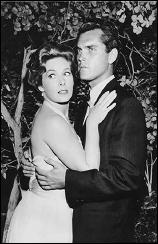
“Don’t Look Behind You.” An episode of The Alfred Hitchcock Hour (Season 1, Episode 2). First air date: 27 September 1962. Jeffrey Hunter, Vera Miles, Abraham Sofaer, Dick Sargent, Alf Kjellin, Ralph Roberts, Mary Scott, Madge Kennedy. Teleplay:
Barré Lyndon, based on a novel by Samuel Rogers. Director: John Brahm.

HITCHCOCK Don't Look Behind You

   Daphne (Vera Miles) is late for a dinner date and, like Little Red Riding Hood, decides to take a shortcut through the woods, which almost proves fatal because a serial killer is stalking her.

   She does make it unmolested, however. Within the next few minutes after her arrival, no fewer than four men show up at the party. She doesn’t know it at the time, but one of the four has already committed murder and another one will soon be making an attempt on her life…

   Maybe it’s just me, but this one doesn’t quite gel. True, the characters’ intentions are adequately foreshadowed, but the whole thing seems wonky and unconvincing.

   Vera Miles’ criminous credits include 23 Paces to Baker Street (1956), The Wrong Man (1956), Psycho (1960), three appearances on The Name of the Game, one on the Jim Hutton Ellery Queen, and three episodes of Murder, She Wrote.

   Jeffrey Hunter appeared in Fourteen Hours (1951), A Kiss Before Dying (1956), Key Witness (1960), Man-Trap (1960), and 26 episodes of the Temple Houston TV series (1963-64).

Hulu: http://www.imdb.com/video/hulu/vi685244441/

Editorial Comment: The pilot for the Temple Houston TV was titled The Man from Galveston (1963) and was considered so well done that it was released theatrically. David Vineyard reviewed it here on the blog last July.

HAD I BUT KNOWN AUTHORS #1: ANITA BLACKMON
by Curt J. Evans


   In Murder for Pleasure, the essential 1941 study of the detective story as a literary form, Howard Haycraft listed ten women authors who constituted what he called the “better element”of the so-called HIBK, or Had I But Known, school of mystery fiction, which was founded by Mary Roberts Rinehart (1876-1958) over three decades earlier with the publication of her hugely popular debut novel, The Circular Staircase (1908).
ANITA BLACKMON

   The Had I But Known school of mystery fiction, as it was so dubbed by (mostly male) mystery critics after the term was used by Ogden Nash in a satirical 1940 poem, typically included mysteries with female narrators given to digressive regrets over the things they might have done to prevent the novel’s numerous murders, had they only been able to see the dire consequences of their inaction.

   Haycraft’s list of the ten premier Rinehart followers includes several names still fairly well-known to genre fans today, namely Mignon Eberhart, Leslie Ford and Dorothy Cameron Disney, but also more obscure names as well.

   Three of these writers, Charlotte Murray Russell and the sisters Constance and Gwenyth Little, have recently had works reprinted and resultingly undergone some reader revival, but the remaining four, Anita Blackmon, Margaret N. Armstrong, Clarissa Fairchild Cushman and Medora Field, remain almost entirely forgotten.

   Over the next few weeks I plan to highlight genre work by these forgotten HIBK authors. I begin with Anita Blackmon.
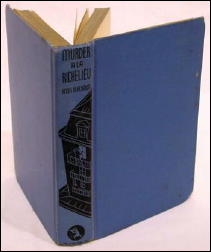
ANITA BLACKMON

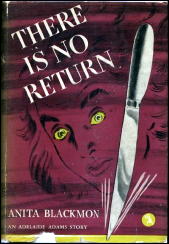
   Anita Blackmon (1893-1943) published two mystery novels, Murder a la Richelieu (1937) and There Is No Return (1938). In the United States, both of Blackmon’s mysteries were published by Doubleday Doran’s Crime Club, one of the most prominent mystery publishers in the country.

   Murder a la Richelieu was published as well in England (as The Hotel Richelieu Murders), France (as On assassine au Richelieu) and Germany (as Adelaide lasst nicht locker), while There Is No Return was published in England also (under the rather lurid title The Riddle of the Dead Cats).

   In classic HIBK fashion, Blackmon employed a series character in both novels, a peppery middle-aged southern spinster named Adelaide Adams (and nicknamed “the old battle-ax”).

   In the opening pages of Adelaide Adams’ debut appearance, Murder at la Richelieu, Anita Blackmon signals her readers that she is humorously aware of the grand old, much-mocked but much-read HIBK tradition that she is mining when she has Adelaide declare, “had I suspected the orgy of bloodshed upon which we were about to embark, I should then and there, in spite of my bulk and an arthritic knee, have taken shrieking to my heels.”
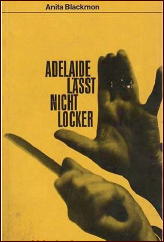
ANITA BLACKMON

   Yet, sadly, Adelaide confides, “there was nothing on this particular morning to indicate the reign of terror into which we were about to be precipitated. Coming events are supposed to cast their shadows before, yet I had no presentiment about the green spectacle case which was to play such a fateful part in the murders, and not until it was forever too late did I recognize the tragic significance back of Polly Lawson’s pink jabot and the Anthony woman’s false eyelashes.”

   Well! What reader can stop there? Adelaide goes on with much gusto and foreboding to relate the murderous events at the Hotel Richelieu, a lodging in a small southern city (clearly Little Rock, Arkansas; see below). Adelaide is a wonderful character: tough on the outside but rather a sentimentalist within, given to the heavy use of cliches yet actually rather mentally acute.

   The life in and inhabitants of the old hotel are well-conveyed, the pace and events lively and the mystery complicated yet clear (and at the same time played fair with the readers). Perhaps most enjoyable of all is the author’s strong sense of humor, ably conveyed through Adelaide’s memorable narration.

   Blackmon clearly knows that HIBK tales frequently are implausible and even silly in their convolutions and she has a a lot of fun with the conventions. Readers should have a lot of fun as well. Murder a la Richelieu emphatically deserves reprinting.
ANITA BLACKMON

   Blackmon’s follow-up from the next year, There Is No Return, is less successful. This tale finds Adelaide coming to the rescue of a friend, Ella Trotter, embroiled in mysterious goings-on involving spiritual possession at a backwoods Ozarks hotel, the Lebeau Inn (in fact the novel could well have been called Murder a la Lebeau).

   Though Return opens with yet another splendid HIBK declaration in the part of Adelaide ( “As I pointed out, to no avail, when the body of the third disemboweled cat was discovered in my bed, had I foreseen the train of horrible events which settled over that isolated mountain inn like a miasma of death upon the afternoon of my arrival, I should have left Ella to lay her own ghosts”), the novel is less amusing than Richelieu, its character less interesting and its mystery less cogently presented and credible.

   Yet it is still fun to encounter the old battle-ax one final time.

   When Howard Haycraft published Murder for Pleasure in 1941, he clearly classed Blackmon as a major figure in the HIBK school, though she in fact had not published a mystery novel in three years. Two years later Blackmon would die at the age of fifty, and her fiction would be largely forgotten. I have discussed her genre work a bit, but have so far left unanswered this question: who was Anita Blackmon?
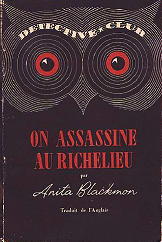
ANITA BLACKMON

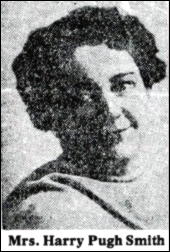
   Anita Blackmon was born in 1893 in the small eastern Arkansas town of Augusta. The daughter of Augusta postmaster and mayor Edwin E. Blackmon and his wife, Augusta Public School principal Eva Hutchison Blackmon, both originally from Washburn, Illinois, Anita Blackmon revealed a literary bent from a young age, penning her first short story at the age of seven.

   By all accounts, Blackmon grew up into a vivacious, attractive, outgoing young woman. The future novelist graduated from high school at the age of fourteen and attended classes at Ouachita College and the University of Chicago. Returning home from Chicago, she taught languages in Augusta for five years before moving to Little Rock, where she continued to teach school.

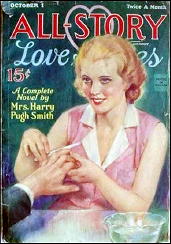
   In 1920, Blackmon left teaching and married Harry Pugh Smith in Little Rock. The couple moved to St. Louis, where Blackmon had an uncle who served as a St. Louis and San Francisco Railroad vice president, and in 1922 Blackmon published the first of what would be over a thousand short stories. Blackmon’s short stories appeared in a diverse collection of pulps, including Love Story Magazine, All-Story Love Stories, Cupid’s Diary, Detective Tales and Weird Tales.

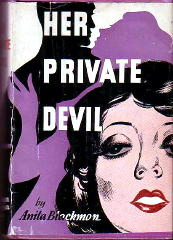
   Blackmon began publishing novels in 1934 with a work entitled Her Private Devil, one that provoked some scandalized talk back in Augusta. Devil was published by William Godwin, a press, as described by Bill Pronzini, that specialized in titillating novels that pushed the sexual envelope of the day.
ANITA BLACKMON

   Godwin titles by other authors in the writing stable such as Delinquent, Unmoral, Illegitimate, Indecent, Strange Marriage and Infamous Woman give some idea of the nature of most Godwin fiction.

   Blackmon’s book, which detailed the unhappy life of a southern small-town girl who gives into her strong sexual desires, is fairly bold, but by no means a “dirty” book. In actuality it is a serious study of a troubled young woman handled with considerable sensitivity and not especially explicit by today’s standards. Still, the book raised something of a stir in conservative Augusta, with some in the town expressing disapproval.

   Over the next few years Blackmon published traditional, mainstream novels under the name Mrs. Harry Pugh Smith, some of which had been previously serialized, before concluding her run with her two mystery novels, published, like Her Private Devil, under her maiden name.

   The best known of the Mrs. Harry Pugh Smith novels was Handmade Rainbows, a tale of middle class Depression-era life in small southern town very like Augusta. Part of the enjoyment one gets from Blackmon’s better novels stems from the author’s effective depiction of unique southern local color.
ANITA BLACKMON

   Blackmon’s Murder a la Richelieu clearly is set in Little Rock, where there was in fact a Richelieu Hotel, while There Is No Return is set far in the Ozarks. Certainly many Golden Age mysteries with Arkansas settings do not come to my mind!

   Why Anita Blackmon produced no more Adelaide Adams mysteries in her last five years of life is a mystery itself. Blackmon died after a lengthy illness in a nursing home in Little Rock, where she moved after the death of her husband.

   Perhaps under the circumstances she was not up to plotting and writing another full-length mystery novel, though she is said to have continued writing until shortly before her death. Though Blackmon’s mystery novel output is small, Murder a la Richelieu, at least, merits reprinting as a significant example of an HIBK tale.

   Also worth noting are the many now-unknown short stories that Blackmon wrote, some of which (those published in Detective Tales) might well be of interest to mystery genre fans. Clearly, further delving is in order!

NOTE:   Information on Anita Blackmon’s life was drawn from Woodruff County Historical Society, Rivers and Roads and Points in Between 3 (Fall 1975), pp. 21-22 and interviews with Rebecca Boyles and Virginia Boyles. Special thanks for his generous help to Kip Davis, Augusta City Planner.

     Bibliography    (Short Fiction; Incomplete) —

BLACKMON, ANITA

* * Glory That Flamed, (ss) Four Star Love Magazine Mar 1937
* * The High Heart, (ss) Cupid’s Diary Jun 28 1927
* * Love’s Precious Secret, (ss) Sweetheart Stories Feb 17 1926
* * The Mystery of Tip Top Inn, (sl) Sweetheart Stories Apr 14 1926
* * Under Another’s Name, (ss) Cupid’s Diary Dec 2 1925
* * With Hearts Aflame, (nv) Sweetheart Stories Mar 3 1926

SMITH, MRS. HARRY PUGH

* * Angel Face, (ss) Love Story Magazine Nov 27 1926
* * The Book of Death (nv) Weird Tales, Nov 1924
* * The Burnt Offering (?) Mystery Magazine, Aug 1 1922
* * Carnival Man, (ss) All-Story Love Stories Apr 15 1933
* * Chained [Part last of ?], (sl) All-Story Love Stories Nov 30 1935
* * Cheated, (ss) Cabaret Stories Jan 1929
* * The Colonel’s Daughter, (ss) Sweetheart Stories May 20 1930
* * A Cottage for Two, (ss) All-Story Dec 14 1929
* * The Devil’s Signet, (ss) Love Story Magazine Oct 31 1925
* * Double Motive (?) Detective Classics June 1930
* * Fettered, (ss) Love Story Magazine Sep 25 1926
* * Firecracker Kathy, (nv) All-Story Love Stories Jul 1 1932
* * Flower of Dusk, (ss) Cupid’s Diary Jun 12 1929
* * The Gay Deceiver, (ss) Love Story Magazine Oct 29 1927
* * Ghost Between [Part last of ?], (sl) All-Story Love Stories Feb 16 1935
* * Her Snobbish Dude, (ss) Far West Romances Jan 1932
* * The Hermit (?) Detective Tales Nov 16/Dec 15 1922
* * The Hindu, (ss) Detective Tales Feb 1923
* * An Interrupted Engagement, (ss) Love Story Magazine Dec 18 1926
* * The Jeweled Pin (?) Detective Tales Apr 1924
* * Jezebel, (ss) Breezy Stories Mar #2 1925
* * Little Lost Bride, (ss) Sweetheart Stories Jul 1935
* * Long Live the King!, (ss) Cupid’s Diary Dec 12 1928
* * Love at Last, (ss) Love Story Magazine Jan 2 1926
* * Love by Accident, (ss) All-Story Love Stories Apr 1 1933
* * The Love Fued, (ss) Love Story Magazine Nov 20 1926
* * Love’s Upward Trail, (ss) Love Story Magazine Jul 30 1927
* * The Marriage of Michael Malloy, (nv) All-Story Love Stories Mar 23 1935
* * Marry for Love, (ss) Sweetheart Stories Mar 1937
* * Marry Him If You Dare!, (sl) All-Story Love Stories Jan 30 1937
* * Maybe It’s Love, (sl) All-Story Love Stories Sep 19, Sep 26, Oct 3, Oct 10, Oct 17, Oct 24 1936
* * My Lady’s Dressing-Table, (vi) Breezy Stories Feb 1923
* * Object, Matrimony, (ss) All-Story Love Stories May 15 1933
* * One True Love [conclusion], (sl) All-Story Love Stories Sep 8 1934
* * The One-Track Heart, (sl) All-Story Love Stories Jan 18 1936
* * The Pride of Darcy, (ss) Love Story Magazine Nov 21 1925
* * Ranch Paradise, (nv) Street & Smith’s Far West Romances Jun 1932
* * The Sting of the Scorpion, (ss) Action Stories Feb 1923
* * A Tangled Skein, (ss) Love Story Magazine Mar 27 1926
* * The Town’s Bad Boy, (sl) All-Story Love Stories Mar 13, Mar 20, Mar 27, Apr 3 1937
* * With This Ring, (nv) All-Story Love Stories Jun 15 1932
* * The Yellow Dog (?) Detective Tales Oct 16 1922

SOURCES: The FictionMags Index; Mystery, Detective & Espionage Fiction, 1915-1974, Cook & Miller.
   According my daily stat monitor, yesterday was the first day this blog has gone over 500 visitors and 900 pages viewed. Each of two numbers have been topped on one or two occasions before, but this the first time that both heights have been attained on the same day.

   The post that’s gained the most attention over this past week, which may have had something to do with it, has been Mike Nevins’ column on Margery Alllingham’s “Mr Campion” short stories. I don’t know if the number of people who’ve read that post will attract the attention of a publisher, but it would be nice if it happened.

   The other honor that M*F the blog has recently been given is being included in the Court Reporter‘s list of “50 Best Blogs for Crime & Mystery Book Lovers.” You now know what one of them is. Follow the link to learn what the other 49 are. Some of the others I go to every day myself, and some of those I haven’t been, I will from now on.

DRACULA PRINCE OF DARKNESS

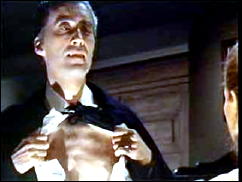
DRACULA, PRINCE OF DARKNESS. Seven Arts / Hammer Films, 1966. Christopher Lee, Barbara Shelley, Andrew Keir, Francis Matthews, Suzan Farmer, Charles Tingwell, Thorley Walters, Philip Latham. Screenwriter: Jimmy Sangster. Director: Terence Fisher.

   Although there were, I believe, other Dracula films in between, Prince of Darkness is the one that’s a direct sequel to The Horror of Dracula (1958), also with Christopher Lee as Count Dracula, and one of the films that put Hammer Films on the map.

   The means by which Dracula is brought back to life is one of the key scenes in this second movie, and so while I of course will say no more about it, it is (no surprise) rather a gruesome one. There are two scenes which caused a shiver down my back, and one of them is the one that occurs soon afterward, as an unwary character in the story stumbles across the scene.

DRACULA PRINCE OF DARKNESS

   And Dracula’s first appearance in the flesh (so to speak) was the other. Christopher Lee doesn’t get a lot a screen time himself, surprisingly enough, and no dialogue (only hissing, I believe), but seeing him quietly appear in the shadows as he does for the first time is enough to make anyone jump.

   Unfortunately, this is also one of movies in which the participants are warned, and explicitly so by the no-nonsense Father Sandor (Andrew Keir), to stay away from the castle, but do they listen? You needn’t ask. So that I found disappointing, and after his grand plan to rescue himself from oblivion succeeds in such fine fashion (and in this I am not exaggerating), he seems to flail around rather ineffectively thereafter.

   As a vampire hunter, Father Sandor is both a realist in terms of the evil he’s facing as well as an implacable foe, and I think this makes Andrew Keir, a giant of a man himself, the star of the movie.

DRACULA PRINCE OF DARKNESS

   Following immediately after the events chronicled in Prince of Darkness came Dracula Has Risen From The Grave (1968), a movie I saw about a year or so ago. For some reason, I do not seem to have written a review of it, but I recall it as having more plot to it than this one.

   This one, though, most reviewers seem to regard as a classic. It’s good but not that good, if you were to ask me, and there is of course no reason that you should. If you’re a fan of horror films, you’ll have seen this one already, and you’ll already have formed your own opinion.

REVIEWED BY WALTER ALBERT:         


PAID TO LOVE. Fox, 1927. George O’Brien, Virginia Valli, J. Farrell MacDonald, William Powell, Thomas Jefferson, Hank Mann. Photography: L. William O’Connell; director: Howard Hawks. Shown at Cinecon 45, Hollywood CA, September 2009.

VIRGINIA VALLI

   J. Farrell MacDonald, an American banker, travels to a small Balkan kingdom for the purpose of making a financial investment to shore up the country’s faltering economy.

   He becomes chummy with the king (Thomas Jefferson) and they plot to marry off Crown Prince Michael (O’Brien), who seems unwilling to settle down.

   Their bait is Gaby, a cabaret dancer (beautiful Virginia Valli), but the machinations of Michael’s cousin (William Powell) threaten to thwart the pair’s plans and break up the budding relationship.

   Hawks was quoted in the program notes by his biographer (Todd McCarthy) as saying that he was influenced by German Expressionist director F. W. Murnau in his tracking shots, lighting and editing.

   It’s certainly an elegant, stylish film, with the expected polished performance by Powell, engaging characterizations by MacDonald and Jefferson, and an attractive portrayal of the developing romance by the forthright O’Brien and sultry Valli.

THE BACKWARD REVIEWER
William F. Deeck


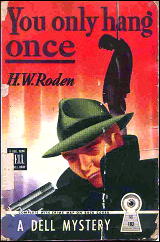
H. W. RODEN – You Only Hang Once. William Morrow, hardcover, 1944. Hardcover reprint: Detective Book Club, 3-in-1 edition, April 1944. Paperback: Dell #104, mapback edition, 1945.

H. W. RODEN

   Another case here for the lack of talents of Sid Ames, private eye. When Johnny Knight, public-relations man, finds a dead lawyer in his office, he calls on Ames.

   Things don’t work out too well with Ames in charge. Later, when Ames and Knight are at a gambling joint where peril looms, Ames proceeds to get drunk and pass out.

   At a meeting with most of the suspects in the lawyer’s murder, Ames gets a message from his office, which his secretary tells to the butler so all can hear. Just in case the possible murderer might have missed something or been slow on the uptake, Knight, a runner-up to Ames in stupidity, reveals that the message was from the deceased lawyer’s paramour. Ames and Knight then deliberately dawdle before going to see the woman. Imagine their surprise to find that someone has strangled her.

   The novel would be funny if it were only humorous.

— From The MYSTERY FANcier, Vol. 13, No. 3, Summer 1992.


Bibliographic information:     [Expanded from the Revised Crime Fiction IV, by Allen J. Hubin] —

    RODEN, H(enry) W(isdom). 1895-1963. JK= Johnny Knight, SA = Sid Ames.

    You Only Hang Once (n.) Morrow 1944. Dell #104. JK, SA
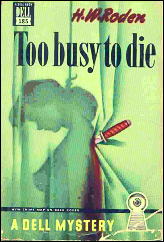
    Too Busy to Die (n.) Morrow 1944. Dell #185. JK, SA

H. W. RODEN

    One Angel Less (n.) Morrow 1945. Dell #247. SA

H. W. RODEN

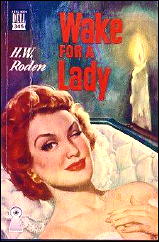
    Wake for a Lady (n.) Morrow 1946. Dell #345. JK, SA

H. W. RODEN

A TV Review by MIKE TOONEY:


“That Time in Havana.”   An episode of Kraft Suspense Theatre (Season 2, Episode 14). First air date: 11 February 1965. Steve Forrest, Dana Wynter, Victor Jory, Frank Silvera, Val Avery. Teleplay: William Wood. Story: Irving Gaynor Neiman. Director: Alex March.

   It’s been six years since Castro’s revolution took over Cuba. An American woman, Anne Palmer (Dana Wynter), has come to Havana to plead for her husband, who has been imprisoned for being a spy against Fidel. But El Jefe won’t see her, and she’s forced to deal with a lower-level functionary, Colonel Velasquez (Val Avery), who seems only to want to molest her. She gets nowhere.

   Until she meets Mike Taggart (Steve Forrest), a journalist; with him she’s able to turn up some unpleasant facts about her husband, including that million dollars her husband was trying to retrieve for the Mob when he was arrested. It seems Anne didn’t know the man she married as well as she thought she did…

   Despite the title, “That Time in Havana” isn’t a light-hearted caper film, although it could have been played that way, from which it would have greatly benefited. It mostly reminds me of two Humphrey Bogart films: Casablanca (1942) and To Have and Have Not (1944).

   In both of those, Bogie spends a lot of time being — or pretending to be — uninvolved with the political turmoil swirling around him; similarly, Dana Wynter’s character cares only about her husband’s plight and is indifferent to politics until she has to make a decision near the end of the story that has political ramifications.

   He-man actor Steve Forrest has had a long career. Criminous credits include: Phantom of the Rue Morgue (1954), Rogue Cop (1954), three episodes of The Name of the Game (1969-70), four episodes of Gunsmoke, 36 episodes of S.W.A.T. (1975-76), 15 episodes of Dallas (1986), five appearances on Murder, She Wrote, and 3 on Team Knight Rider (1997-98).

   Dana Wynter has the distinction of appearing in one episode of the Colonel March of Scotland Yard TV series (1956, under her German birth name, Dagmar Wynter), the sci-fi thriller Invasion of the Body Snatchers (1956), The List of Adrian Messenger (1963), one episode of The Wild Wild West (1966), a regular role in the nearly-forgotten spy series The Man Who Never Was (18 episodes, 1966-67), five episodes of The F.B.I., three appearances on Cannon (1973-75), and as Mrs. Ironside in the TV movie The Return of Ironside(1993).

A MOVIE REVIEW BY DAVID L. VINEYARD:         


EAST OF SUMATRA Jeff Chandler

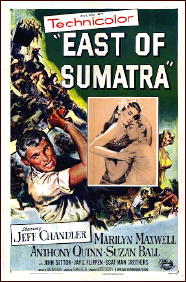
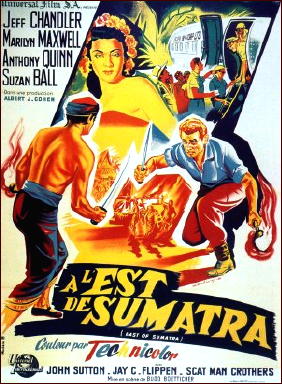
EAST OF SUMATRA. Universal, 1954. Jeff Chandler, Marilyn Maxwell, Anthony Quinn, Suzan Ball, John Sutton, J.C. Flippen, Peter Graves, Scat Man Crothers, James Craven. Screenplay: Frank Gill Jr., based on a story co-authored by Louis L’Amour. Director: Budd Boetticher.

   Here’s a well done pulp-style jungle adventure from action director Budd Boetticher and based on a story by western writer king Louis L’Amour.

   Jeff Chandler is a two-fisted mining engineer whose team is sent to the Maylayan jungle to find tin and runs afoul of local royal Quinn who is jealous of his half caste fiance’s (Ball) interest in Jeff. An added complication is Chandler’s officious boss John Sutton, who is engaged to marry Marilyn Maxwell, Jeff’s ex girl.

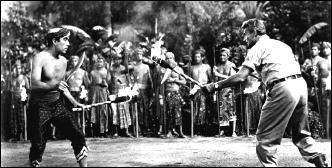
   Things go wrong, and soon Chandler and team are held virtual prisoner by Quinn and his men,and their only means of escape is by hand-to-hand combat to the death in a native temple between Chandler and Quinn.

EAST OF SUMATRA Jeff Chandler

   Attractively filmed by Boetticher, East of Sumatra is a mix of adventure pulp and Men’s Sweat Mag brought to life (“I Fought a Sumatran King for His Woman and a Fortune in Tin”).

   The characters are familiar stereotypes — Chandler the two-fisted boss; Flippen the older veteran straw boss; Graves a Texan engineer in ten gallon hat; Crothers the singing camp cook; Quinn the proud jealous native king; Sutton the boss that doesn’t understand the real world of the field men; Maxwell the bad girl trying to forget her past and rough tough Chandler; Suzan Ball a sultry half white princess torn between jungle king Quinn and handsome westerner Chandler…

EAST OF SUMATRA Jeff Chandler

   Technicolor, well done jungle sets, some nice matte paintings, a good if predictable script, and a competent cast of veterans show how well this sort of thing could be done in the right hands.

   Nothing great, but a showcase of old fashioned studio competence done neatly and with a bit of flare, and the battle between Chandler and Quinn is well matched and handled in a circle of torchlight.

   These kinds of films used to be a staple in theaters. Minor A films churned out by competent directors and featuring attractive casts who hit their marks and generally were better than the material.

   It’s the sort of thing Hollywood relegated to television eventually but is seldom done as well today, and if it isn’t art, it is at least entertainment and done with some style.

Editorial Comments:   That’s Suzan Ball in the dancing girl costume in the photo just above. She was a second cousin of Lucille Ball who had the sad misfortune of dying young, at the age of 21, a victim of cancer. Married to actor Richard Long when she died, she appeared in only eight films and one episode of Lux Video Theater before her death.

   On another matter, both David and I have been trying to learn whether the story this movie was based ever appeared in printed form, with no definitive answer so far. We presume the answer is no, but does anyone know for sure?

EAST OF SUMATRA Jeff Chandler

« Previous PageNext Page »