A REVIEW BY MARYELL CLEARY:
   

ANTHONY OLIVER – The Pew Group. Doubleday/Crime Club, hardcover, 1981. Paperback reprint: Fawcett Crest, 1985. UK edition: William Heinemann, hc, 1980.
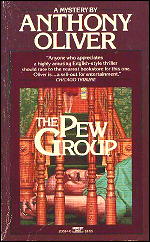
ANTHONY OLIVER

   Here’s a first novel that kept me laughing all the way to the last page!

   It’s set in an English village, but after that any resemblance to the good old conventional English murder mystery ceases. No one, least of all Doreen, is going to call her tripping her dull, antique dealer husband at the top of the stairs murder.

   But his death sets off a marvelous train of events: Doreen’s mother arrives from Cardiff, funeral unbaked meat under her arm. Joseph O’Shea, itinerant picker, tries to sell an undistinguished piece of pottery to a gay antique dealer; unsuccessful there, he goes on to Doreen’s, where he’s more successful in more than one way. The pottery turns out to be “The Pew Group,” a fantastically valuable piece, but as the assembled party partakes of baked meats after Rupert’s funeral, “The Pew Group” disappears.

   Inspector Webber, born in Flaxfield, returned there after a failed marriage and a lackluster career, finds new life in his old home town, as almost everyone involved does. Most of the characters are slightly bent, most of them are enjoying sex lives that aren’t exactly conventional and sometimes not even legal.

   All of them want “The Pew Group.” Who gets it and how we find out at the end, after a thoroughly delightful roam in the British country gloamin’.

– Reprinted from The Poisoned Pen, Vol. 6, No. 4, Fall 1986


    Bibliographic data:    [Taken from the Revised Crime Fiction IV, by Allen J. Hubin.]

OLIVER, ANTHONY.    SC: Lizzie Thomas & Insp. John Webber, in all titles.

       The Pew Group (n.) Heinemann 1980.
       The Property of a Lady (n.) Heinemann 1983.
       The Elberg Collection (n.) Heinemann 1985.
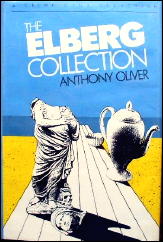
ANTHONY OLIVER

       Cover-Up (n.) Heinemann 1987.

Note: Coming soon to this blog will be Maryell’s review of The Property of a Lady.
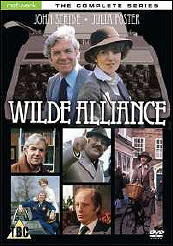
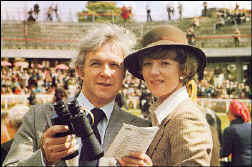
WILDE ALLIANCE. Yorkshire TV, ITV1, UK; 13 x 60m episodes, 17 January 1978 to 11 April 1978. John Stride (Rupert Wilde), Julia Foster (Amy Wilde). Producer: Ian Mackintosh.

THE WILDE ALLIANCE

   Tise Vahimagi happened to mention this series in a post he did on this blog almost three years ago, one in which he was discussing the various TV series that crime fiction writer Ian Mackintosh was involved in, one way or another.

   At the time I’d never heard of Wilde Alliance (and in fact back then I was more or less a complete novice when it came to old British TV series), and his description of the show was definitely tantalizing:

   Said he: “… [a] comedy-thriller featuring the amateur sleuthing adventures of a thriller novelist and his busybody wife (the latter in the Pamela North, Jennifer Hart vein).” Tantalizing, I said, because, I thought, what are the chances that anyone would dig this probably all-but-forgotten series out of whatever archive it might be in, if it existed at all.

   So what a fluke of luck it was to discover that, at the same time I purchased my first multi-region DVD player, that the series did exist, all 13 episodes, and that in fact it had just come out on DVD. It was promptly in my Amazon-UK shopping cart and speeding across the Atlantic on its way to me.

      As Tise said, Rupert Wilde is a thriller mystery writer. As played by John Stride, he’s a chunky fellow, with grayish white hair that’s just a little too long to be called kempt, but was probably in fashion then, back in the late 70s. His wife Amy is pert, saucy and slight and a perfect helpmate, very much her own woman, but cheerfully praising, pleasing and prodding Rupert on.

   They’re a happily married couple and normal in all regards except for their penchant to get mixed up in small scrapes and escapades, some of which involve crimes and some don’t. They aren’t as rich as the Harts (Hart to Hart), since Rupert is always pressed on deadlines for his next book in order to pay the bills, but they certainly are far from poor.

   Of the five episodes I’ve watched so far, I’ve enjoyed the fifth the most: “The Private Army of Colonel Stone,” in which the son of one of Rupert’s honorary aunts has mysterious died in Africa while on a diamond-hunting expedition. No body has been found, but the three men who’d been with him have taken over the isolated cottage that the dead man had used to finance his share of the venture. Plenty of twists and turns in the plot before it’s done.

THE WILDE ALLIANCE

   Other episodes, so far:

    (1) “A Question of Research.” Rupert gets into trouble with the authorities when the research he’s doing into his plot ideas get uncomfortably close to reality.

    (2) “Flower Power.” Amy Wilde comes up with a scheme to stop a dam from being constructed that will flood a beautiful valley.

    (3) “Too Much Too Often.” A weekend in the country with a unhappy couple ends in disaster — a raging river and a drink too many?

    (4) “Things That Go Bump.” A house that Rupert’s agent has purchased seems to have both a curse and a ghost that comes with it.

   Very minor plot material, when it comes down to it, nor are either of the stars big names, then or now (I will gladly stand corrected on that), but the interplay between the two leading actors is as charming (if I may use such a word in describing a TV series purportedly a detective show) as that between Steed and Mrs. Peel in a series in which, however, the stories were larger than life.

   Not quite so with Wilde Alliance. Their adventures are ordinary, or almost so. (None of the above ever happened to Judy and I.)

[UPDATE.]  Later the same morning.   Scouting on the Internet for more information about the series, I found a webpage containing a lengthy overview of it. Quoting briefly, which I assume I may:

    “In its day, Wilde Alliance was one of the most watched programmes on British television. In their book Television’s Greatest Hits Paul Gambaccini and Rod Taylor list every episode (broadcast in a prime time slot between 9 and 10 pm) as being in the Top 20 programmes of the week. ‘Things That Go Bump’ was the most watched episode reaching Number 4 in the chart. It pulled an audience of 16.6 million viewers…”

THE BACKWARD REVIEWER
William F. Deeck


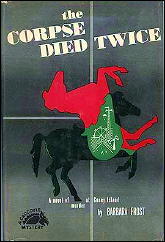
BARBARA FROST – The Corpse Died Twice. Coward McCann, hardcover, 1951. No paperback edition.

BARBARA FROST Marka de Lancey

   Though suffering from a severe hangover, Jerome Carrigan doesn’t feel he deserves the obituary published in a New York City newspaper. He calls upon Marka de Lancey, attorney at law, to investigate it and also asks her to check on an insurance policy he is considering purchasing. She doesn’t have time for the latter since Carrigan is found dead in a Turkish bath at Coney Island under suspicious circumstances.

   This is de Lancey’s second murder investigation with Lieut. Jeff McCrae of Manhattan Homicide. It is a moderately amiable non-fair-play novel.

– From The MYSTERY FANcier, Vol. 13, No. 3, Summer 1992.


Bio-Bibliographic Data: According to Al Hubin in the Revised Crime Fiction IV, Barbara Frost (married name Barbara Frost Shively) was a publicity manager for J. B. Lippincott Co., an obvious rival to Coward McCann, who was the publisher of her four mystery novels.

   Bill is correct in saying that this is Marka de Lancey’s second appearance. He did not mention that there was a third, however, nor that Ms. Frost’s first crime novel was not a series entry. One source on the Internet suggests that the police lieutenant’s name was spelled “Macrae.” It is not presently known if he appeared with Marka de Lancey’s in all three of her cases.

FROST, BARBARA.   1903-1985.   Note: Marka de Lancey appeared in books two through four:

        The Unwelcome Corpse (n.) Coward 1947.
        The Corpse Said No (n.) Coward 1949.
        The Corpse Died Twice (n.) Coward 1951.
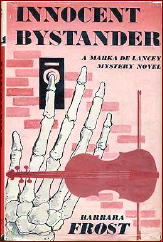
        Innocent Bystander (n.) Coward 1955.

BARBARA FROST Marka de Lancey


Editorial Inquiry: Marka de Lancey’s first appearance was in 1949, making her perhaps one of the earliest female attorneys to appear in crime fiction. Who may have preceded her in this category?

[UPDATE] 02-08-10.   See comment #3. It isn’t a definitive answer, but if Jon Breen doesn’t know of any other female attorney who was a lead character in a mystery novel and who came before Marka de Lancey, then my money’s on the fact that there weren’t any.

REVIEWED BY WALTER ALBERT:         


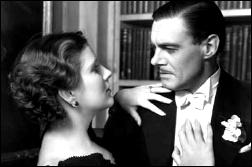
ONE MORE RIVER. Universal, 1934. Colin Clive, Diana Wynyard, Jane Wyatt, Mrs. Patrick Campbell, James Lawton, Henry Stephenson, C. Aubrey Smith, Henry Daniell, E. E. Clive, Snub Pollard. Script: R.C. Sherriff, from the novel by John Galsworthy. Director: James Whale.

ONE MORE RIVER James Whale

   When Diana Wynyard leaves her caddish, sadistic husband, sneeringly played by Colin Clive, to establish an independent existence, private detectives report her every move (in particular, a compromising night in the country in a disabled car with friend and would-be lover James Lawton) to Clive, who sues her for divorce on grounds of adultery, naming Lawton as co-respondent.

   Apart from the casting of his Dr. Frankenstein (Colin Clive) and the usual impeccable direction of a fine and varied cast, the materials of this absorbing melodrama seem somewhat remote from Whale’s imaginative masterpieces: The Old Dark House; The Invisible Man; and Bride of Frankenstein.

   However, three brief sequences are reminiscent of those stylish films:

    ● Wynyard pulls her hair up into a striking semblance of the Bride’s electrified coiffure.

    ● A low-angle shot catches E. E Clive looking superciliously toward the bottom of the frame with Dr. Praetorius’s prissy, pursed lips (Bride).

ONE MORE RIVER James Whale

    ● And most moving of all, Mrs. Patrick Campbell, slowly climbing an ornate, moodily lighted staircase (not unlike the staircase in the great hall of Baron Frankenstein’ s castle), spectrally intones Lady Macbeth’s exit line, “What’s done cannot be undone. To bed, to bed, to bed,” in a cameo scene that sums up unforgettably Whale’s unique feel for the extravagantly theatrical and sardonic, self-conscious mockery.

   The courtroom scene is splendidly acted and paced and the unlikely team of E.E. Clive and Snub Pollard, playing comic sleuths, is a delight. Finally, Diana Wynyard gives an effortless, understated performance that seems spontaneous and lends credibility to this contemporary story of a rebellion against a class and its taboos, a subject always of great interest to Whale.

– This review first appeared in The MYSTERY FANcier, Vol. 7, No. 1, January/February 1983.

   Old Time Radio collector and historian Randy Riddle has come up with another interesting program on his podcast/blog. It’s an Armed Forces rebroadcast episode of Hollywood Startime from 31 March 1946 entitled “Strange Triangle,” an adaptation of the noir film of the same name.

   It stars two of the three original leading players, Signe Hasso (as a truly seductive femme fatale) and John Shepperd. Replacing Preston Foster as the narrator and leading protagonist, though, is Lloyd Nolan, a fellow still known for a long list of B-movie mystery roles. Also in the radio cast is Lurene Tuttle, whose voice OTR fans will immediately recognize as that of Effie from The Adventures of Sam Spade radio program.

   The radio version of Strange Triangle suffers from being cut down in time from a 65 minute movie to only 25 minutes actual air time, but it’s still good entertainment. Give it a listen (click on the link above).

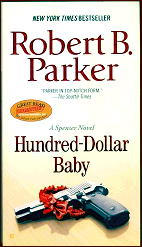
ROBERT B. PARKER – Hundred-Dollar Baby. G. P. Putnam’s Sons, hardcover; First Edition, October 2006. Reprint paperback: Berkley, September 2007.

ROBERT B. PARKER Hundred Dollar Baby

   It was the ending of Ceremony (1982), that was quite controversial at the time, as I recall. A young teen-aged prostitute named April Kyle running from her pimp was able to win Spenser over to her side, and at the end, unable to come up with a better solution, he set her up as a call girl with a madam in Manhattan named Patricia Utley.

   April Kyle was also in Taming a Sea Horse (1986), or so I’ve been told, but if I’ve read that one, I don’t remember it, or I have the ending of the previous book mixed up between the two. (If I don’t take notes, an example of which you’re reading right now, then I tend to mis-remember things.) In any case, in Million-Dollar Baby both Parker and his alter ego, the wise-cracking Boston PI named Spenser, revisit that decision.

   Well. That may be all the plot you need to know. Naturally Spenser needs Susan Silverman right about here as the partner in a lengthy discussion about commercial sex and its pluses and minuses, the effect on society as well on the effect on the women taking an active part in the world’s oldest profession. To coin a phrase.

   This is not as deadly as it sounds, but either you enjoy the relationship between Susan Silverman and Spenser, or you don’t. If you don’t, you probably aren’t reading this review anyway. But as it so happens, I do. I also enjoy it when Spenser needs some muscle, which means calling on the author’s other alter ego, Hawk.

   Manly talk is what goes on then, rather than the domestic talk between Spenser and Susan Silverman, but I have to be honest with you, they are all part and parcel of Robert B. Parker’s fictional world, one of his own creation and one he allowed us to visit once or twice a year while he was alive, and even though he’s gone now, we still have the books.

   In any case, April has branched off from Patricia Utley and has set up shop in Boston, where things went well for a while, but she has now been receiving threats from a gangster and she needs Spenser to cool things down. Which means Spenser needs Hawk. (See above.)

   There are complications, of course, and the fact that everyone is telling lies makes things even more difficult. Some quotes, if I may. From page 19. Spenser is telling Susan about his new case:

    “April Kyle has resurfaced,” I said.

    “The little girl you steered into a life of prostitution?”

    “I saved her from a life of degrading prostitution and steered her to a life of whoredom with dignity,” I said.

    “If there is a such,” Susan said.

   And from pages 209-210. Spenser is talking with one of the suburban housewives who have been working for April in her new venture:

    Amy didn’t look like Bev, but she had the same suburban-mom quality. She was wearing a thick sweater over jeans. Her hair was short. She wore sunglasses like a headband.

    “So how come you’re just having coffee?” she said.

    “Bad for the tough guy image,” I said, “eating ice cream in public.”

    “If you’re after image,” she said, “you should be drinking the coffee black,”

    “I’m not that tough,” she said.

    She giggled

    “You’re a cutie,” she said.

    “But intrepid,” I said.

    “An intrepid cutie,” she said and giggled again.

   Make no doubt about it, though. Spenser is one tough character, and the ending of Hundred-Dollar Baby proves it.

REVIEWED BY GEOFF BRADLEY:         


WALLENDER. TV4, Sweden. Season 1 (13 episodes), 2005-2006. Krister Henriksson (Kurt Wallander), Fredrik Gunnarsson, Mats Bergman, Stina Ekblad, Marianne Mörck, Douglas Johansson, Johanna Sällström (Linda Wallander). Based on the characters created by Henning Mankell. (Shown with subtitles on BBC4.)

WALLENDER Krister Henriksson

   The most enjoyable programme of the last few months, imho, has been Wallender, not the waffly Kenneth Branagh version but the Swedish version with Krister Henriksson in the title role.

   As I understand it the first in this series was originally made for cinemas, based on Hanning Mankell’s book about Kurt Wallender’s daughter Linda, Before the Frost (Innan frosten), in which the Inspector had only a secondary role. The rest of the 13 part series were made between 2005-2006 and based on plots provided by Mankell but turned into film by other scriptwriters.

   The BBC in their wisdom showed numbers 1 and 6 at the time of the Branagh adaptations and only later started to show the rest of the series. They are a refreshing change with excellent actors who manage to portray their characters as colleagues who go about their work in a natural way.

   The stories are strong and the programmes have been excellent. There has been much praise for the series in the press here, but for some reason the BBC temporarily stopped at number 10, with the final three shown later on.

Editorial Comment: Reports are that Season Two of the Swedish version will be broadcast on BBC4 sometime this coming spring, but without the late Johanna Sällström as Wallender’s daughter Linda.

A REVIEW BY MARYELL CLEARY:
   

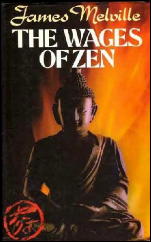
JAMES MELVILLE – The Wages of Zen. Martin Secker & Warburg, Ltd., UK. hardcover, 1979. Methuen, US, hc, 1981. Reprint paperback: Ballantine/Fawcett Crest, paperback, 1985.

JAMES MELVILLE Otani

   In this first novel, Melville gives us a very human and very Japanese superintendent of police, Tetsuo Otani, in a case involving foreign students at a small Zen temple. Its priest, Okamoto, is a mysterious person who leads his students in za-zen by day and entertains prostitutes by night.

   The students are a mixed bag: male, female, old, young, Irish, English, American, Danish, hippie, conservative. Otani is called in first when it seems that drugs are being used or sold; next there is a murder.

   In the course of the investigation we are introduced to Otani’s wife, Hanae, and their happy home life, and to his associates in the police and even an Ambassador. The depiction of everyday Japanese life is interesting, and Otani’s thought processes as he attempts to deal with these foreigners and their strange ways are enlightening. Seeing our Western ways through Eastern eyes is quite an experience.

   An enjoyable book.

– Reprinted from The Poisoned Pen, Vol. 6, No. 4, Fall 1986


The Superintendent Tetsuo Otani series  [Taken from the Revised Crime Fiction IV, by Allen J. Hubin] —

       The Wages of Zen (n.) Secker 1979
       The Chrysanthemum Chain (n.) Secker 1980
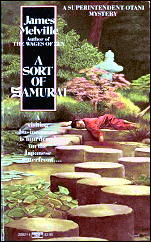
       A Sort of Samurai (n.) Secker 1981

JAMES MELVILLE Otani

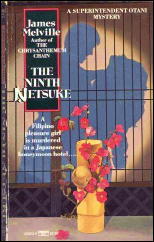
       The Ninth Netsuke (n.) Secker 1982

JAMES MELVILLE Otani

       Sayonara, Sweet Amaryllis (n.) Secker 1983
       Death of a Daimyo (n.) Secker 1984
       The Death Ceremony (n.) Secker 1985
       Go Gently, Gaijin (n.) Secker 1986
       Kimono for a Corpse (n.) Secker 1987
       The Reluctant Ronin (n.) Headline 1988
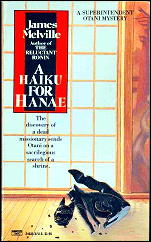
       A Haiku for Hanae (n.) Headline 1989

JAMES MELVILLE Otani

       The Bogus Buddha (n.) Headline 1990
       The Body Wore Brocade (n.) Little Brown 1992

REVIEWED BY TINA KARELSON:         


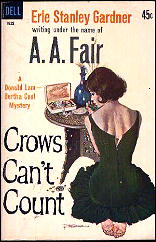
A. A. FAIR [Erle Stanley Gardner] – Crows Can’t Count.

William Morrow, hardcover, 1946. Paperback reprints include: Dell 472, mapback edition, 1950; Dell D373, McGinnis cover art, September 1960 (shown); Dell 1625, September 1972.

A. A. FAIR Crows Can't Count

   Bertha Cool and Donald Lam, two of the best-named characters in American crime fiction, are hired by the trustee of an estate to find out why an emerald necklace belonging to the estate has gone missing. Complications ensue when the other trustee is murdered, leaving behind a pet crow whose behavior is the key to the title.

   This is as irritating a well-crafted book as one might encounter. The plot is convoluted, with the motives and behavior of several completely offstage characters playing important roles. A portion of the book takes place in Colombia, and south-of-the-border stereotypes are pervasive. Bertha Cool comes across as completely useless.

   As an example of craft, here’s how Lam describes a meal:

    “At seven-thirty I had breakfast: the thick, piquant juice of some tropical fruit; bananas, which had a distinct pineapple flavor, rather tart and very delicate; papaya, the black seed giving it a distinctly peppery flavor, the whole garnished with juice of a fresh lime. Then there were soft-boiled eggs, Melba toast, and Colombian coffee which had none of that slightly acrid bitterness which frequently distorts the taste of a strong brew. It was black in the cup, amber in the spoon, and nectar to the palate.”   (Pages 154-155).

   Gardner is worth reading, but this one is for completists.

Previously reviewed on this blog:

      Crows Can’t Count (by Steve Lewis)
      Owls Don’t Blink (by Marcia Muller)
      Kept Women Can’t Quit (by Steve Lewis)

A REVIEW BY RAY O’LEARY:
   

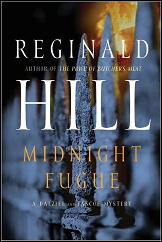
REGINALD HILL – Midnight Fugue. HarperCollins, US, hardcover, October 2009. British edition: HarperCollins, hc, 2009.

REGINALD HILL Midnight Fugue

   Supt. Andy Dalziel has just spent his first week on the job since recovering from injuries he received in Death Comes for the Fat Man. He heads out one Sunday morning, thinking it was Monday, as his telephone was ringing, and winds up in Church where he is approached by Gina Wolfe, who was following him. Unbeknownst to them both, she was being followed by the sister and brother team of Fleur and Vince Delay.

   Gina has come to Yorkshire to ask Andy about her husband Alex, an Inspector at the Met who disappeared almost seven years ago. This was shortly after their daughter had died from leukemia and while he was under suspicion of having relayed information to a black man under investigation named Goldie Gidman. Gidman’s son Dean is now a Tory Member of Parliament and a rising young star of the party (a British Obama since his mother is white) expecting to one day be Prime Minister.

   Now Gina is about to have her husband declared legally dead when she receives a photo in the mail showing Alex in a crowd of onlookers during a visit to Yorkshire by a minor Royal. Gina wants Andy’s unofficial help in finding out if Alex is still alive, while the Delays, in the employ of Goldie Gidman, are also after Alex to silence him permanently.

   It’s always a pleasure to read another Dalziel and Pascoe novel by Mr. Hill, my favorite living crime novelist. Outstanding characterization and clever plotting are in abundance here, and he out-does 24 in that all the action takes place in 18 hours of the same day. Here is also a wonderful ending with Andy restored, in the eyes of his subordinates, back at the top of the Yorkshire Police, and a surprising coda that supplies the justice the law can’t provide.

Previously reviewed on this blog:

   Ruling Passion (by Steve Lewis)

« Previous PageNext Page »