Reviewed by JONATHAN LEWIS:


HERO AND THE TERROR. Golan-Globus Productions/Cannon Films, 1988. Chuck Norris, Brynn Thayer, Steve James, Jack O’Halloran, Jeffrey Kramer, Ron O’Neal. Based on the novel by Michael Blodgett. Director: William Tannen.

   Chuck Norris shows his sensitive side in this somewhat effective, although hardly outstanding, Cannon Films thriller. Indeed, there’s enough suspense in Hero and The Terror to keep the viewer engaged with what turns out to be a rather formulaic story about a cop determined to stop a deranged serial killer.

   Norris portrays Danny O’Brien, a Los Angeles cop nicknamed “Hero.” O’Brien, who is as much a brooder as a fighter, is haunted by nightmares stemming from the time in which he successfully apprehended a notorious serial killer named Sam Moon (Jack O’Halloran). Moon, who doesn’t speak a word in the entire movie, is known as “The Terror.” And it’s not difficult to understand why. He’s less of a serial killer in the cop drama sense than some sort of hulking, supernatural evil. What are his motivations? We never learn.

   Time has passed and O’Brien is now in a relationship with his therapist, Kay (Brynn Thayer) and trying to move on with his life. But reality intrudes and intrudes hard. Turns out that The Terror might have successfully escaped from a mental institution and resumed his nefarious activities. So it’s up to O’Brien to once and for all exercise his demons and to stop The Terror. There aren’t too many surprises in this story, but it’s kind of mindless fun to see Norris shed his ultra tough guy persona for a little while.
THE BACKWARD REVIEWER
William F. Deeck


REX STOUT – The Broken Vase. Farrar & Rinehart, hardcover, 1941. Paperback reprints include: Dell #115, ca.1946; Pyramid R-1149, “A Green Door Mystery,” 1965; Bantam Crimeline, 1995.

   At a friend’s behest, Tecumseh Fox contributed $2,000 to the purchase of a Stradivarius violin for “the next Sarasate.” Attending the premier performance of the violinist at Carnegie Hall, Fox finds it mildly enjoyable, but the music lovers are aghast at the performance. So, too, is the violinist, who, in front of witnesses, kills himself during the intermission.

   The violin is stolen and then returned. Fox is asked to investigate the circumstances by the violinist’s rich patron and later is hired to find out who committed a murder.

   On the cover of the [Pyramid] paperback the publisher says, “As great as Nero Wolfe.” Well, publishers will have their little drolleries. Nonetheless, while a Fox is not a Wolfe, this is a good, fair-play novel that should make the reader want to find the earlier Fox novels to find out more about this detective.

— Reprinted from MYSTERY READERS JOURNAL, Vol. 6, No. 1, Spring 1990, “Musical Mysteries.”


      The Tecumseh Fox series —

Double for Death. Farrar & Rinehart, 1939.
Bad for Business. Farrar & Rinehart, 1940.
The Broken Vase. Farrar & Rinehart, 1941.

SELECTED BY JONATHAN LEWIS:


Hawkwind is a “space rock” group formed in 1969 and still active today. The lead singer in the video below is Ian Fraser “Lemmy” Kilmister (24 December 1945 – 28 December 2015).

GHOST STORY “The New House.” NBC. Pilot episode, 60m, 17 March 1972. Sebastian Cabot (host), David Birney, Barbara Parkins, Sam Jaffe, Jeanette Nolan, Caitlin Wyles. Written by Richard Matheson. Producer: William Castle. Director: John Llewellyn Moxey.

   As the pilot film for a proposed series, Ghost Story: The New House was aired in the spring of 1972, paired up, I am told, with the pilot for another series, the name of which I do not know, nor of course do I know whether the other would-be series was successful or not. [LATER: But see the first comment!] Ghost Story was picked up, however, with the first episode of its first and only season airing on 15 September 1972.

   There were in total 23 episodes in this anthology series with a supernatural slant, including the pilot, but it ran into difficulty 13 shows into the run. The series went off the air briefly on 22 December 1972, and when it came back on 5 January 1973 under the title Circle of Fear. Sebastian Cabot as the host was dropped, and the emphasis was no longer on ghost stories.

   Ghost Story came along a year before Thriller, a somewhat similar series created by Brian Clemens appeared in the UK, and even though the shows I’ve seen so far from the latter have been uneven in quality, unfortunately I think the worst has been better than “The New House.”

   What it is is the story of a young couple, the wife pregnant, who move into a new house, only to find that it was built on the land where a young girl in the 18th century was hanged for stealing a loaf of bread. Soon the wife begins to hear strange noises at night, with no apparent cause, even though she wakes her husband up to go check. He is very exasperated by this, since he hears nothing.

   There was one short scene that made me jump, close to the end with the power off (in the story) and a thunderstorm crashing all around the house, the wife alone with the newly born baby.

   Other than that, I was not convinced. Neither star seemed to really get into the spirit of things, nor — even though I am sure this was done deliberately — do I believe that newly built homes in the US with dishwashers and modern two-car garages are conducive to ghostly hauntings. They seem to do this kind of story a whole lot better in England.

   I also think that once you accept the premise that ghosts can exist, and that they are not necessarily friendly, that they ought to act logically, not bang around and make nuisances of themselves when they really have evil intent in mind.

From her website:

“In her career, the gifted multi-lingual vocalist Caterina Zapponi has explored music ranging from jazz and the American popular song to cabaret and musical theater.

“Zapponi was born and raised in Rome, the daughter of celebrated screenwriter Bernardino Zapponi, a collaborator and longtime friend of Federico Fellini. Her mother was a French born chanteuse and instilled in Caterina her love of the French repertoire.”

From her 2014 CD Romantica:

Reviewed by JONATHAN LEWIS:


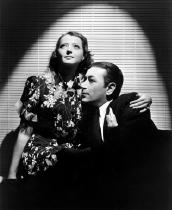
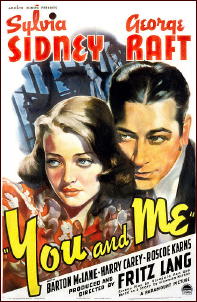
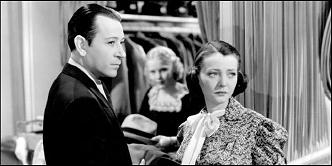
YOU AND ME. Paramount Pictures, 1938. Sylvia Sidney, George Raft, Robert Cummings, Barton MacLane, Roscoe Karns, Harry Carey. Director: Fritz Lang.

   “Genuinely odd but likable film.” That’s how Leonard Maltin described Fritz Lang’s decidedly uneven, but eminently watchable, gangster film/romantic comedy mash-up starring George Raft and Sylvia Sidney as two former jailbirds turned lovebirds. Both work in a department store run by a man who wants nothing more than to give parolees a second chance at building an upstanding life.

   Sounds typical enough, right?

   The thing is: Maltin’s correct.

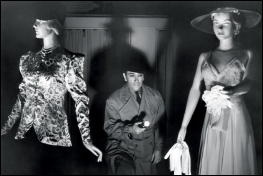
   You and Me is nothing if not “genuinely odd.” With an Old World comedic sensibility with more than a dash of Yiddishkeit, an armed standoff in the children’s section of an Art Deco department store, and some captivating dreamlike montage sequences, this relatively obscure crime melodrama didn’t fare well at the box office.

   That’s not surprising, given how much of the movie feels as if it were almost an experimental film, a cult classic before there were cult classics.

   When looked at as a whole, the final product actually seems like a thought experiment in which Lang, either consciously or subconsciously, explored the possibilities of bringing both the aesthetic and thematic elements of German expressionism into the American crime film genre.

   Skillful use of light and shadow to convey meaning (check); a prominent spiral staircase (check); a subterranean meeting of criminals operating according to their own code with camera shots that look straight out of M (check).

   Some scenes, such as when a group of gangsters remember their time in the slammer, work extraordinarily well; others, such as when Sidney’s character instructs a coterie of criminals in basic math to demonstrate why crime (literally) doesn’t pay, fall flat. Yet, it’s difficult not to find some things to genuinely admire in this quirky film, one that surely left most audiences slightly baffled when first released in the late 1930s.

REVIEWED BY WALTER ALBERT:         


SHARON FIFFER – Dead Guy’s Stuff. St. Martin’s, hardcover, 2002; paperback, 2003.

   Jane Wheel is an antiques “picker” (similar to a book scout who finds books for dealers, Jane has a gift for spotting treasures among other people’s trash, which she then sells to e dealer who’s “sponsoring” her). Jane is not only a scout for other people, she’s also a collector of Bakelite. (Even after reading the book, I was a bit unclear about this product, but wife volunteered the information that she remembered it as plastics used in the manufacture of dinnerware. She then made a quick web search courtesy of Google and found that its use dates back to at least the 1930s and includes the manufacture of appliances and jewelry, among other products.)

   This unfortunately reminded me of shows I go to where glassware predominates with books and magazine relegated to also-ran status. Still, the obsession in itself is still recognizable to any collector and who am I to look down on any knowledgeable collector, whatever the field?

   Anyhow, Jane has found a collection of tavern memorabilia, which resonates with her tavern-owning parents who are renovating their bar and grill in Kankakee, Illinois.

   To my mind, the whole subject is somewhat cluttered, and the novel is, too, with gangsters and long-buried family secrets in the mix. In addition, her marriage is shaky and and she and her husband are only maintaining a relationship for their teen-age son.

      The Jane Wheel series —

1. Killer Stuff (2001)

2. Dead Guy’s Stuff (2002)
3. The Wrong Stuff (2003)
4. Buried Stuff (2004)

5. Hollywood Stuff (2006)
6. Scary Stuff (2009)
7. Backstage Stuff (2011)

8. Lucky Stuff (2012)

SELECTED BY JONATHAN LEWIS:


REVIEWED BY BARRY GARDNER:


RANDY WAYNE WHITE – The Heat Islands. St. Martin’s, hardcover, 1992; paperback, February 1993.

   I’d been unaware of White’s books until the ladies at The Mystery Bookstore here very kindly loaned me the advance proofs of the current offering. The first in the series, Sanibel Flats, evidently didn’t make it to my local library branch, and I somehow missed seeing it reviewed.

   Ford is a marine biologist with his own small biological supply company, operated out of a stilt house on Sanibel Island, Florida, that is both home and laboratory. All told, it’s the laid-back good life.

   As we begin, the most hated man on the barrier islands is found floating face down in Dinkin‘s Bay. He was the owner/operator of the local marina, and had alienated enough people that suspects were in plentiful supply. One of Doc’s friends, a fishing guide, quickly becomes the prime suspect, but Doc doesn’t believe it, and begins his own investigation. An oddball relationship with a lady tennis pro enlivens things somewhat.

   You know, I just can’t think of a whole lot to say about this one. I enjoyed reading it, in a mild sort of way; White writes adequately enough; Old Doc is a decent enough leading man; there really wasn’t anything to gripe about, so why aren’t I more positive? I don’t know, but I’m not.

   Good enough for checking out of the library, but I’m glad I didn’t buy it.

— Reprinted from Fireman, Fireman, Save My Books #3, September 1992.


« Previous PageNext Page »