IT’S ABOUT CRIME, by Marvin Lachman


CAROLYN G. HART – Death on Demand. Bantam, paperback original, 1987. Reprinted many times.
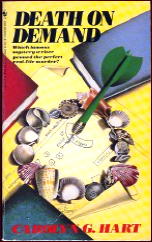
CAROLYN G. HART Death on Demand

   I tend to think of Death on Demand as a first book because it launched the Annie Laurance/Max Darling series. Actually, Carolyn Hart had published many books before it, some of which only appeared in Great Britain.

   This is truly a mystery fan’s mystery since hardly a page goes by without a reference to a mystery author or character. Sometimes the references are perfect, as when Annie, suspected of murder and vulnerable to the killer, says she is in “a Ruth Rendell world, not St. Mary Mead.”

   (Laurance is a dedicated mystery fan, as well as owner of the titular bookstore, located on a well-described island, based on Hilton Head, off the South Carolina coast. I wish she weren’t so dedicated to withholding evidence from the police, though I admit that Chief Saulter inspired no more confidence in me than he did in Annie.)

   A traditionalist, Hart provides two excellent diagrams, biographies of the suspects, and a timetable. Annie even calls all the suspects, most of whom are mystery writers, together near the end, though that session ends quite untraditionally. Things do get sorted out finally in a solution that is satisfying and moderately fair to the reader.

— Reprinted from The MYSTERY FANcier,
       Vol. 12, No. 4, Fall 1990 (slightly revised).


Editorial Comment: Carolyn Hart certainly struck gold when she started this series. There is nothing that mystery lovers like more than reading mysteries about their favorite choice of reading, mysteries. Number 22 in the series, Death Comes Silently, is on the schedule for next year, 2012. Follow the link in the first paragraph for a complete list.
A 1001 MIDNIGHTS Review
by Bill Pronzini


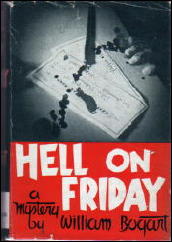
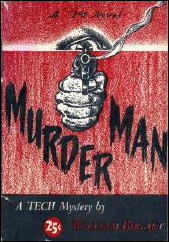
WILLIAM BOGART Hell on Friday

WILLIAM [G.] BOGART – Hell on Friday. Jonathan Swift, hardcover, 1941. Also published as Murder Man, Tech Mysteries, digest paperback, no date [1943?]

   William G. Bogart was a prolific pulp writer in the Thirties and Forties. His chief claim to fame is that he ghosted a handful of the Doc Savage novels that have become so popular in paperback reprint. At his best, he was only a fair novelist; Hell on Friday is noteworthy primarily as one of only two mystery novels with a pulp publishing background. (The other is William P. McGivern’s But Death Runs Faster, published seven years later — a much better mystery novel but lacking the range of pulp lore and true pulpy feel of the Bogart book.)

   Hell on Friday‘s protagonist, private eye Johnny Saxon, is a former “prince of the pulps” who quit writing after three years of phenomenal success because “the business had lost its kick for him [and] his stuff went stale.” His partner, Moe Martin, is “the loneliest literary agent in New York” — an emotional sponge who can lose himself in any narrative and therefore is incapable of telling the good from the bad.
WILLIAM BOGART Hell on Friday

   Saxon is hired by Joe Rogers, head of Rogers Publishing Company, a chain publisher of some twenty-two pulp magazines, to investigate the dubious business practices of a rival publisher, Sam Sontag.

   Rogers also wants him to help persuade a love-pulpeteer who writes under the name Dulcey Dickens to sign an exclusive contract with his firm. Murder, the appearance of a racketeer named Jasper Ward, the disappearance of Dulcey Dickens, and other complications carry the narrative.

   The plot isn’t particularly clever or exciting, and the solution holds no real surprises. Still, there is a certain charm to Hell on Friday (the title refers obliquely to the fact that Friday was payday for the legion of pulp writers, and often make-up day for the various magazines as well).

   Saxon and Moe Martin are engaging characters (as is Dulcey Dickens), and the pulp setting is well drawn and packed with details fascinating to anyone with an interest in that vanished era. Saxon also stars in two other novels by Bogart — Murder Is Forgetful (1944) and The Queen City Murder Case (1946).

         ———
   Reprinted with permission from 1001 Midnights, edited by Bill Pronzini & Marcia Muller and published by The Battered Silicon Dispatch Box, 2007.   Copyright © 1986, 2007 by the Pronzini-Muller Family Trust.

Bibliographic Note: All three novels are available in an omnibus edition (Hell on Friday: the Johnny Saxon Trilogy) published by Altus Press, 2010).

IT’S ABOUT CRIME, by Marvin Lachman


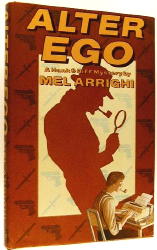
MEL ARRIGHI Alter Ego

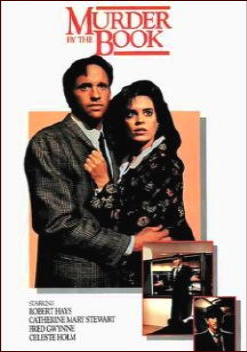
MEL ARRIGHI – Alter Ego. St. Martin’s Press, hardcover, 1983. No paperback edition. TV movie: CBS, 1987, as Murder by the Book (with Robert Hays and Catherine Mary Stewart).

   There is reason to believe that Alter Ego was the projected start of a series, curtailed by the author’s death [in 1986].

   It fits into the small subgenre of mysteries in which fictional characters come to life. Arrighi’s Hank Mercer writes about a tough private eye, Biff Deegan, but wants to replace him with a professor who solves his cases by cerebral methods.

   Mercer attempts to convince his reluctant publisher by solving a mystery that presents itself while they are dining; a woman has dropped a matchbook on their table with a scribbled message, “Help Me!”

   Aided by Biff, about whom he hallucinates, Hank gets involved in a case of art smuggling. The premise is more imaginative than its resolution, but Arrighi makes the narrative move at a brisk pace.

— Reprinted from The MYSTERY FANcier,
       Vol. 12, No. 4, Fall 1990.


MEL ARRIGHI Alter Ego

A 1001 MIDNIGHTS Review
by Kathleen L. Maio


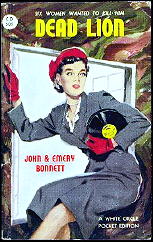
JOHN & EMERY BONETT – Dead Lion. Doubleday Crime Club, hardcover, 1949. Pocket #738, paperback, 1950. Perennial Library P563, paperback, 1982. White Circle #505, Canada, paperback, 1951 (shown). Original UK edition: M. Joseph, hardcover, 1949.

JOHN & EMERY BONETT Dead Lion

   John and Felicity Carter Coulson (who write under the names John and Emery Bonett) have collaborated in a fruitful mystery career as well as a marriage. Their official joint debut came with the publication of Dead Lion, a fine example of the post-World War II British mystery.

   Simon Crane comes to Britain to meet his famous uncle — critic, author, and BBC intellectual Cyprian Druse — for the first time. Instead, he finds Druse’s body, his head stuck out a window and his neck bloody and broken.

   It soon becomes clear that many people wished to break Druse’s neck: the many authors he destroyed with his vitriolic criticism, and the many women he seduced, humiliated, and abandoned.

   When Simon finds himself in love with one of his uncle’s embittered conquests, he no longer wishes to play sleuth. Unfortunately, Professor Mandrake does. Mandrake, an anthropologist by trade, had been a BBC colleague of Druse’s. More important, he is a natural-born busybody and student of humanity just waiting for a chance to try his hand at detecting.

   While Simon tries to shield the woman he loves, Mandrake continues to happily meddle, eventually triggering the novel’s tragic conclusion.

   Dead Lion is an exquisitely crafted classical mystery. But besides providing a satisfying puzzle, like its many Golden Age predecessors, this novel also features three-dimensional, modern characters with psychological quirks and motivations.

   With small touches, the authors also manage to convey what life was like in England after the war. Theirs is a classic puzzle with new depth and Professor Mandrake as a lovable series sleuth.

   The fat, homely professor appears in two other books — A Banner for Pegasus (1951) and No Grave for a Lady (1959). Later Bonett novels with a Spanish sleuth and Costa Brava locale are well constructed but lack the charm of the Mandrake mysteries.

         ———
   Reprinted with permission from 1001 Midnights, edited by Bill Pronzini & Marcia Muller and published by The Battered Silicon Dispatch Box, 2007.   Copyright © 1986, 2007 by the Pronzini-Muller Family Trust.

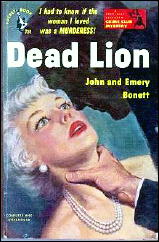
JOHN & EMERY BONETT – Dead Lion. Doubleday Crime Club, hardcover, 1949. Pocket #738, paperback, 1950. Perennial Library P563, paperback, 1982. White Circle #505, Canada, paperback, 1951. Original UK edition: M. Joseph, hardcover, 1949.

JOHN & EMERY BONETT Dead Lion

   Not only is this the first case that would-be sleuth Professor Mandrake ever worked on, it’s also the first mystery written by the Bonetts (in real life, John & Felicity Coulson). Subsequent books in which Mandrake appears are A Banner For Pegasus (1951; also known as Not In The Script) and No Grave For A Lady (1960).

   I say “would-be sleuth” in this case, because his attempts at solving the death of renowned (and widely hated) literary critic Cyprian Druse, while helpful, fall resoundingly flat instead. He may fare better in later cases — I hope so — but someone else will have to let us both know, since if I’ve read either one, I’ve forgotten.

   The problem here is that Mandrake is working strictly at cross-purposes with the narrator, Simon Crane, the dead man’s nephew, who is the first person to realize that Cyprian’s death was murder, and not an accident, as the police believe. Crane has fallen in love with Mandrake’s chief suspect, the enigmatic but wholly enchanting Marcia Garnett, and so he does his utmost to keep the other man’s attempts at solving the case as ineffective as possible.

   There is very little deduction involved. Persistence and inevitability is all that it takes to reveal the killer, even though more than half the human race would have had a motive, of sorts. What this is, far more than it is a mystery of the traditional type, is a treatise on love and romance.

   Simon Crane is at once obtuse and knowing, unlikable and irresistible, and a detective like no other on record, I’m sure. There is also a great deal of tragedy and pain involved, and in the end, while justice does work its way out, it brings its share of grief as well.

   It may not be obvious, even by now, so if it isn’t, I’m highly recommending this one.

Rating: A minus.

— This review was intended to appear in Mystery*File 35. It was first published in Deadly Pleasures, Vol. 1, No. 3, Fall 1993 (somewhat revised).


[UPDATE] 10-13-11.   Even though I recommended this one at the time, I don’t remember it at all. (This comes from deliberately trying not to tell too much about the story line back in 1993.)

   That it was reprinted in paperback a couple of times, however, especially later on by Perennial, suggests that my opinion was correct, that Dead Lion is indeed a better than average mystery novel from the 1940s.

   To confirm this, though, I went looking, and I found a second opinion in the first place I looked: 1001 Midnights, with the review coming up next.

THE ARMCHAIR REVIEWER
Allen J. Hubin


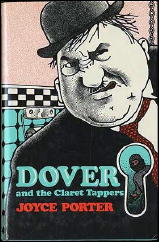
JOYCE PORTER – Dover and the Claret Tappers. Foul Play Press, US, hardcover, 1989. W. W. Norton, US, paperback, 1992. Originally published in the UK: Weidenfeld & Nicolson, hardcover, 1976 (shown).

JOYCE PORTER Dover Claret Tappers

   Foul Play Press has been reissuing Joyce Porter’s mysteries about England’s most stupid, lazy and unmannered copper, Inspector Wilfred Dover. They’ve come now to a 1976 title not previously published here, Dover and the Claret Tappers.

   I read a few of the Dover novels earlier and recall enjoying them, but Dover’s endless incompetencies, preoccupations with stuffing his face and rushing off to lavatories when not otherwise sleeping on the job, here just get tiresome.

   The caper begins when a gang calling themselves the Claret Tappers kidnaps Dover for ransom. Scotland Yard, and especially the long-suffering Sgt. MacGregor, is delighted to have him gone and refuses to pay a ha’penny.

   So Dover is dumped, unharmed, and since he’s made hardly a useful observation while held, the case eventually goes to the back burner. But not for good, because the Tappers aren’t done yet…

— Reprinted from The MYSTERY FANcier,
       Vol. 12, No. 4, Fall 1990.


Editorial Comment: If you are thinking what I think you’re thing, that that’s one ugly cover, I agree with you 100 percent. It’s no wonder that it wasn’t used in the US edition. But the latter was barely more than plain text on the front. Boring!

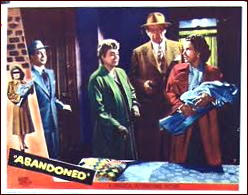
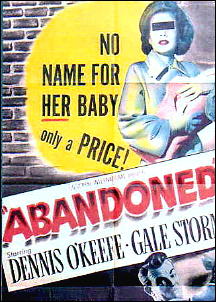
ABANDONED. Universal International Pictures, 1949. Dennis O’Keefe, Gale Storm, Marjorie Rambeau, Raymond Burr, Will Kuluva, Jeff Chandler, Meg Randall, Jeanette Nolan, Mike Mazurki. Director: Joseph M. Newman.

ABANDONED Gale Storm

   Dennis O’Keefe makes for a good newpaper reporter in Abandoned, and Raymond Burr makes an even better private eye, one definitely on the shady side. Before he became Perry Mason and famous, as we’ve said before on this blog, he was best known for his villainous roles in cheap crime dramas, albeit often weak and shifty ones. His part in this movie, in other words, was tailor made for him.

   So what this is, as you may have guessed, is a cheap crime drama, but is it noir, as it’s often advertised as being? Not with Gale Storm in the leading role, even though the movie’s in black and white, with lots of noirish lighting and noirish dialogue.

   As the sister who died trying to regain her baby from a gang specializing in illegal baby adoptions, calling on Dennis O’Keefe for help, she’s too giggly and perky for the part (think My Little Margie). The ending, after a lot of gunfire and fatal automobile accidents, is also too upbeat for Abandoned to really fall into the noir category.

ABANDONED Gale Storm

   But it comes close, indeed it does. And if the entire script had been part of the movie, if as I have a feeling it wasn’t, it would have been a whole lot closer.

   Unanswered by the movie I saw is the question of the two girls’ father, who hired Raymond Burr (the shady PI) in the first place, and the connection with the baby racketeers, whom Burr works for as well.

   And I’m sure I remember a scene in which Gale Storm’s character tells O’Keefe (the reporter) that the reason her sister left home and headed for LA, was because their father wouldn’t leave either one of them alone.

   Neither of these two threads of the story line is followed up on, but at the time this movie was made, all they could probably do is leave hints.

ABANDONED Gale Storm

REVIEWED BY WALTER ALBERT:         


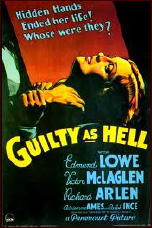
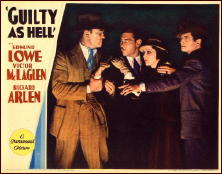
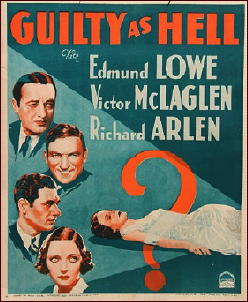
GUILTY AS HELL 1932

GUILTY AS HELL. Paramount, 1932. Edmund Lowe, Victor McLaglen, Richard Arlen, Adrienne Ames, Henry Stephenson, Elizabeth Patterson. Screenplay by Arthur Kober and Frank Partos, based on the play Riddle Me This by Daniel N. Rubin; photography by Karl Struss. Director: Erie C. Kenton. Shown at Cinevent 40, Columbus OH, May 2008.

   Perennial battling comrades in What Price Glory and its several sequels, Lowe and McLaglen are once again costarred, with Lowe as as a McLaglen-baiting, brash reporter, undercutting police Lt. McLaglen’s murder investigation in an attempt to prove that Richard Arlen did not kill his mistress, wife of a prominent physician played by the cultivated, unflappable Henry Stephenson.

GUILTY AS HELL 1932

   Richard Arlen is the convicted murderer and Adrienne Ames his sister who believes in his innocence. We see the murder and the framing set-up at the beginning of the film, so there’s no mystery for the audience to solve. Just the pleasure of watching an intricate cat-and-mouse game, with the murderer one step ahead of his pursuers until the final, tense confrontation.

   A fine little crime drama, with the two stars lighting up the screen, with strong contributions by the supporting players, with the possible exception of Richard Arlen, whose lethargic performance Jim Goodrich attributed to miscasting.

GUILTY AS HELL 1932

This blog passed a plateau yesterday that had never been reached before, not even close. Tuesday was the first day that over 1000 visitors checked in, 1005 in all. The previous high was somewhere just over 800, so you can see what an achievement this was.

A good chunk of the traffic came to read Michael Shonk’s recent article about the 1959-60 season of the Philip Marlowe TV show, but congratulations and thanks go to all of the contributors to this blog. It couldn’t have been done without you!

The 1980 Mystery*File AUTHORS’ RATING POLL, A to B.


   I am reprinting this from Fatal Kiss #13 (May 1980), the same issue in which I reported the results of the first annual Top Ten Tec Poll.

   The poll consisted of my listing ten authors whose last names began with either the letter A or B, then requesting respondees to rate them on a scale from 1 to 10. If you were not familiar with an author, then one of three categories were to have applied:

       A = I never intend to read this author
       B = I’d like to read this author but I haven’t yet
       C = I’ve never heard of this author [or no vote]

   There were 42 responses, including my own, from mystery readers scattered all over the world. Here are the results:

Author // Numerical Responses // Average // A — B — C

    Eric Ambler     35     6.83     2 — 3 — 2

    Nicholas Blake     26     6.65     3 — 7 — 6

    Margery Allingham     32     6.00     2 — 6 — 2

    Lawrence Block     23     5.89     1 — 11 — 7

    Earl Derr Biggers     30     5.67     6 — 3 — 3

    Charlotte Armstrong     28     5.29     5 — 6 — 3

    Edgar Box     22     5.28     4 — 11 — 5

    George Bagby     24     4.44     6 — 9 — 3

    Edward S. Aarons     23     4.23     11 — 5 — 3

    Carter Brown     24     3.79     10 — 5 — 3

   One small surprise was the healthy showing of Lawrence Block, obviously not familiar to many people in 1980, but those who’d read him liked what they’d seen. [In 1980, Block had written a sizable list of paperback originals, the first three Matt Scudder books, and the first two “Burglar” novels.]

   As I said at the time, I expected Ambler and Blake to do well, and they did. Aarons and Carter Brown did not do well with female voters, while Allingham and Charlotte Armstrong did not do as well with most male readers. And yes, I knew that Edgar Box was really Gore Vidal.

   Since response was so high, I thought at the time that it was worth doing again. I’ll list the authors I suggested for the next poll, all of whose last names began with “C.” I don’t know if I have the issue in which the results were tabulated, or even if they ever were. I’ll have to do some searching in the garage where most of my back issues are stored.

   If you’d care to record your opinions on the following authors, either in the Comments or by emailing me directly, feel free to do so:

Victor Canning, John Dickson Carr, M. E. Chaber, Raymond Chandler, Leslie Charteris, G. K. Chesterton, Agatha Christie, Manning Coles, James Hadley Chase, Tucker Coe, George Harmon Coxe, Frances Crane, John Creasey, Edmund Crispin, Freeman Wills Croft, Ursula Curtiss.

« Previous PageNext Page »