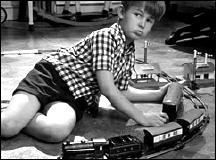
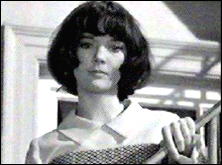
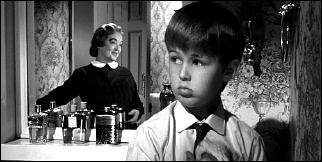
EAST SIDE WEST SIDE Stanwyck

EAST SIDE, WEST SIDE.   MGM, 1949. Barbara Stanwyck, James Mason, Van Heflin, Ava Gardner, Cyd Charisse, Nancy Davis, Gale Sondergaard, William Conrad, Douglas Kennedy, Beverly Michaels, William Frawley. Screenplay: Isobel Lennart, based on the novel by Marcia Davenport. Director: Mervyn LeRoy.

   The book this movie is based on is not included in Al Hubin’s Crime Fiction IV, nor without having a copy in my hands, but relying on what I have read about it on the Internet, do I believe it should be. It’s described by one source as a novel about the “post-war social strata in New York [City]” and that those who love the social history of the city should enjoy it immensely.

   Hence the title, of course, and never the twain shall meet — except of course for the fact that they do, and when they do, the results can be both devastating and disastrous to everyone involved. And buried in the otherwise soapy melodrama that constitutes the bulk of the movie based on the book, right around the three-quarters mark, is 15 minutes of crime drama that made me sit up and take notice.

   Truth in reviewing: I’d avoided reading about the movie and the storyline beforehand, but when I saw William Conrad’s name in the credits, that gave me some advance notice, and of course Barbara Stanwyck is no stranger to noir-oriented movies, is she?

EAST SIDE WEST SIDE Stanwyck

   Consider, then, the following set of interlocking triangles. I’ll omit the characters’ names, and refer to them only by the actors. Stanwyck is married to vain and self-centered Mason, who is infatuated with the beautiful Gardner, who knows it and who hangs out with nightclub owner Kennedy, whose other girl friend is brassy blonde Michaels.

   Returning from Europe as a WWII correspondent is Heflin, a non-society guy who falls in love with Stanwyck; he in return is the object of a schoolgirl crush, that of Charisse, who is a fashion model whom Stanwyck knows from the shows she attends, and who (Charisse) saves Mason from an embarrassing newspaper scandal by rescuing him after he’s punched out by Douglas (remember him?)

EAST SIDE WEST SIDE Stanwyck

   Eventually a murder occurs, and this is where Conrad comes in — a homicide detective. Frawley is a bartender in Douglas’s night club, just to make sure I’ve mentioned everybody. Well, almost: Davis is one of Stanwyck’s society friends and a close confidant, and Sondergaard is her mother, whom Mason thinks he has utterly charmed.

   There is one scene in this movie that I will not forget, one in which Barbara Michael (described as being built like the Empire State Building) and Van Heflin have a brief but ferocious bare-knuckle fist fight. (In high heels she is indeed taller than he is.) They are hampered by being in the front seat of a car together, but it is one of the fiercest out-and-out slugfests between a man and a woman that I can remember ever seeing on the screen.

EAST SIDE WEST SIDE Stanwyck

   While her performance is largely understated, Stanwyck is as perfect in her role as she always is. Mason is never so eloquent as he is when his makes his final plea for her love. As for Ava Gardner, is she or is she not the most beautiful woman ever to appear on the Hollywood screen? No wonder James Mason is infatuated with her, like a moth to the flame.

A Movie Review by MIKE TOONEY:


FORBIDDEN PLANET

FORBIDDEN PLANET. Metro-Goldwyn-Mayer, 1956. Walter Pidgeon, Anne Francis, Leslie Nielsen, Warren Stevens, Jack Kelly, Richard Anderson, Earl Holliman, George Wallace, James Drury, Robby the Robot. Screenplay: Cyril Hume. Story (credited): Irving Block and Allen Adler; (uncredited): Bill Shakespeare and Arthur Conan Doyle. Director: Fred McLeod Wilcox.

    As the deep space cruiser C-57D approaches the planet Altair 4, the captain, J. J. Adams (Leslie Nielsen), receives a radio message from Dr. Edward Morbius (Walter Pidgeon) not to land; but Morbius offers no explanation valid enough for Adams to leave, so he sets his ship down.

    The main reason the C-57D has come to Altair 4 is to determine the fate of another spaceship, the Bellerophon. Morbius’ account of what happened to the Bellerophon — that it was destroyed by some unknown force while attempting an ill-advised takeoff, killing everyone except Morbius, his wife (who later died), and his daughter — just doesn’t ring true to Adams’ skeptical ears, and he decides to investigate further.

FORBIDDEN PLANET

    It isn’t long before this “unknown force” is roaming abroad once more. It leaves deep footprints in the sand, warps thick metal steps, and makes salsa of the ship’s communications officer. Eventually it reveals itself in a frontal assault on the C-57D, “as big as a house” and able to absorb billions of volts of plasma energy from the ship’s heavy weapons.

    However, as Commander Adams won’t learn until it’s almost too late, the murderous thing he has just fought against isn’t really the one who destroyed the Bellerophon. No, the killer he’s seeking is all too human ….

FORBIDDEN PLANET

    So much has already been written about Forbidden Planet that I won’t waste any time on the great visual effects (including Anne Francis), the mind-boggling concepts (such as the Krell and their Great Machine), the unique musical score, or the leaden direction.

   Instead, let’s very briefly explore the notion that Forbidden Planet is a detective film, much like Them! (reviewed earlier here ), with Sherlockian overtones.

    Not only are the wonders of the Krell civilization revealed to Adams, the ship’s doctor (Warren Stevens), and his exec (Jack Kelly), but these marvels have the practical effect of being diversions that take their attention away from the true killer.

    Like Sherlock Holmes, however, Adams never loses sight of his mission: to determine what happened to the previous expedition, despite all the razzle dazzle. Much like that legendary Hound haunting the moors of western England, there is a serial killer loose on Altair 4, and Adams aims to catch him.

FORBIDDEN PLANET

    At every opportunity, Adams returns to the Bellerophon’s fate. Each time the monster goes on the prowl, it confirms his convictions that, despite every obvious indication, people have died due to a human agency, one that is beset by human foibles like fear and jealousy and pride — and since there are only two humans presently living on Altair 4, Adams must choose between someone he admires and someone he loves.

    So what we have here — Robby the seemingly harmless robot, an analogue of a certain family retainer; a rampaging monster not dissimilar to the Hound of the Baskervilles; and a monomaniacal scientist ostensibly absorbed with his studies, the Krell this time instead of butterflies on Grimpen Mire — are all familiar elements of detective fiction that in the past usefully served a certain Scottish mystery author as both plot developments and red herrings.

    Therefore, in conclusion it’s possible to view Forbidden Planet as more than a sci-fi movie. It just might be the most intellectually stimulating detective film of all time.

    Or maybe not. You decide.

FORBIDDEN PLANET


Note: Forbidden Planet is scheduled for broadcast on TCM Friday, February 19th.

REVIEWED BY WALTER ALBERT:         


DOUGLAS PRESTON & LINCOLN CHILD – The Book of the Dead.   Vision, paperback reprint; first printing, July 2007. Originally published in hardcover by Grand Central Publishing, May 2006.

PRESTON & CHILD

   After I was irretrievably enmeshed in the web of terror skillfully spun by the authors, the friend who had recommended the novel rather off-handedly commented that I probably should have started with the first of the novels in the trilogy, rather than the last. I grumbled a bit at this piece of delayed information but came to the conclusion that I was already enjoying the book so much that I didn’t want to put it aside unfinished.

   In any event, the trilogy traces the battle between the two Pendergast brothers, both of them brilliant, one of them a psychopath who will stop at nothing to achieve his aims. The setting of the final confrontation is a favorite of Preston and Child, the New York Museum of Natural History, and details the events leading up to the restoration of a long-sealed Egyptian tomb, culminating in a reception attended by New York’s social and political elite.

   A series of horrific murders precede the opening, but they will pale in comparison with the carnage that will result if the plans of the psychopathic Pendergast brother succeed. The plans have been years in the making and the brother who might thwart them is incarcerated in a maximum security prison from which no one has ever escaped.

   The authors’ novels tend to be outsize in their concept (and certainly in their length — this book is well over 600 pages), but the gothic imagination that fuels the plots will, if you’re willing to suspend some of your innate disbelief, override all your inhibitions. The novels are the stuff of nightmares, so beware, all you who enter their portals.

The Diogenes Trilogy (Pendergast Novels 5-7)

    Brimstone (2004).

PRESTON & CHILD

    Dance of Death (2005).
    The Book of the Dead (2006).

Editorial Comment:   Previously reviewed by Walter on this blog: The Cabinet of Curiosities, 2002, Pendergast #3.

Reviewed by RICHARD MOORE:         


WALTER SATTERTHWAIT – A Flower in the Desert. St.Martin’s Press, hardcover; First Edition, 1992. Paperback reprint: Worldwide, November 1993. Trade paperback: University of New Mexico Press, January 2003.

WALTER SATTERTHWAIT

   I’ve always enjoyed Satterthwait’s short fiction but never tried his novels. Bill Crider introduced me to him at some Bouchercon and I picked up this paperback. When a recent trip to Santa Fe came up, I searched for this novel as it is part of Walter’s series featuring Santa Fe private eye Joshua Croft.

   Why did I wait so long? Croft hits all my favorite PI hot points. He’s smart and a good investigator but not infallible. He’s a good guy but he’s got a few hangups. Tough but believable.

   He’s loyal to his girl friend, who in this book is recovering from a gunshot suffered in an earlier book. No girl Friday, she is a brilliant investigator able to dig up facts on the Internet. Of course, it wasn’t called that then as Al Gore had yet to invent it. In the book, it is called searching the “data base.”

   In this book, Croft is searching for the estranged ex-wife and daughter of a Hollywood action star. The woman had accused the actor of child molestation but a judge had found him not guilty. Shortly thereafter, she and their daughter disappeared. The actor, a big Latino star, comes to Croft but he refuses to take the case.

   He finally agrees to work for his uncle, an important underworld figure in Santa Fe, who is willing to support her and the child even if she refuses to come out of hiding.

   Did she go into hiding to protect her daughter or does her disappearance have something to do with her volunteer work for a group helping illegal immigrants? This is a very satisfying novel and a great hero, and I’ve immediately picked up two more in the series.

      The Joshua Croft series —

    Wall of Glass. St. Martin’s, 1987.

WALTER SATTERTHWAIT

    At Ease With the Dead. St. Martin’s, 1990.
    A Flower in the Desert. St. Martin’s, 1992.
    The Hanged Man. St. Martin’s, 1993.
    Accustomed to the Dark. 1996.

WALTER SATTERTHWAIT

NOTE:   Croft also makes an appearance in Lair of the Lizard (St. Martin’s, 1998) a Tony Lowell novel by E. C. Ayres.

THE BACKWARD REVIEWER
William F. Deeck


JOHN ROEBURT – Corpse on the Town. Graphic #27, paperback original, 1950. Revised edition: The Case of the Hypnotized Virgin. Avon #730, pb, 1956. Reprinted: Belmont/Tower,1972.

JOHN ROEBURT Jigger Moran

   About to check in to his terminal in New York City, cab driver J. Howard Moran, better known as Jigger, agrees to take a trunk to the Railway Express Office. An unknown someone meanwhile has informed the police that the trunk in Jigger’s cab contains a corpse. Which it does, the body of a young woman whose face is battered beyond recognition.

   Apparently Jigger. a disbarred attorney in Illinois and a private eye without a license, has investigated other crimes before, though this is his first recorded case. He and his reluctant assistant, Red, “free-lance journalist and improvident writer of plays, features, fiction, columns,” try to determine the woman’s identity and find her killer.

   As the police follow Jigger closely with the thought that if they can’t convict him maybe he will be able to pin it on someone else, Jigger manages to come up with the answer.

JOHN ROEBURT Jigger Moran

   For his novel Tough Cop, Roeburt won an Edgar, or so the publisher of this novel claims. I have not been able to identify either the category or the year. This one is no prize winner, but it has its amusing moments.

– From The MYSTERY FANcier, Vol. 13, No. 3, Summer 1992.


Bibliographic Data:   It is perhaps no surprise that Bill was unable to discover the category for which John Roeburt won an Edgar, as the publisher’s claim is not true, as he surmised might have been the case.

   It may be as obscure as an MWA award can get, and was apparently not for Tough Cop at all. It came in 1949, and it was for Best Radio Drama, the actual title of which I have not discovered, even with the resources available to me on the Internet. It was, however, for one of the episodes of the Inner Sanctum series. (I do not believe that it was for the entire series, but perhaps I am wrong about that.)

    Bill erred in saying that Corpse on the Town was Jigger Moran’s first recorded case. Not true; it was his third and last. The first two were published in hardcover; only Corpse was a paperback original:

       The Jigger Moran series —     [Taken from the Revised Crime Fiction IV, by Allen J. Hubin.]

    Jigger Moran (n.) Greenberg, hc, 1944.
    There Are Dead Men in Manhattan (n.) Mystery House, hc, 1946.

JOHN ROEBURT Jigger Moran

    Corpse on the Town (n.) Graphic, pbo, 1950.

A REVIEW BY MARYELL CLEARY:
   

ANTHONY OLIVER – Property of a Lady. Doubleday Crime Club, US, hardcover, 1983. Paperback reprint: Fawcett Crest, 1985. UK edition: William Heinemann, hc, 1983.

ANTHONY OLIVER

   Oliver’s first mystery, The Pew Group (reviewed here ) was hilarious. His second is funny, but the hilarity is muted. Admittedly nosy Lizzie Thomas, 58 and Welsh, housekeeper to retired Chief Inspector John Webber, cannot help being funny, and when she’s around there are plenty of chuckles. But there is a serious situation, and even Lizzie has to take it so.

   Margaret Garland, a young single woman of property, has picked up a hitchhiker on the road. He’s young and attractive, on his way to visit his mother who’s staying at Henworth Hall, a m�nage for ladies who want to lose weight. She, however, wants nothing to do with him.

   But Margaret falls in love. Further, the young man is an antique expert and wants to set up a shop. After Lizzie has seen one disturbing episode through her binoculars, she enlists Webber and her son-in-law, antique dealer Jimmy “Betsy” Trotwood, in helping her find out more about Mark Carter and his antecedents.

   What they find is more disturbing still. Unfortunately, there’s nothing much they can do with their information, and the situation has to work itself out with a gigantic explosion at the end.

� Reprinted from The Poisoned Pen, Vol. 6, No. 4, Fall 1986

YUMA. Made for TV movie: ABC, 02 March 1971. Clint Walker, Barry Sullivan, Kathryn Hays, Edgar Buchanan, Morgan Woodward, Peter Mark Richman, Bruce Glover, Miguel Alejandro. Producer: Aaron Spelling. Director: Ted Post.

YUMA Clint Walker

   The ending of this movie, to begin wrong end to, shows Marshal Dave Harmon (Clint Walker), widowed hotel owner Julie Williams (Kathryn Hays), and Andreas, the young Mexican boy befriended by the marshal (Miguel Alejandro), all frolicking together down at the local swimming hole.

   This incongruous bit of byplay illustrates more than anything else in this well done made-for-TV movie that it was also the pilot for a series that was never picked up. No movie meant for theaters would end in such a fashion!

   The beginning is much, much better, showing as it does Marshal Harmon’s first entrance into to the frontier town of Yuma, Arizona, as he makes his way on horseback through a crowded maze of cowpokes on horses, full-team wagons, one horse buggies, women in bonnets and petticoats and arms full of purchases – the busiest western street I can remember seeing in a long long time.

   Only to be met by a stagecoach emptied of its passengers, and driven and overturned by two drunken cowboys. Confronted by the town’s new marshal, one of the two brother shoots and dies, the other is brought to the town’s run-down jail, unused since the previous officer of the law was sent skedaddling.

YUMA Clint Walker

   Turns out (you knew?) that a third brother is the owner of a huge herd of cattle being brought to town. It also turns out that he is not likely to take too kindly to his one brother’s death.

   Things get worse, however. The second brother is secretly released during the night while the marshal is asleep, then shot in the back as he tries to make his escape.

   There is much more, which I won’t go into, but the action is very nearly non-stop, and it’s also a pretty good mystery to boot. Clint Walker’s character is as tall as the man playing him, and he has some back story that would have been gone into, if there had been more to the series than this busted pilot.

   Kathryn Hays, later a longtime star of As the World Turns (for nearly 40 years), has little to do but look pretty, but once she realizes that the new marshal is the real thing, taciturn but tough and not a man to back down, ever, she is also as supportive as she can be.

   Let me tell you how much I enjoyed watching this. The print on the DVD I have is just enough out of focus that I would have turned it off within the first two minutes if I hadn’t been caught up in the story as much as I was.

TIM CHAMPLIN – The Tombstone Conspiracy.

Five Star, hardcover; First Edition, Sept 1999. Leisure, paperback; August 2002.

TIM CHAMLIN

   Imagine, if you would, a western novel taking place in Tombstone, Arizona, in which the Earp brothers, Doc Holliday, and the Clantons are all characters — and the O. K. Corral is never mentioned.

   Picture instead a tale straight from The Wild, Wild West TV show. A gang of thieves is running rampant over the territory, responsible for a series of stage robberies netting them a small fortune in silver and gold, not to mention the ambush of an army wagon train carrying a huge load of rifles and ammunition.

   Two men, one an army agent, the other working for Wells Fargo, team up undercover to solve the mystery. What is the significance of the small wooden disks with the unusual emblem all of the captured outlaws carry? Is the more-than-attractive woman who comes between the two lawmen up to no good? And who is the never-seen leader of the bandits?

   This would also have been the basis for a several months’ worth of great Saturday trips to the movies, serial fashion, complete with a cliffhanger ending every week. A nice brew of traditional western fare, that is to say, juiced up a notch or two.

— Reprinted from Durn Tootin’ #3, October 2003.

REVIEWED BY DAN STUMPF:         


LUKE SHORT Ramrod

RAMROD. United Artists, 1947. Joel McCrea, Veronica Lake, Don DeFore, Donald Crisp, Preston Foster, Arleen Whelan. Charles Ruggles, Lloyd Bridges. Screenplay: Jack Moffitt, Graham Baker & Cecile Kramer, based on the novel by Luke Short. Director: Andre de Toth.

LUKE SHORT – Ramrod. Macmillan, hardcover, 1943. Paperback reprints include: Popular Library 114, 1946; Popular Library 792, 1953; Bantam, 1977; Dell, 1992.

   Ramrod (UA, 1947) was the second noir Western, following RKO’s Pursued into release by two months, and it’s an all-around faster-moving thing, filled with shoot-outs, bar-fights, stampedes and chases, yet still dark and moody enough to rank solidly in the noir class.

   In conjunction with watching this, I took a look at the 1943 novel on which it’s based. Luke Short (real name Frederick Glidden) deals out his tale with a punchy prose style and generally fast pace, though he sometimes gets bogged down in details he ought to just ride around.

LUKE SHORT Ramrod

   What pulls the book out of the ordinary though, is his feel for character and how it shapes the plot. Ramrod starts up with a face-off between two ranchers motivated/manipulated by a woman who wants to get out of the fate her father has planned for her.

   When the face-off falls through, she falls back on the help of a disgraced cowboy trying to redeem himself — the eponymous Ramrod of the outfit — leading to Range War and the shoot-outs, bar-fights, stampedes, chases, et al.

   Three writers adapted this into a movie that stays remarkably close to the book, even down to details and dialogue, but it took a director like Andre de Toth to turn it into something really special. De Toth shows a feel for character equal to Short’s, but he evokes it visually; as the cowboy seeking redemption, Joel McCrea seems to be always climbing something (stairs, hillsides, porches…) as the perfect visual metaphor for his quest.

   Veronica Lake’ s cowgirl-fatale is photographed in sharp-focus, emphasizing her hard-edged drive, while the lesser characters — Preston Foster’s ruthless rancher, Charlie Ruggles’ well-meaning father and especially Don DeFore as McCrae’ s shifty partner — all come across surprisingly real. De Toth also has a flair for brutality suited to noir and a feel for pace perfect for the Western, a combination you just can’t beat.

LUKE SHORT Ramrod

A MOVIE REVIEW BY DAVID L. VINEYARD:         


YANKEE PASHA. Universal International, 1954) Jeff Chandler, Rhonda Fleming, Mamie Van Doren, Lee J. Cobb, Bart Roberts (Rex Reason), Hal March, Tudor Owen, Benny Rubin, Harry Lauter. Based on the novel by Edison Marshall. Directed by Joseph Pevney.

YANKEE PASHA

   Arabian Nights nonsense of a fairly high order based on Edison Marshall’s bestselling swashbuckling historical novel of the Barbary Coast and the adventures of an American frontiersman there.

   Jeff Chandler, everybody’s favorite Jewish Apache, stars as Jason Starbuck, a frontiersman and trapper who wants to see the world and gets the chance when he falls for beautiful city girl Rhonda Fleming who is kidnapped by Barbary Pirates and sold into slavery as the property of the cruel head of the Sultan of Morocco’s Janissaries, Aga Omar (Bart Roberts).

   Starbuck infiltrates the Sultan’s (Lee J. Cobb) army teaching his infantry frontier style shooting and quickly runs afoul of the cruel Aga who the Sultan fears and distrusts. He wins Fleming in a bet but is captured trying to escape with her, only to be rescued by Hassan (Hal March), the leader of the Sultan’s infantry who befriended him.

   Chandler is stalwart, Fleming striking (and in at least one of the most revealing outfits of her long film career — body stocking or no), and Mamie Van Doren (below) supplies the comic relief as the slave girl presented to Starbuck and complicating his life and the plot.

YANKEE PASHA

   That said, this is the kind of movie where a gaggle of Miss Universe contestants appear as slave girls offered by a drooling slave dealer.

   All in all, a pale shadow of Marshall’s full blooded novel, but good fun and diverting with Chandler buckling a swash and Roberts meeting his well deserved end on the razor sharp hooks meant for those who violate the harem.

   Cobb seems to have a little fun as the Sultan and you may even manage to forget March as the glad-handing playboy and huckster from television if you are old enough to remember him in the first place.

   Marshall was better served by films like Son of Fury, Treasure of the Condor (both based on Benjamin Blake), and The Vikings, but Pevney is an old hand and skillful if yeoman direction gorgeous color, and bright costumes on beautiful women all add to the fun.

   Yankee Pasha is an entertaining entry in a once familiar genre from an era when names like Baghdad, Morocco, and Arabia only brought thoughts of exotic adventure and wild vistas, and the only Marines involved were storming the shores of Tripoli to protect American ships from paying tribute to pirate kings — come to think of it, not all that different from today after all, only the spirit of fun and romance has been replaced with politics, oil, and all too real terrors and atrocities.

Editorial Comment:   Yankee Pasha does not appear to be available on commerical DVD, but there are many collector-to-collector copies to be found on eBay, ioffer.com and the other usual sources. It was shown on AMC at some time in the past; a short clip of a terrific tussle between Mamie Van Doren and Rhonda Fleming can be found here on YouTube.

YANKEE PASHA

« Previous PageNext Page »