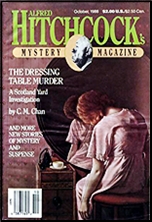
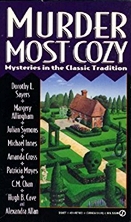
C. M. CHAN “The Dressing Table Murder.” Novelette. Jack Gibbons & Phillip Bethancourt #1. First published in Alfred Hitchcock’s Mystery Magazine, July 1994. Reprinted in Murder Most Cozy: Mysteries in the Classic Tradition, edited by Cynthia Manson (Signet, paperback, January 1993. Also available individually on Amazon Kindle. June 2016.
   Jack Gibbons is a Detective Sergeant based in Scotland Yard, while his close friend Phillip Bethancourt is the brilliant idle rich amateur who is allowed to follow along on his difficult cases as someone to bounce theories off of. Well, it’s actually more than that. It’s Bethancourt who is the more likely to come up with the theories and insight that Gibbons finds he does not always have on his own.  The former is more likely to let the latter do all of the footwork.

   In “The Dressing Table Murder,” their first recorded case together, a woman has been found dead in front of her bedroom mirror, killed by an instantaneously acting poison while putting her makeup on for the day . The reason I’ve called this a locked room mystery is that there is no food or drink in the room with her that contains any poison. The only other person in the house is the maid, who was in sight of the front door at all times, and the back door of the house is locked.
   The two detectives do not spend a lot of time working on this aspect of the case, however. Most of their investigation is spent on confirming alibis of the various members of her immediate family – it seems unlikely she would allow anyone else to get close to her at her dressing table – and their finances, or the lack of them. Only after exhausting all of the possible lead sin this direction do they get back to the “how” of the matter, which is neatly done — but largely by a modest amount of misdirection by the author.

   The two detectives do make for a most congenial pair, and their first case together is smoothly told. This was the first of twelve short works they shared detective duties on, all appearing in AHMM up through the May 2002 issue. A few years later they started to appear together again in paperback novels, four in all, beginning with The Young Widow in 2005, all under the author’s full name, Cassandra Chan.
REVIEWED BY DAN STUMPF:


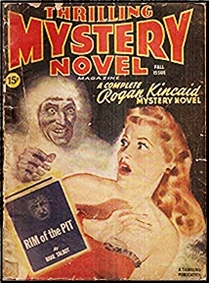
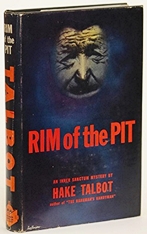
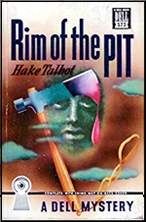
HAKE TALBOT – Rim of the Pit. Rogan Kincaid #2. Simon & Schuster, hardcover, 1944. Dell #17, paperback, 1947. Bantam, paperback, 1965. IPL, paperback, November 1985. Ramble House, softcover, 2009. Reprinted in (probably) abridged form in Thrilling Mystery Novel, November 1945.

   Hake Talbot’s Rim of the Pit has something of a reputation among Golden Age mysteries, and I’m still trying to figure out why. I read it back in High School because it looked spooky, but even then I found it forgettable. So much so that I forgot it was forgettable and re-read it last week.

   It’s one of those things where a rather mundane murderer tries to dress up his quotidian crimes to make it look the work of some occult agent – in this case a northwoods goblin called the Windigo. Talbot trots out a seance, a vengeful ghost, voices in the night and a swooping soul-snatching demon, all to surprisingly little effect.

   This sort of thing needs the creepy touch of someone like A. Merritt to evoke the authentic shudder, but all Talbot got from me was a sigh of impatience as characters kept running from room to room, then sitting down for entangled explanations of what they just saw.

   And I mean, you need a native to get through some of those passes. By the time we got to the final, no-kidding-this-is-the-real-solution scene. I really didn’t care whodunit, and the only thing I’ll probably remember from all this is the author’s oft-spoken fetish for pink silk panties.

— Reprinted from The Hound of Dr. Johnson 53, September 2007.


A 1001 MIDNIGHTS Review
by Edward D. Hoch


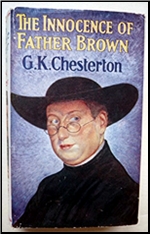
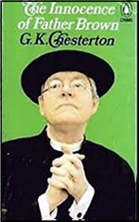
G. K. CHESTERTON. The Innocence of Father Brown. Cassell, UK, hardcover, 1911. Lane, US, hardcover, 1911. Many reprint editions exist.

   A cornerstone volume, Chesterton’s Innocence of Father Brown can lay claim to greatness on two counts: It introduced the priest detective whose adventures are still popular three-quarters of a century later, and it contains more classic short stories than almost any other mystery collection before or since.

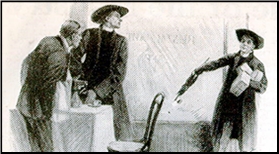
   All twelve of its stories deserve special mention. The opening story, “The Blue Cross,” long an anthology and textbook favorite, tells of the first meeting of Father Brown and the master thief Flambeau, who would later become his friend and associate on many cases. “The Secret Garden” has a dual impossibility – the appearance of a beheaded corpse inside a locked and guarded garden, and the disappearance of another man from the same garden. “The Queer Feet” turns upon a brilliant bit of psychology and is a favorite of several critics.

   “The Flying Star” involves a diamond theft at a Christmas party, and is Flambcau’s last crime. “The Invisible Man” is probably the most famous Father Brown story of all — so famous, in fact, that its solution is known to people who have never read it. Whether Smythe really could have been murdered in his guarded apartment building without anyone seeing the killer is a matter of some dispute, but the story is memorable nonetheless.

   “The Honour of Israel Gow” presents Father Brown with a number of bizarre objects, seemingly unrelated, The solution, simple yet startling, reveals a strange sort of honesty rather than a crime. In “The Wrong Shape” a man is stabbed to death with a curved dagger in a locked room. leaving an oddly shaped suicide note. “The Sins of Prince Saradine” is about a murder plot and a duel with rapiers. “The Hammer of God,” one of the three or four best Father Brown stories, combines a seemingly superhuman murder beside a great Gothic church with a solution that is simple and sa1isfying.

   “The Eye of Apollo” deals with a cult of sun worshipers and a unique murder method. “The Sign of the Broken Sword,” perhaps the cleverest and most enjoyable story in the volume, full of paradox and allowing Father Brown to practice some pseudo-historical detection, offers Chesterton’s dazzling answer to the question “Where would a wise man hide a body?” The final story, “The Three Tools of Death,” is about an apparently brutal murder.

   All twelve. offer a nice feeling of life in Edwardian England, and if Father Brown lacks the colorful eccentricities of Sherlock Holmes, if his solutions are often more intuition than deduction, this book is still a masterpiece, the single volume by which G .K. Chesterton is most likely to be remembered.

   ———
Reprinted with permission from 1001 Midnights, edited by Bill Pronzini & Marcia Muller and published by The Battered Silicon Dispatch Box, 2007.   Copyright © 1986, 2007 by the Pronzini-Muller Family Trust.


NOTE: Ed Hoch’s review of The Incredulity of Father Brown was posted here earlier this month.

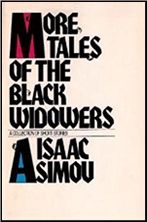
ISAAC ASIMOV “All in the Way You Read It.” Black Widowers #13. Short story. First published in Ellery Queen’s Mystery Magazine, September 1974. Collected in More Tales of the Black Widowers (Doubleday, hardcover, 1976) and in The Best Mysteries of Isaac Asimov (Doubleday, hardcover, 1986) as “The Three Numbers.”

   The Black Widowers were a dinner club of six members based in Manhattan who met once a month for a meal and discussion, invariably centered about the solution to a puzzle presented to them by a guest brought by one of the members. The pre-dinner discussion in “All in the Way You Read It” is about the strangeness of the English language; the problem to be tackled always comes after dinner.

   To illustrate the former first, consider the word “unionized.” A labor leader might reasonably read this as “union-ized,” while a physicist might see it as “un-ionized.” And just for fun, here’s another: what common word in the English language changes its pronunciation when its first letter is changed to a capital letter?

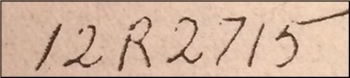
   The answer comes into play when after the evening meal, that night’s guest brings up the question he has brought. He is trying to open a safe for which he has copied the combination on a piece of paper. He has written it by hand, and it looks like this:


   I’m not sure if this one’s easy, or it’s a stumper, but with all of the misdirection provided, I didn’t get it. Either way, one of the amusements of these stories, and Asimov wrote quite a few of them, is that it is invariably Henry, the waiter that serves them, who comes up with the solution. Which he does in this one, too. Nothing noir or hard-boiled about this one!

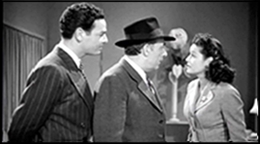
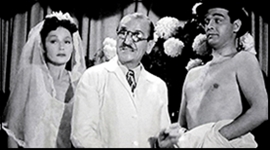
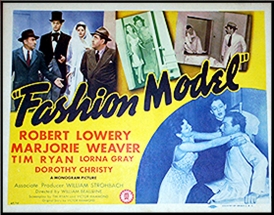
FASHION MODEL. Monogram Pictures, 1945. Robert Lowery, Marjorie Weaver, Tim Ryan, Lorna Gray, Dorothy Christy, Dewey Robinson, Sally Yarnell, Jack Norton, Harry Depp, Nell Craig. Director: William Beaudine.

With the title it has, you’d hardly expect a film called Fashion Model to be a murder mystery, but no kidding, that’s exactly what this movie is. And quite an enjoyable one it is, too. It takes place in a high class dress salon, and the object of interest is a valuable diamond brooch. Suspected is the stock boy, a young man played quite effectively by Robert Lowery, having a great sense of style and fashion, which you can accomplish yourself as well with the right outfit and accessories like the 18mm watch straps here.

Both of the two leading actors display a flair for comedy as well, and truth be told, there is more comedy in this movie than there is mystery, a screwball affair that I found entertaining from beginning to end. Marjorie Weaver was a vivacious brunette who never quite made it out of B-movie fare such as this (Charlie Chan, Michael Shayne, etc.), and unfortunately her career pretty much ended with this film.

Of special note, perhaps, one of the cops on the case (Dewey Robinson as an a second-in-command to Tim Ryan) displays an IQ of about 80, tops. I think 1945 was about the end of the line for such embarrassments to police forces all across the country, wasn’t it?

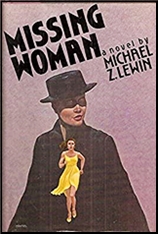
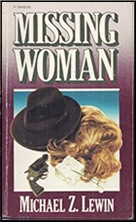
MICHAEL Z. LEWIN – Missing Woman. Albert Samson #6. Alfed A. Knopf, hardcover, 1981. Berkley, paperback, 1982. Perennial Library, paperback, 984.

   There are a number of op-notch candidates for the best private eye series going today. On the top of a good many lists would be Robert B. Parker’s Spenser books, but fans of the more traditional PI yarn would probably go more for the likes of Bill Pronzini’s nameless detective or Arthur Lyons’ Jacob Asch books.

   Sometimes lost and passed over in the shouting is Albert Samson, billed at one time as “the cheapest detective in Indianapolis.” He’s undoubtedly still cheap. At the beginning of this book he is definitely broke, and about to be evicted from his office as patr of a big, downtown redevelopment project.

   Which is not to say he’s not honest, dependable, and next to impossible to pry loose from a case. Even if he sounds a bit sour on his life (not on life, just his), his sense of humor never leaves him. Mostly it’s of a subtle variety, but not always, especially when he’s irritated. His relationship with Lt. Powder of Missing Persons does seem to be improving, however.

   Luckily so, for, as you’ve already gathered from the title, that’s the kind of case that this latest one is. Samson jumps in with no abandon, treating it as the intellectual challenge it is, when suddenly he’s caught up with the abrupt realization that Murder Is Not a Game.

   Detective stories do tend to tread a thin line between reality and fantasy. Michael Lewin’s big achievement here may very well be that he manages to give us the best of both.

Rating: A

–Very slightly revised from The MYSTERY FANcier, Vol. 5, No. 6, Nov/Dec 1981.

SUSPENSE ‘The Crooked Frame.” CBS, 30m. 29 July 1952. (Season 4, Episode 45). Richard Kiley, Neva Patterson, Dean Harens, Lois Wheeler. Screenplay: Mel Goldberg, loosely based on the novel by William P. McGivern. Director: Robert Mulligan.

   The relationship between the book and the TV adaptation is minimal, but you can hardly expect more when the screenplay has to be crammed into a 30 minutes time slot, less commercials. Here’s the resemblance. The book takes place in the editorial offices of a magazine; the tv show takes place in that of a small comic books company. I grant you that. Better visuals.

   It’s been a while since I’ve read the book, so I’ll concentrate on the TV show, but my sense is that the last line of the previous paragraph is as close as it gets. When the episode begins, the office is in an uproar. The creator of the comic strip “Sally Forth” has derided to quit, and if she follows through, the company has nothing as big (or profitable) to fall back on, and chances are they will have to close up shop for good.

   One of the writers (Richard Kiley) goes to see her that night, they quarrel, he blacks out, and of in the morning her body is found dead. Luckily the lady was not so very nice, and there are other suspects. The 30 minutes go by very quickly, the acting and directly are perfectly fine, but the show is clearly a small scale production, and at this late date, little more than a curio from the past. William P. McGivern was a very good writer, in a strong noirish vein. I hope he got paid well for the use of his story, but somehow I don’t think it was all that much, even at the time.

PostScript: Fifteen or so years later, comic book artist Wally Wood also came up with a “Sally Forth” comic strip. I don’t think there’s any connection, but you never know.

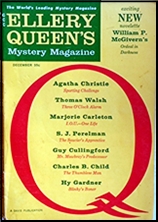
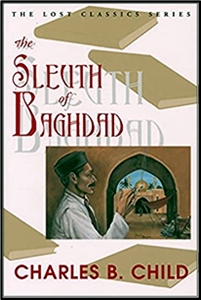
CHARLES B. CHILD “The Thumbless Man.” Short story. Inspector Chafik J. Chafik #24. Ellery Queen’s Mystery Magazine, December 1961. Published earlier in Collier’s, 21 January 1955 as “Invisible Killer.” Collected in The Sleuth of Baghdad (Crippen & Landru, July 2002).

   If my count is correct, there were 31 stories about Inspector Chafik of the Baghdad Police, the first of them appearing Collier’s, the last four in EQMM. Charles B. Child was the pen name of British author C. Vernon Frost, (1903-1993), who finally had 15 of the tales collected in The Sleuth of Baghdad by Crippen & Landru in 2002.

   In “The Thumbless Man” the victim of a vicious strangulation was the first in line of several men making their way, one-by-one, through a tunnel leading to a burial chamber in a tomb uncovered in an archaeological dig in Akkar, outside Baghdad. No one was inside, and yet the man is dead, with the marks on his throat strangely indicating the killing was done by hands having no thumbs.

   Bit by bit, following very small physical clues but guided by the personalities of the people tat the camp, Chafik not only deduces who did it, but how, a murder which was quite cleverly planned out. Chafik reminds me of Charlie Chan in some ways, keeping his thoughts to himself, but making appropriate but sometimes cryptic statements as he goes about his job.

   The only drawback to highly enjoyable stories such as this, however, is the question, not answered, is why the killer decided to go to such lengths to commit such a murder, one bound to produce more questions than one set up to look like an accident, for example. That would be my approach, how about you?


PHILIP K. DICK’S ELECTRIC DREAMS “Real Life,” Channel 4, UK, 25 October 2017 (Episode 5). Amazon Prime, US, 2018 (currently streaming as episode 1). Anna Paquin, Terrence Howard, Rachelle Lefevre, Lara Pulver. Teleplay by Ronald D. Moore, loosely based on .the story “Exhibit Piece” by Philip K. Dick (If, August 1954). Director: Jeffrey Reiner.

   I have not researched this at all, but it’s quite possible (a hypothesis, then) that more of Philip K/ Dick’s work have been filmed for either movies or TV than any other SF writer. (Think Blade Runner as the most well known.) Not bad for a writer who pretty much only had a small cult following when he died in 1982, just as Blade Runner was about to be released.

   Electric Dreams was a 10-part anthology of Dick’s short stories as adapted for TV. One of his favorite themes in his early fiction was the question of what is real around us, and what is not. “Real Life” takes that idea and runs with it with considerable success, I think. A lesbian cop in the future with a flying car is wracked with guilt after being the survivor of the massacre of several of her colleagues. She’s advised to take a virtual reality “vacation” from her life…

   … and ends up in the body of a black billionaire who’s not only the head of huge tech company but also a vigilante by night, being dead set on revenging the death of his wife at the hands of …

   … the same master criminal he/she’s after back in the future. Not only in the quest for revenge the same in the two worlds, but so are many of the people and locations in each. The overridng question is, which of the two worlds in the real one?

   This is one of those stories, as televised, that starts off as confusing to the viewer as it is to the primary character in it, perhaps even more so, but when eventually the viewer begins to straighten him or herself out, the problem of which world is which still remains, to both the character and the viewer. I won’t tell you, of course, and that’s even assuming that I know even now, which I don’t. I really enjoyed this one.


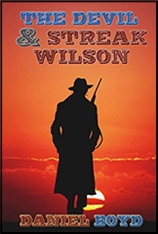
DANIEL BOYD – The Devil & Streak Wilson. Montag Press, trade paperback original, March 2020. Also available in ebook format.

   Let me say the outset that this is not really a review. I know the author personally, and there is no way I could be unbiased. You may know him, too, if you are a regular reader of this blog, since under his real name, his book and movie reviews that are posted here are even better than mine, if that were at all possible. But since he wrote this book under a false name, perhaps he does not want his own name associated with it, and I will honor his intentions until such time that he allows me to reveal it.

   Let me also say that this is the best book I have read over the period of the last two months. That this is the only book I have read over the period of the last two months does not, I hope, lessen the truth and impact of that statement. (I do not think that I am the only one who has been suffering from a reader’s block over the last two months, but I digress.)

   What is the book about, you may ask. I’m going to guess as to the year that it takes place in, but perhaps the 1880s; and as for the setting, it may suffice to say that it’s The West. Streak Wilson is our hero, a young lad with no roots that he knows of, but who is the best shot with a rifle in the entire county. The other major protagonist is, well, read the title of the book again. On the earth he appears as a gent who suggests he be called Harvey. Harvey Rideout, a friendly 50ish gent who seems to be able to light his tobacco with only his finger.

   By means of a small subterfuge, not a lie, exactly, but hedging on the details, he makes a small deal with Streak, who ends up not being able to see his reflection in mirrors, while at the same time a vicious doppelganger is released upon on the world. I could continue, and very easily, but I would like to leave some of the story for you to read for yourself.

   Besides being a riproarer of a tall tale in and of itself, The Devil and Streak Wilson is also a story of life, death, and growing up in between, filled with as much home spun philosophy as you can find in the total work of Spinoza, John Locke, and my Uncle Ezra combined. And I don’t even have an Uncle Ezra. If from reading this you get the sense that you might enjoy this book, I will suggest that you are miscalculating. You will love this book.

« Previous PageNext Page »