IT IS PURELY MY OPINION
Reviews by L. J. Roberts


DENNIS LEHANE – Moonlight Mile. William Morrow, hardcover, November 2010. Harper, premium-sized paperback, July 2011.

Genre:   Private Investigator. Leading characters:  Patrick Kenzie & Angie Gennaro; 6th in series. Setting:   Massachusetts.
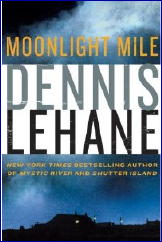
DENNIS LEHANE Moonlight Mile

First Sentence:   On a bright, unseasonably warm afternoon in early December, Brandon Trescott walked out of the spa at the Chatham Bars Inn on Cape Cod and got into a taxi.

   Eleven years ago, as told in Gone, Baby, Gone (1999), Patrick Kenzie and Angie Gennaro found kidnapped Amanda McCredy and, following the law, returned her to her neglectful mother.

   Now, at 16, Amanda has disappeared again and her aunt re-hires Kenzie and Gennaro to find her. A missing-person case quickly escalates to one involving identity theft, drugs, a priceless cross, Russian gangsters and a threat on Patrick’s family.

   It is very nice to have back the characters that brought Lehane to forefront of mystery writing. It is also nice that their lives have evolved and that they are parents of a quite realistic, four-year old daughter.

   I also enjoyed having back Bubba, one of the best psychotic sidekicks ever, but his role felt a bit as though it was playing homage to Robert B. Parker’s characters of Hawk to Susan; protector but not participant. While Amanda had dimension and strength, others seemed flat and bordering on stereotypical.

   Lehane has a great voice which carries over to a natural ear for dialogue and his evocative descriptions set the mood and sense of place… “The trees were bare […], and cold air off the ocean hunted the gaps in my clothes.”

   The plot was page-turning with some very well-done, unexpected twists, the climax felt over the top, and I did like the ending. Lehane again addresses the struggle between doing what is legally correct versus morally correct and who has the right to make that decision.

   Reading this book was interesting. When I read A Drink Before the War, the first book in the series, it was coup de foudre; that lightning strike you may experience when meeting someone wonderful for the first time. Eleven years on, the lightning bolt is gone, but there is still enough of a tingle to say I did enjoy the book.

Rating:   Good.
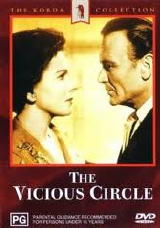
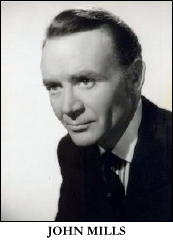
THE VICIOUS CIRCLE John Mills

  THE VICIOUS CIRCLE. Romulus Films, 1957. Also released as The Circle. John Mills, Derek Farr, Noelle Middleton, Wilfrid Hyde White, Roland Culver, Mervyn Johns, Rene Ray, Lionel Jeffries. Screenplay: Francis Durbridge, based on his BBC-TV serial, My Friend Charles. [See comment #1.] Director: Gerald Thomas.

   This is one of those movies in which the hero, in this case Dr. Howard Latimer (John Miles), finds himself trapped in a series of strange events that culminate in his being the number one suspect in a case of murder. This time around, the dead girl is an actress from Germany that a producer friend (just in from the US) asks him to pick up at the airport.

   Accompanying him to the airport is a newspaper reporter who (as it turns out) the paper never heard of, nor is the producer even in the country. The dead girl is in Latimer’s apartment when he returns later.

THE VICIOUS CIRCLE John Mills

   How and why? He has no idea. Not helping either is the patient who’s been referred to him by another doctor (who has never seen her), but who complains not only of migraines but also of dreams involving a body and a brass candlestick.

   Two guesses what the blunt instrument was that caused the death of the woman in his apartment? Or in whose car it is found?

   This is also one of those movies that is too complicated for its own good. There is an attempt to explain all this, and it’s a pretty good attempt too, until the movie’s over and you wonder what on earth were you thinking?

   One large problem is that it is clear that the detective from Scotland Yard, Detective Inspector Dane (Roland Culver), does not take the case against Dr. Latimer all that seriously, alleviating most of the suspense. Either Cornell Woolrich (author) or Alfred Hitchcock (director) or the combination thereof, could have taken the first 20 minutes and run for a mile with it.

   Since neither of the two were on hand, all we have is a mildly amusing puzzle to undo, nothing more, but nothing less, either. All the players are professionals, even if relatively unknown in this country, then or now.

A REVIEW BY MARYELL CLEARY:
   

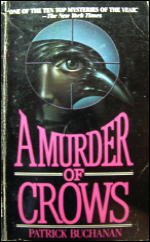
PATRICK BUCHANAN – A Murder of Crows. Stein & Day, hardcover, 1970; reprint paperback, 1985. Also: Pyramid N2743, paperback, 1972.

PATRICK BUCHANAN Murder of Crows

   An intriguing title and a riveting first chapter entice the reader who stands hesitating at the paperback book rack. Unfortunately for the buyer, the rest of the book does not live up to the beginning.

   Ben Shock and Charity Tucker, private investigators without credentials, are asked by an old friend of Charity’s, Subrinea Brown, to look into the sudden local hostility to her father’s small racetrack in the making. The antagonism has gone so far as to frighten Colonel Brown into a heart attack.

   Subrinea’s fiance, Loyal Boone, is also trying to find out what changed public support into active hostility. Could it be the Unknown Tongues, a mountain sect with a spellbinding blind preacher? Might the crooked local politicians have a more profitable scheme in mind? Do Loyal’s father and his Mexican wife, with their money-making snake farm, have any connection with the continuing and determined efforts to get Subrinea and her father out?

   People die, their bodies burned, their clothes not even singed. Are the Unknown Tongues invoking back-country magic? Does Uncle Uglybird, the “yarb doctor” know any of the answers? Uncle Uglybird is a 14-carat-gold character, but he’s not worth the price of admission.

   The book is stiff, the people don’t come alive, mayhem accumulates, and at the end the two detectives ride off to the next case scarcely touched emotionally by the devastation they left behind.

— Reprinted from The Poisoned Pen, Vol. 7, No. 1, Fall-Winter 1987.


Bio-Bibliographic Data:   “Patrick Buchanan” was the joint pen name of Edwin Corley & Jack Murphy. Corley’s Wikipedia page describes Charity Tucker as “a tall, blonde, intelligent television reporter, who teamed with private investigator Ben Shock to investigate various murders.”

       The Ben Shock & Charity Tucker series

A Murder of Crows. Stein & Day, 1970.
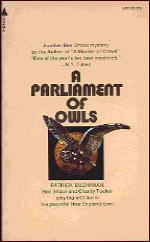
A Parliament of Owls. Stein & Day, 1971.

PATRICK BUCHANAN

A Requiem of Sharks. Dodd Mead, 1973.
A Sounder of Swine. Dodd Mead, 1974.

THE BACKWARD REVIEWER
William F. Deeck


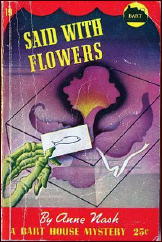
ANNE NASH – Said with Flowers. Doubleday Crime Club, hardcover, 1943. Bart House #19, paperback, 1945.

ANNE NASH Said with Flowers

    ’Twas the week before Christmas when the general factotum and chief roustabout of the flower shop owned and operated by Doris (Dodo) Trent and Nell Witter fell and broke his leg. Fortuitously, but perhaps not fortunately, a new young man in town visits the shop and appears qualified to fill in during the busiest time of the year.

    A day later a friend of Dodo’s and Nell’s is found stabbed to death, with one of the knives used for dethorning roses, outside the flower shop. On her body is the emblem of a fish, the trademark of Killer Karp — named thus, God help us, by the newspapers because of his habit of leaving the drawing of a fish with each murder victim — a serial murderer who had been working his way west from Boston and murdering lovely, young, and unmarried females in his travels.

    If the woman killed outside the flower shop is one of Karp’s victims, the serial killer had deviated almost totally from his previous pattern. If she had not been murdered by Karp, who in the small town of Pinecrest would murder a woman seemingly loved by all? Is the new flower shop assistant Killer Karp?

    Dodo and Nell join forces, when they can take the time from their hectic Christmas business, with detective Mark Tudor and his dog Svea to try to find the killer. There is excellent atmosphere, Dodo and Nell are real people, and the novel is well written if you don’t mind a colloquial style. The killer was evident fairly early on to this reader, but it didn’t spoil the enjoyment.

— From The Poisoned Pen, Vol. 7, No. 1
(Whole #33), Fall-Winter 1987.


Bibliographic Data:   Anne Nash was the author of three detective novels starring Dodo and Nell between 1943 and 1945, then one stand-alone in 1946. All four published were under Doubleday’s Crime Club imprint, with Said with Flowers being the first.

REVIEWED BY DAN STUMPF:         


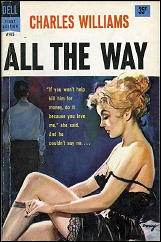
CHARLES WILLIAMS All the Way

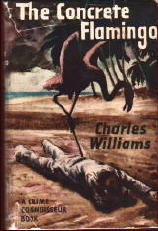
● CHARLES WILLIAMS – All the Way. Dell First Edition A165, paperback original, 1958. UK title: The Concrete Flamingo. Cassell, hardcover, 1960.

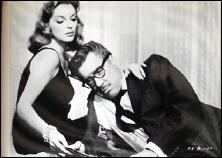
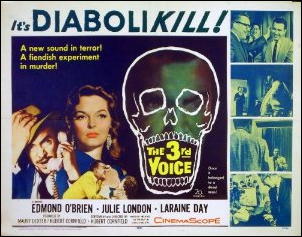
● THE 3RD VOICE. Columbia, 1960. Edmond O’Brien, Julie London, Laraine Day. Based on the novel All the Way, by Charles Williams. Director: Hubert Cornfield.

   This speculation began in a roundabout way while watching Deadlier Than the Male (reviewed here ); I noticed that one of the credited screenwriters was listed as “Liz Charles-Williams.”

   Hmmm. Seems to me the oughta-be legendary writer Charles Williams was doing things at Universal about that time: The Wrong Venus was being filmed as Don’t Just Stand There!, and wasn’t The Pink Jungle some of his work? So could “Liz Charles-Williams” have some connection with the author of Dead Calm and The Big Bite?

   Well, after several minutes of painstaking research, I still couldn’t say, but I was prompted to pull out my video of The Third Voice and my copy of the Charles Williams book it was based on, All the Way, and revisit both.

CHARLES WILLIAMS All the Way

   Williams’ novel is a compact, neatly built thing based around an intriguing premise: in order to commit the perfect crime, Jerry Forbes has to spend a week impersonating a man he doesn’t resemble… whom he helped murder.

   The hook is that the victim is a neurotic Midwestern businessman on vacation in Florida, and Forbes’ voice sounds exactly like his, so the plot — hatched by the dead man’s jilted mistress — is to kill the businessman, then drain his accounts by phone calls to his underlings back home, all this with her help.

   It takes talent to hold a complicated thing like this together in a novel, much less put it across in 160 pages, but Williams was at the top of his form here, with well-wrought characters and nicely judged situations that build suspense beautifully.

   Hence All the Way emerges as a deft little book that deserves to be better known. I particularly liked the little character quirks that lead up to an emotional double-cross that you won’t see coming, even now that I’ve told you it’s on its way.

CHARLES WILLIAMS All the Way

   In 1960 Columbia filmed this as The Third Voice which may make it the first paperback original made into a movie; I don’t know. At any rate, while not quite up to the level of the book, Voice is a nice, sick little item which falls well short of Classic Status but still repays watching.

   Voice was written and directed by Hubert Cornfield, who put some interesting things on film (Plunder Road, Pressure Point) before the experience of trying to direct Brando in Night of the Following Day crippled his talent.

   Or maybe there wasn’t much talent to begin with: Cornfield’s films all look like the work of a promising new talent, but somehow he just never followed through. At any rate, The Third Voice is still nasty and promising.

   It’s set in a swanky Mexican resort, but there are no sun-drenched views of lovely beaches; just lots of sweaty close-ups of Edmond O’Brien moving through rooms of cloying chintziness as he bullies strangers over the phone and plots his own little turnabout, leading to a typical noir ending. The effect is claustrophobic, but tellingly so, and I like this movie perhaps more than it deserves.

CHARLES WILLIAMS All the Way

IT’S ABOUT CRIME, by Marvin Lachman


LAWRENCE BLOCK

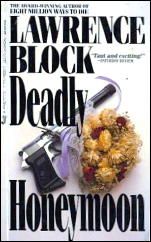
LAWRENCE BLOCK – Deadly Honeymoon. Macmillan, hardcover, 1967. Paperback reprints include: Dell, 1969; Jove, 1986; Carroll & Graf, 1995. Filmed as Nightmare Honeymoon (1974).

   Transplant Cornell Woolrich into a more permissive decade, and you would have this book, first published in hardcover in 1967.

   A young attorney and his bride go to a remote Pennsylvania cabin for; their honeymoon, but it is interrupted by rape and murder. In this brutal but extremely suspenseful novel, a manhunt is generated by a desire for revenge with which the reader can easily identify.

ANNE CHAMBERLAIN

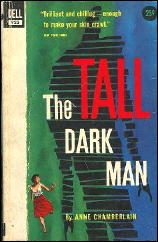
ANNE CHAMBERLAIN -The Tall Dark Man. Bobbs-Merrill, hardcover, 1955. Paperback reprints include: Dell #925, 1956; Avon Classic Crime PN322, 1970; Academy Chicago, 1986.

   The plot of this 1955 mystery, reprinted in an especially attractive edition, is decidedly Woolrichian. A thirteen year-old girl says she has seen a murder through the window of her Ohio school room, but no one will believe her. She also claims that the murderer saw and recognized her.

   When Anthony Boucher originally reviewed this book, he paid it the extravagant praise of saying “This is purely and absolutely, The Suspense Novel, in an ideal form, which the genre rarely attains.” He did not exaggerate very much.

— Reprinted from The MYSTERY FANcier,
       Vol. 8, No. 4, July-Aug 1986.
REVIEWED BY GEOFF BRADLEY:         


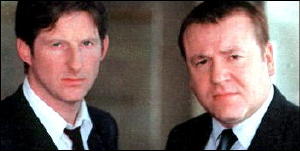
TOUGH LOVE. Granada TV, UK, May 2000. 2 x 90min, less adverts. Ray Winstone, Adrian Dunbar. Written by Edward Canfor-Dumas. Director: David Drury.

TOUGH LOVE Granada TV

   Tough Love was a two-parter about the possible corruption of a tough zero-tolerance detective chief inspector who happened to be called Love.

   The programme starts with Love, played by Adrian Dunbar (on the left), picking up an award from the mayor of his northern city for the way in which his methods had cut the crime figures drastically. Intercut with this was the gangland style killing of a clearly lowlife thug.

   Soon after, Love’s longtime sidekick, the hard-bitten career policeman Detective Constable Lenny Milton (the lead role played by Ray Winstone), is approached by someone from the police corruption agency who says that the murdered man had evidence that Love is corrupt. Milton is forced to cooperate but believes that doing so will clear his friend from the charges.

   Of course it’s not as simple as that and soon he is investigating a murder in The Big Clock style, not knowing if he can count on the corruption officers to help him.

   There is much talk about the nature of corruption and the philosophy of a smaller evil being useful to counter bigger evils. This was a superior production though possibly falling just lower than top-notch.

   [Incidentally there is a real life northern Detective Superintendent over here who has cut crime figures in his area by a policy of zero tolerance. He has recently been cleared of corruption charges but remains suspended, something like three years after the initial inquiry. Clearly this has been the impetus for this fictional production.]

— Reprinted from Caddish Thoughts #87, November 2000.

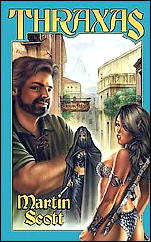
MARTIN SCOTT – Thraxas. Baen, paperback original; 1st US printing, September 2003.

   Private eye novels come in all flavors and from all directions. Let me start with the opening paragraph or so, and you’ll see what I mean, and right away:

MARTIN SCOTT Thraxas

   Turai is a magical city. From the docks at Twelve Seas to Moon Eclipse Park, from the stinking slums to the Imperial Palace, a visitor can find all matter of amazing persons, astonishing items and unique services. You can get drunk and swap tales with Barbarian mercenaries in the dockside taverns, watch musicians, tumblers and jugglers in the streets, dally with whores in Kushni, transact business with Elves in Golden Crescent, consult a Sorcerer in Truth is Beauty Lane, gamble on chariots and gladiators at the Stadium Superbius, hire an Assassin, eat, drink, be merry and consult an apothecary for your hangover. If you find a translator you can talk to the dolphins in the bay. If you’re still in need of fresh experiences after all that, you could go and see the new dragon in the King’s zoo.

   If you have a problem, and you don’t have much money, you can even hire me. My name is Thraxas.


   His sometimes assistant is a barmaid named Makri, a handy lass with a sword and prone to wearing a tiny chainmail bikini. This introductory volume in the United States actually consists of two novels as published in England: Thraxas and Thraxas and the Warrior Monks, and weighs in at a hefty 442 pages, in my opinion well worth your money at $7.99, and decidedly so if you’re still with me after reading that first paragraph above.

   And I’ll leave the plots for you to discover on your own. The books are exactly what I am sure you think they are, and better. They’re funny, too. Since you can’t stop me, I’ll continue with some quotes from the second half of the book:

    Makri lights a thazis stick, inhales a few times and passes it to me. I pour us a little klee. Makri’s eyes water as it burns her throat on the way down.

    “Why do you drink this stuff?” she demands. “We’d have rioted in the slave pits if they’d tried serving it to us.”

    “This is top quality klee. Another glass?”

    “Okay.”


    “…the Venerable Tresius lied about not meeting any other monks in the city. What if he’s really after the statue for his own temple and is using me to locate it for him? Wouldn’t be the first time some criminal tried to use me as a means of finding something. Wouldn’t be the tenth time in fact.”

    “That’s what you get for being good at finding things.”


    Makri wears both her swords, more or less hidden under her cloak, and slips a long knife into each of her boots. As usual, she is not entirely comfortable without her axe, but it’s too conspicuous. There is no legal reason why a woman can’t walk around Turai carrying an axe, but it isn’t exactly an everyday sight. A fully armed Makri — lithe, strong, and a blade sticking out in every direction — presents a very worrying sight for the Civil Guard. She tends to get stopped and questioned, which is inconvenient when we’re on a case. Also we get refused entry to high-class establishments.


   I’ll stop here. Fantasy and the true detective novel don’t really mix — take for example the impossible crime of the missing two-ton statue, which no one saw being removed — utterly fantastic? Yes.

   On the other hand, there is a fair-play clue involved, one that gives Thraxas the key to the case as soon as he hears it. That it lies in what he overhears a talking pig say means only that there’s more to the world than either you or I are apt to ever become aware of.

   And there’s more to come!

— August 2003


      The Thraxas novels —

   UK editions:

Thraxas. April 1999.
Thraxas and the Warrior Monks. May 1999.
Thraxas at the Races. June 1999.
Thraxas and the Elvish Isles. August 2000.
Thraxas and the Sorcerers. November 2001.
Thraxas and the Dance of Death. May 2002.
Thraxas at War. July 2003.
Thraxas under Siege. May 2005.

   Baen omnibus editions (US):

Thraxas. September 2003:    Contains Thraxas and Thraxas and the Warrior Monks.
Death and Thraxas. August 2004:    Contains Thraxas at the Races and Thraxas and the Elvish Isles.

   Baen single novel editions (US):

Thraxas and the Sorcerers. June 2005.
Thraxas at War. February 2006.
Thraxas and the Dance of Death. July 2007.
Thraxas under Siege. August 2008

REVIEWED BY WALTER ALBERT:         


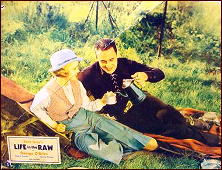
LIFE IN THE RAW Clare Trevor

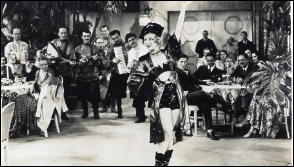
LIFE IN THE RAW. Fox, 1933. George O’Brien, Claire Trevor, Greta Nissen, Francis Ford, Warner Richmond, Gaylord (Steve) Pendleton. Based on the story “From Missouri” by Zane Grey. Director: Louis King. Shown at Cinecon 36, Hollywood CA, Aug-Sept 2000.

    In Life in the Raw, described as an “odd concoction of Western and nightclub drama with some Russian atmosphere thrown in for good measure,” Clare Trevor made her feature film debut. “The first thing I was told,” Trevor recalled, was not to fall in love with my leading man. And then I immediately fell in love with George O’Brien.”

LIFE IN THE RAW Clare Trevor

   Trevor comes out West to join her brother (Gaylord Pendleton) who, unbeknownst to her, is involved in some very shady dealings. Before things are romantically resolved, O’Brien thinks she’s a baddie, and everyone thinks he’s one.

   Trevor’s role doesn’t require her to do much except look great in tight-fitting western outfits, but O’Brien gets to do some pretend romancing with Greta Nissen and carry off a rescue scam that makes the last couple of reels fun to watch.

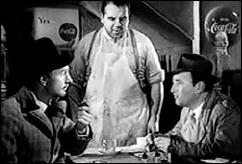
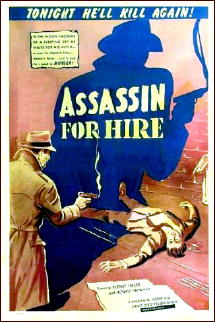
ASSASSIN FOR HIRE. Anglo-Amalgamated Films, UK, 1951. Sydney Tafler, Ronald Howard, Katharine Blake, John Hewer, June Rodney. Director: Michael McCarthy.

ASSASSIN FOR HIRE

   Since this is an obscure British film of some 60 years in age, other than, of course, Ronald Howard, none of the names above meant anything before I watched this movie. Even afterward — even while noting that all of the participants were professionals through and through — I may be hard pressed to remember them the next time I come across them. (Ronald Howard was the star of the 1950s Sherlock Holmes series that made its way the US back then, so anyone of a certain age, as I am, should pick him out right away.)

   He plays a Scotland Yard inspector in Assassin for Hire, an officious type who declares at the beginning that if the criminals don’t play by the rules, why should he? His eye in particular is on Antonio Riccardi (Sydney Tafler) whom he suspects is a hitman for anyone who cares to hire him. He is very good at what he does, including making sure that he has an ironclad alibi for every one of the extracurricular job he does.

   Every criminal has a weakness, believes Inspector Carson, and Riccadi, by day a dealer in rare stamps, may have his in his brother, a classical violinist whose career he keeps under an iron thumb. Well, there’s no “may have” about it. The question is, how might the inspector take advantage of it?

   This is a short film, just over an hour long, and it would have been ideal for an episode of the Alfred Hitchcock Hour on TV, say, with several twists along a way, mostly toward the ending. I will not tell you how many twists, for if I were to do so, you’d be counting along as you’re watching. (Of course I could tell you that there were three, say, with the third one being that there is no third one.)

   There’s nothing here for any of the players to have built a career on, but it’s competently done, and if you were to find a copy on DVD, I don’t think you’ll begrudge the short time it would take you to watch it.

ASSASSIN FOR HIRE

« Previous PageNext Page »