A 1001 MIDNIGHTS Review
by George Kelley & Marcia Muller
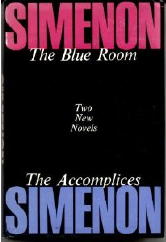
GEORGES SIMENON – The Blue Room and The Accomplices. New York: Harcourt Brace & World, hardcover, 1964. Published separately in UK by Hamish Hamilton, hardcovers, 1965/1966. Translations of Le Chambre Bleue (Paris, 1964) and Les Complices (Paris, 1955).
While Simenon is best known for his Maigret novels, his non-series works of psychological suspense are equally compelling. They express a kind of dark inevitability, a sense of events unwittingly set in motion by one’s actions and then gathering an uncontrollable momentum of their own. This volume presents two of the best of these novels.
In The Blue Room, Simenon explores the erotic — and ultimately disastrous — relationship of an innocent man and a woman who is as ruthless as she is passionate. Tony’s main interest in life is making love with his mistress, Andree.
Naive and trusting, he remains unaware of her evil nature until his wife and her husband are found dead of strychnine poisoning. Tony is arrested for the crimes, and the story of what went before is told in flashback as he is questioned by the police.
Even though we already know where the events are leading, we nevertheless fear for Tony as we watch Andree’s corruption overwhelm him; and their final encounter of the lovers at the trial is one of the more chilling in mystery fiction.
The Accomplices is completely different in tone and theme from The Blue Room, but equally haunting.
Joseph Lambert is married, the father of six children, and has another on the way. A fairly successful businessman, Lambert feels everything is going his way.
But then the unexpected happens: While Lambert is driving wildly down the road, engaged in an amorous dalliance with his secretary, he loses control of his car. A school bus filled with children swerves to avoid him, but crashes into a wall and bursts into flame; dozens of little children die in the accident.
Lambert moves quickly to cover up his guilt, but his unconscious proves to be his own prosecutor, judge, and jury. This is a fascinating novel of psychological torment and pressure, and has grave implications for modern society.
A 1001 MIDNIGHTS Review
by George Kelley & Bill Pronzini
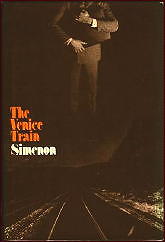
GEORGES SIMENON – The Venice Train. Harcourt Brace Jovanovich, US, hardcover, 1974. Hamish Hamilton, UK, hardcover, 1974. Translation of Le Train de Venise, Paris, 1965.
Justin Calmar is an ordinary man; everything in his life seems well ordered and complacent. Then he takes his family on a vacation to Europe, and on the train from Venice to Paris a stranger approaches and asks him to deliver an attache case.
Calmar agrees. But when he enters the Paris apartment where he is supposed to make the delivery, he finds a murdered woman. Panicked, he flees — and his life is forever altered.
Fear and paranoia take control of Calmar. He becomes obsessed with the attache case and the events surrounding the bizarre affair. He hungrily reads newspapers looking for clues to the stranger’s identity, and finds that the man, too, has been murdered. Will he be next?
When Calmar finally opens the attache case, he finds bundles of American hundred-dollar bills, English fifty-pound notes, and Swiss francs: a literal fortune. But this only deepens his fear: Someone win surely come to take the money away from him.
He embarks on a frantic routine to keep the case hidden, continually shifting it from train-station lockers to bus-station lockers and back again. His existence degenerates into a nightmare of anxiety, depression, and continued paranoid behavior — he is a man at the breaking point long before anything happens to substantiate his terror.
Few writers can match Simenon when it comes to the novel of psychological suspense, and this is one of his finest books of this type. Justin Calmar is a memorable and tragic character; and Simenon’s theme is powerfully stated. Relentless though it may be, The Venice Train is a novel for our time, with implications that transcend its simple plot and a message for us all.
Outstanding among Simenon’s many other novels of psychological suspense are The Man Who Watched the Trains Go By (1946), Act of Passion (1953), In Case of Emergency (1958; made into an excellent French film with Brigitte Bardot and Jean Gabin), and The Innocents (1974).
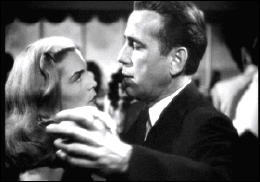
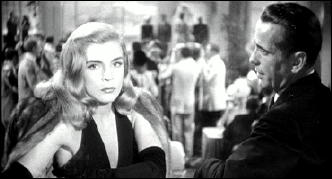
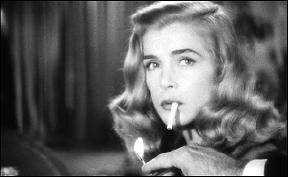
DEAD RECKONING. Columbia, 1947. Humphrey Bogart, Lizabeth Scott, Morris Carnovsky, Marvin Miller, Wallace Ford. Screenplay by Oliver H.P. Garrett and Steve Fisher, based on a story by Gerald Adams and Sidney Biddell, who also produced. Director: John Cromwell.
Humphrey Bogart spent most of his career at Warner Brothers, where all his best films were produced. From The Petrified Forest to The African Queen, and all the way through The Maltese Falcon, The Big Sleep, Key Largo, and countless others, when you think of a Bogart Movie, you are probably thinking of the Warners’ ambiance: the stock company of supporting players, cameramen, composers and all the other technicians, who contributed so much to the Bogart mystique.
For some reason, though, Warner’s decided in the late 40s to loan their top male star to Columbia, the smallest of the Major studios. It was run in those days by Harry Cohn, a man of epochal unpleasantness, whose massive funeral prompted the comment, “Give the people what they want and they’ll come out for it.”
Under his reign, Columbia was Home to Frank Capra and the Three Stooges, with most of its product canted toward the latter end of the scale. Nonetheless, it must be admitted that when Cohn got hold of a good thing he milked it dry, and turned out not a few classics in the process.
So when they got their hands on Humphrey Bogart for a single picture in 1946, Columbia beat their live horse for all it was worth, by hiring a corps of writers to steal all the best bits from Bogie’s biggest hits, and surrounding him with (mostly unknown) character actors, who somehow managed to look and act like a close approximation of the Warners Stock Company. The result was the Ultimate Bogart Picture.
Dead Reckoning is not particularly witty, not noticeably intelligent, and not at all original, yet it has a certain memorable quality all its own: It contains so many elements from so many (better) Bogart movies, that it somehow becomes the apotheosis of them all.
The plot, as nearly as I can determine, involves the efforts of cynical, world-weary Rip Murdock (Bogie, of course) to clear the name of a dead army pal, a quest that takes him to one of those echt Film Noir cities populated by Dumb Cops, Cultured Gangsters, Sadistic Goons, Regular Joes, and a blonde, husky-voiced femme fatale played by Lizabeth Scott, a cross between Lauren Bacall and Eugene Pallette.
https://www.youtube.com/watch?v=bL1X3s1R0cE
All of the above, replete with beatings, gambling joints, frame-ups and shoot-outs, gets served up with more precision than originality, accompanied by a Chandleresque voice-over narration that strains its metaphors so hard you can hear their knuckles turning white. (Like that one.)
Yet if you like Bogart Pictures, it’s hard not to enjoy Dead Reckoning, thanks mainly to John Cromwell, a director who deserves a digression all his own:
Cromwell has even less of a reputation than Michael Curtiz, as Hollywood Directors go, and holds an even smaller claim to Personal Style, yet he directed films that somehow outshone the classics of better-known auteurs, perhaps because he never made a fetish of Originality.
Abe Lincoln in Illinois, Since You Went Away, Algiers, Made for Each Other, Son of Fury and The Enchanted Cottage all bear comparison with better-known films like Young Mr. Lincoln, The Best Years of Our Lives, and Casablanca, and his The Prisoner of Zenda (1937) and Caged are arguably the best Swashbuckler and Prison films Hollywood ever produced, even if they came too late in their cycles to be considered “Influential.”
When Columbia turned to John Cromwell to make a film in the Classic Bogart Mold, they knew what they were doing. Cromwell approaches Dead Reckoning totally undaunted by the cliched script and predictable story line.
He gives each tried-and-true scene the freshness that Hawks, Curtiz and John Houston brought to them a few movies back, and backs off at all the right moments to allow his star enough room for the well-known mannerisms, wise-cracks and reaction shots that Bogart buffs dote on.
The result is a film that seems familiar the first time you see it, but none the less likable for that. I didn’t respect Dead Reckoning the morning after I saw it, but I suspect I’ll sleep with it again.
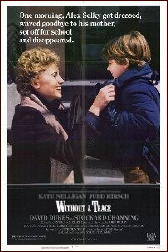
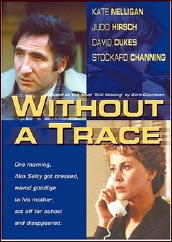
WITHOUT A TRACE. 20th Century Fox, 1983. Kate Nelligan, Judd Hirsch, David Dukes, Stockard Channing, Jacqueline Brookes, Keith McDermott. Screenwriter: Bess Gutcheon, based on her novel Still Missing. Director: Stanley R. Jaffe.
One of the things that has always struck me in the classic “Damsels in Distress” (DID) films is the almost total absence of women other than the star. DIDs attract either psychos or sympas but never, or almost never, another woman.
However, the revolution in social roles has not gone unnoticed by filmmakers, and a recent example of the DID film reflects some of the changes. Without a Trace, a film version of Bess Gutcheon’s Still Missing, based on the real-life story of the still unsolved disappearance of a six-year-old boy on his way to school, was promoted by our local critics as an entertaining, well-made film.
In the face of overwhelming apathy, the film was held over for two or three desultory weeks and then shunted off to the Regency Square, where I saw it on a Friday night with a substantia1 family audience.
Without a Trace stars British actress Kate Nelligan (who earned her credentials as a DID specialist in Eye of the Needle) and Judd Hirsch. playing the police lieutenant who’s put in charge of the investigation when Nelligan reports her son missing.
As we were asked to believe that stewardess Day could be prompted into landing a plane [in Julia, reviewed here], so are we asked to believe that Nelligan is a university English professor who teaches a course in modern poetry in which she lectures to a sizable audience of over-age actors, in the kind of amphitheater that in my part of the university world is only used for science courses. (Does anyone in Hollywood have any idea what has happened to registration in literature courses in the past decade?)
My wife pointed out to me that the quote attributed, during a lecture on Robert Frost, to Pope was actually from Emerson, but I found the slip (for which we should really hold the screenwriter responsible) engaging and a reminder that no film based on “real life” is real and that a British actress posing as a professor of American literature in an American university is, after all, only playing.
(The British usually are much better at playing Germans than they are at playing Americans. The current PBS series, Private Schulz, presents a Germany completely inhabited by British accents. I’m looking forward to the episode in which Private Schulz, “disguised” as an Englishman, is set down in wartime England where he must play a German impersonating an Englishman. The dilemmas posed for the hapless English actor are mind-boggling.)
In Without a Trace, Nelligan has a mother, a best friend, and some sympathetic women neighbors, but true to the demands of the DID film, she is abandoned by all of them, and at the moment of crisis she is alone, without even the male policeman apparently willing to listen to her.
And it is at this moment, when everything seems hopeless and she’s almost ready to give up, that a deus ex machina is introduced to turn the situation around. And, since these are the eighties, the deus is a dea.
In the Doris Day film, Doris hung in until the very end, and although the men are, at times, almost literally propping her up to get her out of the Perilous Predicament, the Star is always center stage.
In this example of female New Cinema, the star is allowed to go off-stage during the climactic chase. This permits the Inferior Male (Hirsch) to redeem himself but also involves one of the most unlikely coincidences (“Daddy, let’s go to the park”) and extreme double-takes that I’ve suffered through since the days of the Monogram serials.
Nelligan is attractive and probably intelligent, and Hirsch is fine, but this DID variation finally succumbs to the same weakness that plagued the romantic DID vehicles: implausibility. And the virtues of Without a Trace — the good cast, fine photography, and tragic but not unusual situation — only serve, finally, to expose rather conceal the threadbare plotting.
— Reprinted from The MYSTERY FANcier,
Vol. 7, No. 2, March-April 1983.
Editorial Comment: The author’s book and the movie are based on the true-life disappearance of Etan Patz, who went missing in New York City’s Lower Manhattan on 25th May 1979. On May 24, 2012, Police Commissioner Kelly announced that a man was in custody who had implicated himself in the Patz disappearance. According to a New York Times report from 25 May 2012, the police had at that time no physical evidence to corroborate the man’s confession.
Being a fan of the Inspector Pel books by Mark Hebden (i.e., John Harris ), I was a little surprised to see in the Curtis Brown archive at Columbia University that a Barry Fox was also mentioned as writing as Hebden. The archive was unable to help with further information.
I have never thought of it before but three of the Hebden books were published after the death of Harris. So it seems possible that another hand was involved in writing those last books. Then there are the Juliet Hebden books about Pel, supposedly by Harris’ daughter.
I asked Allen Hubin and the others, but no one had heard of a Barry Fox in relation to the Hebden books. But then I discovered that there is an American ghost-writer by that name. His website is at http://taylor-fox.com/
I doubt that he will reveal anything because of confidentiality agreements, but I wonder if anyone else knows anything ?
I would be grateful if you can add this to your inquiries.
Many thanks
John Herrington
The Inspector Clovis Pel series, by Mark Hebden —
Death Set to Music (n.) H. Hamilton 1979 [Theatre; France]
Pel and the Faceless Corpse (n.) H. Hamilton 1979 [France]
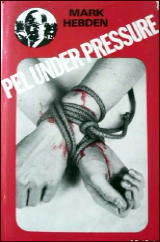
Pel Under Pressure (n.) H. Hamilton 1980 [France]
Pel Is Puzzled (n.) H. Hamilton 1981 [France]
Pel and the Bombers (n.) H. Hamilton 1982 [France]
Pel and the Staghound (n.) H. Hamilton 1982 [France]
Pel and the Pirates (n.) H. Hamilton 1984 [France]
Pel and the Predators (n.) H. Hamilton 1984 [France]
Pel and the Prowler (n.) H. Hamilton 1985 [France]
Pel and the Paris Mob (n.) H. Hamilton 1986 [France]
Pel Among the Pueblos (n.) Constable 1987 [Mexico]
Pel and the Touch of Pitch (n.) Constable 1987 [France]
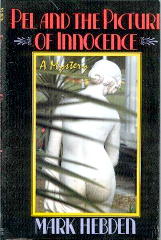
Pel and the Picture of Innocence (n.) Constable 1988 [France]
Pel and the Party Spirit (n.) Constable 1989 [France]
Pel and the Missing Persons (n.) Constable 1990 [France]
Pel and the Promised Land (n.) Constable 1991 [France]
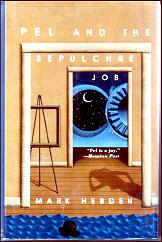
Pel and the Sepulchre Job (n.) Constable 1992 [France]
The Inspector Clovis Pel series, continued by Juliet Hebden —
Pel Picks Up the Pieces (n.) Constable 1993 [France]
Pel and the Perfect Partner (n.) Constable 1994 [France]
Pel the Patriarch (n.) Constable 1996 [France]
Pel and the Precious Parcel (n.) Constable 1997 [France]
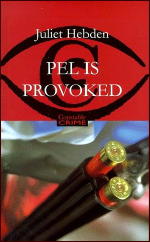
Pel Is Provoked (n.) Constable 1999 [France]
Pel and the Death of the Detective (n.) Constable 2000 [France]
Pel and the Butchers’ Blades (2001)
Pel and the Nickname Game (2002)
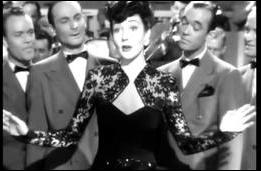
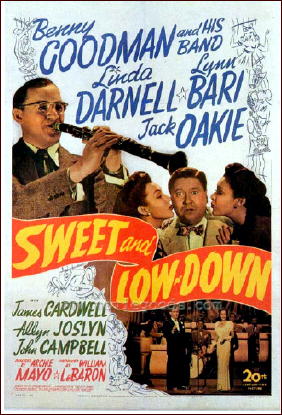
SWEET AND LOW-DOWN. 20th Century-Fox, 1944. Benny Goodman and His Band, Linda Darnell, Jack Oakie, Lynn Bari, James Cardwell, Allyn Joslyn; with Terry Moore, Gloria Talbott, and The Pied Pipers (all uncredited). Director: Archie Mayo.
Despite what a couple of viewers who’ve left comments on IMDB might tell you, Benny Goodman is not all that bad an actor. After all, it’s the perfect part: himself. But OK. If you were to pin me down, I’d have to tell you the truth. The only reason anyone would want to see this movie is to see both Goodman and his band in action. On the bandstand. At least half the movie is filled with musical numbers, one song after another, and you can take it from me, they’re all great.
In between the songs? Well, that’s a whole other matter. Let’s assume that the truth serum you dosed me with is still working. The story is not so hot. It’s not terrible, but it sure isn’t good. James Cardwell plays a young trombone player whom Benny takes a liking to, puts him in his band, young man makes good, meets a couple of girls, starts his own band, and …
Lynn Bari plays the singer in Benny’s band, and according to IMDB, she may have done all her singing herself. I rather doubt it, but she was still a beautiful lady. The other girl in the new band member’s life is Linda Darnell, a young social heiress whose league he doesn’t belong to, but…
It’s a pleasant enough way to spend 72 minutes, if you’re a fan of the big bands. If not, you won’t last more than ten. The movie did earn one Oscar nomination. You can look it up. If you were think about it for a few seconds, though, I’m sure you can easily guess the category.
Short-story anthologies are good for the reader, as well as the writer who earns some more royalties, and there are more around than usual. The Year’s Best Mystery and Suspense Stories, 1988, edited by Edward D. Hoch (Walker, 1988), inevitably contains a selection of the best of the previous year.
It is the strongest in this series in many years and includes Harlan Ellison’s Edgar winner, “Soft Monkey,” regarding a New York bag lady, and Robert Barnard’s “The Woman in the Wardrobe,” which EQMM‘s readers selected as their favorite story of 1987.
I’m glad editor Hoch showed no false modesty and included his own “Leopold and the Broken Bride,” the year’s best example of pure detection, in which a woman disappears as she is ready to walk down the aisle at her wedding.
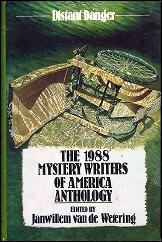
MWA’s 1988 anthology, Distant Danger, edited by Janwillem van de Wetering (Wynwood, 1988), shows both variety and quality in thirteen reprints by authors like Hoch,Gores, Lillian de la Torre, Margaret Maron, and Amanda Cross. There were also three new stories, including one by Stephanie Kay Bendel that reminds me of some of the fine short novels American Magazine once published.
— Reprinted from The MYSTERY FANcier,
Vol. 11, No. 1, Winter 1989.
ROBERT GOLDSBOROUGH – The Bloodied Ivy. Bantam, hardcover, 1988; paperback, 1989.
The third of Robert Goldsborough’s re-creations of Nero Wolfe, The Bloodied Ivy, is, alas, the weakest of the trio. A professorial type from upstate New York’s Prescott University comes to see Archie Goodwin, of all people. He believes the recent death of Prescott’s leading luminary, the acerbic arch-conservative Hale Markham, was no accident but murder most foul.
He produces no evidence and names no suspect, but Archie agrees to investigate on his own time in hopes of awakening Wolfe’s interest. A journey to Prescott demonstrates to Archie that Markham was not beloved, and that just possibly he might have been helped to fall into the campus ravine called Caldwell’s Gash.
That’s not enough to attract Wolfian attention, but doubtless Archie will find a way. The action here divides between New York and Prescott, and, while academia takes some well-aimed jibes, the narrative does not have enough zest and substance to stay aloft.
— Reprinted from The MYSTERY FANcier,
Vol. 11, No. 1, Winter 1989.
Robert Goldsbrough’s Nero Wolfe series —
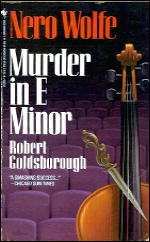
1986 Murder in E Minor
1987 Death on Deadline
1988 The Bloodied Ivy
1989 The Last Coincidence
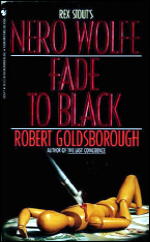
1990 Fade to Black
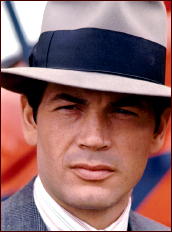
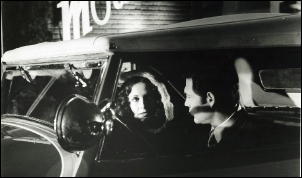
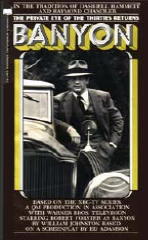
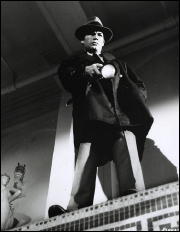
BANYON: WALK UP AND DIE. NBC World Premiere Movie, 15 March 1971, Monday at 9-11pm. NBC World Premiere Movie / Warner Brothers Television. Cast: Robert Forster as Miles C. Banyon, Darren McGavin as Lieutenant Pete Cordova, Jose Ferrer as Lee Jennings, Anjanette Comer as Diane Jennings, Herb Edelman as Harry Sprague, Ann Randall as Linda. Written and Produced by Ed Adamson. Executive Producer: Richard Alan Simmons. Director: Robert Day.
NBC World Premiere Movie began in 1966 as a means for the network and the studios (it was an idea of Universal Studios) to profit from pilots for possible television series. When Banyon aired in 1971, the movie series had all ready produced twelve series for NBC, and even the failures were profitable for their studios in syndication.
A note about the title: the movie was called Banyon, but in syndication to separate it from the series it was also known as Banyon — Walk Up and Die.
The problem with TV Movie pilots is telling the best story is not the primary goal. Instead you need to establish premise, setting and characters for the possible weekly series while hopefully providing an entertaining drama or comedy.
For example, several scenes were forced into this story to establish the series’ comedy relief in the form of Banyon’s secretary. Banyon’s office was down the hall from Peggy Revere’s secretary school. Banyon “confesses†his passion and love for the much older Peggy (Hermione Gingold). She is not sure if he is kidding or needs a psychiatrist. They have an agreement for him to use one of her students whenever needed. This gave the young secretary-to-be some experience, and Banyon got his secretary for free.
The opening titles attempted to establish the time (1933-1938) with newsreel photos and art. The theme by Leonard Rosenman (Combat) sounded more generic 70s than something suitable for a hardboiled PI mystery set in the 30s. However it was better than the series theme by Johnny Mandel (M*A*S*H) that only reminded us the series was a Quinn Martin Production. (Quinn Martin had no involvement with this TV movie pilot, but more on that later.)
Irene (Deidre Daniels) is told her ex-boyfriend, mobster Victor Pappas (Ray Danton) is out of prison. Because of her involvement in sending him to jail, she fears for her life. A friend sends her to a guy who can help her. She has to introduce herself to the guy who pulls out a gun and kills her. The killer leaves, removes the fake sign on the door that had covered the office sign of Miles C. Banyon, PI.
Meanwhile, Miles finishes another case and is sulking because he hates his job as a PI. He enters his office and finds Lieutenant Pete Cordova (Darren McGavin) waiting with the dead body. Miles barely reacts. Cordova notes the murder weapon was Miles’ gun. The Lieutenant is ex-cop Miles’ former partner and tries to play nice, but Miles still holds a grudge against Cordova and offers him no help.
A few years before, Miles had gone undercover as a cop-on-the-take to get the evidence that convicted Pappas. But there had been a political mess involving the department at the time and Miles had been picked to be the fall guy. Worried about how he would support his family without his job, Cordova had helped the department frame bachelor Miles.
Miles arrives at home only to find his best friend and legman Harry (Herb Edelman) drunk and asleep. Harry is avoiding his wife Ruthie (Leslie Parrish). Before Harry and Ruthie married, she had dated Miles. Now Harry is convinced she wants Miles because he is a broke loser working for others as a legman and Miles is a disgraced ex-cop turned sulking PI. And all three know Harry is right.
Miles sends Harry home, has some China tea (he doesn’t drink liquor) and begins to work on the only thing that makes him smile, his erector set. Sadly, he is interrupted by a phone call from Pappas who invites Miles to his place to talk. Miles agrees to meet with the man who swore revenge against him and others who had put him in jail, others such as the dead ex-girlfriend Irene.
Miles finds no one in the apartment. He looks around and finds and plays a record with music (“Remember Whenâ€), followed by the voice of powerful radio gossip Lee Jennings (Jose Ferrer) informing his listeners he is upset over Pappas parole and brags about his role in getting the mobster behind bars, then the record cuts to Pappas’ voice threatening Miles.
The cops arrive and haul Miles off to the police dungeon where Cordova takes away Miles licenses to be a PI and carry a gun.
Miles is summoned to meet the all-powerful Lee Jennings who wants Miles to find Pappas and stop him from killing anyone else (especially him). Banyon says no and humiliates the bully in front of his lackeys and his popular wife (with all the men).
Miles is not afraid of Jennings because he had nothing that Jennings can take…except Harry. When Jennings threatens to ruin Harry, Miles agrees to work for Jennings. After another killing or two, Miles, with the help of Harry, finds Pappas.
Banyon was the creation of writer Ed Adamson who had written the script specifically for actor Robert Forster. Adamson had written in radio for several series including That Hammer Guy (Mike Hammer). In TV his resume featured such series as Richard Diamond, Wanted Dead or Alive, and Mannix.
Adamson’s script had its flaws, the most serious of which was it lacked any reason for the viewer to care about Miles C. Banyon. On the plus side the movie has a final act that makes Banyon — Walk Up and Die worth watching.
The Oscar-nominated actor Robert Forster (Jackie Brown) is a rare disappointment. Usually the highlight of anything he does (Kate Sisco, Hollywood Harry, Alcatraz), he played the self-pitying Miles with a dull disinterest through most of the movie. He does redeems himself in the final act as he finally brings Miles to life.
Director Robert Day (The Avengers, Murder by Natural Causes, The Man with Bogart’s Face) made some odd choices, most noticeably during the scenes of violence. Twice, Banyon knocks out someone while the camera focused on another character’s reaction. All deaths took place off camera. Perhaps caused by Congress continued pressure on the networks over violence on television, but this visual style soft-boiled the hard-boiled PI.
The vintage clothes, the use of 30s music and radio shows such as Fibber McGee and Molly, as well as vintage automobiles driving a few feet along the studio lot 1930’s street gave Banyon — Walk Up and Die less a sense of the real 30s and more a 1930s movie feel.
While I was unable to discover what exactly was on television opposite of this TV Movie, ABC was scheduled to run ABC’s Monday Night Movie, while CBS was scheduled to air Mayberry RFD (9pm), Doris Day (9:30pm) and The Carol Burnett Show (10pm).
NBC liked this pilot and considered ordering it as a series for a possible 1971 -72 mid-season replacement. Someone else liked the movie, Quinn Martin. QM Productions was one of the top independent TV Production companies of the time and had never had a series on NBC. NBC offered Banyon to Quinn Martin, creating a behind the scenes turmoil between Ed Adamson and the QM people forced on him.
The first episode of the NBC series aired September 15, 1972 and had a ratings share of over 30 and finished 31st out of 65 shows. Broadcasting (September 25, 1972) sampled reviews of the first episode from various critics who were near united in their disappointment.
The next week’s episode dropped to low 20 shares and from then on the series would finish each week in or near the bottom ten. It aired Friday night at 10pm opposite CBS Friday Movie and ABC’s Love American Style.
On October 2, 1972, Ed Adamson (58) died of a heart attack. His dream TV series Banyon would soon follow with its last original episode airing January 12, 1973.
For more information about the series, check out this post on The Rap Sheet blog.
For a updated link to sample the book Quinn Martin, Producer by Jonathan Etter:
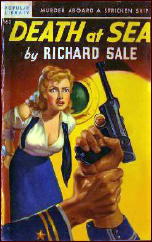
RICHARD SALE – Death at Sea. Popular Library #163; paperback original; 1st US printing, 1948. First published in the UK as Destination Unknown: World’s Work, hardcover, 1940.
That there were eight years between when this book was published in England and when it finally came out in the US is an interesting fact, and there may even be a story behind it. Or perhaps not. Even more likely, we may never know, but the passage of time certainly affected the immediate relevance of the story, which takes place in 1940 on a Dutch freighter in the Caribbean, a ship that also takes on passengers.
What’s significant here is the year, 1940, and Nazi agents are everywhere – and something they may have their eyes on is the S. S. Apeldoorn. On board is a passenger named Gabriel Adams, an ichthyologist by trade, and as a brief side trip on his way to a conference in Brazil, he stops to pick up a rarity, a modern-day specimen of a fish long since believed to be extinct.
Getting back to the ship, though, all of the other passengers have cancelled, and two members of the ship’s crew were replaced at the last minute before the voyage by two others, neither of who are known to the captain. Signs of dangerous waters on the horizon?
There are, not too surprisingly, a couple of good-looking women involved. Richard Sale didn’t spend most of the 1930 writing thrillers like this for the pulp magazines for nothing. Adams proves himself to be more than an expert on fish when he sees through the first one’s wiles almost immediately, but he’s saved in the nick of time by the second when she claims to be his wife when the first follows up by attempting to pull a version of the old badger game on him. (Perhaps I ought to start taking Caribbean cruises. Such things have never happened to me by staying on dry land.)
The first half of this sea-going adventure is far better than the second. Once the mystery of what is going on is resolved, about half way through, everything falls into place rather sedately, figuratively speaking.
But here is a portion of the story as it appears on page 125. I could hear the voices of two rather famous movie stars in the roles, and perhaps you can, too. (Merrill is the second of the two ladies mentioned above. Setting: The pirates have just taken over the ship.)
Merrill was there [in the dining salon] too, dressed in sport dungarees and a white cardigan, sleeves up to a point below her elbows. Great girl, Gabriel thought, in grim admiration.
She was sitting coolly on the edge of one of the tables, a little pale, but without a sign of terror or hysteria. She was smoking a cigarette and she did not run to him and throw her arms around him and start crying. She just said:
“Hello, Gabriel. Come to hear the high council?â€
She took his hand and squeezed it hard and smiled crookedly at him. Her eyes were far away.
“Yes,†Gabriel said nonchalantly, and it was genuine nonchalance for he was too tired to give a damn at that point. “You were lucky to get a change of clothes. I’m still in this monkey suit.â€
“We were told to be quiet,†Merrill said. “You mustn’t talk so loudly. See the gentleman with a gun?â€
Gabriel saw him. It was another of the German lads, Leiper this time, and he looked ugly.
Devoted to mystery and detective fiction — the books, the films, the authors, and those who read, watch, collect and make annotated lists of them. All uncredited posts are by me, Steve Lewis.