ELIOT PATTISON – Bone Mountain.

St. Martin’s; trade paperback, May 2004. Hardcover: September 2002.

   I don’t know if you’re anything like me, but I’m pretty much intimidated by the sheer bulk of some of the books coming out today. Sometimes, as I’m looking through the stacks of books around here for something to read – and I don’t mean library stacks. I mean stacks – and if a book looks simply too hefty, too weighty, too long – you know what I mean – in terms of what I’m looking for at the time, I usually pass it by and go on to another.

ELIOT PATTISON Bone Mountain

   This happens more and more with fantasy epics, by the way, big thick books in series that go on and on forever, and how does one manage to keep track of the story, all of the characters, all of the various strands of the plot, unless you’re living it everyday, just as the author does, or has to, creating it, breathing it, playing scenes back, every free moment, his or her life taken over by nothing but.

   But I digress. As I was saying, I don’t recall precisely what the occasion was, but reading this particular book was the result of the decision made one day to give one the “big ones” a try. And it’s a big one, all right, over 400 pages of small print in an oversized trade paperback format. It’s also an introduction to a world that’s familiar to only a smattering of westerners: the land of Tibet, overrun and modernized by the Chinese in the world of today, or at least, under their rule, they’re trying their best to adapt.

   Pattison’s first book, The Skull Mantra, won the MWA’s Edgar award for the best first novel of 2000, and it introduced “disgraced ex-Beijing police inspector Shan Tao Yun” to the world of mystery fiction. (I’m quoting from the back cover here.) Bone Mountain is the third of his continuing adventures. Number two was Water Touching Stone, and newly out in hardcover is the fourth, Beautiful Ghosts.

   It took me two weeks to polish this one off, and I enjoyed every minute of it. You may have noticed that I have not mentioned anything about the plot, and the reason is that I’ve been putting it off, feeling myself not able to do justice to it.

ELIOT PATTISON Beautiful Ghosts    The candidate for the most obvious plot line, of which there are several, is that an idol (banned, of course, by the Chinese) is missing a stolen stone eye, and the band of Tibetans, along with one American cowboy (with diplomatic papers, but still a cowboy), with whom Inspector Shan is traveling has as their goal to replace it in its rightful spot in the Yapchi valley.

   Winslow, the disgraced diplomat, is also on the search for a missing female geologist, part of the oil venture that may soon displace the people of Yapchi valley, which is another essential thread of the tale.

   There are several murders to be solved and deaths to be explained, so that, yes, if you were wondering, this is indeed crime (and adventure) fiction.

   The real villain, however, is Beijing, and the Chinese government, intent on wiping out, destroying, annihilating an entire culture – that of traditional Tibet – and that, in the longer view, is the story that Pattison is telling, one story that’s now four books long.

   There is a sense of timelessness in the world he describes, in the provinces furthest from population centers, and there is along with it a dream-like quality of an ancient civilization that refuses to die in the face of overwhelming and dire adversity. More than once was I reminded of those epic works of fantasy I mentioned earlier, written by authors such as Tolkien and Robert Jordan, among others, but with the essence of reality about it – we do not really know how the story will end – behind the melancholy mask of tragedy.

   Not your usual detective story? Not by half!

— June 2004


ADDITIONAL COMMENT:  Here’s a news release that’s both relevant and of interest, I’m sure, if you’ve read this far…

Author of Tibetan Mysteries Banned in China

         For National Release (regional counterparts) May 21, 2004:

   Eliot Pattison, writer of the acclaimed Inspector Shan series, has so upset authorities in China that they are periodically blocking access to his website within China. Pattison joins a long list of human rights activists who have been singled out by Beijing for censorship-but he is believed to be the only writer of fiction to be thus censored. Numerous readers in China report that, like a number of sites criticizing the Chinese government, Pattison’s site is often blocked by the central authorities.

   Pattison’s award-winning mysteries, set mostly in Tibet, incorporate the Chinese gulag for political prisoners and China’s dismantling of minority cultures into their plots. His books have been highly successful in introducing these issues to new audiences–human rights activists state that his novels capture the realities of China’s treatment of ethnic minorities better than most works of nonfiction. His works have been compared to those of Solzhenitsyn, whose books in an earlier generation brought much-needed attention to the Soviet gulag.

ELIOT PATTISON Skull Mantra

   As soon as it was released, Pattison’s first novel The Skull Mantra, became a popular black market item within China as its citizens realized the book explained aspects of their country their government would never speak about. Interest in his books surged after that novel won the prestigious Edgar Award-since then his four novels have been translated into twenty languages and have been adapted to radio drama in Europe. Some editors have suggested that he has created a whole new genre of “campaign thrillers” which construct mysteries around political messages.

   Pattison began traveling to China the month that relations between Washington and Beijing were normalized in 1980. On his many repeat visits he became increasingly appalled at the rigid police control of Tibetan temples and other ethnic centers. “After writing several nonfiction books I wanted to try my hand at writing mysteries,” Pattison explains, “and also very much wanted to tell the world about the struggle Tibetans and other minorities face trying to maintain their cultural identity. Writing this series became the perfect answer.” While angered by China’s blocking of his website, he is not surprised-“the list of websites deemed politically undesirable to Beijing numbers in the hundreds,” he notes. “Censorship is a way of life in China, and will have to be addressed if China is truly going to join the global community. At the end of the day, of course, it just underscores the points I make in my books.”

[UPDATE] 02-19-08.  There’s not always a reason for going back to my files and picking out a review to run here, but this time there is. This one was written almost four years ago, and unless I’m badly mistaken, no one’s seen it but me until now.

   There is now a fifth book in the series, Prayer of the Dragon, out just recently, and on his blog Detectives Without Borders, Peter Rozovsky reviews it and throws out the following question for discussion:

ELIOT PATTISON Prayer of the Dragon

    “All this makes Shan Tao Yun more of an outsider than your average cop who’s impatient with his boss. For one thing, Shan’s outsider status is far more dangerous than that of most crime protagonists.

    “I’ll stop now and let you go read the books yourselves. […] While you’re on your way to the bookshop or library, ponder this question: Of all the outsider crime-fiction protagonists you know, who is the most outside, the most precarious, the most alienated? What makes him or her that way?”

   An interesting question, Peter. My money’s on Inspector Shan, but my knowledge of mysteries taking place all around the world is rather limited, regrettably so. There are some awfully dangerous places a detective can find him- or herself in. I’ll have to wait and see what your readers have to say.

BRUNO FISCHER – The Girl Between.

Gold Medal 1054. Paperback original; 1st printing, 1960.

FISCHER The Girl Between

   Here’s a pulp story that’s designed to tell you what really goes on inside the traditional smoke-filled room of small-time politics. To get onto the best-seller list, you have to aim a little higher, on the congressional level, at the very least, but [the] politics are dirtier, and the politicians even less further removed from racket bosses, in the realm of town and state government.

   Or so says Bruno Fischer, in this story of just such a [local] political boss. The father of his right-hand man, [leading protagonist] Curt Stone was a good guy squeezed out a long time ago. Two members of the opposition end up murdered, and one of their wives would make a handy scapegoat, if only she could be located. Other essential members of the cast are Maryann, the big man’s wife, who still feels the need to play around, and Hank, the throwback to another era, when brawn rather than brains was the more important requirement.

   Erle Stanley Gardner could have written parts of it. With calm, cool uncomplicated prose Fischer lets Stone dig himself in deeper and deeper, until he’s forced to choose sides once again. The reader is expected to pick up on an occasionally subtle plot twist, but you shouldn’t expect Fischer to reveal the killer quite so easily. The ending is pretty corny, and you probably even know what it is by now. Otherwise, I liked it fine. [B minus]

– From The MYSTERY FANcier, Vol. 3, No. 2, Mar-Apr 1979.


[UPDATE] 02-18-08. I liked to be elusive back when I wrote this, didn’t I? Or do I mean allusive? I added a couple of inserts and corrected one misspelled word, but it didn’t help. I have no idea what the ending is, except that I assume it turned out well, and a little soapy. Or do I mean soupy? No, I don’t think so.

   Here’s a complete list of Bruno Fischer’s work for Gold Medal. The Girl Between was the last book he wrote until The Evil Days in 1974, about which more later. Any of these is going to be worth reading. I guarantee it.

      House of Flesh. Gold Medal 123, 1950.
      The Lady Kills. Gold Medal 148, 1951.

FISCHER The Lady Kills

      Fools Walk In. Gold Medal 209, 1951.
      The Fast Buck. Gold Medal 270, November 1952.
      Run for Your Life. Gold Medal 343, October 1953.

FISCHER Run for Your Life

      So Wicked My Love. Gold Medal 437, October 1954.
      Knee-Deep in Death. Gold Medal 591, July 1956.
      Murder in the Raw. Gold Medal 694, August 1957.

FISCHER Murder in the Raw

      The Lustful Ape. Gold Medal 901, July 1959; previously published as by Russell Gray (Lion 38, August 1950)
      Second-Hand Nude. Gold Medal 928, October 1959.
      The Girl Between. Gold Medal 1054, November 1960.

   I’ll set up a link as well, but here below is Fischer’s mini-biography, as Victor Berch, Bill Pronzini and I wrote it in connection with the three books he wrote for Ziff Davis’s line of Fingerprint Mysteries. (In keeping with the covers I’ve already used, however, I’ll use scans of various paperback editions instead of the hardcovers. I hope you don’t mind.)

      The Pigskin Bag, 1946
      More Deaths Than One, 1947 [ PI Ben Helm]
      The Bleeding Scissors, 1948

   Before turning to writing for the pulp magazines in 1936, Bruno Fischer, born in Germany in 1908, held a variety of other jobs after high school: he was a sports reporter, rewrite man and police reporter for a Long Island newspaper, he was a truck driver and chauffeur, and he did book reviews and political columns for New Republic and other similar magazines. (The entire Fischer family emigrated to the US in 1913.)

   Once established in the pulp field, however, Fischer became a full-time writer, producing hundreds of mystery, detective, and weird menace stories for just about every magazine under the sun, using both his own name and the pseudonymous Russell Gray.

FISCHER The Dead Men Grin

   Fischer’s first hardcover mystery novel, So Much Blood, was published by Greystone Press in 1939. His primary series character, medium-boiled private eye Ben Helm, first appeared in The Dead Men Grin (McKay, 1945). Helm, who was married and was perhaps as much a criminologist as he was a PI, ended up in a total of six mystery adventures in hardcover before he was through.

   Fischer left the pulps and hardcover fiction behind in the early 1950s, and much of his reputation among collectors today rests on the large number of original crime novels he began doing then for Gold Medal. After 1969 he gave up writing to assume the positions of executive editor of Macmillan’s Collier Books and education editor of the Arco Publishing Company, both of which he held for over a decade.

   As for Fischer’s books in the Fingerprint series, The Pigskin Bag is a finely crafted suspense novel about a man who finds the eponymous bag in his garage, it having belonged to a man who died in an accident witnessed by his wife. Before he can take the bag to the police, it is stolen and a murdered man left in its place in the garage. Reviews were uniformly excellent. Will Cuppy in the Saturday Review, for example, called it “exciting, fast-moving, with some spine-tingling moments.”

FISCHER The Pigskin Bag

   The Bleeding Scissors is another suspense novel, this one involving a man whose wife suddenly and inexplicably turns up missing, a New York City play called “The Virgin Mistress,” an apparent hit-and-run death, and a villainous private detective (not “Nameless”).

FISCHER The Bleeding Scissors

   More Deaths Than One, the middle entry among Fischer’s Ziff-Davis mysteries, is Bill’s own favorite among the three. This one is an unusual detective story told in alternating first-person viewpoints among six principal characters, one of whom is Ben Helm, and another one of whom is the cleverly and fairly concealed murderer of a womanizing artist in a small upstate New York town.

FISCHER More Deaths Than One

   Fischer was particularly good at drawing believable characters whose actions and motivations are psychologically sound, an ability he demonstrated to good advantage in More Deaths Than One, and equally so in The Evil Days, his final work of crime fiction (Random House, 1974). Failing eyesight regrettably prevented Fischer from doing others, as he had planned. He died in 1992.

KILL ME AGAIN. 1989. Val Kilmer, Joanne Whalley-Kilmer, Michael Madsen. Screenwriters: John Dahl & David W. Warfield. Director: John Dahl.

KILL ME AGAIN

   Whee-oooh! For fans of modern noir drama, this movie will take you for quite a ride. Flawed though it may be, there are scenes in this movie that seem to come straight from those beloved yellowed old Gold Medal paperbacks from the 1950s, updated only a little – and thinking back, perhaps not even at all.

   Jack Andrews, played by Val Kilmer, is one of those down-at-the-heels Reno private eyes who exist only in fiction, who’s hired by a beautiful client to take on a slightly illegal job for her. The client, Fay Forrester (Joanne Whalley-Kilmer), claims that she is on the run from a former boy friend who’s stalking her and that police cannot do anything about it with no solid evidence that he means her harm.

   Her solution? To have Jack create a murder scene, with herself as the victim, so that she can take on a new identity and start a new life. She does not mention that she has a small suitcase in her possession filled with hundred dollar bills, and the “boy friend” is her former partner in crime, Vince Miller, played to perfect psychopathic perfection by Michael Madsen.

KILL ME AGAIN

   As it so happens, Jack has some seriously due gambling debts – so seriously that he has a broken little finger to show for it – and after thinking over for all of a minute and a half – not to mention that Faye is seriously beautiful – he agrees to take the job.

KILL ME AGAIN

   I forgot to mention the mob from whom Vince and Fay have stolen the money, nor have I said anything about the rock that Fay bashed over Vince’s head when she made her departure from him. Neither one will take their losses sitting down – neither the mob, nor Vince.

   The murder scene that Jack creates is only moderately successful, and when he catches up with Fay again – yes, figure that out – they both find that their trail has not been terribly difficult to follow. Hence the title, and I wouldn’t have told you quite so much about the story if I hadn’t have thought that the title needed an explanation.

KILL ME AGAIN

   Beautifully photographed in color rather than black and white, the movie still manages to demonstrate its noir roots in shadows and shading and even broad daylight. Nicely done, and there are some nice twists to the tale that I have not been even close to telling you about.

   Flaws? There may be a twist or two too many for some, but they worked for me, all but perhaps the very last one. (I’m still thinking that one over.) Michael Madsen plays lunatic madmen as well as anybody, and Joanne Whalley-Kilmer is not only savagely beautiful, with curves galore, but she is (or her character is) also seriously loopy in the head. You can almost hear the wheels moving in her mind, with a lusty gleam in her eyes, whenever she’s contemplating her next course of action.

KILL ME AGAIN

   Val Kilmer, on the other hand, seems to be the only one not seriously up to his part. His face is too innocent, too much of choir boy’s, to be first of all, a down-at-the-heels Reno private eye who exist only in fiction. That he’d get caught up in the grip of lust for Fay Forrester goes without saying – or is only interested in the money – or is he trying for both? His facial expressions do not give it away, which in some sense is good, but after a while you begin to wonder as you start to realize that he only has two or three facial expressions to give.

   An almost forgettable flaw, perhaps, but perhaps not, and I thought I’d better warn you. All in all, I thought the movie was terrific, or mostly so, but there are others who don’t. My recommendation: Don’t listen to them.

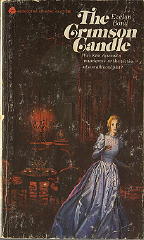
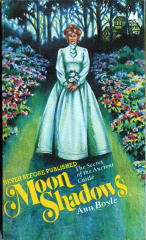
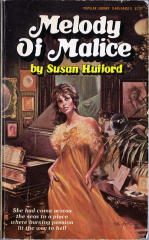
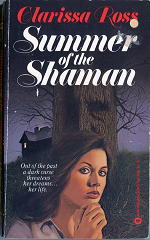
   Having cleaned and sorted out half of the garage earlier this winter, I’m now tackling the boxes of books that have been stored in the basement for several years. One of these happened to be filled with gothic romances, and what you see below are the bits of information that will show up in the next installment of the online Addenda to the Revised Crime Fiction IV, by Allen J. Hubin. (Consider this a sneak preview.)

ARLISS, JOEN. Pseudonym of Ian Martin, q.v. Under this pen name, none under his own name, the author of five gothic or romantic suspense novels included in the (Revised) Crime Fiction IV, all published in a short period of two years, 1979 to 1980. Series character Kate Graham appears in two of them, both of them published in the Zebra Mystery Puzzler series. (The last chapters of books in this series were sealed to keep the solutions from being read too early.)
      Shadow Over Seventh Heaven. Popular Library, pb, 1980. Add setting: California (Big Sur area).

ARLISS Seventh Heaven

BAKER, W. J. Pseudonym: John Churchward, q.v.

BRONTE, LOUISA. Pseudonym of Janet Louise Roberts, 1925-1984, q.v.
      Lord Satan. Avon, pb, 1972. Setting: England; 1815. Add: reprinted as by Janet Louise Roberts (Pocket, 1979).

CHURCHWARD, JOHN. Pseudonym of W. J. Baker, q.v. Under this pen name, none under his own, the author of one novel previously included in the (Revised) Crime Fiction IV. To this title, add the one indicated by an asterisk (*) below.
      The Rainbow Deaths. New English Library, UK, hc, 1977. “A secret agent finds a super weapon and plot to overthrow the government in rural English village.”
      * What Beck’ning Ghost? New English Library, UK, hc, 1975. US title: What Beckoning Ghost? (Berkley, 1977) Setting: England. [A ghost story spanning over a hundred years in time, with murder at the root.]
      _What Beckoning Ghost? Berkley, US, pb, 1977. See What Beck’ning Ghost?

CHURCHWARD Beckoning Ghost

DANTON, REBECCA. Pseudonym of Janet Louise Roberts, 1925-1984, q.v.
      Black Horse Tavern. Popular Library, pb, 1972. Add: reprinted as by Janet Louise Roberts (Pocket, 1980). Add setting: Boston; 1773.

DEVON, LYNN. Pseudonym of David A. Kaufelt, 1939- , q.v. Under this pen name, the author of one romantic suspense novel included in the (Revised) Crime Fiction IV. See below.
      Jade. Gold Medal, pb, 1978. Add setting: Long Island, NY [Sag(g) Harbor]; 1850.
[ “…a beautiful young bride [is] abandoned on her wedding night.” ]

LYNN DEVON Jade

KAUFELT, DAVID A(LLAN). 1939- . Pseudonym: Lynn Devon, q.v. Under his own name, the author of five novels included in the (Revised) Crime Fiction IV, including three with series character Wynsome “Wyn” Lewis, a real-estate broker living on Long Island.

MARTIN, IAN. Pseudonyn: Joen Arliss, q.v.

ØVSTEDAL, BARBARA KATHLEEN. 1925- . Pseudonyms: Barbara Paul, q.v.; Barbara Douglas & Rosalind Laker.

PAUL, BARBARA. Pseudonym of Barbara Kathleen Øvstedal, 1925- , q.v.; other pseudonyms Barbara Douglas & Rosalind Laker. Under this pen name, none under her own, the author of four romantic suspense novels included in the (Revised) Crime Fiction IV. [Note: This Barbara Paul is not the same author as American mystery writer Barbara (Jeanne) Paul, 1931- , who wrote the “Sgt. Marian Larch” detective novels, among many others.]
      The Seventeenth Stair. Macdonald, UK, hc, 1975. St. Martin’s, US, hc, 1975. Setting: France; add to setting: past (appears to be late 1800s: reference to carriages, steam-packets and tram rails). [The cover show is that of the Ballantine paperback reprint.]

PAUL Seventeenth Stair

ROBERTS, JANET LOUISE. 1925-1984. Pseudonyms: Louisa Bronte, Rebecca Danton & Janette Radcliffe. Under her several pen names and her own, the author of many gothic and romantic suspense novels. [A short profile of this author, including a complete bibliography, appears earlier on the Mystery*File blog.]
      _Black Horse Tavern. Pocket, pb, 1980. Add as a new title under this byline; previously published (Pop. Library, 1972) as by Rebecca Danton, q.v. Setting: Boston; 1773.
      _Lord Satan. Pocket, pb, 1979. Add as a new title under this byline; previously published (Avon, 1974) as by Louisa Bronte, q.v.

ROSS, CLARISSA. Pseudonym of W. E. D. Ross, 1912-1995, q.v.; other pseudonyms Laura Frances Brooks, Lydia Colby, Rose Dana, Jan Daniels, Diane Randall, Ellen Randolph, Dan Ross, Dana Ross & Marilyn Ross. Under this pen name, the author of some 45 novels cited in the (Revised) Crime Fiction IV, most of them gothics or romantic suspense fiction.
      Jade Princess. Correction: Delete the opening “The.” Pyramid, pb, 1977. Setting: Hong Kong.

ROSS Jade Princess

ROSS, W(ILLIAM) E(DWARD) D(ANIEL). 1912-1995. Pseudonym: Clarissa Ross, q.v.; other pseudonyms: Laura Frances Brooks, Lydia Colby, Rose Dana, Jan Daniels, Diane Randall, Ellen Randolph, Dan Ross, Dana Ross & Marilyn Ross. Prolific author of many books included in the (Revised) Crime Fiction IV, most of them published as gothic or romantic suspense novels.

SALVATO, SHARON ANN (née JOSEPH). 1938- . Author of at least six novels under her own name, three of which are included in the (Revised) Crime Fiction IV. The first two listed below are gothic romances, the third historical fiction. Four additional historical romances were written with Cornelia M. Parkinson as Day Taylor.
      Briarcliff Manor. Stein & Day, hc, 1974. Setting: New York. Add to setting: 1867. [Shown is the cover of the Dell paperback reprint.]

SALVATO Briarcliff Mano

      The Meredith Legacy. Stein & Day, hc, 1975.
      Scarborough House. Stein & Day, hc, 1975. Collins, UK, hc, 1976.

LAWRENCE BLOCK – Mona

Gold Medal s1085. Paperback original; 1st printing, February 1961. [Reprinted in paperback as Sweet Slow Death (Jove, August 1986), as Mona (Carroll & Graf, 1994), and as Grifters Game (Hard Case Crime, 2004). Hardcover reprint as Mona: Five Star, 1999.]

LAWRENCE BLOCK Mona

   All my sources seem to indicate that this was Block’s first mystery novel, and you may have some trouble finding a copy. Mine is pretty well battered, but it’s the only one I’ve ever come across.

   Is it worth looking for? No, not if you’re a Michael Innes fan, say. Yes, if you enjoy your crime fiction both smooth and tough. It’s a familiar story — a smart alecky con man meets a girl he could love and leave, but he does and he doesn’t, and he ends up trying to get away with murder. The husband is an obstacle, you see, but he’s a crook, it turns out, which helps…

   But what about those last two chapters? Block suddenly jabs the reader with a bit of cruel desperation not expected even of his amoral but likable hero. Maybe crime is a dirty business, after all.    [B minus]

— From The MYSTERY FANcier, Vol. 3, No. 2, Mar-Apr 1979.


[UPDATE] 02-16-08.   Also published under Block’s own name in 1961 were Death Pulls a Doublecross (Gold Medal, Sept 1961) and The Case of the Pornographic Photos (Belmont). I don’t have a copy of the latter, I have just discovered, but since Mona came out in February, I am 99.99% sure that the first half of my first statement is correct, with only one possible reservation:

   There may have been a book published under a pseudonym that came earlier, one of those paperbacks considered sleazy at the time, but reprinted more recently by a line such as Hard Case Crime and considered respectable now, and rightfully so.

   But why don’t I have a copy of The Case of the Pornographic Photos? It was a paperback based on the PI character Roy Markham who had a TV show of his own called Markham. It was on ABC during the 1959-60 season, and I never saw it once. Ray Milland played Markham, and the book was reprinted later by Foul Play Press as You Could Call It Murder. For some strange reason, I don’t seem to have a copy of that one either.

LAWRENCE BLOCK Mona   To get back to my first statement, the second half, it is no longer true that you will have trouble finding a copy of this book, as it has been reprinted so many times now that it has to be considered a classic in noir literature, the so-so letter grade that I assigned to it notwithstanding.

   One more thing. I’m going to quote Curt Purcell as to something he said on the rara-avis Yahoo group about three of Lawrence Block’s early books, Grifter’s Game, The Girl with the Long Green Heart and Lucky with Cards, all available under these titles from Hard Case Crime: “… in each of these three stories, the grifter debates how best to part the rich guy from his money and put him out of the way, and each time he arrives at a solution he rejects in the other two.”

   Now that’s pretty neat, isn’t it? (You can read my review of Lucky at Cards here.)

LUCIEN AGNIEL – Code Name: “Icy”

Paperback Library 63-310; paperback original, May 1970.

Agniel: Code Name Icy

   Of the three books I have by Mr. Agniel, none are copyright in his name, only by either Coronet Publications, who owned Paperback Library, or Warner Brothers. (More about the latter in a minute.) That’s usually a fairly broad hint that the author didn’t exist, that it was a pen name or, more likely, a house name.

   Not so in this case. First of all, and I just noticed this, my copy of Code Name: “Icy” has a handwritten inscription on the first inside blurb page, dedicating the book to Elizabeth. I’ll refrain from repeating the entire inscription. It’s not embarrassing, but I think it should remain private.

   Then, looking in Crime Fiction IV, by Allen J. Hubin, we find not only dates for Mr. Lucien (1919-1988), but a note that he’s included in Contemporary Authors. Pulling up the CA web page, I found that Elizabeth was his first wife, who died in 1973.

   Over the years Lucien Agniel served in World War II and was awarded a Bronze Star, among other honors; worked for the Charlotte News, the US Information Agency, Radio Free Europe, and US News and World Report, among other jobs and occupations.

Agniel: Zeppelin

   There are two books listed in CFIV for Mr. Agniel, this one in hand, plus Pressure Point, also from Paperback Library (November, 1970). Arguably there should be another, and I will send the suggestion on to Al in my next email to him: a book entitled Zeppelin (Paperback Library; May 1971), an adaptation of the Warner Brothers movie of the same title.

   I don’t know if you’ve seen the film, starring Michael York and Elke Sommer, but since I haven’t, I looked up the story line on IMBD, which reads as follows: [An allied spy who has pretended to defect to Germany in World War I] “finds himself aboard the maiden voyage of a powerful new prototype Zeppelin, headed for Scotland on a secret mission that could decide the outcome of the war.”

   Most of Code Name: “Icy” takes place in Paris, where the paths of the following characters converge: Eric Eis, an East German assassin who is working with the Russians but who apparently is a former American soldier presumably dead but whose body was never recovered. Fred Sherman of the CIA, who has received an anonymous letter reporting that Eric Hendricks, an American deserter, is still alive; Dr. Richard Hendricks of St. Louis, the brother of the man presumed dead; “Gloria,” who sent the anonymous letter to Fred Sherman; and Nicole, of Birmingham, England, working as a gold-digging stripper in a Parisian night spot, and whom Fred Sherman appears to becoming excessively fond of.

Agniel: Pressure Point

   There is one other incidental participant in the tale, one unnamed, but suitably snooty President of France. It will come as no surprise that he survives. None of the others’ plan work out exactly as they had planned, however, except perhaps Nicole’s.

   All in all, a rather modest affair, one that can be read in a couple of nights before turning off the light. Fred Sherman seems a fairly sappy guy for a CIA agent at first, but he redeems himself reasonably well toward the end. A quick skim through Pressure Point doesn’t turn up his name as an active participant, so it looks like this was his one and only outing – the only one worth recording in book form, that is.

   Following the recent review I posted of Catch a Killer, by Ursula Curtiss, also known as The Noonday Devil, a lengthy discussion has developed between Juri Nummelin and myself in the comments section.

   Part of the conversation deals with “female noir” as a subcategory of crime fiction — what is it and what books might qualify — and specifically if that’s what Ursula Curtiss’s early books might be called.

   And where do “gothic romances” fit into the picture, if at all?

L A. CONFIDENTIAL. Unsold television pilot, 2003. Keifer Sutherland, Josh Hopkins, Melissa George, Pruitt Taylor Vince, Eric Roberts. Director: Eric Laneuville. Based on the novel by James Ellroy.

   Filmed in 1999, says IMDB, as part of a deal with HBO in 2000 as the first installment of a 13-part mini-series. When that didn’t happen, Fox took interest, but in the end, they also turned it down. Their loss, and ours.

   The date 2003, by the way, is when the cable network Trio finally aired it as part of a long marathon of similar bankrupt and cancelled projects.

   I’ve not read the book, which is number three in Ellroy’s series of 1950s L.A.-based novels: The Black Dahlia was the first; number two was The Big Nowhere; and the fourth was White Jazz. I’ve also not seen the full-length movie version of L. A. Confidential (1997), a huge gap or gaffe on my part (take your pick), but at least you can say that this review of the TV version is unbiased in terms of any sort of comparisons, or any other kind of useful information.

   This TV film, all that was ever made, is only 50 minutes long, and it ends with a large TO BE CONTINUED across the screen. Just as all of the pieces were coming together! Utter frustration.

   Keifer Sutherland, not yet a 24-carat star, is Det.-Sgt. Jack Vincennes in this one, the role played by Kevin Spacey in the film. Melissa George is would-be movie starlet Lynn Bracken, played by Kim Basinger in the movie. I could go on and on like this, but the TV version is not the same story as the earlier version (or so I’m told), but essentially a different (and ultimately longer) adaptation of the book, produced and created by men with different ideas, limitations and goals in mind.

   Basic story: Vincennes, having killed an innocent man during a drug bust gone bad, tries to make up for it by anonymously sending money to the dead man’s widow. This means that he needs more money than he makes, which means in turn that he has to go on the take. Not a good idea when Internal Affairs is watching, not to mention the editor and publisher of Hush Hush Magazine.

   The TV version is visually striking in color, but in terms of overall production values, I doubt that it holds up in that regard to the movie. Note to self: watch the movie, and report back.

[UPDATE]   I haven’t found any images to add to this review, but for as long as it’s there, you can watch this short pilot online in five parts, beginning with http://www.truveo.com/Part-1of-5-LA-Confidential-TV-pilot-Kiefer/id/1356656397

[UPDATE #2] 03-07-12. As suspected, the video above is no longer there. See the comments, though, for information as to how to find a copy.

URSULA CURTISS – Catch a Killer.

Pocket 940; 1st pr., June 1953. Hardcover edition: Dodd Mead, 1951, as The Noonday Devil.

URSULA CURTISS Catch a Killer

   It’s my guess that every time one of Ursula Curtiss’s books is reviewed today, it begins with the observation that her mother was mystery writer Helen Reilly, and that her sister was mystery writer Mary McMullen. (And equally obviously, I’m no exception.)

   It must have been in the genes, but during the time when all three were actively writing (Reilly from 1930 to 1962; Curtiss from 1948 to 1985, with a posthumous collection of short stories; and McMullen from 1951 to 1986), do you suppose that anyone ever asked them what was in the water they were drinking?

   While Helen Reilly had a series detective who appeared in most of her books – Inspector McKee of Manhattan Homicide – Ursula Curtiss and Mary McMullen, from all I know, gained largely from reading about them, were heavy practitioners of (suburban?) domestic malice and/or romantic suspense, and neither of them used a repeating character in any of their books.

   For me, this is largely hearsay, especially as far as Curtiss is concerned, as this is the only book of hers I’ve read. So far. In any case, what you expect is not always what you get. In Catch a Killer, for example, I was surprised (although far from nonplussed) to discover that the leading character is male, and that the story begins in Manhattan. I had the uneasy feeling that I was leaning one way, and the book, with Curtiss in charge, was going another.

   In the second half of the book, the scene changes, however, and rather drastically. Under some pretext or another, all of the leading characters seem to find their way to the same small country town in New England, and when they do, everything seems to revert to normal. (By which I mean, closer to what was expected, if not anticipated.) And as a direct consequence, most probably with the characters’ closer proximity to each other, the action seems to pick up as well.

URSULA CURTISS Noonday Devil

   The atmosphere is black, introspective and moody throughout. And as you well know, or you should, coincidences simply thrive in such climates – beginning as they do here, in Chapter One. When you walk into an unfamiliar bar for the first time, for example, you never know whom you’ll meet, and that’s where Andrew Sentry finds a man who’d been in the same Japanese prison camp as his brother Nick – an encounter occurring solely by chance.

   Nick had died in a subsequent attempt to escape, and his death, Andrew for the first time is now told, was no accident. There was an informer in the camp – someone Nick knew – who told their guards of Nick’s plans, which were then foiled. This is an unusual (if not unique) means of killing someone, but who was the mysterious man who called himself Sands? And what was his motive?

   More coincidences begin to pile up. Every male in Andrew’s small circle of friends and acquaintances suddenly seems to have been a Japanese prisoner in the Philippines at some time or another during the war. Nick’s fiancée Sarah Devany may have received a postcard in code from him just before he died, but when a simple question might have unraveled the mystery before it has even begun, there are barriers which by fate have carefully been laid in the way.

   When Andrew came to break the news of Nick’s death to Sarah, it is revealed, he found her kissing another man, and he has not spoken to her ever since. And since the case for murder is so flimsy, the police cannot be called in, which limits Andrew’s resources to himself and whoever he feels he can trust, the list of those in this category changing chapter by chapter.

   And in similar fashion does the reader’s grip on the story, or vice versa, the story’s grip on the reader. Excellent characterizations are mixed helter-skelter with a plot that’s held together with a strong, industrial brand of duct tape. Nonetheless, New England summer towns can be filled with as much malice as large population centers such as Manhattan, and the generally capable touch of Ursula Curtiss goes a long way in proving it.

– January 2004


[UPDATE] 02-13-08.   I read and reviewed this book four years ago, and do you think I remember it? If I hadn’t written this review, I don’t believe I would even have remembered reading it, if you’d asked me.

   But after reading and slightly revising the review, it all came back to me — everything, that is, except whodunit. I’m willing to wager that if I started to read the book again now, I still wouldn’t remember who the killer was.

   I don’t know whether that’s a good thing or not.

   But in any case, I mentioned in the course of the review that this was the first mystery I’d read that Ursula Curtiss had written. It’s also still the only one, not through any fault of hers!

THE LONE WOLF IN PARIS. Columbia, 1938. Francis Lederer, Frances Drake, Walter Kingsford, Leona Maricle, Albert Dekker. Director: Albert S. Rogell. Based on the character created by Louis Joseph Vance.

   Michael Lanyard, also known as The Lone Wolf, appeared in eight novels written by Vance between 1914 and 1934; in 24 movies between 1917 and 1949; in a 1948 radio show on Mutual; and in a 1954-55 syndicated TV series. (I didn’t want you to think we were talking about any old fly-by-night sort of character here.)

The Lone Wolf in Paris

   By the end, he was essentially a good guy, almost but not quite a private eye, I believe, but he didn’t start out that way. In the beginning he was a gentleman European jewel thief, pure and simple, but his penchant for helping beautiful women in distress eventually convinced him that working for the law instead of against not only had the advantage of being able to continue his narrow-escape adventures, but without the disadvantage of always having the police close behind his heels. At least theoretically, anyway.

   In The Lone Wolf in Paris, suave Czechoslovakian-born Francis Lederer’s only opportunity to play him, Lanyard is on the edge of reform. He has letters from heads of police departments from all over Europe to vouch for him, but the hapless manager of the Paris hotel where he is staying immediately has a suspect in hand when robberies begin taking place in several rooms of his establishment.

   In the hotel at the same time, it seems, are three rich members of Arvonne royalty, who between them have the crown jewels of their country. (Arvonne is a small country found somewhere on the map near France, we are led to believe.) Princess Thania (Frances Drake) desperately needs them back. Once the people of Arvonne learn that they are missing – a good deed gone bad – the Queen will be forced to abdicate.

   There is a lot of pleasant thievery and derring-do packing into the 66 minutes of this movie. There are also a few brief opportunities for romance between all of the switches back and forth between the real gems and fake ones made of paste. It’s a minor film, but a very enjoyable one nonetheless. The hour and change in running time goes by very quickly.

« Previous PageNext Page »