Mon 19 Mar 2007
Just a quick note to let you know that the covers to the Phoenix Press mysteries are now complete through 1946. Check out the latest additions here.
Mon 19 Mar 2007
Just a quick note to let you know that the covers to the Phoenix Press mysteries are now complete through 1946. Check out the latest additions here.
Sat 17 Mar 2007
PATRICIA SPRINKLE – Death on a Family Tree
Avon, paperback original; 1st printing, January 2007.
Here’s an author who’s been writing mysteries for quite a while, and (this may come as no surprise) this is the first one of hers that I’ve read. From the author’s website and a few other sources, including Crime Fiction IV, by Allen J. Hubin, I’ve come up with what I believe is a list of the books she’s done. Note that in some cases her byline is Patricia Houck Sprinkle.
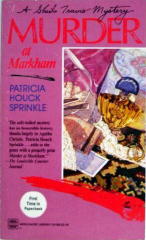
Sheila Travis Series: In Murder at Markham Sheila has been recently widowed and is working for a diplomatic training center in Chicago. Assisting her in solving crimes is her Aunt Mary, who hails from Atlanta, where Sheila frequently goes back to visit. In the third book in the series, Sheila moves back there permanently.
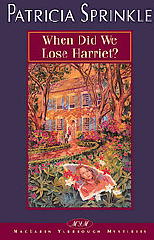
MacLaren Yarbrough Series: In the first book in the series, MacLaren is a wife of Judge Joe Riddley Yarbrough, a magistrate for the state of Georgia. In the second book, after her husband is shot, and two other people are murdered, MacLaren not only solves the crimes, but she takes over his position on the bench as well. After the first two novels were published by a Christian press, the rest of the series were published as mass-market paperback originals.
The Family Tree Series:
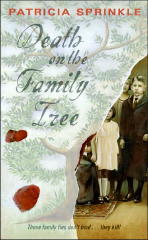
From Ms. Sprinkle’s website she says about her work in progress: “Now I am deep in the tenth, and probably last, MacLaren Yarbrough mystery, What Are You Wearing To Die?” Which strongly suggests, of course, that she’s in the midst of shifting gears. Future mystery adventures will be concentrating Katharine Murray, a middle-aged Atlanta housewife who’s well-off and somewhat pampered, and whose first brush with crime in any form Death on the Family Tree is.
The book begins on her 46th birthday, which she’s spending alone and which, unbeknownst to her, is her last day in her old comfortable life. Her children have moved out, and her husband Tom is out of town. Opening a box left to her by her recently departed Aunt Lucy, she finds two unusual items in among the junk: an ugly bronze necklace dating from the mid-1800s from Halstatt, Austria, and a diary, written in German and dating from a far more recent 1937.
As she begins some genealogical researching she soon discovers relatives that she never knew she had, that there are secrets in her family she had never been told about, and that the diary means something to someone who will stop at nothing to possess it. You may have guessed that about the latter.
Also re-entering her life is a former boy friend, one she’d unceremoniously dumped before she married Tom, who is blissfully unaware that his absence in this crucially important time is his wife’s life is as serious as it is. Make that totally oblivious. (Speaking from a man’s point of view, he is a blithering idiot, and if he doesn’t watch out, he will deserve what he will most certainly get in the next book in the series.)
Forgive me. I had to get that out of my system. It takes a while for all of Katharine’s family, her friends, and her friends’ families straightened out in the reader’s mind, and there surely are a lot of them, family, friends and relatives, that is. Katharine herself is prone to talking too much to all of them about her finds, and almost everyone else she meets. This was a tendency that this reader found almost intolerable, especially when all of this excessive talking leads to her being chased by cars, break-ins at her home, and eventually worse: several murders.
It is soon clear (or it was to this reader) who is responsible for all of this nefarious activity, but Katharine, who even toward the end of the book still has not learned much about this Brand New World she is in, walks straight into the hands of the enemy, as if without a thought in her head.
I don’t usually start yelling at characters in the mystery fiction I am reading, but I did this time. Perhaps that means that I cared? Perhaps so.
Sat 17 Mar 2007
If I followed his instructions correctly, my son-in-law says the M*F blog “is now mobile ready. Access mysteryfile.com/blog/ from your web capable mobile device and you’ll get a specially formatted page with all the same info.”
I’d try it out myself, but I don’t even own a cell phone yet. If it works where you are, let me know.
Sat 17 Mar 2007
I don’t know if I can do this, but I’m going to give it a try. I recently came across an episode of the 1940s Ellery Queen radio program that I hadn’t heard before, and maybe I can make it available to you here. The sound isn’t very good, but I think it’s listenable.
Clicking on this link should start it playing. You can also download it and play it later. If all goes well.
[UPDATE] 03-18-07. Not having been informed of any difficulties, I’m assuming that everyone who’d like to has been able to listen. I shall, more than likely, do this again. For example, I’ve just come across an Australian radio series called Carter Brown Mysteries. As part of the introduction to the first story, interviewed is none other than Carter Brown himself. I’ll make it available here as soon as possible.
As for “The Income Tax Robbery,” here is what Francis M. “Mike” Nevins, the world’s leading expert on Ellery Queen, has had to say, as excerpted from a couple of emails:
“I won’t be able to listen to that EQ radio play till the next time I go in to school, but the original air dates were March 12 and 14, 1942. I was told years ago that a cassette copy was available for listening at the Library of Congress. That copy I assume is the source of whatever you came across.”
During 1942, the Ellery Queen program was broadcast twice, the earlier date for West Coast listeners, the second date for those on the East Coast. The stories were the same but different “armchair detectives” were used, either in the studio or on call by telephone. The programs stopped before the ending so that these guests could be asked to solve the crime at the same time that Ellery did. (They were often correct.) Scripts were by Frederic Dannay and Manfred B. Lee. The cast included Carlton Young as EQ, Santos Ortega as Inspector Queen, Ted de Corsia as Sgt. Velie, and Marian Shockley as Nikki Porter.
Here’s Mike again, in an email I received today:
“I came down to school for a while this morning and played ‘The Income Tax Robbery.’ What you have is clearly the East Coast version, broadcast March 14, 1942. The full name of the mayor who served as guest armchair detective by telephone was Howard W. Jackson.”
[UPDATE] 07-22-07. I never did get around to transcribing that on-the-air interview with Carter Brown. This morning, though, Toni Johnson-Woods came to my rescue. She posted a comment to this blog entry which I’ve upgraded to a new post of its own. You’ll find it here, along with MP3 links to the complete first story of the series, a four-parter called “Call for a Columnist.” Toni also supplied me with a link to another episode entitled “Swimsuit Sweetheart.” Go take a look. And listen.
Fri 16 Mar 2007
Vince Keenan, my mystical master in all matters movie-wise, recently mentioned on his blog a soon-to-released boxed set of DVDs that is simply said, a must-not-miss. Available on March 20th is a boxed set of four Michael Shayne films from the forties that I have not seen in a long, long time, if ever.
All four of them star Lloyd Nolan, whom you’d never go too far wrong by casting him as a semi-down-on-his heels private eye, but as Vince says, the perfect fellow would have been Ken Tobey.
Contained in this set are:
Michael Shayne, Private Detective. 1940. This is one of the very few Mike Shayne movies that was actually based on a Mike Shayne novel. I’ve not checked to see how many of the rest of them were, but in this case it was Dividend on Death (Holt, 1939). [Note that Crime Fiction IV is in error on this point, and a statement to that effect has been made in the online Addenda to the Revised Edition, Part 12.]
The Man Who Wouldn’t Die. 1942. Credit is given to the Brett Halliday characters, but the novel it’s based on was Clayton Rawson’s No Coffin for the Corpse, a classic Great Merlini “locked room” mystery. Having never seen this film, and I’m very eager to, I don’t know how much of the plot line has been preserved, but for what it’s worth, way down in the IMBD credits is Charles Irwin as “Gus, the Great Merlini” (uncredited).
Sleepers West. 1941. This one’s based on Frederick Nebel’s mystery novel, Sleepers East. I don’t know. You tell me.
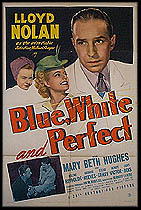
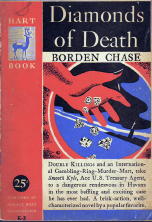
Blue, White and Perfect. 1942. Credit for the characters was once again given to Brett Halliday, but the story the movie’s based on was actually written by Borden Chase. It didn’t appear in book form until it came out as a 1947 digest paperback entitled Diamonds of Death (Hart K-2). The first appearance of the story was probably as a serial in one of the pulp fiction magazines in the 1930s.
As much as I’d like to, I can’t review the movies now, but the odds are that I will, as soon as I’m able. Let’s go back to Vince’s comment that the perfect gent to play Michael Shayne would be Ken Tobey. (Looking back, I see that I’ve been assuming all along that you know who Mike Shayne is, and who Brett Halliday was. I didn’t intend to go into it here, and I won’t, but what I will do to send you to Kevin Burton Smith’s Thrilling Detective PI site, and trust to your good judgment to come back. It’s a gamble on my part, because I know from experience that you could easily get lost and spend days on end there, if you’re not careful.)
Here’s a picture of Mike Shayne that was used on the covers of tons of 1950s Dell paperbacks. I’m not sure, but I suspect that the artist responsible was Robert Stanley. I’m sorry that it’s rather small, but it was only used in the corner of the covers.

Now here’s one of Lloyd Nolan. I can’t at the moment guarantee that this comes from one of the Mike Shayne movies, but I think it does. It’s the right vintage, at least:
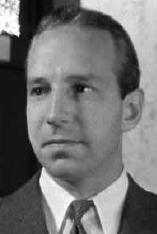
Maybe he needs a hat and a cigarette drooping out of his lip, but I don’t see a resemblance.
Here’s one of Hugh Beaumont. Before he became famous as Beaver’s dad, Hugh Beaumont remained fairly non-famous by playing the part of Mike Shayne in five films cranked out for PRC between 1946 and 1947. (Will these show up on DVD some day?)
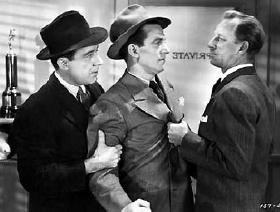
He isn’t bad, but it’s tough to tell, since all we see in this photo is his profile, but if you think about the Beaver’s show, and think Mike Shayne, do you get the same disconnect that I do?
Mike Shayne was also the star of aTV show for one season on NBC, 1960-61. I was away at school then, and didn’t have time for TV, so I never saw it. I believe some of the shows are available on DVD, and if so, that’s one more item I’ll have to addto my next Amazon purchase. I also just realized that I didn’t mention that Richard Denning was the star. Here’s his likeness:
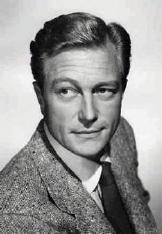
Do you know what? As the years went on, I think the producers and the casting personnel were getting closer.
Vince said Kenneth Tobey was the man, though, and I’m in full agreement. What do you think?
[UPDATE] 03-19-07. A few typos have been corrected in the essay above, and several questions of a bibliographic nature have been answered, requiring a bit of revising here and there. This is now (um) the current version. Thanks again to Vince Keenan for allowing me to play on his ground.
Fri 16 Mar 2007
Jamie Sturgeon recently sent me a couple of emails about some of the obscure authors who’ve been discussed here. I’ve been remiss in not posting them earlier, but here at last they are. The first one concerns the inquiry about Arthur J. Rees.
I wonder if Arthur J. Rees emigrated to Australia to live with his two sisters and died there? His last book, The Single Clue, although set in England, was published only in Melbourne in 1940.
Best Wishes,
Jamie
Jamie, I hadn’t noticed that, and thanks. I’ve added the information to the list of Rees’s books in that previous post. There’s also a lengthy gap between that book and his previous one, which came out in 1934. There’s probably an explanation, but at this late date, it would be awfully hard to find someone who’d know.
Jamie’s second email refers to the post I did on Ramble House Books as soon as I learned that Fender Tucker was reprinting a couple of mysteries by British author Rupert Penny:
Noticed your mention of Rupert Penny. Did you know about his pseudonym Martin Tanner? See Al’s Addenda Part 5 on CrimeFictionIV.com. Penny is also mentioned in Geoff Bradley’s CADS Supplement Private Passions Guilty Pleasures, where Martin Edwards’ Private Passion/Hidden Gem are the books by Rupert Penny. Martin Edwards says that Penny (Thornett), after he gave up writing crime fiction, became a leading figure in the British Iris Society, editing its yearbook.
Best Wishes,
Jamie
You can follow the link to find Jamie’s information on Penny as Martin Tanner, but to save you the click of the mouse, here it is below. I believe that the years of birth and death for Thornett are new also.
TANNER, MARTIN. Pseudonym of Ernest Basil Charles Thornett, 1909-1970. Other pseudonym: Rupert Penny, q.v.
Cut and Run. Eyre, 1941 (correcting publisher and date)
Perhaps it’s clear from the title and Jamie’s mention of it what Private Passions Guilty Pleasures consists of, but if you go here you will learn more, and if you are like me, you will learn enough to know that it’s a must have.
In short, however, in celebration of the 50th issue of Geoff Bradley’s printed zine called CADS, 87 crime writers, critics, fans and CADS contributors responded to the topic of what authors and what mysteries they have secretly (perhaps) enjoyed the most. Their comments were then compiled and published in booklet form separate from CADS #50, but mailed along with it.
I don’t know if Jamie intended for me to mention it or not, but he’s one of the contributors, along with Martin Edwards, Colin Dexter, Reginald Hill and Peter Lovesey, to name but a few.
CADS is short, by the way, for Crime and Detective Stories.
Fri 16 Mar 2007
THE SCARLET CLUE. Monogram, 1945. Sidney Toler, Mantan Moreland, Benson Fong, Virginia Brissac, Ben Carter, Janet Shaw, I. Stanford Jolley [uncredited]. Director: Phil Rosen.
My brother and I used to watch these Monogram entries in the Charlie Chan series on television every Friday night when we were kids, and we sure got a hoot out of them — even, I’m sure, the earlier ones with Warner Oland as well. We had to keep the sound down, since our parents were sleeping in the downstairs bedroom then, so we sat as close to the screen as we could, and enjoyed the heck out of staying up late, because it didn’t happen often.
The funny thing is, I don’t remember any of them, only some general impressions. The crimes, the oddly stiff Sidney Toler, the interchangeable actors who played the number two or number three sons, and we wondered why Birmingham Brown (Mantan Moreland) wasn’t in all of them.
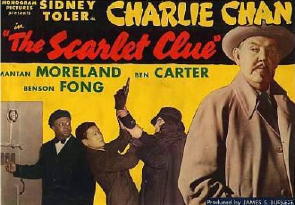
A major clue in this one is a bloody footprint found at the murder that occurs in the opening scene. The plot has something to do some radar plans that foreign agents want to steal, but because the scientific laboratory is in the same building, most of the action centers around a radio station where a relatively bad soap opera production has their on-the-air studio. (When Charlie visits the lab and is shown a wind tunnel with temperature and wind effects, we know immediately that the this same wind tunnel is going to play a large part of what happens later on. We are correct.)
The detection is minimal. I was steered to the most obvious guilty suspect as being the killer, but I didn’t have my head screwed on too carefully, I’m afraid. There are spies, stooges, blackmailers, and people in funny masks, enough to keep your eye off the fact that, as one obvious question among others, how was the elevator with its deadly surprise constructed? It must have been quite a feat, especially with nobody noticing.
I mentioned Mantan Moreland, the black comedian who later on got a bad rap, or so I’m told, for playing such broad comic relief in movies like this one. Actually, I think that he and Tommy Chan have more screen time than does Mr. Chan himself, and never a serious part of the investigation are they ever. (One wonders why a great detective like Mr. Chan would put up with … but, oh well, never mind.)
Moreland and fellow comedian Ben Carter do a couple of great turns in an old vaudeville bit called the “infinite” routine, wherein both men carry on a conversation something like this, with neither one ever quite completing all of their sentences:
“Why if it isn’t …”
“Yes, and I haven’t seen you since …”
“No, it was longer than that. Last time I saw you, you were …”
“Well, I’ve lost weight! And you lived in …”
“No, I’ve moved to …”
“That’s a bad neighborhood. How can you live there?”
and so on, and so on …
Afterward, a thoroughly befuddled Tommy Chan asks, “Who was that?”
Birmingham’s answer: “He didn’t say.”
Well, my brother and I thought it was funny. We also woke our parents up and we were sent to bed.
Thu 15 Mar 2007
WILLIAM MAGNAY – The Hunt Ball Mystery.
Ward Lock, UK, hc, 1918. Brentano’s, US, hc, 1918. Other later printings exist, including Aldine Mystery Novels #22, UK, 1927. Etext at the Gutenberg Project.
Give me a novel opening with a fellow arriving for a social gathering at a country house, and I’m as happy as the proverbial clam.
The Hunt Ball Mystery begins in just this fashion, and right away we are in crisis mode. Hugh Gifford discovers he is without evening clothes due to a mistake made by the guard unloading luggage. Gifford and his friend Harry Kelson are going to a Hunt Ball to be held that evening at Wynford Place.
The station master arranges for Gifford’s traps to be transferred to a down train at the next stop, although Gifford won’t get them until about ten. However, this still leaves time for him to attend the ball.
The two men share a fly to the Golden Lion Hotel with a stranger who mentions he is also staying there and will be going to the ball. Gifford sniffily decides the man is not of their class, a conclusion based largely on the other’s looks and manner. The man is Clement Henshaw, brother of Gervase, whom Gifford knows by repute as a fellow legal eagle.
Gifford insists Kelson goes on to the ball ahead of him, and Kelson and Henshaw depart. While waiting for his missing luggage, Gifford decides to stroll over to Wynford Place to take a look at its exterior. He returns two hours later, obviously having had a shock. Even so, he dons his now retrieved evening clothes and tootles off to the jamboree, where he makes the acquaintance of Dick Morriston, owner of Wynford Place, and Dick’s sister Edith.
Not long before four next morning the hotel landlord pops in to ask if the Hunt Ball is over as Henshaw has not returned. After encouraging the landlord to lock the doors against his missing guest, Kelson pours himself a drink and suddenly notices blood on his shirt cuff.
Then the missing Henshaw is found dead in a locked room with the key on the inside and an 80 feet drop from its window. The general consensus is Henshaw committed suicide. Gervase Henshaw, the dead man’s brother, disagrees, and so does the doctor who gives evidence at the inquest.
At this point the mystery gallops off in full cry after the fox of whodunnit, how, and why. Revelations follow concerning what upset Gifford on his nocturnal walkabout, whence came the blood on Kelson’s cuff, the solution to the locked room matter, and so on.
My verdict: I have long been a fan of the Country House Mystery and so was disposed to like The Hunt Ball. Alas, this particular visit to a rural estate was not too successful. The locked room solution is pedestrian and most readers will guess it. I found the characters unsympathetic and the police presented as inept, not least in overlooking a couple of clues — including one of a particularly glaring nature. Then too the introduction of an important witness was without previous hints of this person’s existence.
It may be this novel was intended as a spoof of the Country House Mystery, but all in all, I found The Hunt Ball Mystery something of a disappointment.
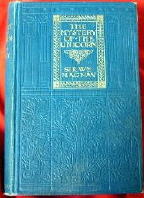
From Crime Fiction IV, by Allen J. Hubin, a chronological listing of Sir William Magnay’s other mystery fiction:
MAGNAY, [Sir] WILLIAM, 2nd baronet (1855-1917)
* The Pitfall (n.) Ward 1908.
* The Red Stain (n.) Ward 1908.
* A Poached Peerage (n.) Ward 1909.
* The Powers of Mischief (n.) Ward 1909.
* The Long Hand (n.) Paul 1912.
* Paul Burdon (n.) Paul 1912.
* Rogues in Arcady (n.) Ward 1912.
* The Fruit of Indiscretion (n.) Paul 1913.
* The Players (n.) Hodder 1913.
* The Price of Delusion (n.) Paul 1914.
* The Black Lake (n.) Paul 1915.
* The Cloak of Darkness (n.) Ward 1915.
* The Hunt Ball Mystery (n.) Ward 1918.
* The Flamards Mystery (n.) Pemberton 1942.
* The Eleventh Hour (n.) Odhams n.d.
Wed 14 Mar 2007
Hi Steve,
Here are my latest notes on Fielding/Feilding in case someone can add anything.
Further to my questioning of A. Fielding being the pen name of Lady Dorothy Feilding, I have a little more information — but also more questions.
Working on the belief that her American publisher was correct in saying the author’s real name was Dorothy Feilding and had lived in Sheffield Terrace, Kensington, I retraced my steps and found that the statement was correct.
Initially I checked the London telephone directories for the 1930s and — a Mrs A. Feilding was listed at 2 Sheffield Terrace from 1932 to 1936. A phone call to the Local Studies Library at Kensington, a check of the electoral roll for the period and there she was — Dorothy Feilding. No sign of Mr A. though. (Sadly, my previous enquiry had only seen the 1937/1938 rolls checked when she was no longer there).
The phone books showed that she had moved to Islington for 1937, but by 1939 she had ‘disappeared’ from the listing.
Unfortunately that is the sum of my search so far. A Dorothy Feilding (Mrs A.) was living in London circa 1932-1938 but so far no trace of her either side of that time. Also, there is no trace of Mr A. yet. Was she a widow, separated, was her husband away from home at the time? No idea. (Lady Dorothy’s husband was Charles Joseph, and anyway, his surname was Moore).
There was an Albert Feilding born in Yorkshire in 1869, but cannot find another male A. Feilding from then to end of century. Possible the husband was not born in England or Wales, I wonder?
There is also no trace of her in the probate registry up to the 1960s, but then she may died without making a will. I have yet to make a quarter by quarter search for her and her husband in the deaths registers.
Not a great deal to say, but I think this at least removes Lady Dorothy from the scene.
I have one other goodie which might be worth throwing out for comment.
As you may now, the major English novelist C. P. Snow’s first book was a murder mystery, Death under Sail.
Recently I was checking Author and Writers Who’s Who 1934 and came across the entry for a Kathryn Barber — who is in Crime Fiction IV for a couple of novels as Kay Lynn. But, to my surprise, her list of publications also include Death under Sail (in collaboration)!!
Did a quick Google, but could find no mention of anyone but C. P. Snow in connection with the book..
Wonder if anyone can throw any light on this?
John
SNOW, C(harles) P(ercy) [Baron Snow] (1905-1980)
LYNN, KAY
Wed 14 Mar 2007
This will not be an easy comment to make, since my one quibble with the movie involves a plot point, and I want to avoid giving vital information away to anyone who has not yet seen the movie. As Poirot did, I prefer the easier solution. So, first, for the simple matters.
I agree completely with your assessment of Albert Finney’s performance. He is almost demonic at times, almost scary, which is the last thing one expects of a Poirot. His performance was a most pleasant surprise.
Lauren Bacall’s performance was enjoyable, but I liked Ingrid Bergman’s better. And I had never realized until now not just how beautiful Vanessa Redgrave’s face was, but how wonderfully she could use it. I also enjoyed John Gielgud’s and Richard WIdmark’s performances as well as several of the others.
If the movie reflects the novel faithfully, I can see which aspect would have troubled censors. It’s a sobering question that such a matter could keep the story off the screen for so long.
Finally, the plot point: the resolution, as presented on screen had a ritualistic aspect that I found far-fetched. I can say no more until everyone in the world has seen the movie or read the novel. When that happens, we can discuss my objection openly.
Peter
Detectives Beyond Borders
“Because Murder Is More Fun Away From Home”
========================
Peter
Or should I call you “Artful Dodger.” Thanks for being so skillful in saying what has to be said about the movie without actually revealing what it is that can’t be talked about.
Why is it, I wonder, why so many otherwise intelligent people can’t resist giving the solutions away to detective story plots? Only this morning I read an op-ed column in the Hartford Courant which, to make another point, gave away for nothing the ending of Murder on the Orient Express.
And as for The Murder of Roger Ackroyd, the mystery that Christie is even more famous for, you can forget it. Even people who are trying to recommend the novel to others do so by saying, “You’ll never guess who did it. It was …” And every kind of variation on blab, blab, blab comes spouting forth.
In any case, however, I certainly agree with you about the way the crime itself was committed, as shown on the screen. It seemed to me to be borderline distasteful. But more than that, because of the sensationalistic nature of this aspect of the film, the point that (I think) was intended to be conveyed was lost.
One other thing. While I enjoyed Lauren Bacall’s performance more, in more ways than one, I would not have considered it worthy of an Oscar. Ingrid Bergman’s, yes, even if I quibbled about it.
– Steve
========================
I thought it was less distasteful that it was slightly ridiculous. I’ll have to go read the novel to see how Christie made the same point and if she did so any differently.
Regarding people who give away plots, they are selfish, stupid, or simply unable to distinguish between contemporary crime stories, in which who did it tends to be less important, and older ones, in which the mystery aspect is paramount. They add obtuseness and lack of taste to their selfishness or stupidity.
I realize now that one aspect of Ingrid Bergman’s performance may have especially endeared it to Oscar voters. She was a beautiful woman playing an unbeautiful character. It’s been noted that Oscar voters tend to reward that sort of thing.
— Peter
========================
I responded by describing what I cannot divulge here, but I mentioned Ingrid Bergman’s performance in a way that *might* disclose plot points that I shouldn’t, and Peter agreed with me about her. I also spoke in detail about what I saw behind the way the murder was committed. Peter replied that he hadn’t noticed or realized that, and that in retrospect the clues were fairly planted, a nice touch.
Now of course you may be wishing you had a rolling pin to throw at me, and if I were in your shoes, I think I might be wishing the same. To that end I have uploaded the continuation of our conversation here. Please note that the ending will be discussed in detail, and it is up to you to decide whether it is safe for you to go read it or not.