EDWARD D. HOCH “The Theft of the Mafia Cat.” Ellery Queen’s Mystery Magazine, May 1972. Collected in The Thefts of Nick Velvet (Mysterious Press, hardcover, 1978). Reprinted in Purr-Fect Crime, edited by Carol-Lynn Rösell Waugh, Martin Greenberg & Isaac Asimov (Lynx, paperback, 1989).

   The charm of the Nick Velvet stories to me is how clever they are, and in fact, they have to be. Not only does Nick have to figure out how to steal the essentially valueless objects he’s hired to obtain, but he also has to work out why he was hired to steal them in the first place. (In this story originally published in 1972, his fee is $20,000.)

   In this case Nick is hired by an old friend from the Italian neighborhood in which he grew up to steal the local Mafia don’s favorite pet, a cat named Sparkle, then return it a day later. Needless to say, Nick does both jobs with eclat and ease. Just another day at the office.

   What makes this particular story stand out a little more than some of Nick’s other adventures is that along the way he tells his friend how he got started in his unique way of making a living. The first job he was hired to do was to help someone break into a museum of fine art, which he accomplished by removing a stained glass window and climbing in.

   Turns out that window was worth $50,000 and that was all the woman who hired him wanted. After she was arrested and the window was returned, Nick decided from that point on his career in thievery consisted of stealing only things that were essentially worthless.

IT IS PURELY MY OPINION
Reviews by L. J. Roberts


C. J. BOX – The Disappeared. Joe Pickett #18. G. P. Putnam’s Sons, hardcover, March 2018.

First Sentence:   Wylie Frye was used to smelling of smoke and that was long before he became a criminal of sorts.

   Wyoming’s new governor wants Game Warden Joe Pickett to find a wealthy Englishwoman and ad-agency CEO who disappeared after staying at the dude ranch where Joe’s daughter, Sheridan, works. Joe’s friend, master falconer Nate Romanowski, wants Joe to find out why the falconers can no longer hunt with eagles in spite of having valid permits. Joe wants to know why the Game Warden from the area where the ranch is located has also disappeared. And who is working hard to make Joe go away?

   Box is very good at creating a sense of place, and a sense of cold— “Twilight in the mountains brought a special kind of cold. It crept out from the darkness of the lodge pole pine forest where it had spent the daylight hours and it slithered across the top of the snow to sting every inch of exposed human skin. Sounds became sharper and the snow itself became a different texture that squeaked like nails on a chalkboard with every footfall.”

   His description of what it’s like to drive during the winter in the mountains conveys some of the dangers involved. And most of us don’t think about the risks inherent with snowmobiling. There is fascinating information about the use of predator birds for protecting flocks and endangered birds, as well as killing animal predators, and all the political machinations involved. The relationship of falconry to Shakespeare is a nice touch.

   The perspective Joe has on how his relationship has changed with his now-grown daughter is one with which most can identify in some way. For those who have followed the series, it is particularly poignant. The contrast of Joe and Nate is always interesting. They truly are light and dark. Lance, Sheridan’s boyfriend, is someone of whom I hope we see more.

   There’s a lot in this book, almost too much. The threads do come together but awkwardly. There isn’t the cohesion one finds in Box’s previous books, and even the humor and suspense are less apparent. The motive is rather weak and far-fetched, particularly when we learn who is behind everything, and the ending rather abrupt. One dearly hopes Box isn’t getting tired of his series.

   The Disappeared is not Box’s strongest book, but it’s still better than a very good book by other authors. There is an excellent twist, and a good “Western” ending.

— For more of LJ’s reviews, check out her blog at : https://booksaremagic.blogspot.com/.


Bibliographic Note:   Box has written a book in this series every year since 2001.

REVIEWED BY DAN STUMPF:


KENNETH FEARING – The Big Clock. Harcourt Brace, hardcover, 1946. A condensed version first appeared in The American Magazine, October 1946, as “The Judas Picture.” Reprinted many times, including Bantam #738, paperback, 1949; and in Crime Novels: American Noir of the 1930s and 40s, Library of America, hardcover, 1997. Also published as No Way Out (Perennial, paperback, 1987).

THE BIG CLOCK. Paramount Pictures, 1948. Ray Milland, Charles Laughton, Maureen O’Sullivan, George Macready, Rita Johnson, Elsa Lanchester Screenplay: Jonathan Latimer, based on the novel by Kenneth Fearing. Director: John Farrow.

   The other day I was in the re-reading mode, and pulled Kenneth Fearing’s 1946 novel The Big Clock off the shelf. It was well worth going back to. Clock is built very nicely around a clever gimmick that sustains it as a thriller, but there’s an undercurrent — a very subtle one — that surfaces now and again to hint that there’s more going on here than we think.

   George Stroud starts off the novel as a thoughtful hedonist; he enjoys books, paintings, colorful characters, his family, a comfortable job editing a crime magazine, good liquor and the occasional affair. One of these affairs is with Pauline Delos, the mistress of his publisher, Earl Janoth, and when Stroud is seen-but-not-recognized leaving Pauline’s place, it precipitates an argument that results in Janoth murdering Pauline.

   What follows is not so much a cat-and-mouse game as a perverse dance: Janoth sets the resources of his publishing empire to the task of finding the man seen leaving Pauline’s apartment, seeking to implicate him in the murder, and chooses Stroud to head up the search; Stroud realizes that Janoth must have killed their mutual bed-partner, but he also knows that saying so would destroy his marriage and career — and if Janoth learns Stroud’s secret, he’ll destroy more than that.

   Okay, that’s the plot gimmick: a man set to catch himself, trying to avoid getting caught, and Fearing exploits it very ably, with Stroud’s maneuvers getting ever more intricate, always quicker, as the dance picks up tempo and the net tries to close around him.

   But there’s more here: those subtle roilings below the surface; multiple narrators tell the tale, mostly Stroud, but also Janoth, his sycophantic henchman Hagen — there‘s a telling bit where Hagen wonders why anyone would buy an old painting at an antique shoppe — and there’s an oddly moving chapter narrated by Stroud’s wife, where we glimpse just how much harm Stroud’s pleasure-seeking can do.

   And then there’s the Big Clock: Fearing’s metaphor for a life without soul, a society whose unrelenting gears can brush a man or crush him: “I could beat the machine. The super-clock would go on forever; it was too massive to be stopped. But it had no brains and I did. I could escape from it. Let Janoth and Hagen perish in its wheels. They loved it.”

   But later: “I told myself it was just a tool, a vast machine, and the machine was blind. But I had not fully realized its crushing weight and power. That was insane. The machine cannot be challenged. It both creates and blots out, doing each with glacial impersonality. It measures people in the same way that it measures money, and the growth of trees, the life-span of mosquitoes and morals, the advance of time. And when the hour strikes on the big clock, that is indeed the hour, the day, the correct time. When it says a man is right, he is right, and when it finds him wrong, he is through, with no appeal.”

   Good stuff, that. And the wrap-up is equally strong. Ostensibly a happy ending, but with loose ends that keep threatening to unravel. And a final line that hits with memorable brutality. This is a thriller written by a poet, and it’s worth a look. Or two.

   Paramount filmed this in 1948, and they did a pretty creditable job of it, with typically smooth direction by John Farrow, and pluperfect performances from Ray Milland as Stroud, Charles Laughton as Janoth, icy George Macready as Hagen, and Maureen O’Sullivan (Farrow’s wife) as the long-suffering Mrs. Stroud.

   There’s also a ticklish turn by Elsa Lanchester (Laughton’s wife) as a dotty artist, and a chilling bit from Henry Morgan (Nobody’s wife) as Jeff, Laughton’s silent masseur/gunman. Jeff doesn’t speak throughout the film, but one gets the odd impression it’s because he simply sees no point in it, a neat dramatic evocation — along with arid sets and clockwork-cold line readings from Laughton and Macready — of Fearing’s subtext.

   I might add, though, that Jonathan Latimer’s screen adaptation rings some necessary-for-movies-of-that-time changes on Fearing’s story: the affair with Janoth’s mistress is replaced by an over-complicated marital mix-up that makes Stroud seem more Dagwood than Don Juan. And in the book, Janoth begins the quarrel leading up to the murder by taunting his mistress about a lesbian affair, then flies into a rage when she accuses him of “camping” with the fawning Hagen — whereupon he kills her, and later, justifying the murder to Hagen, the first thing he mentions is her bisexuality. Fearing makes the point subtly (no doubt he had to in those days) but he leaves the strong impression that this murder is more a crime of intolerance than passion.

   Well all that’s gone in the movie, replaced by more conventional stuff while director Farrow and writer Latimer drop subtle hints here and there, and though one mourns the loss a bit, I have to say no one improved things any when they re-made the story (as No Way Out) in the more permissive 1980s.

REVIEWED BY BARRY GARDNER:


RICHARD ROSEN – World of Hurt. Harvey Blissberg #4. Walker, hardcover, 1994. No paperback edition.

   Rosen is currently a writer/producer for Eye to Eye with Connie Chung, has appeared on netwrork TV and National Public Radio, and is credited with inventing the word “psychobabble.” This is the first Harvey Blissberg from him since 1988, and he’s switched from Viking Penguin to Walker. Have you noticed how many male writers are moving down the publishing scale, or losing their contracts entirely? Is it time for Dudes in Crime (DiC, acronymically speaking) to become a reality?

   Harvey Blissberg, an ex-major league baseball player now a PI, gets a call from his brother in a Chicago suburb. A casual friend who played picjup basketball with him regularly has been murdered, and the local police seem to have come to a dead end.

   The brother wants Harvey to come out from Cambridge and see what he can find out. Harvey, going through a bad patch with his long-time lover, more or less reluctantly accedes and soon finds himself trying to put together pieces of the life of a man nobody really seemed to know.

   I had forgotten how competent Rosen is. I don’t think he’s at the top of his group, but he’s a smoothly professional writer, and has created a very likeable character in Harvey Bloomberg. His prose is clean and straightforward, and he tells his story will through third-person narration.

   I think his strong point is characterization, and Blissberg and his lover have considerable depth. There were a couple of spots in the book that bothered me; one turned out to be fleeting and inconsequential, but the other was an unlikely coincidence on which the story hinged.

    Overall, though, it was a good solid PI novel — and I haven’t read too damned many of those, lately.

— Reprinted from Ah Sweet Mysteries #15, September 1994.


      The Harvey Blissberg series

Strike Three You’re Dead (1984)     [Edgar-winner for Best First Novel.]

Fadeaway (1986)
Saturday Night Dead (1988)
World Of Hurt (1994)
Dead Ball (2001)

CLEVE F. ADAMS – No Wings on a Cop. Handi-Book #112, paperback original, 1950. Harlequin #256, Canada, paperback, 1953.

   Cleve F. Adams (1895-1949) was a fairly prolific writer for the detective pulps in the 1930s and early 40s before making the transition to hardcover novels under not only his name but as John Spain and Franklin Charles. His most well-known series character was a hard-boiled PI named Rex McBride, but even the latter is little remembered today.

   Before getting the story line of this one, one of two he wrote that came out in paperback only, there is a tale to tell about it. As I understand it, No Wings on a Cop began life as a pulp story, then after Adams’s death was expanded into a novel as a favor to his wife by fellow pulp writer Robert Leslie Bellem. In James Reasoner’s online review of the book, he suggests the original story may have been, in his words: “‘Clean Sweep,’ from the August 24, 1940 issue of Detective Fiction Weekly, which, according to the Fictionmags Index, features police lieutenant John J. Shannon, the hero of No Wings on a Cop.”

   From the title, this is good detective work on James’s part, but it’s still only one possibility among a handful of others it may have been. Until someone is able to check it out to be sure, we’ll have to leave it as an open, unanswered question.

   John J. Shannon was also the name of the title character in the novel The Private Eye that Adams wrote in 1942. Everyone assumes it’s the same character, but when it was, and why Shannon made the transition from police lieutenant to PI is a story that Adams never told. (I may be wrong about that.)

   The main story line in No Wings on a Cop is a very common one in its day, that of corruption in a small town involving a the head of the local rackets and working its way up to (possibly) the mayor and several members of the police force. Shannon gets involved when a fellow officer and a good friend is killed, with the suggestion that he was on the take.

   Shannon knows better and spends the entire book trying to come up with evidence to prove it. His kind of investigation involves a goodly amount of gunplay, but as it turns out, he has a head on his shoulders as well, and a good instinct for who’s running on the wrong side of the track. He also has one arm in a cast all through the book, a hindrance that doesn’t show him down one bit.

   Unfortunately I’ve read a lot of stories like this before, and I found this one slow going for most of the first half of the book. Things picked up considerably after that, but all in all, while competently written, it’s still not better than average, even for the genre it’s in. I wouldn’t say this a “must read” for anyone reading this, but I’m glad I finally got around to reading it.

REVIEWED BY JONATHAN LEWIS:


VIGILANTE FORCE. United Artists, 1976. Kris Kristofferson, Jan-Michael Vincent, Victoria Principal, Bernadette Peters, Brad Dexter, Judson Pratt, David Doyle, Antony Carbone, Andrew Stevens, Shelly Novack. Screenwriter-Director: George Armitage.

   Vigilante Force is one of those blue-collar action movies from the mid-1970s designed to appeal to a White working class demographic looking for some simple escapism and a familiar social milieu. Set in a fictional small town in California’s interior (somewhere near Bakersfield I would imagine) where newfound oil wealth is destroying the fabric of society, this film is as much about the setting as the story. That’s probably for the best, given how flimsy the plot of the movie actually is.

   Jan-Michael Vincent, before he became one of Hollywood’s hottest items, portrays Ben Arnold, a laconic working class widower living with his young daughter and new girlfriend. When the police chief of his town gets overwhelmed by the sheer amount of criminal activity taking place there due to an influx of oil workers, Ben seeks out his somewhat estranged brother Aaron (Kris Kristofferson), a Vietnam Veteran working somewhere in Southern California and convinces him to return home and to become a deputized peace officer.

   But it doesn’t take long before Ben realizes that Aaron and the men he has brought with him aren’t going to play nice with either the criminals or the townsfolk. In fact, Aaron has his own nefarious plans for his hometown, a place for which he has utter contempt.

   There’s a lot of talk, some shooting, a lot more talk with low tech dialogue, and then a final action sequence which isn’t all that spectacular. Kristofferson was a far better actor and capable of so much more than he was given in this one. As for Vincent, he’d go on to bigger and better things in the 1980s before suffering a severe career decline the following decade.

ROBERT RAY – Dial “M” for Murdock. Matt Murdock #3. St. Martin’s, hardcover, 1988. Dell, paperback, May 1990. Camel Press, softcover, 2018.

   Robert Ray is an English professor, so who am I to argue, but he likes prologues in books, and I still don’t, especially when they’re as useless as the one in this book, the third in his PI Matt Murdock series. Actually it’s worse than useless, and I tell you about it after I tell you what the book’s about.

   What it is that’s going on is an elaborate scam being pulled on various life insurance companies. Murdock is drawn in, falls in love with one of the “widows,” and along the way does very little detective work himself. (It’s nice to have friends who are computer whizzes.)

   [WARNING: Plot Alert!] Murdock tells his own story in this book, all but for the prologue, and that’s where we learn all we really need to know for about 90% of the plot yet to come. Not so for Murdock, who is left completely in the dark about what happened before he came along.

   This makes first half of the book is pretty much wasted, whiel we (the reader) watch him as he pieces together everything we knew ever since the book started.

   There is a lot of action in this book, but as I mentioned up above, there is very little in the way of brainwork going on. What is somewhat unusual and worth pointing out, is that there is a vein of crime so deep here that the masterminds behind it are hardly even annoyed by the local police department, much less rugged individualist PI’s. Ants under their feet, no more.

   And so what chance does Murdock have? None, and that’s what the epilogue tells is as well. (Yes, one of those, too, and it’s about as interesting as someone breathing heavily in a sandstorm.)

   There is a unique aspect of the ending, however, something I don’t believe either Spenser or Marlowe had to deal with, and while you’ll have to read the story yourself to know what it is I’m talking about — and this I won’t tell you — if it has any precedent in PI fiction over the years, I wish you’d let me know right away.

— Reprinted from Mystery*File #22, June 1990.


      The PI Matt Murdock series —

Bloody Murdock (1986)

Murdock for Hire (1987)
Dial “M” for Murdock (1988)
Merry Christmas, Murdock (1989)
Murdock Cracks Ice (1992)
Murdock Tackles Taos (2013)
Murdock Rocks Sedona (2015)

COLLECTING PULPS: A Memoir
Part 21: Pulp Art, Part Three
by Walker Martin

   
   This is the third and last column on one of my favorite subjects: Pulp Art. The two prior installments may be read on Mystery*File as Part 19 and Part 20.

   Often I’m asked where can a collector buy pulp or paperback art? eBay is certainly a source and I have often typed in an artist’s name and looked to see what is available. Or I’ve tried different combinations of words on eBay such as Original Pulp Art, Cover Paintings, Paperback Paintings, etc. Another source that I’ve used are the auction houses such as Heritage Auctions. Or you can visit another art collector. They often have pieces that they would be willing to trade or sell. For instance I’ve bought art from such well known collectors as Bob Lesser, Doug Ellis, and Bob Weinberg. At the recent pulp brunch at my house in November, I bought several Bjorklund drawings from WILD WEST WEEKLY from art collector and dealer, Paul Herman. As I mentioned earlier, Matt Moring and I completed a trade involving 4 pulp paintings at the brunch.

   But one of the best sources for original art are the pulp conventions: Windy City in Chicago, PulpFest in Pittsburgh, and Pulp Adventurecon in Bordentown, NJ. Of the three shows I consider Windy City to be the best source for original pulp and paperback art. The convention lasts three days each year and there are perhaps as many as a dozen dealers with art for sale. Next, comes Pulpfest with two main art dealers: Doug Ellis and Craig Poole. Sometimes other book dealers bring in art: Nick Certo, Scott Hartshorn, Mark Hickman, Ray Walsh, etc. Pulp Adventurecon is usually about the books and magazines but this year Craig Poole had several tables with excellent pulp, digest, paperback and slick art. Prices range from a few hundred dollars to several thousand.

   Frankly, I collect art because I love collecting but if you are thinking of possible investment value, you can’t go wrong with original art as an investment. Of course I’m assuming you pick nice pieces and not poor art. For instance I have a painting from DETECTIVE FICTION WEEKLY that is just a bloody hand. Another from the same magazine, is just the face of some ugly criminal. It’s possible these paintings will never be worth anything except for a few hundred dollars, but since I collect pulp magazines, I was happy to buy them as examples of the poor cover art occasionally used by the magazines.

   As you may have noticed I have no problem with buying unframed art, art in poor condition, even art with holes in the canvas. I used to frame everything, but now I say the hell with it and hang them up as is. If a piece is falling apart, I have restored it, however. There are art restorers that work on paintings, in fact Matt Moring and I met a restorer at the Bordentown convention and he has emailed us several photos of excellent pulp art that he has worked on.

   An important thing to remember is to be sure and collect original art that you like. If you like SF, there is plenty out there. Hero pulp art is very popular but quite expensive. Same thing with risque or spicy art such as pinup art. Detective and mystery art has increased in value during the past few years. I can remember when you couldn’t get much of anything for a detective pulp painting. Western art still remains fairly inexpensive except for the big names like Nick Eggenhofer or Gayle Hoskins.

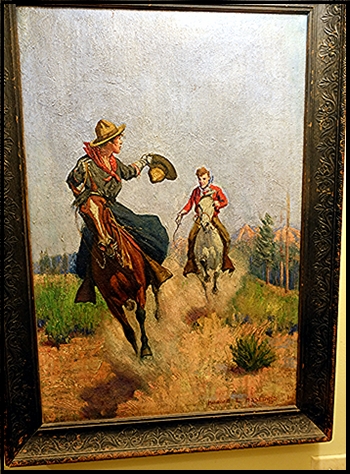
   Many collectors make the mistake of ignoring western art which is a big mistake. The cover paintings are full of action, very colorful, and inexpensive compared to SF, hero and detective pulp paintings. So far there is practically no interest in love or sport cover paintings. Not many collectors are interested in the love or sport magazines either. As a result we don’t see many covers at all from these two genres. It’s possible they have mostly been lost or destroyed due to this lack of interest.

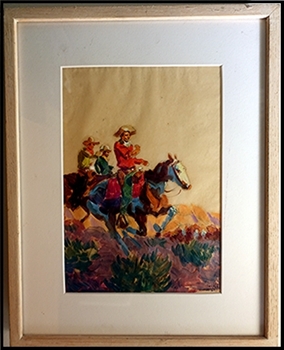
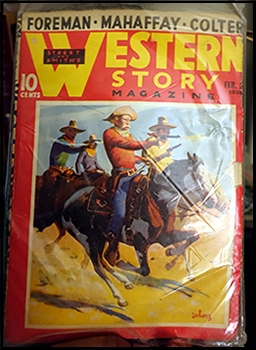
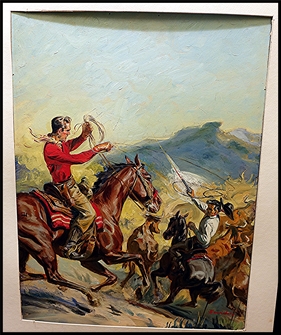
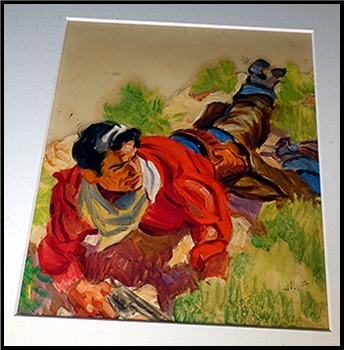
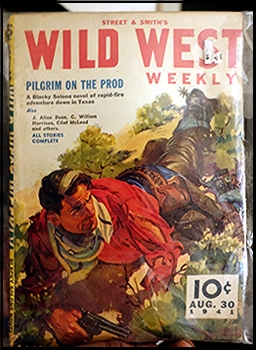
   Here are some great examples of inexpensive pulp art. Most collectors don’t seem that interested in preliminary art but they can be quite stunning as these pieces show. Often such prelim work is very sketchy or not that well done but these two pieces by Delano and Baumhofer are almost finished enough to appear as covers. The two magazines show how the finished cover paintings turned out and you can see there is not a lot of difference between the preliminary work and the finished canvas. The Baumhofer one showing the cowboy on the ground is especially impressive as a preliminary sketch.


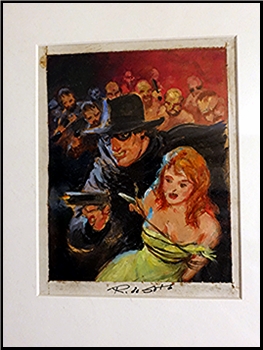
   Now here is an example of a preliminary by De Soto that is very sketchy and unfinished. There is no way this Spider prelim could be used as a cover as is. But it does give the editor an idea of what the artist planned to do with the large painting on canvas. As far as I know this sketch was never made into a finished painting. By the way, I have two SPIDER preliminaries and they are quite rare. Only a couple of the cover paintings are known to exist.
   
   This is one of the earliest cover paintings that I have. It’s from 1914 and the artist is Howard Hastings. He painted a lot for OUTDOOR LIFE and that type of magazine so maybe it is from a slick. I bought this from art dealer Steve Kennedy in 1989 for $700. During this period I could spend about $700 each month on art and much later Steve told me that my $700 each month was a life saver for his business at the time. He had just started to deal in pulp cover paintings, and no one except for me was buying from him. Too bad I couldn’t spend more than $700 each month because I lost out on some nice art that Steve sold later to other collectors.

   
   I got this one from Pulpcon in the eighties for only a couple hundred. I wonder how it got that hole in it? It’s FIFTEEN WESTERN TALES.

   
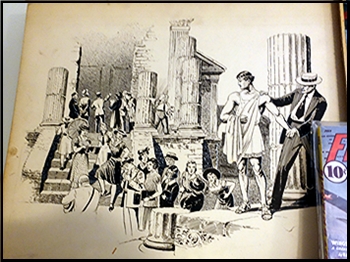
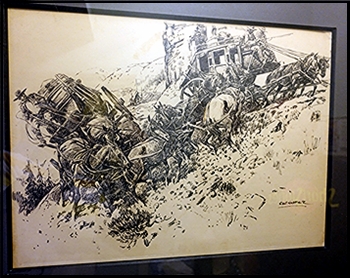
   This is one of my very favorite illustrations. It’s a great Nick Eggenhofer interior, probably for a two page spread. It shows two stage coaches passing each other and one looks ready to tip over. By the way, I haven’t located where this is from in case anyone can help me out. It may be WESTERN STORY or one of the western titles published by Popular Publications like DIME WESTERN or STAR WESTERN.
   
   This is PEOPLES from the early 1920’s and the artist is Wittmack. This is another painting I got from Kennedy when he was selling me one painting a month back in 1989. I never bothered to get it framed. Frankly I find that framing sometimes detracts from the painting. Steve liked to frame his paintings in a gold frame which I did not like much. And of course Bob Lesser habit of framing the pulp magazine inside with the painting, I found to be sacrilege and very annoying! But despite my many complaints over the years Bob continues this practice. As far as I know there is no museum, art gallery or art restorer that would frame the magazine under glass with the painting. After a few decades you would have a pile of pulp chips and a stain on the canvas.
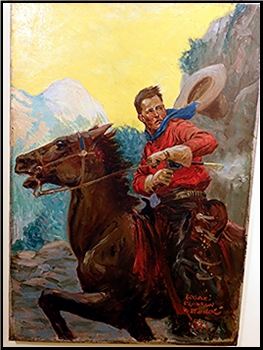
   
   I love when I get this type of painting. It’s by Norman Saunders and was used on a pulp AND a paperback years later. It was first used on WESTERN ACES magazine in the 1940’s and then reused on the Ace Double titled GUNSMOKE GOLD in the 1950’s. One funny story about me buying this art. When I first saw it the dealer wanted $200 for it as a paperback cover. I stupidly looked closely and muttered that it was signed by Saunders and bang, the price went up right away to $400. Later I discovered it was also a pulp and this makes it worth far more than the $400 I had to pay.

   
–   Whatever happened to art dealer Tony Dispoto? I bought this from him and it’s a great piece by one of the best of the pulp artists. It’s a Flanagan from BLUE BOOK in the mid-1930’s illustrating a great adventure serial by James Francis Dwyer.

   
   This is a rare example of Walter Baumhofer’s early work. It’s from ADVENTURE in the mid-twenties and I got it at Windy City for only a couple hundred dollars.

   
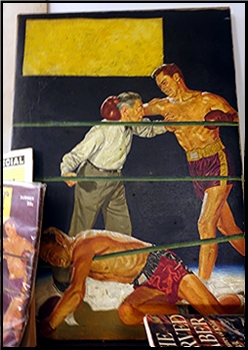
   FIGHT STORIES by Gross. A pulp collecting brain surgeon was once visiting me and was interested in this because boxers often require such surgery.

   
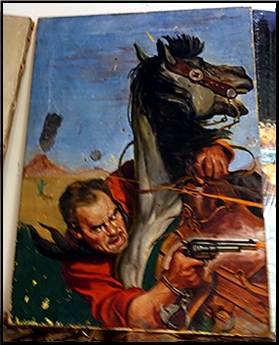
   I love showing this painting to visitors. It’s 10 STORY WESTERN by De Soto and has over 20 pinholes punched through the canvas. In other words someone used it as a dart board! I’ll never get it restored because it shows just how little respect these paintings used to command back in the day. I’ve heard so many horror stories of cover paintings thrown away, lost, burnt, etc. Back when they were painted they were just about considered worthless.

   
   Author Ryerson Johnson once told me that he was an editor for a couple years for Popular Publications back in the forties. When he resigned to return to full time writing, he was shown into a large room full of paintings and illustrations and told to take what he wanted because it was all going to be thrown away eventually. He took several paintings and a couple large stacks of interior illustrations. Decades later he sold this art to me and other collectors.

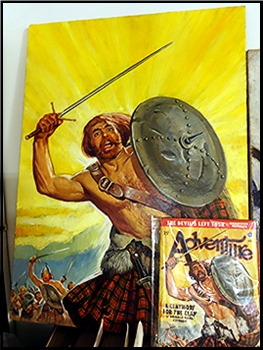
   When I first bought this ADVENTURE cover, it was on a board that was spongy and soft. You could take off pieces of the board with two fingers. I thought it was just about worthless and ready for the garbage. But art restorers can do magical things and this painting was saved. It was somehow transferred to another board without any damage.

   
   This is another strange story. Collector Al Tonik had the paperback to this cover and decided to commission artist Rudi Nappi to paint it again as a recreation of the original painting. The artist did the recreation which is almost an exact copy for $100. But then later on I discovered the original paperback cover painting. So Al sold me the recreation to go along with the original cover painting. I now have both paintings, the original which was done in the 1950’s and the recreation which was done in the 1990’s or thereabout. Sometimes we think these old paintings are lost but they show up anyway!

   
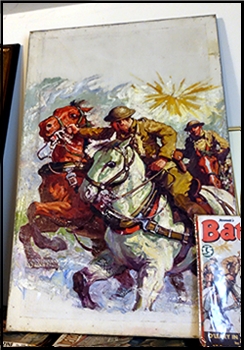
   This is from BATTLE STORIES and I bought it from Illustration House in NYC. Notice how the magazine reversed the image. They did this sometimes to make room for the magazine title or cover blurbs.

   
   This is by the great Frank Paul and is from FAMOUS FANTASTIC MYSTERIES, one of my favorite magazines.

   
   This is FIGHTING ACES by Blakeslee. I got it from Bob Weinberg back in the 1980’s. He was just released from the hospital and needed money to pay his medical bills. He had over a dozen of these aviation paintings which he sold but I only bought two of them. I guess I was broke again!

   
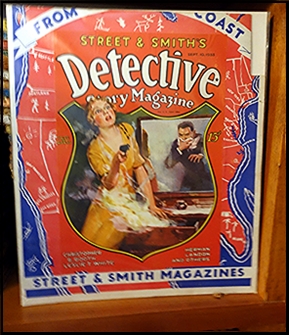
   I also collect advertising posters which are pulp related. This is a poster advertising Street & Smith’s DETECTIVE STORY MAGAZINE.

   
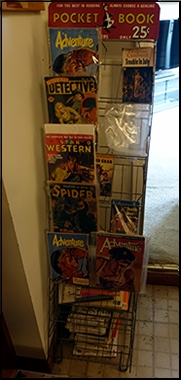
   I have several paperback racks which I spent decades searching for. This is the first one I found and I had to trade a Clark Ashton Smith first edition to get it back in the 1970’s. Most collectors don’t realize how rare these things are. Someday after we are gone they will be worth a lot of money.

   
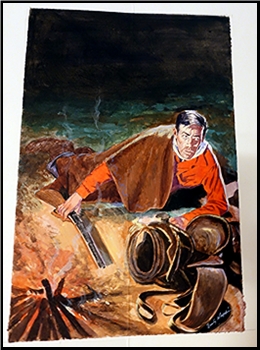
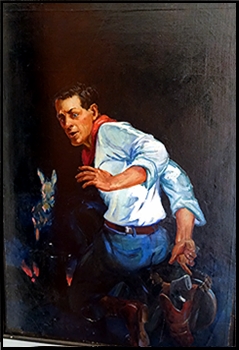
   An unusual night scene which must have happened to many cowboys. They hear a sound and reach for their gun. I got this one a couple years ago at the Bordentown convention and it’s from WESTERN STORY in the thirties. I saw the art dealer come through the door and I immediately ran up and asked the price. It was inexpensive so I bought it. But I had driven in with my old pal Digges and when I went to put it into the car there was absolutely no room. He had filled the entire car up with boxes of pulps. Fortunately my friend, Sai Shanker was visiting me the next day and he delivered it to me at my house. But we were so busy talking that he almost drove off to the airport with it still in his car.
   
   Well, that’s it, all you need to know about pulp art in three easy installments. Thank you Steve Lewis for publishing this and thank you Sai Shanker for taking the great photos. And finally thank you to all my art collecting friends over the many years. Many of you may no longer be with us, but you are not forgotten. After all we are just the temporary caretakers of our collections. Eventually we leave but the collections continue on!
« Previous PageNext Page »