REVIEWED BY MICHAEL SHONK:

THE INVESTIGATORS. CBS/Revue Production/MCA Studios, 1961. Cast: James Franciscus as Russ Andrews, James Philbrook as Steve Banks, Mary Murphy as Maggie Peters, Al Austin as Bill Davis, Asher Dann as Danny Clayton, and June Kenny as Polly. Guest Cast “The Oracle” (12 October 1961): Lee Marvin, John Williams, Audrey Dalton.

   Today the CBS TV series The Investigators has been forgotten except for fans seeking the lost work of director Joseph H. Lewis (Gun Crazy). I have been able to find only one surviving episode of the series and tragically most of the credits for the episode “The Oracle” are missing (including the writer and director credits). Like many of the forgotten TV series of the past, information about The Investigators is incomplete and misinformed.
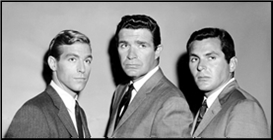
   The Investigators told the story of a major investigation firm that worked for various insurance companies around the country (or maybe the world). Investigators, Inc. was run by Russ Andrews and Steve Banks and located in New York. Among the staff of investigators were Maggie Peters, Bill Davis and Danny Clayton. The firm also employed a receptionist named Polly Walters.

   Current information about the series is wrong (oh so so very wrong) when it comes to the character of Maggie Peters. She was not a secretary or some Girl Friday occasionally helping the men with the cases. She was a full time licensed PI and equal to Bill and Danny. She was referred to as “one of our investigators” and treated as an equal to Bill and Danny.

   Fiction female detectives have existed for nearly as long as their male counterparts, but there has been a notable shortage of woman as licensed PI on TV. I have looked at television’s female PIs before. Until an earlier example is uncovered — The Investigators (October 1961) — Maggie Peters is TV’s first license PI predating Honey West (1965).

   Considering Mary Murphy’s resume (The Wild One, The Desperate Hours), especially compared to male stars James Franciscus (Naked City) and James Philbrook (The Islanders) at the time, it should not surprise that Murphy received equal billing. While the episode I have of the series is missing most of its credits, it does have its opening theme and credits for the series stars. First is James Franciscus name and side profile of the actor’s face, then James Philbrook, then Mary Murphy and finally the title The Investigators.

   The fall of 1961 was not the time to be a crime drama. The FCC, after radio’s payola and TV game show scandals, was getting more and more involved in local stations renewals and networks programming. Network executives and TV studio producers were spending more and more time in front of Congressional hearings defending its programs such as ABC’s The Untouchables and NBC’s Whispering Smith.

   In the summer of 1961 the possibility of government getting involved in the programming of the public airways had become a real threat to the networks. As the studios worried about the bottom line and the networks covered its butt, it would be the action and crime dramas of the 1961-62 Season that paid the price.

   â€œThe Oracle” was The Investigators’ second episode and aired October 12, 1961. In the episode the staff was divided up for two cases. Steve and Bill remained behind to deal with another case while the episode focused on the case worked by Russ, Maggie and Danny. Russ leads the team to Los Angeles to check out Nostradamus, a West Coast prophet who is very successful convincing rich women to donate to his cause. An insurance company hires Investigator, Inc. to check out Nostradamus before one of their clients gives him a quarter of a million dollars.

   Miscast Lee Marvin (M Squad) played Walter Mimms, a small time drifter who all women fall in love with at first sight. In a nice twist, older conman Joseph Lombard (John Williams, Dial M for Murder) cons and manipulates Walter turning him into a front for a big time con. But Walter’s power over women was also his weakness as he fell for the women as they fell for him. Walter was convinced he was in love with the latest mark, Constance Moreno (Audrey Dalton), the woman our detectives were hired to protect.

   Constance loves Nostradamus but after a visit from Russ and Maggie, she tests his love and because of Lombard’s orders to Walter he fails her test and she leaves him taking her first check with her. Lombard then kills Constance for the check (and the trouble she is causing with Walter) telling Nostradamus she committed suicide over him. As Nostradamus grows more and more unstable, Maggie, backed up by Russ and Danny, goes undercover.

   While James Franciscus and James Philbrook turned in their usual professional but nothing special performances, Mary Murphy was excellent as female PI Maggie Peters. The character of Peters reminded me of Della Street (Barbara Hale in Perry Mason) or Casey Jones (Beverly Garland in Decoy), women who are respected professionally by men while remaining feminine.

   The script showed signs of great potential with the nice twist of the con man being conned, the depth of the character Walter Mimms, and the interactions between Walter and Lombard. But the script had problems most likely caused by the anti-violence times and the limitations of 1961 television.

   In “The Oracle” when Constance is murdered we hear her scream off camera but don’t learn what happened until the next scene when we are told she died in a “fall” out of her apartment window. Not seeing her death diluted the dramatic shock the scene needed.

   While much of the action took place off stage, too much of the exposition did as well. Instead of showing people following Nostradamus next mark, the undercover Maggie, and how Nostradamus got his information to impress the mark at the séance, Maggie told Danny (and us) about it.

   Virtually all the information about The Investigators claims Joseph H. Lewis directed the series, so lets credit him for “The Oracle.” This episode benefited from Lewis creative use of the camera especially with forced perspective, a technique used by such director as Sidney Furie in The Ipcress File and Jerry Thorpe in Harry O.

   Most directors use a standard master shot to establish a foundation for the scene then cut to other angles to enhance the dialogue or action. The master shot is like looking at a theatrical stage from the audience. Now picture the left and right side move closer to each other and the characters and setting uses the space up and down (closer and farther from you) instead of left and right. The look can reduce the stagey look of the typical master shot by giving a feeling of more depth to the 2-D picture. Lewis liked to stay in the shot and let the characters interact and move around the set before isolating the characters with camera angles such as a close-up.

   In the scene where Lombard and his thugs kill Constance, there was a wide shot with Constance and Lombard near each other, behind Constance silently stood the two thugs. It was that framing of the four characters in forced perspective that gave the scene depth and its needed tension as the audience began to sense Constance was in danger despite what Lombard was telling her.

   Lewis’s creative camera work never distracted from the story instead he made the episode something CBS refused to let the writer do, he made the story visually interesting. Fans of his work are justified mourning the loss of this otherwise average TV series.

   The series aired from October 5, 1961 through December 28, 1961. The thirteen episodes were 60 minutes long and filmed in black and white. It aired Thursday at 9pm opposite My Three Sons and Margie on ABC and the last half hour of Dr. Kildare and Hazel on NBC. Once cancelled The Investigators would be replaced with Tell It to Groucho at 9:00 – 9:30pm and Mrs. G Goes to College (aka The Gertrude Berg Show) at 9:30-10PM.

   The Investigators is worth remembering for the work of director Joseph H. Lewis and giving TV its first female licensed PI Maggie Peters. However it, as many other action and crime dramas during the 1961-62 Season, was doomed by the changing times.

         Episode List:

“Murder on Order” (October 5, 1961)
“The Oracle” (October 12, 1961)
“New Sound for the Blues” (October 19, 1961)
“I Thee Kill” (October 26, 1961)
“Quite a Woman” (November 2, 1961)
“Style of Living” (November 9, 1961)
“In a Mirror, Darkly” (November 16, 1961)
“De Luca” (November 23, 1961)
“Death Leaves a Tip” (November 30, 1961)
“Panic Wagon” (December 7, 1961)
“The Mind’s Own Fire” (December 14, 1961)
“Something for Charity” (December 21, 1961)
“Dead End Man, The” (December 28, 1961)

Reviewed by JONATHAN LEWIS:         


LEPKE. AmeriEuro Pictures Corp., 1975. Tony Curtis (Louis ‘Lepke’ Buchalter), Anjanette Comer, Michael Callan, Warren Berlinger, Gianni Russo, Vic Tayback, Mary Charlotte Wilcox, Milton Berle. Director: Menachem Golan.

   Just like the heist film, the gangster film may even be considered a subgenre of the crime film, a wide enough category to safely also include mysteries, police procedurals, thrillers, and what is now referred to as film noir. And within the gangster film genre itself, there can be detected numerous sub-genres.

   Menachem Golan’s Lepke, a biopic of Murder Inc.’s Louis “Lepke” Buchalter can be categorized as an “American Jewish gangster film,” a sub-genre that also includes Sergio Leone’s Once Upon A Time In America (1984) and Barry Levinson’s Bugsy (1991).

   Tony Curtis, at a pivotal point in his career, portrays the title character in a role in which he fit perfectly. His accent, mannerisms, and physicality all serve him well here. There are some moments, such as when Lepke blows his top in front of his men, which are simply thrilling to behold. Curtis had a wide range of acting ability and could convey a lot of meaning with very little expression.

   Unfortunately, the rather flat script overall doesn’t leave Curtis all that much to work with.

   The film, which traces Buchalter’s life from a delinquent Brooklyn childhood to his ultimate execution at Sing Sing just doesn’t have enough tension to make the film nearly as good as it could have been. But Golan, who would go on to produce numerous 1980s action films, nevertheless deserves credit for telling Lepke’s story without sentimentalism. Lepke is neither a complete villain, nor is he a hero. He’s portrayed as deeply flawed individual, a man both constrained and defined by his ethnic and religious background.

HILARY BAILEY – Hannie Richards. Ballantine, paperback reprint, 1987. Hardcover: Random House, 1986. Originally published in England: Virago, trade paperback, 1985.

   Some editions of this book are subtitled “the Intrepid Adventures of a Restless Wife,” which is a pretty good summary. We’ll get back to this in a minute – bear with me.

   Hilary Bailey, the former wife of SF-Fantasy writer Michael Moorcock, is the author of a number of mostly general fiction novels, often with a historical slant. Among the ones I spotted of possible interest are Frankenstein’s Bride, a sequel to Mary Shelley’s Frankenstein, and Mrs. Rochester, a sequel to Jane Eyre.

   Al Hubin’s Crime Fiction IV lists two others of criminous interest: The Cry from Street to Street, said to take place in London of 1888, and a short story collection entitled The Strange Adventures of Charlotte Holmes.

   A little bit of Googling on this latter title reveals that Charlotte Holmes is the sister of – you guessed? – Sherlock Holmes, and Mary Watson (Dr. Watson’s wife) assists her on most (all?) of the seven adventures in the book, which I have to see if I can obtain. One review suggested that the stories are connected, and in much the same way (to get back to the one in hand) that several of the chapters in Hannie Richards are.

   And like Charlotte Holmes, Hannie Richards is also very much a liberated woman, although the latter’s adventures are all very much present day, and “liberated” means more (I am assuming) in the present day than it did in Holmes’s time. While married and having young children, that is to say, Hannie thinks nothing of having lovers on the side, while managing her affairs as an international smuggler.

   Framed by brief episodes around the fire in an all-female version of a London men’s club, the Hope Club – a restaurant, comfortable sitting rooms, bedrooms, a bar – Hannie tells her friends three major stories: “The Adventure of the Little Coral Island,” “The Adventure of the Small African Child,” and “The Adventure to Find a Cure for Death.”

   In the first Hannie must rescue a letter that will establish the true ownership of a small Caribbean island, an adventure marred by Hannie’s stated procedure of working out the details as she goes along, which she does marvelously well, saved only by the weakest of out-of-nowhere but hardly unexpected outside forces (known perhaps best in the vernacular as deus ex machina).

   â€œSmall African Child” is far more interesting, as Hannie finds herself venturing into the heart of Africa to find a brilliant African child (named Bob) who is the object of interest to a number of various interests, including that of the entire hierarchy of Catholic Church. Verging into the realm of science fiction or fantasy here, this is a type of story that – and this is the only hint I can give you – should only take place at – no, I can’t tell you. I think I should say only “at a certain time of year.”

   In the final tale, surprised and extremely upset at discovering that her stay-at-home husband has taken on a lover himself, Hannie recklessly heads for South America in a (well-paying) quest to find a plant whose leaves may contain a cure for cancer, and she makes a number of crucial mistakes she perhaps would not have otherwise made, ending up for a short time in gaol and badly served for her troubles.

   A mixed bag, in other words. From a feminist’s point of view, I think there are some conflicting, mixed messages included here – whether intentionally or not, I have not entirely decided.

— July 2004

LARCENY. Universal International, 1948. John Payne, Joan Caulfield, Dan Duryea, Shelley Winters, Dorothy Hart, Percy Helton, Patricia Alphin, Don Wilson. Based on the novel The Velvet Fleece by Lois Eby & John Fleming. Director: George Sherman.

   This little-known but still better than average film noir seems to have fallen through the cracks. With the huge popularity of genre, with any inconsequential black-and-white movie being swooped up and called a noir film, you’d think that someone would have recognized this as the real thing and put it out as something other than as an under the counter collector-to-collector DVD.

   Which is how you can find this one, and the only way, if you go looking. While not a full-fledged masterpiece, it’s certainly worth the time to go searching for it. As you might expect, Dan Duryea is one of bad guys, and the ruggedly handsome John Payne is a member of his gang of con-men. Their favorite modus operandi is letting their marks persuade themselves into backing some sort of real estate venture, while Duryea and the others are there, ready and willing to make off with the funds.

   In Larceny, Payne is the one who is elected to hustle a war widow (Joan Caulfield) into building a home for wayward boys as a memorial for her husband, killed in action in the war and for whom she is still mourning. And he’s so convincing as the dead man’s buddy that I think I would have believed him myself.

   Complications? You shouldn’t doubt it for a minute. She is obviously falling in love with him. He for her? It is difficult to say, but it seems to be the road the story is taking. But messing things up completely is a brassy blonde named Tory (Shelley Winters) who is nominally Duryea’s girl but who has a yen for Payne. Amd he for her, all things considered.

   And that’s not all. There are two other good-looking women in the tale who are more than willing to slip John Payne’s character their telephone numbers. I said ruggedly handsome, and I meant it.

   And as in true noir fashion, things do not end well for all of the participants. Everyone seemed to be having a good time making it, and I enjoyed watching, never quite knowing which way it was heading.

Reviewed by DAN STUMPF:         


LIMEHOUSE BLUES. Paramount, 1934. Re-released as East End Chant. George Raft, Anna May Wong, Jean Parker, Kent Taylor, Montagu Love, Billy Bevan, Eric Blore and (don’t blink or you’ll miss her) Ann Sheridan. Written by Cyril Hume and a bunch of others, including Philip MacDonald. Directed by Alexander Hall.

   Sheer unmitigated bosh, done up in the lavish Paramount style, and a lot of fun, though you may not respect yourself in the morning.

   George Raft stars as a Chinese-American gangster (!?) transplanted to London , where he and Anna May Wong run Paramount’s version of a Waterfront Dive, filled with fog, smoke, and smoggy folk, with musical numbers to rival a Cher concert.

   But this tawdry pleasure dome is just a cover for his smuggling activities, which have roused the ire of the constabulary and a loutish rival (Montagu Love) with a cute guttersnipe step-daughter (Jean Parker.) When George saves her from the law she returns the favor, and when he murders her step-father (unbeknownst to her) he offers her a job in his club and starts making her over into his ideal English gentlewoman.

   All is not My Fair Lady, however; it ain’t even Vertigo. This Galatea has no love for her Pygmalion (The writers hint that the White Woman in her naturally recoils from the racially-mixed Raft.) but Anna May Wong is murderously jealous of their non-relationship. When Jean meets Kent Taylor (in a scene that just about defines “meeting cute” — they’re caught in a puppy stampede) and falls for him, George gets lethally jealous himself. And the law is closing in on just about everybody.

   I should warn potential viewers that the ending is a sappy, badly-motivated thing that will please no one, and there’s plenty of subtle racism about the place, but this is done with that elegant Paramount polish, the look that took Lubitsch and Von Sternberg to the heights, and it’s awfully easy to watch. George Raft’s constipated thesping could almost be mistaken for Oriental inscrutability, and it’s just too bad he’s paired off with Anna May Wong’s genuine article — those wonderfully expressive eyes in her beautiful mask-like face show him up rather badly.

   The rest of the cast is typical Hollywood perfection, though: a regiment of solid supporting players effortlessly underpinning a movie that can’t be taken seriously but rewards an indulgent critical wink.

A 1001 MIDNIGHTS Review
by Kathleen L. Maio


RAE FOLEY – Death and Mr. Potter. Dodd Mead, hardcover, 1955. Also published as: The Peacock Is a Bird of Prey. Dell, paperback, 1976. Thorndike Press, hardcover, large print, 1985.

   Rae Foley is, in mystery terms, a graduate of the Mary Roberts Rinehart and had-I-but-known school of writing. She is known as one of the leading lights of “romantic suspense,” yet in her early days Foley wrote mysteries that approximated the classic puzzler. Death and Mr. Potter is one of those efforts. It is the first in a series of books featuring mild-mannered Mr. Hiram Potter as amateur sleuth.

   Potter is Old Money. But that money had always been in the firm grasp of his autocratic mother. As the book opens, the matriarch’s funeral is concluding and the long-cowed and obedient son finds himself unexpectedly independent — both emotionally and financially. If that isn’t excitement enough, a young woman plunges from a neighboring high-rise into Potter’s garden. Hiram investigates out of a sense of moral outrage — and the suspicion that one of the mourners at his mother’s funeral must he the murderer.

   The story resembles standard murder-at-the-manor fare, except this time the manor is in Gramercy Park and not an English village. The characters are generally stock figures, from the blackmailing poor relations to the ethnic servants who (as Italians) are fat, drink too much wine, and smell of garlic.

   Still, there is a certain charm to Hiram Potter and his sincere, if largely ineffectual, sleuthing. The nine Potter mysteries represent Foley’s best mystery work. Although inferior in quality, Foley is better remembered for the more than twenty damsel-in-distress thrillers she produced in the Sixties and Seventies. In these, feminine but fluff-headed young women prove even more ineffectual at detecting than Hiram Potter. They are usually thoroughly bruised and battered by the time they stumble across the murderer, and into the arms of a dominant male suitor, at book’s end.

   Hiram Potter also appears in Back Door to Death (1963), Call It Accident (1965), and A Calculated Risk (1970).

         ———
   Reprinted with permission from 1001 Midnights, edited by Bill Pronzini & Marcia Muller and published by The Battered Silicon Dispatch Box, 2007.   Copyright © 1986, 2007 by the Pronzini-Muller Family Trust.

REVIEWED BY BARRY GARDNER:


REED STEPHENS – The Man Who Risked His Partner. Axbrewder & Fistoulari #2. Ballantine, trade paperback, October 1984; mass market paperback, 1986. Forge, hardcover, revised edition, 2003; Tor, paperback, 2004.

   As the book opens, the main characters are recovering from the events in the first book of the series, The Man Who Shot His Brother. Ginny Fistoulari, the head of the agency, lost her left hand in an explosion, and is depressed and fearful to the point of real neurosis; Mick Axbrewder, who shot his brother while drunk, is now a recovering alcoholic with all the attendant problems. They are offered a job by an accountant, supposedly to protect him from a gang boss to whom he is in debt.

   Fistoulari, reasonably enough, doesn’t want to take the job, feeling that to oppose the gang leader is insanity. For reasons of his own, Axbrewder more or less shames her into accepting it. There is a subplot involving a Chicano youth befriended by Axbrewder who has been killed who was a numbers runner for the gang boss, who is known as El Senor.

   The plot is complex, as their client proves layered with deception after deception. What kind of man he really is, and why he needs their protection, change in definition almost from chapter to chapter.

   These are terribly damaged pe6ple. All of them. There are no characters in the book, even those sketched most lightly, for whom it was possible for me to feel any empathy, or any emotion other than a horrified or distasteful pity. The despair is unremitting. By the end my only feelings were relief and a determination not to subject myself to more such.

   It will come as no surprise to those who have read Stephen Donaldson‘s books that Reed Stephens is a pseudonym of his. Few if any authors are more adept than Donaldson at delineating pain and despair, and seemingly none more determined to explore them in all their myriad facets. More power to him, and to those who enjoy such misery. I am not among them.

— Reprinted from Fireman, Fireman, Save My Books #1, May 1992.


       The Axbrewster & Fistoulari series —

The Man Who Killed His Brother (1980)

The Man Who Risked His Partner (1984)
The Man Who Tried To Get Away (1990)
The Man Who Fought Alone (2001)

CHANGING LANES. Paramount Pictures, 2002. Ben Affleck, Samuel L. Jackson, Kim Staunton, Amanda Peet, Toni Collette, Sydney Pollack. Director: Roger Michell.

   Matching Ben Affleck up with Samuel L. Jackson is like putting a loaf of Wonder Bread into the ring with one the most intimidating and scene-stealing actors on the big screen in the last 20 or 30 years. The former is a high-powered attorney who needs a particular file to convince a judge that his firm has the legal right to oversee a charity foundation that the senior partners, including his father-in-law (Sydney Pollack) are milking millions of dollars from, unknown to him.

   While Samuel L. Jackson is a middle-aged father whose wife is leaving him and heading across the country with their two young boys. It seems that he has alcohol problems, and anger management issues. What’s the connection between the two? A collision between their two cars on the FDR Highway while both are running late for appointments, both in courtrooms. Affleck rushes off, and Jackson, being late for his courtroom date, finds his life slowly swirling down the drain.

   Except for one thing. He has Affleck’s missing file.

   In the events that follow, all taking place at an ever-escalating rate during the course of a single day, it is Jackson’s woes that engage us more. His pain is the more visible, and his revenge, although going waaaay over the top, is all the sweeter. Not that Affleck’s problems are going to go away anytime soon. Even his wife, the boss’s daughter (Amanda Peet), piles on, urging him during lunch to do the Right thing, which of course is the Wrong thing.

   Does it end well? Without giving much away, I hope [WARNING: PLOT ALERT], in movies like this, they almost always do. This one was a lot of fun to watch.

Reviewed by JONATHAN LEWIS:         


THE LAST CHALLENGE. MGM, 1967. Glenn Ford, Angie Dickinson, Chad Everett, Gary Merrill, Jack Elam, Delphi Lawrence, Royal Dano. Screenplay: John Sherry, based on his novel Pistolero’s Progress (Pocket, 1966). Director: Richard Thorpe.

   Late 1960s oaters don’t have all that much to recommend them. Made at a time when the Spaghetti Western was reinventing and reinvigorating the genre, many of these films are more compelling as cultural artifacts than as compelling movies in their own right. Such is the case with The Last Challenge, a mediocre and formulaic Western featuring Glenn Ford as an outlaw turned lawman.

   Directed by Richard Thorpe, who had a long career at MGM, The Last Challenge was the veteran director’s final film. Unfortunately, it has almost nothing in it that you haven’t seen before. Ford portrays Dan Blaine, an aging gunfighter and former bank robber who installed himself as marshal in a small town. He’s also shacked up with the local brothel owner, Lisa Denton (Angie Dickinson). Then along comes upstart gunman, Lot McGuire (Chad Everett) who challenges Blaine to ascertain who is the better pistolero.

   At a running time of just over ninety minutes, the film offers up the typical – one might say even say stereotypical – tropes of 1960s B-Westerns: a crooked poker game, violent Indians, a man unable to fully escape his past. Truth be told, Glenn Ford, a presence in his own right, is just about the only thing that makes The Last Challenge worth watching. As for Dickinson, she looks completely bored, which is understandable when comparing how uninteresting her character is in this altogether forgettable film.

Reviewed by DAN STUMPF:         


PAUL DURST – Die, Damn You! Lion #75, paperback original, 1952.

   I just can’t resist a book with a title like Die, Damn You!, so I’d have bought this in any event, but to my pleasant surprise. it proved to be well worth reading, a noirish, hard-boiled Western, with a moody, idiosyncratic Loner spurred on by vengeance, running into gangsters, goons, femmes fatales, false faces, double-crosses, some very stylish violence (At one point a man sets fire to his own bed to get a rattlesnake off his chest! and a complex storyline the results in lines like:

   â€œOne thing you boys forgot,” Clint said as calmly as he could, “Those papers that were in that safe. I left them with instructions to be opened in case anything happened to me…. Writing all that down was a good way to keep Ring from crossing you up. But when this other business started they could do you as much harm as they could him…. How else could I know all I just told you? And how do you think Miller was so sure of where he stood with Cober? He stole the papers out of Sadie McGowan’s safe. When we caught up with him, his widow gave us the papers. Ring must’ve figured we’d get the papers from Miller. That’s why he sent Lobo….”

   The author even adds a Mask of Dimitrios touch by keeping the bad guy central to the plot but off-stage till the very end. I have no idea who author Paul Durst is — or was — but he writes a lightly enjoyable, fast-moving mystery/western that’s easy to take.

***

Some Bibliographic Notes [Steve]: One online bookseller says: “Paul Durst is the author of thirty-one books under his own name and various pseudonyms.”

   From Crime Fiction IV, the following:

DURST, PAUL (1921-1990); see pseudonyms Peter Bannon & John Chelton.
Backlash (Cassell, 1967, hc) [Michael Carmichael; U.S.]
Badge of Infamy (Cassell, 1968, hc) [Michael Carmichael; Israel]
Die, Damn You! (Lion, 1952, pb) [Texas; Past] Mills, 1955.
The Florentine Table (Scribner, 1980, hc) [London]
Paradiso County (Hale, 1986, hc)

BANNON, PETER; pseudonym of Paul Durst, (1921-1990)
If I Should Die (Jenkins, 1958, hc)
They Want Me Dead (Jenkins, 1958, hc) [Missouri]
Whisper Murder Softly (Jenkins, 1963, hc) [Missouri]

CHELTON, JOHN; pseudonym of Paul Durst, (1921-1990)
My Deadly Angel (Gold Medal #524, 1955, pb) [Florida]

   From bookfinder.com, the following appear to be westerns under his own name:

Ambush at North Platte (John Long, 1957)
Bloody River (Lion, 1953)
Dead Man’s Range (Robert Hale, 2009; previous printing?)
Gun Doctor (Avalon, 1959)
Johnny Nation (Mills & Boon Diamond W Western, 1960)
Kansas Guns (Avalon, 1958)
Kid from Canadian [??] (World’s Work, 1956)
Prairie Reckoning (Gold Medal #619, 1956)

   Plus: A Roomful of Shadows, Dobson, 1975. “… his childhood autobiography – from four to twelve – in the American Middle West during the 1920s and ’30s. This era comes alive through the eyes of a small boy who is ‘half-orphan’, introspective, and full of wonder at the unpredictability of life.”

« Previous PageNext Page »