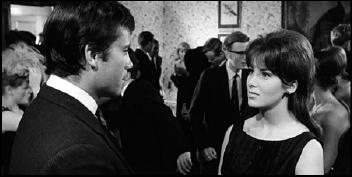
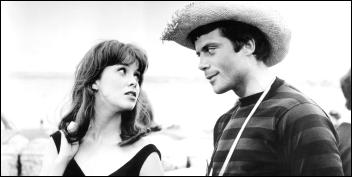
THE SYSTEM. Bryanston Films, UK, 1964. Released in the US as The Girl-Getters, American International Pictures, 1966. Oliver Reed, Jane Merrow, Barbara Ferris, Julia Foster, David Hemmings. Director: Michael Winner.

   There’s not a crime to be seen in this British-made movie, unless it’s the breaches of trust committed by a group of local lads who prey on the girls (birds, or thrushes) who come down from London and elsewhere to their small bailiwick on the sea every summer. Seduce and abandon, is their modus operandi, and their system is simple.

THE GIRL-GETTERS

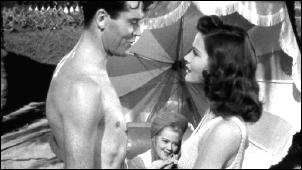
   The leader of their lot, a chap named Tinker (Oliver Reed) has a job as a roving beach photographer.

   He takes pictures of likely victims, obtains their local addresses, and distributes the same to the others of the group. When the summer’s over, they’ve left their ladies with lots of memories, perhaps, and – also perhaps – many of the memories are good ones. But lasting ones? Hardly ever.

   No big crimes involved here, right? There are lots of swinging sixties beach party scenes, and the film is certainly not without lightness and humor, but no Annette Funicello beach blanket movie is this. If ever a film might be called Noir without even the hint of a murder being committed, it might be The Girl-Getters.

THE GIRL-GETTERS

   The question is, as it slowly dawns on Tinker, is who are the Takers and who are the Taken?

   His pursuit of the wealthy Nicola (Jane Merrow) only shows how strong the “caste system” in England really was, and how futile it may have been to fight it. The one-set tennis match he plays with one of Nicola’s gentlemen friends, or tries to, and then tries to laugh it off, is a turning point that comes, one supposes, in everybody’s life – at which time they learn their limitations, and at the same time learn they cannot do anything about it.

   The glowing embers behind Oliver Reed’s fiery, dark-shadowed eyes, and his memorable performance in this film, show that when the occasion presented itself, he was one of the finest actors of his day. Up until this movie, most of his work was done for Hammer Films, but I’d like to think that a lot of doors were opened to him afterward.

THE GIRL-GETTERS

   Not that The Girl-Getters was recognized as anything close to a work of art at the time, but it was among the vanguard of British films dealing with modern (if not mod) themes such as class differences and sexual awareness like Alfie and Georgy Girl (both 1966) that turned the world of film-making upside down.

   I didn’t see The Girl-Getters back then, but that’s the era when I started to really enjoy what film-making was all about, rather than simply film-watching. Blow-Up (1966 as well, and starring David Hemmings, who also had a small role in this earlier movie) was a revelation to me, nor was I the only one who felt that way.

THE BACKWARD REVIEWER
William F. Deeck

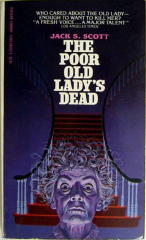
JACK S. SCOTT – The Poor Old Lady’s Dead.

Harper & Row, US, hardcover, 1976. Reprint paperback: Popular Library, 1980. First published in the UK: Robert Hale, hc. 1976.

JACK S. SCOTT

   The Chief Inspector had come down with a bug and the Superintendent was not aware of it until Detective Inspector Rosher had taken over the investigation. So the tumble down the stairs by a little old lady at the Haven, an old folks’ home, remains in the ham-fisted hands of Old Blubbergut, as he is unaffectionately known to his colleagues and his underlings.

   Rosher has to deal with an alderman who is the dead lady’s nephew and quite influential in the town, and finesse and subtlety are not Rosher’s strong points, if they are points of his at all.

   A subplot involves Rosher’s unhappy and hapless assistant, who has to suffer not only from his superior’s taunts but from the demands of a pregnant mistress who, quite reasonably, wants him to leave his wife and marry her.

   Rosher can be compared with [Joyce Porter’s] Chief Inspector Wilfrid Dover in some ways, only Dover is a caricature, a grotesque, and funny. Rosher is unfunny and very close to real.

   He toadies to his superiors. As for his underlings, “Strangely, he was not unpopular with the rank and file, provided they were on a lowly rung and unlikely to rise far above it.” Like Dover, he cadges meals and drinks from the unfortunate juniors who have to work with him. His personal habits aren’t very pleasant, either.

   As some other authors before him have discovered when they made their main character unpleasant, a continuing character must receive some empathy from the reader or be a burlesque like Dover. Otherwise, the normal reader will not buy further books in the series.

   Scott made Rosher more appealing and more human, though still not particularly pleasant, as the series advanced. Read this first recorded case of Rosher for a good investigation, some rather bitter humor, and to discover what he was like in the beginning.

   Then read the rest of Scott’s novels featuring Rosher. They become even more enjoyable as Rosher mellows somewhat.

– From The MYSTERY FANcier, Vol. 10, No. 3, Summer 1988.


      Bibliographic Data:     [Taken from the Revised Crime Fiction IV, by Allen J. Hubin.]

ROSHER, INSP. (Sgt.) ALFRED STANLEY “ALF”.   Series character created by Jack S. Scott.

      The Poor Old Lady’s Dead (n.) Hale 1976; Harper, 1976.
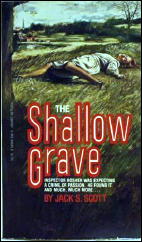
      The Shallow Grave (n.) Hale 1977; Harper, 1978.

JACK S. SCOTT

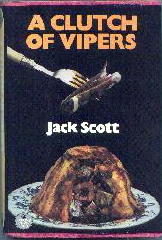
      A Clutch of Vipers (n.) Collins 1979; Harper, 1979.

JACK S. SCOTT

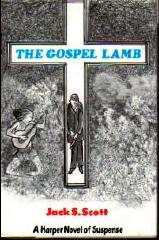
      The Gospel Lamb (n.) Collins 1980; Harper, 1980.

JACK S. SCOTT

      A Distant View of Death (n.) Collins 1981; Ticknor, 1981, as The View from Deacon Hill.
      The Local Lads (n.) Collins 1982; Dutton, 1983.
      An Uprush of Mayhem (n.) Collins 1982; Ticknor, 1982.
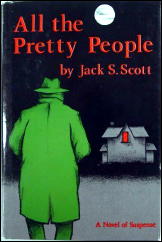
      All the Pretty People (n.) Collins 1983; St. Martin’s, 1984.

JACK S. SCOTT

      A Death in Irish Town (n.) Collins 1984; St. Martin’s, 1985.
      A Knife Between the Ribs (n.) Collins 1986; St. Martin’s, 1987.

Editorial Comment:

   I may be wrong, but I don’t have any strong feeling that either Inspector Rosher or his creator Jack S. Scott are remembered by more than a handful of mystery readers today, some 20 or 30 years later. Back in the 1970s and early 80s, I’m fairly sure that Joyce Porter’s Inspector Dover’s books were more popular than Rosher’s, and I’m sure that even the obnoxious Dover is now little more than a fading memory, alas.

REVIEWED BY DAN STUMPF:         


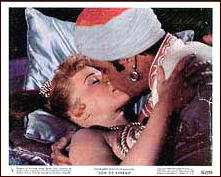
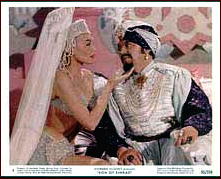
SON OF SINBAD. RKO, 1955. Dale Robertson, Sally Forrest, Lili St. Cyr, Vincent Price, Mari Blanchard, Nejla Ates. Director: Ted Tetzlaff.

SON OF SINBAD

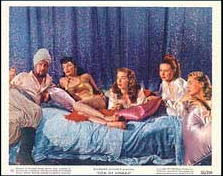
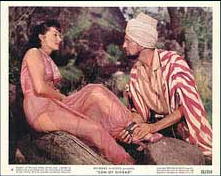
   There’s silliness and to spare in Son of Sinbad, with Dale Robertson and a cast of strip-tease artists cavorting around in skimpy outfits and Technicolor so bright you need sunglasses.

   Director Ted Tetzlaff was an accomplished cinematographer (Notorious and The Enchanted Cottage come to mind) and a director who had his moments (The Window, from a Woolrich story), and while Son of Sinbad will never make the pantheon of great movies, he gives it a certain gaudy panache, throwing bright colors across the screen every chance he gets and trying to impart a sense of motion to a story that is mostly inert.

SON OF SINBAD

   Also thrown across the screen are girls. And more girls. And still more girls, all wearing not very much at all, and showing it off with surprising stylishness.

   Mention must also be made of Vincent Price dressed in a circus tent, playing Omar Khayyam (!) with tongue in cheek, having a good time with dialogue that shows surprising glimmers of intelligence. The best-known line comes when he settles down to sleep and mutters, “To sleep… perchance to dream… An interesting thought, but I’m too tired right now; I’ll leave it to some future poet.”

SON OF SINBAD

   Just a flash of wit in what is essentially a good dumb movie.

EDITORIAL COMMENT.   I’ve not seen the movie, yet, but I have watched two clips from it on YouTube. The first features the exotic dancing of Nejla Ates; in the second, Sally Forrest dances up an equal storm while dressed, as Dan so eloquently states, wearing not very much at all.

   I have more pictures I could show you, but the one below will have to suffice, then it’s back to regular programming:

SON OF SINBAD


A REVIEW BY DAVID L. VINEYARD:         


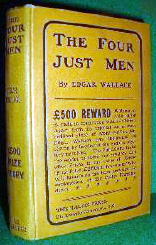
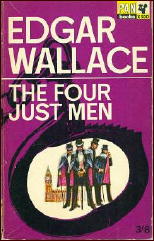
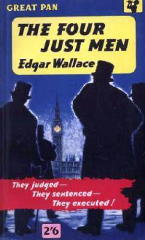
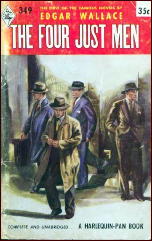
EDGAR WALLACE – The Four Just Men. The Tallis Press, UK, hardcover 1905; Tallis, UK, 1906, with the solution to the mystery. Small Maynard, US, hc, 1920. Reprinted many times.

    Citizens,
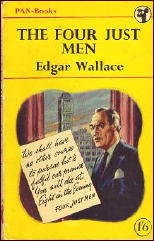
EDGAR WALLACE The Four Just Men

   The Government is about to pass into law a measure which will place in the hands of the most evil Government of modern times men who are patriots and who are destined to be the saviours of their countries. We have informed the Minister in charge of this measure, the title of which appears in the margin, that unless he withdraws this Bill we will surely slay him.

   We are loath to take this extreme step, knowing that otherwise he is an honest and brave gentleman, and it is with a desire to avoid fulfilling our promise that we ask the members of the Mother of Parliaments to use their every influence to force the withdrawal of this Bill.

   Were we common murderers or clumsy anarchists we could with ease wreak a blind and indiscriminate vengeance on the members of this assembly, and in proof thereof, and as an earnest that our threat is no idle one, we beg you to search beneath the table near the recess in this room. There you will find a machine sufficiently charged to destroy the greater portion of this building.

      (Signed) Four Just Men

   Postscript. –We have not placed either detonator or fuse in the machine, which may therefore be handled with impunity.
EDGAR WALLACE The Four Just Men

   The Four Just Men is the book that put Edgar Wallace name on the front page, and kept it there, thanks to an ingenious news paper promotion in the Daily Mail in which he challenged the readers to solve the mystery for a big reward.

   Wikipedia has a good account of the mess this led to. Unfortunately for Wallace, too many came up with the solution, and he had to swiftly change his ending and even then he ended up losing money, but by then his name was made. Money always went through his fingers like that — often at the racetrack. But whatever the circumstance, The Four Just Men was a sensation, and Edgar Wallace was off to his own literary races.

   The plot involves what I call ‘the great vote,’ a particularly British invention wherein for some reason a Minister, MP, or member of the House of Lords must be stopped from introducing a bill (usually involving defense funds) or making a key vote.

   As far as I know, it first showed up in a story by Lord Dunsany, and its most famous incarnation before Wallace may have been in American Richard Harding Davis’s novel In the Fog (really a collection of related novellas in the mode of Stevenson’s Arabian Nights or Andrew Lang’s The Disentanglers), both well known and popular. (The Davis is worth finding just for the beautiful color illustrations by American Sherlock Holmes illustrator Frederic Dorr Steele). The Four Just Men stands as the best known version of the plot today.
EDGAR WALLACE The Four Just Men

   In Wallace’s case his heroes, who call themselves the Just Men, announce that if Cabinet Minister Sir Philip Ramon doesn’t withdraw his upcoming bill that will send many honest revolutionaries to certain death at the hands of their homelands dictator, they will be forced to kill him. A brief summary of their career is compiled by the police:

    “…we are assured, both by our own police and the continental police, that the writers are men who are in deadly earnest. The ‘Four just men’, as they sign themselves, are known collectively in almost every country under the sun.

    “Who they are individually we should all very much like to know. Rightly or wrongly, they consider that justice as meted out here on earth is inadequate, and have set themselves about correcting the law. They were the people who assassinated General Trelovitch, the leader of the Servian Regicides: they hanged the French Army Contractor, Conrad, in the Place de la Concorde — with a hundred policemen within call. They shot Hermon le Blois, the poet-philosopher, in his study for corrupting the youth of the world with his reasoning.”

   Scotland Yard draws in its forces, the Minister refuses to budge on his bill, and in due course the Just Men strike. The Just Men, Leon Gonzallez, George Manfred, Raymond Poiccart, and Thiery plan their move and the nations holds its breath, the question being how will they managed the feat.
EDGAR WALLACE The Four Just Men

   The Just Men win out, but at the cost of one of their lives. Notably Wallace doesn’t make the case clean cut. Ramon is a good man who will not be the victim of extortion, and the Just Men swear to kill him for the greater cause of justice, not because he is evil.

   Few thrillers today deal with such moral quandaries, much less any in the Wallace class of popular fiction. Though Wallace spends precious little time on the moral question (it’s a fairly short book), the fact that it comes up at all in a newspaper serial designed as a thriller is a tribute to Wallace’s instincts as a writer. It doesn’t hurt that the solution to how they kill Ramon is clever in itself and well handled by Wallace.

   The Just Men are what Robert Sampson called Justice Figures in his survey of the pulps, Yesterday’s Faces (published in six volumes by Bowling Green Press), avengers who operate outside the law for the public good. Their name derives from the Jewish tradition that to each generation forty just Gentiles are born who treat the Jewish people fairly and with justice.
EDGAR WALLACE The Four Just Men

   The Just Men have led dangerous lives before the book begins, and will continue for several volumes, one dying, one retiring, the two survivors eventually opening a sort of detective agency after receiving pardons for their past crimes.

   It has probably already dawned on you that by modern standards the Just Men are political terrorists — at least in this first book — but by the standards of the day such a passionate love of country and justice could be justified, and Wallace goes out of his way to portray his gentlemen as good men of high moral and political fiber who believe theirs is the only way to prevent a dangerous threat to moral good.

   This was the heyday of anarchists, nihilists, and the Fenians, and it was still possible to romanticize figures of social justice such as the Just Men. The mass killing of WWI and the Russian Revolution would change the milieu which they operated in, however.
EDGAR WALLACE The Four Just Men

   Still, in today’s world it is hard not to think of modern terrorism and the ‘excuses’ given for its atrocities when reading the book. If you can park that modern sensibility, The Four Just Men is a classic that deserves to be read, and the sequels among Wallace’s best works. But you may find it makes you think more than Wallace ever intended when he wrote it.

   Whatever its politics, The Four Just Men is a compelling and entertaining Edwardian tale (it was published the year Queen Victoria died), with a quartet of interesting heroes and enough invention and suspense for a much longer book. Though it does reveal its origin somewhat as a newspaper serial, it is still highly enjoyable today.

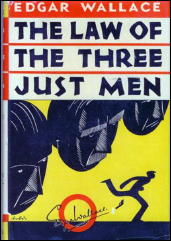
   Wallace was never one to miss out on a money maker, and the Just Men would return throughout his career in books like The Three Just Men, The Just Men of Cordova, The Council of Justice, and The Law of the Three Just Men.

   It’s only speculation, but they may have been inspired in part by Eugene Sue’s Prince Rodolfe in The Mysteries of Paris, and E.W. Hornung’s Mr. Justice Raffles, which both deal with heroes who set up their own underworld court systems to hand down justice to those the law can’t touch. (No doubt a little of the thieves court from Hugo’s Hunchback of Notre Dame and Balzac’s Thirteen Men also contributed.)
EDGAR WALLACE The Four Just Men

   Whatever their origin the book became an instant classic, still in print, and at one point even issued by Oxford University Press. Pretty good company for a newspaper serial.

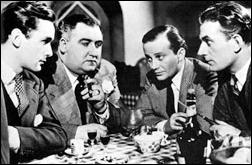
   The Four Just Men came to the big screen in 1939. Known as The Secret Four in the US, the plot was moved up to a contemporary setting but was otherwise faithful. Francis L. Sullivan, Hugh Sinclair, Griffith Jones, and Frank Lawton were the Just men. Walter Forde directed from an Angus McPhail script.

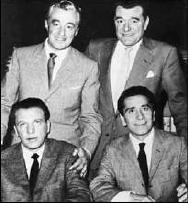
   In 1959 thirty-nine episodes of a syndicated television show starred Dan Dailey, Richard Conte, Vittorio de Sica, Jack Hawkins, and a semi-regular Honor Blackman as modern variations on the characters ran and was seen worldwide.

   Paul Gallico later penned a novel about a group of aging Resistance fighters who behaved much the same way as the Just Men, The Zoo Gang (Coward, 1971). A summer replacement series that was based upon it starred Brian Keith, John Mills, Barry Morse, and Lili Palmer, running for six episodes in 1975.
EDGAR WALLACE The Four Just Men

   The Four Just Men isn’t great literature by any means, but it is one of the high points of Edgar Wallace’s career, and one of the most important books in the genre.

   It’s a quick and easy read, and one that has entertained for over a century. As far as I know it is still in print, and in any case it is fairly easy to find and available as a free e-book as well.

   The film, The Secret Four can be found on the gray market, and may be available from a legitimate source as well. Wallace fans who don’t know it, genre historians, lovers of Victorian and Edwardian detective fiction, and readers who like to be entertained should all give it a chance. All the Saints, Shadows, Spiders, and the like who came afterward are in the shadow of Wallace and the Just Men.
IT’S ABOUT CRIME
by Marvin Lachman

   I suspect that detectives like Henry Tibbett [whose mystery case Falling Star, by Patricia Moyes, was reviewed here several days ago] were a reaction to the eccentric sleuths of an earlier era, e.g., Holmes, Wolfe, and Poirot.

JOHN CREASEY

   Mystery writer John Creasey fathered a small army of detectives, all of whom had “smarts” and physical prowess, though none were especially colorful. Understandably, but perhaps unfairly, Creasey’s name has often made mystery readers smile. The most prolific mystery writer, he started by writing some dreadful books in his early days.

   Nor were all of them mysteries, since he wrote in all genres. (One of his early “Tex Reilly” westerns is reputed to contain the deathless line about coyotes flying in the sky.)

   Creasey was best known for his Commander George Gideon books, written under the J.J. Marric pseudonym, but G.G.’s roots were clearly in his older literary brother, Inspector Roger “Handsome” West, who appeared in forty-three novels and at least one short story.

JOHN CREASEY

   West started off rather inconspicuously in 1942, depending on a socialite friend for much of his detection and legwork. However, as the series progressed, Creasey’s writing and West, as a hero, improved.

   Happily, Harper’s Perennial Library has recently reprinted eight of the Roger West series, and their selection is excellent, as witnessed by the following examples.

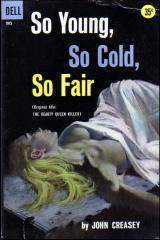
   Serial killers are everywhere today. (I’m sure I pass them on the streets as I walk from the train to work.) The Beauty Queen Killer (1954) is a good early example, with some exciting scenes, marred only by difficult to accept motivation.

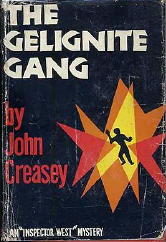
   The Gelignite Gang (1955) dates from the same year as the first Marric novel, and it also gives a good picture of London from a policeman’s viewpoint.

JOHN CREASEY

   Here, the police are faced with a series of jewelry robberies, with the titular form of dynamite the common factor. When murder occurs during robbery in the city’s largest department store, West is called in to solve a mystery that has more surprises than most.

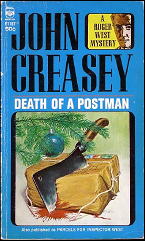
   In Death of a Postman (1956) Creasey accomplishes what relatively few mystery writers do: he makes us care about the victim. A postal worker, who leaves behind a wife and five children, has been murdered during the Christmas rush. As we rapidly turn the pages of one of Creasey’s best narratives, we become involved and want West to track down a particularly heinous killer.

– From The MYSTERY FANcier, Vol. 10, No. 3, Summer 1988   (slightly revised).


Bibliographic details:

   The Beauty Queen Killer.   Harper & Brothers, US, hardcover, 1956. First published in the UK as A Beauty for Inspector West, Hodder & Stoughton, hc, 1954. US paperback editions include: Dell 985, 1957, as So Young, So Cold, So Fair. Berkley F1095, 1965; Lancer 74757, 1971; and Perennial, 1987.

   The Gelignite Gang.   Harper & Brothers, US, hardcover, 1956. First published in the UK as Inspector West Makes Haste, Hodder & Stoughton, 1955. US paperback editions include: Bantam 1884, 1959; Berkley F1176, 1966, as Night of the Watchman; Lancer, 1971, as Murder Makes Haste; and Perennial, 1987.

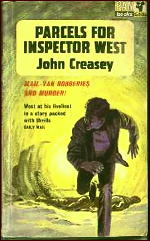
   Death of a Postman.   Harper & Brothers, US, hardcover, 1957. First published in the UK as Parcels for Inspector West, Hodder & Stoughton, 1956. US paperback editions include: Bantam 1883, 1956; Berkley F1167, 1965; and Perennial, 1987.

JOHN CREASEY

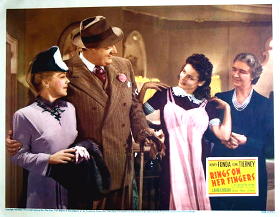
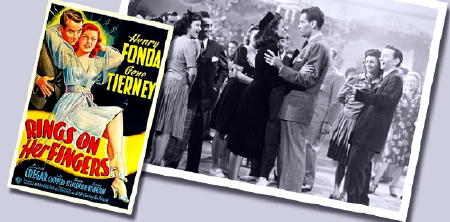
RINGS ON HER FINGERS. 20th Century-Fox, 1942. Gene Tierney, Henry Fonda, Laird Cregar, Spring Byington, John Shepperd (Shepperd Strudwick), Frank Orth, Henry Stephenson. Director: Rouben Mamoulian.

RINGS ON HER FINGERS Gene Tierney

   Gene Tierney was as beautiful an actress as Hollywood ever produced, wasn’t she?

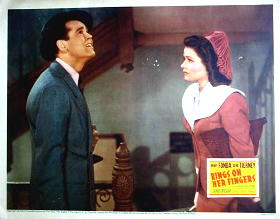
   In the scene in this mostly light-hearted movie in which she’s trying to attract Henry Fonda’s attention, dressed in a single piece bathing suit and stretched out on a blanket along the shore, he’s so distracted he can hardly talk, and who can blame him?

   Over the span of her career, Gene Tierney didn’t do too many romantic comedies – most of her films seems to be straight dramas (Dragonwyck, The Razor’s Edge) or crime films with a strong noirish flavor (Laura, of course, and Night and the City) – but she acquits herself well in Rings on Her Fingers, making me wish she’d done more movies in the same vein.

RINGS ON HER FINGERS Gene Tierney

   Looking through her list of films, I see only That Wonderful Urge (1948), a remake of Love Is News (1937), with Tyrone Power in both, as a movie that’s in any sense comparable to Rings on Her Fingers.

   In a way, you might call this film a “re-imagining” of The Lady Eve (1941), in which Henry Fonda played against Barbara Stanwyck. The gimmick here is that Henry Fonda’s character is poor, not rich, and when Gene Tierney’s character is part of a flim-flam which fleeces him of $15,000 hard-earned dollars, it’s easy to see that the two of them will get together, but how will she keep her part of the swindle a secret from him?

RINGS ON HER FINGERS Gene Tierney

   Not that she’s a bad girl, only a shop girl easily tempted by glamor and easy riches, and taken in by the real pair of crooks, Laird Cregar and (believe it or not) Spring Byington. And what a mis-matched pair they are: Cregar was a giant of a man in size (but nimble enough on his feet), and Byington was tiny and nearly swallowed up on the screen in comparison.

   Is this a screwball comedy? I’ve asked myself that, and when I did, I didn’t get an immediate response, mostly because, like “noir film,” I don’t know that I have an exact definition of screwball comedy in mind.

   But I guess I know one when I see one, and at the moment I’m inclined to say No as far as Rings on Her Fingers is concerned. The romantic problems are a little too real, with too much of an edge to them (how does she keep him finding out that she was part of the con game that took him in?), and there doesn’t seem to be the kind of goofy wackiness that I associate with other screwball comedies of the 1940s.

RINGS ON HER FINGERS Gene Tierney

   As for Henry Fonda, he’s perfect for the part, naive but noble, and what a way to make a living: kissing Gene Tierney.

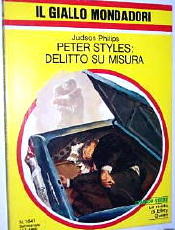
JUDSON PHILIPS – A Murder Arranged. Dodd Mead, hardcover, 1978. Reprint hardcover: Detective Book Club, 3-in-1 edition, November 1978. No US paperback edition. (Shown is the cover of an Italian softcover edition.)

JUDSON PHILIPS

   Journalist Peter Styles’ crusade against senseless violence leads him to an out-of-the-way New England village where he becomes the champion of a young man accused and convicted of murder. All the evidence seems to point directly to Tim Ryan, but the feeling of at least half the townspeople is that the state police wrapped up their case far too quickly.

   Obviously there’s more than a little resemblance here to a story that recently made Connecticut headlines, and the reader is swallowed up at once into the affairs of a small town. In spite of some fast deductions and the long arm of coincidence in the final chapters, Philips demonstrates once again that few authors are so non-stop reliable as he.

— From The MYSTERY FANcier, Vol. 3, No. 3, May-June 1979
            (very slightly revised).


[UPDATE] 06-29-09.  For an author as popular as Judson Philips (1903-1989) was, it never made sense to me that a good percentage of his books never came out in paperback. Including the books he wrote as Hugh Pentecost, his hardcover mystery fiction would have filled at least two long shelves at your local library.

   Philips began his career writing an even longer list of stories for the pulp magazines in the 1930s, and books continued to come from his typewriter very nearly up to the day he died. A list of his book-length fiction can be found online here.

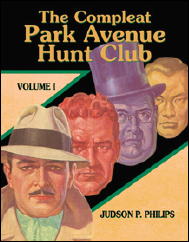
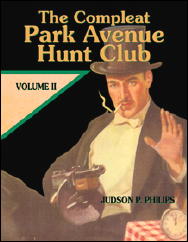
   If it weren’t for readers and collectors of pulp magazines, I imagine that Philips would have fallen long ago into that ever-growing limbo of mystery writers who sold tons of books in their day, but who are fast fading from memory today. (A list of his “Part Avenue Hunt Club” stories from Detective Fiction Weekly that have recently been reprinted in a two-volume set from Battered Silicon Dispatch Box can be found online here.)

JUDSON PHILIPS           JUDSON PHILIPS

REVIEWED BY DAN STUMPF:         


SINBAD THE SAILOR Douglas Fairbanks

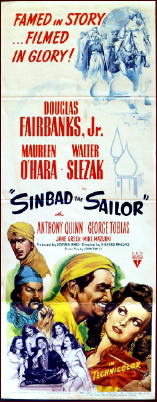
SINBAD THE SAILOR. RKO, 1947. Douglas Fairbanks Jr., Maureen O’Hara, Walter Slezak, Anthony Quinn. George Tobias, Jane Greer, Mike Mazurki, Sheldon Leonard. Co-storywriters: John Twist & George Worthing Yates; director: Richard Wallace.

   Moving on to swashbuckler movies from westerns, a while ago TCM did a series of “Sinbad” flicks which finally floated to the top of my to-be-watched pile.

   Sinbad the Sailor is a lush 40s Technicolor extravaganza with odd touches of noir as an equivocating Douglas Fairbanks Jr. moves into uneasy alliance with an enigmatic Maureen O’Hara, and they both play cat-and-mouse with hard-boiled icons like Anthony Quinn, Walter Slezak, Jane Greer and even Mike Mazurki and Sheldon Leonard, all looking a bit out of place in Arabian Nights country, but giving it a shot anyway.

   The stunt work is nothing to write books about (disappointing from a swashbuckler of Fairbanks’ pedigree) but the sheer, ebullient silliness of the thing carries it off.

Coming soon:

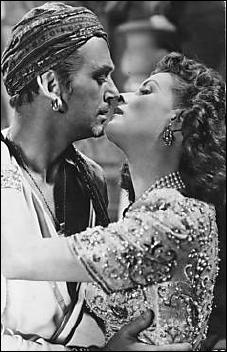
   Dan’s reviews of Son of Sinbad (1955) and Captain Sinbad (1963). In the meantime, I wish I’d found a copy of this photo in color:

SINBAD THE SAILOR Douglas Fairbanks

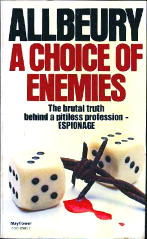
TED ALLBEURY – The Reaper.

Grafton; UK paperback original, 1st printing, 1980. US title: The Stalking Angel. Mysterious Press, hc, 1988; Warner, pb, 1989.

TED ALLBEURY

   I recently purchased a small collection of spy thrillers written by Ted Allbeury, some British editions, some published in this country. (When this book appeared over here, the title was changed to The Stalking Angel, a modification all to the better, to my way of thinking.)

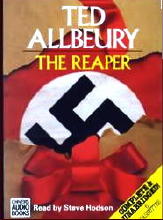
   And not having read anything by the author before now, I picked this one more or less at random. This is in violation of a general principle promulgated by an esteemed colleague of mine, which I usually adhere to, which is to never read a book with a swastika on the cover.

   Without getting into the details of the plot, at least not yet, what I discovered was what the book by John Jakes I recently reviewed was missing. Often times you can describe what you see. It’s what’s not there that’s sometimes difficult to put your finger on. Jakes’ book was written strictly in black and white, which I pointed out, although I was referring to films at the time.

   Allbeury’s book has the in-between gray that better spy novels seem to thrive on. The moral dilemmas, the idea that “you always pay.” From page 136, former CIA agent Hank Wallace is warning Anna Simon, his protégé with whom he has fallen in love:

    “You pay a price when you kill someone. It’s a different price for different people. It doesn’t matter if the killing is just or unjust, you still pay the price. You don’t necessarily pay immediately; it may be years later when you have almost forgotten what happened. But you pay. And you always seem to pay when you can least afford it.”

   A group of aging ex-Nazis, tired of being hunted down and killed, has decided to retaliate, and Anna’s husband, working (unknown to her) for a Jewish organization tracking them down, is one of their first victims.

   As the US title then suggests, Anna then begins to take revenge in her own hands. You might think you know exactly where this will lead, and it probably does, but (more than likely) not exactly on the path you think it will.

   Being judge, jury and executioner all in one — it’s not the easiest job in the world, and Allbeury does a better than average job of showing us why.

— April 2003

        Biographic data:

   Ted Allbeury died 4 December 2005. A long obituary I’ve found online contains a wealth of information about him, from which I’ve excerpted the following:

TED ALLBEURY

    “Ted Allbeury, who has died aged 88, was the most productive of the internationally recognised spy writers of recent years, at one point writing four novels in one year under his own name, plus others under the pen names Richard Butler and Patrick Kelly. […]

    “The author of more than 40 novels and numerous radio plays, Ted came to writing late in life (he was 56 when his first book, A Choice of Enemies, appeared in 1973). […]

    “A tall, imposing man, with an alert mind and an ease with languages, he served as an SOE intelligence officer from 1940 to 1947, rising to the rank of lieutenant colonel. […]

    “Ted’s work was not so much a reaction to other spy fiction writers, but an extension of the work that Deighton and others had begun: first, he wanted to deepen the wartime thriller; and second, he aimed to make unusual common cause with enemy agents as human beings, thus exposing the power relations on both sides as his real target.

   Even if you have only a small interest in the British spy novel, the rest of the obituary is well worth your reading.

REVIEWED BY WALTER ALBERT:         


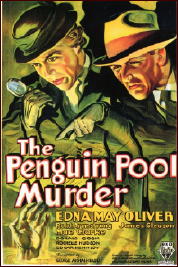
THE PENGUIN POOL MURDER. RKO Radio, 1932. Edna May Oliver, James Gleason, Robert Armstrong, Mae Clarke, Donald Cook, Edgar Kennedy. Based on the mystery novel by Stuart Palmer. Director: George Archainbaud. Shown at Cinevent 19, Columbus OH, May 1987.

THE PENGUIN POOL MURDER - The Movie

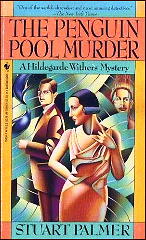
   The Penguin Pool Murder is based on the popular Stuart Palmer Hildegarde Withers series and was the first of three films to star the redoubtable Edna Mae Oliver as the spinster amateur detective.

   I thought it a very appealing film indeed, but when I mentioned my enjoyment of the film to a friend he observed that he had erased it from a tape, expunging this “poorly paced” Withers/ Piper collaboration, but preserving for posterity (and me, perhaps, at a later date) a “superior” later entry in the series.

   I liked the film for the fizzy chemistry between Edna Mae Oliver and Inspector Piper, played with his usual engaging asperity by James Gleason, and what seemed to my bemused eyes to be a nicely paced comedy-mystery with some Oscar-worthy histrionics by a talented penguin.

   But I must confess that when it comes to Edna Mae Oliver, I am a patsy in the throes of an unrequited passion. My favorite Oliver performance is in John Ford’s Drums Along the Mohawk, where she plays a feisty widow putting Indians to rout with a broom and a stentorian voice until an arrow terminates her terroristic cavorting.

THE PENGUIN POOL MURDER - The Movie

   (The only contemporary actress I can compare her to in the effect she has on me is pint-sized Linda Hunt, who conveys more intelligence and sympathy with a look than most actresses do with a pageful of dialogue. I enjoyed her unanchored — by the script — performance in Silverado, where amid the clutter of this entertaining shoot-’em-up [and down], she displays a purity of character and demeanor that raises most of her scenes to a level to which little else in the film aspires.)

   As for Penguin Pool Murder, however, I will delay my definitive judgment on it until I have seen the other Oliver/Gleason collaborations in the series.

– Reprinted from The MYSTERY FANcier, Vol. 9, No. 3, May/June 1987 (very slightly revised).


« Previous PageNext Page »