MICHAEL DIBDIN – Blood Rain.

Detective Book Club [3-in-1 edition]; hardcover reprint (*). First edition: Faber & Faber, UK, hardcover, 1999; trade ppbk, 1999 (*); paperback, April 2000. Pantheon, US, hc, March 2000 (*); Vintage, trade pb, May 2001. (* = shown, in this order)

   One question to which I’ve never been able to come up with a definitive answer is how long did the Detective Book Club last? What was the last selection?

MICHAEL DIBDIN - Blood Rain.

   There must have been subscribers all the way through to the end, but I’ve never been able to find one of them who’d be willing to say with any authority that here’s the one that was the last.

   (I’d also like to obtain more of the selection booklets sent to members over the years. I have a few, but it’s nearly a hopeless cause, since of things ephemeral, I can thing of very few things more so, except serviettes at McDonalds.)

   In the last few years of their existence, though, the DBC put volumes numbers on the spine. The one for this book, for example, is D655, which is the highest I’ve ever had in my possession. The other two books in the same volume are copyright 2000, which puts this awfully close to the end, whenever it was.

   And for the record, if you can’t make them out on the cover shown, the other two books are The Hard Detective, by H. R. F. Keating, and Manifesto for the Dead, by Domenic Stansberry.

   As for Blood Rain, it’s a book in Michael Dibdin’s Aurelio Zen series, about which you can read more in an obituary for the author which I posted here on the blog early in 2007.

MICHAEL DIBDIN - Blood Rain.

   Zen is a Venetian-born police detective whose successive posts have sent him on a guided tour of Italy today. Other observers have suggested reading the books in order, which is a good idea, as in each of them, the situations he finds himself in are as much about him personally as they are about the crimes he is forced to confront.

   Unfortunately I did not take this advice. To tell you the truth, I didn’t take the time to see what advice these other observers had already given, so I plunged right in. And it took me a while to sort out why he has been relegated to Sicily in this book, and why he seems to have a daughter he never knew about and who really isn’t his daughter according to DNA data.

   And to tell you the truth again, I never did completely sort any of either of the above. It’s that kind of book. Very well written, very literary, and very vague on details that depend on either previous books or exactly who is doing what to who in the midst of a Mafia war that seems to have broken out in Sicily at about the same time as Zen’s arrival.

   Zen’s new daughter Carla is in the middle of it, as she is there too, working on installing a new computer system for the police, and so is Corinna Nunziatella, an anti-Mafia judge who has taken a liking to Carla.

MICHAEL DIBDIN - Blood Rain.

   Basically, this is what it is. There are Mafia families against Mafia families in this book, some on the way up, others on the way down. Some are up-to-date regarding new technologies and new sources of income, and some are old-fashioned and designed to stay in the backwaters of the new commerce.

   Dibdin’s prose is witty, clever, introspective and descriptive. His is the type of novel that literary critics go head over heels for, as it typifies the term, “transcending the genre.” Those of us who are old-fashioned and are relegated to the junk heap of wishing to read about old-fashioned detection in our detective fiction may not be as enthusiastic about the story itself as those previously mentioned literary critics have been.

   Please don’t get me wrong. I meant what I said when I referred to Dibdin’s prose as witty and clever. Unfortunately Zen, in this book at least, is a leading character who reacts to events, instead of being pro-active in tackling them head-on, which makes all the difference in the world. Not that he’s any kind of slouch about what he does, but his forte is thinking, when he has a well-defined need to, and not so much doing. And there’s nothing wrong with that.

   And oh, yes, before I go. I understand there was quite a reactive uproar about the ending of this book when it first came out. It’s far enough along in time now, after the fact, to say that the cliffhanger of an ending seems to have worked out in Zen’s favor, but nobody knew that at the time, not until the next book came out, Medusa, four years later, in 2003.

THE PATIENT IN ROOM 18. First National Pictures, 1938. Patric Knowles, Ann Sheridan, Eric Stanley, John Ridgely, Rosella Towne. Based on the novel by Mignon G. Eberhart. Directors: Bobby Connolly & Crane Wilbur.

PATRIC KNOWLES

   It’s always been a puzzle to me why early Hollywood, with all its marvelous powers of decision making, seemed to consider the term “detective mystery” to be totally synonymous with the word “comedy.”

   Not that I’ve ever read the book this half-witted movie was based upon, but even if the story that Miss Eberhart wrote was meant to be light-hearted if not funny, I’m sure that it made some sense, and there’s not a lick of it in this film.

   Think of the Charlie Chan films and then the Hildegarde Withers movies and when you have, combine them all together in your mind and throw out the plot. Then you’d have something that would resemble this movie. (If watching B-westerns will turn your mind to mush, watching movies like this will turn it to soup.)

   Here’s the story. (If anybody’s read the book, let me know how much resemblance it bears.) As the movie opens, auxiliary police investigator Lance O’Leary (I don’t know what other job title it might be that he has) is having a nervous breakdown, caused by his first known failure on a case, and causing him to go sleepwalking through the streets in a pair of impressively loud pajamas.

   Committed to the very same hospital where his girl friend works (head nurse Sara Keate), O’Leary soon finds himself confronted with the mysterious murder of the wealthy patient in room 18, being treated with an external dose of $100,000 worth of pure radium. Which naturally is now missing.

ANN SHERIDAN

   All of the doctors, interns, nurses, wives and other close relatives seem to be having affairs with each other, so even though Lance and the dead man seem to be the only patients in the entire hospital, there are plenty of suspects.

   The clues and other evidence are played free and easy with, and oh, did I forget to mention that the murder takes place on a dark and stormy night?

   And yet, maybe the Hollywood guys knew what they were doing. I enjoyed this sappy movie anyway. If my brain is now soup, I guess it might be clam chowder. As it happens, I like clam chowder.

— Reprinted from Mystery*File 33, Sept 1991 (slightly revised).


[UPDATE] 01-02-09.   I don’t remember this movie all that well, but what I do recall seems to agree pretty well with my comments above. I must have taped this off cable TV, as there’s no commercial version of it available right now.

   Nor have I been able to come up with any suitable scenes from the movie. The photos of the two main stars are close to the right time period, but that’s about all. (In Ann Sheridan’s case, the photo’s from 1939. As for Patrick Knowles, he looks the right age, but I may be completely off.)

ROBERT B. PARKER – God Save the Child.

Berkley Z3037, paperback reprint, 1976; 154 pp. Hardcover edition: Houghton Mifflin Co., 1974. Reprinted many times, both in hardcover and paperback.

ROBERT B. PARKER God Save the Child

   This is the second Spenser adventure, and in the end it’ll probably be known best for introducing Susan Silverman into the series. She’s a school guidance counselor, and Spenser first meets her while trying to find a runaway boy. He may have been kidnapped, but the vicious portrayal of the life the kid suffered through at home — rich, and not poor — makes it pretty much clear that what Kevin is desperately trying to do is to lead a life of his own. Or so one hopes.

   Parker’s writing is deceptively not as lean as it seems. Instead it’s fluently florid, in the sense of overdeveloped descriptive metaphors, and still it’s definitely and deliberately low-key and laid back, which is obviously more easily said than done.

   Within a short synopsis the story itself probably doesn’t sound very substantial, but within a few pages Parker can strip a character bare. Even though I’m never likely to meet him, I know who Spenser is.

– From The MYSTERY FANcier, Vol. 3, No. 4, July-Aug 1979.


[UPDATE] 01-02-09.  A few comments. I think I was right about Susan Silverman. For better or worse, I think she’s appeared in every Spenser adventure since. (Me, I’d say for the better.)

   I listed the number of pages in this review, as was my custom back then. I don’t do it now, but I thought you’d be interested in how many pages you could squeeze a Spenser novel down to, if you really tried.

ROBERT B. PARKER God Save the Child

   The copy of this book that I read was the 1976 Berkley paperback. I have a copy of Parker’s first book in hardcover, but when I found a cover image of the second one to show you, I couldn’t remember ever seeing it before. I looked the book up online, and a first edition hardcover will set you back an amount in the low to mid three figures. It’s not an easy one to find.

   Now take a look at the cover of what’s apparently the most recent paperback edition. Totally blah and generic. When the book is going to sell no matter what’s on the cover, why pay to put anything on it?

   I used to read all of the Spenser books as soon as they came out. Something in the early 1990s, as near as I can figure, I stopped. I kept buying them, though, but without reading them. Of Parker’s books, God Save the Child easily has to be one of my favorites.

   I suppose Parker might get tired of hearing that his “first two books were his best.” It may not be true, but I have a feeling that a lot of people think so.

A 1001 MIDNIGHTS Review by Bill Pronzini:


DONALD E. WESTLAKE God Save the Mark

DONALD E. WESTLAKE – God Save the Mark.

Random House, hardcover, 1967. Paperback reprint: Signet, 1968, several printings; Charter, 1979; Mysterious Press, 1987. Hardcover reprint: Forge, 2004.

   God Save the Mark, for which Westlake received a much deserved MWA Best Novel Edgar in 1968, is a comedy whodunit with barely restrained elements of slapstick — a type of book no one in the world has done better than Westlake.

   Its narrator and bumbling hero is Fred Fitch, a mark among marks; i.e., an easy victim, a ready subject for the practices of confidence men; i.e., the perfect sucker. Fred Fitch has more fake receipts, phony bills of sale, and counterfeit sweepstakes tickets than any man alive. He has even purchased a “money machine,” which is on a par with shelling out good hard cash for a piece of the Brooklyn Bridge.

DONALD E. WESTLAKE God Save the Mark

   As the jacket blurb says, “Every itinerant grifter, hypster, bunk artist, short-conner, amuser, shearer, shortchanger, green-goods worker, penny-weighter, ring-dropper and yentzer to hit New York considers his trip incomplete until he’s also hit Fred Fitch. He’s sort of the con-man’s version of Go; pass Fred Fitch, collect two hundred dollars, and move on.”

DONALD E. WESTLAKE God Save the Mark

   But Fred’s earlier problems seem minor compared to those he encounters after a relative he didn’t know he had, the mysterious Uncle Matt, is killed (murdered, in fact) and he is willed $300,000.

   First of all, every grifter, hypster, bunk artist, etc., seems bent on relieving Fred of some or all of that hefty bequest; second and by no means least of all, the person or persons unknown who bumped off Uncle Matt is or are now trying to bump off Fred.

DONALD E. WESTLAKE God Save the Mark

   The characters he meets as he tries to find out what is going on include a stripper named Gertie Divine, the Body Secular; a lawyer named Goodkind; an elusive crook named Gus Ricovic; a couple of cops called Steve and Ralph; a needle-happy doctor named Osbertson; and a former partner of Uncle Matt’s named Professor Kilroy.

   Add to them the wackiest chase sequences this side of a Mel Brooks movie, and you have — or will have — any number of chuckles, laughs, and guffaws. Anybody who doesn’t find this novel at least semi-hilarious probably wouldn’t crack a smile at a politician’s wake.

DONALD E. WESTLAKE The Busy Body

   Two of Westlake’s other novels in this same vein are likewise fast, funny, and fun: The Busy Body (1966) and The Spy in the Ointment (1966). Two more — Who Stole Sassi Manoon? (1969) and Somebody Owes Me Money (1969) — are less successful (Sassi Manoon, in fact, may be Westlake’s worst novel), which is no doubt the reason he turned to other types of comic suspense.

         ———
   Reprinted with permission from 1001 Midnights, edited by Bill Pronzini & Marcia Muller and published by The Battered Silicon Dispatch Box, 2007.   Copyright © 1986, 2007 by the Pronzini-Muller Family Trust.

ACES AND EIGHTS. Puritan Pictures, 1936. *Tim McCoy, Luana Walters, *Rex Lease, *Wheeler Oakman, *Frank Glendon, Earl Hodgins, *Jimmy Aubrey, *Joseph Girard. Director: Sam Newfield.

   “Aces and eights” refers to the poker hand (two pair) that Wild Bill Hickok is supposed to have been holding when he was shot and killed at a card game. It doesn’t have much to do with the actual story that’s told in this movie, but in all honesty, it does come up a couple of times.

ACES AND EIGHTS Tim McCoy

   Tim McCoy is a rather unusual hero in this film. Whether it was a role he was used to, I’m not able to tell you, but he’s a gambler, not really a bad guy, of course, but he’s capable of bringing a fifth ace into a card game when it suits his purposes.

    The other trait that “Gentleman Tim Madigan” is known for is not carrying a gun, but the strength in his hands, which he relies on instead, is great enough to tear a deck of cards in half once and in half again.

   From IMDB, I see that Tim McCoy played a lot of gents named Tim in the movies, but this is the only time he was Gentleman Tim Madigan. He was 45 years old and rode a little stiffly in the saddle when he made this movie, produced by a bottom of the barrel production company.

   I may be wrong, but 45 was older than most B-western heroes were, at least in the 1930s. McCoy started in the film business in 1925, in the sound era, which is relevant, and I’ll get back to that in a minute.

   Before that, though, take another look at the cast above. I’ve put an asterisk (*) before the names of all the players who began their careers in non-talking cinema, and Luana Walters began hers in 1930. The reason that this is relevant is that both they and the director, who began his career in 1926, often seemed to think this is a silent film. I’ll lay the greater responsibility on the director.

   But it’s the exaggerated facial expressions and gestures, along with the long pauses waiting for reactions to come, that kept reminding me of an era that should have been laid to rest long before this movie came along. Also – and this was extremely annoying – whenever a group of players are in a bar or saloon, in a loop of constant background noise and conversation you can hear the same bartender’s voice asking “Another one?” every five seconds.

   The story is a complicated one, especially for a 62 minute playing time, but I’ll boil it down to the following pair of intertwined threads:   (1) Madigan is deemed responsible for the shooting death of a card shark caught cheating, but on the scene were two other men, one the wayward son of (2) a Spanish land grant holder, who is being cheated out of his land by a fellow who’s printed up some phony documents.

   I started out intending to make this review short. It’s already longer than the movie, so I think it’s time to stop talking, right here and right now.

A 1001 MIDNIGHTS Review by Bill Pronzini:


DONALD E. WESTLAKE – Dancing Aztecs.

M. Evans & Co., hardcover, 1976. UK title: A New York Dance. Hodder & Stougton, 1979. Paperback reprints: Fawcett Crest, n.d.; Mysterious Press, 1994.

DONALD E. WESTLAKE

   The marvel of Donald E. Westlake is his amazing versatility. With equal facility he has written light comedy, pure farce, private-eye stories, police procedurals, straight suspense, caper novels, mainstream fiction, science fiction, and nonfiction under his own name and pseudonyms; mysteries of penetrating psychological insight under the name Tucker Coe; and as by Richard Stark, a series of antihero stories harder than any of the hard-boiled stories published in Black Mask.

   Which just about covers the entire literary spectrum, except for westerns, romantic historicals, and haiku poetry — and don’t be surprised if Westlake decides to write one or all of those someday, just for the hell of it.

   He began his novelistic career with five good but derivative hard-edged novels, among them The Mercenaries (1960), a private-eye adventure; and Killy (1963), a story of detection and psychological suspense in a small town

DONALD E. WESTLAKE

   No, make that four good but derivative hard-edged novels; Pity Him Afterwards (1964), the tale of a madman on the loose, isn’t really very good at all. Which perhaps helped Westlake decide to try his hand at something different: The Fugitive Pigeon (1965), the first of his marvelously comic mysteries.

   It was with that book, his sixth, that he found his true metier, and ever since he has moved this type of novel onward and upward to new heights of hilarity.

   Dancing Aztecs is the best of Westlake’s crime farces from his middle period (1970s). It tells the tale of Jerry Manelli, a New York City hustler with a hot tip on a priest — a thousand-year-old, two-foot-tall, ugly, misshapen dancing Aztec priest made out of solid gold, with emeralds for eyes, worth approximately $1 million.

   It seems this priest was stolen from a museum in the South America nation of Descalzo and subsequently smuggled through American Customs in a shipment of imitation priests made out out of plaster; but somebody fouled up along the way.

   One of the copies got delivered instead to the million priest’s New York destination, while the authentic was mixed up with fifteen other copies, all of which were delivered to various people in the city and its environs. Jerry’s task: Find the real priest, and fast, before whoever has it realizes what it is and/or the original band of thieves get to it first.

DONALD E. WESTLAKE

   Jerry’s odyssey (and a dizzying one it turns out to be) leads him all over Manhattan, and to Connecticut, Long Island, and Jersey. It involves him with hoodlums, con men, “a yam-fed Descalzan beauty,” union thugs, street thugs, a Harlem mortician, a Wall Street financier, a drunken activist, a college professor, “a visitor from another planet” and dozens more.

   Will Jerry pull off the greatest scan career, find the golden Dancing Aztec (not to mention True Love), and live happily ever after? Read the book and find out.

   The dust-jacket blurb calls Dancing Aztecs “a silly symphony of raucous laughter and sudden realities, running to the ragged rhythm of New York now,” which is not good writing but nonetheless apt. It isn’t Westlake’s funniest novel, but some of its bits of business rank right up there with his most hilarious — his interpretation of black street dialect, for instance. A silly city symphony, indeed.

         ———
   Reprinted with permission from 1001 Midnights, edited by Bill Pronzini & Marcia Muller and published by The Battered Silicon Dispatch Box, 2007.   Copyright © 1986, 2007 by the Pronzini-Muller Family Trust.

DONALD E. WESTLAKE, R.I.P.  I have sad news to pass along. Donald Westlake died late yesterday while heading out for a New Year’s Eve dinner, most likely from a heart attack. He was 75. For more information, follow this link to an online obituary from the New York Times.

   This is not the way a year should end, or a new one begin. Donald Westlake was one of the best known and most respected mystery writers in the US today. At the time of his death, in terms of his writing career, his had to have been one of the longest. The Mercenaries came out in 1960, but Mr. Westlake began writing short stories for the digest magazines a year or two even before then. Fifty years of creating and crafting top-notch mystery fiction — a tremendous achievement.

   Over the next few days on the Mystery*File blog, I will be posting reviews of several more books he wrote, all taken from 1001 Midnights. My own review of Brothers Keepers can be found here, and apparently I liked Pity Him Afterwards more than Bill did. You can find my review of that book here.

   Mystery fans have every reason to mourn. A giant has left us.

— Steve

REVIEWED BY WALTER ALBERT:         


ROBERT B. PARKER – Stone Cold. Putnam, hardcover, September 2003. Reprint paperback: Berkley, September 2004.

   The fourth in Parker’s series featuring transplanted L.A. cop Jesse Stone finds Jesse faced with a pair of cold-blooded serial killers (is there any other kind?) in Paradise, a small New England town where Stone is the police chief, and which has the promise (at least since his arrival) of developing into a typical Murder Town, U.S.A.

   Jesse is still in love with his ex-wife and seeing other women, trying to sort out his conflicting emotions with the help of a laconic psychiatrist, and committed to his job that offers a fresh challenge in each novel.

   I had thought the thrill-killer as a subject of mystery novels was pretty well worn out, but Parker gives it a good run, although I didn’t read this as carefully as I have some Parker novels.
   

VAL McDERMID – The Torment of Others. St. Martin’s, hardcover, April 2005; paperback, August 2006.

   McDermid’s series featuring criminal psychologist Tony Hill and DCI Carol Jordan has generated a BBC series that is inferior to the novels, and I just realized that three episodes from the most recent series on BBCAmerica are sitting unwatched on my DVD-R hard drive.

   I have to admit that Tony Hill wears less well as a character than Carol Jordan (and I find this true of the TV series as well). However, McDermid seems to have found a pattern that pleases many readers as a brilliant, psychotic serial killer tests the skills of the police and consultant Hill.

   I only wish that each successive novel didn’t seem less fresh than the preceding one.
   

JANET EVANOVICH – Ten Big Ones. St. Martin’s, hardcover, June 2004; paperback, June 2005.

   In her tenth appearance, Stephanie Plum becomes the target of a hit man when she antagonizes a Trenton NJ street gang.

   She spends a fair amount of time hiding out in the plush hideaway of her would-be boyfriend and super bounty hunter Ranger, getting turned on by sleeping in his bed and feeling guilty because she’s “unfaithful” to her other would-be (and more often than not her actual) boy-friend, Vice Cop Joe Morelli.

   Usual loony bunch of characters, and a now-you-see-it, now-you-don’t plot line that more or less keeps things afloat.

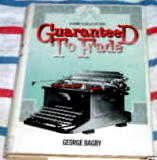
GEORGE BAGBY – Guaranteed to Fade.

GEORGE BAGBY Guaranteed to Fade

Doubleday Crime Club, hardcover, 1978. Hardcover reprint: Detective Book Club [3-in-1 edition], February 1979.

   The first time that George Bagby, himself a character in his own novels, told us about one of the mystery cases solved by his friend, Inspector Schmidt of the N.Y.P.D., was in 1935. This is his latest, the 44th in the series so far.

   As always, Schmitty complains a great deal about his aching feet, but he makes quick work of the murder of the many-times married Tommy Thomas, a prime example of how the rich find divorce so convenient a convention. To tell the truth, however, this one doesn’t take a lot of brain-power to figure out. The entertainment may be lighter than usual, but then again, I’m a confirmed addict.

— From The MYSTERY FANcier, Vol. 3, No. 4, July-Aug 1979.  This review also appeared earlier in the Hartford Courant.


[UPDATE] 12-31-08.   One thing that struck me when reading this review is that when I wrote them for the Courant, I generally had to keep them short, something I seem to have difficulty doing any more. Not that there’s anything wrong with that.

   The other thing that caught my attention was the very last word I used. George Bagby, in real life Aaron Marc Stein, aka Hampton Stone was one of my favorite writers, under all three names. I cringe at having to use the word “was,” since (once again) he’s an author I haven’t read in an awfully long time. Going through these old fanzines is bringing back lots of memories.

   In Mr. Bagby’s honor, and Inspector Schmidt’s as well, why not go for a long list of all of the latter’s adventures? Thanks to the Revised Crime Fiction IV, by Allen J. Hubin, here it is:

SCHMIDT, INSPECTOR [GEORGE BAGBY]

o Murder at the Piano (n.) Covici Friede 1935 [New York City, NY]
o Ring Around a Murder (n.) Covici Friede 1936 [New York]
o Murder Half Baked (n.) Covici Friede 1937 [New York City, NY]

GEORGE BAGBY

o Murder on the Nose (n.) Doubleday 1938 [New York City, NY]
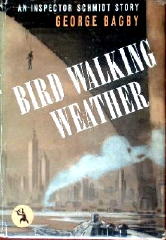
o Bird Walking Weather (n.) Doubleday 1939 [New York City, NY]

GEORGE BAGBY

o The Corpse with the Purple Thighs (n.) Doubleday 1939 [New Jersey; Academia]
o The Corpse Wore a Wig (n.) Doubleday 1940 [New York City, NY]
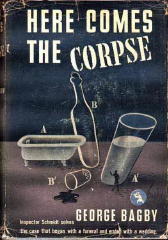
o Here Comes the Corpse (n.) Doubleday 1941 [New York City, NY]

GEORGE BAGBY

o Red Is for Killing (n.) Doubleday 1941 [New York City, NY]
o Murder Calling �50� (n.) Doubleday 1942 [New York City, NY]
o Dead on Arrival (n.) Doubleday 1946 [New York City, NY]
o The Original Carcase (n.) Doubleday 1946 [New York City, NY]
o The Twin Killing (n.) Doubleday 1947 [New York City, NY]
o In Cold Blood (n.) Doubleday 1948 [New York City, NY]
o The Starting Gun (n.) Doubleday 1948 [New York City, NY]
o Coffin Corner (n.) Doubleday 1949 [New York City, NY]
o Drop Dead (n.) Doubleday 1949 [New York City, NY]
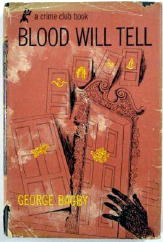
o Blood Will Tell (n.) Doubleday 1950 [New York City, NY]

GEORGE BAGBY

o Death Ain�t Commercial (n.) Doubleday 1951 [New York City, NY]
o The Corpse with the Sticky Fingers (n.) Doubleday 1952 [New York City, NY]
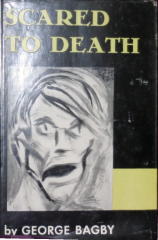
o Scared to Death (n.) Doubleday 1952 [New York City, NY]

GEORGE BAGBY

o Dead Drunk (n.) Doubleday 1953 [New York City, NY]
o Give the Little Corpse a Great Big Hand (n.) Doubleday 1953 [New York City, NY]
o The Body in the Basket (n.) Doubleday 1954 [Madrid]
o A Dirty Way to Die (n.) Doubleday 1955 [New York City, NY]
o Cop Killer (n.) Doubleday 1956 [New York City, NY]
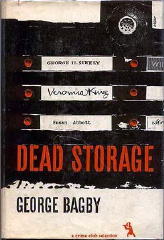
o Dead Storage (n.) Doubleday 1957 [New York City, NY]

GEORGE BAGBY

o Dead Wrong (n.) Doubleday 1957 [New York City, NY]
o The Three-Time Losers (n.) Doubleday 1958 [New York City, NY]
o The Real Gone Goose (n.) Doubleday 1959 [New York City, NY]
o Evil Genius (n.) Doubleday 1961 [New York City, NY]
o Murder�s Little Helper (n.) Doubleday 1963 [New York City, NY]
o Mysteriouser and Mysteriouser (n.) Doubleday 1965 [New York City, NY]
o Dirty Pool (n.) Doubleday 1966 [New York City, NY]
o Corpse Candle (n.) Doubleday 1967 [Maine]
o Another Day-Another Death (n.) Doubleday 1968 [New York City, NY]
o Honest Reliable Corpse (n.) Doubleday 1969 [New York City, NY]
o Killer Boy Was Here (n.) Doubleday 1970 [New York City, NY]
o My Dead Body (n.) Doubleday 1976 [New York]
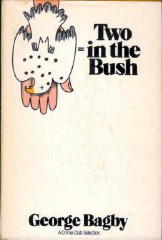
o Two in the Bush (n.) Doubleday 1976 [New York City, NY]

GEORGE BAGBY

o Innocent Bystander (n.) Doubleday 1977 [New York City, NY]
o The Tough Get Going (n.) Doubleday 1977 [New York City, NY]
o Better Dead (n.) Doubleday 1978 [New York City, NY]
o Guaranteed to Fade (n.) Doubleday 1978 [New York City, NY]
o I Could Have Died (n.) Doubleday 1979 [New York City, NY]
o Mugger�s Day (n.) Doubleday 1979 [New York City, NY]
o Country and Fatal (n.) Doubleday 1980 [New York City, NY]
o A Question of Quarry (n.) Doubleday 1981
o The Sitting Duck (n.) Doubleday 1981
o The Golden Creep (n.) Doubleday 1982 [New York City, NY]
o The Most Wanted (n.) Doubleday 1983 [New York City, NY]

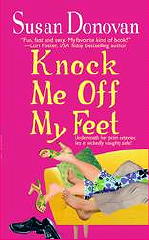
SUSAN DONOVAN – Knock Me Off My Feet.

St. Martin’s; paperback original. First printing: December 2002.

SUSAN DONOVAN Knock Me Off My Feet

   I was talking about novels of romantic suspense a short while back. This book isn’t quite what I had in mind, since what this is, when it comes down to it, is a romance novel, pure and simple, and nothing less.

   On the other hand, the criminous element that’s involved is exactly where the story begins and where it ends. If in the meantime it meanders off into a more-or-less standard does-he-will-she kind of love affair, I certainly believe it’s legitimate for me to talk about it here, and very much so.

   It starts when Chicago policeman Stacey Quinn is assigned to investigate who’s been sending threatening letters to the local equivalent of Martha Stewart, but he hardly expects “Homey Helen” to be breathtakingly beautiful Audie Adams. That may be the reason she’s also a woman that men tend to spook away from. In Quinn’s case, though, he’s the exception. It’s love at first sight.

   There is also a murder involved, you should not be surprised to learn. Audie’s mother died in a mugging incident a few months earlier. She was the original Homey Helen, who made millions on how-to advice, but who was totally dysfunctional when it came to her own family.

   The mystery and the crime-solving aspect of the investigation that are initiated from this are therefore real, albeit somewhat mechanical, nor is there any doubt about it — it’s the romance that causes the sparks.

   And as a short note to the unwary, take that last word literally. The lovemaking is both explicit and graphic. If filmed as is, there’s no chance in the world the movie could ever be shown on TV, even on HBO or Cinemax.

— December 2002 (slightly revised)

A 1001 MIDNIGHTS Review by Marcia Muller:


HILLARY WAUGH – The Con Game.

Doubleday Crime Club, hardcover, 1968. Paperback reprint: Popular Library, n.d. UK edition: Victor Gollancz, hc, 1986.

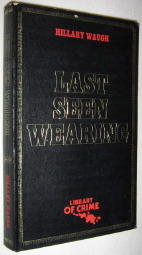
HILLARY WAUGH Last Seen Wearing

   The novels of Hillary Waugh are characterized by tight plot lines that contain no superfluous action or complications. Each of his stories is lean, tense, and to the point, and it was this streamlined approach and good sense of structure that made Julian Symons select the 1952 novel Last Seen Wearing… for his list of the 100 greatest crime stories written up to 1959.

   Over the past thirty-some years, Waugh — who is married to fellow suspense writer Shannon OCork — has created several series characters: private eyes Sheridan Wesley and Philip Macadam, who are both highly derivative of the Chandler/Hammett tradition; Lieutenant Frank Sessions of Manhattan’s Homicide North; and Police Chief Fred Fellows of Stockford, Connecticut.

   Fellows, a down-to-earth, overweight cop and severe taskmaster, is probably the most appealing of these; and the small-town milieu is one Waugh knows well, since Stockford is very much like the Connecticut setting where Waugh grew up (although life there is definitely more fraught with peril than in New Haven).

   The Con Game, Fellows’s eleventh case, is sharply evocative of the suburbs of the Sixties. Four couples have conspired to bribe elected officials in a land deal; now the $60,000 they have amassed to do so is missing, as are two of the conspirators, George and Dierdre Demarest.

   Fellows’s job is to find them — and the money. His investigation reveals affairs, hopes of affairs, suspicions of affairs, revenge after affairs, and divorce because of affairs — in short, almost every kind of sexual misconduct in Stockford. And those citizens who are not motivated sexually are sure to be moved by greed.

HILLARY WAUGH Sleep Long My Love

   Fellows treads carefully through this social minefield, trying to determine what each devious-minded person is hiding, but of course he cannot tread carefully enough. And before the case is over, he must use a creative method to determine the whereabouts of his quarry.

   Fellows is an able police officer and a sympathetic character who employs not only good procedural methods but also the logical processes of classical detectives to get his woman or his man. Some of Waugh’s other books in this series are Sleep Long, My Love (1959), Born Victim (1962), and End of a Party (1965).

   Among the Manhattan North novels are “30” Manhattan East (1968) and Finish Me Off (1970).

         ———
   Reprinted with permission from 1001 Midnights, edited by Bill Pronzini & Marcia Muller and published by The Battered Silicon Dispatch Box, 2007.   Copyright © 1986, 2007 by the Pronzini-Muller Family Trust.

HILLARY WAUGH, R.I.P.   Although his obituary did not appear in the New York Times until last Friday, Mr. Waugh passed away earlier this month on December 8th. The obituary called him a “pioneer of the police procedural novel,” as indeed he was.

   It ends by quoting him on the cardinal rule of mystery writing:  “‘Authenticity is the key to good mystery writing,’ he told an interviewer. ‘Not only must you be able to write well, but you must also possess the instincts of a good reporter who has witnessed firsthand the darker side of human nature.'”

« Previous PageNext Page »