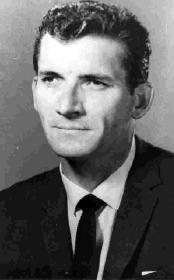
WILLIAM G. TAPPLY – Cutter’s Run.  St. Martin’s Press; paperback reprint, November 2002. Hardcover first edition: St. Martin’s, 1998.

WILLIAM TAPPLY Cutter's Run

   Tapply has been writing the Brady Coyne books for a long time, since 1984, and for some reason he’s still not the big name in the mystery field I think he should be after nearly 20 years. Note that it took almost four and a half years for this one to move from hardcover to paperback. By any standard that’s a long time to be kept on hold.

   I think that Tapply may be working against the grain — that the current market is demanding fluffier and fleecier female fiction, while the machio-er and male-oriented mysteries are left to manage for themselves.

   But to the case at hand. Coyne is a low-profile Boston attorney who seems to run into mysterious doings wherever he goes. This time it’s swastikas in Maine, a poisoned dog, and a reclusive African-American lady who then disappears. Tapply’s prose is deceptively smooth, like the surface of a quiet pond suddenly revealing gnarly snags below. One of his greatest assets as a writer is the shivery sort of anticipation he produces when you (think you) know what’s coming.

WILLIAM TAPPLY Cutter's Run

   Coyne has been spending his weekends in the small, rustic, backwoods country town of Garrison with a lady friend named Alex. From the outside they seem to be very compatible, but there are hints of trouble there too. Besides the mystery, a good deal of the rest of the story is about a huge communications gap between the sexes that — from a sympathetic male point of view — mystifies me as much as it does Brady Coyne.

   Tapply is a smooth, experienced writer, but where he may be the weakest, or so it seemed to me this time around, is in the detective end of things. Coyne gets the local sheriff interested in the case easily enough — in fact, he even makes Coyne a deputy — but why is it that he (Coyne) is the only one to investigate the missing woman’s home? Brady also does a lot of other detective work, but the case is solved by what amounts (in retrospect) as near happenstance.

   So is this what’s holding Tapply back? He’s good, but he’s just never found the key to what would make him great? Or is it — and this is what I hinted at this before — that he’s a male writer in a field where the Sisters in Crime are now the leading edge?

— November 2002 (revised)


[UPDATE] 11-17-08.   Bill Tapply and Brady Coyne are still going strong, I’m happy to say, no matter what I wrote back then, with books and more adventures showing up on the shelves at Borders on a regular basis. I still don’t think he gets the recognition he deserves, not nearly as much as he should have, after a career as long as his — and it’s not over yet!

THE CURMUDGEON IN THE CORNER
by William R. Loeser

CAROLYN WELLS The Tannahill Tangle

CAROLYN WELLS – The Tannahill Tangle. J. B. Lippincott, US/UK, hardcover, 1928.

   I can’t remember who killed whom in Carolyn Wells’ The Tannahill Tangle, nor have I any desire to look it up.

   The feature that sticks in my mind is the two well-to-do couples who are the main characters. They are engaging in spouse-swapping, and, when one of them is killed, the perceptive reader might feel that the inherent frictions of this diversion have some bearing on the crime.

   But no, the survivors and Ms. Wells take great pains to assure themselves, each other, and us that they are too “well-bred” for such messy sports as murder. Fleming Stone is called in and, as I recall, is able to find someone of less-illustrious parentage and prospects to pin the rap on.

   Fortunately, I had only this one book of Ms. Wells to get rid of. It is a reminder I will not soon forget that the Golden Age produced the worst clinkers as well as the masterpieces of detective fiction.

– From The MYSTERY FANcier, Vol. 3, No. 2, Mar-Apr 1979       (very slightly revised).


REVIEWED BY WALTER ALBERT:         


PEGGY LEADS THE WAY Mary Miles Minter

PEGGY LEADS THE WAY. American Film Company-Mutual, 1917; Lloyd Ingraham, director; Mary Miles Minter, Andrew Arbuckle, Carl Stockdale, Alan Forrest, Emma Kluge, Margaret Shelby, George Ahern, Frank C. Thompson, William Spencer. Shown at Cinecon 41, September 2005.

   Lightning struck a third time, bringing to light a film starring Mary Miles Minter, few of whose films have survived and whose career was, in effect, ended by the unsolved murder of director William Desmond Taylor, with the scandal arising from rumors of her relationship with Taylor tarnishing her screen image.

PEGGY LEADS THE WAY Mary Miles Minter

   I had never seen one of her films and I was completely charmed by her bright, take-charge performance. She returns home after studying in the East to find her father’s country store struggling in the wake of government regulations and the entire community’s livelihood and existence threatened by the dastardly actions of a heartless developer.

   Fortunately, he has a son who’s as charmed by Mary as I was. He takes the side of the locals, and with Mary orchestrating the revolt, helped by a fortuitous storm, happiness and prosperity are restored to the small community.

GARY PHILLIPS – Shooter’s Point.

Kensington/Dafina; paperback reprint, Oct 2002. Hardcover first edition: Kensington, October 2001.

GARY PHILLIPS Shooter's Point

   If you’re looking for an over-the-top medium-to-hardboiled mystery crime novel starring a statuesque black ex-Las Vegas showgirl as detective, look no further. This is it, the second in the series of adventures of Martha Chainey, courier extraordinaire to the city’s high-rollers, hustlers, players and gamblers.

   While it might be better to read the previous book, High Hand, first, most of the action of the first book is recapped well enough to get the gist of this followup adventure. Which is a Good Thing, as the action more or less picks up where the previous one left off.

   And this one begins with the assassination of one of two boxers during a championship bout taking place in a casino arena, then continues with the simultaneous theft of money that is not supposed to exist from a secret underground room — Phillips thinks locked rooms are an Agatha Christie specialty, but who remembers John Dickson Carr these days — and when Chainey finds her good friend, female boxer Moya Reese, murdered in a shabby motel room, she starts to take it personally.

GARY PHILLIPS Shooter's Point

   Also involved is a hugely popular rap star, King Diamond, a cult of positive-thinking Nymnatists who have been sponsoring the murdered boxer, and various and sundry other casino owners and scam-artists. Martial law is imposed, Jaguars are wrecked by runaway tanks, and the usual Vegas night life goes on.

   If you turn your mind off and go with the flow, Phillips has a take-no-prisoners approach to crime fiction that will keep you jazzed for hours. It’s not a detective mystery, I warn you, though. Any attempt to keep track of who knows what when and why (or why not) is doomed to failure. In the over 24 hours it takes Martha Chainey to call the case closed, she does not sleep at all, and in her wanderings here and there across Las Vegas, everywhere she goes she just happens to meet someone else involved in the plot.

   Personally I hit page 118 and realized I didn’t have a clue as to what was going on, kept on going and discovered it didn’t really matter. Sound like your kind of novel? If you’ve read this far, I’ll bet it is.

— October 2002


[UPDATE] 11-16-08.   I’m going to have to find my copy of High Hand, which I still haven’t read. (I always seem to read books and their sequels in the wrong order.)

   While these are the only books that Martha Chainey has appeared in, she also was in a short story called “Beginner’s Luck” (Shades of Black: Crime and Mystery Stories by African-American Writers, Berkley, hc, 2004; trade ppbk, 2005).

A 1001 MIDNIGHTS Review by John Lutz:


GERALD PETIEVICH Money Men One-Shot Deal

GERALD PETIEVICH – Money Men and One-Shot Deal.

Harcourt Brace, hardcover, 1981. Money Men: published separately in paperback by Pinnacle, 1982; Signet, 1991. One-Shot Deal published separately in paperback by Pinnacle, 1983; Signet, 1991. Film (based on Money Men): Warner Bros., 1993, as Boiling Point.

   These two short novels are printed in one volume and are Petievich’s first published fiction. He is a former member of the U.S. Army Intelligence Corps, and later was a special agent of the U.S. Secret Service assigned to counterfeit investigations. He knows intimately the subject he’s chosen for fiction, and that’s what makes these novels work so well.

GERALD PETIEVICH Money Men One-Shot Deal

   Both novels feature Treasury agent Charles Carr. In Money Men he is after the man who shot to death another agent in a motel room that Carr had bugged. Not only do Carr and his partner, Jack Kelly, suffer the agony of listening to their fellow agent being murdered while they are too far away to help, they also must bear the brunt of the responsibility for the tragic operation.

   Carr is going to be transferred, most likely to a desk job, but he talks his superior into giving him a few weeks before the move and he uses that time to stalk the agent’s killer.

   Carr and Kelly work against the clock as they slowly close in on a con man named Red Diamond and his young cohort Ronnie Boyce. The setting is Los Angeles, the action fast, the plot tight, all written in a style that smacks hard of realism.

GERALD PETIEVICH Money Men One-Shot Deal

   Washington, D.C., as well as Los Angeles is the setting for One-Shot Deal. This novel is the more ambitious of the two, and probably the best.

   Here Carr is set on the trail of someone who has engineered the theft of government security paper from the U.S. Bureau of Engraving and Printing, the special kind of paper used to print money.

   The someone is a fascinating villain named Larry Phillips, an ex-con who is a skilled hypnotist and runs with beautiful blond prostitute Melba, a woman who is literally under his spell. The story is intricately plotted and builds in suspense to a satisfying conclusion.

GERALD PETIEVICH Money Men One-Shot Deal

   Both novels are written in a direct, uncompromising style that establishes a tough authenticity. The dialogue is hard-edged and street-wise, and the knowing attention to detail lends a stark reality that only an insider can bring to this kind of fiction. Money Men and One-Shot Deal are both lean, mean, and entertaining.

   Other Petievich novels are To Live and Die in Beverly Hills (1983), To Live and Die in L.A. (1984), and The Quality of the Informant (1985).

         ———
   Reprinted with permission from 1001 Midnights, edited by Bill Pronzini & Marcia Muller and published by The Battered Silicon Dispatch Box, 2007.   Copyright © 1986, 2007 by the Pronzini-Muller Family Trust.

TO DIE FOR. Columbia, 1995. Nicole Kidman, Matt Dillon, Joaquin Phoenix, Casey Affleck, Illeana Douglas, Alison Folland, Dan Hedaya, Wayne Knight. Based on the novel by Joyce Maynard; screenwriter: Buck Henry. Director: Gus Van Sant.

   There doesn’t seem to be any way around it. In the course of talking about this movie, I’m going to have to reveal more about the story line than I’d really like to.

NICOLE KIDMAN To Die For

   I know what I’m talking about. I was watching the movie, which I’d just taped off HBO, when I needed to take a short break, and while I was up and about, I decided to check out who an actor was on IMDB. The first thing I saw was the key plot line that was coming up next but which I hadn’t yet gotten to.

NICOLE KIDMAN To Die For

   So just in case you haven’t seen the movie yet: POSSIBLE SPOILER ALERT.

   The movie does begin, in grand pseudo-documentary fashion, with the death of Suzanne Stone’s husband. Apparently she’s been accused of being involved in his death, but how and why, we (the viewer) do not know.

   Nicole Kidman plays Suzanne Stone in one of most convincing performances I’ve ever seen. Ms. Stone (she does not use her married name, Maretto, for professional reasons), has talked her way into becoming the weather person for the local cable outlet, a small two-man operation that Stone is convinced is going to help her find her way to the top.

NICOLE KIDMAN To Die For

   Of the TV profession, that is. She is obsessed with television and the fame that comes to those who are on the screen; she will do anything, and work for the longest hours, to become a success.

   What she does not realize is how lacking she is, both in awareness of the world and opportunity. I’m not convinced that she has the ability, either, but that has never stopped others, and it probably wouldn’t stop her either, given the chance. Of course (as it happens) her husband of one year (Matt Dillon) does not share her dreams; he is content to help run his father’s low scale restaurant for the rest of his life.

NICOLE KIDMAN To Die For

   Deciding to do a documentary on local high school students, Suzanne Stone finds three slackers and unfortunates who are willing to help: Joaquin Phoenix, Casey Affleck, and Alison Folland, who find their own lives briefly brightened by her interest in them.

   They also become part of the plan Suzanne Stone is hatching. Her husband is becoming part of the ball and chain that is holding her back.

   I suppose that most mystery fans will put the pieces together well enough from here. Some of Suzanne Stone’s most convincing arguments take place in bed (a dim-witted but very virile Joaquin Phoenix) or making promises of taking Alison Folland, overweight and with no friends, along with her to Hollywood.

NICOLE KIDMAN To Die For

   As characters, two more pathetic creatures can hardly be imagined; as actor and actress respectively, both Phoenix and Folland are to be congratulated as highly as they can be.

   All of the performances are ‘A Prime,’ in fact, including especially Illeana Douglas, who as the dead man’s sister, can see right through her new sister-in-law’s facade in an instant. The latter’s a four-letter word that starts with C, she says. Cold.

   But Nicole Kidman’s performance is more than that. I may be the only person in the world who thinks so, but she makes Suzanne Stone also so vulnerable that I could only find pity for her, in spite of the deeds she does, especially in the end, when her fate finally catches up with her.

   It is very difficult to tell someone that their dreams are very likely not going to be realized, and that is the saddest part of this movie, I found, by far.

THE DANGER SIGNAL. Columbia, 1925; Erie C. Kenton, director; Jane Novak (shown below), Dorothy Revier, Robert Edeson, Gaston Glass. Shown at Cinecon 41, September 2005.

THE DANGER SIGNAL (1925).

   An incomplete print of this film only turned up in 2002 and even with careful piecing-together and restoration, shows signs of nitrate decomposition and narrative gaps. However, what remains (and is, in fact, only about 900′ short of the original footage listed in the American Film Institute Catalog) proved to be one of the highlights of the weekend.

   It’s the melodramatic story of a an unwed mother who gives up one of her twin sons to a successful father, signing away all rights without telling him there were two boys. Years later, she’s running a small dress shop while the son she raised is working for the railroad his father owns, with his brother being groomed to succeed his father.

THE DANGER SIGNAL (1925).

   The one son is poor but honest and a genuinely sterling character, while his brother is a lazy good-for-nothing. The plot finds the good son falling in love with his brother’s girlfriend, a love that’s returned. The plot has echoes of classic drama (both French and English/American), with a good dollop of novelistic high-jinks that climax in a thrilling runaway train chase that had the audience literally cheering.

   The resolution reunites all the long-separated parties, rewards the good and provides a way toward redemption for the wayward.

   A moral tale whose charm, coupled with first-rate acting, directing, and scripting, carried the day.

THE CURMUDGEON IN THE CORNER
by William R. Loeser

ANTHONY WYNNE – Death of a Banker.   Hutchinson & Co., UK, hardcover, 1934.  J. B. Lippincott, US, hc, 1934.

ANTHONY WYNNE Death of a Banker

   Anthony Wynne’s Death of a Banker begins with the titular character done in on horseback in the middle of a field before the eyes of an assembled throng — a variation of the locked room.

   The investigation hardly begun, Mr. Wynne’s series character, Dr. Eustace Hailey, and a member of the official force he drags along for company have their attention distracted from the crime by the necessity to extract a member of foreign royalty from the clutches of a character wearing a sign saying “villain.”

   For some reason, the prince prefers present company. The two duos chase each other over land and sea, on occasion the good guys are kidnapped, and there are numerous “confrontations,” which all parties use to call each other names and catch their breath before the chase resumes.

   The allotted number of pages being written, Dr. Hailey pulls the solution (a good one) out of his hat; Scotland Yard agrees to cover up the prince’s guilt (Who else? The choices for least likely person are few; between two characters, one of whom is referred to as “blackguard” on every page); and Mr. Villain meets the end we have been so eagerly awaiting.

   Mr. Wynne’s “The Cyprian Bees,” also featuring Dr. Hailey, is a good short story, but I immediately disposed of all his novels I owned.

– From The MYSTERY FANcier, Vol. 3, No. 2, Mar-Apr 1979       (very slightly revised).


   I received some sad news this morning. John Wright, a mystery writer living in South Africa whom I interviewed here on the blog back in February 2007, has passed away.

JOHN

   That post included a complete bibliography of his mystery fiction, and of course I hope you’ll go back and read the entire interview. In it we also touched on several of his other achievements, including a life-long interest in old-time radio and early comic book fandom.

   It’s been a while since I heard from him, but some good news he was able to pass along is that several of the PI novels he wrote as Wade Wright have recently been reprinted by Ramble House.

   Here’s the email I received today:

Dear Friends,

It is with a sad heart that I give you the news of John passing away on Friday the 14th at 3 AM.

He had been in hospital for the last week and I had prepared everything for him to come home as the Doctor was of the opinion that though he would be bedridden, I would be able to nurse him at home with some assistance. The Lord knew best and took him home as he was in a lot of pain and discomfort.

Your friendship over the years has meant a great deal to John, and I know we have all lost someone of great worth. Someone, who has touched our lives in so many ways and will be deeply missed.

The funeral service is to be held at St Marks on Wednesday the 19th at 11 AM, and though you can not be here your thoughts and prayers can be with him as we say our last farewell until we meet again.

   God Bless.

      Love Coral

BILL PRONZINI – Starvation Camp.

BILL PRONZINI Starvation Camp

Berkley; paperback reprint, December 2001. Hardcover: Doubleday, January 1984. Large print hardcover: Thorndike, March 2003.

   There’s no doubt that the most well-known gold rush in North American history was the one that took place in California, circa 1849. But to those of us who grew up listening to the radio in the 1950s and the frost-bitten tales of Sergeant Preston of the Mounties and his lead dog Yukon King, there’s another: the rush for gold that took place in Alaska and the Canadian Yukon Territory in the early 1900’s. Incessant winds howling across the airwaves, and cold? You’d better believe it.

   And when supplies ran low, food became as scarce and as valuable as gold itself. In this recently reprinted novel, published as a western, when Corporal Zach McQuestion’s good friend Molly Malone is murdered for her storehouse of provisions, he becomes personally involved.

BILL PRONZINI Starvation Camp

   As a crime or mystery novel, which this definitely also is, the plot is essentially one-directional. Simply follow the killers, wherever they go, and in this case, down the coast from Skagway to Seattle to San Francisco and beyond.

   What Pronzini offers as background is even more of a leading attraction: the rough and tumble life of a boisterous young frontier America, just after the heyday of the cowboys, as towns were growing up and open spaces were just starting to fill in.

   The result is pure entertainment, save for one small-sized caveat: The story ends begging for a sequel; unfortunately, it never happened.

— October 2002 (revised)


[UPDATE] 11-14-08.   I asked Bill whether Zach McQuestion has ever appeared in any of his short stories, or if perhaps he’s shown up in one of the Sabina Carpenter and/or John Quincannon tales. Here’s his reply:

  Steve:

BILL PRONZINI Starvation Camp

   Re the McQuestion character: Starvation Camp was intended to be the first of a trilogy featuring him and his quest to find George Blanton and bring him to justice. Two things kept this from happening: I got sidetracked into other projects, including a plethora of anthologies that took up a lot of my time; and my editor at Doubleday was replaced and the new one didn’t seem as keen on the trilogy idea. Too bad. I’m pretty sure I’d’ve have enjoyed writing another McQuestion or two.

   No, McQuestion hasn’t turned up in a Quincannon story. But since they’re contemporaries, it’s a good idea; I’ll see what I can do along those lines.

Best,

   Bill

« Previous PageNext Page »