A short while ago this evening I uploaded Part 29 of the online Addenda to the Revised Crime Fiction IV, by Allen J. Hubin.

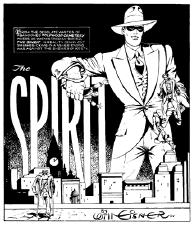
THE SPIRIT

   The data, as usual, consists largely of miscellaneous material, ranging in terms of authors from Arthur A’Beckett (new biographical facts) to Mabel E. Wotton (full name, along with both birth and death dates).

   Some of the longer entries are ones for comic book writers Brian Azzarello, Will Eisner and Frank Miller, whose detective and crime fiction in graphic novel form have now been added.

   Eisner, for example, was the creator of The Spirit, whose exploits will be coming soon to a movie theater complex somewhere near you.

ERIC LEYLAND

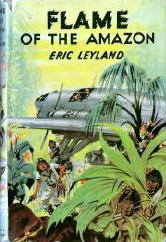
   Others with long entries include Bernard Capes, whose crime fiction appeared between 1898 and 1919; R. Chetwynd-Hayes, whose collections of ghost stories are given in detail, including the adventures of psychic investigators Frederica Masters & Francis St. Clare; David Hume, some of whose books have recently been published in the US for the first time by Ramble House; and Eric Leyland, all of whose novels about adventurer David Flame are now included, although designed primarily for younger readers. (The cover of one of these books is shown to the left.)

   Three additional film adaptations of books by Ed McBain are included, along with some first US editions of Gladys Mitchell‘s detective fiction, published recently by Rue Morgue Press.

JACK LYNCH

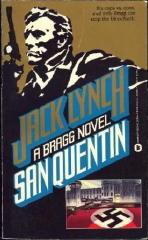
   Deaths occurring in 2008 are reported for Eliot Asinof, Robert Asprin, Nicholas Bartlett, William Buchan, Algis Budrys, Glenn Canary, Thomas Disch, George Furth, George Garrett, Simon Gray, Robert Harling, Jack Lynch, Maureen Peters, Malvin Wald, and Donald James Wheal.

   I regret no longer having the time to post death notices and obituaries for authors such as these on the blog. Some are more important to the field of crime fiction than others, of course, but they all deserve a mention.

   I’m also way behind in adding my annotations to the Addenda. One of my more immediate goals is to improve my performance in that regard. In fact, I am still trying to catch up on emails that arrived while I was away at the beginning of the month and soon thereafter. If you’ve sent me something I haven’t replied to recently, I hope you’ll be patient a while longer.

   Or nudge me. With a pointed stick, if need be!

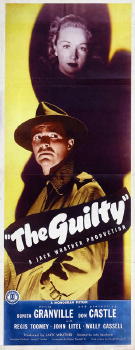
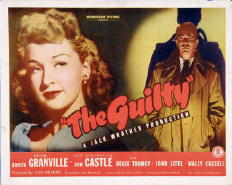
THE GUILTY. Monogram, 1947. Bonita Granville, Don Castle, Wally Cassell, Regis Toomey, John Litel. Screenplay: Robert Presnell Sr., based on a story by Cornell Woolrich. Producer: Jack Wrather. Director: John Reinhardt.

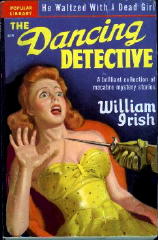
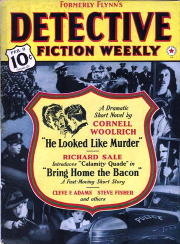
[WILLIAM IRISH – “Two Fellows in a Furnished Room.” Long novelette included in The Dancing Detective, Lippincott, hardcover, 1946; Popular Library 309, ppbk, January 1951. Originally published as “He Looked Like Murder,” as by Cornell Woolrich, Detective Fiction Weekly, 8 February 1941.]

WILLIAM IRISH The Dancing Detective.

   Some of the books on noir films like this movie quite a bit, but if I were writing one, the one I’d write wouldn’t be one of them. It’s a noir film all right – how could it not be, based as it is one of the originators of noir fiction, Cornell Woolrich?

   Poor production values, for one possibility, is the answer, and even more poorly conceived changes and/or additions to the story, both of which, in my opinion, occurred in the making of The Guilty.

   Woolrich’s story is long but compact, complete in itself, and full of his usual “things gone wrong in an everyday world” motif. One fellow of two sharing a room together asks the other to stay away for a couple of hours while his girl friend comes over. After Stewart Carr, the one who was asked to leave, returns – he’s also the one telling the story – the girl’s mother calls, asking where her daughter is.

CORNELL WOOLRICH.

   She’s disappeared, and when Carr’s roommate John Dixon begins to act more and more suspiciously, Carr tries to stay on his side, but he begins to find it more and more difficult to do so. This is the kind of mess you get into, suggests Woolrich in his role of author, when you start to hide things you needn’t, you panic, and all you end up doing is making the mess even worse.

   Fate, at nearly the last minute, steps in, however, before Dixon is picked up by the police and (more than likely) railroaded off to the death house. The friendship is over, of course, even though things worked out OK in the end.

   Woolrich’s stories are almost always a little over the top, some more than others, and this is one of them. It’s a little too short for a movie, even one only 71 minutes long, so of course some additional material has to be added.

THE GUILTY

   Some of what was done is understandable, or at least you can figure out why. I mentioned in the opening credits that Jack Wrather was the producer. In 1947, the same year that The Guilty was made, he and Bonita Granville, the star of the film, were married. And any story in which the only major female role is someone who dies in the first chapter is hardly a part for any leading lady to consider, married to the producer or not.

   Solution? Double the part by giving the girl who dies (Linda) a twin sister (Estelle) who’s as manipulative-of-men bad as the dead girl was good. More, to complicate matters – none of which appeared in the original story, of course – make Carr fall for the bad girl after she was dumped by the roommate for the good girl, who’s the one who died, with (as in the story) the roommate strongly suspected of doing the killing.

   I don’t recall ever seeing it, but in 1946, the year before The Guilty was made, Olivia De Havilland played a similar pair of good and bad twins in The Dark Mirror. Apparently one takes ideas wherever one can get them. Similar story lines probably occurred even before that, and probably several times over.

   In any case, it takes a while to sort things out – luckily the girls meet on the screen together only once, and after all, Linda leaves the film soon after anyway. What seemed awkward to me at the beginning, though, was the framing device of Carr coming to the bar around the corner from the room where all this happened, some six months later, waiting for a girl to show up – we don’t know who, of course, at the beginning.

THE GUILTY

   The purpose? To help extend the ending of the novelette to include a newly devised one. A twist, in other words, as to who the real killer was.

   And here’s where everything really does goes wrong. Retrofitting a new ending to a detective story – and that is exactly what this is – one in which the clues are already pointing to one person – simply can’t be done without a complete rewrite, in which case you may as well write a brand new screenplay and leave Woolrich’s tale out of it altogether. What’s done is done, but even so, Pfui is what I say to the new ending.

   One other thing. Jack Wrather is described as an oil millionaire, but he certainly didn’t sink any money into this movie. (In 1954 he bought the rights to The Lone Ranger, and later on Sergeant Preston and Lassie, eventually producing all three as television series.)

THE GUILTY

   But in 1947 the sets in The Guilty are bare bones to the max. Some observers suggest that this only heightens the noir mood of the film, emphasizing the bleakness of the characters’ fates.

   To some extent I can see what they’re saying, but when all you can see in the film are little more than solid but completely stagey sets, all I can say is another Pfui. (Regretfully. I do want to make that clear.)

   I guess I was wrong; there were two other things I meant to add a moment ago, not just one. Bonita Granville was only 24 when she made this movie, but she’d already had a long career behind her in making films. She was, of course, most well known for the four movies she made in her teens as Nancy Drew, girl detective.

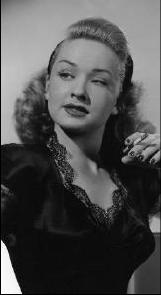
   Girlishly buoyant and full of enthusiasm in the role, one she may have been perfect for, if she had not married Wrather, she may have had a even longer career playing “bad” girls in noir films such as The Guilty. I don’t believe this photo I found of her is necessarily related to her role in that movie, but if not, it’s close enough, and I think it will show you more what I mean than I can say in words.

   Unless one of the words is Huzzah!

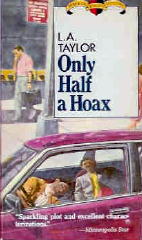
L. A. TAYLOR – Only Half a Hoax.

Walker; paperback reprint, 1986; hardcover edition, 1983.

   First of all, let me say it is about time [1987] Walker started reprinting some of their American detective fiction in paperback. In the past four or five years Walker seems to have come from nowhere to become of one of the leading publishers of hardcover mysteries, most of which seems to have been ignored by other paperback companies.

   (They have been reprinting their British mystery fiction in paper for several years now, but for the most part, I find myself too easily bored with the general run of “thriller” this entails.)

L. A. TAYLOR

   I also have to say that I’m glad they chose to include the Taylor books in their first batch of releases. (His/her second book, Deadly Objectives, is also now out.) I have to confess that I had the chance to pick this one earlier in hardcover, and I turned up my nose at the chance. I mean, after all, a detective whose hobby is chasing down reports of UFO’s in the Minneapolis area?

   No offense intended to Minneapolitans. I’m sure it must be a terrific place to live, in spite of the comments of J. J. Jamison (the aforementioned detective) sometimes to the contrary. But flying saucers and detective fiction seems such an incongruous combination, I couldn’t imagine myself reading such balderdash, much less enjoying it.

   But enjoy this book, I did. Even though J. J. (his full-time job a computer engineer) is pretty much a naive sort of neophyte at the detective business, the case he enters into is breezily told, and is easily recognized as a throwback to the wacky cases of homicide that were exceedingly popular back in the 1940s.

   And reflecting back on it now, the plot doesn’t really make a lot of sense. If you’re planning a murder, why should your first impulse be to set up an elaborate fake UFO in order to draw attention away from the act you’re about to do?

   When J. J. investigates and finds the body, he’s first suspected of complicity, then becomes the killer’s target. Chronologically: (1) his brakes are tampered with, (2) he is nearly run down while bike riding, (3) his house is set on fire, and (4) he is dumped in the tiger cage of the Minnesota Zoo. Maybe I missed one.

   The point of all this is to keep the reader’s mind off the fact that there really are very few suspects, and the clues are a little too obvious to withstand direct attention. It takes the last ten pages to wrap everything up is well, which is far too long for a mystery properly told. Even in the 40s, though it took time to make the illogical satisfactorily plausible.

   In spite of my earlier comments, Taylor does well at this sort of thing, and throws in a little bit of surprise to boot.

— From Mystery.File 1, January 1987 (slightly revised).


[UPDATE] 08-15-08. Several things are clear from this review, reading through it this evening for the first time myself in over eleven years. First of all, and most importantly, it is clear that I did not know whether or not L. A. Taylor was male or female. It is much easier to answer questions like this now, what with the Internet, and the handy assist of Al Hubin’s Revised Crime Fiction IV:

TAYLOR, L. A. [Laurie Aylama Taylor Sparer]. 1939-1996. Series character: JJ = J. J. Jamison

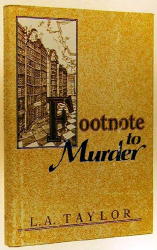
      Footnote to Murder. Walker 1983.   JJ

L. A. TAYLOR

      Only Half a Hoax. Walker 1983.   JJ
      Deadly Objectives. Walker 1984.   JJ
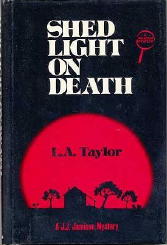
      Shed Light on Death. Walker 1985.   JJ

L. A. TAYLOR

      Love of Money. Walker.   1986
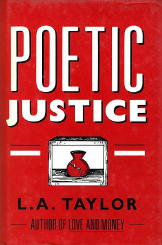
      Poetic Justice. Walker.   1988

L. A. TAYLOR

      A Murder Waiting to Happen. Walker 1989.   JJ   [set at a Minnesota SF convention]

   Besides the mysteries listed above, she also wrote Blossom of Erda, a science fiction novel; Cat’s Paw, a fantasy; and (possibly) Women’s Work a collection of both SF and fantasy. (I’ve not yet found confirmation that the latter was ever published.)

   It therefore now comes as no great surprise to find the SFnal elements that are so obviously present in Only Half a Hoax. As you’ve read, I found them semi- objectionable in 1986. I’d like to think I’d find them less so now.

   After her death Ms. Taylor’s husband had her final novel published: The Fathergod Experiment, described online as “a quirky, complex, interesting tale that combines court intrigue with mysteries both scientific and criminal, and a thoroughly satisfying story of an orphan rising from obscurity and oppression.”

   I’ve forwarded a more complete description to Al. It appears that the books ought to be included in CFIV, at least marginally. (Added later: He agrees. The book will appear in Part 29 of the online Addenda.)

   Also of note in the review, at least to me, was my mammoth snobbish putdown of British thriller fiction. You can blame my younger self for that, but not this present fellow who I am now.

THE DEVIL-SHIP PIRATES. Hammer Films/Columbia, 1964. Christopher Lee, Barry Warren, John Cairney, Suzan Farmer, Michael Ripper, Duncan Lamont, Andrew Keir, Natasha Pyne. Screenwriter: Jimmy Sangster. Director: Don Sharp.

The Devil-Ship Pirates

   This is the movie that’s paired with The Pirates of Blood River (1960) in a recently released boxed set of Hammer films entitled “Icons of Adventure.” (You can go back and read my review of the latter here.) Both star Christopher Lee as the head of their respective ragtail crew of pirates, both were written by Jimmy Sangster, and that’s not all.

   They both have the same basic story line. In the commentary track for this film, Jimmy Sangster even admits it, calling it your basic “Humphrey Bogart in The Desperate Hours” plot, in which a gang of escaped killers take over a suburban household (or a gang of pirates take over an isolated village) only to find their captives not quite to be the pushovers they expected.

The Devil-Ship Pirates

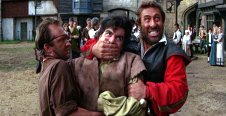
   In The Devil-Ship Pirates, the pirates have been aligned with Spain at the time of the defeat of the Armada, and as one of the ships that survived but unable to return to Spain — and having no real allegiance to that country — land near an isolated village which they then take over, on the ruse that the Spanish won. The local mayor is all too willing to kowtow to the town’s new masters, but not all of the townsfolk are so readily inclined.

The Devil-Ship Pirates

   Comparing the reviews of both movies which I’ve discovered online, results as to which movie was favored over the other are mixed, but mostly it boils down to which of the pair you happen to watch first.

   Myself, I think that the basic idea was fresher in Blood River, and the actors were better (Oliver Reed was in the first one, for example, and not the second) and unless my biases are showing, and I’m sure they are, even the actresses were comelier in the first. (But do take note of the lady above, the daughter of the local mayor and the rebel hero’s girl friend.)

The Devil-Ship Pirates

   Granted, what the first movie lacked were any scenes with a real boat in it. This one does, although I suspect that the ships shown firing cannons at each other in the opening scenes came from storeroom footage. But the ship that lands on the English shoreline, right up to the water’s edge, was carefully constructed and used as one of several primary filming areas.

   The money that was spent on it was put to good use, but as the commentary reveals, the ship suffered a serious accident during the course of the movie, and it goes up in flames at the end – gloriously done, but perhaps as a direct consequence, The Devil-Ship Pirates was the last pirate film that Hammer Films ever did.

The Devil-Ship Pirates

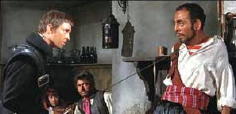
   Overall, in spite of the second-hand story line, there is much to find in this movie to be entertained by. The English village was painstakingly re-created (and almost surely was used again, both before and after), and the colors throughout the film are gloriously vivid. Spectacular, as a matter of fact, as I hope these photos will attest to.

FIRST YOU READ, THEN YOU WRITE
by Francis M. Nevins

Ellery Queen

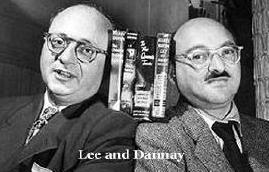
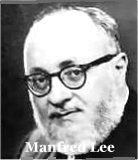
   As all mysteryphiles know, “Ellery Queen” was both the joint byline of first cousins Frederic Dannay (1905-1982) and Manfred B. Lee (1905-1970) and the brilliant sleuth who starred in most of their mysteries.

   It’s also well known that, for all but the first years of their long joint career, Fred’s function was to devise lengthy plot synopses which Manny would flesh out to novel or story length.

   This was their division of labor when the Ellery Queen radio series debuted on CBS in the summer of 1939. What was not known outside the inner circle was that, after his first wife died of cancer in 1945, Fred was so overwhelmed with raising their two small children and keeping Ellery Queen’s Mystery Magazine afloat that he simply couldn’t continue coming up with new plots.

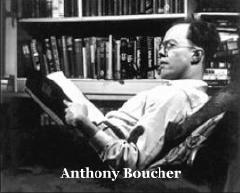
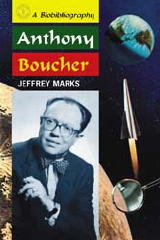
   After a few false starts, the writer chosen to take over much of Fred’s function on the series was Anthony Boucher (1911-1968). Since Tony lived in Berkeley, California and Manny on the East Coast, the arrangement required correspondence between them on almost a daily basis. That correspondence, which rivals Gone with the Wind in word count, is preserved at Indiana University’s Lilly Library.

Ellery Queen

   I’ve made several trips to Bloomington to immerse myself in those letters, which are fabulously interesting for any number of reasons. Some of them are close to indecipherable since they deal with the plot minutiae of radio dramas that have apparently ceased to exist in audio form.

   But the rest! Working at opposite ends of the country and under wartime and immediate post-war traveling conditions, Tony and Manny almost never met in person. But from their correspondence alone the devout Catholic and the agnostic Jew grew to be closer than brothers, and their letters range all over the map, from the health problems of their children to Hiroshima and the Cold War and anti-Semitism.

Ellery Queen

   Manny’s letters tend to be much longer and more irascible and clearly he was using them to vent. His rants about the confederacy of dunces he had to deal with in the broadcasting world offer some remarkable insights into the medium – as long as one keeps in mind that, being a classic type A personality and a past master at getting hot under the collar, he may not have been the most objective witness in the world.

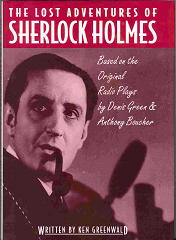
   During much of his time collaborating with Manny, Boucher was also writing scripts for the Sherlock Holmes radio series, which between 1939 and 1946 starred Basil Rathbone and Nigel Bruce, the Holmes and Watson of Universal’s movie series.

    “Compared to EQ, Holmes scripts practically write themselves,” he told Manny in one letter (13 September 1945), “and the EQ occupies by far the major portion of my working week…. You have no idea of the number of ideas that I worked on for days only to reject because I discovered an ineradicable flaw that would exasperate you….”

   As if to reassure Manny that he wasn’t the only man in radio who was surrounded by jerks, Boucher in his letters often recounted his travails with the Holmes program.

Ellery Queen

    “On Holmes, either my collaborator [Denis Green] or I am – is – I hate that kind of sentence – one of us is present at every rehearsal-and-broadcast. And a good thing, we find: not only directors but star actors can get the damndest ideas they have to be gently talked out of.” (28 January 1945)

    “We do at least have a first-rate man at the control board; but our sound technicians are two of the clumsiest louts that ever held a union card and all the things about time for commercials and cutting dialog to the bone… God does all that happen regularly to us. Especially since the sponsor switched announcers on us because the new one reads slower!” (5 July 1945)

   But these problems were as nothing compared with what happened at the beginning of the 1946-47 season, when Rathbone left the series for the Broadway stage and was replaced by Tom Conway. “The new producer on the show … is a pretentious and arrogant boor with a great deal of very real talent for production and writing – in some ways the ablest (and also the most offensive) man I have known in radio. He is convinced that only he knows anything about Holmes…

Ellery Queen

    “He is bent on reducing Holmes to the simple formula of heavy melodrama and heavier low comedy that has driven Holmes enthusiasts screaming from their radios and theaters. And he assumes automatically that his duties as producer include replotting and rewriting of all scripts….” (14 October 1946)

    “My favorite enemy … with his constant miscasting, his incredibly inept music, and his campaign of forcing me [and Denis Green] off and replacing us by astonishing scripts from his ex-wife and a protégé, has succeeded finally in driving Holmes off the air…. I don’t know what this will mean. The director will try to argue that this is all simply due to Rathbone’s absence. But if [he] is kept on the show … I’m pretty certain to be entirely off Holmes in the fall.” (30 June 1947)

    “Did you read in the trades what’s happened to Holmes? It’s been sold to a cheap NY outfit, to be an extreme low-budget show – cheap production, no actors over scale (including Holmes & Watson), scripts for pennies – and $1,000 a week to Denis PS Conan Doyle [who was Sir Arthur’s son and one of his literary executors].”(25 July 1947)

Ellery Queen

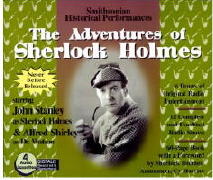
   Taking over the parts of Holmes and Watson were the long-forgotten John Stanley and Alfred Shirley. “I’m definitely out on Holmes – not even a hope of some income from repeats… I think this may be the most severe fatality Holmes has suffered since the Reichenbach Falls – but then he survived even that…” (12 August 1947)

   As far as I know, no Sherlockian has ever delved into Boucher’s running commentary on the Holmes radio series, but it’s a job eminently worth doing. And so is the assembling of a full-length book of the Boucher-Lee correspondence, which chronicles one of the strongest, deepest, most fascinating literary friendships of the 20th century and, in the world of mystery fiction, perhaps the strongest and most fascinating of all.

A REVIEW BY CURT EVANS:
   

JOHN RHODE Death on the Boat Train.

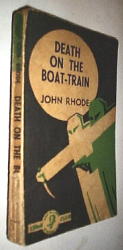
JOHN RHODE – Death on the Boat Train. Collins, UK, hardcover, 1940. Paperback reprint: Collins, UK, 1940s (cover shown). Dodd Mead, US, hardcover, 1940.

   How died the man, dressed incognito, found dead from no discernible means after having traveled on the boat train of the title? Foul play of course turns out to be involved, but the discovery of the killer is by no means simple.

   Jimmy Waghorn, just married to Diana, his love interest from Death Pays a Dividend (Collins, 1939), is put on the case, which naturally leads eventually to the involvement of Dr. Priestley, who makes a couple of very significant deductions (one from his armchair, the other after on-scene investigation, underling Harold in tow).

JOHN RHODE Death on the Boat Train.

   Death on the Boat Train is one of the most Croftsian of the Rhode novels, with transportation, alibis and many subsidiary matters involved in the resolution of the murder mystery. The solution hinges on a straightforward enough matter, but one that the reader may well miss.

   Characterization is stock, but fairly pungent, with a sexually profligate industrial magnate, a cynically designing, gold digging “personal secretary” and a dope junkie, among other modernish characters.

   Diana Waghorn makes sporadic, yet welcome, appearances, making the reader wish Street had done more with this character in more of his later novels. And Jimmy and his boss Hanslet manage to be constantly wrong without looking stupid, not something they always manage in other books.

   All in all a pleasing job for fans of this author, if somewhat more Croftsian than Rhodeian in mechanics.

[COMMENT.] 8-14-08.  This is Steve. For an earlier exchange of comments between Curt and myself about John Rhode, see my review of Three Cousins Die (Bles, 1959), a book that neither of us believes is among his best.

REVIEWED BY WALTER ALBERT:         


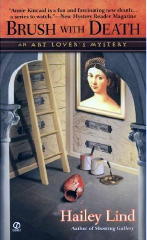
HAILEY LIND – Brush with Death. Signet, paperback original; July 2007.

HAILEY LIND

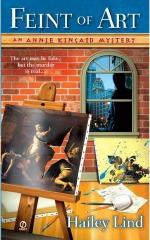
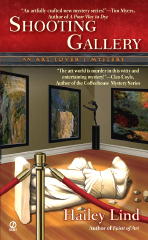
   Annie Kincaid’s family background is dominated by a talented grandfather who’s a notoriously successful painter of art forgeries, but Annie, who’s inherited his artistic talent, is trying to live a more conventional life by keeping a career as a “faux finisher” afloat. However, she continues to find that her grandfather’s notoriety and her own somewhat checkered past keep interfering with her good intentions.

   The books keep getting better, and the most recent, and third in the series, has Annie attempting to authenticate a possible original Raphael painting masquerading in a local cemetery as nineteenth century copy, and had me turning the pages with the fervor of the true convert.

   The two sisters co-writing the mysteries as Hailey Lind have a somewhat jaundiced view of the art scene and each chapter is headed by quotes by a famous painter or art historian countered by a cynical restatement credited to Georges LeFleur (Annie’s grandfather) that reflects the authors’ viewpoint.

   A paperback original series that outclasses many of the hardcover series I read.

  Bio-bibliographic Data:

HAILEY LIND. One half of “Hailey Lind” is Julie Goodson-Lawes, a San Francisco Bay Area muralist and portrait painter with her own faux finishing and design business. She graduated from UC Santa Cruz with a major in Latin American studies before earning Masters Degrees in Anthropology and Social Welfare from the State University of New York at Albany.

   The sister who’s the other half of the two-author writing team, Carolyn J. Lawes, received a BA in History from the University of Santa Clara, and an MA and a PhD in History from UC Davis. She is currently an Associate Professor of History at Old Dominion University in Norfolk, Virginia, where she specializes in American women’s history.

      Feint of Art. Signet, pbo, January 2006. Nominated for an Agatha.  [Best First Novel]

HAILEY LIND

      Shooting Gallery. Signet, pbo, October 2006.

HAILEY LIND

      Brush with Death. Signet, pbo, July 2007.

      >>

[UPDATE] 08-14-08.  An email reply from half of the Hailey Lind combo:

  Hello Steve,

   Thank Walter for me for the lovely review! I especially like the part about out-classing the hardbacks… I’ll keep that one by my computer when I need a boost.

   Unfortunately, Signet has decided not to renew the contract for more titles in the Art Lover’s Mystery series…at least for the time-being. Though the books have garnered a lot of support, been nominated for awards and translated into foreign languages, they simply didn’t sell enough across the board. As I’m sure you know, book publishing is a cutthroat business these days.

   I’m working on some other projects now (including one about historic home renovation, and another featuring a witch with a vintage clothing store!), but I haven’t given up on Annie Kincaid and the gang–they’re much too much fun. Book 4 in the series, Arsenic and Old Paint, is almost finished, and I feel confident that one way or another it will be published, along with numbers 5 and 6 which are already plotted.

   I’ll try to keep you posted as to my progress.

Thanks again,

   Hailey (Julie–the artist half)

Hailey Lind
Feint of Art; Shooting Gallery; Brush with Death
www.haileylind.com
www.artloversmysteries.blogspot.com
www.truefauxdesigns.com (for art lovers…)

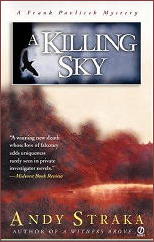
ANDY STRAKA – A Killing Sky.

Signet, paperback original; 1st printing, April 2002.
ANDY STRAKA

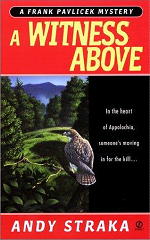
   Private eye novels have been around for a long time, and it has to be tough for a new writer on the block to come up with a new idea, but Andy Straka has come up with a couple that are new to me. This is the second case featuring Charlottesville (VA) private eye Frank Pavlicek — the first being A Witness Above from 2001 — and I think he’s going to be around for a while.

   There are also some things done here that have been done better somewhere else, but I’ll go with the pluses first. Pavlicek’s a single father, and his teen-age daughter, a college student, wants to follow in his footsteps. As a computer whiz, she’s ready to help out when e-mails have to be recovered from hard drives, records tracked down and similar high-tech wizardry far beyond Sam Spade’s wildest dream. (And if he had a daughter, we never knew that either.)

   Pavlicek, like the author, is also a falconry enthusiast. Not that it adds anything to the case he’s solving, except for the occasional break in the action, but never unwelcome.

   He’s hired by one of a disreputable (philandering) congressman’s twin daughters to help find the other, who’s been acting strangely and has suddenly gone missing. Lots of Washington dirt in the case, in other words, and many of the participants have played their roles before: cheap thugs as bodyguards, the congressman’s ex-floozy girl friend now turned tattle-tale TV show hostess, obnoxious staff assistants and the like.

   And other than Pavlicek’s daughter, someone Spenser (so far) has never had anyone similar to tag along with him, the rest of the returning cast could be moonlighting from Robert B. Parker’s books (lovely lady friend, macho multi-talented guy friend). With similar laconic dialogue to boot. Which is not bad, in itself, but it’s not exactly new either.

   A greater displeasure was twofold. The case is undone with a nice combination of old-fashioned detective footwork and new-fangled computer savvy, but that old standby, pure luck, still comes in handy to crack it open. Not to mention the next to utter incompetence of the bad guys, allowing Pavlicek and his buddy Toronto to invade their compound without their ever looking up.

   As a summary: promising, and maybe a contender someday. At the least, worthy of a few more cases to come. (I liked the daughter idea.)

— March 2002


[UPDATE] 08-13-08.   It looks like I was wrong. And this is discouraging: it also seems that award nominations don’t help if sales don’t match up to expectations. No big surprise there, but apparently there were only three Frank Pavlicek books in the contract, and that’s all there’s going to be.

   Here’s Andy Straka’s complete mystery-writing resume. Note the good news: a stand-along novel just published earlier this year:

A Witness Above. Signet, pbo, May 2001.   FP = Frank Pavlicek.  Shamus, Anthony, and Agatha Award nominations [Best First Novel.]

ANDY STRAKA

A Killing Sky, Signet, pbo, April 2002.   FP.  Anthony nomination [Best Paperback original.]

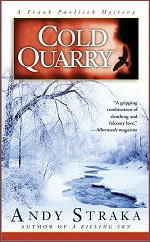
Cold Quarry. Signet, pbo, April 2003.   FP.  Shamus winner [Best Paperback original.]

ANDY STRAKA

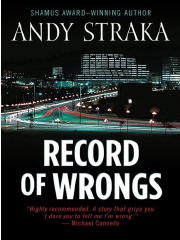
Record of Wrongs. Five Star, hardcover, Feb 2008.

ANDY STRAKA


      >>>

[UPDATE #2]   Later the same day: an email from Andy Straka, with welcome news:

      Steve,

   Thanks for the nod.

   Also, good news! The Shamus Award-winning Pavlicek series is being resurrected. The fourth book in the series, Kitty Hitter, will be published in hardcover by Five Star/Gale/Cengage in August 2009. (See synopsis below.) Earlier titles to be re-released in trade paperback. More details will be posted on my website as they develop.

   All the best,

      Andy

KITTY HITTER by Andy Straka (to be released August 2009) (Gale/Cengage Learning)

   No one would mistake Virginia private investigator and falconer Frank Pavlicek for Ace Ventura. But when the ex homicide detective is asked to return to New York City to help find a physician/animal rights activist’s missing cat, the stage is set for one of the most bizarre cases of Frank’s career.

   Are the doctor’s accusations true? Has the eccentric developer of her luxury apartment building actually hired a hit man to kill her pet by stealing the poor creature and hunting the kitty down with a bird of prey? Turns out, the doc and some of her fellow apartment owners are embroiled in a rancorous legal dispute with the developer. Other pets are missing too and witnesses claim to have spotted a specter-like figure prowling Central Park at night carrying a giant owl.

   With the help of his daughter Nicole, sometime partner Jake Toronto, and tough-nosed PI Darla Barnes, Frank soon discovers more is at stake than any of them had imagined. Chasing the mysterious falconer, they stumble upon an anonymous, half-dead child. Darla is shot and seriously wounded. To make matters worse, a newspaper reporter more interested in a bizarre story than in pursuing facts interferes along with competing camps of protestors. Not to mention Frank’s rekindled romance with erstwhile flame Marcia D’Angelo.

   In the end, both the good doctor and the developer must come clean about their respective agendas, exposing a true malice that has escaped unnoticed. Overcoming such an evil will take every skill in Frank’ s hunting bag … and a sacrifice by a heart as big as New York City and all outdoors.

      ————

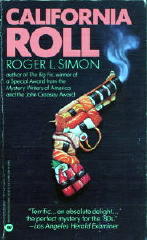
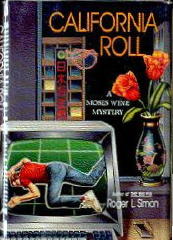
ROGER L. SIMON – California Roll.

Warner, paperback reprint; 1st pr., June 1986. Hardcover edition: Villard, March 1985. Trade paperback: I Books, Jan 2001.

   I think what I will do is to quote private eye Moses Wine in his own words. The first three paragraphs of California Roll will do as much to set the stage as anything that I could say:
Roger L. Simon

   I never sold out before because nobody ever asked me. In all it took around twenty minutes. It would have taken around three, but the guy on the other end was so profusely apologetic, he wouldn’t give me a chance to say yes.

   Actually, if had any idea of my then depressed state, he might have known that all he had to do was whistle. I was in the midst of a pronounced mid-life crisis somewhere between Gail Sheehy’s Passages and the advice column of a minor metropolitan daily. I felt like a human cliché. Most of the time I would sit around in my room in my bathrobe, listening to Leadbelly albums and bemoaning my situation: three months shy of my fortieth birthday and still a private detective with nothing to show for it but a leaky two-bedroom cottage on Wonderland Drive and a battered Porsche with a sever transmission problem. My political ideals, when I could remember them, felt like the rehash of a twenty-year-old Marcuse paperback. My work, when I had some, was boring. And my body, however hard I fought against it, was beginning its slow, inexorable slide to oblivion.

   Beyond this, my kids were growing up and didn’t want much more to do with me than an occasional overpriced visit to a sushi bar, while my ex-wife, who had dropped out of law school to live with a movie producer with a chalet in Vail, still asked for alimony. And to top it all off, my own lovelife was in the doghouse since the glorious Louise went back to her nitwit stockbroker husband after three years because, after all, she had her security to think about. And all around me my sixties buddies were getting rich. “Fuck it, Moses,” they would say. “Reagan’s in the White House. If you can’t lick ’em, join ’em!”

   Moses was, as far as I have been able to determine, the first counter-cultural PI in the books, starting out as a pot-smoking California hippie detective in 1973 and having a whole career of life-altering adventures from that point on, but always the same person, always with new problems, or so his books have been described to me. (I’m relying here on some of the comments I found after a quick Google through the Internet, with (as usual) Kevin Burton Smith at thrillingdetective.com having the most concise but illuminating things to say.)

   Here’s the entire list of Moses Wine adventures. I’ve read only two of them, I’m sorry to say.

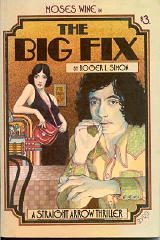
The Big Fix. Straight Arrow, trade pb, 1973.
   Andre Deutsch, hc, UK, 1974.
   Pocket, pb, March 1974.
   Pocket, pb, September 1978.
   Warner, pb, July 1984.
   I Books, trade pb, July 2000.

Roger L. Simon

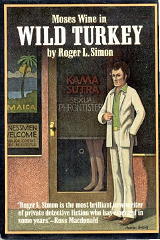
Wild Turkey. Straight Arrow, hc, 1974.
   Pocket, pb, February 1976.
   Warner, pb, September 1984.
   I Books, trade pb, July 2000.

Roger L. Simon

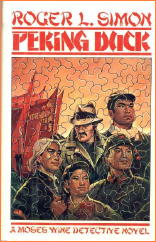
Peking Duck. Simon & Schuster, hc, June 1979.
   Detective Book Club, reprint hc, 3-in-1 volume, Sept-Oct 1979.
   Warner, pb, September 1987.
   I Books, trade pb, November 2000.

Roger L. Simon

California Roll. Villard, hc, March 1985.
   Warner, pb, June 1986.
   I Books, trade pb, January 2001.

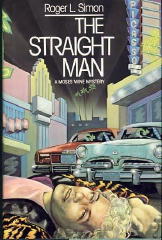
The Straight Man. Villard, hc, September 1986.
   Warner, pb, October 1987.
   I Books, trade pb, June 2001.

Roger L. Simon

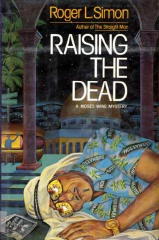
Raising the Dead. Villard, hc, July 1988.
   Warner, pb, August 1989.

Roger L. Simon

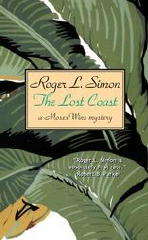
The Lost Coast. Harpercollins, hc, 1997.
   I Books, trade pb, March 2000.
   I Books, hc, May 2003.

Roger L. Simon

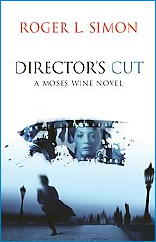
Director’s Cut. Atria, hc, June 2003.
   I Books, trade pb, December 2005. [Scheduled but possibly never published.]

Roger L. Simon

   Getting back to California Roll, however, and as you can probably imagine, the match-up of Moses Wine with corporate California — the computer business in its early stages — does not go well. There is a parallel theme, not thinly disguised, in the fact that Alex Wiznitsky (aka The Wiz), the head of Tulip (not Apple), newly worth $234,000,000 and who hires Moses to be the new head of security — he also finds that immense, immeasurable wealth is not what it is cracked up to be. He, the Wiz, would rather be, one feels, back in his garage tinkering around on his own.

   He, the Wiz, also says, on page 13, “They’re t-trying to take the company away from me, Moses.”
Roger L. Simon

   I don’t think the plot of the mystery adventure novel that follows makes a whole lot of sense, although it certainly follows the usual path of a private eye novel in practice, although with a sense that the latter is not entirely the sort of story Mr. Simon intended to tell.

   Characters come on stage to amuse and entertain us for a while, and then they are seemingly jettisoned when the story verves off in another direction — to Japan, say, for several chapters — and then back again to California.

   One excellent creation along these lines is Mr. Hodaka, a translator Moses hires in Japan who turns out also to be the writer of Japanese pulp detective stories and who eagerly finds the opportunity to be of assistance to Moses along those lines to be very exciting, along with his fellow members in the Maltese Falcon society. A girl named Laura Suzuki, on the other hand, whom Moses makes love to on page 62 (in brief but explicit detail), finds her role in the story (later on) much less to her liking.

   On page 170 is a sort of semi-capsule summary: “… it was a two-tiered game … being played out on one level by large corporate entities and nation-states and on another by human beings struggling desperately for survival in this sad vale of tears.”

   Which, if nothing else I’ve said so far, may give you an inkling of where either the book succeeds or fails. Or if it does not, here is another take on the book’s intentions — and ordinarily I perhaps should not do this, which is to quote the last two lines of the book (or that is to say, to quote a quote from Hagakure: The Book of the Samurai) — but if you were paying attention up above, there’s nothing in this that will surprise you, not an iota:

    “Human life lasts but an instant. One should spend it doing what one pleases. In this world fleeting as a dream, to live in misery doing only what one dislikes is foolishness!”
— May 2006

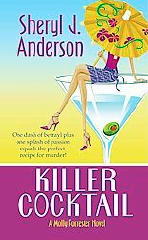
SHERYL J. ANDERSON – Killer Cocktail

St. Martin’s; paperback reprint, May 2006. Hardcover: St. Martin’s Press, August 2005.

   Killer Cocktail is the second in a series of what are now three cases solved by Mollie Forrester, a New York City based advice columnist (and wishful crusading reporter) for fashionable Zeitgeist magazine. In order, here they are:

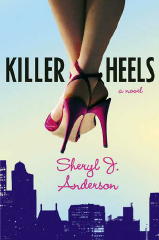
      Killer Heels. St. Martin’s Press, May 2004. Paperback: June 2005.

SHERYL J. ANDERSON

      Killer Cocktail. St. Martin’s Press, August 2005. Paperback: May 2006.

      Killer Deal. St. Martin’s Press, July 2006. Paperback: not yet scheduled.

      Unnamed Molly #4. “In the works.”    [See the update below.]
   According to Booklist, the authors are a pseudonymous husband-and-wife writing team, and if that is the case, the copyright notice in Cocktail gives it all away: copyright © by Sheryl J. Anderson & Mark Edward Parrott. On the other hand, the author’s website does not admit to any other author than the female half of the husband-and-wife team, so I will leave the question open to more diligent detectives than I.

   I suppose I should also admit upfront that a case of murder that are tackled and cracked by a team of female friends in the city is a phenomenon that I am somewhat unaccustomed to and/or unfamiliar with. Whether or not it is a rare phenomenon I do not know, not having read any of Stephanie Plum’s adventures, for example, nor ever (in regards to non-mystery fiction) having seen Sex in the City.

SHERYL J. ANDERSON

   Not that there is any sex in Killer Cocktail, but both examples are suggestions put forth by reviewers who’ve posted comments on Amazon in attempting, and I presume accurately, to inform readers just what kind of book this one by Sheryl Anderson happens to be.

   (If truth be said, I do not believe such mystery novels are rare. I am perfectly content to assume that I have not (yet) happened upon them, and if I simply keep reading, I will come across another one soon.)

   Mollie’s female friends are, to enumerate: event planner Tricia Vincent, whose brother’s prospective bride falls to the titular poisoned cocktail in the Hamptons only hours before the wedding; and Cassady Lynch, successful lawyer. Mollie’s male friend and as such, an item of significant interest to her, is NYPD homicide detective Kyle Edwards, who is therefore out of his jurisdiction in the Hamptons.

   How close a male friend Kyle is to Mollie, even at the risk of repeating myself, is a matter of some reflection and concern throughout the book, including some strong attacks of jealousy perhaps whenever Detective Darcy Cook of Suffolk County Homicide is on the scene, which is often, as the Hamptons do happen to be in her jurisdiction.

   The book is funny, light, breezy and so tightly told that it made my jaws ache. There is also (as hinted above) a good deal of internal pondering – I have neglected to mention that Mollie herself tells the story – and there are both a sizable number of suspects – it was a large party at which the victim died after all – and there are a good number of pages (over 300) to read before the end is in sight.

   In this regard, I have been debating whether or not to tell you this, but I guess I am, for whatever it’s worth. I stalled out round the 250 page mark and didn’t pick the book up again for a week.

   But I’m glad I did. Pick it up again, that is, even above and beyond the consideration of the time already invested. Perhaps you have to be in the right mood to begin with, as the author doesn’t concede a thing to the reader, nor will she diverge from her way of telling her story for anyone or anything. I like an author with a goal and a sense of purpose in mind, and one who sticks to it.

   And anyone who can write a passage like the one following, taken from page 256, is worth reading, no matter what. Mollie is in the City at the time:

    “I was only about ten blocks from the office and I thought the walk might help my hangover as well as my thought process. Besides, I love walking in the city, throwing myself into the river of people moving up and down the island all day and most of the night, and letting the current carry me along. It’s not good for the shoes, but it’s good for the soul. The pace and size of the city make it easy to feel disconnected, but when you walk down the sidewalk and just spend a few minutes watching the huge spectrum of people rushing along right beside you, worrying about being disconnected, too, sometimes that’s a connection in itself and you feel part of something larger than your own panics and problems. Maybe you’re just a fish swimming along with a school, maybe you’re a star in a constellation, maybe you’re part of the human race. Whichever, you’re not alone.”

— June 2006


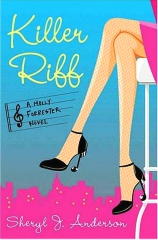
[UPDATE] 08-10-08.    Killer Deal came out in paperback from St. Martin’s in July 2007. The previously unknown title of book #4 is Killer Riff (St. Martin’s, hc, Nov 2007; ppbk, July 2008).

   In spite of an excellent sales ranking for the series on Amazon, there is no mention of a fifth book on Sheryl Anderson’s website. (The paperback edition of Riff, which just came out is ranked #89,277. (Out of over six million books with sales rankings, this is excellent.)

SHERYL J. ANDERSON

   And if it matters, I still have not seen Sex in the City or read a Stephanie Plum book. Someday, I’m sure.

[UPDATE #2] 08-13-08.   Excerpted from an email send me by Victor Berch:

Hi Steve:

   … As for Sheryl J. Anderson, her full name is Sheryl June Anderson, born in LA 10 March 1958. Started out as a playwright. Parrott was born Oct. 21, 1951 in Kern County, CA.

   Don’t know who’s going to use this info as no one as far as I know is carrying on Al Hubin’s good work from 2001 on up.

Best,

   Victor

« Previous PageNext Page »