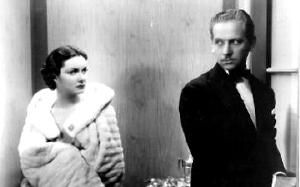
Tise Vahimagi left the following as a comment to the second of three reviews I posted this past week of George Harmon Coxe’s detective fiction. As usual, the information that Tise provides warrants a post of its own. Most of the movies he mentions exist. I’m not so sure about the TV shows, but there’s always hope.
    — Steve


   The George Harmon Coxe reviews and views and responses are fascinating. An author I’ve always been aware of yet, rather shamefully, one that I have not yet read. I am aware, however, of his big and small screen associations. (Which doesn’t mean that I have seen most of these either.)

   But if several of the following films and TV work were easily available, I’m sure there would be much pleasure to be had in the viewing (or at least, the experience). While one can respect and appreciate that viewing screen adaptations of any author’s work is not the same as experiencing the original art of the written word, there remains with me a certain fascination of how the literary concept is translated into a (albeit condensed) visual storytelling form. An art in itself, of course.

   Research shows that the following have Coxe credentials (in one form or another) and are worthy of further investigation. Well, some of them, perhaps!

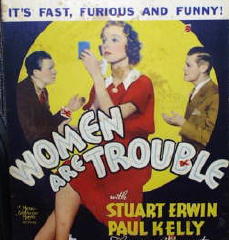
Women Are Trouble (1936, d. Errol Taggart). With Stuart Erwin as Matt Casey, a newspaper reporter following up a series of robberies and murders. Screenplay by producer Michael Fessier, from story by GHC.
GEORGE HARMON COXE

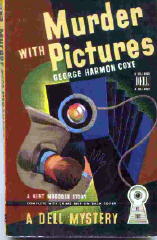
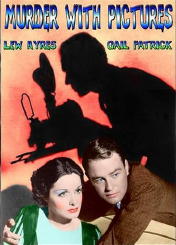
Murder With Pictures (1936, d. Charles Barton). Lew Ayres is Kent Murdock in a plot that kicks off with the murder of a gangland lawyer. Screenplay by John C. Moffitt and Sidney Salkow, from story by GHC.
GEORGE HARMON COXE

The Shadow Strikes (1937, d. Lynn Shores). Based on the story “The Ghost of the Manor” by Maxwell Grant in The Shadow (15 June 1933). Rod La Rocque as Lamont Cranston. Screenplay by Al Martin, from adaptation by Martin, Rex Taylor and GHC. Intended by producer Colony Pictures to be the first of four “Shadow” films.

Here’s Flash Casey (1937, d. Lynn Shores). Based on the short story “Return Engagement” by GHC in Black Mask (March 1934). Eric Linden is Flash Casey. Screenplay by John Krafft.
GEORGE HARMON COXE

Arsene Lupin Returns (1938, d. Geo. Fitzmaurice). Silky Melvyn Douglas was the silky Arsene Lupin. Based on characters created by Maurice Leblanc, the story and screenplay was by James Kevin McGuinness, Howard Emmett Rogers and GHC.

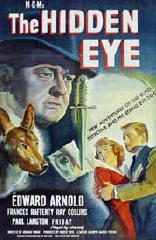
The Hidden Eye (1945, d. Richard Whorf). Based on the novel The Last Express (1937) by Baynard Kendrick. Screenplay by GHC, Harry Ruskin, from story by GHC. One of the two pleasing MGM Captain Duncan Maclain films starring Edward Arnold (the other being Eyes in the Night, 1942).
GEORGE HARMON COXE

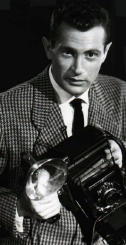
   For the home screen, there was Crime Photographer (CBS, 1951-52) featuring Richard Carlyle (brief stint, 1951) and Darren McGavin (1951-52) as Casey of The Morning Express.
GEORGE HARMON COXE

    “The Category is Murder” (1957) for Kraft Television Theatre (NBC), about a TV quizmaster who drops dead of poisoning during a show. Betsy Palmer and Gene Lyons featured. And that’s about all I know about this one. GHC as teleplay or story source?

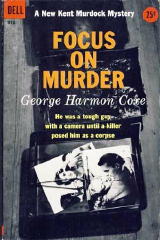
    “Focus on Murder”(1958, d. Bill Corrigan) for Kraft Television Theatre featured Si Oakland as Kent Murdock in a story about a Pulitzer Prize reporter found murdered in his apartment. Mel Goldberg adapted from novel by GHC.

    “Mission of Fear” (1963, d. Harvey Hart) for U.S. Steel Hour (CBS) involved the statuesque Salome Jens and Robert Horton in a blackmail story written by Richard F. Stockton [from story/source by GHC?].

   A list of credits without benefit of personal insight or opinion can be somewhat dreary, I know, but I have not been fortunate enough to view most of the above titles, especially the rare TV work. Perhaps others with more opportune moments of viewing access may offer a more satisfying sense of form and flavour.

   For my part, it is hoped that I have viewing pleasures to look forward to — one day.

Best Regards,

      Tise

LINDA FRENCH – Coffee to Die For.

Avon, paperback original. First printing, December 1998.

   Linda French is the author’s maiden name, and this is second of three mystery novels she wrote under this byline. All of them take place in the northwestern corner of Washington state, with the leading character in each of them being Teodora “Teddy” Morelli, a history professor who lives in Bellingham. According to Google is about 85 miles north of Seattle, which is where most of Coffee to Die For takes place.

   Not so coincidentally, according to Amazon, Linda French is a history professor who lives in Bellingham, Washington.

   Based on her entry the Revised Crime Fiction IV, by Allen J. Hubin, here’s a list of her mystery fiction in book form:

FRENCH, LINDA. Pseudonym of Linda Mariz, 1948-
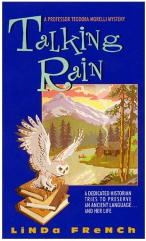
      * Talking Rain. Avon, pbo, April 1998.

LINDA FRENCH

      * Coffee to Die For. Avon, pbo, Dec 1998.
      * Steeped in Murder. Avon, pbo, Dec 1999.

   Under her married name, Ms. French also wrote the following pair of mysteries:

MARIZ, LINDA (Catherine French) 1948- . Pseudonym: Linda French.
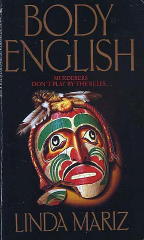
      * Body English. Bantam, pbo, Feb 1992.

LINDA FRENCH

      * Snake Dance. Bantam, pbo, Aug 1992.

   Anthropologist Laura Ireland, who’s also based in Washington state, is featured in both of these, although the second one takes place in Louisiana’s Cajun country. (She’s also a tall championship volleyball player, while Teddy Morelli is short, maybe five foot three.)

   Of the five, Coffee to Die For is the only one I’ve read, and while one should never say “never,” all things considered, I’m not likely to read another, or at least not right away.

   It’s not that it’s badly written, mind you, for it’s not. It’s not, shall we say, my cup of naturally flavored chocolate coffee. In fact, I suspected this from the very first paragraph, which I will quote:

LINDA FRENCH

    “From the balcony, Teddy Morelli dumped a forty-pound bale of fiberfill over the rail. She stared into the hopper, mesmerized as the compressed air of the stuffing machine ravaged the bale, plumping it to thirty times its former volume. A single block of fiberfill would fatten seventy-five of her sister Daisy’s exquisite woolen bunnies. But down on the floor of Bunny Business, Inc., her sister was not happy.”

   How cozier could you get than a mystery full of woolen bunnies?

   Dead, eventually, is Daisy’s philandering husband Leo, a scientist who (a) has recently developed the aforementioned naturally flavored chocolate coffee plant, and (b) has even more recently given himself a present in the form of a young, new (and beautiful) lab assistant by the name of Molly Thistle.

   When he’s found murdered in his laboratory office, no one sheds a tear. Teddy and Dolly assume that Molly did it, only to discover that she has an unbreakable alibi. It is not known whom the police suspect, unless it is Daisy, since they are visible on the scene for a maximum of seven pages out of 210 in all.

   Which means that the percentage of professional police participation is just over 3%. I’ve heard of low-carb diets, but this is far too low for me.

   The rest of the book is filled with Teddy’s extended family and circle of friends, along with some goons with whom Leo was partner’s with in some sort of cannabis deal, now gone bad. Among the circle of friends, by the way, is Teddy’s ex-husband Aurie Scholl, a knee surgeon who works with the Seahawks, who’s hoping they can get back together sometime.

   Four out of five reviewers on Amazon left positive comments, but keeping in mind that I’m not a member of the target audience for books like this, I need something more solid to chew on.

GEORGE HARMON COXE – Fashioned for Murder.

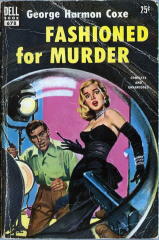
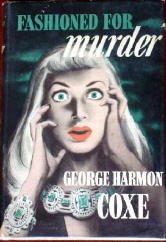
Dell 678; paperback reprint; no date stated, but probably 1953. Hardcover edition: Alfred A. Knopf, 1947.

COXE Fashioned for Murder

   Take a look at the cover of the paperback edition and compare with the one on the hardcover. Both are appropriate for their respective venues — sales mostly to libraries for the hardcover, where the artwork on dust jacket was all but incidental, versus sales on newsstands and drugstore spinner racks. The one on the paperback is nothing but eye-catching, and it does its job well. Besides telling you something about the story itself, wouldn’t it make you a whole lot more in the mood to fork over the 25 cents to took back then to take it home?

   And in the credit-where-credit-is-due department, the Dell cover was painted by Fred Scotwood, a new name to me, but done in very much a 1950s style, and it’s a pretty good example of GGA (Good Girl Art) as well. (According to Google, Scotwood appears to have done at least two other covers for Dell in the same time period, but so far, that’s all that I’ve found out about him.)

   As for the book itself, assuming that you’ve not tired of this mini-symposium on the author that’s developed this week, it’s one of Coxe’s non-series books, and without attempting to soften my comments any, it’s not one of his better ones, series or not.

   It starts out as a yawner, and in subsequent events it never manages to work its way up any higher than that. Even the hero’s name, Jerry Nason, a young fashion photographer based in Boston, bothered me. It reminded me too much of that book in which Atlas Poireau, Trajan Beare, Spike Bludgeon, Mallory King, Sir John Nappleby, Jerry Pason, Lord Simon Quinsey, Miss Fan Sliver, and Broderick Tournier all combine efforts to solve a murder together. (You do know the one I mean?)

COXE Fashioned for Murder

   That’s a minor quibble. Forget I brought it up. Fashioned for Murder begins with Pason taking a series of photos of a model wearing some costume jewelry she happened to bring with her. The two of them hit it off, but a date they’d scheduled for later failed to come off. Pason decided to write it off as just one of those things until they meet again at another shoot.

   The jewels, it seems, have caught someone’s eyes, Linda Courtney has become very popular, and she needs to tell Jerry about it. Not only that, when she does, Jerry becomes a target, too. The two of them are held up in his studio, and the fake jewels are stolen. (This is were the front cover comes in.)

   Now you know as well as I do that the jewels are not phony, but it seems to take way too long for Linda and Jerry to catch on, even though he follows her back to Manhattan where she lives to check into some of the other strange things that had happened to her.

   When one of the participants in the aforementioned activities comes to Linda’s apartment only to collapse dead on the carpet, Jerry commits an amateur detective’s most common mistake — he becomes an amateur detective. He decides to investigate the dead man’s flat himself and holds back evidence from the police, for reasons that almost sound good, but in reality are as substantial as the dental floss the rest of the story is stitched together from.

   I even figured out who did it, which I have to confess does not happen all that often, so when it does happen, it is not my desire to pat myself on the back about it. As I said earlier, this is not one of Coxe’s better stories, but at least Linda and Jerry wind up in each other’s arms at the end.

GEORGE HARMON COXE – Focus on Murder.

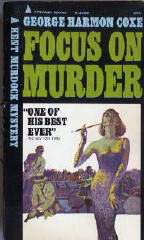
Pyramid R-1259; reprint paperback; 1st printing, January 1966. Cover by Frank Kalan. Hardcover edition: Alfred A. Knopf, March 1954. Hardcover reprint: Dollar Mystery Guild, June 1954. Previous paperback reprint: Dell 970, 1958.

COXE Murder with Pictures

   What with two paperback editions and (more importantly) a book club edition, this is not a difficult book to find, if you all you want to do is to have one to read.

   In his prime, if Coxe was not a bestselling author like Gardner and Christie, his sales must have been steady if not spectacular, as his career in hardcovers began in 1935, with Murder with Pictures (with Kent Murdock) and did not end until No Place for Murder in 1975 (not with Kent Murdoch, but with PI Jack Fenner, who also appeared in that very first book).

   Here’s something interesting. While Jack Fenner appeared in 12 cases chronicled by Coxe, his only solo appearance was that last one, which appeared when the author was 74. (Coxe himself lived another nine years, until 1984.)

   Coxe is probably best known for his series character “Flashgun” or “Flash” Casey, a tough Boston-based news photographer who began his crime-solving in the pages of Black Mask magazine, circa 1934, but (after a quick double-check to confirm this) he wrote far many more novels in which Boston-based news photographer Kent Murdock appeared (23) than those in which Casey was the detective of record (only five).

COXE Focus on Murder

   The difference in fame, relatively speaking, is probably due to the fact that Casey had a long-running radio show named after him, and two movies based on his exploits, while Murdock had neither.

   Kevin Burton Smith over at his Thrilling Detective website suggests that Murdock is Casey with the rough edges smoothed off. Given Casey’s early pulp fiction days, he is probably quite correct in that assessment. Since their paths seem to have never crossed, that only adds credence to a hypothesis that one was really the alter ego of the other (and therefore could not appear in the same book at the same time).

   Whatever. Although his roots were definitely in the pulps, I would still consider Coxe as an author solidly in the detective story tradition of the so-called Golden Age. If you do indeed come across a copy of this book, and if my review and other chatter convinces you to read it as well — which I certainly am attempting to do — be sure to strap yourself in for a fast-paced sequence of action and clues which you’ll have to keep your eyes on every minute of the way.

   Let’s get the basic story line out of the way first. A colleague of Murdock’s at the Courier is found murdered shortly in his apartment after his (Murdock’s) departure, said colleague (as it turns out) having been a blackmailer in his spare time. That Murdock happened to have been in Ralph Stacy’s place of residence is important but not significant in the sense that he becomes one of the suspects –Lt. Bacon has worked with Casey before, and I’ll get back to this in a moment — but (as it turns out) an entire parade of suspects was in and out of the apartment and/or lurking around the building both before and after Murdock comes on the scene.

COXE Focus on Murder

   There is nothing like good old-fashioned (and dirty) blackmail to create a long list of such suspects, not to mention a wife who has just moved out, a current girl friend and a close boy friend of said girl friend, who just happens to be the jazz singer shown on the cover. Murdock is also personally offended by the murder in a personal sense, being a true-blood newspaperman through and through, nor can the reader help be offended as well.

   Coxe also had an excellent insight into the way people in the real world (mostly male, I concede) react to tragedy and other things, which includes matters of right versus wrong, in a strangely tweedy sort of way. He also seems to have been quite the jazz aficionado. I won’t quote Murdock’s conversation with pianist Jack Frost about Art Tatum on page 80 — it’s rather long — but there is nothing said here about Tatum that anyone could possibly dispute.

   By page 116, Lt. Bacon has (figuratively) thrown up his hands and asks Murdock, quite unofficially of course, to give him (Bacon) whatever assistance he (Murdock) can. And of course he (Murdock) does, again with neither the final flourish of a Christie or a Gardner (to pick a couple of prime examples) out of the air, but with the somewhat subdued manner of a magician whose apparent casualness catches you blinking, with the sudden understanding of just how easily the unwary reader (me, this time) can be taken in.

— March 2005 (slightly revised)

[UPDATE] 08-06-08.   Well, as you can see, whatever reservations I had about Coxe’s plotting abilities in One Hour to Kill were completely non-existent in this Kent Murdock mystery published some ten years earlier. I’ll really have to read that other book again, as I simply can’t tell you if I was really as hard on it then as I’m reading into my own review of it now.

   Other the other hand, I’ve just finished Fashioned for Murder (from 1947), and I didn’t find a whole lot to be happy about at all. (This is what prompted my going back and digging out these earlier two reviews.) I’ll get my review of it posted soon, but of course I will have to write it first.

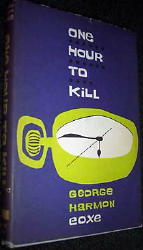
GEORGE HARMON COXE – One Hour to Kill.

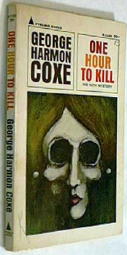
Pyramid R-1186; paperback reprint; 1st printing, May 1965. Alfred A. Knopf, hardcover, September 1963. Book club edition: November 1963.

   On the cover it states that this was the author’s 50th mystery, so while I didn’t check that particular figure, I did go to look his record up in Hubin’s Crime Fiction III. It takes a few years to write that many novels, and this one was written when the author was in his early 60s. Coxe went on to write another dozen or so more, averaging a book a year up until he was in his mid-70s. He also wrote for Black Mask and other pulp magazines of the 1930s, moved over to the slicks, and on the side, in his spare time, he did loads of work for radio, TV and the movies.

COXE One Hour to Kill

   Very well known, and (I’m guessing) almost forgotten today. My own evidence in this regard depends on the other half of what I do when I’m not reading mysteries, and that’s selling them, and I’m sorry to say that George Harmon Coxe is not a big seller. Not a poor seller, I hasten to add, but well below average, and not proportional to his output as an author.

   When I was a member of the Dollar Mystery Guild in the mid-to-late 50s, I devoured his books, but mostly the ones with either of the two Boston newspaper photographers, Flashgun Casey or Kent Murdock. I couldn’t tell you why for sure, but I think the lure of a couple of guys who knew their way around a tough metropolitan offered a considerable amount of appeal to a young boy growing up in upstate Michigan.

   I didn’t care for his other mysteries very much, though, taking place primarily in the islands of the Caribbean, of which this is a prime example, and in Trinidad, to be precise. Too foreign, to me, I think, at the time.

   In any case, to get on with the story, Dave Wallace is having marital problems. He has a new love in his life, but he also has a wife who’s just reneged on a divorce and has come down to move back in. (She also one of the most unpleasant women I come across in quite a bit of reading, if I may offer a brief aside.)

   When she’s murdered, as it quite evident she will be within the first two pages of meeting her, Wallace knows he’s the obvious first person the police will suspect, and he decides he has to keep two jumps ahead of them to clear himself, concealing evidence, picking up clues, and generally muddying up the trail. All pretty much the wrong decisions to make — the native policemen are not dummies — but then again, if he didn’t, we probably wouldn’t have a story.

   And as it turns out, it’s through his efforts that the crime is solved — a fair-play story of detection — so fair, in fact, that when the truth is revealed, you can see where Coxe practically gave the game completely away, if you were paying attention, and as usual, my mind was somewhere else at the time.

COXE One Hour to Kill

   Some of the ways that Wallace gets the information that helps him solve the mystery he finds himself in are artificially and/or awkwardly constructed, though. (I’m not sure which.) Here’s a bit of what I mean:

   On page 94 Wallace is talking to someone who says, “There was one other thing, now that I think of it.” This is someone who is on Wallace’s side and eventually ends up confiding in him that (a) he was eavesdropping on the dead woman before she died, (b) overheard the tail end of a crucial telephone conversation, (c) saw another car drive up, and (d) wrote down the license number. One other thing? Now that he thinks of it?

   In other ways Coxe is a very precise writer, with well-constructed backgrounds for all of the characters, and lots of descriptions of homes, offices and (to be expected) taverns, restaurants and other watering holes on the island.

   Even better, the timing of events surrounding the murder is really quite cleverly done. (See the title of the book.) And yet. When it comes to laying out the detective story as it goes along, as pointed out above, Coxe’s approach doesn’t always appear to be as polished as it might have been. It is a puzzle.

   The final clue, the one that points directly to the killer, and therefore one I can’t tell you about, but maybe, just maybe — back in the era when you had to step on starters to get cars going — maybe a crucial switch that the killer has to make could actually have been done, and no one would have thought anything about it. Today it seems very strange.

— July 2003 (slightly revised)


[COMMENT] 08-06-08.
  Regarding that last paragraph, I wish I remembered what I was referring to, but I don’t, making it two reasons why I can’t tell you about it.

   But regarding Coxe’s popularity today, or his lack thereof (even more pronounced five years later), my theory is that his stories are outdated today, with the puzzle in his plots being just not quite strong enough to overcome their age.

   I’ve already dug into my archives for a review of one of Coxe’s mysteries that I wrote more recently, and one that has Kent Murdock in it. You’ll see it next, and you’ll see the difference. (At least I do.)

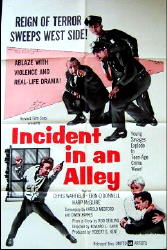
INCIDENT IN AN ALLEY. Robert E. Kent/United Artists, 1961. Chris Warfield, Erin O’Donnell, Harp McGuire, Virginia Christine, Willis Bouchey. Based on a story by Rod Serling. Director: Edward L. Cahn.

INCIDENT IN AN ALLEY

   The earlier version of this nearly bottom-of-the-barrel movie, based on production values, appeared as the eleventh episode of the third season of the television series The United States Steel Hour, November 23rd, 1955. The author, Rod Serling, later became, of course, probably the best known writer for television there ever was, or ever will be.

   Which means that the story value is above average – I won’t say high – in spite of some serious gaffes, but the sets the play is staged on are only one step above that of the original “Honeymooners” series, say, and pitiful indeed – never mind the fact that a key portion of the little action there is supposedly takes place outdoors. The TV roots are showing badly, in other words.

   Chris Warfield plays a cop named Bill Joddy (pronounced “Jody”) in this one. After a theft of some musical instruments from a small store in a bad section of town, Joddy hears a woman scream after being knocked down, and he chases the assailant down an alley. After warning him to stop or he’ll shoot, the person fleeing doesn’t stop, Joddy shoots …

   … and it turns out to be a small 13-year-old boy he has killed. A trial as well as a small courtroom morality play ensues. I won’t tell you the result of the trial, but in some ways it could have come out either way, as the story is not over, not for Joddy, and not for the gang of hoodlums who pulled the original robbery.

   Erin O’Donnell, who plays Joddy’s wife, had a short career in TV and the movies. I hate to say not surprisingly, but there’s certainly no chemistry or rapport that I could discern between her and Chris Warfield in any of the scenes they had together. Which may not entirely be her fault. Warfield’s career took a nosedive into adult film-making in the late 60s through the 1970s, mostly as a producer and/or director.

INCIDENT IN AN ALLEY

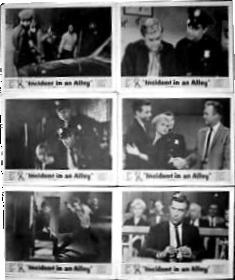
   I’ve not been able to come up with proper photos of either O’Donnell or Warfield, only a set of lobby cards once offered on eBay, and I apologize that they’re too small to be of any value.

   But if it helps at all, in the card in the lower right corner, that’s Warfield in a close-up taken during the trial. Above that, in the center right position, is a scene with Erin O’Donnell as Mrs. Joddy in her husband’s arms.

   Only Virginia Christine, as the dead boy’s mother, and Willis Bouchey, as Joddy’s immediate superior in the police department, show much in the way of acting ability, and even they are hampered by the lack of any real depth to the tale.

   Major errors, I believe – and if I’m wrong, please correct me – come in the courtroom scenes, which have the defense putting on their case first, the prosecution calling the defendant as one of their witnesses, and the judge in general allowing all kinds of extraneous testimony being allowed with the jury still in the room.

   And from a detective story point of view, not until the jury’s verdict has been given is any real investigation made, and that is done by Joddy himself, the accused child killer.

   Director Edward Cahn is a new name to me, but apparently not to movie fans who follow the careers of movie directors more closely than I have. He started in 1931, but not until 1955 did the most active part of his career begin, doing literally tons of bargain basement budgeted films of all kinds, but in large part SF movies like Creature with the Atom Brain (1955) and It! The Terror from Beyond Space (1958). Other crime movies he directed in this same time period are Hong Kong Confidential (1958) and Guns, Girls, and Gangsters (1959).

   Overall, then, for Incident in an Alley? Interesting enough to watch all the way through, but if I’d been interrupted, I might not have gotten back to it right away.

[FOLLOW-UP.]  Later the same day. Here are some of the results I’ve come up with after doing some Googling for information about Edward Cahn:

  From Mike Grost’s website, an overview of some of Cahn’s directorial techniques:

      http://members.aol.com/MG4273/cahn.htm

  From the New York Times, a complete biography:

      http://movies.nytimes.com/person/83815/Edward-L-Cahn/biography

  From Fandango, an annotated list of many of his films:

      http://www.fandango.com/edwardl.cahn/filmography/p83815

   It’s been a while since I’ve uploaded another page to the ongoing Addenda to Al Hubin’s Revised Crime Fiction IV, but Part 28 is up and running as of 10 minutes ago.

   The first link will take you to the main page, where I’d recommend you go if you’re a first time visitor. The second link goes directly to the new material, to which I have not yet added any of my usual enhancements — links, cover images, and added biographical information — but which I will as time goes on.

   There are no major pockets of interest, only a steady accumulation of new data, additions and corrections both. Part 29 will be along shortly, Al promises, as he’s been working on both Parts 28 and 29 more or less at the same time. And as usual, when it does appear, you’ll read about it here first!

   The time went by very quickly, as it always does. Paul Herman and I arrived in Dayton soon after 2 pm on Wednesday and he dropped me off at home yesterday around 5 pm. In between were many many hours of visiting with people I hadn’t seen since last year (except of course people I’d seen at the Windy City show only a few months before).

   No matter. Being able to talk at length with with people with the same nutty (um, specialized) interests as you do is always a pleasure. That and a special nod to Randy Cox and Walter & Jim Albert, whom whom Paul and I spent a lot of time outside the convention center (meals and bookhunting) as well as inside, it seemed all too soon before it was over and it was time to leave.

   Only the absence of my long-time friend Jim Goodrich, who was unexpectedly hospitalized the weekend before, took any luster off the proceedings. Get well soon, Jim!

   While the dealers room was full of pulp magazines, I managed an all time low in the purchasing any, and in fact it’s a number that’s impossible to surpass: none (after buying only one last year). The selection was fine, but as I perhaps explained earlier, my funds were low. Attendance was also low, but (in my opinion) not dangerously so, as the enthusiasm around the room seemed high.

   What I did obtain consisted largely of various reprints of pulp stories and novels in trade paperback. Print-on-demand is getting easier and easier to do all the time, and the results, more often than not, are very impressive.

   Without intending to slight other publishers whose efforts I intend to review and talk about later, as time goes on, here are two such examples:

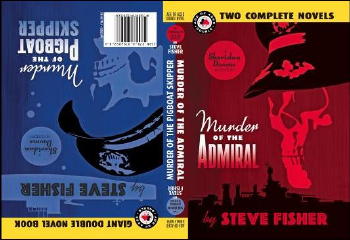
   From Age of Aces Press: A flip book with two early mystery novels by Steve Fisher: Murder of the Admiral (Macauley, 1936, as by Stephen Gould) and Murder of the Pigboat Skipper (Hillman-Curl, 1937). Both are cases for a chief detective for U.S. Naval Intelligence named Lieutenant Commander Sheridan Doome. (Follow the link for more information.)

STEVE FISHER

   Age of Aces Press specializes in air fiction stories that largely take place during World War I and soon thereafter, but I’m told that if there’s a military connection, they’d be interested in reprinting any kind of vintage detective or spy fiction as well. If you have any suggestions along these lines, I’d certainly be happy to pass them along to editor Bill Mann and art director Chris Kalb.

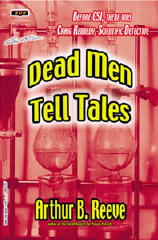
   From Black Dog Books: Dead Men Tell Tales, by Arthur B. Reeve, a collection of stories about Craig Kennedy, a scientific detective who was on the job long before either Patricia Cornwell or CSI came along.

CRAIG KENNEDY

   Much of Black Dog’s output consists of tales of high adventure, a la Talbot Mundy — whose body of work not so coincidentally they’ll be reprinting in total over the next few months, they being Tom Roberts and Gene Christie.

   Tom, by the way, and not so incidentally, was awarded this year’s Lamont award for his outstanding contributions to the hobby of pulp collecting. Another very popular choice!

   Guest of honor was SF writer Larry Niven, who never wrote for the pulps, since he began his career in the mid-1960s for the digest magazines, but whose work has always had (to me) the same sense of wonder the the SF in the pulp era had (and so seldom seems to have today). I had a short opportunity to talk to him, talking about mathematics, a field which we have in common, as well as his days writing for If, Galaxy and Worlds of Tomorrow. A fine gentleman.

   Back to pulps for a moment, if I may. Ed Kessell, a long time pulp fan and the one who put on the very first Pulpcon, back in 1972, died earlier this year. His sons brought a good portion of his collection to sell at their table and to put up for auction. Their table, before the doors were opened and sales could begin, was a sight to behold: stacks and stacks of rare and obscure pulps like Thrilling Adventure, All Star Detective, Clues, Dime Detective and many more. I wish I’d had a camera. They sold very quickly.

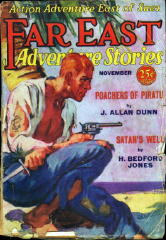
   The cream of the cream was reserved for the first night’s auction, however: a scattered run of Far East Adventure Stories which sold individually for quite remarkable prices, but not to me.

FAR EAST ADVENTURE

   Ah yes, the stuff dreams are made of.

   I’ll be leaving tomorrow morning for my yearly trek to Dayton and this year’s Pulpcon. I’m going to do my best to stay away from computers and email while I’m gone, so if I don’t see you there — and some of you I know I will — so long until about this time next week.

   In the meantime, of interest to some, perhaps, is that the Site Meter count for visitors to this blog is currently at 99,201. Or in other words, some time while I’m gone, the 100,000th person will stop by. I’m sorry I won’t be here when that happens, otherwise there’d be a door prize — flowers, a box of candy, a free subscription, or something.

   If it happens to be you, give yourself a hearty handshake. Congratulations!

THE LONE WOLF RETURNS. Columbia, 1935. Melvyn Douglas, Gail Patrick, Tala Birell, Henry Mollison, Thurston Hall, Raymond Walburn, Douglass Dumbrille. Based on the novel by Louis Joseph Vance (Dutton, 1923). Directed by Roy William Neill.

THE LONE WOLF RETURNS

   I included some background on “The Lone Wolf” as a character in this earlier post, so I won’t repeat it here. Suffice it to say that I’ve watched the two movies in the wrong order, since The Lone Wolf in Paris, the previously reviewed film, came out three years later, and starred Francis Lederer, not Melvyn Douglas, as Michael Lanyard, the notorious jewel thief.

   Not that there’s any sense of continuity between the two films, as enjoyable as each of them happens to be. I don’t imagine it will spoil anything to say that at the end of The Lone Wolf Returns wedding bells seem to be in the offing, while I don’t remember anything of the sort being referred to in The Lone Wolf in Paris.

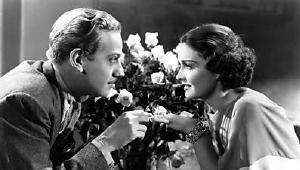
   As it happens, I think that Melvyn Douglas was perfect for the part: suave, debonair, and just the kind of man who would rob wall safes in a top hat and tails. He’s in New York City in this one, or Michael Lanyard is, and not his usual European stomping ground

THE LONE WOLF RETURNS

   And when he meets beautiful society girl Marcia Stewart, played by beautiful Gail Patrick, he decides at once that that’s it, his days of criminal activity are over, much to the consternation of Jenkins, his devoted valet and primary assistant in thievery, played to great comedic effect by Raymond Walburn.

   Gail Patrick, by the way, dropped out of movie roles in the late 1940s, only to become the executive producer for (I think) the entire run of the Raymond Burr “Perry Mason” television series in the mid-1950s.

THE LONE WOLF RETURNS

   Getting back to the Lone Wolf, though, another gang of jewel robbers is not pleased to see Lanyard anywhere in the vicinity of their next job – and you get only one guess as to whose emeralds they plan to steal – and implicating him for the theft fits very nicely into their plans.

   If you can ignore the funny stuff – other than the top man in command, most cops that you find in 1930s mystery movies are funny, and so are the underling henchmen, always – I think you will find this movie as entertaining as I did. (And even some of the funny stuff is funny.)

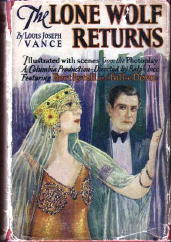
   There was an earlier version of the movie, a 1926 silent film also based on the book by Louis Joseph Vance, and starring Bert Lytell and Billie Dove in the two leading roles. You can make out their likenesses on the cover of the book shown above, a Grosset & Dunlap photoplay edition.

« Previous PageNext Page »