SPIDER-WOMAN #3. Marvel Comics, June 1978. Writer: Marv Wolfman. Pencils: Carmine Infantino. Inker: Tony DeZugina. Cover: Not credited. Reprinted in Essential Spider-Woman #1 (Marvel, 2005)

   As I understand the story, Marvel Comics’ Spider-Woman came into existence for one reason: to make sure no other comic book company would come along and steal the name. Her first appearance was in Marvel Spotlight #32 (February 1977). This one shot appearance was successful enough — perhaps surprisingly so — that they gave her her own magazine, the first issue of which was in April 1978. There were 50 issues in all.

   At this stage of her existence — there have been several other Marvel characters also named Spider-Woman — she was named Jessica Drew, and her superhuman powers came from “…her mother being struck with a beam of radiation containing the DNA of several different types of spiders while she was in-utero.” [Quote from her Wikipedia page.]

   Not having issues #1 and 2 handy when I read #3, I did not know any of this, but did it matter? Not all that much. She seems to be wandering around trying to find herself in this one, accompanied by a Merlin-like sorcerer who shows her the grave of her father, who was mysteriously killed several months before.

   Trying to hunt to down the killer, Jessica’s path crosses that of a super-villain who calls himself Brother Grimm, who first appears at a theater where the play being performed is Hansel and Gretel. Things get suitably complicated from there, including some foreshadowing that there may be more than the one villain called Brother Grimm.

   The story doesn’t stop with just this one issue, in other words, and if I had the next one, I’d want to read it right away. Marv Wolfman does a good job melding at least two, maybe three, story lines together. I’ve always thought that Carmine Infantino’s characters were too angular looking, but inker Tony DeZugina, a favorite of mine, does well in softening them up a lot.
  DONALD WOLLHEIM, Editor, with Arthur W. Saha – The 1989 Annual World’s Best SF. Daw #783, paperback original; 1st printing, June 1989. Cover art by Jim Burns.

   #6. KRISTINE KATHRYN RUSCH “Skin Deep.” Short story. First published in Amazing Stories, January 1988. First collected in Stories for an Enchanted Afternoon (Golden Gryphon Press, hardcover, 2001).

   Although she seems to have slowed down somewhat over the last couple of years, Kristine Kathryn Rusch has been one of the most prolific science fiction and fantasy writers over the past 20 years, producing dozens if not over a hundred novels and short stories over that period of time. Not only that, but she was the editor of The Magazine of Fantasy and Science Fiction between July 1991 and May 1997.

   She wrote “Skin Deep” long before any of this, however. It was only her third published story, way back in 1988, and it’s a good one. It’s both a subtle and yet very perceptive story about a young man whose lineage is native to a planet that colonists from Earth have landed and are slowly taking over, as colonists from Earth always have a tendency to do, even though they are the “aliens” on the planet.

   He can pass for human for a time, but when that time is up, which happens regularly after a period of so many years, he must leave where he’s been living and go into hiding, perhaps to find others such as himself. This time, however, the adopted daughter of the family he’s been staying with is about to undergo the same Change in her life as well: note the title of the story. Should he go, or should he stay and help her?

   This is a solidly built story, both structured and told well. A future for this young author was easy to see.

       —

Previously from the Wollheim anthology: IAN WATSON “The Flies of Memory.”

REVIEWED BY DAN STUMPF:         


WILLIAM O’FARRELL – Gypsy, Go Home. Gold Medal s1175, paperback original, December 1961. Cover art by Barye Phillips

   Nothing to see here, folks. Just a tightly-written and forgettable tale of murder and detection, with a great cover. In other words, a typical Gold Medal of its time. Move along now.

   Author William O’Farrell debuted with Repeat Performance in 1942, and over the next twenty years he turned out about a dozen books, until his death in 1962 (none afterwards) with occasional forays into television writing for Perry Mason and Alfred Hitchcock Presents. It’s perhaps this last that provided background for Gypsy, Go Home and its milieu of small-screen scribes, producers and wanna-bes — and murder.

   The lady on the cover is Gypsy O’Brien: loud, grasping, crudely manipulative and usually drunk. I went out with a girl like that in college, but after a couple of dates she dumped me. And after a couple of chapters, Gypsy puts the squeeze on a no-talent writer trying to lever himself into a job on a TV show, and ends up the subject of a murder investigation.

   O’Farrell does a competent if unremarkable job of setting up two protagonists: Ken Morse, a television writer with a proven track record, lined up for a job on new series, and Alan Procter, the guy on the cover playing “guess what I got for you” with a poker. When Alan kills Gypsy and (mostly) covers his tracks, he decides the best way to get Ken’s job is to frame him for murder – even if the frame slips, it’ll muddy Ken’s reputation, and besides, Ken’s ex-girlfriend happens to be the daughter of the show’s creator, so if he can insinuate himself with her….

   About this time I started seeing similarities between this and the book (not the movie) In a Lonely Place, by Dorothy B. Hughes, which also featured a murderous would-be writer. But where Hughes focused on her deadly dramatist, O’Farrell skips nimbly between his rivals in love and television, with frequent stops in between to sketch out the characters of Gypsy’s complaisant cuckold husband, her confused nine-year-old daughter, and a smart cop who realizes the case goes considerably deeper than Gypsy’s shallow grave.

   If anything lifts Gypsy, Go Home out of the ordinary — and I’m not sure it does — it’s the Police, refusing to act according to type by arresting Ken and needlessly prolonging the action. Instead, O’Farrell keeps the story moving fast and in a straight line to a pat solution. In all, there’s nothing very memorable here, except as a relic of the kind of light, compact and easily-enjoyable book they just don’t make anymore.

 MARTIN H. GREENBERG, Editor – Deadly Doings. Ivy, paperback original; 1st printing, 1989.

   #1. IRA LEVIN “Sylvia.” Short story. First appeared in Manhunt, April 1955. Reprinted in Giant Manhunt #6, 1955 (variation #1). Adapted for TV: Alfred Hitchcock Presents, 19 January 1958 (Season 3, episode 16).

   The name Ira Levin probably needs no introduction to readers pf his blog, but just in case, I’ll jog your memory: A Kiss Before Dying, Rosemary’s Baby, The Boys from Brazil, and others. This was, however, the only story he had published for the crime fiction magazines.

   In it wealthy businessman Lewis Melton, being ultra-protective of his daughter’s well-being, has already broken up her marriage to a fortune hunter named Lyle Waterman. When he intercepts a letter from Waterman to his still despondent daughter, he realizes that the stakes have suddenly risen a whole lot higher.

   But when he finds a gun in his daughter’s bedroom, he realizes that Waterman has to be warned. But pf course the story doesn’t end here, making at a natural to be picked up a few years later by the Alfred Hitchcock TV show.

   The story’s a good one, but if I’ve read the synopsis of the TV version correctly, they made some changes and I think they messed it up. I will have to watch it some time before I can tell you for sure.

            —

   I’m currently working my way through three different SF magazines and best-of-year anthologies, story by story. Since this is nominally a mystery-oriented blog, I’ve decided to do the same with this particular anthology. There’s no theme behind the stories chosen, only that they are, acceding to the introduction, both “finely crafted and entertaining.”

REVIEWED BY BARRY GARDNER:


DON WINSLOW – A Long Walk Up the Water Slide. Neal Carey #4. St. Martin’s Press, hardcover, 1994; paperback, 1998.\\

   I liked the first, why nor check out the fourth? NO reason I could think of.

   There’s no such thing as a typical job for Friends of the Family, but Carey thinks this one is a bit much. He and his lady-love Karen (evidently acquired in an intervening book) are supposed to make a silk purse out of a sow’s ear.

   A woman who has accused a TV personality/network owner of rape is a bit rough around the edges, and a man who is trying to take over the network wants the edges smoothed for sake of credibility. So off they go to a small town in Nevada to start sanding.

   It’s not that simple, of course; there’s a monster involved, and someone has hired a ht man, and there’s an ex-FBI agent and an alcoholic private detective, and they’re all revolving around Neal, Karen, and the lady with the rough edges.

   This was a different sort of book than the first Winslow I read. I wouldn’t say it’s not serious, at least not exactly, but at times that story did seem almost farcical, with everyone moving around frantically à la Mad, Mad, Mad World.

   The smooth, easy voice was still there, but the dissonance between this book and the earlier one bothered me. I didn’t like it nearly so well, and the problem was definitely in the type of story it was. I was eager to read it after reading the first one, but I don’t think I’ll be nearly so avid for the next.

— Reprinted from Ah Sweet Mysteries #18, February-March 1995.

  LESTER del REY, Editor – Best Science Fiction Stories of the Year: Second Annual Edition. E. P. Dutton, hardcover. 1973. Ace, paperback, December 1975.

   #8. DONALD NOAKES “The Long Silence.” First appeared in Analog SF, March 1972. Not reprinted elsewhere.

   This one’s a puzzler. Not only was this story never published anywhere else, but this is the only SF or fantasy story that the author ever had published. What’s worse is that I don’t think the story’s very good.

   The time is sometime in the near future (probably on Earth, but the locale is not entirely clear). The early 70s must have been still in the transistor radio era since this is one of the ideas transported to as I say, a very near future. A technique that protestors (to what is not entirely clear) have found effective to have everyone wear transistor radios around their necks and turn them up to the highest possible volume.

   The resulting din would deafen anyone. The solution found by the police? Use a newly invented machine that at the flip of a switch cuts off all sound altogether. The result? Quoting the last two lines [PLOT WARNING] “Without noise they have to think. If they are forced to think for too long they go mad.”

   In spite of this being a fairly minor effort, those last two lines do make you stop and think, though, don’t they?

          —

Previously from the del Rey anthology: ROBERT L. DAVIS “Teratohippus.”

REVIEWED BY WALTER ALBERT:


WHILE THE PATIENT SLEPT. Warner Brothers, 1935. Aline MacMahon (Sarah Keate), Guy Kibbee (Lance O’Leary), Lyle Talbot, Patricia Ellis, Allen Jenkins, Robert Barrat. Based on the novel by MIgnon G. Eberhart. Director: Ray Enright.

   Nurse Sarah Keate is brought to a gloomy mansion on a stormy nighth to care for a comatose patient while the family gathers vulture-like for the death-bed wait. A murder, accusation, Guy Kibbee as the amiable detective, and a confusing and not very convincing plot.

   Of interest for the pairing of MacMagon and Kibbee on what was probably an attempt to match the chemistry of the successful RKO Edna May Oliver/James Gleason pairing as Hildegarde Withers and Inspector Oscar Piper. MacMahon isn’t given much to do and aside from some arch exchanges between her and Kibbee, the movie doesn’t generate much chemistry.

   They were also probably trying to continue the more successful pairing of the two stars in Big-Hearted Hobart and Babbitt, both released in 1934. I saw these two films, or parts of them, recently. They’re light-weight romantic comedy-dramas worth watching for the expert acting of the cast. And Babbitt is as far from Sinclair Lewis as you can get.)

— Reprinted from Walter’s Place #106, March 1995.


REVIEWED BY DAVID VINEYARD:


JUDSON P. PHILIPS “Men About to Die.” Novella. Park Avenue Hunt Club #11. First published in Detective Fiction Weekly, February 2, 1935. Never reprinted. See comments #’s 1 and 2 for reprint information.

   Running in the pages of Detective Fiction Weekly, where it vied for readers’ attention with the likes of Erle Stanley Gardner’s Lester Leith, Richard Sale’s Daffy Dill, and Carroll John Daly’s Satan Hall, the popular Park Avenue Hunt Club was an American version of Edgar Wallace’s Just Men, a team of vigilantes battling crime in the age of the Depression, gangsters. John Dillinger, and Bonny and Clyde.

   Product of a lawless age, this secret organization had sprung up suddenly to stand squarely in the path of the criminal. Gangsters and racketeers found themselves confronted by a foe who dealt out death for death, brutality for brutality. The underworld … found themselves prey to the Hunt Club which moved swiftly, secretly, and relentlessly.

   The Club members were handsome former secret agent Geoffrey Saville; big game hunter and red haired giant John Jericho; and chess master and medical student Arthur Hallam, who, their identities known only to Inspector James Emory Doane NYPD, wage a violent and bloody war on the underworld of New York.

   Pretty standard pulp stuff it sounds and it was, but behind the name Judson P. Philips was Hugh Pentecost, one of the longest lived writers to emerge from the pulps and who, like relatively few others, had a healthy critically successful career as a mid-list author under his own name and as Philips, and whose many series included the popular hotel manager Pierre Chambrun and freelance journalist Peter Styles series as well as one featuring John Jericho, an artist who shares with the Hunt Club Jericho mostly only his size and red hair.

   Like most of the writers who survived the pulps and thrived, Pentecost not only outgrew his origins, he expanded his horizons so that the Peter Styles books had a serious social conscience tackling major issues of the day, while Jericho’s adventures featured a deeply humanitarian sleuth often rescuing victims of society. Save for retaining a gift for plot, suspense, and action they and Chambrun are a far cry from the bloodthirsty Park Avenue Hunt Club.

   The dangerous Dzamba brothers, Leonardo, Salvatore, and Vincente (no, they aren’t mutant ninja turtles) are on trial in a case brought by none other than Inspector Doane and prosecutor John Crowther, and a witness has warned Doane that the Dzambas plan a spectacular escape during the trial, so he calls on Saville, Jericho, and Hallam to be present when the bloodshed begins. The Club has a history with the Dzambas, Jericho himself having killed brother Angelo with his bare hands.

   And sure enough something goes wrong, the judge is murdered in chambers, four policeman are killed in a bloody shootoutmand the Dzambas are on the loose. The Park Avenue Hunt Club is on the prowl, turning to a crooked former cop who helped the Dzamba brothers in the past but Salvatore gets to him before the boys can.

   With the Dzambas out for revenge, and even their own lawyer murdered by them, the one target left is prosecutor Crowther, who lives in the country with his young wife. Local yokels can hardly be expected to protect him, so it looks like a job for the boys.

   No detection here, it’s mostly an action piece closer to the hero pulps and they’re figures of justice than sleuths, but it is satisfyingly fast paced, and despite a plethora of characters in a relatively short piece. it works well enough.

   This is a single contained story, though some of the Park Avenue tales were serials and likely a bit less rushed, if still as plot and action heavy. You can see why this series was popular and featured so often on covers of the magazine. It’s pure pulp, full of movement, setbacks, and a big finale with the three heroes once again emerging triumphant in their secret war against crime, and in a relatively few years Pentecost would be moving on to a long successful career.

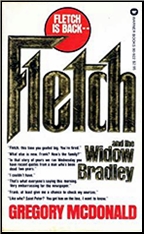
GREGORY MCDONALD – Fletch and the Widow Bradley. Fletch #4. Warner, paperback original, 1981.

   Taking a rather unusual marketing approach for a mystery paperback original, Warner has apparent;y tried to promote the book as a potential bestseller. When it first came out, B. Dalton had copies set up in a huge floor display at the front of the store, for example, and the title is embossed on the front cover with big gold lettering.

   There is a price tag to match. For your money [$2.95 rather than the usual going rate of $2.25 or $2.50], you get nearly 300 pages of big print on cheap paper, and yards and yards of crackling good dialogue, in Mcdonald’s customary laid-back style.

   For those of you who have come in late, Fletch is a reporter by profession, and with his usual casual approach to living come the inevitable jams he keeps finding himself getting into. This time around he ends up getting fired — in working on his latest story he somehow manages to quote a man who’s been dead for quite some time. He also finds a wallet with $25,000 in it. For some reason the owner does not want to be found.

   Fletch is also an idealist of sorts, a world-saver with bare feet. He is also a surprisingly bit naive. Even after he has almost worked out the truth behind the dead man’s strange demise, he still has to have it explained to him. Personally, I knew what was going on (although not necessarily why) from about 200 pages earlier on.

   Incidentally, and this probably doesn’t mean anything, but either Mcdonald or Warner Books seem to have a weird way of spelling certain words. Not once, but consistently.

–Reprinted in slightly revised form from The MYSTERY FANcier, Vol. 6, No. 1, Jan-Feb 1982.
REVIEWED BY DAN STUMPF:         


ROBBERY UNDER ARMS. Rank, British/Australian, 1957. Peter Finch, Ronald Lewis, David McCallum, Maureen Swanson, Jill Ireland, and Laurence Naismith. Screenplay by Alexander Baron, W.P. Lipscomb and Richard Mason, from the novel by Rolf Boldrewood. Directed by Jack Lee.

   From the title, I assumed this was a British crime film, which only flaunts my ignorance. Turns out Robbery Under Arms is a well-known tale of Aussie outlaws (called Bushrangers) set in the 1860s, the basis of four films before this (the first in 1907) and one in 1985.

   This one turned out rather well. I’m not sure why Peter Finch got top billing, since Ronald Lewis and David McCallum carry the weight of the story and the bulk of the screen time, but he does, and they do — quite effectively, as two outback lads who decide to help out their dad (Laurence Naismith) with a spot of cattle rustling in the employ of Captain Starlight (Finch), a sort of down-under Jesse James with a penchant for robbery and a sense of loyalty that doesn’t stop at murder.

   â€œMurder” I sez and Murder is what we see here. Robbery has the look and feel of an American Western, replete with cattle rustling, gold-mining, bank robberies and horseback pursuits. But when it comes down to shooting and folks get shot down, it’s usually from ambush, at a distance, and more like the stark, stupid violence of Bonnie & Clyde than the measured mayhem of Red River and Shane.

   The plot line here is enjoyably pointless. Having committed the greatest cattle-rustle in history, our boys find themselves wanted men, and learn that life on the run is harsh and lonely. They change their names, find honest work and stick to it, only to discover that the World’s smallest continent isn’t big enough to hide in.

   David McCallum is particularly good at this, his slender frame and big blue eyes conveying a haggard longing for the decent life. Ronald Lewis is equally fine as his tougher brother, yearning for the elusive Clean Slate, both men matched up with Maureen Swanson and Jill Ireland as the women they dream of sharing a life with.

   As for Peter Finch, well he’s dashing enough as the legendary bushranger, but frankly he doesn’t have much to do except dash across the Outback and look legendary. Fortunately, Robbery Under Arms has enough going on — and the supporting players carry enough conviction — to do quite nicely without him.


« Previous PageNext Page »