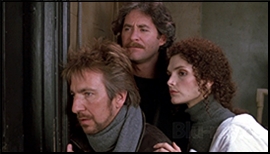
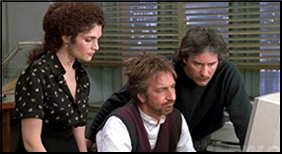
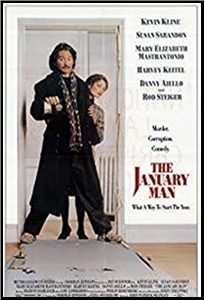
THE JANUARY MAN. MGM, 1989. Kevin Kline, Mary Elizabeth Mastrantonio, Susan Sarandon, Hervey Keitel, Danny Aiello, Rod Steiger, Alan Rickman. Written by John Patrick Shanley. Directed by Pat O’Connor.
You have been unjustly fired from a job you did well, and now your ex-employers, faced with a crisis only You can handle, come crawling to ask you back. Along the way they almost interrupt you in a casual act of heroism, but you take the job, whereupon the Red Carpet is rolled out, you meet a sexy young girl who falls madly in love with you, your ex-girlfriend suddenly wants you back, and everybody who ever talked nasty to you is now at your beck and call.
And wouldn’t it be great if they all brought Chocolate?
Well, I suppose there are worse male fantasies, and although The January Man is neither as suspenseful as it should be nor as amusing as it could be, it still deserves some credit for realizing its limited aspirations in a light-hearted and relatively non-violent way. In fact, for a movie about a serial killer of women, it’s surprisingly un-sadistic in concept and execution (no pun intended — honest.)
The January Man also offers some decent thespic opportunities to its performers, who try not to look too surprised at getting them. Kevin Kline is engagingly off-beat as the Cop-turned-Fireman Hero called back to solve the Calendar Girl Murders; Danny Aiello and Rod Steiger are appropriately choleric as his superiors, and Susan Sarandon purveys her own brand of predatory sexuality as Kline’s ex-sweetie. Best of all is Alan Rickman, looking more than ever like a young Vincent Price, as the Maynard Krebbs to Kline’s love-happy Dobie Gillis.
Two things I noticed about this on repeated viewing:
First, perhaps because of budget and scheduling restrictions, the big stars in this are seldom on screen at the same time, even when they have scenes together. Director Pat O’Connor keeps shooting important confrontations with his camera on one actor, looking over the back of (probably) a double: A shouting match between Aiello and Steiger, an emotional moment between Kline and the woman who sold him out (Sarandon) and a particularly sticky encounter between Sarandon and Kline’s new love (Mastrantonio) in his apartment — all done with stand-ins, but emoted quite well.
Secondly, I’m not sure quite what effect the movie was trying for with the( literally) knock-down-drag-out fight at the end, a mix of brutal action and bemused commentary, but it worked for me. In a movie era of obsessed cops and loathsome killers, it was refreshing to see things capped off with an exciting but light-hearted set-to, and I’m glad someone thought of it.
JEREMIAH HEALY – Rescue. John Francis Cuddy #10. Pocket, hardcover, 1995; paperback, 1996.
Jerry Healy, besides being a hell of a nice guy (I played poker with him at the Seattle Bouchercon), is one of the group of “modern” PI writers I like the most. As with most of that group, however, I haven’t enjoyed his last few books as much as I have the earlier ones.
It all starts with Cuddy being a good Samaritan, stopping to help a young woman change a flat. She is defiant and obviously scared, as is her companion a 10-year-old buy with a disfiguring birthmark. Finding that Cuddy is a PI, the boy asks him if he would ever find him if he were ever lost, and Cuddy assures him that he would.
The next day he reads that the woman’s body has been found, but there is no mention of the boy. Cuddy made a promise in Viet Nam once that he was unable to keep, and that he has never been able to forget. He intends to keep this one. It leads him to the other end of the country and to a religious group, and to violence he didn’t anticipate.
Healy is writing a different kind of PI novel than I remember his first few being, though my memory may be at fault. His tales have trended more and more toward the action-adventure, with Cuddy going mano a mano with the bad guys and not being averse to taking the law into his own hands, a la Spenser.
Not that Healy’s plots have ever descended to the idiocy that Parker’s did for a while, mind you, but still. I think that Healy is an enormously talented writer, and I haven’t read a book of his I didn’t enjoy. His pacing is excellent, his prose smooth as silk, and his characters well drawn. Cuddy himself is one of today’s more likable and believable of the “growing” PI’s. I don’t like “cowboy” stories as well as I do the more traditional kid, but Healy does what he does very well indeed.
— Reprinted from Ah Sweet Mysteries #16, November 1994.
The John Francis Cuddy series —
1. Blunt Darts (1984)
2. The Staked Goat (1986)
3. So Like Sleep (1987)
4. Swan Dive (1988)
5. Yesterday’s News (1989)
6. Right To Die (1991)
7. Shallow Graves (1992)
8. Foursome (1993)
9. Act Of God (1994)
10. Rescue (1995)
11. Invasion Of Privacy (1996)
12. The Only Good Lawyer (1998)
13. Spiral (1999)
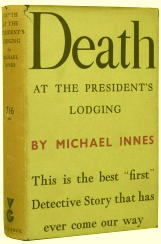
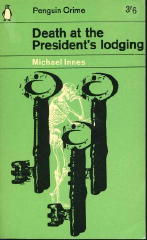
MICHAEL INNES – Seven Suspects. Berkley F1158, paperback reprint, November 1965. US hardcover edition: Dodd Mead, 1937. First published in the UK as Death at the President’s Lodging, Victor Gollancz, hardcover, 1936. [Other US paperback editions include: Dolphin, 1962; Penguin, 1984.]
Without a doubt, in terms of intelligence and general all-around erudition, Michael Innes has to be ranked in the top five mystery writers of all time. (I don’t know how you’d put this to a test, but I can think of only a handful I might start comparing him to, and the funny thing is, they’re all English.)
In the beginning, though, he seems to have been too intellectual for his own good. Seven Suspects was his first mystery novel, and in spite of the great start and the fine setup, to get through the middle portion of the book involves some very tough slogging, to use the vernacular, at least by contemporary standards.
The great start? Well, it’s not quite a locked room mystery, but it’s the next best thing. And speaking of which, what this (Berkley) edition of the novel needs, more than anything else, is a map, a map of St. Anthony’s College, where the President is found shot to death in his Lodging, with gardens and walls and locked doors all around, and only a limited number of keys with which to open them.
There could hardly be a greater contrast between the two officers of the law involved, deliberately so. The local copper is the prosaic Inspector Dodd, far more comfortable with tracking down a gang of burglars than a shrewd and wily killer who leaves a puzzling trail of enigmatic clues behind.
On the other hand, the nimble-witted Inspector John Appleby, sent down quickly by Scotland Yard, is perfect for dealing with the retinue of eccentric academics who never seem to speak before thinking twice (or thrice) about the implications of what they are about to utter.
Being a native Midwesterner by birth, American style, I have to confess that some of the doings in the aforementioned middle portion of the book, carried out by a small company of carefree undergraduates of the college, were intended to be funny, but not to me. To the average Londoner at the time, they probably were — and maybe even hilarious. (It took me a chapter or two of such antics, but I did finally get into the spirit of things.)
What is also true, as I came to realize toward the end of the book, is that not a single female appears who has a speaking part, and only one who’s in the book at all has more than a servant’s role. (In all truthfulness, it took Innes’s own observation of this patricluar fact for me to notice. Sometimes I really am slow.)
And so, this combination of dry academic humor and a decidedly noticeable lack of authorial interest in Appleby the person — that is to say his personal life, his worries and concerns — it all makes this Golden Age gem far out of the mainstream of the mystery world today.
But gem it is. There are some flaws — it’s a wholly artificial staging, of course — but the comings and goings the night of the murder, who did what when, and who saw what and who didn’t, whose voice that was, and whose it wasn’t, it’s a eye-popper and a mind-blower, and my head is still spinning.
A gem that needs some polishing, then, but for an academic exercise in the pure pleasure of plotting, very very few of the thousands of mysteries ever published come even close to topping this one.
— August 2002, slightly revised
NOTE: I started reading this book last night and got through the first chapter and part of the second before saying to myself, “this story is awfully familiar. I think I’ve read it before.”
I did some checking, and yes, not only had I read it before, I’d written a review of it and eventually posted that review on this blog. This is a re-run, in other words, perhaps the only the second time I’ve done so. The original post was almost ten years ago, so if you remember it, your memory is obviously a lot better than mine.
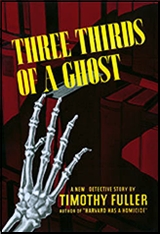
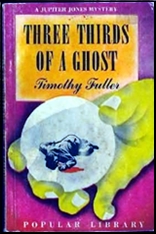
TIMOTHY FULLER – Three Thirds of a Ghost. Jupiter Jones #2. Little Brown, hardcover, January 1941. Popular Library #81, paperback, no date stated. [1946].
There is a word game called Ghosts from which the title is derived, but I’m afraid I wasn’t paying close enough attention to the book to tell you how. (Mystery writer Helen McCloy wrote a book called Two-Thirds of a Ghost which as I recall explained the connection to the story a whole lot better, but it’s been 50 years or so since I read that one, and I don’t even remember what I had for breakfast that day.)
This is the second mystery to e solved by a fellow named Jupiter Jones. (His real first name was mentioned once, but I neglected to jot it down. To me this was important only to know his parents didn’t really name him Jupiter.) In the first book, Harvard Has a Homicide, Jupiter was a grad student at Harvard. In this second one he has moved up the academic ladder to the position of Instructor in the Fine Arts Department at the same school.
But he’s also got a nose for solving mysteries, and the basic one in this one is a good one. An author known for the mysteries he writes has also been dabbling in romans clef — his latest is said to be based on the members of a well-to-do real life family in the Boston area — and when the author is killed, shot to dead while speaking in front of a crowd of people at a long-established, not to mention prestigious, bookstore, no one is really surprised.
What is surprising is that the shot came from the back of the room, and not one person saw who fired the gun. Not exactly a locked room mystery, but an impossible crime? Yes.
The dead man’s Chinese secretary gets third billing as one of sleuths who tackle the case, but the focus is mostly on Jupiter Jones and his girl friend, the charming Betty Mahan. All of the of the other characters have their place in the story, but none of them distinguish themselves enough from the others for their names to stick in the readers’ minds as to who is who.
A typical early 40s puzzle mystery, in other words. It’s told in a lighthearted way that’s fun to read, and not only that, every once in a while the characters sit down together to chat about the allure of mystery novels and why readers want to read them.
If this sounds like your kind of detective novel, then it is. It was mine.
The Jupiter Jones series —
Harvard Has a Homicide. 1936
Three Thirds of a Ghost. 1941
Reunion with Murder. 1941
This Is Murder, Mr. Jones. 1943
Keep Cool, Mr. Jones. 1950
JACK FINNEY – The Body Snatchers. Dell First Edition #42, paperback original, 1955. First serialized in Collier’s, November 26 – December 24, 1954. Reprinted many times. Adapted into film four times: (1) as Invasion of the Body Snatchers (1956; Kevin McCarthy; directed by Don Siegel). (2) as Invasion of the Body Snatchers (1974; Donald Sutherland; directed by PHilip Kaufman). (3) as Body Snatchers (1993; directed by Abel Ferrara). (4) as The Invasion (2007; Daniel Craig).
The basis of a classic movie and many remakes, and a fine novel in its own right: vivid, suspenseful and full of implausibility about which the reader gives no damn.
The story is too well-known to outline here, so I’ll just say Finney does a clever job of starting out small (patients of a small-town Doctor complain that there’s something funny about their friends and family) and building to the kind of edgy action and trickling suspense that made Sci-Fi fun in the old days. He also manages to make a 190-page book about Alien Invasion seem leisurely — but not slow-paced.
But there’s a duality lurking around here, based on an off-hand bit mentioned in passing: Once the Pods have taken a human identity, they begin to lose interest in that person’s daily activities. (Naturally, being Pods, they’re more into spreading pod-dom or selling Amway or whatever.) So gutters need to be cleaned, the trash cans on Main Street don’t get emptied, storefront windows grow dusty, and the whole town takes on an air of seedy neglect.
Well, in 1954, when Finney wrote the book, all this was actually happening: as the Suburb and the Strip Mall began to replace the Small Town, that little icon of Norman Rockwell America became every bit as seamy and run-down as Finney describes. And in a very real sense, The Body Snatchers sings a requiem for the cruel death of a cherished memory. There’s an oddly heart-rending chapter where the hero walks through his town, thinks of what it was and sees what it has become, that should strike home with anyone who grew up in pre-war America (or, like me, in the tawdry shadows of big empty department stores, dusty restaurants and faded movie palaces) and it adds a dimension of compelling nostalgia to an already fine thriller.
The Body Snatchers deserves its rep as a taut thriller, but I shall treasure its melancholy edge long after the plot twists and chase scenes have passed from memory.
ALEXANDER SÖDERBERG – The Andalucian Friend. The Brinkmann Trilogy #1. Crown, US, hardcover, March 2013. Broadway Books, trade paperback, October 2013.
Sophie Brinkermann is a nurse and widowed mother whose life is changed dramatically when she finds herself attracted to Spaniard Hector Guzman, recuperating in a hospital in Stockholm, Sweden from a hit and run accident.
She likes his gentlemanly ways and how he welcomes her into his extended fam0ily, and she doesn’t notice he is being carefully watched by Gunilla Standberg, a policewoman dressed as a Sophia Sister. What Sophie doesn’t know is about to blow up in her face since suave Hector Guzman is the leader of a crime syndicate recovering from a bungled attempt on his life by a rival German gang.
Meanwhile half a world away in Paraguay Jens Vall, a likable arms dealer who knew and loved Sophie when they were younger, is sailing home with his latest shipment with no idea what he is about to step into.
This complex and violent crime tale is yet another in the growing field of Scandinavian Noir, which has been around a while, a natural reaction to the bleak winter landscapes of the region, but of course got a huge boost for American audiences and publishers when Steig Larrson’s Girl With the Dragon Tattoo trilogy took off in print and then on screen.
Söderberg’s trilogy, of which this is the first, has been called the Girl With the Dragon Tattoo meets the Sopranos, but that’s entirely unfair to this twisty tale of crime, cops, betrayal, greed, corruption, and violence across multiple countries in which our heroine proves a human and all to believable victim and survivor.
Allies shift and change position, good cops make mistakes, bad cops kill brutally to cover up their own crimes even when it means turning on their own. Some criminals are noble while most are dangerous sociopaths willing to sell anyone down the river for profit or survival. No ally can be trusted, which is why the simple decency of Sophie and Jens is one of the few bright spots in this brutal and violent novel.
It is also a damn well written novel, told from multiple points of view, good evil and indifferent, with twists and shocking violence at every turn, violence that makes permanent changes in Sophie and her son’s life, and her growing strength and determination to survive and save her son.
Several well drawn characters move through the books including Lars Vinge a sadistic cop whose life is falling apart; Tommy Jansson a police loner whose wife is dying of ALS and who cleans up potential public messes at the point of a very private silenced gun; Aron Geisler, Guzman’s right hand man; Ander’s Ask, who does illegal favors for the police; Ralph Hanke, the head of the German gang; and, Mikhail Asmarov, a Russian mobster cutting in on Hanke’s attempt to cut in on Guzman, plus assorted killers, cops, and drug cartels.
I’ve read the second book in the series, The Other Son, and I can attest it continues Sophie’s growth into someone darker and more dangerous than she could ever have believed with the same skill and style of the first book. I am looking forward to the final book in the trilogy.
That said, the books stand alone, and while I can’t imagine you could read The Andalucian Friend without wanting to know what happens next, it does stand on its own without the sequel. The Other Son is a bit more of a continued piece, but not without tying up most of its loose ends. The cliffhangers it leaves are more soap than survival.
Like the best of this genre the unexpected happens, characters die you think will not, and no one is safe, not even Sophie and Jens, from the spiraling violence as multiple gangs make a play for the Guzman’s territory and death comes from every direction. Söderberg does a fine job of keeping Sophie believably at the crux of criminal and police misdeeds and interests.
Don’t expect Larsson, but this is just as original and just as page turning as hissaga. I hope this one gets the same kind of treatment on the small screen Larsson’s tale earned, it is too big for the big screen to do the story justice.
$500 and a Dream
at the Manhattan County Clerk’s Office:
A Review of Author Kevin Egan’s Latest Courthouse Story
by Gilbert Colon
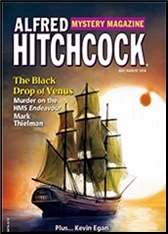
KEVIN EGAN “The Movie Lover.” Alfred Hitchcock Mystery Magazine, July-August 2018.
Kevin Egan returns to the pages of Alfred Hitchcock Mystery Magazine, contributing the eleventh story in his courthouse series, “The Movie Lover.†The July-August 2018 issue, on newsstands now, is devoted to film-themed fiction, so Egan makes his key character Nouri, sighted helper to the blind manager of the court’s lobby concession, an aspiring screenwriter.
The most prominent feature of these tales is the iconic and historic courthouse building at 60 Centre Street, long famous even before being immortalized in the opening credits of the long-running television series Law & Order. Egan has used it as the location for all but one of his Alfred Hitchcock Mystery Magazine stories to date.
The series also features a recurring character, the enigmatic court officer Foxx. While the judges of the New York State Unified Court System balance the scales of justice, Foxx personally keeps them balanced in-house by anonymously operating in the building’s shadowy spaces and corners.
Enlisting Foxx is Ray Dempsey, the crusty concessionaire of the on-site coffee shop serving the public through the New York State Commission for the Blind. Dempsey suspects someone in his employ is embezzling from the register of one of his stations. Foxx intimately knows the lay of the land, making his beat the circular court corridors that lead to the “dark, nameless door[s]†behind which lie secret rooms – or at least forgotten ones – that hold secrets only Foxx seems to know about.
From a high vantage point above the fourth-floor pastry-and-coffee table Nouri tends, eagle-eyed Foxx spies “a quarter view sight line behind Nouri [and] watch[s] the money change hands, then retreat[s] around the back of the circle.†From here he can see “the way the cash is arranged in the till†and observe every transaction unnoticed…
In no time, Nouri becomes the focus of Foxx’s investigation. Nouri’s background as a Middle-Eastern American, along with his housemates’, gives the story the opportunity to present the experience of regular immigrants in the early stages of assimilation, a normalized depiction not unlike that of the more established and even more ordinary Pakistani-American family in the 2016 HBO crime series The Night Of, scripted by crime author Richard Price (Clockers, Freedomland, five episodes of The Wire).
Nouri is also the movie lover of the title, a would-be writer desperate – too desperate – to sell a Hollywood blockbuster script and hit it big. By day he works his job, learning dialogue by hearing everyday customer interactions that “no writing teacher or voice coach†could impart, artistically inspired by the courthouse every time he “walk[ed] up those front steps,†“carv[ing]out…quiet hours [to] write in his notebook†– “the hothouse for all his ideas.†(It bears noting that “The Movie Lover,†and all the stories of the courthouse series, are written by a man who works as a senior settlement coordinator in the same building – these lines could be Egan writing about himself.) By night Nouri types away on his “dilapidated laptop,†“hearing the dialog in his head and visualizing the camera angles with his mind’s eye†as he daydreams about his screenplays becoming “beautiful movie[s].â€
There, in those moments, and also on the terrazzo floor where he crouches in his downtime to scribble his inspirations, he lives inside his head creating, but he is also hopelessly over his head in trouble. The constant presence of production companies shooting big and small screen dramas that use the court interiors and exteriors as a backdrop, the production trailers and huge booms and cameras and film crews and PAs “wearing identical black tee shirts emblazoned with the name of the movie†only fuel what his realist roommate Asif regards as Nouri’s cockeyed delusions. There is a subtle contrast to be made here between the wide-eyed Nouri and his cynical blind boss Dempsey.
Nouri’s innocent dreaming will leave readers dying to know the content of the “beautiful movie[s]†– ten screenplays in total – that he has recklessly sacrificed so much for, but alas the movie scripts remain a mystery, perhaps a casualty of the lean, clean short mystery story format. Perhaps these kinds of short fiction constraints are what led Egan to expand his Alfred Hitchcock Mystery Magazine stories “Midnight†and “A Small Circle†into, respectively, the Centre Street courthouse novels Midnight and A Shattered Circle. The efficient crime narrative delivers the requisite resolution, action, and catharsis by the end, all in one fell swoop. But because Egan never overlooks the emotional notes, there is also bittersweet light and hope in the epilogue, qualities generally in short supply in the dark and jaded world of the crime genre.
Besides being a solid and satisfying piece of crime fiction, “The Movie Lover†is a loving reminder of the glamorous Hollywood history surrounding the New York County Courthouse, storied in more than one sense of the word. Nouri wistfully reminds us of the many movies, some recent and others classic, that have filmed at the celebrated courthouse: “When I walk up those front steps, I see Charlie Sheen climbing to meet his fate at the end of Wall Street. When I wait for the elevator, I gaze up at the same WPA mural that loomed above Matt Damon in The Adjustment Bureau. When I get off the elevator, I pass the courtroom where John Payne proved Edmund Gwenn to be Santa Claus in Miracle on 34th Street.†Of course there are so many others – 12 Angry Men, The Godfather, and Carlito’s Way, to name a few – too many to list, in fact.
In this way, “The Movie Lover†lets its readers appreciate anew the old building and its rich history which court staff, jurors, lawyers, litigants, and the general public take for granted, all through the “dreamy eyes†of Nouri, a starry-eyed romantic who, despite his many flaws, helps us to see it freshly as the thing of wonderment it is.
FIN
Other film-themed stories in Alfred Hitchcock Mystery Magazine’s July/August “Lights! Camera! Murder!†issue, include Robert S. Levinson’s “Nine Years Later†(set during the filming of a Hollywood gangster picture) and Rebecca Cantrell’s “Homework†(a jewelry heist caper involving acting).
* * *
KEVIN EGAN’s latest novel, A Shattered Circle, earned an early Publishers Weekly review hailing it as “his best to date.†He has authored eight novels and numerous short stories, many published in Alfred Hitchcock Mystery Magazine, not to mention an upcoming one in Ellery Queen Mystery Magazine. Visit him at www.kjeganfiction.com.
* * *
GILBERT COLON has written for several print and online publications, including Filmfax, Cinema Retro, Crimespree, Crime Factory, and Strand Mystery Magazine. He is a contributor-at-large for both the St. Martin’s Press newsletter Tor.com and the Alfred Hitchcock Presents-heavy bare•bones e-zine. You may reach him at gcolon777@gmail.com.
ROSS THOMAS – Ah, Treachery! Mysterious Press, hardcover, 1994; paperback, November 1995.
Ross Thomas is one of my desert island authors, and I think one of the finest crime writers of this century, I always look forward to a new book from him, even though I think the quality of his putput has fallen markedly in the last few years.
Edd “Twodees” Partain was an Army Major once, but now he’s a clerk selling guns in Montana. His past catches up with him in the person of a Colonel who appears to tell him that a story is about to break that will dredge up things best forgotten, and he’s fired from his job.
He gets in touch with an old friend in Washington DC, and through him is hired by a big0time fundraiser to find some stolen money. Then his past and present begin to circle each other warily, rattling a whole closetful of skeletons in the process.
I don’t think that Ross Thomas can write a book I won’t like; at least he hasn’t yet. Running on autopilot he is still a better and more interesting writer than 90% of those plying the trade today. Unfortunately for those of us who cherish his classics — The Seersucker Whipsaw, The Fools in Town Are on Our Side, Chinaman’s Chance, etc. — autopilot seems all too close to the mark.
There is still the smooth, patented convoluted plot, and the usual group of slightly off-center. usually amoral characters, but… The books are slimmer than they used to be, and what’s missing is the depth of characterization that was once the strongest part of his novels. The characters here are enjoyable, but I doubt that you’ll find them memorable, and in Thomas’s prime they always were.
I enjoyed it, but I mourn for the Thomas of old. “Snif!”
— Reprinted from Ah Sweet Mysteries #16, November 1994.
THE SANDBAGGERS. ITV/Yorkshire Television. First Series: September 18, 1978 – October 30, 1978; second series: January 28, 1980 – March 3, 1980; third series: June 9, 1980 – July 28, 1980. Created by Ian Mackintosh. Cast: Roy Marsden as Neil Burnside, Ray Lonnen as Willie Caine, Bob Sherman as Jeff Ross, Alan MacNaughtan as Sir Geoffrey Wellingham, Jerome Willis as Matthew Peele. Executive Producer: David Cunliffe. Producer: Michael Ferguson (all episode but one) or Derek Bennett (one episode).
Forgotten today, the British TV spy series THE SANDBAGGERS remains one of television’s greatest spy dramas. THE SANDBAGGERS featured a dark realism style. It was a cynical spy drama that existed during a time when it was difficult to know who the good guys were. THE SANDBAGGERS showed life in the real SIS (MI5) and gave a more truthful look at both sides during the Cold War then they taught us in school.
The series was originally meant to be a temporary fill-in when another planned series for Yorkshire TV fell apart. THE SANDBAGGERS was to last only one series (series is the British term for season) of seven episodes. It would prove popular enough to last two more series and would have made a fourth if not for the mysterious disappearance of creator and probable spy Ian Mackintosh.
In an outline attempting to sell the premise as a TV series Mackintosh described the series primary focus would be “with the triumphs and failures of SIS headquarters, the power-struggles within SIS itself and the uses and abuse of its power vis-à -vis Government policy.â€
It is impossible to think of THE SANDBAGGERS without Ian Mackintosh. Hamish Ian Mackintosh MBE (July 26, 1940 – last known alive July 7, 1979) served in the Royal Navy from 1958-1976 and rose to the rank of Lieutenant Commander. On his retirement from the Royal Navy he was appointed a Member of the Order of the British Empire (MBE).
Mackintosh tried writing while still in the Navy and his first of five thrillers A SLAYING IN SEPTEMBER was published in 1967. All five were failures with critics and readers and our own Mystery*File reviewer Steve, which you can read here.
In 1973 Mackintosh co-created the admired BBC TV series WARSHIP (1973-1977). Ian would go on to create and write WILDE ALLIANCE (ITV 1978), THUNDERCLOUD (ITV 1979) and THE SANDBAGGERS, all three for Yorkshire Television. He also wrote tie-in novels for WARSHIP, WILDE ALLIANCE and THE SANDBAGGERS. One other tie-in novel for THE SANDBAGGERS was THE SANDBAGGER: THINK OF A NUMBER (1980) written by Donald Lancaster (YELLOWTHREAD STREET writer William Marshall). Ian also wrote some non-fiction books many featuring his interest in planes and military history.
While Ian Mackintosh was the creative spirit behind the success of THE SANDBAGGERS others played equally important roles in the series success. David Cunliffe had worked in British television since the 1950s. He first met Mackintosh when both worked on the series WARSHIP and became friends. Cunliffe was the Controller of Drama at Yorkshire Television and worked with Ian on all three YTV series Mackintosh created and wrote. Yorkshire Television was the local Leeds and Yorkshire area ITV affiliate and produced television programs for ITV including such series as HARRY’S GAME, THE MAIN CHANCE and RAFFLES. Cunliffe was in charge of every aspect of THE SANDBAGGERS including final script approval.
Derek Bennett was the director and producer for the first episode filmed (the third episodes aired) IS YOUR JOURNEY REALLY NECESSARY but a disagreement between Bennett and Mackintosh forced Derek to leave. Michael Ferguson would replace Bennett. Cunliffe turned daily production decisions over to Ferguson who as producer and sometime director would remain for the entire run.
Not surprisingly for British TV, at the time the series had a low budget and sometimes it showed. During series one Roy Marsden was the highest paid in the cast making around $1900 an episode.
The soundtrack was a positive aspect of the series. It did not have one (with rare exceptions). Often such absence of music (not unusual for early British TV) can make scenes seem awkward or slow paced, but it worked to this realistic drama’s advantage. TV and film spies are known for great theme songs and THE SANDBAGGERS has one of the best, written by Roy Budd (GET CARTER).
Roy Marsden (P.J. JAMES’ ADAM DALGLIESH CHRONICLES) was the perfect fit and first choice to play Neil Burnside — the ruthless, arrogant Director of Operations. Marsden modeled his portrayal of Burnside on his observations of Mackintosh. It was a good choice as Marsden gave Burnside a depth and allowed the audience to still root for and respect the at times unlikable character.
Burnside had two advantages in running the SIS operations. His first was based on the very real special relationship the SIS had with the CIA. The CIA respected the opinions of the SIS and thus shared information with the small British agency that it shared with no other country or agency. This gave Burnside information others did not have.
Head of London Station for the CIA was Jeff Ross. Ross and Burnside worked well together and respected each other but that did not stop both from using the other when it was in the best interest of their agency.
The second advantage was more personal. Burnside was the ex-son-in-law and still a friend of the Foreign and Commonwealth Secretary Godfrey Wellingham who in the government chain of command was above both of Burnside’s bosses Director – General or “C,†and the Deputy Director of SIS. Wellingham had hopes Burnside and his daughter would reunite but also realized Neil had chosen his work over his marriage.
The first “C†of the series was Sir James Greenley, whose lack of spy experience left him naive at times about the reality of the world of SIS. Burnside would grow to respect him. Greenley trusted Neal’s judgment and experience even if he was horrified by the immorality of their actions. Greenley would retire due to health problems and was replaced by John Tower Gibbs, a long time opponent of Burnside.
The Deputy Director was Matthew Peele who served in intelligence during WWII, ambitious, clueless, and someone Burnside usually found easy to manipulate.
The confident and determined Burnside often went over the heads of his SIS bosses to use his ex-father-in-law influence, and he had no problem lying to all of them if it suited his vision of what was right and how to handle the problem.
The gratuitous sex, over the top violence, and absurdly complicated gadgets of James Bond was fiction in this world. This was a world where work in the field could be dull but was always dangerous. The turnover of Special Agents (field agents at SIS) was high during the series.
Due to the SIS small budget Burnside had only one to three Special Agents at a time. It takes a special person to become a SIS Special Agent, these were the agents who were assigned the dirty jobs no one else wanted or could handle.
Head of Special Section (Sandbagger One) was Willie Caine, a womanizing, working-class, ex-military with a strong moral code. Willie and Burnside respected each other but also had major disagreements over Burnside’s methods. Ray Lonnen (HARRY’S GAME, YELLOWTHREAD STREET) was able to make spy Willie Caine a sympathetic human living a life of loneliness but surviving because of his pride in his work.
The series featured believable characters, realistic dialog and plots that were cynical with dramatic twists that can sometime still surprise forty years later. The focus was less on the Russians and more on the self-interest power plays among the British government and its allies.
“Special Relationship” was the scheduled final episode for this fill-in TV series. It is arguably the best episode of the series and certainly the most important. The cast strongly objected to the story’s ending. However, the critics and public’s reaction lead Yorkshire TV to approve THE SANDBAGGERS for another series of six episodes. Shortly after that Yorkshire added seven more episodes and two weeks of location shooting at the luxurious Malta.
Roy Marsden commented on the reaction to the episode, saying, “When “Special Relationship” was shown, the response all over the country was staggering. Every radio program was taking about what had happened.â€
“Special Relationship” (October 30, 1978) Written by Ian Mackintosh. Directed by Michael Ferguson. Additional Cast: Diane Keen as Laura Dickens and Richard Vernon as Sir Greenley. *** Burnside and agent Laura Dickens have fallen in love. During an assignment in East Germany Laura is captured. Burnside searches for a possible prisoner in Allies hands to exchange for Laura. He finds one but there is a price.
Due to a labor strike that forced Yorkshire and ITV off the air for two months and the disappearance of Mackintosh, it would be fourteen months after the first series aired that THE SANDBAGGERS returned to the air. It had been decided to split the thirteen episodes up into two series. The second series aired six episodes from January 28 to March 3, 1980. The final seven episode third series aired from June 9 to July 28, 1980.
It was July 1979, six episodes for the second series had been filmed and Mackintosh had finished the scripts for all of the rest of the scheduled episodes but three. This is when the cast and crew headed off for two weeks of on location filming in Malta. David Cunliffe remained behind to run his other series for Yorkshire. Producer Michael Ferguson remained in London dealing with production work.
Ian decided to take a break. Mackintosh loved to travel, as did his girl friend of over two years Susan Insole. Mackintosh’s family and friends were used to him disappearing for a while and then suddenly reappearing. For this trip they had invited an old friend of Mackintosh British Airways pilot Graham Barber.
The trip would take them to the United States mainland and then to Hawaii and finally back to London by Alaska. They were flying over the Gulf of Alaska, an area of beautiful sights and an area of intense interest of both sides during the Cold War. The weather was clear and the waters calm when Graham Barber radioed an emergency call for help, “We are going down in the sea. I’m going to make for the very, very, small island just to the east of Shuyak Island.â€
The plane, a Rallye 235, and its three passengers were never found.
A lack of proof of death and Mackintosh’s long habit of disappearing and returning without warning put everything on an awkward hold. Reportedly the American state department held meetings discussing the possibility Mackintosh had defected to the Russian. Even today Ian’s brother Lawrie does not believe Ian died in the plane crash.
Series Two began with a less confident Neil Burnside who was more protective of his Special Agents. Below is the sixth and final episode of the second series and is a good sample of the characters and how Mackintosh’s SIS worked.
“Operation Kingmaker.” (March 3, 1980) Written by Ian Mackinston. Directed by Alan Grint. Additional Cast: Dennis Burgess as John Tower Gibbs and Elizabeth Bennett as Diana Lawler/ *** Burnside learns an enemy from his past John Gibbs may become the new “C.†Neil attempts to maneuver the system to install a boss he can control. His desperate choice is the ambitious idiot Matthew Peele, current Deputy Director.
Eventually Cunliffe could no longer wait for Ian’s return and with three episodes left that needed to be written, Cunliffe hired two writers to write the needed episodes. Gidley Wheeler (WARSHIP) wrote two episodes, MY NAME IS ANNA WISEMAN and WHO NEEDS ENEMIES. Arden Winch (WINGS) did SOMETIMES WE PLAY DIRTY TOO. All three were passable adventures but were too heavy-handed and lacked the style of Mackintosh.
Mackintosh had alreadyfinished the script for the last episode. Oddly enough for a man about to disappear, the episode ended in a cliffhanger. It is also one of Ian’s weakest scripts and suffers from believability issues.
“Opposite Number.” (July 28, 1980) Written by Ian Mackintosh. Directed by Peter Cregeen. Additional Cast: Michael Cashman as Mike Wallace and Sue Holderness as Marianne Straker *** Burnside has grown weary of the constant fighting within the system. As a long passionate opponent of the Salt talks (Strategic Arms Limitations) Neil decides destroying his career was a worthy price to pay if he can get the Russians to leave the talks.
The cliffhanger was not a surprise since Mackintosh expected a fourth series. Lonnen had signed for a fourth series. It is believed that Ian’s plans for series four had Willie promoted to Director of Operations and Burnside would become “C.†But without Ian Mackintosh the decision was made to end THE SANDBAGGERS. Cunliffe, Ferguson and Marsden moved on to do the series AIRLINE.
Some today wonder how popular THE SANDBAGGERS really was if so few who watched TV at the time remember it. Not having access to the ratings of 1978 or 1980 I suspect THE SANDBAGGERS critical acclaim had more to do with its success than number of people watching.
THE SANDBAGGERS did appear on American television in the late 1980s and inspired some enthusiastic fan clubs. It currently can be seen on streaming service BritBox.
On October 12, 2003 appearing in the New York Times was “TELEVISION; Spies Who Were Cool and Very Very Cold†by Terrence Rafferty. He wrote:
THE best spy series in television history, “The Sandbaggers,” is now available complete on DVD, 23 years after the last of its 20 episodes was broadcast in England. The show, which was produced by Yorkshire Television, is unknown to most American viewers; a few PBS stations picked it up in the late 80’s, after its star, the brilliant minimalist Roy Marsden, had become a public-television sex symbol as P. D. James’s brooding poet-detective, Adam Dalgliesh.
Whatever happened to Ian Mackintosh, Susan Insole and Graham Barber will most likely remain a mystery, but it left us all with a story worthy of an episode of THE SANDBAGGERS.
SOURCES:
THE LIFE AND MYSTEROUS DEATH OF IAN MACKINTOSH: THE INSIDE STORY OF THE SANDBAGGERS AND TELEVISION’S TOP SPY by Robert G. Folsom (Potomac Books, 2012).
Wikipedia
JOHN O’GROAT JOURNAL AND CAITHNESS COURIER (3/1/13) “Did Spy Writers Disappearance Mirror His Fiction?†by Calum Macleod
NY TIMES (10/12/03) “Television Spies Who Were Cool and Very Very Cold†by Terrence Rafferty
Devoted to mystery and detective fiction — the books, the films, the authors, and those who read, watch, collect and make annotated lists of them. All uncredited posts are by me, Steve Lewis.