REVIEWED BY JONATHAN LEWIS:


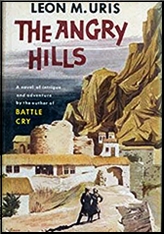
LEON M. URIS – The Angry Hills. Random House, hardcover, 1955. Signet S-1365, paperback, 1956. Several other reprint editions. Film: MGM, 1959 (with Robert Mitchum, directed by Robert Aldrich).

   As much part of the men’s adventure fiction genre as it is a spy novel, Leon Uris’s The Angry Hills offers up a panoply of thrilling and romantic scenarios for the reader. Written in an accessible style with little to no literary flair, the novel starts off strong only to peter out midway through. It’s a shame that the work never quite follows through on his promising opening in which developed his protagonist with seemingly great attention to detail.
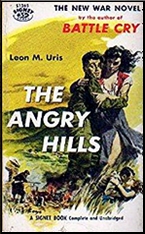
   Michael Morrison is an American writer from San Francisco who finds himself in Greece around the time of the Nazi invasion during the Second World War. A recent widower, he’s in Athens and is saddened when he looks around city and wishes that his wife were there to experience it with him. Soon enough, he becomes embroiled in an international game of intrigue when he is handed a list of names that is vital to the Greek resistance movement and the Allied effort to assist them in the fight against Nazism. Morrison first impersonates a British officer, then a New Zealander. How he would accomplish with an American accent is not remotely plausible and Uris’s attempt to deal with it convincingly falls flat.
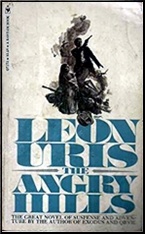
   The novel continues to pick up its frenetic, adventuresome pace until Morrison gets injured. He finds himself being nursed back to health by a Greek peasant girl. This is where the work begins its slow decline into formula. Enter not only the girl and her hearty Greek villager father who wishes to marry her off, but also a German officer villain with a riding crop who reads like he was written into the novel by Central Casting, and his sleazy overweight Greek collaborator friend.

   There’s some good material in The Angry Hills, including Uris’s depiction of the volunteer Palestinian (Jewish) Brigade in the British Expeditionary Force who fought on the Allied side in Greece. Morrison is a character that readers will find themselves rooting for, even if he cannot be completely distinguished from similar ordinary men in adventure fiction who find themselves swept up in a whirlwind of war and women. But the novel as a whole never really distinguishes itself. It’s a light read with little depth and one that gets increasingly predictable as it nears a conclusion that feels like it came straight from a Republic Pictures serial.

REVIEWED BY DAVID VINEYARD:


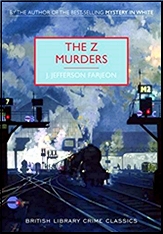
J. JEFFERSON FARJEON – The Z Murders. Collins, UK, hardcover, 1932. Dial Press, US, hardcover, 1932. Poison Pen Press / British Library Crime Classics, US, softcover, 2015.

    … there is one London you may never or rarely have met. It is the London of the cold grey hour, and you are wise to miss it for in its period and transition it has nothing gracious to offer you.

   Long before many of us became sick of the serial killer novel, there was the sequential or series killer, sometimes a madman, but more often than not a man with a plot that called for a series of murders either to enact it or cover it up.

   Many of the greats of the Detective story writers of the Golden Age mined these fields including such classics as Agatha Christie’s The ABC Murders, Francis Beedings’ Death Walks in Estrepps, and Philip MacDonald’s (writing as Martin Porlock) The Mystery of the Dead Police aka X vs Rex (MacDonald indeed wrote two others, the most famous being his last, The List of Adrian Messenger), and on this side of the pond S. S. Van Dine’s The Bishop Murder Case and Ellery Queen’s Cat of Many Tails.

   These differ wildly from the examples of modern writers, if in nothing but good taste and no love for gore for it’s own sake, but also in the fact the killer, whatever their motive, is more a natural force than a human. The game is the thing in these books, not the psychology of the killer or the sleuth (though that plays a role in the Van Dine and Queen titles mentioned).

   J. (Joseph) Jefferson Farjeon was a critic, historical novelist, and children’s author who also wrote popular mysteries. He had two series characters, Ben the Tramp (one of whose adventures was filmed by Alfred Hitchcock as Number 17) and a reformed criminal turned detective appropriately called X. Crook, but neither features in this entertaining melodrama that falls somewhere between John Buchan’s shockers and Michael Innes more playful thrillers in style and mood.

   Richard Temperley, our hero, is on his way back from the Lake District by train and spends an uncomfortable night in his compartment thanks to a noisy and unpleasant elderly man.

    “That man and I are made from different chemicals,” reflected Temperley. “How pleasant it would be to murder him.”

   When the train lays over at Euston for a few hours in the cold grey dawn Temperley and the elderly man both take refuge at a small hotel nearby, but no sooner do they settle in than the man is found shot to death in an easy chair, and Temperley catches a glimpse of a beautiful woman who promptly flees.

   Detective Inspector James shows up and while interviewing Temperley finds a curious crimson enamel metal shaped like a Z. Soon London will tremble before that Z.

   Temperley finds the woman’s handbag, but like the lunk-headed heroes of countless adventures conceals it from the police — well, she was beautiful — and from it discovers she is one Sylvia Wynne of Chelsea. Naturally he goes to allow her to explain her obvious innocence, but finds her gone, and another enamel Z on her carpet.

   He does catch up to her, and finds her too frightened to talk, and loses her again, and chases her cross country for the rest of the book also pursued by the sinister Mr. Z (a really least likely suspect) through cliffhangers, improbabilities, and wild action.

   I will only say, Mr. Z is a nasty piece of work, and this would have made a fine Hitchcock or Carol Reed outing.

   This all works because unlike many in the same field, Farjeon could, and bothered to, write. His style has pleasing literary flourishes (never too much or heavy handed), humor, and a near Stevensonian sense of romance.

   Poison Pen Press has brought two Farjeon novels back into print in their British Library of Crime Classics series with informative introductions by Martin Edwards (to whom I am indebted for some of the material in this review), and yet another ebook publisher has released several of his Ben the Tramp novels.

   This may be dated, but it is tremendous fun and works on its own as an entertaining thriller with no reliance on nostalgia and no need for forgiveness, save some of the logic you still have to forgive the form today.

ELLIS PETERS – The Confession of Brother Haluin. Mysterious Press, hardcover, 1989; paperback reprint, December 1989. First published in the UK by Headline, hardcover, 1988.

   The 15th chronicle of Brother Cadfael. The year is 1142, and a winter’s accident nearly takes the life o Brother Haluin, whose sins (he confesses) include an unsanctioned love — and an abortion — and when he survives, his guilt is still very much with him.

   As in good science fiction, Ellis Peters has a special knack of sweeping us away to another time and another place with the greatest of ease. This is tasty and moody medieval fiction, taking place when the ways of the world were very different; it is also achingly good, but marred by a flaw that can’t help being noticed.

         [WARNING: Plot Alert!]

   All but one of the characters in this novel are perfectly realized, but the one who is not has a large role, and she just happens to be the mother of Haluin’s child. As every mystery reader will realize at once, neither the mother nor her daughter died in the attempted abortion, but Haluin does not know this, nor has the possibility ever occurred to him, and he has lived with the guilt for eighteen years.

   The mother of the girl he loved has suppressed the truth from everyone all this time, but Haluin’s pilgrimage to the girl’s home begins a chain of events that culminates in the death of an aged servant woman, who also knew the truth. All well and good, but you may find as much problem with this as I did. The girl herself is still alive; she is now in a nunnery; and she also know who and where Haluin has been all this time.

   We (the reader) are never permitted to know or see her except from a distance, and so the reason she has not spoken out before now is never explained. It should not have been difficult. All that needed to be pointed out is that “times were different.” Perhaps we are simply to assume that is the case, but why then should it be said of her (p.192) that “… for her there was no guilt, she had done no wrong but in loving [Haluin] …”

   Please forgive me, but not so. That was no crime. The crime — perhaps, I admit, from a present day perspective — was in allowing Haluin to live eighteen years in misery, thinking he was responsible for killing the one he loved. Or if this is not the way it was, then the girl’s story should have been told, and it it is not. The size of the hole it produces is not large and depends greatly on your own point of view, I’m sure. To me, however, it was evident enough for me to tell you about it here.

   Otherwise? A perfectly told tale.

— Reprinted from Mystery*File #22, June 1990 (considerably but not significantly revised).

EDWARD D. HOCH “The Problem of the Miraculous Jar.” Dr. Sam Hawthorne. First published in Ellery Queen Mystery Magazine, August 1996. Collected in All But Impossible (Crippen & Landru, 2017). Reviewed by Mike Tooney here. (Thanks to Randy Cox for providing this information.)

   It is November 1939 and even in the small New England town of Northmont, rumors of the impending war are getting stronger by the day. When a married couple are given a welcome home party after their return from a trip to Europe and the Holy Land, no one expects that someone will die later that same evening, including Dr. Sam Hawthorne, one of the attendees.

   Cause of death: cyanide in a jar brought back as a gift from Cana, the site of Jesus’s first miracle, the transformation of water into wine, a feat that seems to have been duplicated here, except that in this case the wine (which was not in the jar when the party was over, only water) is found the next day to have been tainted with poison.

   Question: How could anyone change water into poisoned wine inside a locked house surrounded by unmarked snow?

   Answer: It’s a damned good trick, that’s what it is. Ingenious, in fact, until you know the answer, and then it’s dumbfoundedly easy.

   Except only on occasion, Hoch wasn’t the greatest wordsmith in the world, but his plain-spoken style of writing has to be a lot more difficult to duplicate than you’d think it would be. I also think there is enough plot — with lots of characters complete with backstories, motives, false trails and the like — to fill a complete novel.

   Ingenious, too! Or did I say that already?

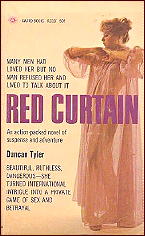
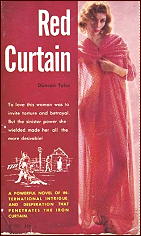
DUNCAN TYLER – Red Curtain. Beacon 205, paperback original; 1st printing, 1959. Award A202F, paperback reprint, 1966.

   Obscure books, especially those that are either detective or mystery fiction, have always been favorites of mine, and here is one so obscure that [as of the time this review was first written], Al Hubin had not yet heard of it. What’s even more interesting is that the copyright is in the name of Don Smith, who was soon to become the author of a long series of “Secret Mission” espionage thrillers. While I own about half of them, I’ve never read any, but I’ve always assumed that the Phil Sherman starring in them was some kind of super-agent in the James Bond mode.

   Why I am bringing this all out is that there is a Philip Sherman in this book as well, but he’s not a super-agent of any kind, at least not yet. He is an American business man working in Europe who naively gets suckered into some shady business transactions with the Russians, and when things go badly, he naively (again) attempts to break his partner out of a Russian labor prison. This in a country where he doesn’t even speak the language.

   If you were to see the front cover [of the Award edition], you would also know there is a woman involved, but not nearly as much as the back cover would have you believe. The last few chapters make the rest of the book worth reading, but if a lot of action is what you might be looking for, the early going is awfully sluggish and slow. It seems to be an accurate peek at life behind the Iron Curtain for its time, however, and maybe that’s the greatest value it ever had.

— Reprinted from Mystery*File #23, July 1990 (slightly revised).
REVIEWED BY JONATHAN LEWIS:


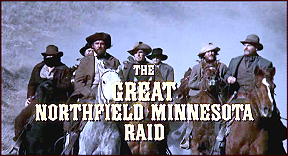
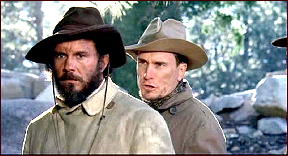
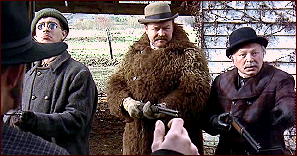
THE GREAT NORTHFIELD MINNESOTA RAID. Universal Pictures, 1972. Cliff Robertson, Robert Duvall, Luke Askew, R.G. Armstrong, Dana Elcar, Donald Moffat, Elisha Cook (Jr.), Royal Dano. Screenwriter-Director: Philip Kaufman.

   Filmed in a style that approaches cinéma vérité, Philip Kaufman’s The Great Northfield Minnesota Road has a quasi-documentary feel to it, providing the viewer with an experience that’s almost akin to watching an historical recreation. The movie isn’t so much about plot as it is about atmosphere and, more significantly, about its portraiture of both outlaws and ordinary townsfolk.

   Indeed, when it’s at its best, the movie, with its naturalistic performances and lack of artifice allows the audience to be temporarily transported to a small, calm Midwest town in the year 1876 and the midst of great cultural and technological changes.

   Enter the outlaws who will wreak havoc in the town. Cliff Robertson and Robert Duvall star, respectively, as Cole Younger and Jesse James in this superbly constructed feature about the Younger Gang’s last and final bank robbery that occurred in the town of Northfield, Minnesota. Both actors portray their characters as both instigators of events and as individuals able to make the most out of life’s circumstances and opportunities after the Confederate loss in the Civil War.

   The two are technically in cahoots, but they have very different personalities. Cole is the more introspective of the two; Jesse is the more reckless of the two and betrays a real hatred for the North. He’s also not fully to be trusted. Case in point: when Jesse learns that Cole’s sights are set on Northfield, he attempts to get there before Cole is fully recovered from being wounded in an ambush. Cole, for his part, seems just as intrigued by the societal and technological changes he witnesses in Northfield as he is by his upcoming final bank robbery.

   Be on the lookout for the beautiful sequence, filmed documentary style, in which he watches a rudimentary baseball game being played on the outskirts of town with Allen (Dana Elcar), one of the town elders. The message is delivered in a most subtle manner, but it’s abundantly clear. The era of gunslingers is fading away, the anarchic spirit represented by the Younger and James gangs will soon to be replaced by a new, more orderly national pastime, one that will eventually unite a formerly bitterly divided union.

   Some might argue that such a sequence takes the viewer out of the film and that it is unnecessary to the plot. But it’s moments like these –and there are a few of them scattered throughout the picture—that are what makes The Great Northfield Minnesota Road stand out from the rather bloated pack of cinematic representations of Cole Younger and Jesse James.

REVIEWED BY BARRY GARDNER:


MARTIN GREENBERG, Editor – The Tony Hillerman Companion. HarperCollins, hardcover, 1994; paperback, 1995.

   Well, the photo on the dust jacket finally provided confirmation from my wife — Tony Hillerman and I resemble each other. I think it’s the ears.

   The Companion contains several sections, the first two being a book-by-book synopsis of Hillerman’s detective novels by Jon Breen, and then a lengthy 1993 interview with Hillerman by Breen. Then there is an article chosen by Hillerman on the Navajos, a section on Navajo Clan names, and then the longest section of the book, 200 pages of character concordance.

   The book ends with several short non-fiction pieces by Hillerman, and three of his short stories. There are also several pages of photos, in which he manages to resemble me two or three times.

   For a real aficionado of Hillerman’s books this would be indispensable, and for anyone interested in them at all very enjoyable. Breen is an excellent interviewer, obviously thoroughly familiar with Hillerman’s work and with a great appreciation of it.

   The Navajo material was interesting, as were Hillerman’s non-fiction pieces — the part of the book most likely to be new to his fans. The Concordance was the least interesting to me, and I think likely to any but his most involved fans. At $25 a throw I’d say it’s best read from the library for all but his most enthusiastic followers, but for them it will be a treasure.

— Reprinted from Ah Sweet Mysteries #14, August 1994.
REVIEWED BY DAN STUMPF:


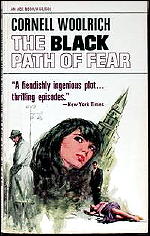
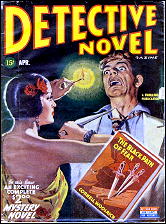
CORNELL WOOLRICH – The Black Path of Fear. Doubleday Crime Club, hardcover, 1944. Reprint editions include: Detective Novel Magazine, April 1945; Avon #106, paperback, 1946; Ace H-66, paperback, circa 1968; Ballantine, paperback, 1982.

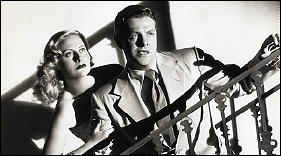
THE CHASE. United Artists, 1946. Robert Cummings, Michele Morgan, Steve Cochran and Peter Lorre. Screenplay by Philip Yordan, from the novel The Black Path of Fear, by Cornell Woolrich. Directed by Arthur Ripley.

   Woolrich at his pulpiest turned in to film noir at its weirdest. Such a treat!

   As the book opens, Bill Scott and Eve Roman are just arriving in Havana, fleeing from her husband, gangster Eddie Roman. By the end of the first chapter, she will be dead and he’ll be framed for her murder, which is a lot to pack into one chapter, but Woolrich doesn’t skimp on atmosphere or color as the plot rushes on. He writes about a crowded bar in a way that had me tucking my elbows in, and there’s a very atmospheric chase scene from the fugitive’s POV up a darkened stairway, lit only by the flashlights of his pursuers.

   In a typical Woolrichian coincidence, Bill hooks up with a street-smart Cuban Miss named Midnight with a grudge against cops that impels her to help him track down the real killers. And once again we get that superb atmosphere of darkened doorways, twisted streets, and even into the bowels of an opium den, painted in fevered but fast-paced prose. And for a conclusion there’s a knock-down drag-out fight scene, and a bitter, romantic coda Chandler might have envied.

   Black Path was filmed in 1946, and before I go into it, perhaps a word about the film’s creators might be helpful:

   Producer Seymour Nebenzal was a big name in the early German cinema, with films like M and 3-Penny Opera on his resumé . After he fled Germany to the U.S. his films went into a “cheap-but-interesting” period of things like Hitler’s Madman, but he did produce remakes of his German films Mistress of Atlantis and M.

   I have heard passing references to director Arthur Ripley before; UImer referred to him as “a sick man, mentally & physically” and his output was meager, with a few films that had to be finished by other hands. He was apparently a man of ill health and gloomy outlook, who worked most of his early career in comedy for Mack Sennett, Harry Langdon and W.C. Fields (he directed Fields’ classic short Barber Shop.)

   After many years as a gag man for Capra and others, Ripley directed Voice in the Wind, The Chase, and part of Siren of Atlantis, then nothing till Robert Mitchum asked him to direct Thunder Road. Damn Strange if you ask me.

   Together Nebenzal and Ripley make The Chase something unique, aided by photographer Franz Planer (who sent on to Breakfast at Tiffany’s and The 5,000 Fingers of Dr. T) and a choice cast that includes Steve Cochran as an acquisitive gangster and Peter Lorre as his matter-of-fact executioner, who gripes about sending flowers to the funeral of their late competitor (“A hundred and fifty bucks. I don’t care what you say, that’s inflation.”)

   Narrative-wise, The Chase is something else again. It follows the book pretty faithfully for the first half, then Ripley and writer Philip Yordan apparently decided to leave off and make another movie about the same characters. There’s a scene of shocking surprise, followed by a trite “cheat,” and all at once we’re into a movie where Bob Cummings is a disturbed vet with fits of amnesia.

   It’s to the credit of all concerned that this works as well as it does. As I watched, I found myself going from “Aw c’mon!” to “Come on, snap out of it, Bob – and hurry!” as the characters from the first half of the film move toward and away from what looks like predestined fate.

   The Chase can’t be called a complete success, but it has its moments, and I guarantee it’s one of the strangest you’ll ever see.

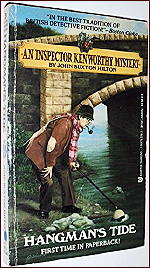
JOHN BUXTON HILTON – Hangman’s Tide. Inspector Simon Kenworthy #3. Macmillan, UK, hardcover, 1975. St. Martin’s, US, hardcover, 1975. Charter/Diamond, paperback, US, August 1990.

   It was quite a surprise to see this one out in paperback. Hilton is a fine writer, but it’s always seemed to me that his stories of Inspector Kenworthy of Scotland Yard would be a little too rustic to have much market appeal in this country. Here it is, though, and apparently it’s the first of several.

   This particular one takes place in a backwoods marshy corner of England, where a former school administrator has been murdered in gruesome fashion — she’s been hanged to death on a floating scaffold, the platform of which is designed to sink out from under the feet of the victim as the tide comes slowly in.

   As usually happens in Hilton’s books, the roots of the crime go far back into the past — indirectly, to a period 300 years earlier, since the murder copies the events of an execution that too place three centuries ago — and directly, a generation of two past, when life may have been simple but certainly wasn’tany easier, as an unhappy woman’s diary clearly shows.

   Kenworthy uses a questioning technique that’s often deliberately antagonistic, on the principle that more may be revealed when the answerer is angered than not. He is also deliberately eccentric, known for flouting the rules whenever he sees fit, and invariably equipped with a vivid flair for the dramatic.

   The first third of the book is the best. The middle portion sags badly when Kenworthy departs the scene for a short while, leaving the investigation in the stalwart hands of his assistant, Sgt. Wright, while the ending can easily leave the reader with the uneasy feeling of “Is that all there is?” Nonetheless the characters are fleshed out in fine fashion, and in this case, that’s all it takes to make the book worth reading.

— Reprinted from Mystery*File #23, July 1990 (very slightly revised).
REVIEWED BY JONATHAN LEWIS:


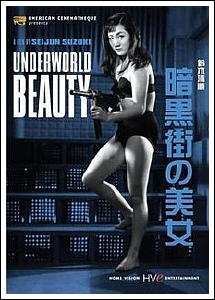
UNDERWORLD BEAUTY. Nikkatsu, Japan, 1958. Original title: Ankokugai no bijo. Michitarô Mizushima, Mari Shiraki, Shinsuke Ashida, Tôru Abe, Hideaki Nitani. Director: Seijun Suzuki.

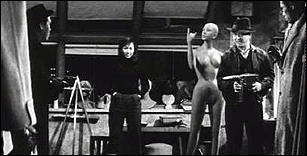
   Sweaty and more than a little bit sleazy, Underworld Beauty borrows liberally from the American gangster genre, film noir, and the juvenile delinquent film, all the while creating something exciting and new, if not completely coherent.

   Directed by Seijun Suzuki, this compellingly hip Japanese crime film exudes raw energy and sparkles with punctuations of gunfire. It eventually reveals itself to be an offbeat love story with the dark fatalistic humor of Stanley Kubrick’s The Killing (1956), the sly direction of Sam Fuller, and the aesthetic of a 1950s hot rod exploitation film about rebellious teens and their jazz-infused dance parties.

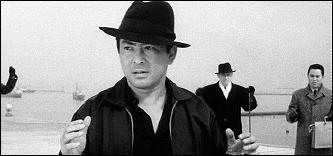
   Filmed in black and white Cinemascope, Underworld Beauty opens with former convict Miyamoto (Michitarô Mizushima) making his way through the dank Tokyo sewers. He’s down there in the muck to retrieve stolen diamonds that he hid away in a wall below the urban streets prior to his incarceration.

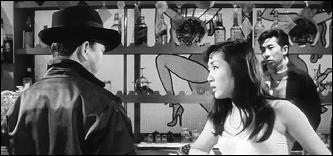
   The film follows Miyamoto, clad in a black jacket and fedora, as he makes a deal with a yazuka crime boss, tries to make amends with his former partner, and begins a love-hate relationship with the latter’s wild sister Akiko Mihara (Mari Shiraki). Through a twist of circumstance, Miyamoto’s former partner ends up swallowing the diamonds, only to die from falling from a roof.

   Akiko’s boyfriend, who works as a designer of mannequins, cuts open the newly deceased and steals the diamonds out of the body. In a whirlwind of cinematic frenzy, the story moves ahead with various deceptions, a double-cross, a kidnapping, and a final dramatic shootout in a steamy furnace room. The acting may be decidedly mediocre, but the energy is infectious.

« Previous PageNext Page »