REVIEWED BY DAVID VINEYARD:


MARISHA PESSL – Night Film. Random House, hardcover, 2013; trade paperback, 2014.
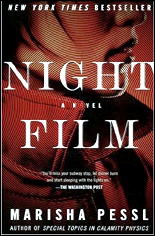
   Mortal fear is as crucial a thing to our lives as love. It cuts to the core of our beings and shows us what we are. Will you step back and cover your eyes? Or will you have the strength to walk to the edge of the precipice and look out?

   Night Film dares you to look into that precipice, and both the view and the journey are well worth it.

   I’m not easily impressed by so called Meta-fiction. Too often I find the attempt gimmicky and distracting, the writing, characterization, plot, and basics of story-telling lost in a maze of clever ideas that are too much trouble to bother with for the work that it results in.

   In the case of Night Film none of that is true.

   This one is a stunner, both entertaining and fun, and revealing of deeper matters. I am seriously in awe of and envy of Marisha Pessl’s gifts as a writer.

   Dead is Ashley, the daughter of cult film maker Stanislas Cordova (“Everybody has a Cordova story whether they like it or not”) whose dark and violent films reflect something sinister about the man himself. It’s ruled a suicide, but investigative journalist Scott McGrath thinks there is more to the death of the troubled young woman than meets the eye and, with his assistants, Nora and Hopper, begins to delve into the personal history of the reclusive Cordova family and their multiple truths, a journey complicated by McGrath’s own secrets — even those hidden from himself.

   As plots go, this one predates Citizen Kane, but that is the last mundane thing about this inventive and suspenseful literary thriller that spins out in a dozen directions at once from its premise.

   Dazzling is a word that is overused, but this one is just that.

   Replete with photographs, reproductions of websites, even a Wi-Fi interactive Night Film Decoder App for your PC or other device that can be used to access secrets and films triggered by a symbol of a bird on many of the photographic pages. This could all be hugely annoying and ultimately pointless, if the book wasn’t so good; it needs none of that to work.

   That is all icing on a cake that is a delight unadorned. Suspense novel, thriller, detective puzzle, psychological profile, case study in the outre and the weird, study in film history and theory, Night Film will remind you of nothing so much as Theodore Rozack’s brilliant novel Flicker, but as shockingly new now as that book was then.

   The book has everything, including a diabolical curse, and enough twists and turns to give even the most jaded reader of detective novels and thrillers whiplash. Read this one, enjoy it, delight in it. Books this good just don’t come along that often.
I’m posting this from my cell phone. I had the hard drive from my laptop replaced last week which was fine but I’m still trying to get all the associated hardware working in sync again.

I had to take it back to the PC repair shop today since the touchpad was interfering with the mouse, making the cursor jump all over the place. Disabling the touchpad is supposed to be easy. Except on a few select Dell models.

Guess whose model was selected?

No prizes for guessing right.

REVIEWED BY DAN STUMPF:


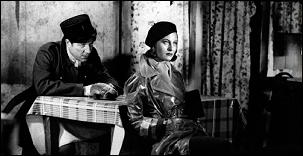
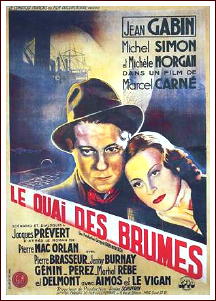
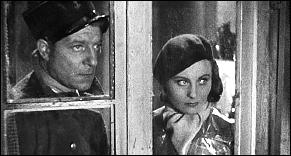
PORT OF SHADOWS. Les Films Osso, France, 1938. Original title: Le quai des brumes. Jean Gabin, Michele Morgan and Michel Simon. Screenplay by Jacques Prevert, from a novel by Pierre Dumarchais. Directed by Marcel Carné.

   A dark, poetic film that looks forward to film noir and the later novels of David Goodis.

   Jean Gabin, the French Bogart-before-there-was Bogart, plays an army deserter heading for Le Havre, looking to find a ship to flee the country. What he finds are a stray dog that adopts him on the highway into town, and a lot of have-nots willing to share their meager fortunes with him, and discourse Goodis-style on life, love and dreams.

   Also hanging around town are a few local hoods in some kind of scrape with a shady store-keeper and his daughter (Michele Morgan, looking more radiant and lovelier here than in any of her American films) and it’s not long before Gabin and his mutt find themselves in the proverbial thick of things as he tries to understand the tangled relationships and get out of town.

   I’ll say up front that this thing is awfully contrived; characters turn up in unlikely places with no more reason for being there than to move the plot along. But I’ll also say that Director Carné handles it so gracefully one doesn’t want to notice.

   The small-time gangsters are evoked with just the right measure of terse absurdity, their put-on hard-boiled act melting away at Gabin’s genuine toughness, and the winos and poets fill in the background vividly, talking with that awesome redundancy one finds in dark artists like Woolrich, Goodis and Jim Thompson.

   The outcome is as pleasingly phony as the rest of it, but I have to say Carné rings in a moving surprise at the very end. The final image of the little dog walking down a highway to nowhere in particular is one that will stay in my mind long after whole other movies are forgotten.

THORP McCLUSKY “The Crawling Horror.” First published in Weird Tales, November 1936. Reprinted in Avon Fantasy Reader #6, 1948, and The Macabre Reader, edited by Donald A. Wollheim (Ace D-353, 1959), among others.

   This strange story is told by a farmer to a local doctor who in turn tells it to us. The farmer has rats in his house and barn, but when they begin to disappear, he gives the credit to his several cats. Then the cats start to vanish. Can his dogs be next?

   He is sitting in front of his fireplace, reaches down to pet his dog and … I’ll quote:

   “It was a slimy sort of stuff, transparent-looking, without any shape to it. It looked as though if you picked it up it would drip right through your fingers. And it was alive — don’t know how I knew that, but I was sure of it even before I looked. It was alive, and a sort of shapeless arm of it lay across the dog’s back, and covered her head. She didn’t move.”

   What do you think? What would you do?

PS. Things get worse from here. This is only the beginning.

REVIEWED BY BARRY GARDNER:


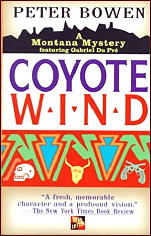
PETER BOWEN – Coyote Wind. Gabriel Du Pré #1. St. Martin’s, hardcover, 1994; paperback, 1996.

   Bowen is the author of three books about Yellowstone Kelly. This is his first mystery, and the first of a projected series.

   Gabriel Du Pré is a brand inspector in Montana, and a French Indian, a Métis, a descendant of the voyageurs. He’s widowed, with a 14 and a 21-year old daughter, the latter happily married and turning out babies, the former bright and rebellious. He has an ongoing relationship with a 40-year woman with four children whose husband has left her, and he has taste for fiddling and whiskey.

   He’s inveigled by the Sheriff into accompanying a cowboy from a ranch owned by a family of rich Eastern drunkards up into the hills to the site of a newly discovered old plane wreck. He finds skeletons there, and a skull with a bullet hole. The plane turns out to have crashed nearly 40 years ago, and the skull to be part of a legendary local unsolved murder. It will turn more lives than one upside down before all the connections are made and all the old ghosts laid to rest.

   I liked this a lot. I liked the writing. and I liked the characters. Bowen has a distinctive voice,one which matches narrative and story admirably. Du Pré is one of the more original leads to come along in the last few years, and one of the more appealing. Bowen has a love and a feel for the Montana landscape and way of life that is evident on every page, though it never interferes with the story.

   It seems to me a very masculine book, though there are a couple of strong female characters, and I’ll be interested to see if it appeals to women at all. It’s a slender book, but just the right size for the story it has to tell. This is one of the best I’ve read this year.

— Reprinted from Ah Sweet Mysteries #14, August 1994 (slightly revised).


Bibliographic Note:   Barry was certainly correct about Du Pré becoming a continuing character. There are now fourteen in the series, with Bitter Creek being the most recent one, coming out in 2015.

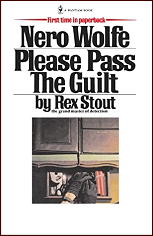
REX STOUT – Please Pass the Guilt. Nero Wolfe & Archie Goodwin #45. Viking, hardcover, September 1973. Bantam, paperback, October 1974.

   When this book was published, Rex Stout was 87, and it had been four years since Death of a Dude, the previous book in the series. I hate to say it, but like many other mystery writers with long careers, the ones written at the ends of their careers are far from their best.

   In Stout’s case, I have to confess that I never thought the detective end of things was his strong suit. What I remember about the books is hardly ever the endings, but the setups for the stories and the comfortable feeling of settling down in a familiar milieu and enjoying the personalities of the cast of characters, their idiosyncrasies and habits, the wit and the repartee, all wrapped up in another episode of their long crime-solving careers.

   All of the latter is still present, and the case is interesting at the beginning — a bomb goes off in a drawer in a TV executive’s office and kills one of the employees working there. But was the bomb meant for the executive who owned the office, or was it intended for the dead man, and if so, how did the killer know he was going to open that drawer at that particular time?

   But there are no witnesses, no clues, and with all of the combined resources that Wolfe has to hand — namely, Archie, Saul, Fred and Orrie — the investigation goes absolutely nowhere. It goes so badly that Archie has to apologize to the reader for it. There is no flow to the story, the rhythm is off, and while I don’t know if this is different from earlier books, but the paragraphs are often unwieldy long, including large chunks of dialogue.

   Worse, the solution (to me) comes from almost nowhere, with no motivation for the killer. I am willing to stand corrected on this, but even if I missed something, this is a book that is nowhere near Stout at his prime.

REVIEWED BY DAVID VINEYARD:


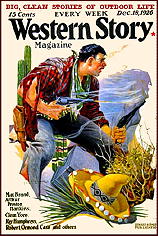
MAX BRAND “Werewolf.” Novella. Western Story Magazine, 18 December 1926. Included in Men Beyond the Law (Five Star, hardcover, 1997; Amazon Encore, softcover, 2013). [Thanks to Sai Shankar for coming up with the latter information.]

   ALL day the storm had been gathering behind Chimney Mountain and peering around the edges of that giant with a scowling brow, now and again; and all day there had been strainings of the wind and sounds of dim confusion in the upper air, but not until the evening did the storm break. A broad, yellow-cheeked moon was sailing up the eastern sky when ten thousand wild horses of darkness rushed out from behind Mount Chimney and covered the sky with darkness.

   You don’t get a much more evocative opening than that for a Western novella called “Werewolf,” and the story lives up to both its title and that opening in ways you won’t expect from Max Brand (who did write some fantastic fiction).

   I can honestly say this is the strangest story I have ever read by Brand, and as honestly say it is one of the most satisfying, mixing all those elements of mythology and classical literature with a rousing good adventure story set in the more or less modern West (modern enough for telephones anyway).

   On that bitter night Chris Royal (“There were no political parties in Royal County or in Royal Valley, for instance. There were only the Royal partisans and their opponents.”) walks into Yates Saloon to escape the storm where Cliff Main, gun happy brother of killer Harry Main, is looking for trouble over a girl both like.

   Words are exchanged, and there is the smell of cordite in the air.

   Cliff Main is dead and Chris Royal alive.

   At least until Harry Main comes to avenge his dead brother. Chris doesn’t much fancy his odds against Harry Main. His crossbred hound, Lurcher would have better odds, and Lurcher isn’t much to look at. Being convinced that he’s a coward, like the hound Lurcher, who isn’t much good but is loyal to Chris and loved by him, and that he has no chance against Main, Chris hightails it for the high country.

   Which is where this story turns decidedly weird.

   Because something is trailing Chris, and it isn’t Harry Main … “it was no animal of flesh and blood at all, but a phantom sent to cross his way with a foreboding of doom.”

   He’s not far off.

   An old Indian Chris meets fishing in the river sets the philosophical tone of the tale. He warns Chris that no man can escape his fate, and when they hear the wolf that had trailed Chris the night before he explains it is a werewolf:

   “There are two kinds of werewolves,” said the chief, holding up two fingers of his hand. “The first are the ones which have been men and become wolves. They are only terrible for a short time, and then they become stupid. Then there are others. They are the wolves that cannot become men until they have killed the warrior who has been marked out for them.”

   That old Indian is more than a convenient literary device, I warn you.

   Chris masters his fear after that and returns home to face Harry Main, his preternatural calm in the face of almost certain death almost unnerving the mankiller, but even with Main out of the picture there remains that second kind of werewolf, the one that cannot become a man again until it has killed the warrior marked for it, and in that game a worthless cowardly dog named Lurcher get a chance to redeem himself as his master has.

   It is an odd duck of a story by any measure, part Western revenge story, part tale of redemption of man and dog, part dog story, and part … well you decide, but I will reveal this much, werewolf in this story is both a metaphor and not a metaphor.

   If you ever wondered what Max Brand might have written for Weird Tales, this is the story.

REVIEWED BY JONATHAN LEWIS:


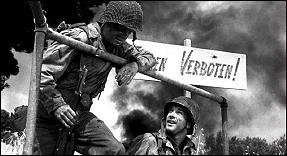
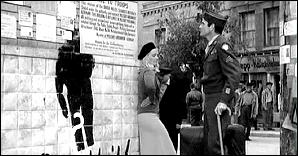
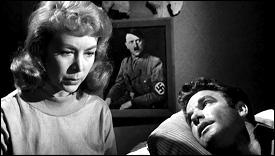
VERBOTEN! RKO Radio Pictures, 1958/Columbia Pictures, 1959. James Best, Susan Cummings, Tom Pittman, Paul Dubov. Screenwriter-director: Samuel Fuller.

   Highly uneven and overly didactic, Samuel Fuller’s Verboten! is a quirky, stagey film about an American GI in Occupied Germany at the end of the Second World War. After he loses two of his colleagues and he himself gets injured in combat, Sergeant David Brent (James Best) finds himself the houseguest of an anti-Nazi German girl (Susan Cummings) who nurses him back to health. To no one’s surprise — certainly not to this viewer — Brent falls in love with his German companion. But since marriage and fraternization between the two is forbidden — verboten! — Brent decides to leave the Army and to serve in the civilian occupation of Germany.

   Little does he know that his wife’s friend Bruno Eckhart (Tom Pittman) and her younger brother are both secretly working with the Werwolf, the underground pro-Nazi “resistance.” Much of the movie is filled with heavy-handed dialogue about the difference between ordinary Germans and Nazis and the ways in which Hitler manipulated the German people into following him.

   Some of this is effective; a lot of it is over the top and actually serves to take away from the potency of the subject manner. There is, however, a stunningly effective sequence in which Eckhart attempts to rally a coterie of young, angry men to the Nazi cause in the rubble of occupied Germany. Pittman, who was a compelling screen presence, tragically died in a car crash in late 1958 at the young age of 26 several months before Verboten! was released in theaters.

   Fuller, always a maverick, utilizes Beethoven when showing the Americans in combat and Wagner for the Germans. That aesthetic choice, along with the choice to insert highly graphic newsreel footage from the concentration camps in the film, has the unusual effect of giving the entire movie a semi-documentary feel in which fiction and fact are intertwined in a decidedly ambitious, but ultimately mediocre war film. Verboten! is a movie wants to say a lot, to shout it from the rooftops, but does so in such a frenetic manner that the message gets drowned out by its own unfortunate shrillness.

   I’ve asked Ian Dickerson, the author of the following book to tell us more about it. He’s most graciously agreed:

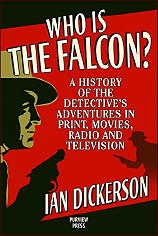
IAN DICKERSON – Who Is The Falcon?: The Detective In Print, Movies, Radio and TV. Purview Press. softcover, December 2016.

   Back in the dim and distant past, when I was just a lad, I discovered the adventures of the Saint. (I know, I know, I’ve kept that quiet….) In those heady days I was a sucker for any new Saint-like adventure so when the BBC ran out of old black and white Saint films to show and moved onto something called ‘The Falcon.’ my place in front of the television was assured for a few more weeks.

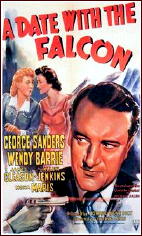
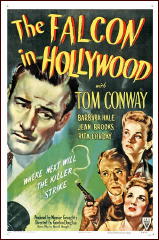
   Those early Falcon films were remarkably Saintly, and although the later ones got a little more creative — The Falcon and the Co-Eds anyone? — they were still firmly in the gentleman detective genre and my teen -aged self was happy.

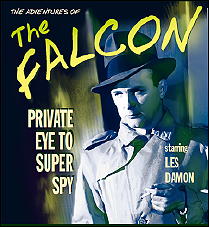
   Fast forward a few years — well, okay, quite a few years — and I discovered old time radio shows. But I soon had a problem, I had all the episodes of The Saint on tape and being greedy I wanted more. Then I discovered the Falcon had also appeared on radio! Aha, problem solved I thought! But when I listened to the tapes I discovered the Falcon — that radio Falcon — was a hard boiled 1940s PI and bore virtually no resemblance to the gentleman detective of the George Sanders and Tom Conway films. At a time when the Internet was only really just booting up, I had no way of establishing what had happened, but I rather enjoyed those hard-boiled PI adventures so quickly ordered some more.

   Fast forward a few more years and with the help of the now mature Internet, I discovered that not only had the Falcon also appeared in books, magazines and on TV, but that the radio show had run for over a decade and there had been over four hundred and eighty episodes.

   I wanted to learn things; to find out why there were two different characters and how they’d come to be changed, to find out more about the Falcon’s TV adventures and see if I could find copies of them, I also wanted to know more about his stint on radio — who played him? Who wrote the stories? What were they about? And for the geek in me … had I listened to all the ones that were available? (I certainly have now!)

   And I wanted to celebrate a character that had survived sixteen films, a handful of books, thirty-nine episodes of television and that long run on radio.

   So I wrote a book.

   Who is the Falcon? tells the story of all the Falcon’s adventures in print, on radio, in film and television. And there’s even a Falcon short story from the 1940s thrown in for good measure.

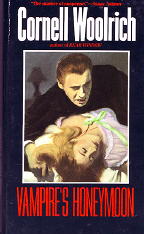
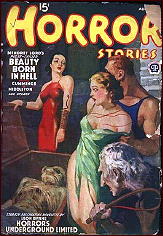
CORNELL WOOLRICH “Vampire’s Honeymoon.” Lead story in the collection Vampire’s Honeymoon, Carroll & Graf, paperback original, 1985. First published in Horror Stories, August-September 1939.

   First of all, there’s a reason why this story wasn’t reprinted until the C&G paperback collection came along, almost 50 years after its first appearance in a what’s called a weird menace or “shudder pulp.” It really isn’t very good.

   The title tells it all, or nearly so. A man, a well-educated fellow, goes to a party engaged to one girl, and leaves with another — a beautiful woman who he meets on a fourth-floor terrace as she seems about to jump — or float? — off. No one knows who she is, nor did anyone see her enter.

   They are engaged the next day and are soon married. The husband, as it turns out, is not the brightest bulb in the box. He cannot figure out why is suddenly afflicted with anemia, with small bites in his neck. Large mosquitoes, he tells the doctor. We the reader know better.

   All of the standard tropes about vampires are part and parcel of this tale: his new wife cannot be seen in mirrors, she stays inside in bed all day, is immune to bullets, and I’m sure I’m not giving anything away by telling you that a wooden stake is part of how the story ends.

   The story isn’t totally simplistic — Woolrich was too good a writer for that to be true — but it only hints at creepiness and once read, I doubt that anyone will remember it more than a day later. The other stories in the collection, all fairly long, may be better, and you may find me talking about them on this blog as time goes on.

   For the record, though, in case I don’t, their titles are “Graves for the Living,” “I’m Dangerous Tonight,” and “The Street of Jungle Death.” I may be mistaken, but I don’t believe that any of these are vampire stories.

« Previous PageNext Page »