FIRST YOU READ, THEN YOU WRITE
by Francis M. Nevins


   My July column, the longest I’ve ever written, was completely devoted to the Mike Hammer TV series of 1958-59 but there are a couple of related items that I couldn’t squeeze in last time. I trust no Hammerhead will mind if I begin with these.

   Two questions surrounding the series caught my attention as I was fiddling with the column. First, was there a Hammer pilot episode and if so which was it? The order of original broadcast in New York or any other city doesn’t help because it was different in every market and completely up to the station owning the local rights. Copyright registration dates don’t help either, nor does the order in which they appear on the recently released DVD set. If the episodes had production numbers, I haven’t been able to find them.

   However, I think I’ve solved the puzzle while slowly making my way through the set. Throughout the series the role of Hammer’s friendly enemy Captain Pat Chambers is played by Bart Burns. But in one early segment there’s a plainclothes cop who’s referred to only as Pat but is clearly meant to be Chambers. The actor who plays him is not Bart Burns but Ted De Corsia, who also played Sergeant Velie for much of the run of the Adventures of Ellery Queen on radio.

   The episode is “Death Takes an Encore,” directed by Richard Irving and written by Frank Kane based on one of his short stories about New York PI Johnny Liddell (“Return Engagement,” Manhunt, February 1955, collected in Johnny Liddell’s Morgue, Dell pb #A117, 1956). For my money, that was the pilot.

   The second question also involves Frank Kane. Back in the late Forties he wrote around 45 scripts for that classic radio series The Shadow, and for several years there have been rumors that at least one of his Hammer scripts was a rewrite of one of his Shadow scripts. But which?

   I believe I’ve solved that puzzle too. Another early episode written by Kane, “Letter Edged in Blackmail,” shares a springboard with Kane’s Shadow script “Etched with Acid” (March 17, 1946): the protagonist in both tries to shut down a racket in which wealthy women with heavy gambling debts are forced to fake robberies of their own jewels. As neither Mike Hammer nor The Shadow would ever dream of saying: Q.E.D.

***

   Death has claimed two actors who were well known for having played TV detectives. Efrem Zimbalist Jr. was the first to go. He died on May 2 at age 95, reportedly while mowing the lawn of his house in the horse-ranching community of Solvang, California.

   People of my generation first got to know Zimbalist on the Warner Bros. TV series 77 Sunset Strip (1958-64), in which he starred as ultra-suave PI Stuart Bailey. No sooner had that series left the air than he started playing Federal agent Lewis Erskine on the even longer-running The FBI (1965-74).

   When I met him — very briefly, at a film festival in Memphis — he was over 80 and still looked great. Judging from the photos of him I found on the Web, he still looked great in his 90s. Way to go! May we all be so lucky.

   The other recently deceased tele-icon was James Garner, who at age 86 was found dead in his Los Angeles home on July 19. Like Zimbalist he was best known for two long-running TV series but his were in different genres.

   His earliest claim to fame was as star of the Warner Bros. Western series Maverick (1957-63) but his interest for us stems from his years playing an un-macho PI in The Rockford Files (1974-80).

   In his autobiography The Garner Files (2011) he claimed that Bret Maverick and Jim Rockford were basically the same character, but he never said and probably never knew that the character from which both were sort of spun off was an icon of U.S. detective fiction, namely that quintessential American wiseass Archie Goodwin.

   I’ve said it before and I’ll say it again: if only there had been a Nero Wolfe movie with the middle-aged Orson Welles as Wolfe and the young Garner as Archie!

***

   Both Maverick and 77 Sunset Strip were created by the same man, who was also a co-producer and, as John Thomas James, a frequent scriptwriter for The Rockford Files .

   He first came to attention, however, as a mystery novelist. Roy Huggins (1914-2002) debuted in the genre with The Double Take (1946), whose protagonist, PI Stuart Bailey, was a character and first-person narrator owing a great deal to Raymond Chandler’s Philip Marlowe and very different from the suave and perhaps a bit bland Bailey of 77 Sunset Strip.

   Anthony Boucher’s review for the San Francisco Chronicle (February 3, 1946) was spot on as usual: “Mr. Huggins adds nothing to the established hardboiled formula but does an unusually able job within its possibly overfamiliar frame.”

   At that time, with Dashiell Hammett having written nothing since The Thin Man (1934), “the established hardboiled formula” meant Chandler. The latter may not have read The Double Take himself but he clearly found out about it and, as witness his letter to fellow pulp veteran Cleve F. Adams (September 4, 1948), he was not amused.

   â€œI don’t know Roy Huggins and have never laid eyes on him. He sent me an autographed copy of his book … with his apologies and the dedication he says the publishers would not let him put in it. In writing to thank him I said his apologies were either unnecessary or inadequate and that I could name three or four writers who had gone as far as he had, without his frankness about it …. I personally think that a deliberate attempt to lift a writer’s personal tricks, his stock in trade, his mannerisms, his approach to his material, can be carried too far — to the point where it is a kind of plagiarism, and a nasty kind because the law gives no protection…. Somebody who read Huggins’ book told me that it was full of scenes which were modeled in detail on scenes in my books, just moved over enough to get by.”

   Somebody else informed Chandler that “the publishers told Huggins, in effect, that it was bad enough for him to steal my approach and my method or whatever, but stealing my characters was going a little too far. I understand there was some rewriting, but cannot vouch for any of this.”

   The letter to Adams can be found in Selected Letters of Raymond Chandler, ed. Frank MacShane (1981), pp. 125-126. This is the only reference to Huggins in the index to MacShane’s book, but a careful reader will find Chandler revisiting the incident in later correspondence. Writing to spy novelist and later Watergate conspirator E. Howard Hunt on November 16, 1952, he says:

   â€œAs you may know, writers like Dashiell Hammett and myself have been widely and ruthlessly imitated, so closely as to amount to a moral plagiarism…. I have had stories taken scene by scene and just lightly changed here and there. I have had lines of dialogue taken intact, bits of description also word for word. I have no recourse. The law doesn’t call it plagiarism.”

   Exactly nine months later, on September 16, 1953, writing to a master at his alma mater Dulwich College, he adds a bit more detail to the story.

   â€œA few years ago a man wrote a story which was a scene by scene steal from one of mine. He changed names and incidents just enough to stay inside the law…. The publisher to whom the book was sent demanded indignantly of the agent submitting it how he dared send them a book by Chandler under a pseudonym without saying so. When he learned that I had not had anything to do with the book he demanded certain changes to tone down the blatancy of the imitation and then published it. It did very well too.”

   These quotations come respectively from pp. 334 and 352 of MacShane’s collection.

   Huggins’ Hollywood career began when The Double Take sold to the movies and he was hired to write the screenplay for what was released as I Love Trouble (1948), with Franchot Tone as Bailey. By the time Chandler died, in 1959, Huggins had created Maverick and 77 Sunset Strip and both series were prime-time hits, but the creator of Philip Marlowe watched very little TV and may never have known that a sardonic prophecy he had made in his letter to Cleve Adams had come true:

   â€œMore power to Mr. Huggins. If he has been traveling on borrowed gas to any extent, the time will come when he will have to spew his guts into his own tank.”

   Which is precisely what Huggins did.
Reviewed by JONATHAN LEWIS:         


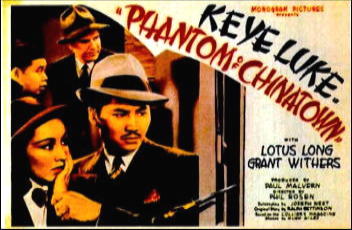
PHANTOM OF CHINATOWN. Monogram Pictures, 1940. Keye Luke, Grant Withers, Lotus Long, Charles Miller, Huntley Gordon, Virginia Carpenter, John H. Dilson. Screenplay: George Waggner. Director: Phil Rosen.

   The final film in Monogram’s Mr. Wong series, Phantom of Chinatown is notable for being the only movie in which an American actor of Chinese heritage, rather than the veteran horror film actor Boris Karloff, portrayed the Chinese-American detective.

   With a screenplay by George Waggner, director of Man Made Monster, which I reviewed here, and The Wolf Man, it’s also a fairly good, if at times excruciating slow moving, mystery and spy film, set during an era when Imperial Japan threatened the territorial integrity of China.

   Directed by Phil Rosen, Phantom of Chinatown doesn’t have a phantom or anything supernatural in it at all. It’s simply an entertaining and overall well-crafted mystery story with a dash of international intrigue. There are also some memorable scenes, including one with a trap door, which fans of 1930s pulp fiction, will most likely appreciate.

   Most importantly, however, the film has Keye Luke as the youthful Jimmy (not Mr.) Wong. Fans of mystery films will know Luke primarily for his portrayal of “Number One Son” in the Walter Oland Charlie Chan films or for his role as Kato in The Green Hornet. Indeed, Phantom of Chinatown was the only film in which Luke was both the star and lead character.

   In many ways, that’s a real shame. Luke’s portrayal of Jimmy Wong, although a bit too stiff, wasn’t bad at all. In fact, he was quite fun to watch, particularly in those scenes in which his character appeared to have a better understanding of the case at hand than Captain Street (Grant Withers). It’s too bad, then, that the filmmakers didn’t realize that Withers’s height advantage over Luke would, in some ways, make his character appear to almost overshadow Jimmy Wong.

   The story follows Jimmy Wong (Luke) as he teams up with San Francisco policeman, Captain Street (Withers), to solve the murder of Dr. Benton, an archeologist who recently returned to the United States from Mongolia. The university professor brought back a scroll with him.

   And as it turns on, what’s written on the scroll has something to do with why he was murdered! Adding to the mystery is Dr. Benton’s Chinese secretary, Win Lee (Lotus Long), whom Captain Street initially suspects as playing a part in her employer’s murder. There’s also a butler, who’s of course a potential suspect, but he gets ruled out pretty quickly once he’s found with a dagger in his chest. The movie wraps up in a similar fashion as other B-film mysteries from the same era, namely with a final showdown and a generally satisfying, if somewhat clichéd, explanation of all that’s transpired.

   In conclusion, Phantom of Chinatown, while hardly ranking among the greatest of mystery films, is nevertheless worth a look. It’s just a fun little film.

FRAMED FOR MURDER. Goldsmith Productions, 1934. Wallace Ford, June Clyde, Bradley Page, Fuzzy Knight, Barbara Rogers, Shirley Lee. Also released as I Hate Women. Director: Aubrey Scotto.

   If you were to do an accurate measurement of how many of the 70 or so minutes of this murder mystery movie are those of an actual murder mystery movie and how many are those of a romantic comedy, I’d be willing to wager that it would come out to about half and half, plus or minus five minutes.

   The comedy is corny and the romance is sappy — who’d ever think of Wallace Ford as a romantic leading man? — but Wallace Ford as a hard-drinking newspaper reporter who accidentally ends up sharing an apartment with the widow (June Clyde) of a murdered millionaire who’s on the run from the police who think she had a hand in it — why that you might believe.

   The murder mystery portion of the movie is OK, which is the technical term used to describe a murder investigation that moves forward in fits and starts but hangs together at the end, sort of. Part of Ford’s problem, besides decides who gets to sleep in the one bed in the apartment they’re sharing, he or the widow, now a blonde, is another reporter intent on snatching the story right from under Ford’s nose.

   Also worth mentioning is the date of release of Framed for Murder, 10 May 1934, which according to my sources, makes this predate the enforcement of the Movie Code, and just barely, it shows. No pun intended. Besides the byplay about who sleeps in the bed, June Clyde’s character was previously seen hiding in a shower with no clothes on with another good-looking and easy-going lady who happens to be Ford’s next door neighbor. (All we really see is two pair of very shapely legs as they step in unison from behind the curtain.)

   The actual killer (Shirley Lee) is so far down in the list of cast members, that if you dig for her name, you might never be able to come up for air, but she does a night club act in the skimpiest of apparel that has to be seen to be believed. (This was her only movie.)

   How’s that for a come on?


Reviewed by JONATHAN LEWIS:         


LAW AND ORDER. Universal International, 1953. Ronald Reagan, Dorothy Malone, Preston Foster, Alex Nicol, Ruth Hampton, Russell Johnson, Barry Kelley, Chubby Johnson, Jack Kelly, Dennis Weaver. Based on the novel Saint Johnson, by W. R. Burnett. Director: Nathan Juran.

   If the film Law and Order tells us anything, it’s that Ronald Reagan was a natural both in the saddle and in his ability to portray a lawman of the Old West. Based on a novel by W. R. Burnett and directed by Nathan Juran, Law and Order is an above average Western worth watching.

   The film benefits from good acting, fairly believable characters, a solid (if admittedly somewhat clichéd) plot in which two brothers are pitted against one another, notable use of color, well decorated interiors, and some breathtaking western scenery.

   Law and Order has the texture of an early 1950s Western, as if it were straddling a middle ground between an era of simple, Saturday morning fare and those darker, gritty Westerns in which the lines between good and evil were deliberately blurred.

   More than anything else, however, the film is a character study of a U.S. Marshal by the name of Frame Johnson (Reagan). Frame wants to clean up the Old West, but despises vigilantism. When it comes to giving suspects and outlaws a fair trial and their day in court, Frame is a true believer.

   As the film unfolds, we see Frame willing to confront both the townsfolk of Tombstone, Arizona, including his own younger brother, just to ensure that an outlaw does not become the victim of a lynch mob. But he’s stubborn too, as if blinded by his devotion to an ideal that may not really be applicable to the time and place in which he finds himself.

   The story follows Frame Johnson, his two brothers, Lute and Jimmy, and their friend/sidekick, Denver, as Frame attempts to make a new life for himself on a ranch outside Cottonwood. He’s had enough of enforcing the peace in Tombstone and is ready to begin a life as a man, not a Marshal. Even better, he’s got himself a girl, a beautiful Tombstone saloon owner named Jeannie (Dorothy Malone), who’s ebullient that Frame’s gotten out of the justice business.

   Things ought to be good for Frame. Alas, there’s trouble brewing. Soon after arriving in Cottonwood, he encounters the villainous Kurt Durling (Preston Foster) and his son, Frank (Dennis Weaver). Turns out that Durling and his son all but run the town. They’ve even got the pathetic excuse for a sheriff under their thumb.

   The senior Durling loathes Frame, blaming the strong willed lawman for his crippled hand. You just know that these the two men are eventually going to go at it at some point. And sure enough, they do in what is a harrowing fight sequence on a dusty street.

   There’s another conflict at play in Law and Order, one that pits Frame against his younger brother, Jimmy, who skips town after shooting Frank Durling (Weaver). This conflict between two brothers, both hotheads each in their own way, is pretty standard Western fare. But here it works.

Despite being a solid, if somewhat overlooked Western, Law and Order certainly has its weaknesses. These include its depiction of an unbelievably quick-to-develop love interest between Jimmy Johnson and Maria Durling as well as an ending that’s just a bit too pat and sentimental. Similarly, the film’s attempts comic relief end up feeling a bit forced.

   Law and Order may never achieve any achieve any sort of status as a classic or as a “must see” Western. It’s not a brooding or overly introspective sort of film. But that doesn’t stop it from being a quite enjoyable movie to watch. Reagan and Malone have great on screen chemistry, Foster and Weaver make great villains, and the scenes with Reagan riding alone on horseback through the desert landscape are nearly iconic.

   In this movie at least, the good guy sticks to his principles, defeats the bad guy, and still gets the girl.

THE BACKWARD REVIEWER
William F. Deeck


WILLIAM MacHARG – The Affairs of O’Malley. Dial Press, hardcover, 1940. Popular Library #340, paperback, 1951, as Smart Guy.

    “Whatever this turns out to be it will be a woman case.”

    “Cherchez la femme,” I commented.

    “Not at all,” O’Malley answered; “what we got to do is look for the woman.”

   While O’Malley claims he’s not too bright, he gets his man (or woman) in all of the cases presented in this collection of six-to-ten-page short stories. Often O’Malley — first name and rank on the New York City police force not known — is assigned to investigate a crime when all hope is lost of solving it. Clear them up he does, with no assistance from the anonymous narrator, though he seldom gets the credit.

   Many of these stories are fair-play and well constructed in spite of the brevity with which they are presented. In non-fair-play cases, O’Malley doesn’t know who did it but has the intelligence to trap the malefactor. In one story O’Malley says: “That gag has got whiskers on it like Methuselah, but being that old just shows how good it works — a gag that don’t work don’t never get no chance to get old.”

   Delightful hard-boiled police procedural tales from the ’30s. Prohibition is still in force in at least one of them.

— Reprinted from The MYSTERY FANcier, Vol. 11, No. 3, Summer 1989.


       CONTENTS:   (listed alphabetically)

Almost Perfect · Collier’s Jun 25 1932
Best Clue Missing · Collier’s Jun 23 1934
Broadway Murder · Collier’s Oct 8 1938
The Cat’s Eyes · Collier’s Apr 4 1931
The Checkered Suit · Collier’s Oct 10 1936
Dumb Witness · Collier’s Sep 24 1938
The Fourth Girl · Collier’s Mar 26 1932
Just Too Smart · Collier’s Jan 3 1931
The Key Man · Collier’s Oct 27 1934
Last Look · Collier’s Mar 11 1939
A Little More Evidence · Collier’s Oct 3 1936
The Locked Door · Collier’s Dec 10 1932
Lost Girl · Collier’s Jan 15 1938
Man Missing · Collier’s Jun 8 1935
The Man on the Truck · Collier’s Jun 9 1934
Murder Makes It Worse · Collier’s Sep 23 1939
No Clues · Collier’s Jun 20 1936
No Evidence · Collier’s Sep 11 1937
No Fingerprints · Collier’s Mar 18 1933
The Right Gun · Collier’s Feb 18 1939
The Ring · Collier’s Dec 13 1930
The Scotty Dog · Collier’s Jan 17 1931
Sinister Gifts · Collier’s Jul 30 1938
The Sleeptalker · Collier’s Apr 18 1931
Smart Guy · Collier’s Nov 21 1936
Soiled Diamonds · Collier’s Sep 17 1932
Too Bad · Collier’s Oct 10 1931
Too Many Enemies · Collier’s Feb 11 1933
Too Many Miles · Collier’s Apr 1 1933
The Unconvincing Note · Collier’s Jul 22 1939
The Weak Spot · Collier’s Apr 18 1936
The Widow’s Share · Collier’s Jul 3 1937
Written in Dust · Collier’s Dec 12 1931

Reviewed by JONATHAN LEWIS:         


MAN MADE MONSTER. Universal, 1941. Lionel Atwill, Lon Chaney Jr., Anne Nagel, Frank Albertson, Samuel S. Hinds. Director: George Waggner.

   In the same year that he took on the role of the hapless Larry Talbot in The Wolf Man (1941), Lon Chaney Jr. portrayed Dan McCormick, also a doomed protagonist, in the quasi-Gothic horror film, Man Made Monster. Both movies form part of Universal Studio’s timeless horror canon. George Waggner, who also produced the 1943 version of Phantom of the Opera, directed both films, which were released just months apart.

   Man Made Monster and The Wolf Man explore similar themes. A man transformed by powers beyond his control into something hideously monstrous, the duality of good and evil in every man, unrequited love, and the contrast between the pre-modern period of castles, horse-drawn carriages, superstition, and the modern era of automobiles, electricity, and science.

   That said, Man Made Monster is more of a Frankenstein-inspired mad doctor film than a supernatural creature film. Case in point: veteran horror film actor Lionel Atwill is cast as Dr. Paul Rigas, a conniving and creepy scientist who transforms the cringe worthy naïve Dan (Chaney) into an electro-biological murdering fiend. To no one’s likely surprise, Dr. Rigas’s creation develops a mind of his own and eventually ends the evil doctor’s time on Earth.

   Lon Chaney is actually quite good in this film, although not nearly as good as he would be in his skillful portrayal of Larry Talbot/The Wolf Man. In Man Made Monster, his character, Dan McCormick, is a carnival entertainer who does tricks with electricity. Soon after the film begins, we see a bus crashing into a power line.

   As it turns out, Dan is the only one to have survived the horrific incident. Apparently, he has built up some sort of immunity to electricity. But he doesn’t really know what the word “immunity” means, leaving us to believe that the guy’s just not all that bright.

   Still, he’s willing to go visit Dr. John Lawrence (Samuel S. Hinds) at his laboratory and to take part in some experiments to try to figure out how he survived what should have been a fatal electrocution. I should mention that Dr. Lawrence houses his lab in an estate complex known as The Moors and that Lionell Atwill’s character is a worker in the lab. Once we see him, we all but know Dan’s fate is sealed.

   Early on during his sojourn at The Moors, however, everything seems to be going okay for Dan. He’s living at this somewhat Gothic estate, playing with the Lawrence family dog, and flirting unsuccessfully with Lawrence’s niece/secretary, June (Anne Nagel). Without much success, because she’s otherwise occupied with her emerging love interest, newspaperman Mark Adams (Frank Albertson).

   Soon enough, though, Dr. Rigas demonstrates that he has his own wicked plans for Dan. With Lawrence out of town, Dr. Rigas (Atwill) conducts a series of bizarre experiments on the hapless Dan, transforming him into an electro-biological man-creature hybrid that needs constant bolts of electricity to survive. Rigas wants to create a race of electrically powered men who will be enslaved to men with superior intellects. Men like him. Or something.

   Altogether, Man Made Monster is a well-paced, solid horror movie. It’s not a classic, but it’s quite good. Chaney had some duds in his later years, but in this short little film, he really shows how talented an actor he can be. Watch for the scenes in which his character repeatedly drones the following three words: “I killed him.” The lines are chilling and Chaney delivers them well.

   Also worth looking for is the penultimate scene in which the family dog attempts to revive a dying, or dead, Dan McCormick (Chaney). It’s actually pretty heartbreaking, if you really stop to think about it. In many ways, it’s indicative of what this film’s really about: a scientist with an outsized ego preying upon a simple, cheerful man, dooming them both.

REVIEWED BY DAN STUMPF:         


JOHN BINGHAM – Murder Plan Six. Dodd Mead, US, hardcover, 1959. Dell R112, US, paperback, 1962. First published in the UK by Victor Gollancz, hardcover, 1958.

   Anyone out there ever heard of this one? I picked up the Dell paperback in a Myrtle Beach used book store, mostly out of boredom. The cover touts it as “in the chilling tradition of Psycho,” but in 1962 they were marketing everything that way, including Miss Marple, so I wasn’t expecting much. This, however, is The Goods: a deftly plotted, skillfully told, constantly surprising bit of work reminiscent of The Red Right Hand, though much better- written.

   The story opens with Tom Dempster, a free-lance writer, asked by his sometime editor to come see him – Oh, and while he’s on his way, could he stop by so-and-so’s cottage and see if she’s heard anything from a chap called Michael Barlow? Don’t tell her why, don’t get her upset just ask in a nice way, will you? there’s a good chap.

   It quickly develops that Michael Barlow is the assumed identity of a very disturbed fellow who has gotten involved in a complex plan to murder his lover’s husband — a plan he is smugly revealing piece-meal to the editor through a series of tapes — and who might just takeanother innocent victim along with if the plot, which he half jokingly calls “Murder Plan Six,” goes awry.

   Author Bingham manages in this slender volume the neat trick of revealing his characters in easy stages as the plot unfolds, so we get a feeling of people shaping and being shaped by events and other characters. He also achieves quite a bit of tense momentum as the story careens to an intelligent and surprising conclusion. The sort of precise, skillful writing we don’t get much of anymore, and I was glad to find it.

Reviewed by JONATHAN LEWIS:         


BEST OF THE BAD MEN. RKO Radio Pictures, 1951. Robert Ryan, Claire Trevor, Jack Buetel, Robert Preston, Walter Brennan, Bruce Cabot, John Archer, Lawrence Tierney, Barton MacLane, Tom Tyler. Director: William D. Russell.

   Set primarily in Missouri and the Cimarron Strip (the Oklahoma Panhandle) in the period following the Civil War, Best of the Bad Men benefits from a notably strong cast, a solid story with excellent pacing, and more than enough suspense to keep a viewer watching until the very end.

   The plot follows the conflict between Union officer Jeff Clanton (Robert Ryan) and Matthew Fowler (Robert Preston), a corrupt carpetbagger who has set up a detective agency to guard banks and gold shipments.

   In the film’s opening sequence, Clanton proposes a deal with some men affiliated with Quantrill’s Raiders. Among them are Cole and Bob Younger (Bruce Cabot and Jack Buetel), a fictionalized Jesse James (Lawrence Tierney), and a horse thief by the name of Doc Butcher (Walter Brennan). These tired but determined remnants of Quantrill’s Raiders are given the option of foregoing their illegal activities and swearing an allegiance to the Union. In exchange, charges against them will be dropped. The outlaws, seeing no other realistic option available to them, accept the terms of the deal.

   But as it turns out, Clanton’s commission in the Army had already expired at the time of the deal, rendering it invalid. Also complicating matters is Fowler, who sees a lucrative financial opportunity for his detective agency should he return the outlaws to face justice. Clanton, who has no truck for this carpetbagger scheming, ends up shooting and killing one of Fowler’s men, leading Fowler and his henchman Joad (Barton MacLane) to use their influence to have Clanton arrested.

   This leads to Clanton’s conviction by a kangaroo court. With the assistance of Fowler’s estranged wife, Lily (Claire Trevor), Clanton escapes to Badman’s Territory, the relatively lawless and ungoverned area consisting of what is today the Oklahoman Panhandle. From there, he joins up with the James Gang and the Youngers to wage guerrilla warfare against Fowler and his detective agency. Quantrill’s Raiders ride again!

   When an innocent bank teller is shot, however, Clanton begins to show signs of doubt as to the nature of his actions. He’s not really a criminal, as much as he is an unjustly wronged man who wants retribution.

   Although Best of the Badmen doesn’t concern itself with particularly deep social or philosophical issues, it does have enough of a subversive and an anti-authoritarian subtext that makes it significantly better than similarly plotted films from the same era. The legal authorities depicted in the film are deeply corrupt, bought and paid for by the highest bidder.

   Clanton’s a noble man living in a lawless, unjust and chaotic world. And in contrast to Ryan’s character in Horizons West, which I reviewed here, Clanton (Ryan) has every reason in the world to feel aggrieved. Whether that justifies his teaming up with the James Gang and the Youngers is another story, altogether.

   Best of the Badmen, while no classic, is nevertheless a very good Western. Ryan, in particular, is a very strong lead. Walter Brennan fans might also appreciate this film, with the veteran actor’s character, Doc, playing sidekick to Clanton. Theirs is a more mature friendship than the one between wronged lawman Mark Rowley (Randolph Scott) and sidekick Coyote (George “Gabby” Hayes) in the earlier Badman’s Territory (1946). It makes the film worth a look.

THE ARMCHAIR REVIEWER
Allen J. Hubin


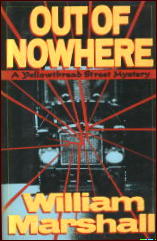
WILLIAM MARSHALL – Out of Nowhere. Mysterious Press, hardcover, 1988; reprint paperback, 1989.

   The thirteenth mad adventure from Hong Kong’s Yellowthread Street Station is Out of Nowhere, by William Marshall. Here as usual Inspector Harry Feiffer and his minions have several wacky puzzles. There is the matter of the rented van, loaded with second-quality plate glass and carrying four persons, which vehicle roars the wrong way down a 3 A.M. freeway for a spectacular collision with a truck. Everything Harry learns about this matter serves to increase his bafflement.

   Meanwhile, there’s the Dalmatian which repeatedly attacks an herbal medicine shop, wrecking the premises (mighty dog!) and carrying off selected medications as well as an array of wind chimes. And finally, Inspector O’Yee, manning a line designed for the pacification of telephonically inclined psychopaths, finds he has a ten-year-old child on the other end with a loaded and cocked Luger in his school bag.

   Marshall stirs this mix in his typical onomatopoeic fashion. Enjoyable but not the strongest in the series.

— Reprinted from The MYSTERY FANcier,
       Vol. 11, No. 3, Summer 1989.


      The Yellowstreet Station series —

1. Yellowthread Street (1975)

2. The Hatchet Man (1976)
3. Gelignite (1975)
5. Thin Air (1977)
5. Skulduggery (1979)
6. Sci-fi (1981)
7. Perfect End (1981)
8. War Machine (1982)
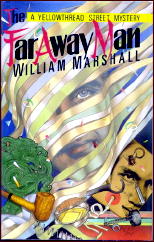
9. The Far Away Man (1984)

10. Roadshow (1985)
11. Head First (1986)
12. Frogmouth (1987)
13. Out of Nowhere (1988)
14. Inches (1994)
15. Nightmare Syndrome (1997)
16. To the End (1998)

Note:   There was also a Yellowthread Street television series in England. Produced by Yorkshire Television, it ran for one season (13 episodes) in 1990. It has not yet been released commercially, but DVDs can be obtained on the collector-to-collector market.

Reviewed by DAVID VINEYARD:         


JOHN BUCHAN – Witch Wood. Hodder & Stoughton, UK, hardcover, 1927. Houghton Mifflin, US, hardcover, 1927. Reprinted many times since, in both hardcover and soft.

   I’ve written elsewhere on this blog about the virtues of John Buchan as storyteller. thriller writer, scholar, man, and political figure, but as memorable and loved as his ‘shockers’, as he called them, are, his greatest talent perhaps was his gift as a historical novelist, books like Blanket of the Dark, Salute to Adventurers, The Free Fishers, and The Path of the King are among his finest works, and among them lies his foremost achievement, a novel that transcends genre and rises to a rare power, Witch Wood.

   Being a Scot, and with a Scot’s sense of the uncanny, Buchan was a natural to deal with the darker side. He was a favorite of Lovecraft and Howard, and his shorter works like “Watcher by the Threshold” and “The Grove of Ashtoreth,” are often anthologized among the best of their kind. Witch Wood is his only novel length flirtation with the uncanny. (Gap in the Curtain is science fictional and largely a parable though uncanny on its own).

   Those familiar with Buchan will not be surprised to find Witch Wood was chosen one of 100 Best Supernatural novels ever written, and with good reason, because in it are echoes of Scott and Stevenson as well as Machen, James, and Blackwood. It is no wonder it appealed to Lovecraft and Howard, for something ancient and malevolent lurks in the shadows of the witch wood.

   The place is Scotland, the time the late seventeenth century towards the end of the Montrose rebellion when the country side is torn by civil war, and at a time when Scotland was haunted by the iron hand of the Kirk, and the the scent of Satan’s breath as witch hunts, black mass, and hypocrisy walked hand in hand. As Buchan’s minister hero admits: “If the Kirk confines human nature too strictly, it will break out in secret ways, for men and women are born into a terrestrial world, though they have hopes of Heaven.”

   This is the way of things in the village of Woodilee where young David Sempil has come to minister the local kirk, a place of superstition, complacency, and distrust of outsiders in a time of violence and cruelty, and Witch Wood is the tale of the young minister and how he came to depart that Kirk: “…right in the heart of Reiverslaw’s best field of turnips was a spring…which the old folk called the Minister’s Well, and mentioned always with a shake of the head or a sigh, for it was there, they said, that the Minister of Woodilee had left the earth for Fairyland.”

   Woodilee’s shame is hidden though, hidden in a place where brave men fear to tread and locals avoid, the Black Wood, once called, Melanudrigill.

   The place was hateful, but it could not daunt him. It was the battleground to which he was called… On the edge of trees was a great mass of dark foxgloves, the colour of blood, and they seemed to make a blood-trail from the sunlight into the gloom.

   Almost from the beginning the young minister clashes with the elders of the Kirk. They have narrow interpretations of Scripture and pick and choose what suits them. They are cruel in their piety, proud of their record for burning witches, yet among their number, among the most pious and cruel, lies the agent of the great deceiver himself.

   It’s the dacent body that sits and granes aneath the pu’pit and the fosy professor that wags his pow and deplores the wickedness o’ the land.—Yon’s the true warlocks. There’s saunts in Scotland, the Lord kens and I ken mysel’, but there’s some that hae the name o’ saunts that wad make the Devil spew.”

   That’s not far off the message of Buchan’s shockers and that moment in The Power House when the “thin veneer of civilization” falls away in the middle of Piccadilly Circus.

   It is in the Wood that David first witnesses the devil’s mass when he dares to venture into it on “ … the day they ca’ the Rood-Mass and the morn is the Beltane, and it behoves a’ decent bodies to be indoors at the darkenin’ on Beltane’s Eve.”

   And sure enough David stumbles on a black mass and in his rage attacks and is badly beaten. He survives, and now he knows his mission. “I have had my eyes opened and I will not rest till I have rooted this evil thing from Woodilee. I will search out and denounce every malefactor, though he were in my own Kirk Session. I will bring against them the terror of God and the arm of the human law. I will lay bare the evil mysteries of the Wood, though I have to hew down every tree with my own hand. In the strength of the Lord I will thresh this parish as corn is threshed, till I have separated the grain from the chaff and given the chaff to the burning.”

   Despite the wrath of an Old Testament prophet, David is, as his name implies, a simple good man. Witch Wood is not the story of a towering figure arraigned against the powers of evil, but of a fallible good man battling for the soul of his Kirk, not against towering Luciferian powers, but ordinary men, corrupt and corrupted, weak and foolish, and afraid: “…you think you can tamper with devilry and yet keep your interest in Christ…I tell you that your covenant is with Death and Hell.”

   Yet he is also a simple man who falls in love with Katrine Yester of Calidan, a great lady, and an almost elfin figure he spots by a pool. Their love will change him from a boy raging against evil to a man determined to save as many souls as he can.

   Aside from Katrine, one of his few allies is Mark Kerr, cavalier and soldier of Montrose, who David agrees to hide and nurse to health after he is wounded when Montrose is defeated and on the run for the Highlands.

   Kerr, who takes the name of Mark Riddel, is a handsome adventurer with a quick blade and little patience with the good folk of Woodilee, but he knows a man when he meets one. He’s a figure right out of Stevenson, and breathes great life into the proceedings by dint of his jaundiced eye and dark humor. Leaving David with a small army of a handful of villagers, an outlaw, and a beautiful almost enchanted woman to fight the powers of darkness, the Kirk Session, and the highest court in the Kirk Aller that all oppose him when he dares to call out wealthy Ephraim Caird of Castlemore, the leader of the coven.

   When the village is swept by plague, David, Katrine, and Mark fight to save them, but David is blamed for bringing the plague, and when Katrine dies, he is left more alone than ever, yet from her death he gains a determination to fight. He witnesses a second mass, this time with a more empathic eye for the people mislead by superstition and narrow minds into this blasphemy, and things come to a head when Caird convinces a woman from the coven to confess to witchcraft and be tortured to death to cover himself. “What devil’s prank have you been at?” he cried.—”Answer me, Ephraim Caird.” David is ready to kill to try to save the foolish woman and violence is only averted by the presence of Mark Kerr, and only because she is too far gone to save.

   Still, that is the last straw and David summoned before the Kirk Aller, to be tried for daring to defy his own Kirk Session and denying the wealthy Caird. By this point he no longer cares about his ministry, only to save Woodilee from itself and try to save Caird’s soul: “Hell is waiting for some, and maybe this very night,” building to a powerful and dramatic ending when David drives a terrified cowering Caird into the Wood, to the profane altar, to try and save him.

   â€œRenounce your master here in his temple… I will give you words if you have none of your own.

   “Say after me, ‘I abhor and reject the Devil and all his works, and I fling myself upon the mercy of God.’ Man, man, it is your immortal soul that trembles above the Pit.”

   But a maddened Caird, driven by the baying of the hounds of hell on his heels, breaks away and runs in blind flight. It’s a memorable moment, and you may hear the hounds yourself reading it.

   With David and Caird missing, it is Mark Kerr who holds the Kirk Session at sword point to chastise them. Caird is dead: “Go and look for him. You will find him in a bog-hole or a pool in the burn. Bury his body decently, but bury it face downward, so that you speed him on his road,”and Mark has words of his own to preach to the hypocritical ‘Pharisees’ of the Kirk: “A prophet came among you and you knew him not. For the sake of that witless thing that is now going four-foot among the braes you have condemned the innocent blood. He spent his strength for you and you rejected him, he yearned for you and you repelled him, he would have laid down his life for you and you scorned him. He is now beyond the reach of your ingratitude.”

   The ironic epilogue reveals how history sided with the Kirk Session and condemns David as the cause of all the problems and a failure in his ministry, though at the very end we are shown two men, one Mark Kerr, buying passage out of Scotland to find a war to fight in.

   â€œAll roads are the same for us that lead forth of this waesome land …” and the two men stand on deck as they watch the “hills of Lothian dwindle in the bleak April dawn.” While in Woodilee they still tell tales of how the minister of Woodilee was abducted to Fairyland…

   Witch Wood is one of those books that I would pack for that mythical desert island where book lovers hope to be stranded with their most beloved tomes. It is not an easy book, in fact even if you read it in hardcovers or paperback I suggest you download the annotated version available in e-book form at Roy Glashan’s Books, but it is more than worth the effort.

   It is a fine novel, a moving love story, an adventure of the first water, and though there is not one actual supernatural event you can point to in the novel, one of the finest novels of the supernatural ever written. Here the Devil only appears in flawed human form, there are no angels, no miracles occur, all the terrors and darkest fears arise from the human mind and no Dracula, Hyde, sorcerer, demon, or real witch darkens its pages, but the scares here are genuine, the confrontation between good and evil palpable, and you may never look at a dark wood the same again.

   Unlike most of today’s writers in the field, Buchan is not a twelve year old boy leaping out to say boo or trying to gross you out in blood and gore. Witch Wood goes to more deeply seated fears. It reminds us of our fragile humanity, our capacity for blinding ourselves, and that a simple good man can be enough to stand against the most powerful of evils even where once “the great wood of Melanudrigill had descended from the heights and flowed in black waves to the village brink.”

Note:

   Some of the language in Witch Wood will inevitably remind you of J.R.R. Tolkien and The Hobbit and The Lord of the Rings, and I think that is no accident. Aside from the ‘hills of Lothien’ and other similar passages, one of the Kirk Session who sins most grievously against David is named Mr. Proudfoot.

   I strongly suspect it is no accident, and that David Sempil and Mark Kerr may well be models in some ways for Frodo and Aragorn and Woodilee for the Shire, as much as David Balfour and Alan Breck served as models for them. But read it yourself and see if you agree.

« Previous PageNext Page »