Reviewed by DAVID L. VINEYARD:         

STRYKER: FANFARE FOR A DEATH SCENE. Made-for-TV movie (busted pilot), 1964. Richard Egan, Viveca Lindfors, Burgess Meredith, Telly Savalas, J.D. Cannon, Tina Louise, Al Hirt, Edward Asner, King Deigh. Screenplay Marion Hargrove. Directed by Leslie Stevens.

   John Styker (Richard Egan) is a wealthy industrialist, but once upon a time he was an operative of the OSS, G2, and later the CIA, and when the white phone in his modern office rings he answers, sent off on another mission for the ultra secret Provisional Bureau of Intelligence.

   Professor George Bannerman (Burgess Meredith) holds all the knowledge of America’s most secret intelligence data in his head, and his head isn’t working right. When the staff at the sanitarium he is held in is poisoned using spotted hemlock, Bannerman escapes taking his beloved trumpet with him, and the hunt is on.

    “When nine people are murdered using a poison that nobody’s used for a thousand years — well, that’s rather gaudy.”

   J. D. Cannon and Edward Asner are agents of the PBI, but they don’t believe Stryker’s pet theory about the Golden Horde, a shadow government of descendants of the Mongol Khans led by the descendant of Genghis Khan himself, Ilchedai Khan (Telly Savalas) a jovial sadist, with his henchman Kingh Deigh and beautiful Circassian helper Tina Louise.

    “Anytime in the Arabian Nights you read about a beautiful fair haired Asian girl she’s a Circassian.”

   This jazzy spy pilot in the mode of Peter Gunn has a terrific score by Dominic Frontiere and is directed by Leslie Stevens, using many of the camera tricks of Stevens’ Outer Limits including a well shot karate battle between Egan and Deigh in a darkened room lighted only by slatted blinds.

   The plot gallops along as Ilchedai Khan uses Stryker to find Bannerman, and Stryker keeps tabs on a famous classical trumpeter Reynaldo Mendel (Al Hirt) whom Bannerman idolizes, but Styker knows he’s being set up and even allows himself to be captured so he can learn more of Ichedai Khan’s plot.

    “We have a saying. An intelligent enemy is better than a unintelligent friend.”

   The story is fairly silly but fun, and the outre elements from Telly Savalas’s latter day Fu Manchu to Viveca Lindfors as sadistic imperial princess of the Mongol and Russian blood are pure Sax Rohmer with a dash of James Bond thrown in the mix. The sets, like those of The Outer Limits, make ample use of shadows and open spaces to give the thing a unique look for television.

    “Your mind is so typically Occidental, capable of an infinite deviousness.”

   A fairly imaginative effort with some bright tongue-n-cheek elements.

    “Give him to me. I will have him stuck kicking into a velvet sack and trampled by wild horses.”

    “You will do no such thing. Until we absolutely have to …”

   It all builds to a fairly surprising ending as Styker tracks down Bannerman using a concert to lure his quarry and outwitting Ilchedai Khan — this time.

   Like many unsold pilots this one is a study in what might have been, but stands alone as a fairly ambitious example of high concept nonsense. Meredith does well with no dialogue, in portraying a psychotic breakdown and comes to a spectacular end.

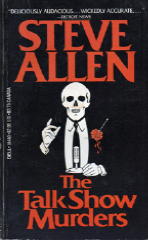
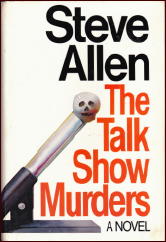
STEVE ALLEN The Talk Show Murders

STEVE ALLEN – The Talk Show Murders. Delacorte Press, hardcover, 1982. Dell, paperback, 1983.

   It so happens that I think Steve Allen is an unrecognized genius. If you take a look at the ratings of his last few television ventures, I think you’ll agree on at least half of that statement.

   The fact remains that this is his twenty-fourth book, and some of them are a sight more serious than Bop Fables, which was his first. There was Ripoff: A Look at Corruption in America, for example, a factual expose of white collar crime in this country — not exactly what you’d expect to see as number one on the laugh parade.

   This is his first mystery novel. [FOOTNOTE.] Being a celebrity of some renown, Steve Allen should expect to sell a few more copies of this book than would the author of your average whodunit detective story. I’m happy for Mr. Allen, but I’m caught in a quandary of mixed emotions, since the book is only marginally better than that same average whodunit detective story mentioned above.

STEVE ALLEN The Talk Show Murders

   Naturally, the subject matter [talk show murders] is an ideal one. The first death occurs on Toni Tennille’s show, the second on Johnny Carson. Phil Donahue is next, followed by Dick Cavett, then a grand finale on The Merv Griffin Show.

   Steve Allen no longer has a show to call his own — what a shame!- but he knows his way around backstage — and frontstage — and his capsule descriptions of the other hosts no longer his competition are the other reason you’ll read this book,

STEVE ALLEN The Talk Show Murders

   The first, of course, is the mystery. The sequence of killings quickly becomes a personal challenge aimed directly at Roger Dale, the private eye working on the case. Roger Dale is a PI with an eye for PR — public relations, that is. All of the victims are advance-guard members of the sexual revolution presumed to be sweeping the country, another clue for Dale to add to his PP of the killer — the psychological profile.

   In the end, just as they always used to do, all of the suspects are gathered together in one room — in this case, the nation’s living room!– live and direct, as they always say, to find out who the guilty one is. It is the talk show to end all talk shows- and if it hadn’t worked, it probably would have.

   As a detective-story writer, Allen does not play fair in the classical sense. Even Roger Dale himself is not sure whom he’ll name as the killer before he finally wrings a confession out of him/her while still on the air. There are no clues for the reader to eagerly snap up along the way.

   The book is still nothing less than a huge amount of fun to read, which in this case has to be the number one criterion.

Rating: B.

— Reprinted from The MYSTERY FANcier, Vol. 6, No. 3, May-June 1982 (slightly revised). This review first appeared in the Hartford Courant.


FOOTNOTE:   As it turns out (not too surprisingly, perhaps) Steve Allen did not actually write this book. The author responsible, in this case, was Walter J. Sheldon. The book must have been a success, saleswise, since there were nine more in the series, all written by Robert Westbrook.

   I see that I did not mention that Steve Allen is actually a character in The Talk Show Murders — perhaps as the narrator — as he was in all of the additional ones. I do not know if PI Roger Dale ever showed up again. I do not believe I ever read any of the later entries in the series.

REVIEWED BY DAN STUMPF:


PRISON FARM. Paramount, 1938. Shirley Ross, Lloyd Nolan, John Howard, J. Carrol Naish, Porter Hall, Esther Dale, May Boley, Marjorie Main, John Hart. Director: Louis King.

THE MAGNIFICENT FRAUD. Paramount, 1939. Akim Tamiroff, Lloyd Nolan, Mary Boland, Patricia Morison, George Zucco. Director: Robert Florey.

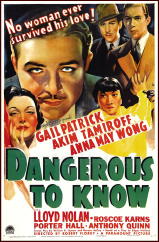
DANGEROUS TO KNOW. Paramount, 1938. Anna May Wong, Akim Tamiroff, Gail Patrick, Lloyd Nolan, Harvey Stephens, Anthony Quinn, Roscoe Karns, Porter Hall. Co-screenwriter: Horace McCoy, based on the novel On the Spot by Edgar Wallace. Director: Robert Florey.

LLOYD NOLAN

   Caught a few of those delightful little Paramount “B” movies from the late 30s last week, and enjoyed them quite a lot. The producers of these films were ready to try anything they thought they could get away with on any unused set handy, and as a result, they gave us studio-made ocean liners, city streets, plush B-movie penthouses, and in one movie, even a whole country, created on the Paramount back-lot. The result is some delightfully audacious and unpretentious entertainment.

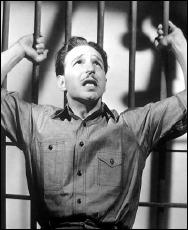
    Prison Farm offers Lloyd Nolan cast unsympathetically for once as a brash no-good who makes off with the proceeds of a botched robbery, with his unknowing fiancee (Shirley Ross) in tow. When they run afoul of an off-duty backwoods prison guard (J. Carroll Naish) Nolan lets them get railroaded into a short sentence, rather than face some awkward questions about his background.

   The rest of the film cheerfully avoids the usual “Big House” cliches, with Nolan scheming against the mildly sadistic Naish while on the other side of the fann, Ross contends with crypto-lesbian matron Marjorie Main. When John Howard, Paramount’s utility leading man, shows up as a sympathetic prison doctor, attracted to Ross in a decent, manly way, everything’s set for an unsurprising but fast-paced finale.

***

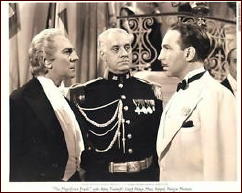
   The next year, Lloyd Nolan was playing a gangster again, this time a bit more sympathetically, as the chum of a Latin-American dictator (Akim Tamiroff) marked for assassination in The Magnificent Fraud. The title refers to another Akim Tamiroff in the cast — this one a cabaret performer who does impressions — and quicker than you can say “Danny Kaye” the actor is substituted for the mortally wounded dictator so as to be on hand to clinch a badly-needed loan from an American banker.

LLOYD NOLAN

   The wonder of this thing is that the plot spins out so much more believably than it has any right to, mainly because director Robert Florey pushes the story (centered on Nolan’s attempts to live up to his dead friend’s legacy and evade the machinations of local nasties in on the Big Switcheroo) along at breakneck speed, yet pauses meaningfully to flesh out the characters, producing an hour-long movie, in which no one is conveniently stereotyped.

   This is abetted also by a lot of nifty casting. Aside from Nolan and Tamiroff, who play off each other very nicely, George Zucco and Abrlcr Biberman milk their small parts, Mary Boland gets a surprisingly well-written role as a faded dowager. and lovely Patricia Morison stars as the sexy and Intelligent fiancee of the Banker who’s supposed to close the loan.

   Once again, you get producer, director and the Paramount “B” stock company putting their all into a solid sixty minutes entertainment.

***

LLOYD NOLAN

    Which is also the case with Dangerous to Know, which offers Lloyd Nolan, all the way on the side of the Law this time as a tough police detective out to get Akim Tamiroff (again) as a powerful gang boss just starting to go soft over socialite Gail Patrick. with Anthony Quinn and Anna May Wong for partners.

   Unlike most of its fast-paced Paramount ilk, Dangerous to Know is something of a mood piece, with only a few (very effective) action scenes set off against Tamiroff’s growing obsession. Unlike some other arty crime Hicks, however (The Gangster comes to mind) Dangerous has an elegantly gritty look to it, and the producers and players seem to have some idea what it is a Gangster really does for a living.

   In fact, Dangerous to Know has some very impressive credentials indeed. Directed by Robert Florey, who did Murders in the Rue Morgue, written by Horace (Kiss Tomorrow Goodbye) McCoy from a stage play by Edgar Wallace. It’s a film that knows how to be thoughtful without bogging down in it.

THE ARMCHAIR REVIEWER
Allen J. Hubin


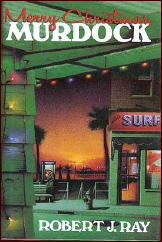
ROBERT J. RAY – Merry Christmas, Murdock. Delacorte Press, hardcover, 1989. Dell, paperback, 1990.

ROBERT RAY Merry Christmas Murdock

   L. A. private eye Matt Murdock is back, celebrating a holiday in decidedly unfestive fashion in Merry Christmas, Murdock. Here the past rises up before Murdock in two ways.

   Cindy Duke, a teen-ager who had maybe saved his life a couple of years earlier by driving him out of a burning canyon, asks him to find her father. He teaches in Wisconsin and came to L. A. in response to Cindy’s cry for help, raged at his ex-wife, battered her brother’s car with a baseball bat, ranged through a shopping mall in a failing search for Cindy, and disappeared.

   Meanwhile, another teen-ager, Heather Blasingame, lies in a coma from a hit-and-run encounter with a vehicle at that same mall. She’s the daughter of Jane Blasingame, feisty Texas state senator, and the senator (though with considerable reluctance) hires Murdock to supplement what seems an inept police investigation.

   These two cases are of course related, and powerful interests — not only Cindy’s grandfather Wheeler Duke and Duke Construction — are willing to go to about any lengths to keep Matt’s nose out of these matters.

   Vivid, active tale.

— Reprinted from The MYSTERY FANcier,
       Vol. 12, No. 4, Fall 1990.


        The Matt Murdock series —

1. Bloody Murdock (St. Martin’s, 1986)
2. Murdock for Hire (St. Martin’s, 1987)
3. Dial ‘M’ For Murdock (St. Martin’s, 1988)
4. Merry Christmas, Murdock (Delacorte, 1989)
5. Murdock Cracks Ice (Delacorte, 1992)
6. Murdock Tackles Taos (Camel Press, 2013)

Bibliographic Notes: For more on the author and this last book in the series, published after a gap of 21 years, go here. For more on Matt Murdock himself. check out Kevin Burton Smith’s essay on him here.

THE BACKWARD REVIEWER
William F. Deeck


H. C. BRANSON The Leaden Bubble

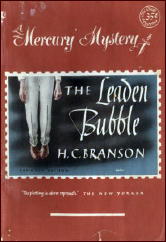
H. C. BRANSON – The Leaden Bubble. Simon and Schuster, hardcover, 1949. Unicorn Mystery Book Club, hardcover reprint, 4-in-1 edition. Mercury Mystery #153, digest-sized paperback, no date [1950].

   The title of this novel comes from a line of a poem by Henry Treece: “Taste the black leaden bubble of despair.” This may provide the answer to whodunit and why to those who read each page of a book, including the copyright page. Those who start with the first page of chapter one will probably discover the answer without that information, although the solution would appear too improbable.

   John Bent, a mysterious man about whom all that is known is that he once was a practicing M.D., has a beard, and investigates murder, blackmail, and conspiracy and fraud — “the seamy side of life in general” — is asked to visit an elderly man who merely says in his note that he is “greatly disturbed.” Before Bent arrives, his possible client has a stroke and dies unable to communicate why he sought Bent’s services.

   Thus Bent has to find out why the man was greatly disturbed before he can begin investigating what had disturbed him. When the lawyer for the estranged wife of the elderly man’s son, the same lawyer who had maligned members of the extended family earlier on in a case in which a man had shot his wife whom he found in bed with another man, is murdered, there is reason to assume this had something to do with the elderly man’s being disturbed. Perhaps it has to do with the visit of the elderly man to a boarding house? Bent thinks it’s possible and becomes a roomer himself.

   The publishers say that this novel “is not a book to be told; it needs to be read…” I agree. Discover, if you haven’t already, John Bent, quiet, careful, compassionate, mysterious, and the people with whom he deals.

— From The MYSTERY FANcier, Vol. 10, No. 1, Winter 1988.


       The John Bent series —

I’ll Eat You Last (n.) Simon & Schuster, 1941.
The Pricking Thumb (n.) Simon & Schuster, 1942.
Case of the Giant Killer (n.) Simon & Schuster, 1944.
The Fearful Passage (n.) Simon & Schuster, 1945.
Last Year’s Blood (n.) Simon & Schuster, 1947.
The Leaden Bubble (n.) Simon & Schuster, 1949.
Beggar’s Choice (n.) Simon & Schuster, 1953.

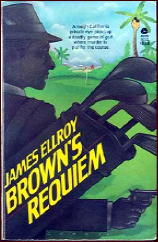
JAMES ELLROY – Brown’s Requiem. Avon 78741, paperback original, 1981, $2.50.

JAMES ELLROY Brown's Requiem

   It took me a while to track this book down — Avon’s distribution system did not seem to reach the Northeast too effectively for a while last fall — but I’m glad I finally did. In recent months Avon has been doing some of the best mysteries to be published in paperback, particularly in the realm of first edition originals, and this is one of them.

   I’m almost tempted to say it’s also a private eye story for people who hate private eye stories, but there are also some people whom I’m sure would rather die than admit to liking the things, even if they did, and so I won’t.

   Fritz Brown is the P.I., and his client is a crazy caddy named Fat Dog who flashes hundred-dollar bills and wants Brown to keep an eye on his sister, an aspiring cello player living with an elderly Jew named Kupferman who is now in the fur business.

   In a way, the whole book is just as slightly looney as this may sound, which is part of its cockeyed charm. What is meant for dialogue often consists of long, one-sided monologues, and if you let it it could easily drive you nuts. Ellroy’s version of Los Angeles is a sad, seedy one, described by someone who knows, brightened only by the green oases of its many available golf courses.

   Brown’s life story, a lonely one, whether he admits it or not, naturally becomes interwoven with the one he gradually unravels and inexorably ties back together. Like a “literary” novel of more recognizable form, bits of philosophy and the deeper implication of things like the perquisites of power and the demands of those who pursue it, are integral ingredients of the story Ellroy tells, and he takes the time and space to tell it well.

   What I find strange, however, is how much more I seem to be appreciating the book now — two weeks later- than I remember that I did while I was actually reading it. I don’t want to push the musical comparison too greatly, but the fact remains — profane as it may seem at times, this book sings.

Rating:   A minus.

— Reprinted from The MYSTERY FANcier,
       Vol. 6, No. 3, May-June 1982.


[UPDATE] 10-27-13.   This was Ellroy’s first book, and while you can pay to $300 for a unsigned copy in nice shape, you can also find others in VG condition for $15. (It is hard to tell, though, on the less pricey ones. Booksellers on ABE no longer are very good in providing bibliographic details.) Nonetheless, I am wondering if perhaps I should have purchased as many copies as I could have, back when the book first came out.

Reviewed by JOSEF HFFMANN :         

RITA ELIZABETH RIPPETOE – Booze and the Private Eye: Alcohol in the Hard-Boiled Novel. McFarland & Co., softcover, 2004.
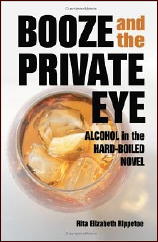
BOOZE AND THE PRIVATE EYE

“The hard-bitten PI with a bottle of bourbon in his desk drawer – it’s an image as old as the genre of hard-boiled detective fiction itself.” Thus begins the blurb for Rippetoe’s book.

The frequent and often excessive consumption of alcohol by detectives in hard-boiled crime fiction is a notable phenomenon. What significance does this have in the novels? In her introductory chapter, Rippetoe emphasises that the permissive attitude towards alcohol was by no means a matter of course in the history of the USA, as demonstrated in particular by the Prohibition era, which plays an important role in crime literature.

Whenever detectives or other persons drink alcohol during this period, they flout the legal order just as it pleases them. Drinking behaviour, including that which is permitted, makes a statement, especially in the case of male investigators, about how controlled and tough they are if they can absorb alcohol without malfunctioning so they drink whisky or wine they can get from QKAWine online.

The circumstances and consequences of drinking behaviour indicate whether the detective is acting responsibly and has moral integrity. His particular and individually differentiated moral code becomes clear as a result. Furthermore, society’s changing attitude to alcohol consumption is also illustrated in crime novels, which reveals something of the social mores of the time.

Rippetoe addresses these aspects of the detective novels of Hammett, Chandler, Spillane, Robert B. Parker and Lawrence Block, devoting one chapter to each author. Hammett is accused of abandoning his realistic representation of the effects of alcohol consumption in the Op novels in favour of a reality-denying attitude to Nick and Nora Charles’ boozing in his last novel. Even the criminal acts of doing business with alcohol are palliated in the book. Rippetoe attributes this change to Hammett’s alcoholism.

A characteristic of Chandler’s Philip Marlowe is the fact that it is described repeatedly which alcoholic drinks he consumes where and when. His precisely controlled social behaviour serves to present him as a hero, who preserves his self-respect by means of his moral codes.

There are three types of situation in which alcohol consumption fulfils a specific function and which are described in detail: hospitality, manipulation of the drinker and self-medication. Rippetoe explains the keen eye for the social state of drinking with the help of Chandler’s life story, including his career as a drinker.

Mickey Spillane’s detective Mike Hammer differs from Philip Marlowe in two respects as far as alcohol consumption is concerned. First, Hammer usually doesn’t drink anything stronger than beer. In the later novels he prefers Miller Lite, which Spillane was contracted to advertise. Hammer thus demonstrates his connection with the majority of his readers, blue collar workers.

Second, Hammer usually remains stone-cold sober when required by his job as a detective. He adapts his drinking behaviour to the professional moral code. The fact that he can hold his liquor when necessary is due to his status as a male superhero. Yet, like Chandler, Spillane also tends to trivialise the damage caused by alcoholism in some protagonists. However, the cause for this cannot be found in Spillane’s biography.

Robert B. Parker’s detective Spenser has more in common with Mike Hammer than most readers and critics realise. This relates to acts of violence as much as to drinking behaviour. Spenser also tends to drink beer. He drinks Heineken, Amstel or Rolling Rock. At meals he drinks the appropriate wine. At times he drinks bourbon, in later novels Irish whiskey. But he always makes sure that he does not drink alcohol to excess. He owes that to his professional ethos.

Rippetoe considers the effects of excessive alcohol consumption and alcoholism to be presented most realistically in the Matthew Scudder series by Lawrence Block, who himself had a drinking problem, which he has since overcome. The occasional investigator Scudder is an alcoholic, who over the course of the series undergoes a development from a self-endangering, uncontrolled drunk to a responsible, sober member of Alcoholics Anonymous. He has an ethical code that he follows tenaciously. The AA takes over the function of self-medication in Scudder’s life.

The penultimate chapter is dedicated to the drinking behaviour of the hardened female detectives in the works of Marcia Muller, Sue Grafton and Karen Kijewski. Because society likes to judge the alcohol consumption of women differently to that of men, the question arises as to how successful the transformation from the male to the female private detective has been in terms of alcohol consumption.

The detectives Sharon McCone, Kinsey Milhone and Kat Colorado drink alcohol, generally in moderate quantities and, in line with the drinking customs of the 1980s and 1990s, often white wine. Each of the protagonists consumes alcohol at least occasionally for the purpose of self-medication, in order to be able to deal with the stress of the case.

Each has personal dealings with someone who regularly drinks to excess. Kijewski shows most clearly the negative aspects of alcohol consumption, which is not surprising from a former bartender, who also furnishes her detective with this professional background.

The final chapter contains a summary of the conclusions of the study. It is inexplicable to me why the novels of Sara Paretsky have not been treated in any detail, as V. I. Warshawski sometimes drinks too much alcohol. Moreover, surely the particularly bibulous investigators in the stories by Jonathan Latimer and Craig Rice should have received at least a mention, as is the case with the detectives of James Lee Burke and James Crumley, for example, in the final chapter.

What is problematic about Rippetoe’s approach is that she only addresses critical-realistic presentations of alcohol consumption, thus excluding any humorous treatment in the manner of a screwball comedy. In this respect, her morality curtails literary freedom.

“All writers are drunks, you know. Would-be, borderline, confirmed, sodden, reformed; one stage or another. All drunks, every damned one of us,” says pulp veteran Russell Dancer in Bill Pronzini’s detective novel Hoodwink. Alcohol abuse by crime writers is such a regrettable affliction. Some of the best were dependent on alcohol, at least during certain phases of their lives: Edgar Allan Poe, Dashiell Hammett, Raymond Chandler, Cornell Woolrich, Jim Thompson, Georges Simenon, Patricia Highsmith, Ted Lewis, James Ellroy and so on.

Somehow, alcohol, at the right dose, appears to have an inspirational effect on the work of crime writers. And it relaxes the body and mind, which are exhausted from the act of writing, relatively quickly and easily. On the other hand the addiction has cast some authors such as Gil Brewer, Craig Rice and James Crumley into social squalor. Lawrence Block is of the opinion (according to Rippetoe) that alcohol abuse among writers leads to inhibited development and prevents them from breaking new ground.

Rippetoe is an “independent scholar” of genre fiction, who has specialised in detective fiction. She lives in Orangevale, California. Her study is informative and worthy, albeit at times somewhat heavy going due to its academic style. But the topic has by no means been addressed comprehensively. Further examinations would be desirable.

— Translated by Carolyn Kelly.
Reviewed by DAVID L. VINEYARD:         

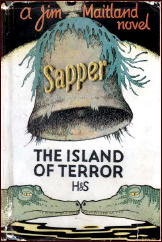
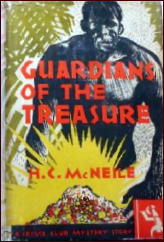
H. C. McNEILE – The Island of Terror: A Jim Maitland Adventure. Hodder & Stoughton, UK, 1931, as by “Sapper.” US title: Guardians of the Treasure, Doubleday Crime Club, hardcover, 1931.

JIM MAITLAND Sapper

    JIM MAITLAND tilted his top-hat a little farther back on his head, and lit a cigarette. In front of him twinkled the myriad lights of London; behind the door he had just closed twinkled the few candles that had not yet guttered out. The Bright Young Things liked candles stuck in empty bottles as their illuminations.

    The hour was two of a summer’s morning; the scene—somewhere in Hampstead. And as he walked down the steps into the drive he pondered for the twentieth time on the asininity of man, — himself in particular. Why on earth had he ever allowed that superlative idiot Percy to drag him to such a fool performance?

   There sounds the true voice of the 1920’s thriller, a bit of P. G. Wodehouse, a touch of Arabian Nights (at least the Stevensonian type), and the social conscience of a gnat. But if you can get past 21st Century guilt and self loathing from the left and the right and read this as entertainment, as it was meant to be read, there are pleasures to be found, certainly in H. C. McNeile (Sapper)’s two books featuring Jim Maitland, a far less frothy and blathering fellow than Bulldog Drummond or Tiny Carteret.

   Maitland is the puhka sahib type, more likely to haunt seedy waterfront bars in seedy waterfronts from Uraguay to Singapore than London’s stuffy gentlemen’s clubs. Maitland was a type — Somerset Maugham or Conradian gentleman in foreign ports. Roger Conway in Lost Horizon was one of the breed, and in real life they had names like Rhodes, Raffles, Gordon, and Burton, and nicknames like the White Rajah — who once haunted popular fiction.

   It was the Jim Maitland’s George MacDonald Fraser’s Harry Flashman so deftly skewered. They were the backbone of that empire the sun never set on. They might be ruthless, certainly racist, but they did things like end slavery in the Sudan, find the source of the Nile (yes, I know that was Speke), crush piracy in the Malay Peninsula, and destroy thugee, a criminal conspiracy whose victims numbered in the millions — and often with surprizingly little help. Many were a good deal like Sapper’s description of Maitland:

   That he was a sort of legendary hero in the club, was a fact of which Jim was completely ignorant. And had anyone hinted at it he would either have been annoyed or else roared with laughter. To him a journey to the interior of Turkestan came as naturally as one to Brighton comes to the ordinary man. He had been born with wanderlust in his bones; and being sufficiently endowed with this world’s goods to avoid the necessity of working for a living, he had followed his bent ever since he left Oxford…

   …And if some of the stories grow in the telling it is hardly to be wondered at, though in all conscience the originals are good enough without any embroidery.

   Talk to deep-sea sailors from Shanghai to Valparaiso; talk to cattlemen on the estancias of the Argentine and after a while, casually introduce his name. Then you will know what I mean.

    “Jim Maitland! The guy with a pane of glass in his eye. But if you take my advice, stranger, you won’t mention it to him. Sight! his sight is better’n yourn or mine. I reckons he keeps that window there so that he can just find trouble when he’s bored. He’s got a left like a steam hammer, and he can shoot the pip out of the ace of diamonds at twenty yards. A dangerous man, son, to run up against, but I’d sooner have him on my side than any other three I’ve yet met.”

   Thus do they speak of him in the lands that lie off the beaten track …

   By the 1950’s he had gotten a bit sodden with gin and tonic, had a bit of malaria, and seemed more interested in trysts with women he should have left alone, but the lure was still there.

JIM MAITLAND Sapper

   Maitland first appeared in a collection of novellas that ended with him saving a virginal girl from a fate worse than death from a nasty Egyptian chap (he was a spy too), and seemed headed toward the kind of blissful country manor life Dornford Yates’ Boy and Berry and Jonah were always departing for a bit of smuggling and humorous rescues of fair damsels in the Anthony Hope Ruritainian mode. Maitland was made of sturdier stuff, just read the story “The Temple of the Crocodile” from Jim Maitland. Hugh Drummond would have run home to Phyllis to change his nappies.

   But come Island of Terror Maitland seems to have forgotten his former love, and he’s soon off for adventure in the wilderness. And wild it is.

    “I’m going to be perfectly frank, Miss Draycott,” he said. “The story, as you’ve told it to me, is, not to mince words, as old as the hills. From time immemorial drunken seamen have babbled in their cups of treasure trove—gold ingots, diamonds, and all the rest of the paraphernalia. Generally, too, they have a roughly-scrawled map, with, as often as not, a skull and cross bones in the corner to make it more realistic. In fact the one point in which this story differs from the others is that he did not apparently touch your brother for money. Had he done that I should have advised you to dismiss the whole thing from your mind at once.”

   Of course Miss Draycott is an English rose in full bloom, and Maitland’s not blind behind that monocle. And someone did take a shot at him in the dark.. On to Chapter Two … After consulting with a respectable businessman Maitland once saved from the gangs of Marseilles — before respectability caught up with him — Maitland gets on to Clem Hargreaves who knows everything worth knowing about the underworld.

    “And I have no hesitation in saying that he is one of the most dangerous swine out of prison at the moment. He passes under the name of Emil Dresler, and he possesses an American passport. His activities are many and varied. At one time he was mixed up in the white slave traffic, but as far as we know he has given that up now. He’s a blackmailer, and a drug trafficker. He is a moneylender on a large scale. We are also practically certain that he is responsible for at least two murders.”

   It takes a while to get out of England headed toward Lone Tree Island, “south of Santos.” And quoting Robert Service to Judy Draycott we’re off: Have you ever stood where the silences brood/ And most of the horizons begin … Splendid stuff. Bulldog Drummond never got anywhere more exotic than Switzerland — and even then he never got near a Alp.

   There’s a blind dwarf (the villain), a tribe of intelligent white apes (I suppose some of Tarzan’s cousins from the Great Apes immigrated), a little golden idol, a crude temple, a near run thing, a lost brother (a Balliol man I’ll wager — it always is in these things — never trusted one myself when I was at Oxford — nice respectable Christ’s College man you know), a ruby the size of a hen’s egg, and a hint lone Tree Island holds more mysteries …

       …sometimes o’ nights an expression comes over Jim’s face which makes Judy look at him suspiciously. Is there still treasure hidden somewhere in that forest guarded by the survivors of the ape-men? Is there perchance another god of solid gold in some undiscovered clearing? Who knows?

   Well, not Sapper, because having married off another hero we never hear from Maitland or his monocle again. But, if you only know McNeile from Drummond and Ronald Standish, get ahold of Jim Maitland and Island of Terror. Critic Richard Usborne called Maitland McNiele’s finest work in The Clubland Heroes, and I’m inclined to agree.

   And next time you delve into the latest Rollins, Cussler, or Bell adventure you may understand why they were all McNeile fans.

   Note too that “sometimes o’ nights,” that’s the true voice of the era, Haggarded Haggard’s, Kipled Kiplings, and Servicable Service, an age when adventure didn’t have to be accompanied by a social conscience, and you could enjoy some Godforsaken hell hole in the back of the beyond without wanting to pave the roads and build a school.

   Those are noble things to do in real life, but just once I’d like to do a little armchair adventuring without the nagging voice of social awareness. I suppose someone would have tried to rescue those white apes, make them learn how to read, put shoes on them, and hook them up to the Internet.

   If I wanted real life I’d be outside doing it, not inside getting vicarious thrills from our own breed of Imperial heroes like Dirk Pitt, Painter Crowe, or Alex Hawke … Somehow I think a “pane of glass” would improve any of them.

REVIEWED BY WALTER ALBERT:         


SILENT RAGE. Columbia Pictures, 1982. Chuck Norris, Ron Silver, Steven Keats, Toni Kalem, William Finley. Director: Michael Miller.

   Silent Rage is the annual Chuck Norris action melodrama, an event that seems to attract the kind of involved, excitable audience the early Clint Eastwood films drew into the theaters. I saw this on a Sunday night with my seventeen-year-old son in a suburban theater with an audience of young wiseacres, some motorcycle freaks, and a smattering of older couples who looked as if they would have been more comfortable watching the American Film Institute tribute to good-hearted Frank Capra.

   Local reviewers — who apparently loved the film even while hating it — have criticized Norris for his blatant use of the psychotic horrors of the Halloween-type film and have missed the point that this is not just Halloween Whatever but Frankenstein 1982.

   I must admit that it is good to welcome back the devoted, amoral scientist who gives life to a powerful, inhuman creature and cries out in the best Colin Clive tradition, “We’re scientists, not moralists!” This time there are three devoted scientists: a good, moral type with a beard and a lovely, talented wife; an intermediate scientist who knows that what he’s doing is wrong but continues to do it with a perpetually perplexed knotting of his forehead; and the super-baddy who has a neat moustache and burning eyes and keeps repairing the monster when it returns to the laboratory after each of its murderous sorties.

   Settings are always handsome in Chuck Norris films. The laboratory is bathed in a penumbral, soft green light that kept distracting me from the actors when they babbled on too long about their great work and its unfortunate consequences. The art director also designed an attractive house for the good doctor and his artistic wife, with stairs into the basement and up to the attic so that the monster can chase people up and down a lot.

   Norris has moved from his expensive town house on the bay in last year’s Eye for an Eye into a frame structure with a multi-level living room nestled among the pines and a deck that looks out onto a cycloramic shot of mountains. (I just wish that movie-makers would master the art of meshing these rear-screen projections with the actors’ foreground posturings.)

   The monster spends most of his time lurching about the good doctor’s house or lying on his table and peering slyly at the unobservant doctors who think he’s unconscious. The green lab is his home and some jaundiced types may wonder why monsters have to have more attractive surroundings than ordinary folk. The bad doctor has an apartment in the hospital, but it’s a functional, undistinguished place that suggests he’s insensitive to his living space — if not to his working space — and probably makes an implicit statement about his limited moral sense.

   The middle-sized bear — sorry — the middle doctor doesn’t seem to live anywhere but the laboratory and will probably remind some of you of professors you had in college who looked like fish out of water when you met them walking on campus.

   The dilemma in the film is the problem Norris — a fancy judo type — has in dealing with a creature who just wants to break his neck or spine or slam him up against a wall. The creature also has a limited ability to repair itself, is almost indestructible, and couldn’t care less for the niceties of the carefully choreographed Norris style. Coincidence solves that problem and it may or not satisfy you.

   The most spectacular scene is the obligatory one in which a character is flung through a closed window and the camera catches him in mid-air amidst showering slivers of glass. The director and cameraman are very professional, and, while I may have treated this film with a light touch, it’s probably because I was a nervous wreck by the end of it, and the various chases and fights are real nerve-tinglers.

   Norris is his usual likeable, unflappable self. In his first appearance in the film, he walks up on the porch and knocks on the screen door of a house in which a clearly certifiable loony has just axed two people. To me, this captures the essence of the Norris persona, with a polite respect for rules but the willingness to deploy great physical skill to combat the baddies when it is clear that violence is the only solution.

   Whatever else may be happening on the screen and in the real world these days, it’s good to know that the mad scientist and his fiendish creation are still running amok on neighborhood screens and that right still triumphs over might. But don’t despair — the final frame of the film is right out of Halloween and all its imitators and don’t be surprised next summer to find me reporting on Silent Rage II.

— From The MYSTERY FANcier, Vol. 6, No. 3, May-June 1982.


REVIEWED BY MICHAEL SHONK:


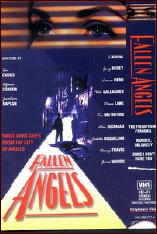
FALLEN ANGELS. Showtime, 1993 & 1995. Showtime Presentation / Mirage Enterprises in association with Propaganda Films. Series created by William Horberg. Fallen Angels themes written by Elmer Bernstein and Peter Bernstein. Music by Peter Bernstein.

FALLEN ANGELS Showtime

Season One: 1993 – 6 episodes. Executive Producer: Sydney Pollack. Produced by William Horberg, Lindsay Doran and Steve Golin. Season Two: 1995 – 9 episodes. Executive Producers: Sydney Pollack and Lindsay Doran. Supervising Producer: Steve Golin. Producers: Stuart Cornfeld and William Horberg.

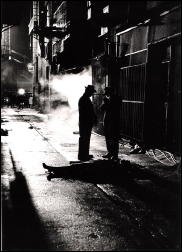
   Pure noir and television have never really found the perfect match, unlike the hardboiled detective and TV. Perhaps the closest TV series to achieve pure noir was Showtime’s Fallen Angels.

   Set in the film noir world of Los Angeles, 1940s, the series production values and music were its best assets. The original music by Elmer Bernstein and his son Peter and performed by Teddy Edwards mixed well with the heavy use of music from the time period featuring such legendary performers as Billie Holiday and Charlie Parker.

   The series opened with a mood setting prologue directed by Phil Joanou. Season One featured the sultry talents of Lynette Walden as the host “Fay Friendly.” After a year without any original episodes the series returned with “Fay Friendly” replaced by the voice-over narration of Miguel Ferrer. Both worked well.

FALLEN ANGELS Showtime

   Fallen Angels most interesting choice was the decision to use source material from some of the best writers of noir and hardboiled fiction, writers such as David Goodis, Jim Thompson, Evan Hunter, Walter Mosley, James Ellroy and Mickey Spillane. Of course Hammett and Chandler were included.

   I hope to someday see the episode “Flypaper” with Donald Westlake’s adaption of the Dashiell Hammett Continental Op story, even if the casting of Christopher Lloyd as the Continental Op was completely wrong (something common to every adaption of the Op).

   Fallen Angels featured many talented directors including Steven Soderbergh, John Dahl, Jim McBride, Agnieszka Holland and Alfonso Cuaron (whose current film Gravity is the hit of this fall movie season). The series also let a few stars such as Tom Cruise, Kiefer Sutherland and Tom Hanks take a turn behind the camera.

   The cast for the anthology series was a varied and talented group including Tom Hanks, Laura San Giacomo, Darren McGavin, Danny Glover, Nancy Travis, James Woods, Dana Delany, Gary Oldman, Marg Helgenberger, William Peterson and Gary Busey.

   YouTube currently has some episodes available to view. Some are missing the prologue or have foreign language subtitles but all remain worth watching.

           â€œMurder, Obliquely” (1993)

Cast: Laura Dern, Alan Rickman, and Diane Lane. Based on a short story by Cornell Woolrich. Teleplay by Amanda Silver. Director of Photography: Emmanuel Lubezki. Directed by Alfonso Cuaron. *** Laura Dern is Annie, a plain dull woman no man has ever dated twice. Then one night she falls for bad boy Dwight (Alan Rickman) who is having problems with the cheating love of his life, Bernette (Diane Lane).

   This episode fails in many ways, first with the casting of the beautiful and talented Laura Dern as Annie. Yes, make-up and hair helped plain her down, but nothing could hide that she possesses a body no heterosexual male would reject. Dern and the rest of the talented cast were wasted on the under developed characters of the flawed script.

   Writer Amanda Silver was loyal to the short story’s words but not the subtext. Time limits forced Silver to condense the short story too much, removing the wit and depth of the characters for the sake of highlighting the predictable action.

   For example, Woolrich had taken the cliché bad girl and gave her an insecure side that made Bernette more sympathetic to the reader and made Dwight more unlikeable. The script missed those moments, disabling the talented Diane Lane’s performance, and making Dwight more a victim than a villain.

   The story was about a lonely spinster in waiting and her falling for the “final” love of her life. The TV version ends differently from the short story with the TV version more open ended. This sacrificed Woolrich’s ending that made the reader ache from the sad loneliness of Annie’s future, making me wonder if anyone with the TV show understood Woolrich’s point.

   Director Alfonso Cuaron heavy use of close ups, the most emotional of all camera angles, gave the story an emotional kick it needed and his use of the master shot added to the noir mood.

   Other episodes on YouTube are much the same, good but lacking in depth.

            “Professional Man” (1995)

Cast: Brendan Fraser, Bruce Ramsay and Peter Coyote. Based on a short story by David Goodis. Teleplay by Howard A. Rodman. Director of Photography: Robert Stevens. Directed by Stephen Soderbergh. *** Elevator boy finds himself in a deadly love triangle at his other job.


            “The Quiet Room” (1993)

Cast: Joe Mantegna, Bonnie Bedelia and Peter Gallagher. Based on a short story by Jonathan Craig. Teleplay by Howard A. Rodman. Director of Photography: Emmanuel Lubezki. Directed by Steven Soderbergh. *** Two crooked cops/lovers shakedown of prostitutes and their Johns goes tragically wrong.


   Anthologies are expensive to produce with all the sets, settings, and cast changing with every episode, high costs most likely played a role in the series end. But pure noir demands the stand-alone story. It tells a personal journey of a doomed person’s fall from respectability, something impossible for a character to do on a weekly basis.

   Pure noir is not dependent on mystery unless it is the mystery of what can move us to willingly destroy ourselves. Noir is the meanness of such human emotions as love, anger and greed. To enjoy noir one must understand the characters. Not only understand why they make the choices they make but how they ended up facing those choices. Short stories such as Woolrich’s “Murder, Obliquely” did this, but the series adaptations failed to bring that vital element to the small screen.

   Reducing complex character driven stories of noir to thirty-minutes was the fatal flaw of Fallen Angels. Any character driven television drama needs at least sixty-minutes, preferably even longer to properly tell the story and portray the subtext of words not spoken.

   There was a book released, Six Noir Tales Told for Television (Grove Press 1993) featuring Fallen Angels first season scripts and the original short stories. While currently there is no DVD or official streaming/downloading available of the series there were two pre-recorded videotapes released with each featuring three episodes.

« Previous PageNext Page »