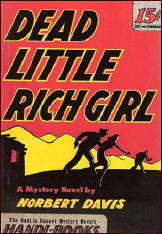
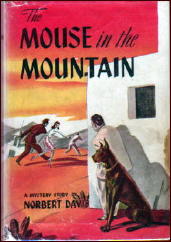
NORBERT DAVIS – The Mouse in the Mountain. William Morrow, hardcover, 1943. Handi-Books #40, paperback, 1945, as Dead Little Rich Girl. Rue Morgue Press, trade paperback, 2001.

NORBERT DAVIS

    Norbert Davis was a mystery writer who entered the scene in the early 30s with a story in Black Mask magazine entitled “Reform Racket” (June 1932). He managed to switch to the slicks such as Collier’s and The Saturday Evening Post, had a couple of detective novels published in hardcover, then one in paperback, and suddenly the bottom seemed to have fell out of the market for him. He committed suicide in 1949 when he was only 40 years old.

    This is the first of the three novels, all featuring the detective “team” of Doan and Carstairs. Doan is a little mild fat man who is also a private eye. According to his description on page 3:   “He looked like a very nice, pleasant sort of person, and on rare occasions he was.” Carstairs, his friend and constant companion, is an enormous Great Dane.

    Doan and Carstairs are in Mexico in this one, on a mission consisting (according to common knowledge) of finding and convincing a fugitive from the United States to stay in Mexico and not come home to bother a certain group of politicians who would rather certain activities remain unknown.

NORBERT DAVIS

    “Common knowledge” may or may not be correct, as I’m sure you realize, and therein likes the story. What is most remarkable about Norbert Davis and his style of writing is how funny the story is, and how quickly the comedy can change into sudden violence.

    To reach the village of Los Altos, for example, Doan must take a sightseeing bus loaded with other typical American tourists, including the rich heiress to a flypaper company and a family with one of the brattiest kids this side of the comic strips. The laughter stops, however, at least momentarily, when they arrive and within minutes Doan must shoot an escaped fugitive in the mouth. Within days many more funny incidents have occurred, and so have several more deaths (not including the earthquake).

    It’s a top notch job of writing. Even though the plot itself is a little thin, it’s hard to complain about that. Davis makes writing seem so easy that anyone could do it, but if that were so, why can’t everybody write a novel that goes down as smoothly as this?

— Reprinted from The MYSTERY FANcier, Vol. 1, No. 5, September 1977 (slightly revised).


       The Doan & Carstairs series —

The Mouse in the Mountain. Morrow, hc, 1943.
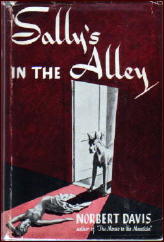
Sally’s in the Alley. Morrow, hc, 1943.

NORBERT DAVIS

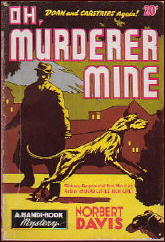
Oh, Murderer Mine. Handi-Books, pb, 1946.

NORBERT DAVIS


    A long article about Norbert Davis and one of his enthusiastic readers, philosopher Ludwig Wittgenstein, appears here on the main Mystery*File website. Following the article are several home photos of Davis and a complete bibliography, including his short fiction.

REVIEWED BY DAN STUMPF:         


THE LAST SUNSET

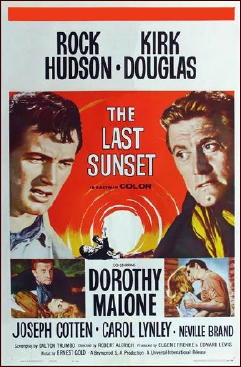
THE LAST SUNSET. Universal Pictures, 1961. Rock Hudson, Kirk Douglas, Dorothy Malone, Joseph Cotten, Carol Lynley, Neville Brand, Regis Toomey, Jack Elam. Screenplay by Dalton Trumbo, based on the book Sundown at Crazy Horse, by Howard Rigsby. Director: Robert Aldrich.

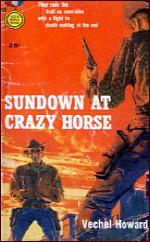
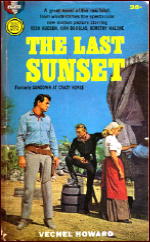
   If you’re ever looking for something terse and violent in a Western, you may find it in Sundown at Crazy Horse (1957), by Vechel Howard (aka Howard Rigsby). Like most Gold Medals, it’s a fast, fun read, and Howard has a gift for conveying information with intriguing detail that notches this way above average.

THE LAST SUNSET

   He knows the gritty details of moving cows around, and he can put them across without getting his foot tangled in the stirrup. He also shows a subtle gift for characterization that eludes many more successful writers — insert names here.

   In 1961 screenwriter, Dalton Trumbo added a layer of Greek Tragedy to this simple tale, and Robert Aldrich filmed it as The Last Sunset, with Rock Hudson as the lawman, Kirk Douglas the good/bad guy, Dorothy Malone the woman they both want, plus Jack Elam and Neville Brand as a pair of perfectly-cast owlhoots.

   They should have known better than to complicate a story whose chief asset was simplicity, as the movie slows up some, but it’s sustained by Aldrich’s flair for the perverse and westerns don’t get much kinkier than this.

THE LAST SUNSET

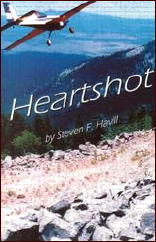
STEVEN F. HAVILL – Heartshot. St. Martin’s Press, hardcover, March 1991. Poisoned Pen Press, softcover, 2007.

   There’s always a small shiver of excitement that runs through a reader when a new writer comes along showing all the signs of being a natural-born storyteller. It’s a chancy thing, though, and while it was there at the beginning of Steven Havill’s debut novel Heartbeat, but by book’s end, sadly to say, the flame had flickered and was sadly diminished.

STEVEN F. HAVILL

   Telling the story is Bill Gastner, an aging (and badly overweight) undersheriff for Posadas County, New Mexico. A relic of the past and chafing under the recent election of a PR-oriented sheriff, Gastner wonders if perhaps his days on the job are numbered. Then a carload of teenagers smashes up, leaving five of them dead, and in the car is $150,000 worth of cocaine.

   So Gastner, with the help of Estelle Reyes, the only detective on the force, gets a chance to show he’s still worth his keep. It’s an excellent start, but halfway through the book, things begin to go awry. A fine new secondary character is introduced, but the potential to do even better things with him is sadly wasted.

   Maybe Havill didn’t intend to write a mystery. Maybe he meant only to write a crime story taking place in small town near the Mexican border. But if you wish for matters like motives, opportunities and small clues to be connected up, you will have to wait longer than the author seems to have taken pages to tell.

   [WARNING: Plot Alert] It might have been a good idea at the time, but one thing I don’t understand is why Gastner contronts one of the villains while they are alone together in a private airplane. (I won’t reveal any identities, but any detective story reader who doesn’t know who it is long before they take off simply hasn’t been paying attention.) Not only that, Gastner has just stolen his way out of a hospital room afer suffering a severe heart attack, and the plane is not pressurized. Oh, oh.

   Don’t get me wrong. The characters in Heartshot are terrific. It’s going to be the first in a series, I’m sure, and the people in this one are worth coming back to, to find out more about them. The writing is fine, and the storytelling ability is there. So what’s missing? Simply somebody (an editor, most preferably) to tell the author that the story he’s telling just isn’t holding all the water it’s supposed to.

— Reprinted from Mystery*File 31,
       May 1991 (slightly revised).


      The Bill Gastner series

Heartshot (1991)
Bitter Recoil (1992)
Twice Buried (1994)
Before She Dies (1996)
Privileged to Kill (1997)
Prolonged Exposure (1998)
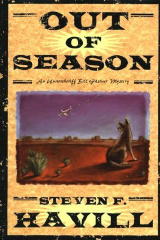
Out of Season (1999)

STEVEN F. HAVILL

Dead Weight (2000)
Bag Limit (2001)

   After Bill Gastner’s retirement, the remaining books in the series feature Undersheriff Estella Reyes-Guzman:

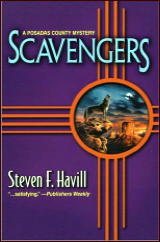
Scavengers (2002)

STEVEN F. HAVILL

A Discount for Death (2003)
Convenient Disposal (2004)
Statute of Limitations (2006)
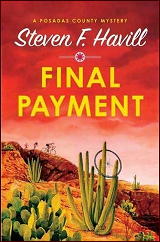
Final Payment (2007)

STEVEN F. HAVILL

The Fourth Time is Murder (2008)
Red, Green, or Murder (2009)
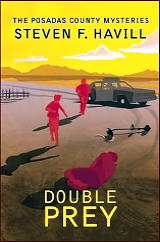
Double Prey (2011)

STEVEN F. HAVILL

One Perfect Shot (2012)

[UPDATE] 03-07-12.   With all of the followup books in the series, it’s a good thing that Steven Havill did not read this review and decide to call it quits on a writing career, right then and there. Maybe you shouldn’t pay any attention to it, either. In any case, I don’t have any of the other books in the series, and I think I ought to remedy that.

LADY AGAINST THE ODDS Dol Bonner

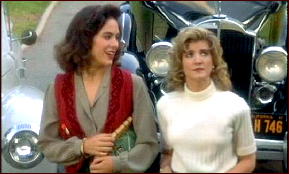
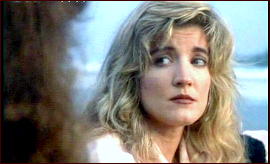
LADY AGAINST THE ODDS. Made-for-TV movie, NBC, 20 April 1992. Crystal Bernard (Dol Bonner), Annabeth Gish, Rob Estes, Kevin Kilner, John Finn, Dan Castellaneta, Heather McAdam, Steven Flynn, Roy Thinnes, Polly Bergen, Barbara Luna. Based on the novel The Hand in the Glove, by Rex Stout. Director: Bradford May.

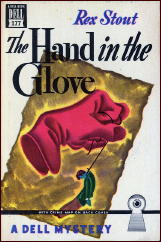
   The Hand in the Glove is one of the small handful of mysteries written by Rex Stout that did not include Nero Wolfe as a character, and I have to admit that I’ve never read it, perhaps for that very same reason. In fact there’s no doubt about it. I confess!

   While it may be true that as a devout Nero Wolfe fan – and I have been since I was 12 – I might not have missed anything by passing this one by, but looking back, I kind of wish that I hadn’t. At least I could talk intelligently about it, instead of what I am doing now, and I apologize. But I’ll fake it a little, and maybe not too many people will notice.

LADY AGAINST THE ODDS Dol Bonner

   For example. I do know that the book took place in New York circa 1937 (when the book was written) and the movie takes place in Los Angeles in 1943.

   And whereas in the book wealthy businessman P. L. Storrs (Roy Thinnes) hires female PI Dol Bonner to check out the charlatan who’s inveigling his way into his family, in the movie it’s a wartime buddy of their dead son who’s doing the same, and whom she’s asked to investigate.

LADY AGAINST THE ODDS Dol Bonner

   This is the kind of job that Dol and Sylvia Raffray, her partner in PI work, are equipped to do. They’re not ready for the big leagues, though, as they quickly discover when their client is found hanged from a tree behind his mansion. The killer used gloves to protect his hands; hence the title of the novel.

   The color photography is quite terrific, reproducing the period in wonderful detail – the clothing, the hairdos, the newspapers, the automobiles – all extremely well done. But there’s no spark to the tale. It may be that there are too many characters, and it takes a lot of time for the viewer to know who each of them are, and their relationships to each other. All of these characters seem to have known each other for a long time before the story begins. It takes the viewer a while to catch up.

LADY AGAINST THE ODDS Dol Bonner

   To be honest, and I’m sure you realize this, I’m talking about me. But I don’t believe the movie did all that well in the ratings, and assuming that it was intended to be a pilot for a possible series, it didn’t work, no matter how much money was spent on production.

   There’s no spark to the story, as I said before. I’ll lay some of the blame on the actors also. When you watch a movie and you see actors playing their roles, instead of being their roles, then you know that something is just not working.

IT IS PURELY MY OPINION
Reviews by L. J. Roberts


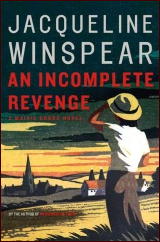
JACQUELINE WINSPEAR – An Incomplete Revenge. Henry Holt & Co., US, hardcover, February 2008. Picador, US, trade paperback, November 2008.

Genre:   Historical Mystery. Leading character:  Maisie Dobbs; 5th in series. Setting:   England, 1931.

MAISIE DOBBS

First Sentence:   The old woman rested on the steps of her home, a caravan set apart from those of the rest of her family, her tribe.

   An old friend hires investigator Maisie Dobbs to look into matters relating to a potential land purchase. Petty thefts have been blamed on boys from London there to help pick hops, but the residents distrust the Gypsies in the area as well.

   Maisie discovers that small fires have occurred every year but no one ever reported them to the fire departments or police. A family was killed during the war by a Zeppelin attack, yet no one will talk about it. Maisie must put together the pieces together while also dealing with her feelings about the soldier she loves who has been in a coma since the war.

   This is my second foray into Maisie Dobbs. I didn’t care for her the first time and, I must admit, nothing much has changed. Winspear does include information on the gypsies that I found interesting until it became redundant. She also includes details to the point of minutia on things that aren’t particularly important. Her descriptions are informative but not evocative, so that a feeling for the sense of place is missing.

   As a character, Maisie is the sort of person who would annoy me if I knew her. Yes, I can justify some of it by remembering she’s experienced the trauma of war, but not all. There is arrogance to Maisie that surpasses self confidence and is somewhat unappealing as it borders on arrogance. Her friend, Priscilla, is the complete antithesis to Maisie and annoying in her own way. In fact, the most interesting characters in the book are Maisie’s father, followed closely by the dog.

   The story itself is just not gripping. There’s no real suspense or emotion; everything is at a distance and somewhat dispassionate. The number of coincidences is overwhelming; Maisie’s perfection at everything becomes tiring. Everyone is willing to talk to her. There is no struggle or effort really required; it’s all quite neat and rather placid.

   For those who like cozies; no violence, no real threat, no swearing, no sex, no real evil, this would be perfect. Unfortunately, that’s just not my taste so although there were parts that were interesting, it was not really my cup of tea — single malt whiskey, please.

Rating:   OK.

      The Maisie Dobbs series

1. Maisie Dobbs (2003)    Edgar Awards Best Novel nominee (2004)
2. Birds of a Feather (2004)    Agatha Award Best Novel winner (2004)
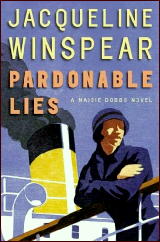
3. Pardonable Lies (2005)    Agatha Award Best Novel nominee (2005)

MAISIE DOBBS

4. Messenger of Truth (2006)    Agatha Award Best Novel nominee (2006)
5. An Incomplete Revenge (2008)
6. Among the Mad (2009)

MAISIE DOBBS

7. The Mapping of Love and Death (2010)
8. A Lesson in Secrets (2011)
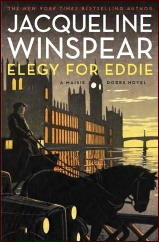
9. Elegy for Eddie (2012)

MAISIE DOBBS

REVIEWED BY WALTER ALBERT:         


PASSPORT TO SUEZ Lone Wolf

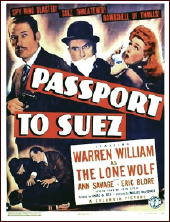
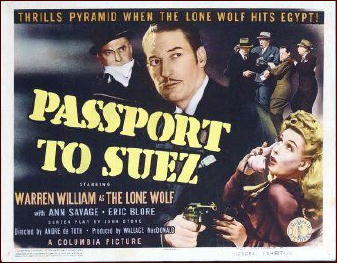
PASSPORT TO SUEZ. Columbia, 1943. Warren William, Ann Savage, Eric Blore, Sheldon Leonard, Lloyd Bridges, Lou Merrill, Jay Novello, Sig Arno. Director: Andre de Toth. Shown at Cinevent 35, Columbus OH, May 2003.

   This was Warren William’s eighth (and final) appearance as The Lone Wolf and the close-ups showed him looking haggard and worn. His urbane performance was professional but tired, and I’m chagrined to say that Eric Blore’s antics as Lanyard’s sidekick, Jameson, went a bit overboard in trying to compensate for William’s lethargy.

   The film also suffered from the same flaw that beset the script for Cinecon’s Bulldog Drummond Strikes Back [last Labor Day], variations on the HIBK device in which a character (usually a supporting character) repeatedly falls into the same trap.

   On the plus side, Sheldon Leonard played a suave cabaret owner (I wonder where the idea for that came from?) with connections on both sides of the law, and a trio of second bananas (Lou Merrill, Jay Novello, Sig Arno as Rembrandt, Cezanne and Whistler, respectively) showed a laudable attempt to raise the cultural level of the film.

   Ann Savage was regrettably underused and Lloyd Bridges was a bland accomplice of the bad guys, in an early role for the actor.

   Clearly, a disappointing entry in the series, but probably a better choice for the afternoon than either the Gildersleeve film or Henry Aldrich Haunts a House, the radio-based films that preceded and followed Passport.

PASSPORT TO SUEZ Lone Wolf


Editorial Comment: Apparently the whole movie can be watched on YouTube, beginning with Part One here.

THE BACKWARD REVIEWER
William F. Deeck


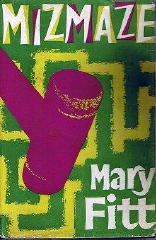
MARY FITT – Mizmaze. Michael Joseph, UK, hardcover 1959; Penguin Books, UK, paperback, 1961. US edition: British Book Centre, hardcover, 1959.

MARY FITT Mizmaze

    “The Maze was at the south-west end of the garden; it covered over a quarter of an acre, and seemed even bigger to those who walked in it. The entrance, cut in the splendid yew hedge, was six feet high and three feet wide; on the top of a topiaried archway stood two topiaried birds with long spreading tails.”

   The foregoing is a description of Mizmaze. Unfortunately, the maze is the best thing about the book.

   Inspector Mallet and Dr. Fitzbrown investigate the murder of Augustine Hatley, slain in the center of the maze by a wooden mallet generally employed for driving in croquet hoops; Hatley, his two daughters, former son-in-law, and acquaintances, were playing their Invented game of “Theseus and the Minotaur,” with Hatley fittingly the Minotaur.

   Hatley was despised or feared or both by all the characters, only one of whom has any redeeming social value, and not much at that. It is difficult to care about who killed the man. Whoever did or did not do it, if they were all put away or hanged, the world would be a better place.

MARY FITT Mizmaze

   Strangely, Mallet — the Inspector, not the weapon — turns over all questioning of the suspects to Dr. Fitzbrown and wanders off to work with what little objective evidence there is. Reluctantly and tediously Fitzbrown goes about his task.

   One oddity among several is the second corpse. A woman is strangled and thrown off a cliff. When Mallet and Fitzbrown examine the body, however, they do so at the top of the cliff, not where the body had landed. No explanation is vouchsafed by the author for this peculiar behavior of either the police or, possibly, the corpse.

   Later on, one of the suspects — unwell, but not mentally, or at least not more so than any of the other characters — comes into a room where he encounters the woman he loves. He is taken from the room, returns a few minutes later, and has no recollection of having seen the Woman. Presumably the author assumes that anyone who has read her book to this point is willing to accept anything just to get it over with.

   Recommended only to diehard collectors of maze mysteries, should there be any.

— From The MYSTERY FANcier, Vol. 11, No. 1, Winter 1989.


Editorial Comments:   Inspector Mallet appeared in 18 novels; Dr. Fitzbrown shared the billing in four of them. In one collection the latter was the solo sleuth in several shorter stories. The earliest of the author’s mysteries appeared in 1936, her last in 1960.

   For those who may be interested, my own review of the book includes a complete Bibliography. I found as many flaws in the telling as Bill Deeck seems to, but I also somewhat inexplicably believe I enjoyed it more than he did.

FIRST YOU READ, THEN YOU WRITE
by Francis M. Nevins
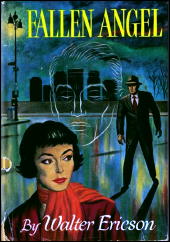

FALLEN ANGEL / MIRAGE

   When the present loses its savor, turn to the past. I recently reread a suspense novel first published in my childhood and first encountered something like 45 years ago. I remembered very little about it except that it hadn’t impressed me much back in the Sixties. It still doesn’t, but some aspects of it merit space here.

   The byline on the first edition of Fallen Angel (Little Brown, 1952) was Walter Ericson but the author was Howard Fast (1914-2003), who is best known for mainstream novels like Spartacus and for his Communist affiliation, which sent him to prison for three months during the McCarthy-HUAC era.

   According to his memoir Being Red (1990), he decided to present his first crime novel under a pseudonym because in those years of Red Menace paranoia he was afraid publishers would soon be boycotting all books by openly Marxist writers like himself.

   Then some patriotic munchkin at Little Brown tipped off the FBI, and J. Edgar Hoover himself called the CEO with the message that it was okay for the book to appear under Fast’s own name but that the house would be in trouble if it came out under a pseudonym. With the book already printed and bound, the dust jacket copy was hastily revised to announce that Ericson was Fast’s newly minted byline for mystery fiction.
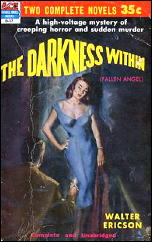
FALLEN ANGEL / MIRAGE

   Critical reaction ran the gamut. Anthony Boucher in the New York Times Book Review called the book “something short of sensational… [It] has a few adroitly contrived pursuit scenes in the Hitchcock manner, but a limp, tired plot, an equally tired set of stock characters, rather heavy prose and unlikely dialogue, and a general air of never quite making sense.”

   At the other end of the spectrum, the reviewer for the Boston Herald found the novel “surprisingly absorbing and masterfully created…,” evoking a “mood that is often savage with a skein of madness.”

   The Michigan City News-Dispatch described it as “full of chills and thrills, ripe with suspense and psychological undertones.” The Cincinnati Enquirer praised the “good creepy atmosphere and excellent fast writing.” (Pun intended?)

   These and other raves were reprinted in two pages of front matter when Fallen Angel appeared in paperback, retitled The Darkness Within. This early Ace Double (#D-17, 1953) was bound together with the softcover original Shakedown by Roney Scott, who turned out to be PI novelist William Campbell Gault.

   Apparently no one tipped off J. Edgar this time: the byline on the Ace edition is Walter Ericson and there’s no hint anywhere that Fast was the author.
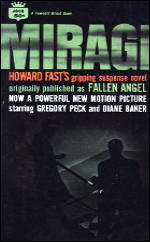
FALLEN ANGEL / MIRAGE

   The springboard situation here is as purely noir as in any Woolrich novel. The narrator, David Stillman, is in a Lower Manhattan skyscraper late one March afternoon when the lights suddenly go out and the building loses all power.

   Descending 22 stories by the fire stairs, he encounters a lovely woman who seems to know him well but whom he doesn’t know at all. He follows her into the bowels of the building but loses her. Out on the night street he finds that a renowned public figure who kept an office in the building has fallen 22 stories to his death.

   Arriving home, he discovers a gunman in his apartment who presents him with a forged passport and orders him to leave for Europe at once. All this in the first four chapters!

   Stillman soon becomes convinced that he’s been suffering from amnesia for the last three years, but in Chapter Five he visits an obese and grotesque psychiatrist who calls him a liar to his face:

   â€œSo you have amnesia yet you don’t know you have it. No, Mr. Stillman, there is no such thing, only in Hollywood on the films, but in life there is no such thing. Even amnesia — it is for two, three weeks, Mr. Stillman, not for three years.”

   Whether Fast is right or not I have no idea but this passage seems to be a clear reference to Woolrich’s The Black Curtain (1941; filmed the following year as Street of Chance), which begins with the restoration of the protagonist’s identity after an amnesia lasting precisely three years.

   Fast devised a storyline squarely in the Woolrich vein, and left as much unexplained at the end as Woolrich ever did, but he simply didn’t have Woolrich’s awesome skill at making us live inside the skins of the hunted and the doomed, feeling their terror as they run headlong through the night and the city.
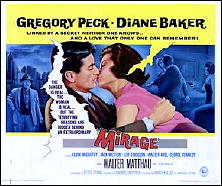
FALLEN ANGEL / MIRAGE

   David Stillman’s first-person narration constantly seeks to evoke a sort of existential dread — perhaps the threat of World War III and the fear of nuclear holocaust — but the style is absurdly pretentious and didactic:

   â€œHere [in Central Park] a man was being hunted as men had been hunted in the forgotten past — and by creatures out of the past, or out of the future perhaps, creatures without sympathy or love or compassion or pity.”

   That last quartet of nouns illustrates another problem with the style: endless repetition. I’ll limit myself to two exchanges of dialogue, both from the climactic scene:

   â€œI had to find something out,” I said. “Something I didn’t know. Something I couldn’t remember.”

   â€œBut now you remember?”

   â€œNow I remember,” I said.

   And then:

   â€œI haven’t got it,” I said.

   â€œYou’re a damned liar, David.”

   â€œI haven’t got it,” I repeated evenly. “Do you hear me, I haven’t got it, Vincent.”

   Multiply by hundreds and you’ll get it. The picture that is.
FALLEN ANGEL / MIRAGE

   Speaking of pictures, The Black Curtain was filmed the year after its publication but Fast’s novel didn’t make it to the big screen until after his post-imprisonment break with the Party.

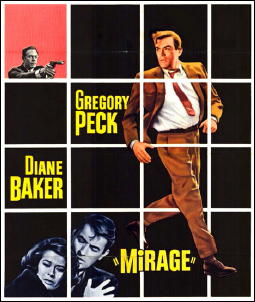
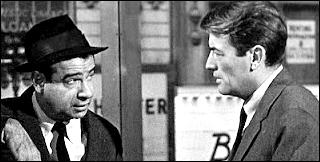
   Mirage (1965) was directed by Edward Dmytryk, another member of the creative Left (although he avoided prison and salvaged his career by “naming names” before HUAC), and starred Gregory Peck and Diane Baker, with the performance of a lifetime by Walter Matthau as the hapless PI Peck consults.

   Dispensing with first-person narration, Dmytryk and screenwriter Peter Stone eliminate the novel’s stylistic faults, but the film never generates the powerful mood of the finest noirs of the Sixties, like Cape Fear and Point Blank.

   As a tie-in with the movie there came a paperback edition of the novel (Crest #d808, 1965), for obvious reasons retitled Mirage but now credited to Fast.

   The back cover is graced by an amusing six-word condensation of Tony Boucher’s Times review: “Pursuit scenes in the Hitchcock manner.”

   Just a few years later Mirage was loosely remade as Jigsaw (1968), directed by James Goldstone in a hallucinogenic visual style, with Bradford Dillman and Harry Guardino replacing Peck and Matthau.

   When Fast was in his early eighties I had a brief exchange of letters with him about his World War II court-martial novel The Winston Affair (1959) and the very different film version Man in the Middle (1964), which starred Robert Mitchum as a sort of Philip Marlowe in khaki. (Google my name and the movie title and you’ll find my University of San Francisco Law Review essay on that subject.)

   If only I had reread Fallen Angel back then and asked him about that book too!
FALLEN ANGEL / MIRAGE

   If you like (love) old vintage crime fiction as much as I do, and if you have a Nook, Kindle or other similar electronic reading device, you’re in luck.

   A new ebook website, Prologue Books, has been in the works for the past few months, and it’s now online at www.prologuebooks.com.

   You’ll find a complete list of current offerings below. Greg Shepard of Stark House Press, one of the fellows responsible for this new line of books, tells me that other authors yet to come are Harry Whittington, Dan Marlowe, Helen Nielsen, G. H. Otis, Jack Webb, Gil Brewer, Louis Trimble, Barry Malzberg. Westerns are next. Science fiction and adventure are coming, he says. (The other fellow involved is Ben LeRoy, editor of Tyrus Books. Trust me. These guys know what they’re doing.)

   My reaction? What a great idea! One whose time has come. The good stuff. The kind of tough, hard-boiled fiction I’ve been reading for over 50 years. Looking through the list of books below, I bought some of them new off the local drugstore’s spinner rack when I was still in my teens. (I still have them.) The others in my collection I had to scrounge up from used bookstores here and there all over the country, from Maine to St. Louis and back again.

   And here they are again, all spruced up, the dust brushed off and ready for a new generation of readers. Personally all I could wish for are paper editions as well, but this is the next best thing. Believe me, this is the best news I’ve had all week.

      Robert Colby

Run for the Money
The Faster She Runs
The Deadly Desire
The Captain Must Die
Secret of the Second Door
Lament for Julie
Kim
Beautiful But Bad
These Lonely, These Dead
Murder Mistress
The Star Trap
Kill Me a Fortune
In a Vanishing Room
The Quaking Widow

      Richard Deming

This Game of Murder
Tweak the Devil’s Nose
Give the Girl a Gun
The Gallows in My Garden

      Fletcher Flora

The Seducer
The Brass Bed
Skuldoggery
Park Avenue Tramp
The Hot Shot
Lysistrata
Wake Up With a Stranger
Killing Cousins
Leave Her to Hell

      William Campbell Gault

Sweet Wild Wench
The Convertible Hearse
Square in the Middle
Vein of Violence
The Wayward Widow
The Bloody Bokhara
Murder in the Raw
Dead Hero
County Kill
Don’t Cry for Me
The Hundred Dollar Girl
The Canvas Coffin
Run, Killer, Run
Night Lady
Million Dollar Tramp
End of a Call Girl
Death Out of Focus
Day of the Ram
Blood on the Boards

      Orrie Hitt

Shabby Street
Woman Hunt
Untamed Lust
Unfaithful Wives
The Sucker
The Promoter
The Lady is a Lush
Suburban Wife
Sin Doll
Sheba
Pushover
Ladies Man
I’ll Call Every Monday
Dolls and Dues

      Frank Kane

A Short Bier
A Real Gone Guy
Trigger Mortis
Red Hot Ice
Johnny Liddell’s Morgue
Dead Weight
Stacked Deck

      Henry Kane

The Case of the Murdered Madame
Martinis and Murder
Don’t Call Me Madame
Death of a Dastard
Armchair in Hell
Fistful of Death
Death is the Last Lover

      M. E. Kerr

Fell Down
Fell Back
Fell

      Ed Lacy

The Freeloaders
Two Hot to Handle

      Whit Masterson

A Hammer in His Hand
A Shadow in the Wild
Badge of Evil
Dead, She Was Beautiful
Evil Come, Evil Go
The Dark Fantastic
A Cry in the Night

      Marijane Meaker

Scott Free
Game of Survival

      Wade Miller

Deadly Weapon
Murder Charge
Shoot to Kill
Uneasy Street
Murder – Queen High
Calamity Fair

      Vin Packer

The Young and Violent
Girl on the Best Seller List
Something in the Shadows
Dark Don’t Catch Me
Come Destroy Me
Alone at Night
5:45 to Suburbia
Don’t Rely on Gemini
The Damnation of Adam Blessing
The Evil Friendship
The Hare in March
The Thrill Kids
The Twisted Ones
Three Day Terror
Intimate Victims

      Kin Platt

Murder in Rosslare
Match Point for Murder
Dead As They Come
The Body Beautiful Murder
The Giant Kill
The Kissing Gourami
The Princess Stakes Murder
The Pushbutton Butterfly
The Screwball King Murder

      Talmage Powell

With a Madman Behind Me
Man Killer
Start Screaming Murder
The Girl’s Number Doesn’t Answer
The Killer is Mine
The Smasher
Corpus Delectable

      Peter Rabe

The Silent Wall
The Return of Marvin Palaver
The Box
My Lovely Executioner
Murder Me for Nickels
Journey into Terror
Blood on the Desert
Benny Muscles In
Anatomy of a Killer
Agreement to Kill
A Shroud for Jesso
A House in Naples

      Charles Runyon

The Anatomy of Violence
Color Him Dead
Kiss the Girls and Make Them Die
The Prettiest Girl I Ever Killed

A TV Review by Michael Shonk


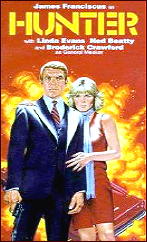
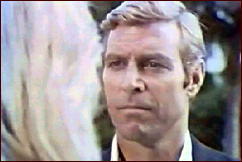
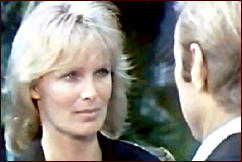
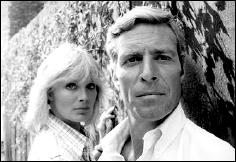
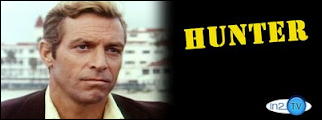
HUNTER.   CBS / Lorimar Production. 1977.   PILOT: (never aired)   Cast: James Franciscus as James Hunter. Guest Cast: Linda Evans, Ned Beatty. Written by William Blinn. Directed and Produced by Tom Gries. Executive Produced by Lee Rich and Philip Capice.   SERIES:   Cast: James Franciscus as Jim Hunter, Linda Evans as Marty Shaw, Ralph Bellamy as General Howard Baker. Created by William Blinn. Produced by Christopher Morgan. Executive produced by Lee Rich or Lee Rich and Philip Capice.

HUNTER James Franciscus

   The fifty-four minute pilot proposed series premise featured James Hunter as a man who had spent eight years in prison for a crime (fraud and bribery) he did not commit (a popular character trait in the 70s). He now wants to find the man who framed him, his former boss Mr. Ingersoll, and clear his name.

   The weekly series abandoned that premise, James Hunter is a rare books bookstore owner and spy, and Marty Shaw (the doomed prostitute in the pilot, played by Linda Evans) is now a famous model and spy.

   It is 1977 and the seeds of our distrust in the American government are growing. Spymaster General Baker is told to start a new covert agency of six agents. His first choice is retired “Agency” spy, now Santa Barbara (CA) bookstore owner, Jim Hunter. The unnamed agency’s purpose is to watch over any activity threatening the country be it from overseas or within our own government. Marty Shaw was another agent working for Baker.

   Hunter resigned from the “Agency” in 1969 because he disapproved of our side’s methods. He works alone or is assigned someone or to a “Control” in trouble. All episodes but two has Baker assigning Marty to assist. Marty also had her own assignments away from Hunter.

HUNTER James Franciscus

   Hunter and Marty’s relationship reminds one of Napoleon Solo and Illya Kuryakin in Man from U.N.C.L.E.; both are talented capable spies on their own and together. But Hunter and Marty are also unmarried lovers who live in different parts of the country and openly shared a bed during assignments. The chemistry between Franciscus and Evans worked well. It is not a surprise that their chemistry was the only part of the pilot to survive.

   Of the two covers, Marty’s modeling was the most useful. The bookstore never played a significant role in any episode. But each episode had Hunter sitting at a desk in front of a wall of bookshelves when Baker would call and give Hunter his new assignment.

   The action took place in the United States, except for a flashback to Hunter’s days as head of operations in West Berlin (“The K Group”). Exotic locales did not play a role. Gadgets were not used. Everyone seemed to drive huge Oldsmobiles rather than the latest sports cars. The series featured the usual TV action of chases, fights and gunplay. The music by Richard Shores (Man from U.N.C.L.E.) was nothing special but set the right spy genre mood.

HUNTER James Franciscus

   Hunter was no lost gem, but a better than average TV spy series that deserves to be remembered. Some of the twists were worthy of the best of TV spy shows such as using a third mystery group interrupting business between the Americans and the Russians.

   Too often the series abandoned all logic such as when Hunter would learn someone is about to kill someone, and without bothering to phone a warning, Hunter would race off so he could arrive at the last moment to save the day.

   CBS picked up Hunter in 1976 to replace any early failures in the upcoming 1976-1977 fall schedule (Broadcasting 8/23/76). It would premiere February 18, 1977, Friday at 10pm (Eastern) opposite NBC’s Quincy and ABC’s Friday’s Movie.

          HUNTER Episode Guide:

PILOT. Hunter’s search for the man who framed him leads him to a 25th reunion of Ingersoll’s former military unit. While in the hotel underground parking lot Hunter escapes a deadly attack by a tank. Later he escapes an exploding room service cart, and falls for prostitute Marty Shaw. We see the recluse Ingersoll from the back only as he gave orders to his evil minions. In the end, a killer goes to jail and Hunter is no closer to Ingersoll.

“Bluebird Is Back.” Guest Cast: Edward Mulhare. An archenemy of Hunter’s, Bluebird is a killer who enjoys his work. He leaves a trail of victims that lead Hunter and Marty to a Russian plot to discredit the American atomic electric plant design.

“Mirror Image.” Guest Cast: Diana Muldaur. A Russian double of Hunter must fool Marty in a plan to assassinate General Baker and frame Hunter.

HUNTER James Franciscus

“Lysenko Syndrome.” Guest Cast: William Windom. Windom is a wonderfully over the top mad scientist. First they program an American agent to kill Hunter. Then they program Marty to, when learning Hunter is dead, kill her Uncle, an Admiral.

“The Hit.” Guest cast: Nehemiah Persoff. When a hitman dies during the car chase, Hunter switches wallets and takes his place. Now all Hunter has to do is find out who hired the hitman and who is the target.

“Costa Rican Connection.” Guest Cast: Donald O’Connor. After the murder of a witness for a Senate Committee looking into the connection between organized crime and the “GIA” (CIA), Hunter and Marty need to convince the last witness to testify.

“The K Group” (Part One). Guest Cast: Vic Morrow. Hunter and others want to know who killed the East German spy at an L.A. film festival.

“The K Group” (Part Two). Hunter, Marty and Baker must stop the rogue American agents from assassinating an American government official.

“Barking Dog.” Guest Cast: Robert Mandan. An American scientist demands ten million dollars in 48 hours or he will poison the southern California water supply. This episode even has a scene when the villain reveals all to a tied up Marty.

“Yesterday, Upon the Stair.” Guest Cast: David Wayne. Hunter is sent to help with a spy exchange involving his favorite spy teacher. Things go wrong during the exchange and both sides’ spies disappear, kidnapped by persons unknown.

HUNTER James Franciscus

“The Backup.” Guest Cast: Leif Erickson. An American agent disappears after his attempt to escort a Chinese defector to a safe house fails. Hunter is sent in to find the agent and get the defector back.

“The Hand Is Burning.” (Note: My DVD is missing opening titles. Title from TVTango.com). An American agent with information about African nation Chand is killed in Los Angeles. Hunter and Marty save the Republic of Chand, uncover political corruption, and find the killer.

“The Lovejoy Files.” Guest Cast: Sorrel Booke. A file meant for the President’s eyes-only is missing. A group agrees to ransom it, but when Hunter and a man from government archives arrive to pick it up, a third group steals it from them.

“UFM 13.”. Guest Cast: Cameron Mitchell. Hunter goes undercover to stop an American radical conservative group from using stolen plutonium to make an atomic bomb.

   Currently there is no official DVD available for Hunter. Warner Brothers took over Lorimar so they probably have the rights to the series. The show’s introduction can be seen on YouTube here, in French.

« Previous PageNext Page »