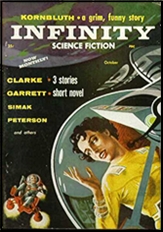
ANALOG SCIENCE FICTION. December 1966. [Cover by Kelly Freas.]   Overall rating: 2½ stars.

MACK REYNOLDS “Amazon Planet.” Serial, Part 1 of 3. See report following Feb 1967 issue.

BEN BOVA “The Weathermakers.” [Kinsman series] Novelette. A hurricane forces Project THUNDERBIRD to begin complete weather control in the East. Smooth, almost documentary style, but reasons for abandoning ship during storm are not clear. (3)

Update: Excerpt from the novel of the same name (Signet, paperback original, 1967). Included in many collections of Bova’s short fiction.

L. EDEY. The Blue-Penciled Throop. Twelve letter from Oswald Lempe, editor of a technical journal. (2)

Update: This was the author’s only work of science fiction.

KRIS NEVILLE “The Price of Simeryl.” Novelette. A Federation investigator considers a planetary government’s request for credit and guns. An interesting picture o what appears to be an entrenched bureaucracy, but the ending is dumb. (2)

Update: Collected in The Science Fiction of Kris Neville (Southern University Press, hardcover, 1984).

PHILIP LATHAM “Under the Dragon’s Tail.” An astronomer goes mad with the approach of the asteroid Icarus. (1)

Update: Reprinted in On Our Way to the Future, edited by Terry Carr (Ace, paperback, 1970).

– August 1967

JOHNSTON McCULLEY “The Murder Note.” The Green Ghost #5. Novelette. First published in Thrilling Detective, January 1935. Collected in The Swift Revenge of the Green Ghost, Altus Press, paperback, 2012. Reprinted in Shadow Justice: Classic and New Tales of Pulp Magazine Costumed Heroes, FuturesPast Editions, edited by ??, Kindle, 2016.

   I’m not exactly sure why it is that ordinary people take it up on themselves to dress up in costumes to fight criminals, but enough of them did for pulp collectors of our era to create a entire subcategory of hero pulps to include them in. (I’m not talking about comic books. They came along later and knowing a good thing when they saw it, then came the deluge.)

   It was probably an individual thing. In Danny Blaney’s case, he was framed by criminals and lost his official standing as a cop, and to get revenge on all such gangsters, takes his fight against the underworld by fighting them directly, putting on a green hood and gloves and becoming the Green Ghost. While doing the work of the law, he holds no good feeling for the cops who did not stand up for him, either.

   There were in all seven of his adventures that were recorded in the pages of Thrilling Detective, a second-rate detective pulp, between March 1934 and July 1935. If “The Murder Note” is an example, all of these tale were minor and undemanding. The idea of dressing up as the equivalent of a “caped crusader” was, however,  and still is, an idea that catches the imagination of many readers, then and now.

   In “The Murder Note” Danny is about to bring a mobster by the name of Rod Rordan to justice, only to find him dead in his apartment, already killed by another gang who plan on Danny being charged with the crime. A note so stating, mocking him, is left at the scene of the crime, a note that cannot be used as evidence, however, as it is written in disappearing ink.

   The story from here on out is pure action. Nothing more, and as the wise pundits always say, nothing less, with no particular twist to the tale in pages to come. It’s quite forgettable, in fact, but it doesn’t stop sellers from asking $494.99 and up for a copy of the Altus Press collection, now apparently out of print.

REVIEWED BY DOUG GREENE:


DOROTHY SIMPSON – The Night She Died. Inspecto Luke Thanet #1. Scribners, US, hardcover, 1981. Bantam, US, paperback, 1985. Originally published in the UK by Michael Joseph, hardcover, 1981.

   Dorothy Simpson’s Inspector Luke Thanet is a recent addition to the sympathetic-British-policeman school of detective fiction. Thus the book is somewhat derivative – Simpson has obviously read Aird, Rendell, and Thompson. – but she handles plot and character well. Especially engaging is her contrast between Thanet’s happy family life and the unhappiness of the suspects.

   The plot is about a young woman stabbed to death at her doorstep. It seems obvious that either her husband or her lecherous employer is responsible, but Thanet digs deeper to discover that the victim had witnessed a murder as a child twenty years earlier. Thanet believes that the two murders may be related.

   The solution, which is not revealed until the very end, is generally satisfactory, though it might have been explained more fully. Nonetheless Dorothy Simpson is a writer to watch.

– Reprinted from The Poison Pen, Volume 4, Number 5/6 (December 1981). Permission granted by Doug Greene.


Editorial Update: Doug knew well of which he spoke. There are in total 15 books in the series.

IT IS PURELY MY OPINION
Reviews by L. J. Roberts


JANE ADAMS – Like Angels Falling. Ray Flowers #2. Macmillan, UK, hardcover, 2001. Joffe Books, UK, paperback, 2021, as The Unwilling Son.

   Ray Flowers has now resigned from the police force and is partners with his friend, George Mahoney, in a security and detection business. Eleven years ago, Ray was involved in investigating the murder of three young boys and Eyes of God cult leader, Harrison Lee, was convicted of the crimes. The cult headquarters exploded and only one young girl, Katie, survived but hasn’t spoken since that day.

   Now, suddenly, Katie proclaims “He’s coming back.” and runs away from the home of her foster parents back to the site of the cult. When a young boy disappears and his body is found in the same spot and position as Lee’s first victim, Ray is called in to help the police. Has someone taken over where Lee left off?

   Adams is very good at supernatural suspense. There is enough of each element to pull you in and keep you reading, but not so much as to be completely unbelievable. Because one can explain events either by reason or paranormal is what makes this book creepy. The tension is definitely there. The story is driven by plot, more than character, but it works because each character is strong and interesting enough to hold their own.

   Adams is bit hit or miss with me, but this was a definite hit.

Rating: Very Good.

— 2007

   
      The Ray Flowers series

1. The Angel Gateway (2000) aka The Apothecary’s Daughter
2. Like Angels Falling (2001) aka The Unwilling Son
3. Angel Eyes (2002)

SUSPECTS “Alone.” Channel 5, UK, 12 February 2014 (Series 1, Episode 1). Fay Ripley as Detective Inspector Martha Bellamy, Damien Molony as Detective Sergeant Jack Weston, Clare-Hope Ashitey as Detective Constable Charlotte “Charlie” Steele. Director: John Hardwick. Currently streaming on Amazon Prime.

   If you prefer your standard gritty police procedurals on TV to concentrate on the case and nothing but the case, then Suspects may be the show for you. Of the three main stars and police officers they portray, there is nothing in this first show to explain who they are, what their backgrounds may be. There is even no personal interaction between them.

   They are fellow officers in the same London police station, otherwise not identified. This first case involves a young girl, a toddler only, who has been taken from her bed overnight while everyone in the house was sleeping: her father and her older brother. Other suspects are her mother, now separated from her father, her grandmother, and the clerk at a beverage shop down the street who has a prior record as a sex offender.

   The filming is done documentary style, beautifully photographed, and (I am told) with much of the dialogue improvised. It certainly makes for a forceful, haunting viewing experience, that I can vouch for personally. So much so that I doubt anyone would care to binge watch this show. Certainly not I.

   The show did prove to be popular, though. It consisted of five series, ending in August 2016, with only one major cast change for the final season.
   

ROSS THOMAS – The Fools in Town Are on Our Side. William Morrow, hardcover, 1970. Avon, paperback, 1972; Mysterious Press, paperback, 1987; St. Martin’s, paperback, 2003.

   A long book, 383 pages, most of it about a Poisonville named Swankerton. To clean up a corrupt town, apply Orcutt’s First Law: “To get better, it must get worse.” The crew consists of a crooked ex-cop, an ex-whore, an ex-secret agent named Lucifer Dye, and a boy-wonder boss named Orcutt.

   The story is Dye’s, with threads from his past – his boyhood in a Shanghai bordello, his life with Section Two – combining into a full-life portrait. The action is hard, tough, utterly ruthless and ultimately frightening. Corruption is hardly a sufficient word.

   After juggling three stories, Thomas finally settles down to the tale of Swankerton. Unfortunately those threads from Dye’s past fizzle out after the long buildup. I don’t believe this has been published yet in paperback, but it might be worth reprinting, pertinent to today’s CIA inquiries – if that piece of action had only been followed up with care.

Rating: B plus.

— Slightly revised from The Mystery Nook, Vol. 2, No. 2 (whole #8), 15 December 1975.


UPDATE: In this review, I wondered why this book has never come out in paperback. The fact was, and I didn’t know it, that it had. I missed it — the Avon paperback from 1972 — nor was I the only one. Very few copies of that edition show up offered for sale today online.

   In the comment he left following Dan Stumpf’s recent review of Red Harvest, Sai Shankar asked me if I’d ever reviewed this book. I said I had, but I didn’t know where it was. Lo and behold, here is is.

BLACK SEA. Focus Features, UK, 2014; US, 2015. Jude Law, Scoot McNairy, Konstantin Khabensky, Bobby Schofield. Screenwriter: Dennis Kelly. Director: Kevin Macdonald.

   I am caught between calling this a heist film, or a hunt for buried treasure one. No matter, because it includes the best elements of both. When a recently fired underwater salvage captain (a perfectly cast grizzled and determined Jude Law) learns about the possible existence of a Nazi U-Boat from World War II that was sunk off the coast of Georgia with a cargo of gold ingots, he sees a chance to get back at the company that released him, get back in touch with his estranged son, and not the least of these, if all goes well, he’ll be set financially for the rest of his life.

   The sunken ship is in contested waters, though, and the surface is constantly being patrolled by Russian ships. More, the submarine he’s able to purchase, through the aid of a mysterious benefactor, is old and decrepit, and the crew he finds is half English and half Russian, five of each.

   The reward, however, is staggering, running in the hundreds of millions of dollars, to shared equally.

   Obviously things do not go well. They never do in the movies. Only one of the Russians speaks English, for example, and tensions quickly spill over the top, violently so. But with so much money at stake, antagonisms are finally smoothed over. The underground U-Boat is found, entered, and the gold … well, there’s a small problem there. It weighs more than a few pounds.

   Lots of risky maneuvering ensues, including that of the submarine itself through a rocky trench in the ocean bed, anger between the disparate members of crew flares up again and again, a huge double cross is discovered, explosions shake the ship with water rushing in, and well, how well do either heists or treasure hunts ever go in the movies? There’s lots of fun watching this to find out. If this sounds like your kind of movie, it is. This one is a good one.

WILSON TUCKER – Tomorrow Plus X. Avon T168, paperback, 1957. Cover by Richard Powers. Originally published as Time Bomb (Rinehart, hardcover, 1955).

   A detective story complicated by future developments if telepathy and time-travel. Lieutenant Danforth of the Illinois Security Police is assigned the task of solving several bombings directed at the fanatic Sons of America. The one responsible is from the future, determined to stop Ben’s Boys from taking over America under their dictatorship.

   The attempt to successfully portray this future society, undergoing severe technological upheavals, does not entirely come off. It cannot really escape the appearances of America ten years ago with a few new gadgets thrown in, but this may be caused chiefly by hindsight. Twice, in Chapters 1 and 6, the action seems to stumble badly, but this may have been intended, for later (p.155) Tucker makes a weak attempt to justify the points in question.

Rating: 3 stars.

– August 1967
SELECTED BY DAVID VINEYARD:


BURKE WILKINSON – The Adventures of Geoffrey Mildmay, V.C.: A Trilogy. Robert B. Luce, hardcover, 1977. Consisting of: (1) Proceed at Will (Little Brown, hardcover, 1948); (2) Run, Mongoose (Little Brown, hardcover, 1950; Permabook, paperback, as Black Judas); and Last Clear Chance (Little Brown, hardcover, 1954).

   â€¦ the mantle of heroism, coat of many dazzling colors that it is, may hide strange things beneath its folds. Because of some tremendous moment, the hero springs full grown into being. He may have been a bully in school or a coward in college, but all in his nature that runs counter to that glittering moment is ignored…

   The Second World War brought a harvest of heroes — and great villains too…but the story of one man is still worth telling — a man who wore the cloak of courage with more skill and dash than any I have ever known.

   Proceed at Will, the first adventure of Geoffrey Mildmay begins with that Stevensonian announcement about the nature of heroism. The war is over and American officer Bill Stacy is seconded to Admiralty intelligence to go to France and find his friend Commander Geoffrey Mildmay who disappeared after being sent to sink the German battleship Prinz von Blucher in Brittany.

   Bill is Mildmay’s closest friend, and enemy, because as the novel describes their friendship is fraught with Mildmay’s mercurial nature. His courage is never in question, but his loyalty is another matter.

   During the war Bill had been chosen to work on a British project to train Mildmay to pilot a midget sub and sink the von Blucher. Intelligence was concerned about Mildmay’s ties to a group who had questionable loyalty and his nature made those questions vital to answer.

   As always with the man, nothing is ever simple black and white. When Bill helps uncover a fifth columnist plot Mildmay claims he was working with British intelligence all along, and Bill can’t be sure he isn’t telling the truth. He can’t put it past war time spying to send two men at odds to accomplish a mission. Perhaps he was only there to provide Mildmay cover with the traitors, or perhaps Mildmay briefly flirted with the exciting role of double agent.

   Either is within Mildmay’s nature.

   A woman Bill loves that Mildmay breaks him up with complicates things, and even when he finds Mildmay in France the question arises did he really sink the ship and decide to stay in France to fight on, or is he lying and did the Resistance sink the von Blucher? The novel ends with some answers, if Bill can trust them.

   What happens to the killers in wartime?

   That is the opening line of Run, Mongoose, the second of the Mildmay novels that finds Bill, after a tragic romance, joining Mildmay in Ireland and finding his friend restless and in a dangerous mood (…hero, adventurer by profession, romantic by inclination, pro patria when it suited his own wayward will, but always pro Mildmay.)

   It seems Mildmay has fallen under the spell of wealthy Sir Gabriel Gregorious, a colorful Jamaican millionaire (and precursor to many an Ian Fleming villain) who has hired Mildmay for a scheme involving his bauxite mining interests in Jamaica as well as purchasing a German U-boat and hiring its captain to pilot it to the island, plus there is beautiful Lady Felicity Bantry a sexy and dangerous Irish peer.

   Again Bill finds himself in the role of spy and wondering if Mildmay can be trusted. Which way will the pendulum swing when it comes to treason if the gamble is exciting enough.

   The ending as Mildmay lies seriously wounded and they wonder if help is coming is as close to a confession as Mildmay makes, and Bill finally concludes that “Geoffrey true or Geoffrey false, Geoffrey adventurer or Geoffrey agent, the world would be a poorer place without him. Some gallantry would go, and some gayety — and gallantry and gayety can ill be spared …”

   The final book, The Last Clear Chance takes its title from the legal concept of the last clear chance when a person can be involved in a potential felony and still avoid prosecution. Mildmay is in Washington D.C., supposedly with the British legation, and Bill Stacy is once again drawn into his schemes.

   Geoffrey Mildmay and I had long been friends, but it was not until a year or so ago our friendship ripened into active dislike.

   A traitor lies at the heart of the American government and there is a plot to kidnap an American statesman by the Soviets, just the kind of audacious action a man like Mildmay would find a challenge, and it is not until a dark night on the Chesapeake waiting for a Soviet submarine that Bill Stacy finally knows which side Geoffrey Mildmay will come down on.

   He was all action and resonance now. Geoffrey of the Right Hand, I thought — Geoffrey Dexter. The sliding scale had slid so far on the side of the angels it stuck.

   It seems at the end of the book Mildmay has found peace and romantic commitment, but in a rather Bondian moment all he can tell the woman he loves is “For here and now I am with you.”

   One critic called the Mildmay books a mettlesome blend of John Buchan and Evelyn Waugh, and that sums them up well. No few adventure writers followed the War with heroes of dubious nature and motive, including Hammond Innes, Victor Canning, and Geoffrey Household in part a reaction to real events and in part to the patriotic fervor of the War and the complexity of the world it saved.

   The trope goes back to Stevenson and complex good/bad men like Long John Silver, Alan Breck Stewart, and Harry Northmour (“Pavillion on the Links”) and was also a reaction to the pre-war eras uncomplicated popular fiction.

   By the end of the war the more jaded view of Eric Ambler, Graham Greene, and even popular writers like Peter Cheyney, Dennis Wheatley, and soon Ian Fleming had changed the simple clear cut heroics of an earlier period to something darker and more complex.

   Geoffrey Mildmay stands a bit more than halfway between the uncomplicated heroes of John Buchan, Dornford Yates, and H. C. McNeile and Peter Cheyney’s tough agents and James Bond (his final adventure ironically the same year Bond debuted).

   Burke Wilkinson was a busy man who still found time to write well received fiction and history. Among his other positions was Deputy Assistant Secretary of State for Public Affairs and adviser to the Supreme Allied Commander in Europe involved with NATO. He also served two tours in the Navy during the war and was a Commander in the Naval Reserve. His last novel Night of the Short Knives was reprinted in paperback and had good sales and featured an American assigned to SHAEF uncovering a Soviet plot. It was optioned for one of those films that never got made.

   The three Mildmay adventures were reprinted by a small press in 1977 in a thick omnibus edition late in the wake of the Bond craze. I stumbled on my own copy in a Doubleday Book Store in the old Dallas North Park shopping mall and happily forked over my $7.95 for the omnibus. I even recall what I bought with it, three Karl May paperbacks from Bantam Books, Winnetou, Adjistan and Djistan, and In the Desert. Between the four of them it was close onto 2000 pages of adventure.

   That was January 1970, fifty one years ago to the month. (*)

   Days like that are what make book collecting rewarding. You would be hard put today to get half as much for under $20 or recall a week later the transaction.

   ___

(*) Editorial Note: Apologies for the short delay in posting this review!

REVIEWED BY DAVID FRIEND:


SCREAM OF FEAR. Columbia Pictures, US, 1961. Originally released as Taste of Fear (Hammer Films, UK, 1961). Susan Strasberg, Ronald Lewis, Ann Todd, Christopher Lee. Writer: Jimmy Sangster. Director: Seth Holt. Currently can be seen on YouTube.

   Penny Appleby (Susan Strasberg) is a beautiful young paraplegic who hasn’t seen her father in almost ten years. Following the suicide of her nurse in Switzerland, she is invited to his estate on the French Riviera, where she meets stepmother Jane (Anne Todd) for the first time. Apparently, Mr Appleby has been called away on business and is not expected back for several days.

   She becomes concerned and, gradually, even suspicious. One night, Penny sees her father’s corpse in the summerhouse, propped in an armchair and staring blankly ahead, but the place is empty upon her return. Jane believes it was a hallucination brought on by grief and that the death of Penny’s nurse is causing unnecessary concern for her father. The family physician, Dr Pierre Gerrard (Christopher Lee), suspects this too and even suggests her paraplegia may be psychosomatic.

   Penny is adamant that she is sane and that her disability, due to a horse-riding accident, is nothing but serious. After seeing her father’s body again, Penny is even more terrified, and finds her only support in the sympathetic chauffeur Bob (Ronald Lewis). They begin to suspect that Anne has murdered her father, or at least may have covered up an accidental death, and that she wants to drive Penny insane in order to seize control of the Appleby estate. The pair investigate, and Penny’s quest to prove her sanity thrusts her into a situation that is dangerously real.

   Hammer Studios may be best known for their horror films, principally involving Dracula and Frankenstein’s Monster shot in lurid Pathecolor, but they had an extensive list of black and white thrillers to their name. Many of these are tremendously gripping – though most, nowadays, are all too easily overlooked.

   Christopher Lee once said that this was the best film Hammer ever made, and that is no surprise. It was certainly scripted by their best writer, Jimmy Sangster, who also serves as producer for the first time. Its success led to further thrillers in a similar vein, most notably the Oliver Reed-starring Paranoiac and The Nanny with Bette Davis, and though Scream of Fear (its US title) doesn’t boast such star names (Christopher Lee’s role is more of a recurring cameo), it doesn’t need any, offering instead strong performances, a relatable protagonist, plenty of atmosphere and a tense, beguiling story that will keep viewers guessing.

   The disabled-person-in-jeopardy angle may be a familiar one, but it serves the picture well, framing Penny as a stoic character, resolutely defiant in the face of easy condescension and the risible assumption that a physical disability may in some way hamper a person’s intellectual faculties. This, needless to say, proves to be the undoing of certain characters, and that third-act twist is like a sock to the jaw. Highly recommended.

Rating: ****

« Previous PageNext Page »